
Phone-Bill Casinos, Ranked Honestly
 Available in GB
A mobile top-up casino is a licensed UK gambling site that lets you fund your account through your phone bill rather than a debit card or e-wallet. You confirm the deposit by SMS, the amount is added to your monthly contract or deducted from your prepaid credit, and your casino balance is credited within seconds. That is the entire mechanism, and it is worth understanding precisely because the marketing around it tends to inflate what the deposit actually buys.
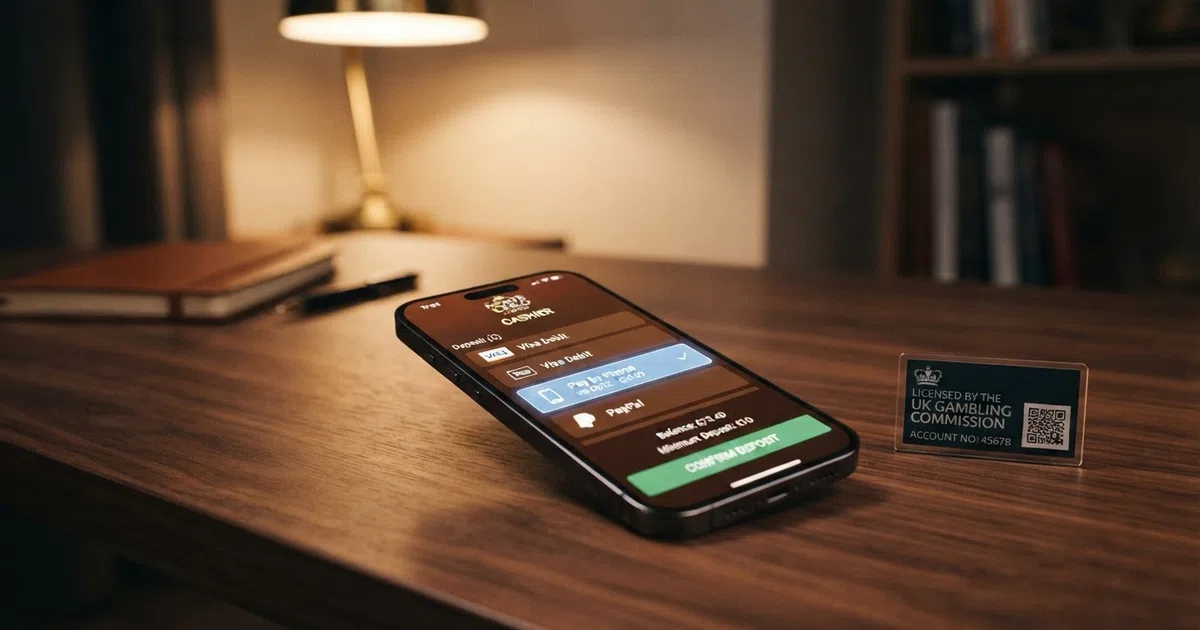
The appeal is straightforward. No bank or card details are shared with the casino. No credit check. A single £10 or £20 top-up settles almost instantly. The Phone-paid Services Authority, the regulator for these transactions, caps daily deposits at £40 across the major UK networks, and most networks set their own per-transaction limit at £30 with a monthly ceiling somewhere between £240 and £300. Those caps are not a feature. They are the regulator and the carriers drawing a line around how much a player can route through a phone bill in a given period.
The credit card ban that has been in force across all UK remote gambling since 14 April 2020 is sometimes offered as context for why phone-bill deposits exist. The logic is that since credit cards are blocked, phone billing must be the substitute. It is not. Carrier billing is not a credit mechanism in the regulatory sense; it is a payment service regulated under the Payment Services Regulations 2017, not the gambling-specific credit rules. Adding a deposit to your monthly contract is functionally a short-term credit arrangement, and Finimize has flagged the gap as a regulatory grey area. What matters for the reader is that phone-bill deposits do not require a credit check and do not appear on a credit file, even when they ride on a postpaid contract.
The single largest provider of this payment channel in the UK is Boku, which reports more than 28 million active users across over 90 countries, charges no user fees, and confirms each casino deposit via SMS with Strong Customer Authentication. Boku is one of four providers serving the UK market; Fonix, Payforit, and Siru Mobile round out the field, and each carries a different mix of networks, daily limits, and per-transaction fees. The provider table later in this page maps the differences.
A privacy point needs clearing up. Pay by mobile lets you deposit without sharing bank or card details, making it one of the more privacy-friendly options available, but it cannot be used to withdraw, so a secondary method must be set up for cashing out . The phone-bill channel is deposit-only. Every UKGC-licensed casino requires full identity verification before a first withdrawal anyway, so the privacy benefit is narrower than it first appears. What phone-bill deposits actually offer is a way to fund play without entering card details at the cashier, not a way to play anonymously.
Data current as of September 8, 2026, licence claims verified against the UK Gambling Commission’s public register at gamblingcommission.gov.uk/public-register/businesses.
Mobile Top-Up vs Standard Deposit Methods
A debit card deposit lands in your casino balance immediately, has no per-transaction ceiling other than your own bank limit, is accepted by every welcome offer in the UK, and is the standard against which every other method is measured. A phone-bill deposit lands just as fast, has a hard cap of £30 per transaction and roughly £240–£300 per month, and is excluded from most welcome bonuses by operator policy . The trade is privacy and convenience against cap and bonus eligibility.
E-wallet deposits sit between the two. Skrill and Neteller are fast and carry no per-transaction cap from the wallet side, but operators treat them the same way they treat phone-bill deposits for bonus purposes: many sign-up offers explicitly exclude e-wallet funding, on the rationale that bonus abuse and chargeback risk are higher with these routes. Debit card remains the only method that combines speed, no cap, and universal bonus eligibility. That is the trade-off, and it is the reason phone-bill deposits serve a specific reader rather than a general one.
The withdrawal asymmetry is the most important difference. A player who deposits by phone bill still needs a bank account, debit card, or e-wallet to cash out . The phone-bill channel is one-way. This means the convenience of a phone top-up carries an extra step the first time a player withdraws: setting up a verified payout method. For a player who only intends a short session and does not expect a withdrawal, this is a non-issue. For a player who plans to play across multiple sessions, it is a setup cost paid in advance.
The credit card ban context matters here. Because credit cards have been blocked across all UK remote gambling since April 2020, the practical question is which of the remaining methods best serves a player who wants to keep card details off a casino site. Phone-bill deposits answer that question for players willing to accept the cap. Open banking deposits answer it for players who want higher limits. E-wallets answer it for players who already use Skrill or Neteller for other things. None of them replaces the credit card’s combination of speed, cap, and bonus eligibility. The UK market has not produced a perfect substitute, and the phone-bill channel is one of several compromises rather than a workaround.
The UK Mobile Top-Up Casino Landscape in 2026
The UK online gambling market is large, mature, and dominated by slots. Total online Gross Gambling Yield reached £1.55 billion in the first quarter of 2026, up 7% year-on-year, with online slots GGY at £773 million — a 12% increase on the same quarter the year before. Slots are the largest single product line in remote gambling, and the segment that phone-bill deposits overwhelmingly fund. Roughly 4.98 million players were active on slots across the largest UK operators in the same quarter, spinning 25.1 billion times.
The participation base is broad. Thirty-seven per cent of adults in Great Britain had gambled online in the past four weeks as of the most recent participation survey, with the figure falling to 15% once lottery-draw-only players are removed. Phone-bill deposits serve a slice of that base — players who want to keep card details out of the cashier, players funding a short session with small stakes, and players who have already excluded themselves from credit-funded gambling through other means.
Session length has been falling. The number of online slots sessions lasting more than one hour dropped 12% year-on-year to 8.9 million in Q1 2026, and the average session length now stands at 15 minutes. That trend cuts in two directions for phone-bill deposits. On one side, short sessions suit a £30 phone-bill cap: a player who plans to spin for 15 minutes rarely needs more than a single top-up. On the other, the new stake limits — £5 per spin for players aged 25 and over, £2 for players aged 18–24 — mean a £30 deposit buys fewer spins than it did a year ago. A £30 balance at £5 per spin is six spins. At £2 per spin, it is fifteen. The arithmetic of phone-bill play has tightened.
The market context matters because phone-bill deposits are not a separate industry. They are a payment channel that sits inside the same slots market, with the same games, the same RTP, and the same operator obligations under the UKGC. The distinction is at the cashier, not at the slot.
Why Your Mobile Top-Up Is Smaller — and Costlier — Than You Expect
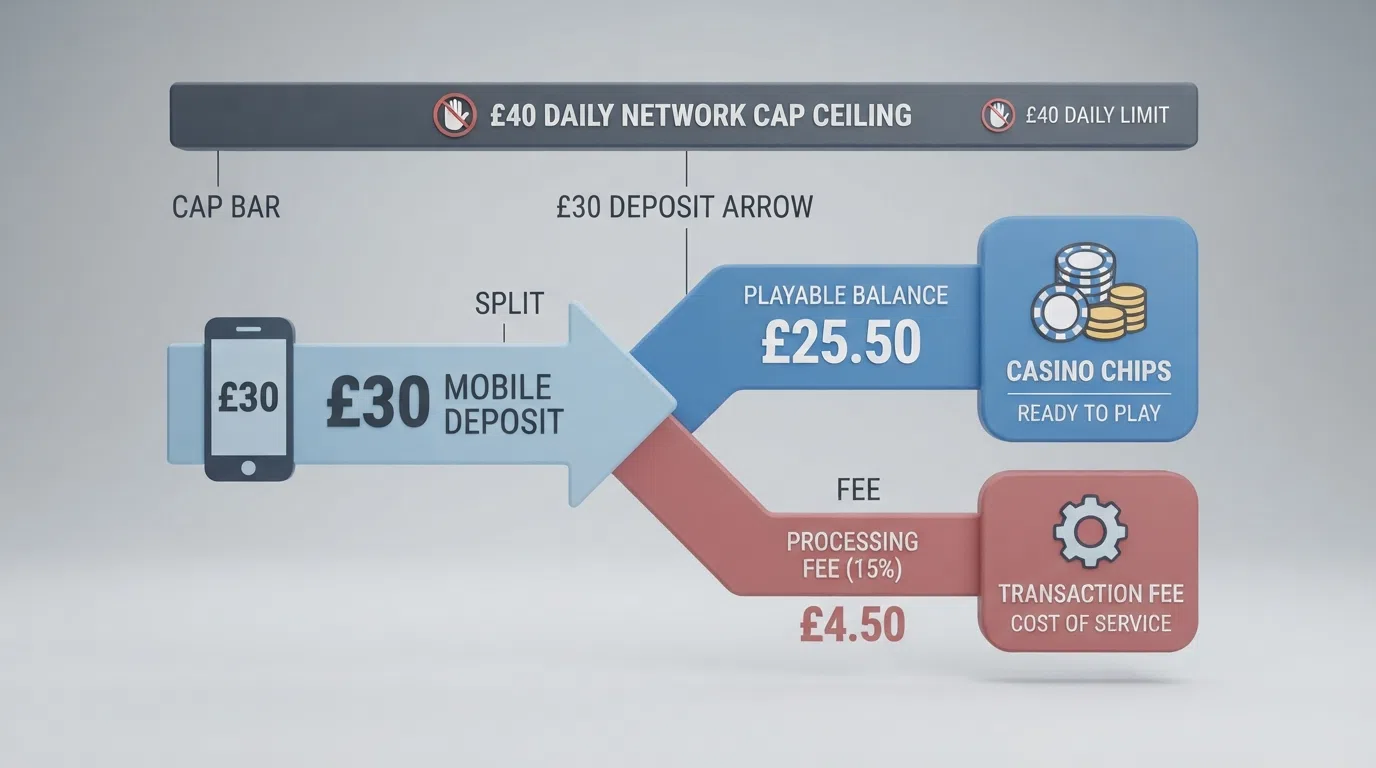
The headline is simple: a phone-bill deposit is capped, and the cap is enforced by the network, not by the casino. Most UK networks set the per-transaction ceiling at £30 and the monthly aggregate somewhere between £240 and £300. The Phone-paid Services Authority adds its own £40 daily ceiling on top of network rules. A player who tries to deposit £50 in a single transaction will be declined at the SMS confirmation stage. A player who tries to spread deposits across the day will hit the PSA ceiling.
These caps exist for a reason. The PSA regulates phone-paid services to prevent consumers from running up large bills on premium-rate numbers and, more recently, gambling top-ups they cannot afford. The cap is a consumer protection, not an inconvenience. The trade-off is that the same cap also limits how much a player can stake from a single funding source, which matters when the welcome bonus requires a £10 minimum and a £25 trigger. Duelz’s larger free-spins variant, for example, asks for a £25 deposit and play , which sits comfortably under the per-transaction cap but uses nearly the full monthly allowance if repeated across offers.
The second cost is the fee. Deposit fees vary significantly between providers and casinos, with some absorbing the cost entirely and others charging up to 15%, so the effective playable balance on a £30 deposit can be as low as £25.50 . Boku does not charge the player a fee, but the casino may still take a margin. The fee is typically a percentage of the deposit rather than a flat rate, and it is taken before the casino credits the balance. A player who deposits £30 expecting £30 in their account can find £25.50 there, and the difference is not recoverable. This is the cost of the convenience: the privacy and the SMS confirmation come at a price that the casino may or may not pass on.
The third cost is opportunity. Phone-bill deposits are commonly excluded from welcome bonuses at UK casinos . The exclusion is operator policy rather than a regulatory requirement, and it follows the same logic that excludes Skrill and Neteller: operators restrict sign-up bonuses to debit-card or bank-funded first deposits to reduce bonus abuse and chargeback risk. For a player whose priority is the welcome offer, a phone-bill deposit may simply not work. Paddy Power’s 100-spin deposit offer requires a debit card or Apple Pay even though the brand is listed as accepting pay by phone . Bet365 is explicit: pay by phone is not accepted for bonus-qualifying deposits . Ladbrokes and William Hill do not accept pay by phone at all .
A reader weighing the channel against the offer needs to know which one matters more. The cap is fixed. The fee is variable. The bonus exclusion is operator-specific. Each can be checked in advance, and the check takes less time than the deposit itself.
How Mobile Top-Up Payments Work End to End
The deposit flow is the same across all four UK providers. A player opens the casino cashier, selects Pay by Phone (or the provider-specific label), enters the deposit amount within the network’s cap, and enters their mobile number. The provider sends an SMS containing a one-time passcode or a confirmation prompt. The player confirms, Strong Customer Authentication completes, and the casino balance is credited within seconds. The amount appears on the player’s next monthly phone bill, or is deducted immediately from prepaid credit.
Settlement timing is fast. The casino side credits instantly. The carrier side bills on the standard monthly cycle for contract customers or deducts at confirmation for pay-as-you-go. There is no chargeback mechanism in the same sense as a card payment: the carrier has already paid the casino, and the player owes the carrier. This is one reason operators accept the channel — the money is settled, not pending.
The legal classification sits under the Payment Services Regulations 2017, specifically Schedule 1, Part 2(l), which covers certain payment services related to mobile network operator billing. The PSR framework is the Financial Conduct Authority’s domain, not the Gambling Commission’s, which is why the UKGC’s own rules on credit and payment methods do not directly govern phone-bill deposits. The cross-jurisdiction is one reason the credit card ban does not catch carrier billing: the ban is a gambling-specific rule, and carrier billing is a payments-specific service.
Phone Bill Deposits: Boku, Fonix, Payforit and Siru Mobile
| Provider | Daily Limit | Monthly Cap | Player Fee | Supported UK Networks |
|---|---|---|---|---|
| Boku | £30–£40 | £240–£300 | None to player | EE, O2, Vodafone, Three |
| Fonix | £30–£40 | £240–£300 | None to player | EE, O2, Vodafone, Three |
| Payforit | £30 | £240 | None to player | EE, O2, Vodafone, Three |
| Siru Mobile | £30 | £300 | None to player (operator may pass on processing cost) | Selected networks |
The four providers offer a similar player-facing experience. Boku is the largest by user base, with 28 million active users globally and SMS-based confirmation with Strong Customer Authentication. Fonix powers Duelz and is confirmed as Duelz’s pay-by-phone provider . Payforit is the network-owned standard, integrated into the billing systems of EE, O2, Vodafone and Three. Siru Mobile operates a slightly different model, with a focus on pay-as-you-go users and higher processing costs that some casinos pass on to the player.
The table shows that player-facing fees are uniformly zero or near-zero. The cost the player encounters is at the casino, not the provider: casinos that do not absorb the provider’s processing fee may take a margin of up to 15% . This is the figure worth checking before a deposit, because it directly reduces the playable balance.
Phone Credit and Prepaid Top-Ups
Pay-as-you-go credit works the same way as a contract for casino deposits. The deposit is deducted from the prepaid balance at the point of confirmation, and the network caps apply identically. A £30 deposit on a £5 PAYG balance will be declined; the same deposit on a £50 balance will be accepted and the credit reduced to £20.
The carrier-enforced caps are the same for prepaid and postpaid. The Phone-paid Services Authority’s £40 daily ceiling is universal. The convenience is that no bill is generated — the deduction is immediate. The inconvenience is that a player whose prepaid balance is low cannot top up by voucher and then deposit the same day without hitting either the network’s deposit cap or the voucher purchase limit.
The minimum top-up on most UK networks is £5 or £10. A player who wants to make a £10 casino deposit needs at least £10 in prepaid credit plus enough to cover the provider’s processing fee if the casino does not absorb it. PAYG users are the most exposed to the fee because their balance is more likely to be checked to the penny, and a £1.50 processing fee on a £10 deposit is a 15% loss that a contract customer paying a £30 deposit might tolerate as 5%.
SMS Casino Deposits Explained
The SMS layer is the security mechanism. When a player confirms a deposit, the provider sends a text containing either a one-time passcode or a one-tap confirmation link. Boku’s flow uses Strong Customer Authentication, meaning the player must confirm via a second factor. The casino never sees the phone number’s billing details — only confirmation that the carrier has approved the transaction.
The security strength is that the deposit is tied to a physical SIM, which an attacker would need to compromise. The security weakness is SIM-swap fraud, where an attacker convinces a carrier to port a number to a new SIM. SIM swap is a real and growing fraud vector, and carriers have responded with porting PINs and cooling-off periods. For a player, the practical protection is to set a strong account PIN with the carrier and to monitor for unexpected SMS confirmations. A casino deposit confirmation you did not request is a red flag.
The SMS layer is also the audit trail. Every deposit generates a confirmation message that the player can reference in a dispute. Disputes are rare — carrier billing has lower chargeback rates than cards, which is one reason operators tolerate the channel — but the SMS log is the player’s evidence if a deposit is not credited or is credited to the wrong account.
Deposit Speed, Limits and Fees by Method
| Method | Speed | Per-Transaction Cap | Fees | Bonus Eligibility |
|---|---|---|---|---|
| Phone bill (Boku/Fonix/Payforit) | Instant | £30 | Up to 15% (casino may absorb) | Often excluded |
| Debit card | Instant | Bank-set, typically high | None | Universal |
| Open banking | Instant to minutes | None from provider | None | Generally accepted |
| E-wallet (Skrill/Neteller) | Instant | Wallet-set | None from wallet | Often excluded |
| PayPal | Instant | PayPal-set | None | Generally accepted |
The comparison shows the trade clearly. Phone-bill is the only method that combines instant settlement with a hard regulatory cap. The cap protects the player from overspending through this channel; the same cap limits what a bonus can be triggered with. A player whose priority is the welcome offer should deposit by debit card. A player whose priority is keeping card details out of the cashier should accept the cap and check whether the casino absorbs the fee.
The Best Mobile Top-Up Casinos in the UK for 2026
| Operator | GB Licence | Pay by Phone Accepted | Welcome Offer | Free Spins |
|---|---|---|---|---|
| Duelz | Confirmed (UKGC) | Yes (Fonix) | 50–140 free spins, £10–£25 deposit, 10× wagering, 60 days | 50–140 |
| Paddy Power | Confirmed (Flutter) | Listed (bonus requires debit card/Apple Pay) | 60 no-deposit FS + 100 FS on £10 deposit, 7 days | 160 |
| MrQ | Confirmed (UKGC) | No (phone credit top-ups discontinued) | 100 FS on Big Bass Splash, £10 deposit, 0× wagering, 48h, uncapped cashout | 100 |
| Sky Vegas | Confirmed (Flutter) | No | 50 no-deposit FS + 200 FS on £10 stake, 0× wagering, 7-day expiry | 250 |
| Gala Bingo | Confirmed (Entain) | Not confirmed | 100 FS at £0.10, £10 deposit and spend, 0× wagering, 7-day claim | 100 |
| Betfair | Confirmed (Flutter) | — | — | — |
| Ladbrokes | Confirmed (Entain) | No | Bet £5 Get £30 free bets (sportsbook) | — |
| Bet365 | Confirmed (UKGC) | No (for bonus-qualifying deposits) | Variable FS (5–50 per selection, up to 10), £10 minimum lifetime deposits, 30-day claim | Variable |
| Betfred | Confirmed (UKGC) | — | — | — |
| William Hill | Confirmed (evoke/888) | No | 200 FS at £0.10 on Big Bass Splash, £10 deposit and wager, 1× wagering, 7 days | 200 |
Wagering requirements on casino bonuses are capped at 10× in Great Britain under LCCP Social Responsibility Code 5.1.1, in force since 19 December 2025. That cap applies to every operator on this list. Mixed-product promotional offers — bet on football, get free spins — are banned under the same provision.
Duelz — Fonix Phone-Bill Deposits With a 10× Wagering Offer
Duelz is one of the few featured operators that still accepts phone-bill deposits, and the route runs through Fonix . The welcome offer varies by source: 50 cash spins on a £10 deposit and wager, or 140 free spins on a £25 deposit and play. The wagering requirement is 10×, which is now the regulatory ceiling and is at the higher end of what UK bonuses carry post-December 2025. Players have 60 days to complete wagering, which is generous by UK standards.
The 10× wagering is the trade for the higher free-spins count. At the lower end, 50 spins at 10p each on a £10 deposit means a player needs to wager £100 before winnings become withdrawable. That is a higher multiplier than MrQ’s 0× or Sky Vegas’s 0×, and it is the cost of the Duelz offer. A player who wants wager-free spins should look elsewhere. A player who wants the highest spin count from a phone-bill-eligible deposit will find it here.
For a player who intends to deposit by phone bill and trigger the bonus, Duelz is the strongest of the featured set. The combination of Fonix integration, 60-day validity, and a 10× ceiling makes it the most phone-bill-friendly welcome offer on this page. The catch is that wagering multiplies the real cost of the bonus, which the section on what a phone bill deposit actually costs unpacks later.
Paddy Power — Listed for Pay by Phone, But Bonus Requires Debit Card
Paddy Power is listed as accepting Pay by Phone, but the 100-spin deposit offer requires a debit card or Apple Pay . The split is common across the Flutter group: the brand accepts phone-bill deposits, and the bonus excludes them. A player who tops up by phone bill can play with the deposited balance, but will not trigger the 100 free spins on a £10 deposit.
The 60 no-deposit free spins on sign-up are genuinely deposit-free, which means they are available regardless of how the player later funds the account. The 100 deposit spins require a debit card or Apple Pay, not phone bill. For a player whose priority is the deposit-triggered spins, Paddy Power is a phone-bill-accepting brand where the bonus is not. A player who values the 60 no-deposit spins and intends to fund the rest of play by phone bill will get value from Paddy Power, but the headline 160-spin count is misleading: only 60 of them are accessible without a card.
Paddy Power is a Flutter brand, which means it shares game providers with Sky Vegas and Betfair — Playtech, NetEnt, Pragmatic Play . The catalogue is broad, and a player who wants Playtech progressives alongside phone-bill deposits will find few other options in the featured set.
MrQ — Wager-Free Spins, But Phone Credit Top-Ups Discontinued
MrQ’s site states that phone credit top-ups are no longer available . The brand remains in this ranking because the offer is the most generous wager-free package on the page: 100 free spins on Big Bass Splash for a £10 deposit, with 0× wagering, a 48-hour spin validity, and an uncapped cashout. The spins are valued at £0.10 each, so the face value is £10.
The trade is the channel. A player who wants phone-bill deposits cannot get them at MrQ anymore. A player who has a debit card and wants wager-free spins with no cashout cap will find MrQ’s terms hard to beat. The 48-hour window is tight, and the 0× wagering means winnings are paid as cash immediately after the spins are used, which is the regulatory ideal post-December 2025.
The Big Bass Splash title is part of Pragmatic Play’s fishing series, which carries a 96.71% RTP for the related Big Bass Bonanza. The RTP is not specifically confirmed for Big Bass Splash in research, but the series sits in the same range. The volatility is medium-to-high, which means the £10 face value of the spins is more likely to produce a small number of large wins than a steady drip of small ones.
For a player who can use a debit card and wants the cleanest bonus terms in the featured set, MrQ is the standout. MrQ has shifted its payment strategy away from carrier billing, making it an unsuitable choice for players relying on this specific funding channel.
Sky Vegas — 50 No-Deposit Spins, But No Phone-Bill Route
Sky Vegas’s 50 no-deposit free spins on sign-up are genuinely free, and the 200 additional free spins on a £10 deposit and stake carry 0× wagering with a 7-day expiry . The total of 250 free spins is the highest in the featured set, and the 0× wagering on both tranches means winnings are paid as cash. Pay by phone is not accepted — Sky Vegas requires Debit Card or Apple Pay for promotional deposits.
The 50 no-deposit spins are the interesting part. A player who signs up and claims them has used no payment method at all. The 200 additional spins require a £10 stake, which is a deposit-and-wager condition rather than a pure deposit. The effective cost of triggering the 200 spins is a £10 stake that the player would have made anyway, and the 0× wagering means the winnings are withdrawable immediately.
For a player whose priority is the volume of wager-free spins, Sky Vegas is the highest count in the featured set. The channel is debit card or Apple Pay, not phone bill, which is a hard constraint. A player who wants both phone-bill deposits and the 250 spins will need to pick one, and Sky Vegas is the side that takes the spins.
Gala Bingo — 100 Wager-Free Spins, Phone-Bill Status Unclear
Gala Bingo’s offer is a £10 deposit and £10 spend on slots in exchange for 100 free spins at £0.10 each, with 0× wagering and a 7-day claim window . The winnings are credited as cash. Pay-by-phone availability is not confirmed for this specific Entain brand, and Entain has been phasing out the channel across its portfolio.
The offer sits in the same shape as MrQ: deposit, spend, claim spins, win cash. The difference is the trigger — MrQ’s spins are on Big Bass Splash, Gala Bingo’s are on a selected game. The 7-day claim window from registration is tighter than MrQ’s 48-hour spin validity but is a claim window rather than a spin window, so the player has 7 days to make the deposit and trigger the spins, and then 7 days to use them.
For a player who already has a Gala Bingo account or prefers the bingo-adjacent catalogue, the offer is competitive with MrQ. Players specifically seeking mobile-billing options should verify availability directly in the cashier, as support for this channel remains inconsistent across Entain’s broader portfolio.
Betfair — Flutter Group Casino With Unconfirmed Phone-Bill Support
Betfair is GB-licensed under Flutter, and the licence is confirmed on the UKGC public register . Betfair’s casino welcome offer and pay-by-phone availability are currently unverified. The brand shares Flutter’s game provider catalogue — Playtech, NetEnt, and Pragmatic Play — and the parent group also runs Paddy Power and Sky Vegas.
The lack of confirmation is itself information. Flutter’s other brands show a pattern: phone-bill deposits are listed for Paddy Power, excluded from Sky Vegas, and unconfirmed for Betfair. A player who wants to deposit by phone bill at a Flutter brand should check Betfair’s cashier directly, because the pattern across the group is mixed.
For a player whose priority is Flutter’s game catalogue and who can fund by debit card, Betfair is a familiar option. Betfair’s mobile-billing status remains unverified, so players should perform a quick cashier check before committing to a deposit.
Ladbrokes — No Phone-Bill Deposits Accepted
Ladbrokes does not accept pay by phone bill. The cashier routes through debit card, Apple Pay, or Google Pay . The featured welcome offer in this research run is Bet £5 Get £30 in free bets, which is a sportsbook promotion rather than a casino welcome. The casino welcome bonus was not confirmed.
Ladbrokes is on this list because it is one of the largest UK high-street brands and a reader comparing mobile top-up casinos will encounter it. The honest read is that the brand has opted out of the channel entirely, and a player who wants phone-bill deposits should not expect to find them at Ladbrokes. The Entain group has been moving away from pay-by-phone across its portfolio, and Ladbrokes is the clearest example.
For a player who wants the Entain catalogue and accepts the debit card or e-wallet route, Ladbrokes remains a major UK bookmaker. Ladbrokes has discontinued carrier billing support, prioritizing other modern payment methods instead.
Bet365 — Phone-Bill Deposits Accepted, But Not for the Welcome Bonus
Bet365 is the largest UK bookmaker, and the welcome offer is structured around free-spin selections: variable prizes of 5, 10, 20, or 50 free spins per selection, with up to 10 selections available within 20 days of registration . The minimum lifetime deposit is £10, and the claim window is 30 days. Pay by phone is not accepted for bonus-qualifying deposits, which is the standard Flutter and bet365 pattern.
The free-spin structure is unusual. Rather than a fixed welcome bonus, a player makes selections that reveal a variable number of spins. The structure rewards repeat play in the first 30 days, which is the kind of design the December 2025 cap on wagering requirements and the ban on mixed-product offers were aimed at curbing. The offer is now compliant because the wagering multiplier is at or below 10× and the spins are not bundled with a sportsbook trigger.
For a player who wants bet365’s catalogue and is comfortable funding by debit card, the welcome structure is one of the more flexible in the market. For a player seeking phone-bill deposits, bet365 is out: the channel is not accepted for the offer, and a player who tops up by phone bill can play with the deposited balance but will not trigger the bonus selections.
Betfred — GB-Licensed Operator With No Confirmed Mobile Billing Data
Betfred is GB-licensed, and Betfred’s casino welcome bonus and pay-by-phone availability are currently unverified . The game providers are Playtech and IGT, which is a different catalogue emphasis from the Flutter and Entain brands. Playtech and IGT power most of the progressive jackpot and branded slot content at UK online casinos.
The lack of confirmation is the same as Betfair’s: a player who wants to deposit by phone bill at Betfred needs to check the cashier directly. The Playtech/IGT catalogue is a draw for players who want those specific providers’ titles. For a player specifically seeking phone-bill deposits, the channel status is unverified.
Betfred is on this list because it is a longstanding UK bookmaker with a GB licence and a strong retail presence. The research gap is acknowledged rather than papered over.
William Hill — 200 Free Spins, But No Phone-Bill Deposits
William Hill’s welcome offer is 200 free spins at 10p each on Big Bass Splash, triggered by a £10 deposit and wager, with 1× wagering and a 7-day validity . Pay by phone is not currently accepted at William Hill, confirmed by CasinoLyzze. The evoke/888 group has stepped back from the channel.
The 1× wagering is the second-lowest in the featured set after the 0× wager-free offers at MrQ, Sky Vegas, and Gala Bingo. The player wagers the £10 deposit once on casino games, and the winnings from the 200 spins become withdrawable. The 7-day validity is tight but standard. The Big Bass Splash title sits in the Pragmatic Play fishing series with a 96.71% RTP for the related Big Bass Bonanza.
For a player who has a debit card and wants 200 spins with low wagering, William Hill is competitive. For a player seeking phone-bill deposits, William Hill is out: the channel is not accepted.
The Slots Accessible With a Mobile Top-Up
A £30 phone-bill deposit at the new UK stake limits buys between 6 and 15 spins, depending on the player’s age band. The statutory maximum stake per game cycle is £5 for players aged 25 and over, in force since 9 April 2025, and £2 for players aged 18–24, in force since 21 May 2025, imposed by SI 2025/215. A £30 deposit at £5 per spin is six spins. A £30 deposit at £2 per spin is fifteen. The arithmetic is straightforward, and it is the reason a phone-bill session is short by design.

The slots themselves do not change. A deposit by phone bill funds exactly the same games as a deposit by debit card, with the same RTP, the same volatility, and the same bonus features. The difference is the session economics. A £30 phone-bill deposit at £2 per spin runs for fifteen spins, which at an average spin speed of 2.5 seconds — the regulatory minimum — is under forty seconds of play. The 15-minute average session length reported for online slots requires multiple top-ups, and the PSA’s £40 daily cap means a player cannot chain phone-bill deposits to extend a session indefinitely.
The RTP reality is what it is. Book of Dead has a theoretical RTP of 96.21%, but Play’n GO offers five RTP configurations down to 84.25%, and most UK casinos deploy at 94.25%. The deployed rate — the figure that determines actual returns — is lower than the theoretical ceiling, and a player who picks a slot with a 94.25% deployed RTP is facing a 5.75% house edge rather than the 3.79% the headline rate implies. This is not a phone-bill-specific issue. It applies to every deposit method. But it is the figure a player should know before calculating the cost of a session.
Starburst’s RTP sits at 96.09%–96.10%, with low volatility and a 250× maximum win. The low volatility means a session of fifteen spins is more likely to produce a series of small wins than a single large one, which is the opposite of what a player chasing a phone-bill session might hope for. Big Bass Bonanza’s 96.71% RTP and medium-to-high volatility, with a 2,100× maximum win, is the higher-variance option. The trade is a wider distribution of outcomes, which at fifteen spins is a wide distribution of small samples.
How Mobile Top-Up Slots Differ From Standard Online Slots
The slot is the same. The deposit is different. That is the only honest summary, and the rest of this section is what follows from it.
A player who deposits £30 by phone bill at MrQ, Sky Vegas, or any of the featured operators reaches the same Book of Dead, the same Starburst, the same Big Bass Bonanza that a debit-card depositor reaches. The RNG, the paytable, and the bonus features are identical. The RTP is the same. The provider is the same. The session is different only because the deposit ceiling is lower and the funding is one-way.
A £30 phone-bill deposit at £5 per spin is six spins. A £300 debit-card deposit at £5 per spin is sixty spins. The number of spins is what changes the session, and the number is a function of the deposit cap, not the deposit method. A player who plans to play for an hour needs to top up multiple times, and each top-up is gated by the PSA’s daily ceiling and the network’s monthly aggregate. The session length that a phone-bill player can sustain is structurally shorter than what a debit-card player can sustain, and the difference is felt at the slot rather than in the cashier.
Slot Titles With Confirmed RTP You Can Play at Phone-Bill Casinos
| Slot | Provider | Theoretical RTP | Deployed RTP (UK) | Volatility | Max Win |
|---|---|---|---|---|---|
| Book of Dead | Play’n GO | 96.21% | 94.25% at most UK casinos | High | 5,000× |
| Starburst | NetEnt | 96.09%–96.10% | 96.09%–96.10% | Low | 250× |
| Big Bass Bonanza | Pragmatic Play | 96.71% | 96.71% | Medium-high | 2,100× |
Book of Dead’s five-config deployment is the most important figure in this table. The theoretical RTP of 96.21% applies to the game’s design; the deployed RTP of 94.25% is what the player actually faces at most UK casinos. Play’n GO offers operators five RTP configurations (96.21%, 94.25%, 91.25%, 87.25%, 84.25%), and the majority of UK licensees select 94.25%. The 1.96 percentage point gap between theoretical and deployed is the operator’s margin expansion, and it is the figure a player should check before playing. The game’s help screen will state the active RTP, and the figure should be visible before any stake is placed.
Starburst’s deployed RTP matches its theoretical, which is the cleanest of the three. The low volatility and 250× max win make it a session-friendly slot — small wins are more common than large ones, and a fifteen-spin phone-bill session is more likely to return something than a same-length session on a high-volatility title.
Big Bass Bonanza’s 96.71% RTP is the highest of the three, and the medium-to-high volatility with a 2,100× max win is the variance that suits a short session. A player spinning at £2 per spin for fifteen spins has a small chance of a 200× to 2,100× outcome, which is the shape of a phone-bill session: low frequency of play, wide distribution of outcomes.
Slot Providers and Studios Behind Phone-Bill Casino Games
The five studios that dominate the UK phone-bill casino catalogue are Pragmatic Play, Play’n GO, NetEnt, Playtech, and IGT. Every featured operator carries at least three of them, and most carry four or five.
Play’n GO is the provider of Book of Dead and the broader Dead series. The studio’s five-RTP configuration system is the model for the deployed-versus-theoretical gap that defines modern UK slot economics. Pragmatic Play is the provider of Big Bass Bonanza and the fishing series, with the 96.71% RTP and medium-to-high volatility that defines the series. NetEnt is the provider of Starburst, the low-volatility flagship that has been a UK casino staple for over a decade. Playtech and IGT are the providers behind most of the progressive jackpot and branded slot content, and they are the catalogue emphasis at Betfred, Ladbrokes, and William Hill.
The choice of studio is rarely the deciding factor for a phone-bill player. The deciding factor is the deposit cap, and the cap is the same regardless of which studio’s slot the player chooses. What differs is the volatility and the RTP configuration, and those are the figures a player should check before staking.
Is Pay-by-Phone Gambling Legal in the UK? The Full Picture
Pay-by-phone gambling is legal in the UK, regulated, and licensed. The framework is dense, and the short version is that every UK-facing online casino needs a GB licence from the UK Gambling Commission, and phone-bill deposits sit inside the licensed payment stack rather than outside it. The longer version involves the Gambling Act 2005, the Gambling (Licensing and Advertising) Act 2014, the Payment Services Regulations 2017, the Phone-paid Services Authority’s payment rules, the UKGC’s Licence Conditions and Codes of Practice, and a statutory levy that funds treatment. None of this is a loophole.
The UK Gambling Commission is the single statutory regulator, an executive non-departmental public body sponsored by DCMS. The Gambling Act 2005, extended by the 2014 Act, requires a GB licence for any operator serving GB customers at point of consumption. Section 1 sets three licensing objectives: preventing crime, ensuring fair and open gambling, and protecting children and vulnerable persons. Every operator on the featured list holds a GB licence, verified on the UKGC public register.
The credit card ban that took effect on 14 April 2020 under LCCP 6.1.2 covers all remote gambling payments, including credit-card-funded e-wallet deposits. The ban does not cover carrier billing, because carrier billing is not a credit mechanism under the UKGC’s framework — it is a payment service regulated under the PSR 2017. The distinction is regulatory rather than functional: adding a deposit to a monthly contract is a short-term credit arrangement, and Finimize has noted the gap as a grey area. What the gap means for the player is that phone-bill deposits are legal and not subject to the credit-card ban, but they are also not protected by the credit-card consumer protections that apply to card payments.
The offshore risk is the other side of the legality picture. A Curaçao, MGA, or Gibraltar licence is not a substitute for a GB licence. Operating without a GB licence is a criminal offence under section 33 of the Gambling Act 2005 — up to 51 weeks’ imprisonment, an unlimited fine, or both. The UKGC does not currently hold statutory ISP or DNS blocking powers, and enforcement runs through cease-and-desist notices, search-engine delisting, domain suspension, and payment-provider referrals. The player-side consequence of using an unlicensed site is the loss of protection: no GAMSTOP coverage, no alternative dispute resolution, no Commission complaints route.
The legal framework is the floor, not the ceiling. Every operator on this page is licensed, every bonus is capped at 10× wagering, every slot is age-banded at £5 or £2 per spin, and every deposit is subject to mandatory affordability and vulnerability checks. The framework is one of the strictest in the world, and phone-bill deposits sit inside it.
UKGC Licensing: What a Phone-Bill Casino Must Hold
Every UK-facing online casino needs a GB licence from the UK Gambling Commission, and the licence is verified on the public register at gamblingcommission.gov.uk/public-register/businesses. The register lists every licensed operator with its licence status and activity dates, and it is the single source for confirming whether a brand is licensed.
The three licensing objectives from section 1 of the Gambling Act 2005 are the test the UKGC applies: preventing crime, ensuring fair and open gambling, and protecting children and vulnerable persons. For a phone-bill casino, the second and third objectives are the relevant ones. Fair gambling means the games are independently tested, the RNG is certified, and the RTP is deployed as advertised. Protecting children and vulnerable persons means age verification, identity verification, GAMSTOP coverage, and the financial vulnerability checks at the £150 net-deposit threshold.
The point-of-consumption requirement, in force since the 2014 Act, means a brand serving GB customers from Malta, Gibraltar, Curaçao, or anywhere else needs a GB licence to do so. The GB licence is compulsory, not optional, and it is the single most important check a player can make before depositing. Every operator on this page is on the public register.
GAMSTOP and Mobile Billing: How Self-Exclusion Works
GAMSTOP is the national multi-operator online self-exclusion scheme for Great Britain, mandatory for every UKGC online operating licence since 31 March 2020. A player who registers with GAMSTOP is blocked from opening new accounts and from depositing at existing accounts with every UKGC-licensed operator. The exclusion periods are six months, one year, five years, or five years with auto-renewal. The exclusion cannot be cancelled early.
GAMSTOP blocks the account, not the payment method. A self-excluded player who tries to deposit by phone bill at a UKGC-licensed casino will be declined at the cashier, because the casino’s account system has flagged the player’s details. The phone network is not aware of the GAMSTOP registration, and the carrier billing system will still process a payment for a non-gambling service. The block is at the operator, not the carrier.
The unlicensed-site gap is the critical limitation. GAMSTOP is licence-bound: it covers UKGC-licensed operators only. A self-excluded player who accesses an offshore site is not protected by GAMSTOP, and the offshore site has no obligation to honour the exclusion. This is the strongest argument for using a UKGC-licensed brand: the protection is real, and it extends across every licensed operator, regardless of which payment method the player uses.
The Credit Card Ban, Carrier Billing and the Regulatory Grey Area
The credit card ban under LCCP 6.1.2 has been in force since 14 April 2020 and covers all remote gambling payments, including credit-card-funded e-wallet deposits. The ban is a gambling-specific rule, and it does not extend to carrier billing because carrier billing sits under the Payment Services Regulations 2017, not the UKGC’s credit rules.
The functional reality is that a phone-bill deposit on a postpaid contract adds to a future bill, which is the same mechanism as a credit card charge appearing on a future statement. The regulatory treatment is different: the credit card ban catches the credit-card-funded gambling payment, and the PSR 2017 framework catches the carrier-billed gambling payment. Finimize has noted the gap as a regulatory grey area, and the practical implication for the player is that phone-bill deposits are not subject to the gambling credit rules, but they also do not enjoy the credit-card consumer protections (chargeback rights, section 75 protection) that apply to card payments.
The distinction matters when a dispute arises. A player who disputes a phone-bill charge is dealing with the carrier, not the card issuer, and the carrier’s dispute process is less developed than the card issuer’s. A player who disputes a credit-card charge has a clear chargeback route. A player who disputes a phone-bill charge has a phone bill complaint. The regulatory framework treats the two routes as different, and the player’s protections are different too.
Playing Safely: The Deposit Caps, Checks and Self-Exclusion Reality
The UK’s player-protection machinery applies to phone-bill depositors on the same terms as every other depositor. The carrier-enforced caps sit on top of the UKGC-mandated tools, and the combination is one of the strictest consumer protection regimes in any gambling market. The system is not optional, and a player who funds by phone bill is covered by every layer of it.
The carrier-enforced caps are the first layer. Networks cap deposits at £30 per transaction and £240–£300 per month, and the Phone-paid Services Authority adds a £40 daily ceiling. These caps are network-level and apply regardless of which casino the player uses. A player who tries to deposit £50 will be declined at the SMS confirmation stage.
The UKGC-mandated tools are the second layer. The new Remote Technical Standard 12, effective 30 September 2026, requires operators to offer a deposit limit on a gross deposit basis, and the offer is mandatory at registration. The offer is not a cap — a player can decline it — but it must be made. Financial vulnerability checks are mandatory at a £150 net deposit threshold in a rolling 30-day period, in force since 28 February 2025. The checks use publicly available data only.
GAMSTOP is the third layer. Mandatory since 31 March 2020, with exclusion periods of six months, one year, five years, or five years with auto-renewal. The exclusion cannot be cancelled early, and it covers every UKGC-licensed operator. The block is at the account level, not the payment level, and it is the strongest single tool a player has.
The help infrastructure is the fourth layer. GamCare’s National Gambling Helpline handled over 130,000 calls and online messages in 2025/26, made 7,100 referrals to treatment, and delivered 8,100 treatment sessions with an average wait time of 1.3 days. The NHS gambling harm clinics reported 4,355 referrals in 2024/25, up 91% from the year before. GambleAware’s National Gambling Support Network treated 11,960 clients in 2024/25. The system is funded by the statutory levy, which replaced voluntary contributions on 6 April 2025 at a top rate of 1.1% of GGY for remote casino licences.
The demand on the system is real. 81.5% of people contacting GamCare’s helpline in 2026 cited online forms of gambling as their primary concern, up from 72.9% in 2022 — a five-year high. GamCare’s January 2026 referrals were up 48% year-on-year. Problem gambling prevalence in England is approximately 0.5% of the adult population, with 3.8% at elevated risk, and 7% of the British population are negatively affected by someone else’s gambling. The numbers are not abstractions: they are the reason the protection system exists, and they are the reason the deposit caps, the vulnerability checks, and the self-exclusion tools are mandatory rather than optional.
Deposit Limits and Spend Caps: What the Carrier and the Regulator Each Enforce
The carrier caps and the UKGC tools are different layers, and they enforce different things. The carrier caps are per-transaction and per-period, and they apply to the phone-bill payment method. The UKGC tools are per-player and per-account, and they apply to the player’s relationship with the operator.
A player who deposits by phone bill at Duelz hits the network’s £30 cap on the first transaction, can deposit again immediately, and hits the PSA’s £40 daily ceiling or the network’s monthly aggregate within a few transactions. The cap is on the payment method, not the player. A player who deposits by debit card at the same casino has no network cap, but the UKGC’s mandatory deposit-limit offer applies, and the £150 net-deposit vulnerability check applies after thirty days of deposits. The cap on a debit-card player is set by the player’s own deposit limit, not by the network.
The distinction matters for two reasons. First, phone-bill depositors have a lower hard ceiling than debit-card depositors, which is a form of consumer protection. Second, the UKGC’s mandatory tools apply to both, which means a phone-bill player who registers with a £500 deposit limit at a UKGC-licensed casino will be capped at £500 even if the network would allow more. The two layers stack: the lower of the two caps is what the player faces.
The September 2026 RTS 12 change is worth flagging. The new requirement mandates a gross deposit limit, which counts deposits before withdrawals, and the offer is mandatory at registration. This is a tightening of the existing requirement and a signal of where the regulatory direction is heading. Phone-bill depositors will see the same offer at the same registration point as debit-card depositors.
Self-Exclusion Tools and How They Interact With Mobile Billing
GAMSTOP, time-outs, reality checks, and deposit limits are the four self-exclusion tools every UKGC-licensed operator must offer. GAMSTOP is the multi-operator block, mandatory since 31 March 2020. Time-outs are short-term account suspensions the player can set themselves. Reality checks are mandatory pop-ups at fixed intervals during play. Deposit limits are the player-set cap on net deposits over a chosen period.
The interaction with mobile billing is at the account level, not the payment level. A self-excluded player is blocked at the operator’s account system, and the cashier will not process a deposit regardless of method. The carrier is not aware of the GAMSTOP registration and will process a phone-bill payment for a non-gambling service, but the casino side will reject it. The block is robust because it is at the operator.
The unlicensed-site gap is the limitation. A self-excluded player who moves to an offshore site is not protected, because the offshore site has no GAMSTOP integration and no UKGC obligation to honour the exclusion. The protection is real, and it is bounded by the licence. A player who wants the full protection of the UK system needs to stay within it.
GamCare, the NHS and Where to Get Help
- GamCare runs the National Gambling Helpline on 0808 8020 133, with online chat and messaging support. In 2025/26 GamCare handled over 130,000 calls and online messages, made 7,100 referrals into treatment, and delivered 8,100 treatment sessions with an average wait time of 1.3 days. In January 2026 the helpline made 996 referrals, up 48% year-on-year. 81.5% of 2026 helpline contacts cited online gambling as the primary concern.
- The NHS operates gambling harm clinics across England. 4,355 referrals were made in 2024/25, up 91% from 2,284 in 2023/24. Referrals come from GPs, self-referral, and partner organisations.
- GambleAware funds the National Gambling Support Network (NGSN), which treated 11,960 clients in 2024/25, up 11% from the year before. The NGSN provides free, confidential treatment across England, Scotland, and Wales.
- GAMSTOP registration is at gamstop.co.uk. Exclusion periods are six months, one year, five years, or five years with auto-renewal. Registration cannot be cancelled early.
The help infrastructure is funded by the statutory levy on gambling operators, which replaced voluntary contributions on 6 April 2025 at a top rate of 1.1% of GGY for remote casino licences. The system is one of the better-funded in any jurisdiction, and the demand on it — rising referrals, rising prevalence among affected-others — is the reason the system is being expanded.
Frequently Asked Questions
Can I deposit at a UK casino using my phone bill?
Yes, you can deposit at many UKGC-licensed casinos using your phone bill. This method, often called pay-by-mobile or carrier billing, adds your deposit amount to your monthly phone bill or deducts it from your prepaid credit. It is a secure, instant funding method popular for smaller deposits and quick sessions.
Can I withdraw my casino winnings to my phone bill?
No, you cannot withdraw winnings to your phone bill. The carrier billing channel is strictly one-way for deposits. If you win, you must set up a separate, verified withdrawal method—such as a bank account, debit card, or e-wallet—to cash out your funds securely and compliantly under UKGC rules.
Are pay by phone casino deposits eligible for welcome bonuses?
Often, no. Many UK operators explicitly exclude phone-bill deposits from welcome offers, similar to how Skrill and Neteller are treated. This is to mitigate bonus abuse and chargeback risk. Always check the specific terms and conditions of the casino’s welcome offer to ensure your preferred payment method qualifies.
What mobile networks support casino deposits in the UK?
Most major UK mobile networks, including EE, O2, Vodafone, and Three, support carrier billing for casino deposits. While availability can vary slightly between operators and providers like Boku or Fonix, these four networks cover the vast majority of mobile users and are widely accepted across licensed casinos that offer mobile billing.
What are the fees for depositing at a casino via phone bill?
Fees vary by casino and provider. While some casinos absorb the processing costs entirely, others pass them on to the player, sometimes reaching up to 15% of the deposit amount. Always check the cashier’s fee disclosure before confirming your transaction to ensure you know the effective balance you will receive.
How does GAMSTOP affect pay by phone bill casino deposits?
GAMSTOP is a multi-operator self-exclusion scheme that blocks you from all UKGC-licensed online casinos. If you are registered with GAMSTOP, your casino account will be blocked, and you will be unable to make deposits via any method, including phone bill, because the restriction is applied at the operator account level.
Every operator on this page is verified on the UK Gambling Commission’s public register at gamblingcommission.gov.uk/public-register/businesses. The register is the single source for licence status, and it was the first check made for each operator. The register was last accessed in August 2026.
Operator-specific data — welcome offers, free-spin counts, wagering multipliers, validity windows, pay-by-phone acceptance — was sourced from the operators’ own sites and from competitor platforms that rank UK casinos. The competitor sources consulted were OLBG, Casino.org, Racing Post, the Independent, TalkSport, Bojoko, Bookies.com, BonusFinder, Casinos.com, CasinoWithdrawal.co.uk, and CasinoLyzze. Where the sources disagreed — Duelz’s free-spin count varies between 50 and 140 depending on the offer variant — the range is reported rather than a single figure chosen.
The evaluation criteria were four. First, pay-by-phone acceptance: is the operator listed as accepting phone-bill deposits, and is the channel available for the welcome offer? Second, bonus terms: wagering multiplier, validity, free-spin count, cashout cap. Third, licence status: GB licence confirmed on the public register, with the licence holder identified. Fourth, game catalogue: the providers and signature titles available.
What was excluded were offshore brands without a GB licence, brands whose licence could not be verified on the public register, and offers that were not specifically confirmed for the operator in question. The featured set is ten operators, and the ranking is by what they offer a phone-bill depositor — not by marketing claims or by overall brand size. Ladbrokes and William Hill are on the list because a reader comparing options will encounter them, even though they do not accept phone-bill deposits; excluding them would leave the comparison incomplete.
Where a figure was not confirmed, the gap is shown rather than filled. Betfair’s welcome bonus and Betfred’s casino offer were not confirmed in this research run, and the gaps are reported as gaps. The same applies to pay-by-phone availability for Gala Bingo, Betfair, and Betfred, where the channel status could not be verified from the sources consulted.
What a Phone Bill Deposit Actually Costs You — and Whether It Is Worth It
The expected cost of a £30 phone-bill session on Book of Dead at the deployed 94.25% RTP, spinning at £2 per spin for fifteen spins (the 18–24 age band) is about £1.73. The calculation: fifteen spins at £2 per spin is £30 in total stakes, and the house edge at 94.25% RTP is 5.75%, so 5.75% of £30 is £1.73 in expected loss. At £5 per spin for six spins (the 25+ age band), the expected loss is the same: 5.75% of £30 is £1.73. The stake tier does not change the expected cost, because the total stake is the same.
The £1.73 is the house’s edge. It is the amount the player is statistically expected to lose across many such sessions, not the amount lost in any single session. A six-spin session can return £0 or £200, and the £1.73 is the average across the long run. The calculation is a statistical estimate, not a guaranteed outcome.
Add a 15% processing fee on the £30 deposit, and the effective cost rises: the player pays £30 to the carrier, £4.50 of which is the fee, and £25.50 reaches the casino. The expected loss on £25.50 at 94.25% RTP is £1.47, but the player has already paid £4.50 in fees, so the total cost of the session is £5.97. The fee is the larger cost, and it is the cost the carrier or the casino takes before a single spin is played.
The fee is the trade. A player who deposits £30 by phone bill and absorbs a 15% fee is paying £4.50 for the convenience of not entering card details. A player who deposits £30 by debit card pays no fee and has the same £30 balance. The phone-bill player has a privacy benefit and a £4.50 cost; the debit-card player has neither. The calculation above assumes the player values the privacy at less than £4.50 per session, which is most players most of the time.
The bonus exclusion is the other cost. A player who deposits by phone bill at Paddy Power, Bet365, or Ladbrokes and expects the welcome offer will be disappointed: the offer requires a debit card or Apple Pay . The phone-bill deposit funds play, not the bonus. A player who deposits by debit card and triggers the welcome offer has a higher expected return from the offer (a 50-spin, 100-spin, or 200-spin package at 0× to 1× wagering) than from a phone-bill deposit with no offer triggered. The bonus value can be £10 to £30 in face-value spins, and that is the cost of choosing phone-bill at an offer-excluding brand.
The one question the reader should ask before depositing is whether the bonus or the channel matters more. If the bonus matters — and at MrQ, Sky Vegas, and William Hill, the bonus is the headline — the channel should be debit card. If the channel matters — and at Duelz, where Fonix integration is confirmed and the offer is phone-bill-eligible — the deposit can run through the phone bill. The two routes are not interchangeable, and the operator’s terms determine which one is the right choice.
For a player with a small bankroll who plans a single short session and has no card details to hand, a phone-bill deposit at Duelz or any Fonix-enabled brand is a reasonable fit. For a player who plans to trigger a welcome offer, fund multiple sessions, and withdraw winnings, the debit-card route is the stronger one. The phone-bill channel is a specialist tool, not a default, and the best use of it is the one that matches the offer terms at the brand the player has chosen.
Payments – nonukgc-licensedcasinos
Content created by the «nonukgc-licensedcasinos» team