
Credit Card Casino Sites in the UK: What the 2020 Ban Actually Means
 Available in GB
The short answer to the headline question is unflattering for anyone searching for one: there are no casino sites in the UK that accept credit cards, because credit cards have been banned for gambling at every operator the Gambling Commission licenses since 14 April 2020. What the search term used to describe no longer exists inside the regulated British market. The phrase survives because search engines still carry it, because offshore sites keep targeting it, and because players who once paid with a Visa or Mastercard credit card are still arriving here looking for the answer they got five years ago.

Verified against the UK Gambling Commission’s public register on September 8, 2026.
The ban sits at the heart of how UK online gambling now works. LCCP licence condition 6.1.2 prohibits every GB-licensed operator from accepting credit card payments for gambling — direct charges, indirect payments routed through e-wallets, the whole chain. The Commission’s stated reason was that 22% of online gamblers using credit cards were classified as problem gamblers, and that a payment instrument which lets you spend money you have not yet earned was the wrong tool to leave open. Neil McArthur, the Commission’s chief executive at the time, said the ban was designed to “minimise the risks of harm to consumers from gambling with money they do not have.”
That framing matters because it explains why the rest of this page is structured the way it is. The credit card is not a missing payment method awaiting a workaround. It is a removed payment method, and the workarounds exist precisely because the alternative was judged too harmful to leave open. The page below explains what the ban covers, why it reaches e-wallets too, where the grey market still accepts credit cards, how bank-level blocks add a second line of defence, and which ten GB-licensed operators offer the legal debit card and e-wallet deposits UK players use instead.
What “Credit Card Casino” Means in the UK Today
The phrase “credit card casino” used to describe a UK online casino that accepted Visa or Mastercard credit cards as a deposit method. Before April 2020, most GB-licensed sites took credit cards alongside debit cards, e-wallets and bank transfers, and the difference between a debit card and a credit card deposit at the casino cashier was, for many players, almost invisible. The card networks were the same, the deposit cleared instantly, and the credit card carried no obvious in-product surcharge.
After 14 April 2020, that distinction became the line between legal and illegal. Every GB-licensed casino now blocks credit card deposits at the cashier. The term “credit card casino UK” no longer describes a regulated site. Inside the British market, it points either to a historical pre-ban offer or to a category that no longer exists. Outside it, the term still describes something: offshore casinos licensed in Curaçao or Malta that the UKGC cannot bind, and that accept credit cards from UK players because their own regulator does not stop them.
Many online search results still return the phrase because players’ interests differ. Some players want to know whether they can use their credit card at a casino they already trust. Other players want offshore casinos that will take one. Both audiences land here, and the page below speaks to both — the first group needs to understand why their card was declined, and the second group needs the honest list of what they would be giving up by going offshore.
The 14 April 2020 Ban at a Glance
On 14 April 2020, licence condition 6.1.2 of the LCCP came into force. From that date, no GB-licensed gambling operator could accept a payment for gambling by credit card. The rule covers every remote gambling licence (remote casino, remote betting, remote bingo, remote lottery) and every non-remote general betting, pool betting and betting intermediary licence — which is the formal way of saying every high-street bookmaker as well. The only category the ban does not cover is non-remote lottery, the National Lottery products sold in shops.
The regulator’s reasoning was explicit. The Commission’s consultation found that “credit cards provide a convenient means of borrowing money to fund gambling and can facilitate high levels of gambling debt.” The 22% problem-gambling figure among credit card users was a headline statistic in the consultation response. The instrument was the problem: a payment method that lets a player draw on credit to chase losses, and that makes losses feel abstract because the bill arrives a month later.
The impact was immediate and comprehensive. Every UK-facing regulated casino had to update its cashier. Banks processed the transactions as gambling and either blocked them outright or saw them declined. By the end of April 2020, the UK credit card gambling ban was simply the way the market worked.
The UK Credit Card Gambling Ban: Inside the Rules That Changed Everything
The credit card ban was not a one-off rule. It opened a decade of escalating player-protection regulation that has reshaped what a GB-licensed casino looks like in 2026. Understanding the wider architecture matters because the ban is settled law and is not going anywhere, and the alternative deposit methods that replaced it sit inside the same regulatory envelope.
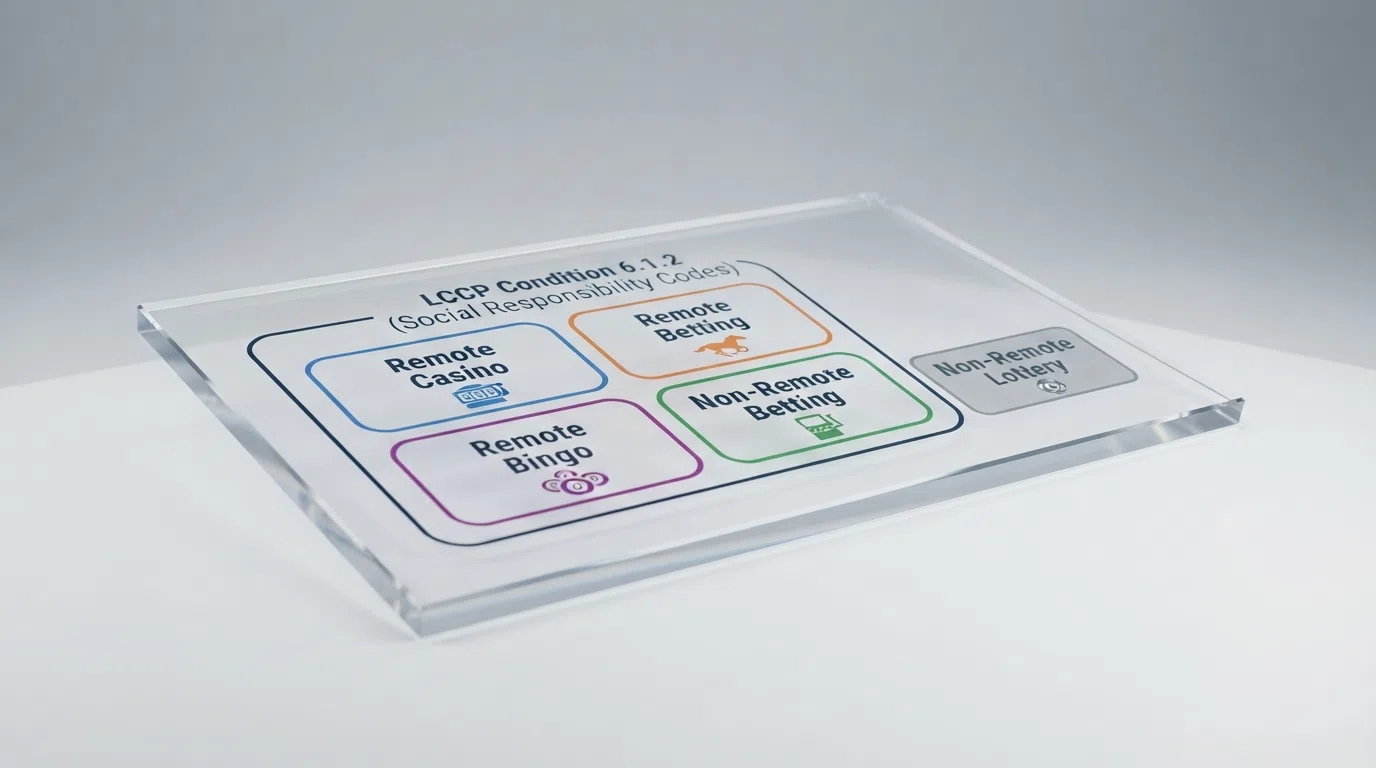
The statutory base is the Gambling Act 2005, which set three licensing objectives: preventing gambling from being a source of crime or disorder, ensuring gambling is conducted in a fair and open way, and protecting children and other vulnerable persons from being harmed or exploited. The 2014 Gambling (Licensing and Advertising) Act extended those obligations to remote operators on a point-of-consumption basis, which is why every operator serving GB customers must hold a GB licence regardless of where the company itself is incorporated. The credit card ban, the stake limits, the wagering cap, GAMSTOP and the deposit-limit prompt all sit under that umbrella.
What LCCP Condition 6.1.2 Actually Covers
The licence condition reaches further than most players realise. It does not stop at the credit card transaction itself. The prohibition covers any payment for gambling by credit card, including payments made through a money service business — which is the formal term that pulls PayPal, Skrill, Neteller and similar e-wallets into scope when their funding source is a credit card. So the ban is not “the operator cannot take a credit card at the cashier.” It is “no money that originated as credit can reach the operator’s balance through any intermediary.”
The condition also covers non-remote licences. A high-street bookmaker licensed under a non-remote general betting standard cannot take credit card payments either. The same was already true for non-remote casinos, bingo halls, adult gaming centres and family entertainment centres under earlier rules, so the 2020 change did not invent the non-remote ban — it extended it to betting shops and, critically, to every remote operator.
The lone carve-out is non-remote lottery. The National Lottery and similar products sold in retail outlets remain unaffected. Every other gambling format is covered.
The Ban Reaches Your E-Wallet Too
A common work-around in the months leading up to the ban was the e-wallet detour: fund PayPal with a credit card, then deposit from PayPal to the casino. The Commission closed that loophole from day one. LCCP 6.1.2 covers credit-card-funded payments through money service businesses, which means operators have to trace the funding source of an e-wallet deposit and decline it if the trail leads back to a credit card.
In practice, this means PayPal deposits from a UK player at a GB-licensed casino work if PayPal is funded by a UK bank account, a debit card or a PayPal balance built up from prior deposits. They do not work if PayPal is funded by a credit card. The operator’s payment processor checks the funding instrument, and the deposit is declined. This is not a soft “we’d prefer you didn’t” rule — it is a hard decline built into the payment flow.
Non-GamStop Casinos That Still Accept Credit Cards
Offshore casinos licensed in Curaçao or Malta accept credit card deposits from UK players because the UKGC ban does not bind them. Their regulator is not the Commission, the licence condition is not LCCP 6.1.2, and the player protections attached to a GB licence do not travel with the player when they cross the regulatory border.
What a UK player loses at an offshore credit card casino is the entire safer-gambling architecture built up since 2020. There is no GAMSTOP coverage, so a self-exclusion registered with GAMSTOP does not block these sites. There is no Commission complaints route — the UKGC will not take a complaint against an operator it does not regulate. There is no ADR provider approved under GB rules. There is no British consumer redress: if the offshore operator withholds funds, the player has to pursue the complaint in the operator’s home jurisdiction, on the operator’s home turf, under the operator’s home law.
The Commission does not currently hold statutory ISP or DNS blocking powers. Its enforcement model is disruption, not blocking. Between October 2024 and September 2025, the Commission reported 208,088 enforcement actions on illegal online gambling, the largest category being search-engine referrals. Between April 2024 and June 2025 the Commission issued 3,140 disruption notices, referred 447,778 URLs to search engines and saw 287,961 URLs removed. That is real activity, but it is disruption — it makes the sites harder to find, it does not make them impossible to reach.
There is no penalty traced for a player who merely gambles on an unlicensed site. The penalty for unlicensed operation falls on the operator — up to 51 weeks’ imprisonment, an unlimited fine, or both, under section 33 of the Gambling Act 2005. The player who plays at such a site loses protection, not liberty. That asymmetry is the honest framing of the offshore market: it is reachable, it accepts credit cards, and it offers none of the safeguards that justified the credit card ban in the first place.
Bank Gambling Blocks
UK banks now offer optional gambling blocks on both debit and credit cards.
| Bank Block Type | Coverage | Status |
|---|---|---|
| Credit Card Block | Yes | Available |
| Debit Card Block | Yes | Available |
The Best UK Casino Sites for Debit Card and Alternative Deposits in 2026
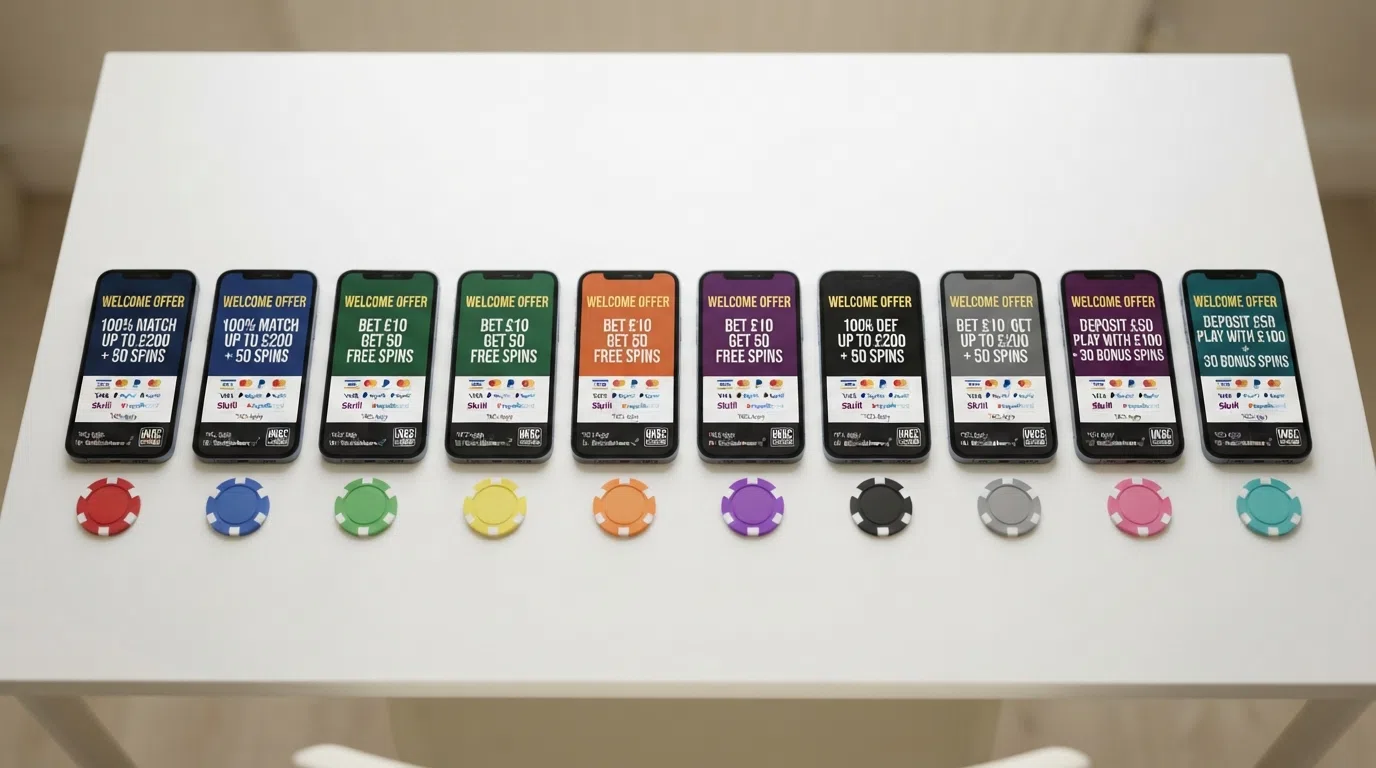
Every operator in the table below is GB-licensed, confirmed on the UK Gambling Commission’s public register, and prohibited from accepting credit card deposits. They are the legal alternatives a UK player deposits with today. The table compares them on welcome offer, free spin count, wagering terms and the payment methods each accepts.
| Market | Protection | Gambling Regulation | Payment Options |
|---|---|---|---|
| Licensed UK Casino | High | Strict | Debit card, E-wallet, Bank transfer |
| Offshore Casino | None | None | Credit card accepted |
The wagering column is where the table does most of its work. Eight of the ten offers sit at 0× on the free spin element, which means whatever a spin wins is withdrawable cash. William Hill’s 10× wagering with a £30 cap is the outlier — the lowest cap in the featured set and a clear ceiling on what the offer can pay out, even after the wagering is cleared. 888 Casino’s 10× on bonus funds is the only deposit-match offer in the group, and it carries the longest wagering window at 90 days. The payment-method column shows that Betfred alone excludes e-wallets from its welcome offer, which is the kind of small print that determines whether the headline offer actually works for the deposit method a player intended to use.
Bet365: 500 No-Wagering Free Spins and Full Payment Flexibility
Bet365’s welcome offer is the largest no-wagering free-spin package in the featured set: 500 spins at 0× wagering, credited across 10 selections over 20 days, with a 24-hour validity per selection and a 30-day window to claim. The minimum deposit is £10. The payment method range is the widest in the comparison — debit card, Apple Pay, PayPal and bank transfer all accepted, none of them excluded from the welcome promotion. The 500-spin headline is meaningful because at 10p per spin that is £50 of slot action before any withdrawal, and because 0× wagering means whatever those spins produce is cashable immediately.
For a player who used to pay by credit card and now wants a single operator that combines the widest cashier with the most generous spin count, Bet365 is the obvious first stop. The offer structure is also the most forgiving in the set — 30 days to claim and 24 hours per selection means a player does not have to drop everything to use the spins, and the multi-selection structure spreads the credit rather than dumping all 500 into a 48-hour window.
Sky Vegas: 200 Wager-Free Spins with a Low Entry Point
Sky Vegas sits in the Flutter Entertainment group and runs a straightforward low-deposit welcome offer: deposit and spend £10, get 200 free spins with no wagering. The £10 entry point is the same as most of the featured set, but the 0× wagering on the spin winnings puts Sky Vegas in the cleaner half of the comparison. Spins are valid for 7 days and the deposit/stake requirement must be met within 30 days.
The offer suits a player who wants a quick path to cashable spin winnings without chasing a complex promotion. The 7-day validity on the spins is the relevant constraint — the player has a week to use them, not 30 — but the underlying wagering structure is as clean as it gets.
William Hill: 200 Free Spins on Big Bass Splash — with a £30 Cap
William Hill’s 200 free spins are tied to a named slot — Big Bass Splash — at 10p each, with 10× wagering on the winnings and a £30 maximum cashout. The 72-hour validity from credit is the shortest in the featured set, and the £30 cap is the lowest. Deposit £10 and stake £10 to qualify.
The cap is the point. At 10p per spin, 200 spins is £20 of slot action, and a £30 ceiling on winnings limits what the offer can ever pay out regardless of how the spins run. This is a named-slot, capped-payout offer from a major evoke plc brand, and it is best read as a low-ceiling taster rather than a value play. A player who wants the full spin count without the ceiling should look at the 0× offers above; a player who likes the named slot and the evoke brand can take the ceiling as the cost of admission.
Ladbrokes: Free Spins Plus Ladbucks — a Hybrid Offer
Ladbrokes, an Entain brand, mixes 100 free spins with 300 Ladbucks — the operator’s loyalty currency — at 0× wagering on the spins and 10× on the casino bonus element. The bet £10 trigger is standard, the 48-hour window to accept the spins is short, and the 7-day use window on the spins and 30-day bonus wagering window are typical for the group. Payment methods are debit card, Apple Pay and Google Pay.
The Ladbucks element complicates the offer. Spins at 0× are clean, but Ladbucks are a loyalty currency convertible to bonus funds at a rate that turns the headline into “100 spins plus a small additional bonus.” For a player who only values the spin element, the offer still works at face value; for a player chasing headline value, the Ladbucks are the part of the promotion that needs the most reading.
Paddy Power: 60 No-Deposit Free Spins Before You Pay a Penny
Paddy Power is the only featured operator offering free spins with no deposit at all — 60 no-deposit spins just for signing up, plus 200 additional spins on deposit and wager of £10, for 260 total at 0× wagering. The no-deposit spins are valid 7 days from credit; the deposit-triggered spins must be claimed within 30 days. Payment methods are debit card, Apple Pay and PayPal.
The 60 no-deposit spins are the headline. A player can register, claim the no-deposit spins, play them through, and walk away before depositing anything — though any winnings from the no-deposit spins are subject to the same 0× wagering as the deposit-triggered spins, which keeps the value proposition unusually clean. For a player testing a new operator with minimal commitment, this is the lowest-friction entry in the set.
Betfred: 200 Wager-Free Spins — but Watch the Payment Method
Betfred’s offer is 200 wager-free spins (0× wagering) for staking £10, with 48 hours to credit and 7 days to use. The wagering structure is clean. The catch is in the small print: PayPal and e-wallets are not eligible for the welcome offer. The qualifying stake has to come off a debit card.
A player who planned to deposit via PayPal will find the welcome offer unavailable to them. A player depositing via debit card gets the full 200 wager-free spins. This is the kind of detail that does not appear in the headline and is easy to miss at the cashier — and it is the reason the table above shows “debit card only” in the payment-method cell for Betfred while the others list e-wallets.
Coral: The Lowest Deposit Threshold Among the Featured Set
Coral, another Entain brand, has the smallest financial commitment in the comparison: play £5, get 100 free spins at 10p each plus a £10 casino bonus. The 10× wagering applies to the bonus element, the 0× structure applies to the spins. 48 hours to accept, 7 days to use the spins, 30 days for the bonus wagering. Payment methods are debit card, Apple Pay and Google Pay.
The £5 trigger matters because it halves the entry cost of the next-cheapest offer in the set. For a player with a tight bankroll — someone who used to use a credit card precisely because the deposit was small and the bill came later — Coral is the lowest-commitment GB-licensed welcome offer in the comparison.
888 Casino: The Only Deposit-Match Offer in the Featured Set
888 Casino is the only featured operator offering a percentage match rather than free spins: 100% deposit match up to £100, with 10× wagering on bonus funds, 90 days to complete the wagering and a £100 cap on bonus winnings. Payment methods are debit card, Apple Pay, PayPal and bank transfer.
The 90-day wagering window is the longest in the set by a wide margin, and the £100 cap matches the maximum deposit bonus. The offer suits a player who prefers a bonus-funds structure to a free-spin structure and who wants the longest possible runway to clear wagering. It is also the only featured offer where the headline figure (£100) and the cap (£100) are the same number — which is honest but tight.
For a £100 bonus at 10× wagering, the required turnover is £1,000. At a £1 stake per spin below the £5 statutory cap, that is 1,000 spins. At five seconds per spin, that is 5,000 seconds of play, or roughly 1 hour and 23 minutes of continuous slot action. The £100 cap on bonus winnings means the offer cannot pay out more than the bonus itself regardless of how the wagering runs — a tight ceiling on value, but a clean estimate of what clearing the bonus takes.
Gala Bingo: Bingo Heritage, Slot-Focused Welcome Offer
Gala Bingo, an Entain brand best known for its bingo halls, runs a slot-focused welcome offer: deposit £10, spend £10 on slots, get 100 free spins at 10p each. The wagering on the spin winnings is not explicitly stated, but under the December 2025 UKGC rules a wagering requirement above 10× is no longer permitted at GB-licensed operators, so the absence of a stated multiplier reads as the standard ceiling rather than an open-ended one. 7 days to use, 7 days to claim. Payment methods are debit card, Apple Pay and PayPal.
The offer suits a player who likes the Entain group and wants a clean slot welcome without the complexity of a bonus-funds or Ladbucks structure. The 7-day claim window from registration is the relevant constraint.
Betfair: An Exchange Giant Whose Casino Welcome Shifts
Betfair, part of Flutter Entertainment, is best known as a betting exchange, and its casino welcome offer varies by product. The wagering structure sits at the UKGC’s 10× cap, and the payment methods are debit card, Apple Pay, PayPal and bank transfer — the broadest in the comparison.
The variable offer is the reason Betfair sits at the foot of the table rather than higher. A player who wants a stable, comparable welcome offer should look at the operators above; a player who already uses Betfair’s exchange or sportsbook and wants the casino welcome as an add-on can check the current terms at the cashier before depositing.
Casino Deposits Without a Credit Card: How Payments Work Now
The credit card is gone, and every legal alternative deposit method at a GB-licensed casino has its own quirks. The sections below walk through how each works, what it costs in time and friction, and where it can collide with a welcome offer’s terms.
Debit Card Deposits: The Direct Replacement for Credit Cards
A Visa or Mastercard debit card works at every GB-licensed casino. The card network is the same as a credit card, the deposit clears instantly, and there is no borrowing involved — the funds come straight out of the player’s current account. There are no cash-advance fees (those are credit card charges), no interest charges, and no monthly statement that separates the gambling spend from the rest of the household budget by thirty days.
The key difference from a credit card is the source of funds. A debit card draws on money the player already has. That distinction is exactly what the 2020 ban was built around, and it is the reason the cashier shows debit card as the default option rather than a fallback. A player who wants the closest behavioural equivalent to their old credit card deposit — same card, same network, same instant clearance — is using a debit card.
A UK bank gambling block can be applied to a debit card as well as a credit card, so a player who has activated the block at their bank will see casino deposits declined at the bank’s end regardless of whether the card is debit or credit.
E-Wallets, Apple Pay and Google Pay: Faster but Mind the Bonus Terms
PayPal, Apple Pay and Google Pay are widely accepted across the featured set. PayPal is available at Bet365, Sky Vegas, William Hill, Paddy Power, Gala Bingo, 888 Casino and Betfair; Apple Pay is available at every featured operator except Gala Bingo (where it is listed); Google Pay is available at Ladbrokes and Coral. Deposits clear instantly, and the e-wallet layer sits between the bank and the casino as an extra separation — a player funding PayPal from a debit card or bank account can deposit to multiple casinos from the same PayPal balance without re-entering card details.
The friction is in welcome-offer eligibility. Betfred explicitly excludes PayPal and e-wallets from its welcome promotion, so a player who deposited via PayPal would not trigger the 200 wager-free spins. The other operators in the featured set do not exclude e-wallets from the welcome offer, but the small print at any individual promotion can change the position. Reading the payment-method terms of the welcome offer before depositing is the practical move.
Bank Transfer and Open Banking: The Slower but Uncapped Option
Bank transfer works at Bet365, 888 Casino and Betfair among the featured operators. The processing time is typically one to three working days, which is slower than a debit card or e-wallet deposit, but the channel is not subject to the same intermediary restrictions — there is no e-wallet in the middle, so the funding source is unambiguously the player’s bank account. No e-wallet exclusion applies to a bank-transfer deposit at a welcome offer.
Open Banking is the emerging faster option in this category. Open Banking casino integrations let a player authorise a deposit directly from their bank via a regulated API, with the deposit clearing in seconds rather than days. Adoption is uneven across the featured set, but the direction of travel is clear: bank transfer is moving from a one-to-three-day channel toward an instant channel without giving up the direct bank-to-casino funding path.
Playing Online Slots When You Used to Pay by Credit Card
The slot experience changed in parallel with the credit card ban. Stake limits, game-design rules and deposit tools have reshaped how a UK player spins, and the changes are independent of the deposit method — a player paying by debit card feels them at the same intensity as a player who used to pay by credit card.
Slot Stake Limits: £5 or £2 Depending on Your Age
Two adults at the same casino can now face different maximum bets on the same slot. SI 2025/215 introduced an age-banded stake cap: £5 per game cycle for players aged 25 and over, in force from 9 April 2025, and £2 per game cycle for players aged 18 to 24, in force from 21 May 2025. The cap applies per game cycle, not per spin session, and it is the maximum stake any single cycle can be set to.
The age band is unusual. Most stake limits are uniform across the player base; this one is not. The rationale the Commission published is that younger adults are over-represented in problem-gambling statistics, and the lower cap is a proportionate response to that concentration of risk. For a former credit card player, the practical effect is that their stake ceiling on slots is now set by statute rather than by their own bankroll — a hard line that the cashier enforces.
Game-Design Rules That Changed Alongside the Ban
The credit card ban was the first in a sequence of slot reforms that took effect on 31 October 2021. Auto-play is banned — a player has to press the spin button themselves each cycle. Spin speed may not be faster than 2.5 seconds per game cycle. Features designed to speed up play (turbo mode, quick-spin toggles) are banned. Losses disguised as wins — slot outcomes that show a win animation alongside a net loss — are banned. Reverse withdrawals are permanently banned, so a player cannot cancel a withdrawal request and put the funds back into play.
The slot screen must also show total losses and wins and time played during a session. The display sits in the game interface and updates in real time, so a player can see at a glance how the session is going without leaving the slot. The cumulative effect of these rules is that the slot product in 2026 runs at a deliberately slower pace than the slot product of 2019, with the financial picture on screen at all times.
Slots vs Table Games: What Credit Card Users Should Know
The slot-specific stake limits and game-design rules do not all apply to table games and live casino. A player at a blackjack table or a live roulette wheel is not bound by the £5/£2 stake cap (table games carry their own stake structure tied to minimum and maximum table limits), and the 2.5-second spin speed is irrelevant in a game without spins. The deposit-method rules, however, apply uniformly: no GB-licensed gambling product — slot, table, live casino, bingo, sportsbook — accepts credit card payments.
For a former credit card player, the practical choice between slots and table games comes down to product preference rather than regulatory treatment. The deposit method is the same. The player-protection tools are similar. The game-design rules diverge where the games diverge.
Safer Gambling: The Full Player-Protection Architecture UK Regulation Now Requires
The credit card ban removed a borrowing tool from gambling. The wider safer-gambling architecture adds deposit limits, self-exclusion, financial-vulnerability checks and a growing treatment network. The sections below describe each layer in the order a player is most likely to encounter them.
GAMSTOP: Self-Exclusion That Cannot Be Cancelled Early
GAMSTOP has been a mandatory condition of every GB online operating licence since 31 March 2020. A player who registers with GAMSTOP is excluded from every GB-licensed online gambling site for a chosen period: six months, one year, five years, or five years with auto-renewal. The exclusion cannot be cancelled early — once the minimum period has elapsed, the player has to take an active step to lift it, and the lift is not instantaneous.
The coverage is GB-licensed online sites only. GAMSTOP does not reach offshore or non-GamStop casinos. A player who has self-excluded via GAMSTOP can still reach an offshore credit card casino, which is exactly the gap the architecture acknowledges without closing.
Deposit Limits, Reality Checks and Financial Vulnerability Checks
Beyond self-exclusion, every GB-licensed casino must now prompt a player to set a deposit limit before their first deposit. The prompt came into force on 31 October 2025. A gross deposit limit — based solely on money paid in, without netting withdrawals — must be offered and given at least equal prominence in the cashier. Only a gross deposit limit may be labelled “deposit limit”; any other framing is no longer permissible.
A light-touch financial vulnerability check kicks in when a customer’s net deposits reach £500 in a rolling 30-day period (since 30 August 2024) and then £150 (since 28 February 2025). The check uses publicly available data — county court judgments, bankruptcy orders, individual voluntary arrangements, debt relief orders — and does not access the player’s income. It is a flag, not an affordability assessment. Full financial risk assessments have been announced but have not yet commenced; their start date is pending the Commission’s formal consultation response.
Reality checks (pop-up prompts at fixed session intervals) and time-outs (operator-side breaks from play) are also mandatory tools in the GB-licensed environment. They sit alongside deposit limits and GAMSTOP as the operator-side layer of the architecture.
Where to Get Help: GamCare, NHS Clinics and the National Gambling Support Network
The treatment infrastructure has grown sharply. NHS gambling referrals reached 4,355 in 2024/25, nearly double the 2,284 recorded in 2023/24. The National Gambling Support Network treated 11,960 clients between April 2024 and March 2025, an 11% increase on the previous year’s 10,754. GamCare’s National Gambling Helpline made 996 referrals to treatment in January 2026, a 48% increase year-on-year from January 2025’s 674.
The prevalence picture underneath those figures is the NHS Health Survey for England 2024: 5% of adults had a Problem Gambling Severity Index score of 1 or more, indicating at-risk or problem gambling, and less than 1% scored 8 or more (the problem-gambling threshold). 0.4% sit at the PGSI 8+ band, 1.6% at moderate risk (PGSI 3+), and 3.8% at elevated risk. The statutory levy that funds this treatment infrastructure came into force on 6 April 2025 at 1.1% of gross gambling yield for remote casino, bingo, betting and software licences, with proceeds split 50% to treatment, 30% to prevention and 20% to research.
For a player who needs help, the National Gambling Helpline (operated by GamCare) is the front door. Gamblers Anonymous runs peer-support meetings across the UK. NHS gambling harm clinics operate in England, Scotland and Wales. The Network’s regional providers carry the bulk of the treatment volume.
How We Evaluated These Casino Sites
Every operator in the ranking was checked against the UK Gambling Commission’s public register, which lists more than 2,661 licensed gambling businesses and is updated daily. The register was used to confirm each operator’s licence status at the time of writing. No per-operator licence date is published on the register; what is shown is licence type and current status.
The evaluation criteria were qualitative. Licence status was the first filter — only GB-licensed operators are ranked, because only GB-licensed operators offer the architecture described in this page. Offer quality and wagering terms were the next filter, with a preference for 0× wagering on free spin winnings and a clear cap or absence of cap. Payment method range was the third filter, with a note wherever an e-wallet exclusion sat in the small print. Player-protection tools were the fourth filter, with every ranked operator inheriting the GAMSTOP, deposit-limit and financial-vulnerability architecture as standard. Operator track record was the fifth filter, drawing on the major UK brands’ long-standing presence in the regulated market.
Offshore credit card casinos are described in the section above but are not ranked. They do not meet the licence-status filter, and ranking them alongside GB-licensed operators would imply equivalence that the regulatory framework specifically does not provide. Brand-owned comparison sites were not used as a source — the comparison above is built from operator-level data and the Commission’s own register.
What UK Players Should Actually Do Instead of Chasing Credit Card Casinos
The credit card ban is settled law. LCCP condition 6.1.2 is not guidance, not a recommendation, and not a rule the Commission has signalled any intention to revisit. Chasing offshore credit card casinos trades every protection the ban was designed to provide for the convenience of a payment method — and the trade is one-sided, because the payment method is the only thing the player gains.
The ten GB-licensed operators ranked above accept debit card deposits that clear instantly, e-wallet deposits that work through PayPal, Apple Pay and Google Pay at most of them, and bank transfer deposits that clear within a few days at the rest. Every one of them is reachable through GAMSTOP if the player decides to step back. Every one of them is subject to the deposit-limit prompt, the financial-vulnerability checks and the game-design rules described above. Every one of them is answerable to the Commission if the player has a complaint. None of them charges interest on a deposit, because none of them accepts a credit card in the first place.
The safer-gambling infrastructure is real and growing. NHS referrals nearly doubled in a year. The statutory levy now funds treatment at scale. The treatment network took nearly 12,000 clients in a single year. The decision a UK player is actually making is between the convenience of a credit card at an offshore site and the entire architecture of British consumer protection at a GB-licensed site. The architecture is the product. The credit card was never the product — it was the financing instrument, and the financing instrument is exactly what the regulator judged too dangerous to leave open.
Frequently Asked Questions
When were credit cards banned for gambling in the UK and why?
Credit cards were banned for gambling at all GB-licensed operators on 14 April 2020, under LCCP licence condition 6.1.2. The Gambling Commission consulted on the ban in 2019 and found that 22% of online gamblers using credit cards were classed as problem gamblers, and that credit cards “facilitate high levels of gambling debt.” Neil McArthur, the Commission’s chief executive, said the ban was designed to “minimise the risks of harm to consumers from gambling with money they do not have.”
Can you use a credit card at non-GamStop casinos in the UK?
Yes. Offshore casinos licensed in Curaçao, Malta or other jurisdictions outside the UKGC’s remit accept credit card deposits from UK players because the UKGC ban does not bind them. What a UK player gives up at those sites is the full safer-gambling architecture — no GAMSTOP coverage, no Commission complaints route, no British ADR provider, no UK consumer redress if funds are withheld. The player is not committing an offence by playing, but the protection that justified the ban is absent.
Does the UK credit card gambling ban apply to e-wallets like PayPal and Skrill?
Yes. LCCP condition 6.1.2 covers credit-card-funded payments through money service businesses, which pulls PayPal, Skrill, Neteller and similar e-wallets into scope when their funding source is a credit card. Operators trace the funding source of an e-wallet deposit and decline the transaction if the trail leads back to a credit card. Funding an e-wallet from a debit card or bank account and then depositing to a GB-licensed casino works as normal.
Do UK banks block credit card gambling transactions?
UK banks now offer optional gambling blocks on both debit and credit cards. A player who activates a gambling block at their bank will see casino deposits declined at the bank’s end before they reach the operator, regardless of whether the casino is GB-licensed or offshore. The block is opt-in, can be set up through the bank’s app or by phone, and covers both credit and debit cards on the same account.
Is it safe to use a credit card at an offshore casino as a UK player?
The term “safe” is doing a lot of work in that question. Offshore casinos that accept credit cards are reachable, and they do accept credit cards from UK players. They are not regulated by the UKGC, they do not offer GAMSTOP coverage, they do not answer to the Commission on complaints, and they do not provide British consumer redress. The safer-gambling architecture built up since 2020 — deposit limits, vulnerability checks, self-exclusion, the treatment levy — is absent. A player choosing an offshore credit card casino is choosing the payment method over the architecture, and the trade-off is one-sided.
Payments – nonukgc-licensedcasinos
Content created by the «nonukgc-licensedcasinos» team