
The £2 deposit casino: what the UK market actually offers in 2026
 Available in GB
The £2 minimum deposit casino exists as a search term long before it exists as a product. Type those words into any UK comparison site and the same contradiction appears: pages promise a floor that the licensed market does not currently deliver. Among the ten UKGC-licensed operators reviewed for this guide, the lowest published deposit threshold is £5, set by five major brands; the other five sit at £10. None of the featured operators accepts £2 outright, and the bank-transfer route that theoretically reaches £2 is offered almost exclusively by offshore brands operating outside the UK Gambling Commission’s oversight.

That gap is the story. A reader who wants the smallest possible entry cost in the UK is not looking for a £2 deposit casino — they are looking for a no-deposit bonus, because three of the brands in this ranking give away free spins or free play without asking for a penny. Beyond that, the real floor is £5, and the best value at that floor comes from operators whose welcome offers carry zero wagering requirements and pay winnings as cash. Everything else on this page works out from that starting point: what £2 would buy if it existed, why it largely does not, where the £5 floor came from, and what a player on a tight budget actually keeps at the end of a session.
Current as of September 8, 2026; verified against the UK Gambling Commission’s public licence register.
The £2 casino floor: what your money actually buys
What a £2 minimum deposit casino is — and is not
A “minimum deposit casino” describes a site that will accept the smallest possible real-money top-up from a new player, in practice the lowest amount that triggers the welcome offer and unlocks the real-money lobby. In the UK, this concept has shrunk over the past three years. A floor of £10 was once standard across most major brands; a floor of £5 has since become common, particularly at Flutter and evoke brands. A floor of £2 remains a marketing niche, almost always offshore.
Why the £2 figure still attracts search volume is partly language: “minimum” implies the absolute lowest, and a reader who enters that phrase is signalling they want the cheapest possible entry. They are also signalling they may not yet know that the UK market has shifted. The honest version of the answer is that no UK-licensed brand in the comparison set below currently publishes a £2 deposit floor, and bank transfer — the payment method that reaches sub-£5 deposits — is rarely listed at the UKGC-licensed end of the market.
A more useful framing of the £2 concept sits one level deeper: at a 10p minimum spin, £2 buys twenty real-money spins, and a player who treats those spins as a paid demo rather than a session has a reasonable chance of walking away with a small cash balance. That is the genuine use case. It is also where the UK’s regulatory framework gets unusual. The same UK Gambling Commission rules that cap online slot stakes at £2 per game cycle for players aged 18 to 24 mean a younger player depositing £2 is, in a single transaction, hitting the minimum deposit floor and the maximum per-spin stake floor at the same time. No other major gambling market sits on both edges of the bet size at once.
Low-deposit vs standard-deposit casinos: where the real line sits
The UK market divides cleanly at two thresholds. The lower one, £5, is set by Sky Vegas, Paddy Power, Betfred, bet365 and William Hill Vegas — a mix of Flutter and evoke brands covering slots, live casino and sports crossover. The higher one, £10, is the floor at 888casino, MrQ, PlayOJO, LeoVegas and Casumo. Across the ten, the gap is largely a function of platform economics: the £5 brands tend to run leaner welcome structures and treat the low deposit as an entry funnel; the £10 brands tend to run larger game libraries and heavier welcome packages that the operator wants funded by a more substantial first deposit.
What changes between the two tiers is not the games. The same Pragmatic Play, NetEnt and Evolution titles appear on both sides. What changes is bonus eligibility. Several offers in the £10 tier — MrQ’s up to 300 free spins, PlayOJO’s 50 wager-free spins, LeoVegas’s 50 wager-free spins, Casumo’s 50% match — trigger only on a first deposit of £10 or more, even though the casino itself may accept a smaller top-up. A reader who deposits £5 at MrQ has funded an account but has not triggered the welcome offer; a reader who deposits £5 at Sky Vegas has triggered part of it, because the no-deposit spins need no deposit at all.
This is the part of the comparison that catches new players out. A casino advertising a £5 minimum does not always mean a £5 deposit unlocks the headline bonus. The fine print on the welcome page tells the reader which floor applies to the offer, and it is almost always higher than the floor that applies to the cashier.
Real-money play at £2: what a couple of quid unlocks
At 10p per spin, £2 funds twenty real-money spins on any slot that accepts minimum stake. Big Bass Splash from Pragmatic Play is the title that recurs most often in UK welcome offers — it carries an RTP of 96.71%, high volatility, and a maximum win of 5,000x stake — and it sits comfortably within the 20-spin budget. Starburst from NetEnt, at 96.09% RTP and low volatility with a 500x max win, is the gentler alternative: a tighter bankroll lasts longer on a low-variance title because the wins arrive more frequently, even if individual payouts are smaller. Book of Dead from Play’n GO (96.21% RTP, high volatility, 5,000x max win) is the third slot the UK market most often features in low-deposit play.
Demo mode runs alongside all of this. Every UK-licensed casino in the comparison set offers free-play versions of its slots, and a player who wants to test mechanics without risking their £2 can do so without registering at all. The real-money £2 path is for the player who wants the chance — small, statistical, but real — of converting a stake into a withdrawal.
The 10 best low-deposit casinos open to UK players in 2026
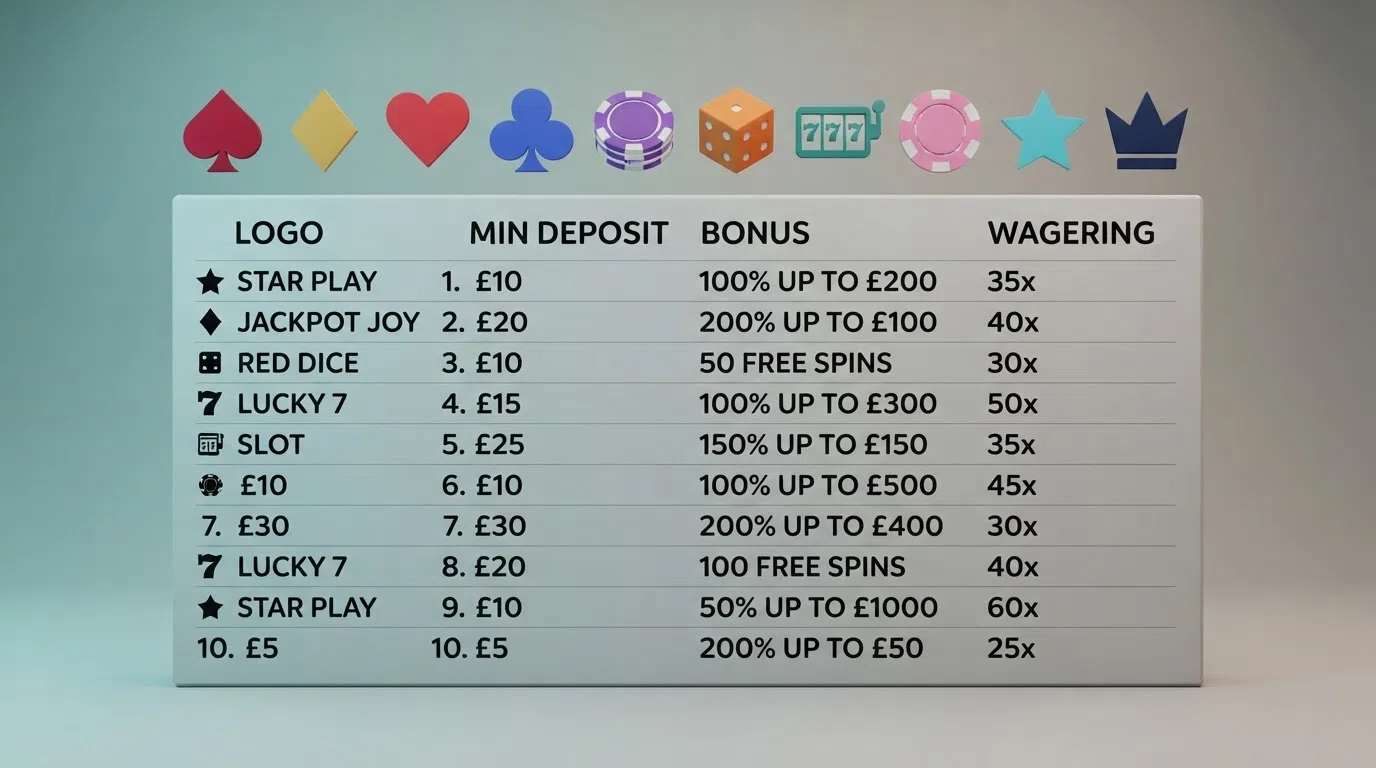
The table below ranks the ten UKGC-licensed operators reviewed for this guide. None currently accepts a £2 deposit; the lowest published floor is £5, and the column reflects each operator’s own cashier. Welcome-offer terms are taken from each operator’s current UK page at the time of writing. Wagering is stated as the multiplier applied to the qualifying deposit or bonus; “0x” means no wagering requirement and winnings are paid as cash.
| Casino | UKGC Licence | Min Deposit | Welcome Offer | Wagering | Bonus Validity |
|---|---|---|---|---|---|
| Sky Vegas | 65519 | £5 | 50 no-deposit spins + 200 on £10 deposit/stake | 0x | 7 days |
| Paddy Power Games | 39483 | £5 | 60 no-deposit spins + 200 on £10 deposit/wager | 1x | 7 days |
| Betfred | 39544 | £5 | Stake £10 on slots, get up to 200 free spins | 1x | 48 hours |
| bet365 Games | 55149 | £5 | Up to 500 free spins over 10 days on £10 deposit | 1x | 10 days |
| 888casino | 39028 | £10 | Up to £88 free play, no deposit required | 30x (10x cap) | 14 days |
| William Hill Vegas | 39225 | £5 | 200 free spins on Big Bass Splash with code, £10 deposit/wager | 1x | 72 hours |
| MrQ | 39579 | £10 | Up to 300 free spins, 75/day over 4 deposits of £10+ | 0x | 48 hours per batch |
| PlayOJO | 39326 | £10 | 50 free spins on Big Bass Bonanza on first £10 deposit | 0x | Standard terms |
| LeoVegas | 39198 | £10 | 50 wager-free free spins on Big Bass Splash on first £10 deposit | 1x | Standard terms |
| Casumo | 61549 | £10 | 50% deposit match up to £100 on £20 deposit | 10x on bonus | 7 days |
The table is read left to right by deposit floor first, then by wagering burden. The three no-deposit rows at the top — Sky Vegas, Paddy Power, 888casino — sit there because they let a player start without funding the account at all. The wager-free rows that follow — MrQ, PlayOJO, LeoVegas — represent the cleanest combination of low entry and unrestricted winnings. Casumo’s 50% match closes the table because it is the only deposit-match bonus in the set, and because its £20 minimum makes it the highest entry threshold.
Sky Vegas: no-deposit spins with zero wagering
Sky Vegas (UKGC licence 65519, Bonne Terre Ltd, Flutter Entertainment) leads the comparison on a single point: 50 free spins require no deposit and carry no wagering requirement. A new account is created, the spins are credited, and anything won is paid as withdrawable cash with no cap. A second tranche of 200 spins triggers on a £10 deposit and stake, also at zero wagering. The headline number — 250 free spins — oversells the offer; the practical number is 50 spins the player never has to fund.
The library is broad: 1,000-plus titles from Pragmatic Play, NetEnt, Play’n GO, Blueprint and Evolution, including a Big Bass Splash variant that recurs across the UKGC-licensed comparison set. Spin value is 10p, the free-spin expiry is 7 days from credit, and the deposit-and-stake requirement must be completed within 30 days of registration. For a player whose primary goal is to start playing without depositing, Sky Vegas is the strongest option in the ranking.
Paddy Power Games: 60 no-deposit spins plus a deposit bonus
Paddy Power Games (UKGC licence 39483, PPB Counterparty Services Ltd, Flutter Entertainment) runs one notch above Sky Vegas on no-deposit volume — 60 free spins on registration, no deposit required — and adds 200 more on a £10 deposit and wager, with 1x wagering on that second tranche. The total headline is 260 spins.
The trade-off is the cashout cap. Free-spin winnings on the deposit tranche are capped at £260, and 1x wagering applies. That is still low by historical UK standards — most pre-2026 UK bonuses ran 35x or 40x — but it is the first friction a player encounters in this comparison. Paddy Power suits the reader who wants the highest possible no-deposit spin count and accepts the cap as the cost of the larger number.
Betfred: stake £10 get up to 200 free spins
Betfred (UKGC licence 39544, Petfre Gibraltar Ltd) skips the no-deposit path. The welcome structure is a straight deposit-and-play: stake £10 on slots and receive up to 200 free spins with 1x wagering. The catch is the validity window. Free spins expire 48 hours from credit — the tightest window in the comparison, and a real constraint for a player who does not log in daily.
The trade for that tight window is simplicity. There is no no-deposit component to track, no code to enter, no cashout cap flagged in the headline terms. The library spans Playtech, Pragmatic Play, NetEnt and IGT, with bingo and live casino alongside slots. Betfred suits a player who plans to deposit, play, and use the spins within two days — a one-weekend welcome structure rather than a one-month one.
bet365 Games: up to 500 free spins over 10 days
bet365 Games (UKGC licence 55149, Hillside New Media Ltd) publishes the largest headline spin count in the comparison: up to 500 free spins released in daily batches over 10 days on a £10 minimum deposit, with 1x wagering. The mechanic is reveal-style — each batch discloses prizes of 5, 10 or 20 free spins on eligible games — and there is a 24-hour gap between each spin set. The 10-day usage window is long; the per-batch window is short.
A practical note on payment methods: bet365’s minimum deposit is £5 on debit card and £25 on PayPal, so the £10 welcome trigger is reachable through either rail but the PayPal floor is higher. The library is unusually deep for a sportsbook-anchored brand — bet365 Originals, Pragmatic Play, NetEnt, Playtech, Evolution and Microgaming — and the welcome structure is best suited to a player who logs in daily across the full 10-day window.
888casino: £88 free play with no deposit required
888casino (UKGC licence 39028, 888 UK Limited, evoke plc) offers a genuine no-deposit free-play credit: up to £88 awarded on registration with no deposit required, plus a deposit bonus on the first top-up. The free-play bonus carries 30x wagering as a headline number, but the 19 January 2026 UKGC 10x cap means the effective wagering on any applicable bonus is 10x. A £100 cap applies to no-deposit-bonus winnings, and the 14-day validity is the longest in the no-deposit cluster.
The library is multi-vendor: 888 originals, NetEnt, Playtech, Evolution, Pragmatic Play and Red Tiger. 888casino is the right pick for a player who wants a no-deposit credit usable across a broader range of games than the Big Bass Splash cluster that dominates the free-spin offers — and who is comfortable with the cashout cap that comes with it.
William Hill Vegas: 200 free spins on Big Bass Splash
William Hill Vegas (UKGC licence 39225, WHG International Ltd, evoke plc) focuses the welcome on a single title. Deposit and wager £10 with a code, and the player receives 200 free spins on Big Bass Splash — the Pragmatic Play title at 96.71% RTP — with 1x wagering, a 72-hour expiry, and a £30 cap on free-spin winnings.
The £30 cap is the tightest in the comparison and worth flagging. A player who hits a strong line on Big Bass Splash early in the 72-hour window can see most of the upside absorbed by the cap. The spin value is 10p, and the eligible title is fixed — there is no rotation across the wider Pragmatic Play catalogue. William Hill Vegas suits a player who specifically wants Big Bass Splash and accepts the cashout ceiling in exchange for a focused, single-title welcome.
MrQ: up to 300 wager-free spins across four deposits
MrQ (UKGC licence 39579, Lindar Media Ltd) takes a different structural approach. The welcome releases up to 300 free spins on Big Bass Splash in batches of 75 per day across the first four deposits of £10 or more. All MrQ promotions are wager-free, winnings are paid as cash, and there is no maximum cashout cap. The 48-hour validity applies to each batch, not to the full 300 spins.
The library leans into the studios UK players favour: Pragmatic Play, NetEnt, Play’n GO, Evolution, Hacksaw Gaming and Nolimit City. MrQ is the cleanest wager-free offer in the comparison and the right pick for a player who plans to make four qualifying deposits and wants every penny of winnings paid out without a multiplier or a cap eating into them.
PlayOJO: 50 wager-free spins with no playthrough
PlayOJO (UKGC licence 39326, SkillOnNet Ltd) brands itself around a single proposition: no wagering, ever. The welcome is 50 free spins on Big Bass Bonanza (the Pragmatic Play title at 96.71% RTP) on the first £10 deposit, with zero wagering and no cashout cap. Spin value is 10p.
The SkillOnNet platform behind PlayOJO carries 3,000-plus games — Pragmatic Play, NetEnt, Play’n GO, Evolution, Microgaming — and the wager-free policy applies to all promotions, not just the welcome. For a player who values the structural simplicity of “winnings are paid as cash, no exceptions” over spin volume, PlayOJO is the more consistent long-term pick than any of the larger headline counts.
LeoVegas: 50 wager-free spins on a £10 deposit
LeoVegas (UKGC licence 39198, LeoVegas Gaming PLC) runs 50 free spins on Big Bass Splash on the first £10 deposit at 1x wagering, effectively wager-free in practice. Spin value is 10p. The mobile library is the brand’s structural advantage: LeoVegas built its platform mobile-first, and Pragmatic Play, NetEnt, Evolution, Play’n GO and Microgaming titles are tuned for smaller screens. The standard LeoVegas terms apply to validity.
For a player whose primary play device is a phone, LeoVegas is the strongest mobile experience in the comparison. The wagering is functionally identical to MrQ and PlayOJO, and the spin count is lower; the case for LeoVegas rests on the mobile execution rather than the welcome structure.
Casumo: a 50% deposit match for bonus hunters
Casumo (UKGC licence 61549, Recro Ltd) is the only deposit-match bonus in the comparison. A £20 minimum deposit unlocks a 50% match up to £100, with 10x wagering on the bonus amount, 7-day validity, and a maximum bonus conversion equal to lifetime deposits up to £250. The wagering sits at the UKGC cap and is the lowest in the deposit-match segment of the UK market, but the offer is still structurally different from every free-spin welcome above it.
The library is the largest in the comparison: 3,500-plus games from Pragmatic Play, NetEnt, Play’n GO, Evolution, Microgaming and Nolimit City. Casumo is the right pick for a player who prefers bonus cash over free spins and is comfortable with the £20 minimum that the bonus requires. Every other operator in the table is a free-spin welcome; Casumo is the alternative shape.
How to spot a safe low-deposit casino in under five minutes
A UK player can confirm a casino’s legitimacy in three checks that take less time than reading the welcome offer. None of them requires specialist knowledge; all of them rely on tools the UK Gambling Commission publishes publicly.
- Check one: the UKGC licence number. Every licensed operator publishes an account number in its website footer. The number maps to the licence holder’s name and operating status on the UKGC’s public register. A site that omits the number, or one whose number does not resolve on the register, is not operating under a UKGC licence — and the protections that come with one (mandatory KYC, GamStop participation, the 10x wagering cap, the credit card ban) do not apply.
- Check two: the GamStop connection. This is the national self-exclusion service for online gambling. Every UKGC-licensed operator is required to participate, and the service allows players to block themselves from all participating sites at once. The responsible-gambling page of a licensed casino links to GamStop directly; an offshore operator advertises the fact that it is not on GamStop, and that is the red flag.
- Check three: the bonus terms. Since 19 January 2026, the UKGC has capped bonus wagering at 10x the bonus amount across all UK-licensed sites. A welcome offer that advertises 30x, 40x or higher wagering is either out of date, mis-stated, or running on an offshore licence that does not honour the cap.
The three legitimacy checks that matter
The three checks above are not equally weighted. The licence number is the foundation — without a valid UKGC account, the other two are decorative. The GamStop connection is the player-protection proof: a casino on GamStop means a single self-exclusion registration blocks access to every UK-licensed site, which is the mechanism that makes a self-exclusion decision stick. The wagering-cap check is the most recently introduced and the easiest to miss; a reader who only reads the welcome page may not notice that the headline bonus is non-compliant.
Each check is a one-minute task. The licence number is in the footer of every UKGC-licensed site and resolves on the Commission’s register at the same URL. The GamStop link is on the responsible-gambling page, usually one click from the footer. The wagering figure is in the bonus terms, which every UKGC-licensed site must display prominently. A reader who runs all three in sequence has confirmed, in five minutes or less, that the casino is licensed, that it participates in national self-exclusion, and that its bonus structure sits inside the current regulatory ceiling.
Safety signals a £2-deposit casino cannot fake
A UKGC licence does more than authorise a casino to operate. It imposes a set of structural protections that a player takes for granted at a licensed site and discovers are missing the moment they step offshore. Mandatory KYC means the operator has verified the player’s identity before they place a bet. The credit card deposit ban, in force since April 2020, removes the most direct route to debt-fuelled gambling. GamStop cross-operator self-exclusion means a single registration blocks every UK-licensed site at once, not just the one where the player signed up. ADR access gives the player an independent dispute-resolution route if a casino withholds winnings or mishandles a complaint.
None of these are optional, and none of them are easy to fake. A site that displays a UKGC badge but does not appear on the Commission’s register is misrepresenting itself; the badge is a graphic, the licence is a register entry, and the two must agree. The 10x wagering cap from January 2026 is the newest of these signals, and the easiest to test against: a UK-licensed casino’s bonus terms will state 10x or less, because anything higher is a breach of the operating licence conditions.
UK licence or offshore promise: what is really at stake with a £2 deposit
The licence jurisdiction is the single most important fact about any casino that takes a player’s money. Everything else — the bonus size, the game library, the payout speed — sits downstream of it. A UKGC-licensed casino is operating under the Gambling Act 2005 and is bound by the Commission’s licence conditions. A Curaçao- or Anjouan-licensed casino is operating under a different regime with different rules, and the differences are not cosmetic.
| Protection | UKGC-Licensed Casino | Non-GamStop Offshore Casino |
|---|---|---|
| GamStop self-exclusion | Mandatory | Not connected |
| Mandatory KYC before play | Required | At operator’s discretion |
| Credit card deposit ban | Yes (since April 2020) | No |
| Online slots stake limits | £2 (18–24) / £5 (25+) | None |
| Bonus wagering cap | 10x (since Jan 2026) | No cap |
| ADR access | Independent body available | No UK route |
| Regulator recourse if winnings withheld | UKGC can assist | No UK regulator involvement |
The left column is what a UK player gives up the moment they deposit at an offshore site. GamStop is the mechanism that makes self-exclusion work for a person who has decided to stop, and an offshore casino opts out of it by design. The credit card ban, the stake limits and the 10x wagering cap are the three structural protections that limit how much harm a session can do; an offshore operator ignores all three. ADR access is the only practical recourse when a casino withholds winnings, and an offshore dispute may not have one at all.
The bottom row is the one that matters when money is at stake. If a UK-licensed operator withholds winnings, the player can complain to the ADR and, if the ADR finding is not honoured, escalate to the UKGC. If a Curaçao-licensed operator withholds winnings, the player has whatever dispute mechanism the operator chooses to provide, and no UK regulator has jurisdiction. The Gambling Act’s criminal penalties apply to the operator, not the individual player — but the practical cost of a lost bankroll sits entirely with the player.
How the UK Gambling Commission protects your £2
The Gambling Act 2005 is the statute, and the UK Gambling Commission is the regulator. Every operating licence the Commission issues comes with a set of conditions that govern how the casino treats player funds, identity, marketing and dispute resolution. The 2026 changes layered new conditions on top of the existing framework: the 10x wagering cap from 19 January, the deposit-limit mandate from 30 June, and the RTS 12B spend-and-stake terminology changes from 30 September. The online slots stake limits — £2 per game cycle for 18 to 24 year-olds, £5 for 25 and over — are now in force, having taken effect on 9 April 2025 for the £5 tier and 21 May 2025 for the £2 under-25 tier.
The £2 stake cap is the condition most directly relevant to a page about £2 deposits. A player aged 18 to 24 who deposits £2 at a UK-licensed casino and plays online slots is playing at both the minimum deposit floor and the maximum per-spin stake floor at the same time — a single £2 transaction can fund exactly one spin at maximum stake for that age group. The same player at a Curaçao-licensed site can stake the entire £2 on a single spin at any size, with no statutory cap to limit the exposure. Remote Gaming Duty, at 40% from 1 April 2026, is paid by the operator and not the player; it is one of the highest gambling tax rates globally and a structural reason the UK market offers tighter margins than offshore competitors.
What “not on GamStop” actually means
GamStop is the UK’s national self-exclusion service for online gambling. Every UKGC-licensed operator is required to participate, allowing players to block themselves from all participating sites at once. Registration is straightforward: players choose an exclusion period—6 months, 1 year, 3 years, or 5 years—and the block remains active for the full duration.
A casino that advertises being “not on GamStop” is signalling that it does not hold a UKGC licence. The site is almost always registered in Curaçao, Anjouan or Malta — jurisdictions that do not require participation in the UK self-exclusion scheme. The advertising is the tell: a UK-licensed casino cannot legally offer itself as outside GamStop, because it is not.
The under-25 cohort is the fastest-growing segment of GamStop registrations, up 26% year-on-year and now nearly one in three of all self-exclusions. That number is the part of the GamStop data most directly relevant to a page about low-deposit accessibility. The same regulatory environment that created the £2 stake cap for under-25s has also produced the demographic that registers for self-exclusion at the highest rate.
The real risks of playing at a non-GamStop casino
The risks are not abstract. They are the specific protections a UK player loses the moment they deposit offshore, named in the order they would be missed. No statutory online slots stake limits, so an 18-year-old at a Curaçao-licensed casino can stake any amount per spin. No credit card ban, so the route that the UK closed in April 2020 remains open. No mandatory KYC, so identity verification happens only if the operator chooses to perform it, typically at withdrawal rather than at deposit. No ADR access, so a dispute over withheld winnings has no independent UK body to adjudicate it. No UK regulator involvement if funds are not returned.
The phrase “no UK regulator can help recover funds” is the operational summary. The UK Gambling Commission’s enforcement powers extend to operators serving the UK market without a licence, and the Gambling Act’s criminal penalties apply — but the penalties are levied against the operator, not the individual player, and they do not include a mechanism for returning a player’s withdrawn bankroll. A reader who values the protections the UK market provides should look for the licence number in the footer, confirm it on the Commission’s register, and avoid any site that advertises itself as outside the system.
Why your 2026 bonus at a low-deposit casino is smaller than it looks
The headline number on a welcome offer — 500 free spins, £88 free play, 50% up to £100 — is the marketing number. The realised number is what the player actually clears after the wagering requirement, the validity window, the eligible games and the cashout cap have all done their work. The UKGC’s 10x cap from 19 January 2026 reduced the wagering burden by roughly two-thirds relative to the pre-2026 market, where 35x and 40x were routine, but the headline-to-realised gap is still substantial on most offers in the comparison.
The expected cost of clearing the bonus tells the same story from the other side. A representative welcome offer from the comparison set is Casumo’s 50% deposit match up to £100 on a £20 minimum deposit. The bonus amount is £10 — half of the qualifying £20 deposit — and at 10x wagering on the bonus, the required turnover is £100. At Big Bass Splash’s 96.71% RTP, the expected house edge across £100 in wagering is £3.29; at Starburst’s 96.09% RTP, it is £3.91; at Book of Dead’s 96.21% RTP, it is £3.79. The player’s expected loss is in the £3 to £4 range depending on which eligible title they play, and that is the bonus’s real cost: not the £100 turnover figure, not the £10 bonus, but the £3-ish that the wagering is statistically expected to extract before the bonus converts.
The same calculation applied to a free-spin offer looks different. Sky Vegas’s 50 no-deposit spins at 10p each represent £5 in slot play with zero wagering, meaning anything won is paid as cash immediately. At Big Bass Splash’s 96.71% RTP across 50 spins, the expected return is £4.84 — the house edge on £5 of wagering is 16p, and the player keeps the rest. A free-spin welcome with no wagering is structurally cheaper for the player than a deposit-match welcome even at the UKGC’s 10x cap, because no playthrough means no further expected loss after the initial spin value is consumed. The headline comparison of “50 spins vs 50% up to £100” does not show this; the calculation does.
The 10x cap also interacts with the 40% Remote Gaming Duty that operators pay from 1 April 2026. The combination — a low wagering ceiling on bonuses and a high tax on operator revenue — is one of the structural reasons generous low-deposit bonuses are difficult to offer in the UK. Operators must clear both the bonus value and the duty before the offer is profitable, and the margin for player-friendly terms is correspondingly tighter than in lower-tax jurisdictions.
Welcome bonuses that actually accept low deposits
The lowest-deposit welcome offers in the comparison set break into three tiers. The no-deposit tier is Sky Vegas (50 spins, no deposit, 0x wagering), Paddy Power (60 spins, no deposit, 1x on the second tranche) and 888casino (£88 free play, no deposit, 10x effective). The £10-deposit tier holds bet365 (up to 500 spins over 10 days, 1x), William Hill Vegas (200 spins on Big Bass Splash, 1x, £30 cap), MrQ (up to 300 spins across four deposits, 0x), PlayOJO (50 spins on Big Bass Bonanza, 0x) and LeoVegas (50 spins on Big Bass Splash, 1x effectively 0x). The £20-deposit tier is Casumo alone: 50% up to £100, 10x wagering on the bonus.
The no-deposit offers are the structural outliers. A player who triggers Sky Vegas’s 50 spins, Paddy Power’s 60 spins or 888casino’s £88 free play has started playing without funding the account, and the wagering and cap terms apply to whatever the spins win rather than to a deposit the player has already made. The £10-deposit tier is the market standard at the UKGC-licensed end of the spectrum, and the £20 deposit at Casumo is the highest entry threshold in the comparison.
The free spin you get without spending a penny
No-deposit bonuses are rare in the UK because the UKGC’s affordability and player-protection rules make them expensive for operators to offer. Three of the ten operators in this comparison publish one, and each structures the offer differently. Sky Vegas pays no-deposit winnings as cash with no cap. Paddy Power caps no-deposit winnings at £260 and adds 1x wagering to the deposit tranche. 888casino caps no-deposit winnings at £100 and applies 10x wagering after the January 2026 cap took effect.
The difference between the three is what the player actually keeps. A player who hits a strong line on Sky Vegas’s 50 spins keeps the full amount, withdrawable immediately. A player who hits the same line on Paddy Power’s 60 spins keeps up to £260 of it, with the rest returned to the casino balance. A player who hits the same line on 888casino’s free play keeps up to £100, with the rest subject to 10x wagering before it becomes withdrawable. The marketing headline does not distinguish between these three outcomes; the terms do.
Wagering requirements: the 10x cap and what it means for your £2
Before 19 January 2026, UK bonus wagering routinely ran at 35x or 40x. A £10 bonus at 40x wagering required £400 in turnover to clear; the same bonus at 10x requires £100. The cap shrinks the clearance burden by roughly three-quarters, and the player’s expected cost of clearing the bonus falls proportionally. At Big Bass Splash’s 96.71% RTP, a £10 bonus at 40x wagering carries an expected clearance cost of around £13; at 10x, the expected cost drops to around £3.29. The cap is the single largest structural improvement to UK bonus terms in the past decade.
The 10x cap does not eliminate wagering. It caps it. A player who takes a Casumo 50% match on a £20 deposit still has £10 of bonus funds to clear at 10x, and the £100 in required turnover still carries an expected house edge of around £3 depending on the eligible game. What the cap does is make the bonus arithmetic legible: a player who reads the terms can calculate the expected cost of clearing the offer in advance, and the answer is small enough to be worth taking on a title they want to play anyway. A 40x bonus made that calculation difficult; a 10x bonus makes it one multiplication and one percentage.
Paying and cashing out: what works at £2 and what does not
The payment-method reality at the £2 floor is that almost no method reaches it. PayPal, debit cards and the major e-wallets (Apple Pay, Trustly, Paysafecard) all set their own minimums at £5 or above because the processing fees on sub-£5 transactions eat the operator’s margin faster than the deposit clears. Bank transfer is the only rail that consistently processes at sub-£5, and the pay-by-mobile option routes through the phone carrier’s billing system in some configurations. Among the ten operators in the comparison, the £5 deposit floor is the practical answer to “what works at £2”; below £5, the answer is “almost nothing, and what exists is mostly offshore”.
Payout speed is a different question. The rail that processes a deposit does not determine withdrawal speed — the operator’s processing queue and the receiving rail’s settlement window are the bottlenecks, and both are independent of deposit size. A £2 deposit does not slow or accelerate a withdrawal relative to a £100 deposit on the same method, because the operator runs withdrawals through the same queue regardless of how much funded the account.
Bank transfer: the only route below £5
The structural reason PayPal, debit cards and e-wallets set £5 minimums is per-transaction processing fees. A card transaction on a £2 deposit carries a fixed fee that, for the operator, is a meaningful percentage of the deposited amount; on a £10 deposit, the same fee is a much smaller proportion and the margin works. Bank transfer avoids the per-transaction fee structure and can clear at lower amounts, which is why the £2-deposit niche lives almost entirely on bank transfer rails at the offshore end of the market and is largely absent at the UKGC-licensed end.
Pay by Mobile is a different mechanism. Some UK-facing brands — not the ten in the comparison set, but operators in the wider UK market — advertise a £2 or £3 deposit floor through pay-by-SMS, which routes the deposit through the player’s mobile carrier’s billing system. The deposits appear on the phone bill, and the carrier takes a percentage. The convenience is real; the fee is higher than on a card transaction, and the deposit does not always count as a qualifying deposit for welcome-offer purposes.
Cashing out: why payout speed depends on the method not the deposit
The UK market’s standard withdrawal timelines, by method, run roughly as follows. Debit card withdrawals clear in 1 to 3 business days after the operator approves them, with the operator’s internal processing typically adding 24 to 48 hours on top. PayPal withdrawals are usually faster, often within 24 hours of approval, because PayPal’s own settlement is near-immediate. Bank transfer withdrawals sit in the 2 to 5 business day range, depending on the receiving bank. Apple Pay and Trustly generally mirror the debit card or PayPal timelines depending on which rail the operator uses underneath.
None of these windows change with the size of the deposit. A player who deposited £2 and won £50 on free spins waits the same time as a player who deposited £100 and won £50 on a matched bonus, because the operator’s queue and the rail’s settlement are the constraints, not the deposit amount. The exception is the no-deposit path: an operator that approves a £20 no-deposit free-spin withdrawal may impose additional verification before processing, which can extend the timeline beyond the standard for the chosen method. That is KYC doing its job, not the rail slowing down.
£2-deposit gaming on your phone: what the apps deliver
The UK mobile casino market in 2026 is, in practical terms, two parallel experiences. The first is the native app — iOS and Android downloads from the App Store and Google Play, built and maintained by the operator. The second is the responsive mobile browser, which loads the same game library through the phone’s browser without requiring a download. Every UKGC-licensed operator in the comparison set supports mobile browser play, and the app-versus-browser choice comes down to which titles the operator gates behind each entry point.
LeoVegas is the structural mobile-first operator in the comparison — the platform was built mobile-first, and the game library is tuned for smaller screens. Sky Vegas, Paddy Power, bet365, William Hill Vegas, MrQ, PlayOJO, 888casino and Casumo all offer native apps alongside their browser play. Betfred’s mobile offering sits more in the browser-led cluster, with a responsive site that mirrors the desktop experience.
Mobile casinos that accept low deposits
The £5 and £10 deposit floors apply identically on mobile. A player depositing £5 at Sky Vegas through the app is making the same transaction as a player depositing £5 through the desktop site; the cashier and the payment rail do not differentiate by device. The KYC verification step, where it is required, runs through the app or browser in the same form, and the deposit-limit prompt that the UKGC mandates from 30 June 2026 appears on the mobile registration flow as it does on the desktop one.
The mobile-specific difference is game availability. Some operators — not many in the comparison set, but enough in the wider market to be worth noting — reserve certain live-casino or exclusive titles for the app, leaving the browser version with a slightly smaller library. The opposite also happens: a few operators carry more games in the browser than in the app because the app’s release cycle lags behind the browser’s. A player who has a specific title in mind should check the app or browser library before depositing, rather than assuming the two are identical.
Depositing £2 on mobile: what the process looks like
The mobile deposit flow for a bank transfer at a UK-licensed operator runs through four steps. The player opens the cashier on the app or browser, selects bank transfer as the payment method, enters the deposit amount (£2 where the operator accepts it, £5 or £10 where it does not), and confirms. The casino then redirects to the player’s banking app or mobile browser for the transfer authorisation — a standard Open Banking or direct-debit flow depending on the operator’s integration. Once the bank confirms, the funds appear in the casino account, typically within minutes for an instant-transfer integration and within hours for a slower BACS-style transfer.
The KYC step may precede the deposit on a first-time account. The UKGC requires identity verification before play, and most operators trigger the verification prompt during or immediately after the first registration. A player who has not yet uploaded ID may find that the deposit clears but the withdrawal is held pending verification, which is a structural feature of the licensed market rather than a per-operator quirk.
Slot gaming on a £2 budget: titles RTPs and what your spin is worth
The slot catalogue at the £2 minimum-stake level is broad. The titles with researched RTP data that recur across the comparison set are three: Big Bass Splash from Pragmatic Play, Starburst from NetEnt, and Book of Dead from Play’n GO. Each carries a different volatility profile and a different max-win ceiling, and the three together cover the main shapes a small bankroll can take.
| Slot Title | RTP | Provider | Volatility |
|---|---|---|---|
| Big Bass Splash | 96.71% | Pragmatic Play | High |
| Starburst | 96.09% | NetEnt | Low |
| Book of Dead | 96.21% | Play’n GO | High |
At 10p per spin, a £2 deposit funds twenty real-money spins on any of the three. On Big Bass Splash, the £2 is statistically expected to return £1.93 over twenty spins, and the high volatility means the variance around that expected return is wide — a player can hit a 5,000x line and walk away with a substantial multiple of the deposit, or they can hit nothing and lose the full £2. On Starburst, the expected return on £2 over twenty spins is £1.92, but the low volatility means most of that return comes in small, frequent wins rather than occasional large ones. The bankroll lasts longer in number of spins, and the session feels more active. On Book of Dead, the expected return is £1.92 over twenty spins at 10p, with high volatility and a 5,000x ceiling — similar variance to Big Bass Splash but with a different bonus structure.
Which slots you can play with a £2 deposit
A £2 deposit reaches any slot that accepts a 10p minimum stake, which is the UK market standard. Big Bass Splash is the title that recurs most often in welcome offers, and it sits comfortably within the 20-spin budget that £2 funds. Starburst is the gentler alternative for a player who wants the bankroll to last across a longer session. Book of Dead is the high-ceiling option for a player who would rather have one shot at a large payout than twenty small ones.
The three are not the only titles available. Every operator in the comparison set carries a library of 1,000 to 3,500-plus games, and the eligible slots for welcome offers rotate over time. The three above are the ones the research covers with specific RTP data, and the RTP-and-volatility column is reserved for them; other titles are available in the lobby but are not catalogued here.
Live casino and table games at minimum stakes
A £2 deposit reaches the live-casino and table-game lobby at minimum stakes, though the number of rounds is small. UK live-roulette tables typically accept bets from £0.20 to £1.00, which means a £2 deposit funds two to ten rounds depending on the table. Live blackjack sits in a similar range, with minimums of £0.50 to £1.00. A player who treats the live lobby as a paid demo rather than a session gets a meaningful number of hands for the deposit, and the same goes for the digital table-game lobby.
The online slots stake limits — £2 for 18 to 24, £5 for 25 and over — do not apply to table games or live casino. A £2-deposit player sitting at a £0.50 blackjack table faces no statutory per-round cap, and the same is true at the roulette wheel. The stake limits are a slots-specific protection, and the rest of the casino lobby is unaffected.
New low-deposit casinos in 2026: fresh faces same limits
The new-entrant landscape in the UK online casino market in 2026 sits inside the same regulatory ceiling as the incumbents. A new UKGC-licensed casino launching in 2026 faces the 10x wagering cap from day one, the deposit-limit mandate from 30 June, the online slots stake limits, the credit card ban, mandatory KYC and GamStop participation. None of those conditions are grandfathered for new licensees, and a new operator that wanted to offer a £2 deposit floor would still need to clear the same payment-method, KYC and affordability requirements as a brand launching at £5 or £10.
The commercial pressure on a new operator to push the floor below £5 is weak. The processing-fee economics that make sub-£5 deposits unprofitable for established operators apply equally to new entrants, and the UKGC’s affordability and player-protection requirements make a sub-£5 floor more expensive to operate than a £5 or £10 one. A new brand that wants to differentiate tends to do so on welcome-offer size, game library or mobile experience rather than on deposit floor. The £5 minimum is the market standard because the market has settled on it, and the settlement looks stable.
Recently launched casinos that accept low deposits
The new-licensee cohort in 2026 inherits the £5-to-£10 market standard and the full UKGC player-protection framework. The Commission’s licensing process requires new entrants to demonstrate affordability-check capability and player-protection systems before a licence is issued, which raises the cost of entry but also makes the post-launch operating environment predictable. A new UKGC-licensed casino launching with a £5 deposit floor is competing on the same terms as Sky Vegas, Paddy Power, Betfred, bet365 and William Hill Vegas; a new entrant launching with a £2 floor would need to find a payment-rail structure that makes the per-transaction economics work, and the research does not identify a UKGC-licensed new entrant that has done so in 2026.
The practical advice for a player evaluating a new UK-licensed casino is the same as for an incumbent: confirm the licence number on the UKGC register, confirm GamStop participation, and read the bonus terms for the 10x wagering cap. A new brand is not safer or more dangerous than an established one on these measures; it is simply less tested by time, and the player’s own due diligence fills the gap.
Playing small stakes safely: tools that work at any deposit level
Low deposits do not eliminate gambling risk. They reduce the per-session ceiling, but a player who plays frequently at low stakes can accumulate losses that look modest in any single session and substantial across a month. The UKGC’s 2026 regulatory changes — the deposit-limit mandate from 30 June, the 10x wagering cap from January, the online slots stake limits — are explicitly designed to address the intersection of low-deposit accessibility and harm risk, and the tools the Commission mandates are the most direct line of defence a UK player has.
The UK prevalence data puts the stakes in context. Around 0.5% of the adult English population experience problem gambling; 3.8% are at elevated risk of gambling harms; an estimated 7% of the British population are negatively affected by someone else’s gambling. The numbers are small in percentage terms and large in absolute terms, and the help infrastructure is sized accordingly: GamStop’s 614,738 registered users, the National Gambling Helpline’s 996 treatment referrals in January 2026 alone, and the GambleAware National Gambling Support Network’s coverage of self-exclusion and limit-tool users.
Deposit limits and low-stake budgeting
From 30 June 2026, every UK-licensed online operator must offer a deposit limit based solely on the amount paid into the account over a set duration. The Commission specifies that the limit must be set at registration — the player cannot proceed without being prompted — and the limit can be daily, weekly or monthly. A player who sets a £10 weekly deposit limit on a £2-per-session budget can fund five sessions per week and no more, regardless of how the casino’s welcome offers are structured. The limit is a structural ceiling, not a recommendation.
The RTS 12B changes from 30 September 2026 replace the “spend limits” terminology with “stake limits” and amend the loss-limit definition. The practical effect for a player is the same: the operator must offer the limit, the player must set it at registration, and the limit binds across the account’s lifetime until the player changes it. A player who wants to set a £2-per-week limit on a casino account to match a low-deposit session pattern can do so, and the operator cannot override the choice.
GamStop self-exclusion: how it works and why registrations are rising
GamStop registration takes minutes and covers every UKGC-licensed operator at once. A player provides their details, selects an exclusion term from 6 months, 1 year, 3 years or 5 years, and is blocked from logging in, depositing or playing at any participating site for the duration. The exclusion cannot be lifted early by the player or by the operator; the term runs to its end, and the player must wait it out.
During the first half of 2026, 614,738 consumers registered — a 16% year-on-year increase, with May setting a new monthly record. Over half of those registered users chose the maximum five-year exclusion, which is a longer commitment than the average UK mortgage. The under-25 cohort is the fastest-growing segment, up 26% year-on-year and now nearly one in three of all self-exclusions. A young player who registers on GamStop at 21 is locked out of the UK-licensed market until at least 26, and potentially until 26 plus a further chosen exclusion term.
The reason registration is rising fastest among under-25s is the same reason the £2 stake cap exists for that age group: the UK regulator has identified low-stakes, high-frequency play as a specific harm vector for younger players, and the tools — the stake cap, GamStop, the deposit-limit mandate — are calibrated accordingly.
Where to get help: helplines tools and support networks
The free, confidential help infrastructure for UK players is sized for the population that needs it, and the usage figures for early 2026 are the highest on record.
- The National Gambling Helpline (operated by GamCare) is free, confidential and available 24/7. The number for England and Scotland is 0808 8020 133; the number for Wales is 0808 2819 265. In January 2026 alone, the Helpline made 996 referrals to treatment and peer-based support, up from 674 in January 2025 — a 48% year-on-year increase. GamCare is the most common route into treatment for UK problem gamblers.
- The GambleAware National Gambling Support Network is the treatment-referral infrastructure that the Helpline routes into. 81% of gambling clients in the network reported using a self-exclusion or limit tool, which is the structural ceiling that the 30 June 2026 deposit-limit mandate formalises across the licensed market.
- GamStop is the self-exclusion mechanism, and the responsible-gambling page of every UKGC-licensed operator links to it. The page is also the entry point for BeGambleAware, the public-facing responsible-gambling brand, and its online self-assessment tools.
The prevalence data sits behind all of this. Around 0.5% of the adult English population experience problem gambling; 3.8% are at elevated risk; an estimated 7% of the British population are negatively affected by someone else’s gambling. The numbers are not large as percentages, and they are not small as absolute counts. A player who recognises the signs in their own play — chasing losses, playing longer than intended, hiding the activity from family — has a direct line to help, and the help is free.
How we chose and ranked the casinos on this page
The ten operators in this comparison were selected from UKGC-licensed brands serving the UK market and cross-checked against the Commission’s public licence register. The ranking considered minimum deposit, welcome-offer value, wagering terms, game-library breadth and player-protection features. No weightings or percentages were applied to the criteria, because the relative importance of each depends on what the individual player values — a player who wants the highest possible no-deposit spin count weights the welcome offer most heavily, while a player who plans a long relationship with a single brand weights the wagering terms and the game library.
The page does not review every UKGC-licensed casino. There are more licensed brands in the UK market than this comparison includes, and a brand absent from the table is not necessarily unsafe or unsuitable — it simply fell outside the scope of this ranking. The ten operators above are a representative sample of the major UK-licensed platforms at the low-deposit end of the market, not a complete census of the licensed market.
What your £2 deposit really buys you — and where to go from here
The honest starting point is the gap. The search for a £2 minimum deposit casino leads to a UK-licensed market where no featured operator currently accepts less than £5, and where the bank-transfer route that theoretically reaches £2 is offered almost exclusively by offshore brands. The £2 deposit casino is a search term, not a product category — and the reader who wants the lowest possible entry cost is better served by the no-deposit offers at the top of the comparison table than by chasing a £2 floor that the licensed market does not deliver.
A player who wants to start playing without funding the account should target Sky Vegas’s 50 no-deposit spins, Paddy Power’s 60 no-deposit spins or 888casino’s £88 free play. All three require no deposit; the wagering and cap terms differ, and Sky Vegas is the cleanest of the three on both counts. A player who plans to deposit £5 to £10 should choose a wager-free offer — MrQ, PlayOJO or LeoVegas — so that any winnings are paid as cash with no playthrough, no multiplier and no cap. A player who wants bonus cash rather than free spins should look at Casumo, with the understanding that the £20 minimum and the 10x wagering make it the most demanding offer in the set to clear.
The wider context is what makes the UK’s market distinct. The 10x wagering cap from January 2026, the mandatory deposit limits from June, the £2-per-spin stake cap for under-25s, GamStop’s 614,738 registered users, the credit card ban and the mandatory KYC checks all sit on top of the same Gambling Act 2005 framework. A £5 deposit at a UKGC-licensed casino in 2026 sits inside more structural player protection than virtually any other gambling market on earth, and the comparison set above is the licensed end of that market. The £2 floor does not exist there — but the protections that prevent it from existing are the same ones that make the £5 deposit the safest small-stake casino experience available to a UK player.
Frequently asked questions
Can I really deposit just £2 at a UK online casino?
No UKGC-licensed operator in the comparison set currently accepts a £2 deposit. The lowest published floor among the ten featured brands is £5, set by Sky Vegas, Paddy Power, Betfred, bet365 and William Hill Vegas; the other five sit at £10. Bank transfer theoretically reaches sub-£5 deposits, but it is rarely listed by UKGC-licensed operators at that level. Offshore brands advertise £2 deposits, but they operate outside the UK Gambling Commission’s oversight.
What payment methods can I use to deposit £2 at an online casino?
Bank transfer is the only payment method that typically processes a £2 deposit because PayPal, debit cards and e-wallets generally set their own minimums at £5 to £10. Pay by Mobile is an alternative at some operators, routing the deposit through the mobile carrier’s billing system, but it is not universally available. At UKGC-licensed operators, cryptocurrency is not accepted, and credit cards have been banned for gambling deposits since April 2020.
What bonuses can I get with a £2 deposit at a UK casino?
A £2 deposit at a UKGC-licensed operator does not trigger the welcome offer at most brands; the welcome triggers at £10 or more. The structural alternative is a no-deposit offer, which requires no deposit at all: Sky Vegas gives 50 free spins, Paddy Power gives 60, and 888casino gives up to £88 in free play. All three are credit-only and require no funding, and the wagering terms and cashout caps vary across the three.
What does it mean if a £2 deposit casino is not on GamStop?
A casino that advertises being not on GamStop is operating without a UKGC licence, typically under a Curaçao or Anjouan registration. The practical consequences are: no mandatory KYC before play, no credit card deposit ban, no online slots stake limits, no 10x bonus wagering cap, no UK ADR access, and no UK regulator to assist with withheld winnings. GamStop itself is the UK’s national online self-exclusion scheme, and every UKGC-licensed remote operator must participate by law.
Are there any new £2 minimum deposit casinos in the UK for 2026?
No new UKGC-licensed casino has launched with a £2 deposit floor in 2026. New entrants face the same 10x wagering cap, the same deposit-limit mandate from 30 June 2026, the same credit card ban and the same payment-method economics as incumbents, and the £5-to-£10 market standard has held. A new UK-licensed brand is best evaluated on the same three checks as an established one: UKGC licence number, GamStop participation, and bonus terms inside the 10x cap.
Limits – nonukgc-licensedcasinos
Content created by the «nonukgc-licensedcasinos» team