
Anjouan-Licensed Casinos Accepting UK Players: What the Licence Actually Covers
 Available in GB
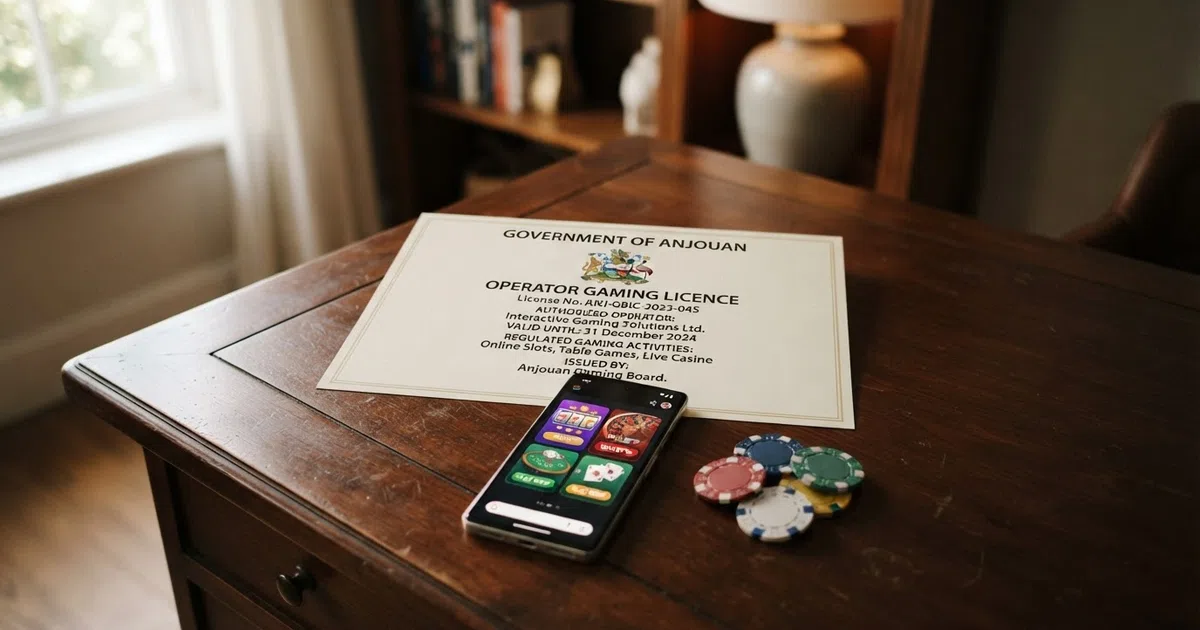
Anjouan-licensed casinos are everywhere in the affiliate listings, but the licence itself is poorly understood by the people it actually affects. The Anjouan Internet Gaming Licence is issued under Act 007 of 2005 by the Anjouan Offshore Financial Authority (AOFA), operating through the Anjouan Betting and Gaming Board (ABGB) — and as the regulator itself has put it, an Anjouan licence is “not, and has never been presented as, a universal authorisation to operate in every country in the world.” The register lists approximately 1,398 active licence holders in mid-2026, up from a handful five years earlier. None of those licence holders is automatically licensed to take bets from customers in Great Britain. The Gambling (Licensing and Advertising) Act 2014 closed that door: any operator serving GB customers needs a UK Gambling Commission licence, regardless of where it is based.
*Current as of September 8, 2026 · Licence claims cross-checked against the Anjouan public register at anjouangaming.com and the UK Gambling Commission’s regulatory publications.*
What Anjouan Casinos Actually Offer UK Players in 2026
How the Anjouan Gaming Licence Works
The Anjouan licence is a commercial permit for internet gambling operators, governed by Act 007 of 2005 and administered by the AOFA through the ABGB. The fee structure alone tells a story: €17,828 for issuance and the same amount for each annual renewal, payable in euros, with non-refundable application fees. Compare that with a UK Gambling Commission remote operating licence, which carries higher capital requirements and a multi-month application process, and the commercial appeal of Anjouan becomes obvious. The cost has made it the default offshore jurisdiction for crypto-first brands and smaller operators who want a regulatory artefact on the wall without committing to the UKGC’s prescriptive rulebook.
What the licence actually requires of an operator is narrower than most players assume. Holders must implement KYC and AML procedures, have their games audited by a certified RNG testing house, disclose game fairness information, and provide access to an Alternative Dispute Resolution (ADR) provider. They must also offer responsible-gambling tools: self-exclusion, deposit limits and reality checks. Beyond that baseline, the AOFA does not prescribe how those tools are implemented or verify that they work as intended. There are no standardised technical specifications, no audit cycle for self-exclusion effectiveness, no mandated player fund segregation, and no spot checks on tool functionality. The Anjouan framework sets a floor. It does not build the house.
The licence also comes with an explicit geographic restriction. Operators are required to geo-block players from the United Kingdom, the United States, France, the Netherlands, Australia, Comoros itself, and any country on the FATF blacklist. In practice, a significant proportion of Anjouan licensees do not enforce those blocks against UK traffic, which is precisely why this article exists. The licence forbids the operator from serving UK customers; many operators serve them anyway.
The Anjouan Casino Landscape: Sites, Crypto and New Entrants
The headline number — roughly 1,398 active licensees — is large enough to be meaningless without context. Five years ago, the same register carried a handful of names. The growth has come overwhelmingly from two directions: crypto-native gambling brands that needed a regulatory wrapper for their token-based operations, and white-label operators launching rapid-fire casino brands from Curaçao, Cyprus or other lightweight jurisdictions and adding Anjouan as a second badge.
Crypto-friendly operators dominate the Anjouan register for structural reasons. Bitcoin, Ethereum and stablecoin deposits sit outside the UKGC’s regulated payment rails, and an Anjouan licence imposes no obligation to integrate with Gamstop or follow UK advertising codes. Brands like Stake, FortuneJack, Rollbit and Bets.io have built their customer base around crypto deposits, and Anjouan gave them a regulator to point to when journalists or affiliates asked the obvious question. The licence does not endorse crypto — it merely tolerates it.
The wave of new entrants is a separate phenomenon. Launching an Anjouan-licensed casino in 2026 is a matter of weeks rather than the months the UKGC process takes, which has produced a steady churn of new brands, some of which will not survive their first year. That churn has consequences for player trust. Player-review aggregators consistently rank older Anjouan operators ahead of newer entrants on payout reliability and complaint handling, which is unsurprising — the operators with time on the register have had time to build (or fail to build) a track record.
There is also a counterfeit problem worth flagging now. ABC News reported in December 2025 on entities issuing fake licence certificates citing AOFA authority, with a former Comoros attorney-general calling one such licensor “an illegal entity.” Yogonet International noted in July 2026 that “a counterfeit problem is growing alongside” the legitimate register. The genuine register at anjouangaming.com allows verification in roughly a minute; a licence number that does not resolve there is not a licence, however official the certificate looks.
How Anjouan Casino Bonuses Compare to UKGC Offers
The headline numbers on Anjouan sites are larger. That is the whole commercial point. A UKGC-licensed operator can offer, at most, a 10× wagering requirement and cannot bundle free spins with a deposit match as a single promotional offer — those rules landed in the LCCP on 19 December 2025. Anjouan operators face neither constraint. Welcome packages of 200%, 250%, even 500% are routine, paired with free-spin counts in the hundreds and wagering multiples that commonly run 30× to 45× across the bonus and the spin winnings separately.
The arithmetic behind the larger headline is what a UK player needs to see. A 500% match with 30× wagering on the bonus funds requires substantial turnover to clear. A 200% match at 40× on deposit plus bonus similarly requires significant volume of play to complete. Those turnovers are not impossible — they are simply larger, and they consume real time at the slot machine. The larger the headline percentage, the more the bonus costs in volume of play, and the less of it a typical session will actually clear.
What the UKGC’s 10× cap buys is not a smaller bonus. It buys a smaller commitment of turnover for the bonus you do take, which means a higher proportion of casual players actually complete the requirement and see any of the bonus money as withdrawable cash. The Anjouan model bets that the headline percentage will draw the deposit, and that most players will not complete the wagering. In a meaningful sense, both regulatory models are designed around the same fact — most players lose the bonus — but the Anjouan model extracts more of the deposit before that fact is reached.
The absence of the mixed-product ban matters in a specific way. UKGC operators cannot legally offer “200% plus 200 free spins” as a single welcome package. Anjouan operators can and do. For a player who values free spins as a feature rather than as serious winning opportunities, the bundled Anjouan offer delivers more entertainment per deposit. For a player who reads the wagering terms carefully, it also delivers more required turnover.
The Anjouan-Licensed Casinos Accepting UK Players: How They Compare
Ten Anjouan-licensed operators accept UK traffic, to a greater or lesser degree, despite the licence’s own geo-blocking requirement. They vary enormously on bonus structure, transparency of terms, and how clearly they disclose the regulatory gap to potential UK customers. The comparison below ranks none of them as “best” in any absolute sense — every one of them is unlicensed for GB, and that fact does not vary. What varies is what each one offers a player who has decided, with eyes open, to play offshore.
The Comparison at a Glance
| Operator | Welcome Bonus | Free Spins | Wagering | Bonus Validity |
|---|---|---|---|---|
| Ybets | 500% up to $8,000 (4 deposits) | 400 (100 per stage) | 30× bonus / 45× FS | 60 days |
| Bets.io | 225% up to 1 BTC (3 deposits) | 225 (20/day release) | 40× bonus + FS | 7 days |
| Rainbet | 250% up to $1,750 (3 deposits) | 60 | 40× (or no-wager option) | 7 days |
| Duel | No welcome bonus | — | 0× on rakeback | N/A |
| Stake | 200% up to $1,000 | Not specified | 40× deposit + bonus | 30 days |
| FortuneJack | 500% FS package + 100% sports freebet | Up to 1,000 | 30×–40× | Per promotion |
| Rollbit | Tiered FS + cashback | 20–50 | 30× FS | 7 days |
| Spinbetter | 150 no-deposit FS + deposit package | 150 + tiered | 20× no-deposit / 35× deposit | 2 / 7 days |
| Betroom24 | Not specified | Not specified | Not specified | Not specified |
| Bet25 | Not specified | Not specified | Not specified | Not specified |
The wagering column is where the comparison does its real work. A 0× wagering on withdrawable cash (Duel’s rakeback) is not in the same category as a 30× requirement on bonus funds, even though both appear as “wagering.” The bonus validity column matters because a 7-day window on a 40× turnover is a very different proposition from a 60-day window on a 30× turnover. Betroom24 and Bet25 carry no bonus data in publicly retrievable form, which is itself information: a player cannot check what they cannot find.
Ybets: A 500% Welcome Package Spread Across Four Deposits
Ybets runs the largest headline match in this set: 500% up to $8,000 plus 400 free spins, distributed across the first four deposits. The first deposit alone delivers 200% plus 100 free spins on Gates of Olympus 1000, with each subsequent stage adding another 100 spins. The wagering structure splits the requirement: 30× on bonus funds and 45× on free-spin winnings, both with a 60-day validity window — generous by Anjouan standards, where 7-day windows are common.
The licence is verifiable on the public register: ALSI-202411003-FI1, held by Sigg Marketing Limited, valid until November 2026. The package is structured to maximise headline value rather than to maximise the chance of clearing. A player taking the full $8,000 in bonus funds faces a turnover of $240,000 at 30×, and the free-spin winnings carry their own 45× cycle. Ybets is best suited to a player who plans to make all four deposits and spread the wagering across the full 60 days. It is poorly suited to a player who deposits once, plays briefly, and expects to withdraw bonus-derived winnings — the wagering will not be completed.
Bets.io: A Crypto-First Bonus With 225 Free Spins
Bets.io denominates its bonus in bitcoin — 225% up to 1 BTC across three deposits, with 225 free spins attached. The first deposit is 100% up to 1 BTC plus 100 spins, and the spins release at a deliberate drip of 20 per day on Olympus TRUEWAYS (a Bgaming title). The wagering requirement is 40× on bonus plus free-spin winnings, with a 7-day validity window — the tightest end of the Anjouan spectrum.
The licence (ALSI-202410047-FI2, TESSERA LIMITED SRL, valid until October 2026) is confirmed on the public register. The 20-spin daily release matters more than it appears. A player who deposits on day one has nine more days of free spins arriving, but only six of those days fall inside the 7-day validity window. The spins arriving on day eight through ten cannot be played under the bonus terms. The combination of crypto denomination, daily-drip free spins and a short validity makes Bets.io a fit for a player who plans to play daily for a week, not for someone whose gambling is occasional.
Rainbet: The Only Reviewed Operator With a No-Wager Option
Rainbet’s structure is unusual enough to deserve attention. The headline is 250% up to $1,750 plus 60 free spins across three deposits, with the first deposit delivering 100% up to $700 and 20 spins on Sweet Bonanza. The wagering is 40× on the combined deposit and bonus if the player chooses the wager-locked track. If the player does not, Rainbet offers a no-wager gradual-release alternative, in which bonus funds unlock incrementally as wagering completes at a much lower effective rate. The validity is 7 days for the wager-locked option.
The licence is ALSI-152406029-FI2, RBGAMING N.V., valid until June 2026. The no-wager track changes the comparison materially. A player who would otherwise reject Rainbet because the 40× requirement is too steep has an alternative path that delivers less bonus but with no clearing hurdle. For a player who values certainty over headline percentage, Rainbet’s no-wager option is the strongest offer in this set. Those who prefer maximum bonus value, however, may still find the standard wager-locked track preferable.
Duel Casino: Zero Bonuses, 50% Instant Rakeback Instead
Duel has built its entire proposition on rejecting the bonus model. There is no welcome deposit bonus, no free spins, and no wagering — because there is no bonus. Instead, Duel pays 50% instant rakeback on slots and 80% on its in-house Duel Blackjack, credited as real withdrawable cash. The rakeback carries zero wagering. The site publishes a “Why Bonuses Suck” page explaining the anti-bonus stance as a deliberate strategy: the argument is that bonuses impose wagering requirements the average player does not clear, while rakeback returns money on every spin regardless of outcome.
The licence (ALSI-202411026-FI1, Immortal Snail LLC, valid until November 2026) is confirmed. The 80% blackjack rakeback is the standout figure in the set, but blackjack contributes a small share of most players’ volume. The slots rakeback at 50% is comparable to loyalty programmes at GB-licensed operators — except at Duel it begins from the first spin rather than after a tier climb. For a player who plays slots regularly and is willing to forgo the headline bonus for steady cash return, Duel is the most economically rational offer here. The lack of a bonus will be a non-starter for those seeking to maximize their initial bankroll.
Stake: The High-Profile Crypto Casino Operating Under an Anjouan Licence
Stake is the most recognised brand in this review by a considerable margin. Its Anjouan licence places it in the same regulatory category as far smaller operators — and that is the point worth understanding. A licence that treats Stake and a white-label start-up identically is not making claims about player protection that scale with operator size. The welcome offer is 200% up to $1,000 on the first deposit, with 40× wagering on deposit plus bonus and a 30-day validity.
Stake’s licence is listed in the Sharkbetting Atlas tracker (score 75), which is the highest among the operators in this set confirmed via that source rather than direct register retrieval. The brand recognition brings reputational protection that smaller operators do not have, but it does not bring UKGC-style regulatory protection. A UK player at Stake has the same gap in fund segregation, the same absence of GAMSTOP coverage, and the same lack of UKGC complaints route as a UK player at any other Anjouan-licensed brand. The 30-day validity is on the longer end of the Anjouan spectrum, which is a genuine practical advantage for a player who will not complete the wagering in a week.
FortuneJack: Up to 1,000 Free Spins on First Deposit
FortuneJack’s offer is structured around free spins rather than a deposit match. Up to 1,000 free spins on the first deposit, valued at 100% of the deposit as spins, plus a 500% free-spin package across multiple deposits and a 100% sports freebet. Wagering is 30× to 40× depending on the specific promotion, with some cashback rewards carrying no wagering at all. The minimum deposit is $20 or 0.002 BTC.
The licence is confirmed via Sharkbetting Atlas (score 34). The headline spin count is enormous, but its real-world value depends on the per-spin stake and the games attached. A thousand spins at a low per-spin stake on a single title is not equivalent to a thousand spins distributed across a curated selection. The cashback-without-wagering component is the genuinely valuable part of FortuneJack’s offer — it provides a hedge against early losses without imposing a clearing requirement. Crypto depositors starting at the $20 minimum will likely find the effective value reasonable, whereas high-stakes players may struggle with the associated wagering load.
Rollbit: Tiered Free Spins and First-Deposit Loss Cashback
Rollbit scales its free-spin count with the first deposit: 20 spins for a £10–£29 deposit, rising to 50 spins for £50 or more. The headline welcome is the free spins plus up to £100 cashback on first-deposit losses, with 30× wagering on free-spin winnings and a 7-day validity. Total winnings from the bonus are capped at 4× the original deposit — a meaningful ceiling that limits upside.
The licence is confirmed via Sharkbetting Atlas (score 51). The cashback structure is the differentiator: a player who loses their first deposit gets up to £100 back, which softens the cost of a session that goes wrong. The 4× winnings cap is the constraint — a player who hits a large win on a bonus spin sees it truncated. Rollbit fits a player making a modest first deposit who values the loss cushion over the ceiling on upside. A high-deposit player will find the cap restrictive relative to other operators in the set.
Spinbetter: The Only Reviewed Operator With a No-Deposit Free-Spin Offer
Spinbetter is the only reviewed operator offering 150 free spins with no deposit required, on Book of Wealth III. The terms are the tightest in this set: 20× wagering on no-deposit free-spin winnings, with a 2-day validity window. The deposit welcome package is a four-tier structure with match bonuses and additional free spins, at 35× wagering and 7-day validity.
The licence is confirmed via Sharkbetting Atlas (score 20 — the lowest among the ten operators in the Sharkbetting-confirmed set). The no-deposit free spins are an unusual offer for a UK audience accustomed to UKGC sites, where no-deposit bonuses carry similar wagering but tighter game eligibility. The 2-day window is the practical catch: a player must register, verify, deposit (if choosing the deposit package) and complete the wagering inside 48 hours to extract any value from the no-deposit spins. Spinbetter fits a player who wants to test a casino without committing funds and is willing to play intensely for two days.
Betroom24: An Anjouan-Licensed Operator With Limited Public Offer Data
Betroom24 is confirmed as Anjouan-licensed via the Sharkbetting Atlas tracker (score 38). Welcome bonus, free-spin count, wagering requirement and bonus validity were not specified in the sources retrieved for this review. The absence of publicly retrievable bonus data is itself a signal — it does not mean the bonus is poor, but it does mean a player cannot evaluate it before depositing. A UK player evaluating Betroom24 would need to register and inspect the current promotions page directly before deciding whether to deposit. The licence status, at least, is verifiable through the Sharkbetting tracker rather than being unconfirmed.
Bet25: A New Entrant With a 2026 Anjouan Licence
Bet25 holds Anjouan licence ALSI-202505001-FI1, issued in 2025 to Horns and Hooves Company S.A. and verifiable on the public register. As with Betroom24, welcome bonus, free-spin count, wagering requirement and bonus validity were not specified in the sources retrieved for this review. The licence is newer than most in the set, which means a player evaluating Bet25 is assessing an operator with limited public track record. The licence is genuine; the offer terms are not publicly documented at the time of review.
Best by Feature: Where Each Operator Stands Out
Grouping by what each operator does best cuts across the ranking more usefully than any single ordering. Ybets carries the largest headline match at 500%. Duel carries the lowest effective wagering — at zero, on withdrawable cash. Spinbetter is the only reviewed operator with a no-deposit free-spin offer, and Rainbet is the only one offering a no-wager bonus track alongside its standard wager-locked structure. FortuneJack carries the highest free-spin count, at up to 1,000 on first deposit. Stake carries the highest brand recognition in this regulatory category. Rollbit is the only operator whose welcome package includes first-deposit loss cashback as a standard feature. Each of these positions is defensible on its own terms. None of them changes the underlying fact that every operator here is unlicensed for GB.
Why an Anjouan Licence Leaves UK Players With Fewer Protections
The Legal Reality: What UK Law Says About Offshore Casinos
The Gambling (Licensing and Advertising) Act 2014 established the point-of-consumption rule: any operator providing gambling facilities to customers in Great Britain requires a UK Gambling Commission licence, regardless of where the operator is based. The Anjouan licence does not satisfy this requirement. The relevant criminal offence sits in section 33 of the Gambling Act 2005 — providing facilities for gambling without the required licence is punishable by up to 51 weeks’ imprisonment, an unlimited fine, or both. The liability falls on the operator, not on the player. No sanction traced in this review targets a player who merely gambles on an unlicensed site.
What the player loses is protection, not liberty. There is no GAMSTOP coverage at an Anjouan-licensed site, because GAMSTOP participation is mandatory only for GB-licensed online operators. There is no UKGC complaints route, because the UKGC has no jurisdiction over an operator it has not licensed. There is no approved ADR provider within the UKGC framework, and there is no British consumer redress if the operator withholds funds. The player who has a dispute with an Anjouan casino is dependent on the casino’s own dispute resolution process — or, in practice, on the goodwill of the operator.
This is the core trade-off. The Anjouan licence is cheaper for the operator, less prescriptive on bonus terms, and unburdened by the UKGC’s stake caps and wagering limits. In exchange, the UK player at an Anjouan site has fewer places to turn when something goes wrong. The decision to play offshore is a decision to accept that gap. Players who have self-excluded via GAMSTOP and are considering an Anjouan site need to understand that the GAMSTOP exclusion does not extend there — a UKGC-mandated exclusion applies to UKGC-licensed operators only.
Anjouan vs the UK Gambling Commission: A Protection Gap
| Protection Feature | Anjouan Standard | UKGC Standard |
|---|---|---|
| Self-exclusion | Per-operator request, no cross-operator register | GAMSTOP, mandatory for all GB-licensed online operators |
| Player fund segregation | Not mandated | Required under LCCP |
| Wagering cap | No statutory cap; operator-set, commonly 30×–45× | 10× maximum from 19 December 2025 |
| Stake limits | No statutory cap on online slots | £5 (25+), £2 (18–24) per game cycle |
| Mixed-product bonuses | Permitted | Banned from 19 December 2025 |
| ADR | Operator-provided, not UKGC-approved | UKGC-approved ADR provider required |
| Responsible-gambling tool verification | Tools required, no standardised implementation or spot checks | LCCP Social Responsibility codes, enforced |
The table is a fair comparison of what each framework requires, not a moral judgement. The Anjouan framework requires the responsible-gambling tools to exist. It does not require them to work in any standardised way, and it does not audit their effectiveness. The UKGC framework prescribes how each tool must function, audits compliance, and ties the operating licence to continued adherence. A player who relies on self-exclusion as a safety measure needs the tool to actually exclude them across every site they might visit. Anjouan offers per-operator exclusion only — excluding at one Anjouan site leaves access open at every other.
The stake cap gap is similarly structural. A 25-year-old UKGC player cannot legally stake more than £5 per spin on an online slot. The same player at an Anjouan-licensed casino faces no such cap. The 10× wagering cap has the same shape: it does not ban bonuses, but it caps the clearing burden. Anjouan offers routinely require 30×, 40×, even 45× turnover, which is a quantitatively different commitment of play.
How to Verify an Anjouan Licence Is Genuine
The genuine Anjouan register is at anjouangaming.com/public-register/, and a licence number in the ALSI format resolves against it in roughly a minute. The licence number itself follows the format ALSI- followed by a year identifier, a sequence number, and an issuer code. A licence that does not resolve on the register is not a licence, however professional the certificate document looks.

Verification matters because the counterfeit problem is real. ABC News reported in December 2025 on entities issuing fake certificates citing AOFA authority, with a former Comoros attorney-general calling one such licensor “an illegal entity.” Yogonet International’s July 2026 coverage noted that “a counterfeit problem is growing alongside” the legitimate register. The certificates look official — they carry seals, they cite the AOFA by name, they use the ALSI number format. They are not in the register.
The verification step does not establish GB authorisation. A genuine Anjouan licence still does not satisfy the point-of-consumption requirement. The two checks are independent: the Anjouan register confirms the operator holds an Anjouan licence; only a UKGC operating licence confirms the operator is authorised to take GB customers. No Anjouan-licensed operator reviewed here holds the latter.
What UK Enforcement Actually Does — and What It Cannot Do
The UKGC’s enforcement model is disruption, not blocking. Between April 2024 and June 2025, the Commission issued 3,140 disruption notices to illegal operators, referred 447,778 URLs to search engines for delisting, and saw 287,961 URLs removed as a result. The model works by making offshore sites harder to find through search and harder to process payments through UK-facing infrastructure. It does not currently extend to statutory ISP or DNS blocking — that power has been proposed in legislation but not enacted.
The practical consequence for a UK player is that an Anjouan-licensed casino accepting GB traffic may be harder to locate than a UKGC-licensed equivalent, but it is not inaccessible. A player who actively seeks out an offshore site can generally find it, register, deposit, and play. The enforcement apparatus targets the discoverability of the site, not the player’s ability to use it. A self-excluded UK player who is considering whether to circumvent their GAMSTOP exclusion by moving to an offshore site should understand that the offshore site is the path of least resistance, and that the UKGC has no technical mechanism to prevent access.
The Tax and Levy Drivers Pushing Players Offshore
The Remote Gaming Duty rise from 21% to 40% from 1 April 2026, under section 86 of the Finance Act 2026, is the largest single tax shift in the GB online casino market in over a decade. It is not the only one. The statutory levy at 1.1% of gross gambling yield for remote casino licences has been in force since 6 April 2025, replacing voluntary contributions, with proceeds split 50% treatment, 30% prevention, 20% research. An onshore UKGC operator pays 40% duty plus 1.1% levy on the same gross yield that an Anjouan operator pays nothing on.
Industry analysts described the RGD increase as a “significant headwind” for onshore operators and a contributor to player migration offshore. The mechanism is straightforward: an operator paying 41.1% of yield to the UK exchequer cannot match the bonus headline of one paying 0%. The gap shows up in welcome packages, in promotional frequency, and in the rakeback and cashback rates available to active players. A UK player comparing offers at a UKGC site against offers at an Anjouan site is not comparing like-for-like on the operator side — the Anjouan operator has structurally more to spend on customer acquisition.
Players do not pay UK tax on gambling winnings, so the duty does not affect the player directly. It affects the offers available to the player, because the operators competing for those offers are paying very different tax rates.
Responsible Gambling Without GAMSTOP: What UK Players Lose
The Tools Anjouan Casinos Offer — and What Is Missing
Anjouan-licensed operators are required to offer self-exclusion, deposit limits, and reality checks. They are not required to implement those tools to any standard specification, and they are not subject to spot checks verifying that the tools function as described. The difference is not academic. A self-exclusion that can be lifted by customer support after a phone call is a different product from a GAMSTOP exclusion that runs for a minimum of six months and cannot be cancelled early. A deposit limit that defaults to a high ceiling and is reset on request is a different product from a UKGC-prescribed limit with equal-prominence rules and immediate-action decreases.
A UK player who has used responsible-gambling tools at a UKGC site — and has come to expect that the tools work in a particular way — needs to understand that Anjouan tools are operator-implemented rather than regulator-prescribed. The labels are the same. The behaviour underneath may not be.
The cross-operator gap is the structural one. GAMSTOP exclusion covers every GB-licensed online operator simultaneously. Excluding at one Anjouan site leaves access open at every other Anjouan site, every Curaçao-licensed site, and every other offshore site not in the GAMSTOP database. For a player who has decided to stop gambling, relying on individual site exclusions is rarely a sufficient safeguard against relapse.
UK Help Resources That Work Regardless of Where You Play
The UK’s safer-gambling infrastructure does not check the casino’s licence before providing help. The National Gambling Helpline, run by GamCare, is free on 0808 8020 133, available 24 hours a day, 7 days a week. Callers can also use live chat, WhatsApp and email. GamCare’s January 2026 data shows 996 referrals to treatment and peer-based support — a 48% increase from the 674 referrals in January 2025. Of contacts to the helpline, 81.5% disclosed online forms of gambling as the primary concern, the highest proportion on record.
The NHS runs a network of specialist gambling treatment clinics: the National Problem Gambling Clinic in London, the Northern Gambling Service, the Southern Gambling Service, and the Primary Care Gambling Service covering the rest of England. GamCare and GambleAware fund treatment and prevention through the National Gambling Support Network. Gamblers Anonymous runs peer-support meetings across the country. NHS prevalence data (Health Survey for England 2024) puts 5% of adults at PGSI 1 or above (low-risk, moderate-risk or problem gambling) and under 1% at PGSI 8 or above (problem gambling). The help infrastructure exists, it is funded, and it does not require the caller to be gambling at a UKGC-licensed site.
GAMSTOP and Why It Cannot Cover Anjouan-Licensed Sites
GAMSTOP is the national multi-operator online self-exclusion scheme for Great Britain. Participation has been a mandatory condition of every GB-licensed online operating licence since 31 March 2020. The exclusion periods offered are six months, one year, five years, or five years with auto-renewal. An exclusion cannot be cancelled early — the minimum commitment is six months.
GAMSTOP cannot cover Anjouan-licensed operators because the technical integration is conditional on holding a UKGC operating licence. Anjouan licensees hold no such licence. They have no regulatory obligation to integrate, no technical requirement to check the GAMSTOP database, and no commercial incentive to do so. A UK player who has self-excluded via GAMSTOP will be blocked at every GB-licensed online casino, but will not be blocked at any Anjouan-licensed site, any Curaçao-licensed site, or any other unlicensed offshore operator. The exclusion stops at the regulatory boundary.
This is the most concrete protection gap. A self-excluded player who moves offshore is not evading a technical block — they are simply leaving the jurisdiction where the technical block exists.
How We Evaluated These Anjouan-Licensed Casinos
The review drew on the Anjouan public register, individual operator terms pages, the Sharkbetting Atlas licence tracker, UK Gambling Commission regulatory publications, and GamCare and NHS safer-gambling data. Licence numbers for five operators — Ybets, Bets.io, Rainbet, Duel and Bet25 — were cross-checked against the Anjouan public register at anjouangaming.com and confirmed as live. Licence status for the remaining five — Stake, FortuneJack, Rollbit, Spinbetter and Betroom24 — was confirmed via the Sharkbetting Atlas tracker, which is a third-party licence-tracking source rather than the regulator’s own register. No licence number was individually retrieved for those five in this run.
The criteria that ordered the comparison were licence verifiability, bonus terms transparency, wagering burden, and the completeness of publicly available offer data. Where bonus terms were not retrievable in publicly accessible sources — as for Betroom24 and Bet25 — the absence is noted rather than estimated. The review is not a ranking of “best casino.” Every operator is unlicensed for GB. The ordering reflects what each operator offers, not whether it should be patronised.
The limitations are worth stating. Some bonus data was not retrievable at the time of review, and the data that was retrievable reflects the promotions pages of each operator as they appeared during research. Operators change welcome packages frequently, and the terms current at the moment a reader visits an operator may differ from what is summarised here. Checking the live promotions page before depositing is a sensible precaution regardless of which operator is being considered.
Before You Play at an Anjouan Casino: What Every UK Player Should Know
The central finding is simple and worth stating plainly: Anjouan-licensed casinos are unlicensed for GB, and none of the UKGC’s mandatory player safeguards applies at them. No GAMSTOP coverage, no UKGC complaints route, no statutory stake cap, no guaranteed fund segregation, no British consumer redress if a payout is withheld. The Anjouan licence is a commercial permit for the operator; it is not a player protection regime.
The real-world consequence is that a UK player who chooses to play offshore is the layer of protection between themselves and the operator. Disputes go to the operator’s own ADR, not to a UKGC-approved body. Self-exclusion must be set up separately at every operator, and there is no cross-operator register to enforce it. The deposit limits, reality checks and self-exclusion tools exist because the licence requires them, not because a regulator has verified that they work as labelled.
What a UK player should check before depositing at any offshore casino: whether the licence number resolves on the Anjouan public register (roughly one minute at anjouangaming.com); what the bonus wagering requirement is and how long it must be cleared in; whether the operator publishes a real payout time rather than a marketing range; whether the responsible-gambling tools behave as the help pages describe. The National Gambling Helpline (0808 8020 133, free, 24/7) and the NHS treatment clinic network are available to any player regardless of where they gamble. GAMSTOP is the right exclusion route for anyone who wants to stop gambling at UKGC-licensed sites, and it does not extend offshore.
The judgement: the headline numbers are larger offshore, and the protection gap is real. A player who has weighed both and decided to play offshore has made a defensible choice, but it is a choice made with full knowledge of what is being given up. A player who has not weighed both is gambling on the marketing rather than the terms.
Frequently Asked Questions
Who issues the Anjouan casino licence and what does it actually cover?
The Anjouan Internet Gaming Licence is issued under Act 007 of 2005 by the Anjouan Offshore Financial Authority (AOFA) and administered through the Anjouan Betting and Gaming Board (ABGB). It covers KYC and AML procedures, certified RNG, ADR access, and the provision of self-exclusion, deposit limits and reality checks. It does not cover UKGC-equivalent player fund segregation, standardised responsible-gambling implementation or cross-operator self-exclusion.
Can a UK player legally gamble at an Anjouan-licensed casino?
Online casino is licensable in GB, but only by the UK Gambling Commission. The Gambling (Licensing and Advertising) Act 2014 requires any operator serving GB customers to hold a UKGC licence regardless of where it is based. An Anjouan licence does not satisfy this requirement. The player who gambles at an unlicensed offshore site is not the subject of a criminal sanction under current UK law, but is operating outside the UKGC’s protection framework.
What can a UK player do if an Anjouan casino refuses to pay out winnings?
The UKGC complaints route is not available, because the UKGC has no jurisdiction over operators it has not licensed. The player is dependent on the operator’s own ADR process and, in practice, on the operator’s goodwill. There is no British consumer redress mechanism that applies to a casino licensed only by Anjouan. Pre-deposit verification of payout times and terms is the practical safeguard.
Are Anjouan casinos covered by GAMSTOP?
No. GAMSTOP participation is mandatory only for GB-licensed online operators, and Anjouan licensees hold no UKGC licence. A GAMSTOP self-exclusion blocks access at every UKGC-licensed online casino in Great Britain but does not extend to Anjouan-licensed sites, Curaçao-licensed sites or other offshore operators. The exclusion stops at the regulatory boundary.
Can Anjouan casinos legally accept cryptocurrency from UK players?
Anjouan does not prohibit cryptocurrency deposits, and crypto-friendly operators dominate the Anjouan register. From the UK side, no statute traced in this review specifically prohibits a UK player from depositing crypto at an offshore casino, but the underlying gambling activity remains unlicensed for GB. Crypto deposits also bypass UK payment-rail protections that apply to debit card and bank transfer transactions.
How do I tell a genuine Anjouan licence from a counterfeit?
Genuine Anjouan licences resolve on the public register at anjouangaming.com/public-register/, typically within a minute. A licence number in the ALSI format that does not resolve on the register is not genuine, however official the certificate document appears. The genuine register coexists with counterfeit certificates citing AOFA authority, and verification is the only reliable check.
Licence – nonukgc-licensedcasinos
Content created by the «nonukgc-licensedcasinos» team