
The Best Video Slots in the UK Right Now — Data, Casinos and What the Rules Actually Cost You
 Available in GB
£773 million of gross gambling yield in a single quarter, generated by 25.1 billion spins across 4.8 million average monthly active accounts. That is the size of the UK online slots market at the start of 2026, and it is the most heavily regulated slots market anywhere in the world. Every spin is governed by rules most players will never read: a £5 maximum stake for adults 25 and over, a 10× cap on bonus wagering, a mandatory 2.5-second minimum between spins, and a session display that forces the operator to show you the damage in real time. This page is the analysis of what that market actually offers, the data behind the titles, and what the welcome bonuses cost once the small print stops being small.

Data current as of September 8, 2026 and verified against the UK Gambling Commission’s public register of licence holders.
What Makes a Video Slot Worth Your Time in 2026
A video slot is a five-reel digital slot machine with no mechanical parts, animated paylines, bonus rounds and usually a soundtrack that would have been illegal in a 1990s arcade. The original one-armed bandit was three reels, one payline and the lever. A modern video slot is five reels (sometimes six, occasionally seven), dozens or thousands of paylines, free-spin rounds, expanding symbols, multipliers, gamble features and, in some titles, a bonus-buy button that lets you pay to skip straight to the feature. The shift from physical reels to software happened in the late 1990s and the UK market has been digital-only for years; every slot you can play in a British licensed casino today is a video slot in this technical sense.
From One-Armed Bandits to 5-Reel Video Slots
The mechanical slot ran on a fixed set of physical stops, which is why classic three-reel games had a hard ceiling on combinations and a relatively transparent return structure. Software does not carry that limit. A five-reel video slot is a random number generator producing a fresh outcome on every spin, mapped to symbols on a virtual reel, with paylines determined by the game’s design rather than by the physical layout of the cabinet. The visible difference is animation and themes. The structural difference is the maths: thousands of possible outcomes per spin instead of a few hundred, which is what allows modern games to layer in free-spin rounds, expanding symbols, cluster pays and the other mechanics that now define the category.
The UK market is enormous. The UK Gambling Commission’s operator data for the first quarter of 2026 records £773 million in gross gambling yield from online slots, a 12% year-on-year rise, generated by 25.1 billion spins across an average of 4.8 million monthly active accounts. To put that in human terms: the average UK slot account spins the reels roughly 1,740 times a month, or around 58 times a day. The product is not a niche.
The Slot Titles UK Players Rate Above All Others
Four titles dominate the conversation whenever UK players compare the best video slots. All four are available at every casino reviewed below, all four have been on the market long enough for their return data to be stable, and all four illustrate a point the rest of this section is going to keep making: the headline number on a slot’s paytable is not the only number that matters.
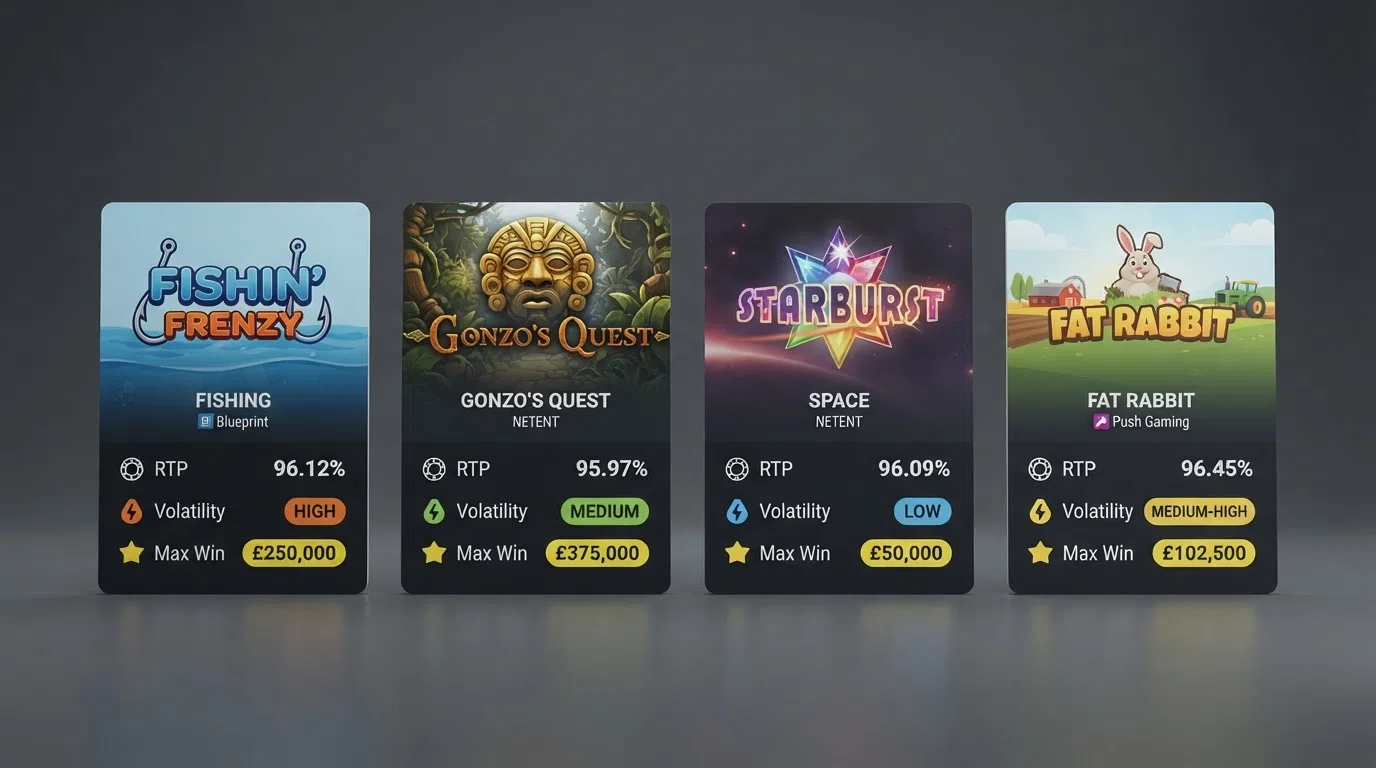
| Slot Title | Provider | RTP (Headline) | Volatility | Max Win |
|---|---|---|---|---|
| Big Bass Bonanza | Pragmatic Play | 96.71% | High | 2,100× |
| Book of Dead | Play’n GO | 96.21% | High | 5,000× |
| Starburst | NetEnt | 96.09% | Low-to-medium | 800× |
| AgroCulture | Relax Gaming | 96.1% | Medium | 10,000× |
The first thing to notice is how close the four headline RTPs are: 96.71%, 96.21%, 96.09%, 96.1%. Within a range of 0.62 percentage points sits a £100 average loss difference of 62p per £100 wagered, which is not the variable that decides whether a session is fun or ruinous. What separates the four is volatility and max win. Book of Dead offers five times the maximum payout of Starburst and a higher volatility profile, which is the technical way of saying the wins come less often and the dry spells are longer. Starburst’s 800× ceiling is modest by modern standards but the slot pays out small amounts far more regularly. Big Bass Bonanza and AgroCulture sit in different places on the same spectrum: Bonanza for a high-volatility fishing trip, AgroCulture as a medium-volatility recent release with a 10,000× ceiling that puts it in a different weight class.
The second thing to notice is what research has done to those headlines. Book of Dead has five configurations spanning 96.21% down to 84.18%, and the version you actually play depends on which configuration your casino has chosen to run. Starburst ships in six configurations from 96.09% to 90.05%. Big Bass Bonanza drops to 95.67% and 94.02% at the lower end. The published number on a review site is the top of a range, not a fixed property of the game. A player who has read about a 96.21% Book of Dead may be sitting at an 84.18% Book of Dead, and there is no on-screen indicator of which configuration is loaded. The only honest thing to say is that the headline is what the provider offers, the casino chooses which configuration to ship, and the version you get may return meaningfully less.
How to Actually Play a Video Slot (and What You Can No Longer Do)
The mechanics of a video slot session are simpler than the surrounding vocabulary. You set a stake per spin, you press the button, the reels settle, and any win is paid according to the paytable. The post-2021 UK rulebook makes a few things that used to be standard no longer legal. Auto-play is banned: every spin has to be a deliberate button press. The minimum spin speed is 2.5 seconds, measured as a game cycle from initiation to outcome, which means turbo mode is gone. Features that disguise a net loss as a win are banned, so the slot can no longer celebrate a return of 80% of your stake with flashing lights and a fanfare. Reverse withdrawals are banned permanently, so once you ask for your money back, the request stands.
The paytable is the slot’s own rules page and it tells you what each symbol pays, how the free-spin feature triggers, what the wild does and what the bonus round pays. Read it once before you stake. The session display is the operator’s obligation: every UK-licensed casino has to show you total losses, total wins and time played during your session, and the display has to be visible without you going looking for it. That is the closest thing the regulator has mandated to a real-time statement of what the game is costing you.
The stake you can put in is capped. A game cycle starts with the initiation of a spin and ends when all staked money is lost or all winnings delivered; the £5 statutory cap (for adults 25 and over) applies to total staked within that cycle, which means even a £0.10 spin on ten paylines is fine because the cap is on the total amount at risk, not on the per-line value. The cap drops to £2 for players aged 18 to 24. Both limits have been in force since 2025, imposed by SI 2025/215.
The Slot Types and Features That Change Your Odds
The format of a video slot shapes the experience more than the theme does. A standard five-reel slot with 20 or 25 fixed paylines is the most common layout and the one most UK players cut their teeth on. A Megaways slot, by contrast, randomises the number of symbols on each reel on every spin, producing anything from a few hundred to 117,649 ways to win on a single game cycle. The volatility of a Megaways slot is almost always high, because the maths engine has to balance the rare mega-payouts with frequent dead spins. Cluster pays slots pay when symbols touch rather than landing on defined lines; cascading reels remove winning symbols and drop new ones in, allowing chain reactions on a single paid spin.
Inside the game itself, wild symbols substitute for others, multipliers amplify wins, expanding symbols stretch across reels during free-spin rounds and gamble features let you risk a win on a coin-flip or card-draw for the chance to double or quadruple it. A bonus buy is a paid shortcut into the game’s main feature: instead of waiting for the free-spin round to trigger, you pay a multiple of your stake (often 50× to 100×) to enter it directly. In the UK, the bonus buy is constrained by the £5 or £2 stake cap, so the entry price to a feature that would cost £500 elsewhere runs at £5 here. That is one of the more interesting unintended consequences of the stake cap: the bonus buy is now a flat-price ticket rather than a stake-scaled one, and the games still let you buy it.
Playing Video Slots for Real Money: What Changes
Free play and real-money play use the same software, the same random number generator and the same return structure. The difference is the stake cap, the deposit limit and the identity verification. Free play is unrestricted on configuration, and bonus features trigger at the same frequency in demo as in real play. Real-money play has all of the safer-gambling architecture attached: the deposit-limit prompt before your first deposit, the session display, the GAMSTOP registration, the £150 financial vulnerability check that fires when your rolling 30-day net deposits pass £150. None of this changes the maths of the slot. It changes the shape of the session by forcing the operator to surface the cost while you are still incurring it.
A £5 minimum deposit is the practical floor at most GB-licensed casinos. A £5 maximum stake on a 96% slot gives you a long session for a small outlay: 1,000 spins at the cap, returning 96% on average, costs you £200 in expected loss and takes the best part of an hour at the regulated 2.5-second minimum spin speed. That is the real-money unit of account on the UK market in 2026: about an hour of play, costing around £200 in expected value, for a top-end payout of 2,100× to 10,000× your stake depending on the title.
Progressive Jackpots: When One Spin Can Change Everything
A progressive jackpot accumulates a portion of every stake across a network of casinos, feeding a single prize pool that pays out on a trigger condition, usually a symbol combination or a randomly awarded jackpot round. A standalone progressive runs only on one casino’s deployment of the game; a pooled progressive links every casino carrying the same game into one prize. Mega Moolah, Age of the Gods and the Mega Jackpots network are pooled. The base-game return on a progressive slot is typically lower than on a non-progressive slot of similar quality, because a slice of every spin is being diverted to fund the pool.
The maths of chasing one on a £5 cap is straightforward. A 2,100× max win on Big Bass Bonanza is £10,500 at the stake ceiling. A pooled progressive that has climbed to seven figures is mathematically attractive on a per-spin basis, but the odds of triggering it are tiny and the base game is paying less to fund the pool. The honest framing is that progressive slots are entertainment products where the entry ticket is small and the prize is large, and the expected loss per spin is what it is on every other slot. The dream of a £5 spin changing your life is not a strategy; it is a price of admission.
The UK-Licensed Casinos Worth Playing At
Every casino on this list holds an active GB operating licence on the UK Gambling Commission’s public register, which was last updated on 29 July 2026. The ranking is built on the quality and transparency of each operator’s video-slots welcome offer, with particular weight on whether the offer carries a no-deposit leg, what the wagering requirement is, and whether the small print buries a cashout cap. A 0× wagering offer outranks a 10× wagering offer of the same headline value, because the 0× offer returns the winnings as cash and the 10× offer puts them through a turnover requirement that has to clear before withdrawal.

| Casino | GB Licence Status | Welcome Bonus | Free Spins | Wagering | Key Providers |
|---|---|---|---|---|---|
| Sky Vegas | Active (Bonne Terre Ltd, 67370) | 50 no-deposit + 200 on deposit | 250 total | 0× | NetEnt, Pragmatic Play, Play’n GO, BTG |
| Bet365 Casino | Active (Hillside ENC, 38721, 17 Oct 2019) | Up to 500 spins on deposit | Up to 500 | 1× | NetEnt, Pragmatic, Play’n GO, exclusive slots |
| Betfred Casino | Active (Petfre (Gibraltar) Ltd, 39544) | Stake £10, get 200 spins | 200 | 0× | NetEnt, Pragmatic, Play’n GO, Blueprint, Red Tiger |
| Paddy Power Games | Active (PPB Entertainment, Flutter) | 50 no-deposit + 100 on deposit | 150 total | 0× | NetEnt, Pragmatic, Play’n GO, Blueprint, Red Tiger |
| William Hill Vegas | Active (WH Organization Ltd, 2752) | Deposit & stake £10, 200 spins Big Bass Splash | 200 | 10× | NetEnt, Pragmatic, Play’n GO, Blueprint, Red Tiger |
| Coral Casino | Active (LC International, Entain) | Bet £10, get 100 spins | 100 | 10× | NetEnt, Pragmatic, Play’n GO, Blueprint, Red Tiger |
| Betfair Casino | Active (PPB Entertainment, Flutter) | Free spins, no wagering | Not specified | 0× | NetEnt, Pragmatic, Play’n GO, Blueprint, Red Tiger |
| Ladbrokes Casino | Active (Ladbrokes Betting & Gaming, 1611, 1 Nov 2014) | Not surfaced | — | — | NetEnt, Pragmatic, Play’n GO, Blueprint, Evolution |
| 888 Casino | Active (888 UK Ltd, 39028, 1 Nov 2014) | Not surfaced | — | — | NetEnt, Pragmatic, Play’n GO, Blueprint, Red Tiger, exclusive 888 |
| Virgin Games | Active (Virgin Bet Ltd, 54310, 21 May 2019) | Not surfaced | — | — | NetEnt, Pragmatic, Play’n GO, Blueprint, Red Tiger |
The two top-of-table offers that justify their ranking are Sky Vegas and Paddy Power, because both carry a genuine no-deposit leg: 50 spins that credit to a new account without any money changing hands. Most welcome offers on the UK market require a £10 deposit to release anything; a no-deposit spin is a small thing in headline terms but a meaningful one in practice, because it lets a player try the casino’s software and game selection before committing. The wagering column is the other separator. Five of the ten offer 0× wagering on free-spin winnings, which means the moment a spin wins, the money is cash and can be withdrawn. The two 10× offers, William Hill and Coral, are the only ones in the set where free-spin winnings have to be re-wagered before withdrawal.
Ladbrokes, 888 and Virgin Games are listed on the UKGC register and verified as active, but their slot-specific welcome-bonus terms were not surfaced at the time of review. They are not uncompetitive; the data simply was not available to rank them. A player comparing offers should check each operator’s current promotion page before signing up, because the small print on a bonus is the only document that tells you what the headline is actually worth.
Sky Vegas
Sky Vegas runs the cleanest no-deposit offer in this set: 50 free spins credit to a new account without a deposit, and a further 200 spins arrive once the player has deposited and wagered £10. Both legs carry 0× wagering, which means every winning spin pays out as withdrawable cash, not as bonus money. The spins are worth £0.10 each and run on selected games; the seven-day expiry from credit is the only meaningful constraint, and seven days is a reasonable window for a player who knows the offer is there. The operator is licensed under Bonne Terre Limited (account 67370), part of the Flutter group. It currently stands as the most robust choice for a no-deposit entry point on the UK market.
Bet365 Casino
Bet365 is the biggest name in British betting and the casino arm carries the weight of the parent brand. The headline offer is up to 500 free spins on deposit, with 1× wagering on spin winnings, a £5 minimum deposit and access to exclusive bet365-designed slots alongside the NetEnt, Pragmatic Play and Play’n GO library. The licence has been active since 17 October 2019 under Hillside (UK Gaming) ENC (account 38721). The 500-spin headline is large but the 1× wagering layer is real, unlike a 0× offer where winnings are cash immediately. The 500-spin ceiling is the most generous in this set by raw count, and for a player with a longer session in mind the bet365 library is the deepest.
Betfred Casino
Betfred’s offer is the simplest of the high-quality ones: stake £10 and receive 200 free spins with 0× wagering, so the winnings are cash as soon as the spin lands. The provider roster covers NetEnt, Pragmatic Play, Play’n GO, Blueprint and Red Tiger, which is the standard UK premium set. The operator is licensed under Petfre (Gibraltar) Limited (account 39544). Betfred delivers a straightforward no-wagering experience for deposit-based players; however, those specifically hunting for exclusive game content may find other libraries more accommodating.
Paddy Power Games
Paddy Power matches Sky Vegas on the structure that matters: 50 spins with no deposit, then a further 100 spins on a £10 deposit-and-bet, and 0× wagering across the lot. Seven-day validity from credit is the only window. The licence is held under PPB Entertainment Limited, the same Flutter group entity that operates Betfair. The 150-spin total is lower than Sky Vegas’s 250 but the no-deposit leg is identical, and Paddy Power’s slot library and promotional cadence are stronger on the sportsbook side, which is a consideration for a player who wants to use a single account across products.
William Hill Vegas
William Hill is offering 200 free spins on Big Bass Splash at £0.10 per spin, on a deposit and stake of £10. The headline looks generous until the small print arrives. Wagering is 10× on the spin winnings, the spins expire after 72 hours and the maximum cashout from free-spin winnings is capped at £30. That is the work the wagering column hides: 200 spins at £0.10 with a 10× turnover and a £30 ceiling means the maximum cash value of the offer is £30, not the £20 face value of the 200 spins. Big Bass Splash’s headline RTP is 96.71%, but that does not change the cashout arithmetic. The licence is held under William Hill Organization Limited (account 2752). It is a functional choice for those focused on the Big Bass title specifically, but it remains one of the more restrictive bonus structures available.
Coral Casino
Coral’s bet-£10-get-100-spins offer carries 10× wagering and a 30-day validity window, which is the longest expiry in the featured set. The 30-day window is genuinely useful for a player who does not want to clear a bonus in 72 hours, and the 10× cap is the statutory ceiling. The provider roster covers NetEnt, Pragmatic Play, Play’n GO, Blueprint and Red Tiger, and the operator is licensed under LC International Limited, the Entain group entity. The trade-off versus a 0× offer is straightforward: a player is paying for time and bonus size with turnover, not getting cash from the spin.
Betfair Casino
Betfair’s offer is free spins with 0× wagering and no stated cashout cap, which is the cleanest combination short of pure cash. Specific spin count and validity were not surfaced at review time, which is a real gap rather than a marketing omission. The operator is licensed under PPB Entertainment Limited (same Flutter entity as Paddy Power) and the provider roster spans the standard premium set. Betfair serves as a reliable secondary option if your primary interest lies in the Flutter ecosystem.
Ladbrokes Casino
Ladbrokes is a heritage UK bookmaker and a member of the Flutter group alongside Sky Vegas, Paddy Power and Betfair. The remote casino licence has been active since 1 November 2014 under Ladbrokes Betting & Gaming Limited (account 1611). The provider roster includes NetEnt, Pragmatic Play, Play’n GO, Blueprint and Evolution. Slot-specific welcome-bonus terms were not surfaced at the time of review, so the welcome offer cannot be ranked against the rest of this set on data alone. It remains a secure, heritage choice for those already familiar with the brand.
888 Casino
888 is a long-established UK-licensed casino with an active licence since 1 November 2014 under 888 UK Limited (account 39028). The library is unusual in that 888 ships exclusive in-house slot titles you cannot play anywhere else, alongside the common providers found at most major UK sites. Slot-specific welcome-bonus terms were not surfaced for this run. 888 represents a specialized choice for unique content, even if its welcome-bonus transparency is currently limited.
Virgin Games
Virgin Games is a more recent GB entrant, licensed since 21 May 2019 under Virgin Bet Limited (account 54310). The slot library is curated from NetEnt, Pragmatic Play, Play’n GO, Blueprint and Red Tiger, which is the same provider set the larger operators carry. Slot-specific welcome-bonus terms were not surfaced at review time, so the welcome offer cannot be compared directly. For a player who values the Virgin brand and a clean interface over a deeply quantified bonus comparison, Virgin Games is a reasonable option; for a player picking between operators on offer transparency, it is at the back of this set.
How to Read a Slot’s Numbers Before You Play
Three numbers decide whether a slot is worth your bankroll: the return to player, the volatility class and the max win. RTP is the long-run average return as a percentage of stake. Volatility is the distribution of that return across sessions. Max win is the ceiling on a single spin. None of the three is what happens to you on any given evening, and the gap between the published numbers and a single session is the single biggest source of disappointment in slot play.
RTP and Payout Rates: What the Percentage Actually Means
RTP is a statistical average calculated over millions of spins. A 96% slot does not return £96 from a £100 session; it returns £96 from every £100 wagered across an unimaginably large sample, and the actual return on any specific session is determined by variance around that average. The house edge is the complement: a 96% slot has a 4% house edge, meaning the operator keeps 4p of every £1 wagered on average. The two figures are the same number expressed differently.
The figure that matters more than the headline is the configured RTP. Pragmatic Play, Play’n GO and NetEnt all ship multiple configurations of their major titles, and the casino chooses which one to deploy. Book of Dead has five configurations spanning 96.21% to 84.18%, a 12-percentage-point spread that is the difference between a 4% house edge and a 16% one. Starburst has six configurations from 96.09% to 90.05%, a narrower but still meaningful range. Big Bass Bonanza drops to 95.67% and 94.02% at the lower end. A player who reads about a 96.21% Book of Dead is reading the best-case configuration, not the configuration running at the casino they have signed up to.
There is no on-screen indicator of which configuration is loaded. The only way to know is to ask the operator’s customer support, or to play at a casino that publishes its RTP tiers in the help section. The honest summary is that the headline RTP is the top of a range, and the version you play may be anywhere in that range.
Volatility: Why Two 96% Slots Play Completely Differently
Volatility is the second axis and the one that decides what a slot actually feels like to play. A low-volatility slot pays out small amounts frequently: many spins return something, the wins are modest and the bankroll moves slowly. A high-volatility slot pays out rarely and in larger amounts when it does: long dry spells punctuated by occasional hits. The same 96% RTP applied to a high-volatility game and a low-volatility game produces two completely different experiences. Book of Dead at 96.21% and high volatility is a slot where most sessions lose slowly until they hit, and most players quit before the hit. Starburst at 96.09% and low-to-medium volatility is a slot where most spins return something small and the bankroll drifts down over a long session.
The bankroll implication is direct. A high-volatility slot needs a deeper bankroll to ride out the dry spells, because the slot is mathematically designed to absorb your stake over many spins before returning it. A low-volatility slot tolerates a smaller bankroll because the slot returns money more frequently, in smaller pieces. Volatility is a design choice, not a regulator-set value, and the regulator does not require the casino to disclose a slot’s volatility class on the game page; you usually have to consult a third-party database to find it.
How We Review Video Slots and What the Data Leaves Out
The titles in the table above were selected on verified RTP data, volatility class and max-win figures sourced from provider pages and RTPTrack. The featured casinos were drawn from the UKGC public register and ranked on the quality and transparency of their video-slots welcome offer. Every operator listed holds an active GB Casino Remote operating licence. The evaluation criteria (licence status, bonus structure, wagering terms, provider roster, offer transparency) were applied qualitatively, because a one-number score would imply a weighting that does not exist in practice; a 0× wagering offer is worth more to one player and less to another, depending on how much they value cash certainty over bonus size.
What no review can tell you is what any slot will do on a specific session. The data is a long-run average, a design intention and a configured tier, and the actual experience of playing the game is determined by variance around all three. The most useful thing a review can do is to make sure the player knows the numbers that exist, the numbers that vary, and the numbers they cannot check.
Why Your 2026 Slot Bonus Is Smaller Than It Looks
A welcome bonus is a marketing headline before it is a financial product. The “up to” in “up to 500 free spins” is a ceiling that almost no player will hit, the 0× wagering that looks like a free gift is a constraint on what the casino will let you do with the winnings, and the £30 cap on cashable winnings is the line where the offer stops paying out no matter how well you do. Four levers determine a bonus’s real value: the wagering multiplier, the game weighting, the cashout cap and the expiry. The 10× statutory cap on wagering, in force from 19 December 2025 under LCCP Social Responsibility Code 5.1.1, has narrowed the gap between offers, but the gap is not closed.
Welcome and Deposit Bonuses for UK Slot Players
The two dominant welcome structures in the UK are the deposit-match bonus (a percentage of your first deposit credited as bonus money, subject to wagering) and the free-spin package (a fixed number of spins credited on registration or after a small qualifying deposit, subject to wagering on the winnings). The deposit-match used to be the larger headline, but the 10× statutory cap on wagering has changed the calculation: a 100% match up to £100 at 10× wagering requires £1,000 of qualifying turnover, which is a long grind on a 96% slot. A 0×-wagering free-spin offer of 200 spins at £0.10 has a face value of £20 but pays out as cash from spin one, and the actual expected return is a function of the slot’s RTP and volatility rather than of a turnover requirement.
The general rule is that a 0×-wagering free-spin offer can be worth more than a larger match bonus with 10× wagering, because the match bonus is paying you in bonus money that has to be cleared before withdrawal, and the free-spin offer is paying you in cash. The arithmetic for an expected loss across the two offer types is laid out below; the headline tells you the offer exists, the maths tells you what it costs.
No-Deposit Free Spins: The Offers That Cost Nothing to Claim
Two operators in the featured set offer a genuine no-deposit leg: Sky Vegas and Paddy Power, both with 50 free spins credited to a new account without a deposit. The catch, such as it is, is that the winnings are usually subject to a wagering requirement or a cashout cap, and that identity verification is required before the spins can be played. The 0× wagering on both Sky Vegas’s and Paddy Power’s no-deposit spins means winnings arrive as cash; the lack of a stated cap on either means there is no ceiling on the value of the spins. The 7-day expiry from credit is the only window.
A no-deposit free spin is the closest thing the UK market offers to a risk-free trial. It is also the offer type most likely to be quietly changed by an operator after publication, so the player should re-check the terms on the operator’s promotion page before signing up.
In-Game Bonus Rounds and Features Worth Spinning For
A slot’s bonus round is built into the game itself, not the casino’s promotion. Free-spin features are triggered by landing three or more scatter symbols; pick-and-click rounds appear when a bonus symbol lands on specific reels; expanding symbols stretch across a reel during a free-spin round; multipliers amplify wins. A gamble feature is a separate decision layered on top of a win: the player chooses a colour or a suit and risks the entire win on a 50/50 or 25% chance of doubling or quadrupling it. The gamble feature is the part of a slot that resembles a betting decision most closely, and it is the part most players should leave alone; the math is structured to favour the house over the long run and the variance on a single round is high.
A bonus buy is the paid shortcut into the main feature, and in the UK the £5 stake cap means a 100× buy costs £500 on an uncapped market and £5 in the UK. The cap has flattened the entry price for bonus buys to a uniform £5 ceiling regardless of stake, which is one of the more interesting side-effects of the 2025 reform. A player can buy a feature round for the price of a single regular spin.
Bonus Terms That Eat Your Winnings: Wagering, Caps and Expiry
Wagering is the turnover requirement on bonus money. A 10× wagering requirement on a £10 bonus means you have to wager £100 before the bonus and any associated winnings can be withdrawn. A 0× wagering requirement means the bonus money is treated as cash from the moment it is credited. The 10× cap is a hard ceiling: no UK-licensed casino can offer a bonus with a wagering requirement above 10×, and any offer above that threshold is either offshore or non-compliant.
A worked example: William Hill’s 200 free spins on Big Bass Splash at £0.10 per spin, with 10× wagering and a £30 cashout cap. The face value of the spins is £20. With Big Bass Splash’s 96.71% headline RTP, the expected return across 200 spins is £19.34, less than the face value because of the 3.29% house edge. Apply the 10× wagering requirement and the player has to wager 10× the winnings before withdrawal; apply the £30 cashout cap and no withdrawal above £30 is permitted regardless of how the spins performed. The expected loss is calculated below.
A cashout cap is the lever most likely to surprise a player. William Hill’s £30 cap means that even a 2,100× outcome on a single spin (which is impossible on a £0.10 stake) would be capped at £30 on withdrawal. A wagering-free offer without a cashout cap is the cleanest possible structure, and a player comparing offers should weight the cap as heavily as the spin count.
Expiry is the third lever. A 72-hour expiry (William Hill) means a player has three days from credit to use the spins and clear the wagering, which is tight for a casual player. Coral’s 30-day validity is the most generous in the set. Sky Vegas and Paddy Power both run 7-day windows. The expiry window matters because unused spins are forfeit, and a player who signed up on a whim and forgot about the offer is paying for the casino’s marketing.
Play for Nothing: Free Video Slots and Demo Mode in the UK
Every UK-licensed casino offers demo mode on most of its slot catalogue. Demo mode is the slot running with play-money credits: same random number generator, same paytable, same return structure, no real money at risk. It is the closest thing to a free look inside a slot, and it is the tool a player should use before depositing at any new casino.
Free Play vs Real Play: What Demo Mode Teaches You
Demo play teaches you the slot’s rhythm. The hit frequency, the bonus-trigger cadence, the volatility feel, the size of the typical win relative to your stake. All of those are visible in a demo session, and all of them are part of the information a player needs to decide whether the slot is worth real money. What demo mode does not teach is the psychological weight of real losses. A dry spell at play-money stakes is a curiosity; a dry spell at £5 per spin is the reason slots cost more than the maths says they do.
A useful framing is that demo play is a shortlisting tool. Use it to filter twenty titles down to three, and then play one of the three for real. The two-step is the closest a player can get to making an informed choice without paying for the information.
No-Download and No-Registration Play: How Far It Goes
Most UK-licensed casinos offer instant browser play, which is the no-download promise in practice. The slot loads in HTML5 and runs in the browser tab without a separate client, on desktop and mobile. No-registration play is a different question. A casino’s embedded demo, accessed through the casino’s own website, is age-gated under the UKGC’s rules because it sits on the licensee’s site, which means a player has to confirm they are 18 before the demo opens. Third-party demo libraries hosted by the provider or by affiliate sites are not subject to the same age-gating, because they do not sit on a licensee’s domain.
The line that matters is that any demo accessed through a UKGC-licensed casino is age-gated, and any demo accessed through the provider’s own site or an affiliate demo library is generally not. The latter is the more useful tool for a player who wants to test a slot before deciding whether to sign up at all.
Playing Slots for Fun Without a Casino Account
The provider sites and affiliate demo libraries are the for-fun play route. Relax Gaming’s game page, NetEnt’s game page, Play’n GO’s game page and Pragmatic Play’s game page all carry demo versions of their major titles. The demos are unrestricted in play-money mode, which means a player can spend an hour on a slot without creating an account anywhere. The for-fun play is a research tool, not a substitute for the real thing, and the line between it and a no-deposit free-spin offer is sharp: a no-deposit spin at a UK-licensed casino can pay real money; a for-fun demo cannot.
Getting Your Money In and Out of a UK Slots Casino
Payment rails at UK-licensed casinos are constrained by two rules: the credit card ban in force since 14 April 2020 (LCCP condition 6.1.2), and the mandatory identity verification required before the first deposit or any gambling. The credit card ban reaches through e-wallets, so a credit-card-funded PayPal or Skrill deposit is not permitted. Debit cards and PayPal are the two dominant deposit methods; the practical effect is that most UK players have a Visa or Mastercard debit plus a PayPal account, and the rest of the options are alternatives to those.
Deposit Methods That Work for UK Slot Players
Visa and Mastercard debit work at every GB-licensed casino. PayPal is the most common e-wallet option, and the major operators in this set all support it. Apple Pay and Google Pay are increasingly common, generally routed through a debit card. Bank transfer is available for larger deposits but the processing time is longer. The credit card ban is the only deposit constraint that matters in practice: a player who tries to fund an account with a credit card, including via a credit-card-funded e-wallet, will have the transaction declined.
The identity-verification step runs before the first deposit. Name, address and date of birth have to be verified since 7 May 2019, which means a player has to submit documents before the casino will accept a deposit or credit any bonus. The verification is a one-time event at each casino and is part of the UKGC’s anti-money-laundering and age-verification framework. No GB-licensed casino offers anonymous play.
Withdrawal Times: How Long You Actually Wait
Per-operator withdrawal-speed data was not surfaced at the time of review, so the table is replaced with the framework. A withdrawal has three stages: the pending period (the casino’s internal processing window, usually 24 to 72 hours during which a withdrawal can in principle be reversed, although reverse withdrawals are banned for the player), the processing stage (the payment provider’s transfer time), and the transit time to the player’s account (longer for bank transfer, shorter for e-wallets). A e-wallet withdrawal that passes through a 24-hour pending period and an instant transfer typically arrives same-day; a debit card withdrawal typically arrives in one to three working days; a bank transfer typically takes three to five working days.
The first withdrawal is slower than subsequent ones because the identity verification is being completed in parallel. Documents submitted in advance and approved during the initial deposit stage will significantly accelerate the first payout compared to delayed verification.
Minimum Deposits and the Cost of a Session
The standard minimum deposit at UK-licensed casinos is £5 or £10; the exact floor varies by operator. A £5 minimum deposit combined with the £5 maximum stake gives a player one spin at the ceiling; a £10 minimum deposit gives two. The deposit-limit prompt that every operator must offer before a first deposit, in force from 31 October 2025, is the regulator’s intervention at the deposit stage, and any request to decrease the limit is actioned immediately. A gross deposit limit (based solely on money paid in, not net of withdrawals) must be offered from 30 September 2026 under RTS 12.
The session cost is the maths of the slot. A 96% RTP slot at £5 per spin returns £4.80 on average, costing the player 20p per spin or 4% of stake. A 1,000-spin session at the ceiling costs £200 in expected loss and takes the best part of an hour at the 2.5-second minimum spin speed. The session is a paid entertainment product, and the price is the expected loss; the ceiling on the upside is 2,100× to 10,000× the stake depending on the title.
Video Slots on Your Phone: What the UK Market Actually Delivers
Mobile slot play in the UK is mature. Every casino in the featured set is mobile-compatible, most run a native iOS and Android app alongside the browser version, and the slot providers design mobile-first. The real question is not whether a casino works on a phone, because they all do, but whether the app adds anything worth the download.
Mobile Browser vs Native Slot Apps
The browser experience is the default. A player types the casino’s URL into a phone browser, the HTML5 slot loads, and the session runs. No storage is consumed, no update cycle is forced, the same account works on any device. The native app adds push notifications (so a player can be told about a new promotion or a deposit-limit reminder), biometric login (Face ID, Touch ID, fingerprint) and a slightly faster cold-start. The trade-off is the storage cost and the app’s slower update cycle.
The game-design rules apply across all platforms. Auto-play is banned on mobile as on desktop, the 2.5-second minimum spin speed is the same, and the session display has to be visible on a phone screen. The safer-gambling architecture is identical, which is the regulator’s intent: the rules are platform-neutral, and a player using a phone in a queue has the same protections as a player at a desktop.
Free Mobile Slots: What You Can Play Without Paying
Demo mode on mobile works the same as on desktop, with the same age-gating on the casino’s own site. The free-to-play games on a licensee’s site are age-gated, which means the demo requires an age confirmation before it loads. Third-party demo libraries (provider sites, affiliate pages) are not subject to the same age-gating and are accessible on mobile without a confirmation step.
The age-gating rule is the part of the demo-play experience that surprises most players. A casino’s own demo is gated; a provider’s demo is not. A player who wants to test a slot on a phone before signing up to a casino should use the provider’s site, not the casino’s.
The Mobile Casinos That Get Slots Right
The mobile experience at the top-featured operators is qualitatively similar because the underlying games come from the same providers. Sky Vegas, Bet365 and Paddy Power all run the NetEnt, Pragmatic Play and Play’n GO libraries, and those libraries are designed mobile-first. Game-load speed is a function of the provider’s CDN rather than the casino, so the game itself is rarely the bottleneck. The casino’s contribution is the lobby navigation (how quickly a player can find a specific title) and the portrait-mode layout, which is where the experience is most likely to vary.
The pragmatic reality is that slot providers design for mobile, the casinos host the games, and the difference between one casino and another on a phone is mostly the lobby, not the slots. A player who has chosen a casino on the basis of the welcome offer and the licence is unlikely to find the mobile experience a tie-breaker.
What’s New in UK Video Slots in 2026
The slot release calendar in 2026 has been steady rather than spectacular, and the most notable new release with verified data is AgroCulture, which arrived on 13 August 2026 with a six-reel, 1,024-ways layout and a 10,000× max win. The new-release landscape is broad; the verified-data landscape is narrow, and that gap is the most useful thing to know about choosing a new slot.
The Latest Slot Releases Worth Your Attention
AgroCulture is the title to watch in the back half of 2026. The headline RTP is 96.1%, which is competitive with the established titles in the table above. Volatility is medium, which puts the slot in a different feel from Big Bass Bonanza or Book of Dead: less risk of long dry spells, lower ceiling per spin. The 10,000× max win is the standout number and the reason the slot has attracted attention; at the £5 UK stake ceiling, that is a £50,000 single-spin outcome, which is the largest max win on any verified title in this article. Stakes range from 10p to £5, which is the standard UK band.
The pattern with new releases is that the headline RTP is published at launch, and the configuration tiers arrive over the following months. A player who tries AgroCulture in the first few weeks may be playing the top-tier configuration; a player who tries it six months later may be playing a lower one. The way to evaluate a new title is the same as the way to evaluate an established one: ask the casino which configuration is running, or check a third-party RTP database, and assume the worst unless told otherwise.
New UK Slot Sites and What They Bring
The UKGC licensing framework applies uniformly to a brand-new licensee and a decades-old operator, which means a new site carries the same regulatory obligations on stake caps, age verification, GAMSTOP, safer-gambling tools and bonus terms as any of the ten featured here. The competitive lever a new site typically pulls is the welcome offer: aggressive free-spin packages and matched deposits are the standard way to build an initial player base, and a player comparing offers should treat a new site’s headline with the same scepticism they would apply to any other offer.
The trade-off a player makes is between a fresh bonus at an unproven operator and a familiar bonus at a familiar one. A new site’s welcome package may be more generous, but the absence of a long operating history means the player is buying trust rather than receiving it. The featured set in this article is the long-history end of the spectrum, and the operator with the shortest history is Virgin Bet, licensed in 2019.
The Rules Behind Every Spin: UK Slot Regulation in 2026
The UK has the most regulated online slots market anywhere. Every aspect of a spin is shaped by rules the player may never see, and the framework is built on a single statute (the Gambling Act 2005), a single regulator (the UK Gambling Commission), and three licensing objectives: preventing gambling from being a source of crime or disorder, ensuring gambling is fair and open, and protecting children and vulnerable persons from harm or exploitation.
The UK Gambling Commission and Its Licensing Regime
The UKGC is an executive non-departmental public body sponsored by DCMS, the government department for digital, culture, media and sport. It licenses operators, personnel and software under the Gambling Act 2005, which was extended to remote operators by the Gambling (Licensing and Advertising) Act 2014 in a point-of-consumption reform that brought offshore operators under GB law. Day-to-day obligations sit in the Licence Conditions and Codes of Practice (LCCP) and the Remote Technical Standards (RTS), and the three licensing objectives in section 1 of the Act are the test against which every operator is measured.
The verification route for a player is the UKGC’s public register of licence holders, which lists every active licensee with their account number and the date the licence was issued. The register is searchable by name and is the single most useful tool a player has for confirming that a casino is what it says it is. The register was last updated on 29 July 2026; every casino in this article is on it as an active licensee.
The £5 Stake Cap: What the Age-Banded Limits Mean for Your Play
The statutory maximum stake on online slots in the UK is £5 per game cycle for players aged 25 and over, in force since 9 April 2025 under SI 2025/215. For players aged 18 to 24, the cap is £2 per game cycle, in force since 21 May 2025. A game cycle begins with the initiation of a spin and ends when all staked money is lost or all winnings delivered, and the cap applies to total staked within the cycle. Two adults at the same casino can face different maximum bets on the same slot, and the casino is responsible for verifying the player’s age band.
The cap applies to online slots only and does not extend to sports betting, live casino, bingo or any other product. A player who is over 25 and chooses to stake £5 per spin on a slot is at the regulatory ceiling; a player aged 18 to 24 is at a tighter ceiling of £2. The cap is the defining 2025 reform and the reason the bonus-buy entry price is now uniformly £5 rather than stake-scaled.
Licensed vs Unlicensed: What You Lose Offshore
A GB licence is compulsory at the point of consumption. Providing gambling facilities without the required licence is a criminal offence under section 33 of the Gambling Act 2005, carrying up to 51 weeks’ imprisonment, an unlimited fine, or both. The penalty is on the operator, not the player; no penalty has been traced for a player who merely gambles on an unlicensed site, but the player loses every protection the UK system provides.
A player on an unlicensed site has no GAMSTOP coverage, no UKGC complaints route, no alternative dispute resolution (ADR), and no British consumer redress if the operator withholds funds. The UKGC’s enforcement against unlicensed operators is disruption-based rather than blocking-based: cease-and-desist notices, search-engine URL referrals, domain registrar and host suspensions, payment-provider referrals. From April 2024 to June 2025, the Commission issued 3,140 disruption notices and referred 447,778 URLs to search engines, of which 287,961 were removed. The Commission does not currently hold ISP or DNS blocking powers; legislation to grant those powers has been proposed but not enacted.
The honest summary is that the offshore route is cheaper to enter and more expensive to exit. A player who chooses it gives up the regulatory backstop and keeps the maths of the slot, which is the same maths on every site.
Game-Design Rules: No Auto-Play, No Turbo Spins, No Illusions
Four rules in force since 31 October 2021 changed how every UK slot behaves:
- Auto-play is banned. Every spin has to be a deliberate button press; the player cannot set the slot to run a fixed number of spins unattended.
- Minimum spin speed is 2.5 seconds per game cycle. Turbo mode is gone; features that speed up play are banned.
- Losses disguised as wins are banned. The slot cannot celebrate a net-loss outcome with flashing lights and a fanfare; the visual feedback has to match the actual return.
- Reverse withdrawals are banned permanently. Once a withdrawal request is made, the request stands; the player cannot cancel it to gamble the money back.
The session display is the fifth obligation: every operator has to show the player total losses, total wins and time played during the session, and the display has to be visible without the player going looking for it. The combination is the regulator’s intervention at the game-design level, and the closest thing the UK has to a built-in reality check on every spin.
When the Fun Stops: Safer Gambling Tools Every UK Player Has
The UK has a player-protection architecture that no other regulated market matches. GAMSTOP is the national self-exclusion scheme, mandatory for every UKGC online operating licence. The deposit-limit prompt is the regulator’s intervention at the deposit stage. The financial vulnerability check at £150 of net deposits is the silent data check that runs without interrupting play. The National Gambling Helpline is free, 24/7 and confidential. The statutory levy funds treatment, prevention and research from operator gross gambling yield.
GAMSTOP Self-Exclusion: How It Works and What It Covers
GAMSTOP is the national multi-operator online self-exclusion scheme. Registration is free at gamstop.co.uk. Since 31 March 2020, participation has been a mandatory condition of every UKGC online operating licence, which means a player who has self-excluded through GAMSTOP is blocked from every GB-licensed online gambling site, not just one.
The four exclusion periods are six months, one year, five years, and five years with auto-renewal. The exclusion cannot be cancelled early: a player who registers for the minimum six months cannot withdraw the request after two months, and the only way back into the market at the end of the period is to wait it out. GAMSTOP covers all GB-licensed online operators but cannot reach unlicensed offshore sites, which is one reason the offshore route is more dangerous for a player trying to self-exclude.
Deposit Limits, Reality Checks and Time-Outs
The mandatory deposit-limit prompt is the operator’s first intervention with a new customer, in force from 31 October 2025. The operator has to prompt the player to set a financial limit before the first deposit, make it easy to review and change the limit, and action any request to decrease the limit immediately. A gross deposit limit, based solely on money paid into the account, must be offered from 30 September 2026 under RTS 12, and only this form may be called a “deposit limit”.
- Reality checks interrupt play at set intervals to show the player how long they have been playing and how much they have spent. The interval is operator-set and is part of the safer-gambling tools every UK casino has to offer.
- Time-out is a short-term exclusion of 24 hours to several weeks, separate from GAMSTOP. It is a useful tool for a player who wants a break without committing to the minimum GAMSTOP period.
- Self-exclusion at a single operator is the longest intervention and is operator-specific. A player who has self-excluded at one casino can still play at another, which is why GAMSTOP is the more comprehensive answer.
The £150 Financial Vulnerability Check: What It Looks At
The financial vulnerability check fires at a net deposit threshold of £150 in a rolling 30-day period, in force from 28 February 2025 under LCCP Social Responsibility Code 3.4.4. The check uses publicly available data only: county court judgments, bankruptcy orders, individual voluntary arrangements and debt relief orders. The check is not a credit check, does not ask the player for documents and does not block play by default. The output is a flag that the operator uses to decide whether to intervene with the player.
The staged rollout of fuller financial risk assessments has been confirmed by the Commission in principle, but the start date is pending formal consultation response. The stage 1 thresholds are £5,000 in net deposits over 24 hours for players aged 25 and over, and £2,500 for those under 25. The final thresholds are £1,000 in 24 hours and £3,000 over 90 days for 25+, and £750 in 24 hours and £2,000 over 90 days for under 25. None of these are in force yet. The £150 check is the only financial data check currently operating.
Where to Get Help: Helplines, Clinics and Support
The National Gambling Helpline, operated by GamCare, is free, confidential and available 24/7 on 0808 8020 133 for England and Scotland, and 0808 2819 265 for Wales. The helpline is the front door to a wider network: NHS specialist gambling treatment clinics in England, Scotland and Wales, with self-referral available, and GambleAware’s service finder for free local support. Gamblers Anonymous UK runs peer-support meetings across the country.
The prevalence data behind the services is striking. The Adult Psychiatric Morbidity Survey 2023–24 found 0.4% of adults in England experienced problem gambling (PGSI 8+) and 1.6% experienced at least moderate risk (PGSI 3+). NHS England estimates as many as 593,000 problem gamblers in Great Britain. In January 2026, GamCare made 996 referrals to treatment and peer-based support, up 48% year-on-year from 674 in January 2025; 81.5% of contacts in 2026 cited online forms of gambling. The statutory levy, in force from 6 April 2025 at 1.1% of GGY for remote casino licensees, splits proceeds 50% to treatment (NHS), 30% to prevention (Office for Health Improvement and Disparities) and 20% to research (UK Research and Innovation).
Frequently Asked Questions
Which video slots have the highest RTP at UK-licensed casinos?
Headline RTP is the top of a configured range, not a fixed property. While titles like Big Bass Bonanza can reach 96.71%, casinos often choose lower-RTP tiers. Always verify the specific configuration at your chosen casino, as the headline figure is rarely the version actually loaded in the game.
Are video slot winnings taxed in the UK?
No. Gambling winnings are not subject to income tax in the UK. The tax burden falls on the operator, who pays Remote Gaming Duty on their gross gambling yield. Players receive their winnings as tax-free cash, regardless of the size of the payout or the title played.
How do I know if an online casino offering video slots is UKGC-licensed?
The most reliable verification tool is the UK Gambling Commission’s public register of licence holders. You can search by operator name or licence number. Every licensed operator must display their licence status, often in the site footer, and you should always confirm this against the official register before depositing.
What is the difference between a slot’s theoretical RTP and the actual RTP configured at a casino?
Theoretical RTP is the return percentage for the game’s best configuration. In practice, providers ship multiple versions, and casinos select which tier to deploy. Your actual RTP may be significantly lower than the provider’s headline figure, as game configurations are a business choice rather than a static game feature.
What is the maximum stake allowed on online slots in the UK?
Since 2025, the statutory maximum stake for online slots is £5 per game cycle for players aged 25 and over, and £2 for those aged 18 to 24. A game cycle includes the entire spin process, and this limit applies to the total amount at risk per cycle.
The slot titles in the comparison table were selected on verified RTP data, volatility class and max-win figures sourced from provider pages and RTPTrack. The headline RTPs are not the only configurations those games ship in: Book of Dead has five configurations down to 84.18%, Starburst has six down to 90.05%, and Big Bass Bonanza drops to 94.02% at the lower end. A player reading the table is reading the top of a range, not a fixed property of the game, and the version they play depends on the casino’s configuration choice.
The featured casinos were drawn from the UK Gambling Commission’s public register of licence holders, last updated on 29 July 2026. Every operator listed holds an active GB Casino Remote operating licence. The ranking is built on the quality and transparency of the video-slots welcome offer: a 0×-wagering offer ranks above a 10× offer of the same headline value, a no-deposit leg adds weight, a £30 cashout cap subtracts it, and a long expiry window is preferable to a short one. The criteria (licence status, bonus structure, wagering terms, provider roster, offer transparency) were applied qualitatively, because no single weighting captures what a player values. Three operators, Ladbrokes, 888 and Virgin Games, are listed with their licence data but without a ranked bonus position, because their slot-specific welcome terms were not surfaced at the time of review.
What the criteria do not include: a per-operator payout-speed test, a per-operator customer-service review, or any data on the live performance of the welcome offer after publication. A bonus offer is a moving target, and the small print on the operator’s promotion page is the only document that tells a player what the headline is worth today.
Is It Worth Playing Video Slots in the UK Right Now?
The UK market in 2026 is the most heavily regulated slots market in the world, and the regulations have changed what the product is. A £5 maximum stake per game cycle caps the upside of high-volatility play: a 10,000× max win on AgroCulture at the ceiling is £50,000, which is a real sum, but the same configuration on a slot with a 2,000× cap is £10,000, and the practical difference between the two is smaller than the headline suggests. The 10× wagering cap has narrowed the gap between welcome offers, but the gap is not closed: a 0×-wagering free-spin package pays out as cash, and a 10× offer has to clear a turnover requirement before withdrawal, and the two are not the same product. Configured RTP tiers mean the slot you play may return meaningfully less than the slot you read about, and there is no on-screen indicator of which configuration is loaded.
The honest answer is that video slots are a paid entertainment product with a built-in mathematical disadvantage. A 96% slot has a 4% house edge, the house edge applies on every spin, and the long-run return is the only number the maths offers. The UK framework is designed to stop that disadvantage from becoming a financial harm, not to turn it into an advantage. The single regulator, the hard stake caps, the mandatory self-exclusion, the 10× wagering ceiling, the free 24/7 helpline and the statutory levy funding treatment are all interventions in the same direction: keeping the cost of the entertainment inside the entertainment budget, and providing the routes out when it stops being entertainment.
The next step for a player is straightforward. Use demo mode to shortlist three or four titles. Check the UKGC public register before depositing at any new casino. Set a deposit limit on day one, and treat it as a budget rather than a guideline. Pick a casino whose welcome offer is a 0×-wagering free-spin package or a no-deposit leg, because the expected loss on those is the easiest to calculate. And treat every spin as the purchase of a few seconds of play, not as an investment with a return. The maths is what it is, and the UK system is built to make sure the maths does not break anyone.
Slots – nonukgc-licensedcasinos
Content created by the «nonukgc-licensedcasinos» team