
Casinos That Accept EntroPay UK: The Verified Alternatives
 Available in GB
EntroPay is gone. The virtual Visa prepaid card that once sat between thousands of UK players’ bank accounts and online casinos stopped issuing cards on 1 July 2019, and no UK Gambling Commission-licensed operator lists it as a current payment method. Any page promising “the best EntroPay casinos” is recycling a list from before the closure. The honest answer in 2026 is shorter, and more useful: a verified set of ten UKGC-licensed casinos with the payment methods that actually work today, ranked by what each one offers, with the £5 (25+) and £2 (18–24) per-spin stake caps, the 10× bonus wagering ceiling and the mandatory deposit-limit prompt all factored in.
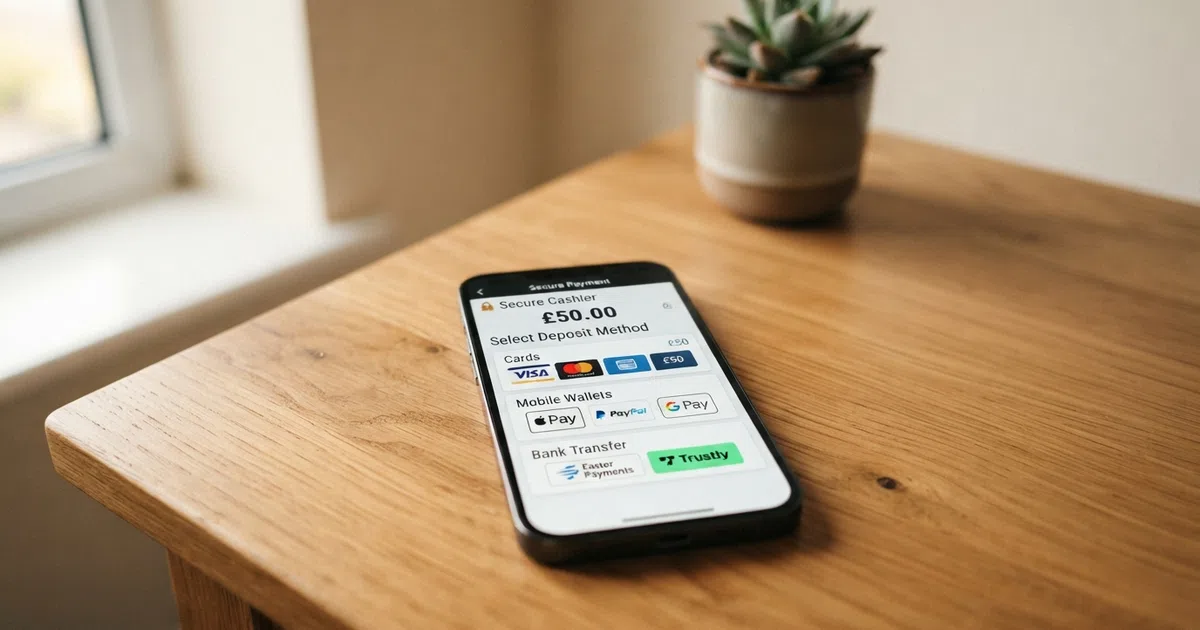
Data current as of September 8, 2026, checked against the Gambling Commission’s public register of licence holders (2,663 business records, last updated 29 July 2026).
EntroPay Is Gone — Here’s What UK Casino Players Need to Know
EntroPay was a wholly-owned Nium subsidiary, registered in England and Wales as company 04072405 and authorised by the Financial Conduct Authority under the Electronic Money Regulations 2011 (FRN 900800) to issue electronic money. It was not a gambling licence, and that distinction matters: a payment provider can be perfectly compliant on the FCA side and still disappear if the card network behind it walks away. In EntroPay’s case, VISA cancelled the partnership, and the consumer product was discontinued on 1 July 2019. The corporate entity survives under Nium, but it no longer serves consumers, and no UK casino currently accepts it.
This page is organised around that fact. The first section explains what EntroPay was and why it vanished. The second ranks ten UKGC-licensed casinos against the Gambling Commission’s public register, the only place to check whether a brand is actually licensed in Great Britain. The third covers how UK casino payments work in 2026, from debit cards to Open Banking. The fourth unpacks what a UKGC licence means for player money. The fifth walks through the safer-gambling tools every UK player has, from GAMSTOP to the GamCare helpline. The methodology section at the end shows how the ranking was assembled, and the closing section translates all of this into a single decision a reader can act on.
What EntroPay Was — And Why It Mattered to UK Players
EntroPay issued virtual Visa cards. You loaded money onto the card from a bank account, and the card worked at any online merchant that accepted Visa, including any online casino on the Visa network. At the cashier, a player selected EntroPay, entered the 16-digit card number, expiry date and CVV, and the deposit was credited instantly, because EntroPay sat inside the Visa rails rather than running on a separate settlement schedule. Withdrawals, when supported, took 1–5 days.
The product’s appeal in the UK was its position as a middle layer. A player who did not want a casino’s name on their bank statement, or who did not want to share card details with an operator, could fund EntroPay once and then spend from a virtual card. There was no credit check, no overdraft, no gambling-related flag on a primary bank account. For a stretch of years, EntroPay was the default prepaid answer for UK casino players who wanted distance between their bank and their bets.
Why VISA Pulled the Plug in July 2019
VISA cancelled the partnership. The exact reason was never made public, and the closure was abrupt: the consumer site went offline and the product ceased to exist. SBO, writing in 2019, recorded that “Entropay officially closed its business after VISA cancelled their partnership.” The corporate entity survived, and still does, as a Nium subsidiary, but it stopped serving consumers, and the virtual Visa cards were never reissued.
The implication for a UK player searching for “casinos that accept EntroPay” in 2026 is binary: the product is gone, and any list still naming it is wrong. The right next step is to look at the payment methods UKGC-licensed casinos do accept, and the regulatory framework that governs how those methods work, which is what the rest of this page covers.
What This Means for Your Casino Deposits Today
Zero UKGC-licensed casinos list EntroPay as a current payment method. The Gambling Commission’s public register, the authoritative source for which operators hold a GB operating licence, carried 2,663 business records as of 29 July 2026, and none of them references EntroPay as an active payment rail. Every casino ranked in the section that follows is verified against that register, and the payment methods listed for each one are the methods that operator accepts today, not a list recycled from a 2018 guide.
The working alternatives fall into a small set: debit cards, e-wallets (PayPal, Skrill, Neteller), mobile wallets (Apple Pay, Google Pay, Revolut Pay), bank-to-casino transfers (Trustly and Open Banking), and prepaid vouchers (Paysafecard). The breakdown of how each one works, and the UK rules that constrain them, is in the payments section. The operator-by-operator ranking, with welcome offers, free-spin counts, wagering terms and payment-method breadth, is next.
Why These 10 UK-Licensed Casinos Stand Out After EntroPay
The table below ranks ten UKGC-licensed casinos by welcome-offer quality, payment-method breadth and UKGC standing, all verified against the Gambling Commission’s public register as of 29 July 2026. The ranking reflects a weighted assessment across payment-method breadth, free-spin count, wagering burden, per-spin value, and bonus validity, not a single “best” claim. Methodology is in the section on how the ranking was built.
| Operator | UKGC Licence | Welcome Offer | Free Spins | Wagering | Value per Spin | Bonus Validity | Payment Methods |
|---|---|---|---|---|---|---|---|
| Bet365 Casino | 39563 (Hillside UK Gaming) | Up to 500 free spins on four slots | Up to 500 | 0× | £0.10 | 30 days | Debit cards, Apple Pay, Paysafecard (excluded from bonus), bank transfer |
| Sky Vegas | Flutter Entertainment | 50 no-deposit + 200 on £10 stake | 250 | 0× | £0.10 | 7 days | Debit cards, PayPal, Trustly, Apple Pay, Revolut Pay, bank transfer |
| William Hill Vegas | WHG (International) | 200 free spins on Big Bass Splash | 200 | 10× | £0.10 | 72 hours | Visa, Mastercard, PayPal, Apple Pay, Paysafecard, instant bank, Skrill, Neteller |
| Betfair Casino | 39435 / 2062 | Not specifically found this run | — | — | — | — | Debit cards, PayPal, Apple Pay, bank transfer |
| Paddy Power Games | PPB Counterparty / PPB Entertainment | 60 no-deposit + 200 on £10 wager | 260 | 0× | £0.10 | 7 days | Debit cards, PayPal, Apple Pay, bank transfer |
| Ladbrokes Casino | Entain Operations | 100 free spins on three slots | 100 | 0× | £0.10 | 30 days | Debit cards, PayPal, Apple Pay, bank transfer |
| Coral Casino | Entain Operations | 100 free spins, cash payout | 100 | 0× | £0.10 | 30 days | Debit cards, PayPal, Apple Pay, bank transfer |
| Virgin Games | Nozee Limited (Gamesys) | 100 free spins on Big Bass Splash | 100 | 0× | £0.01 (1p on 10 lines) | 30 days | Visa Debit, Visa Electron, Mastercard, Apple Pay, Google Pay |
| PlayOJO | SkillOnNet | 50 free spins on Big Bass Bonanza | 50 | 0× | £0.10 | — | Debit cards, Trustly, instant bank |
| Grosvenor Casinos | Rank Digital Gaming (Alderney) | £40 bonus + 100 free spins on Big Bass Splash | 100 | 10× | — | — | Debit cards (PayPal and Paysafecard excluded) |
Eight of the ten welcome offers carry zero wagering on free-spin winnings. Two — William Hill Vegas and Grosvenor Casinos — carry 10× wagering, which is still the legal ceiling under LCCP Social Responsibility Code 5.1.1. A reader scanning this table for “the offer with the most spins” lands on Bet365; a reader scanning for “the offer with the longest validity” lands on Bet365, Ladbrokes, Coral and Virgin Games at 30 days. The widest payment-method range is Sky Vegas and William Hill Vegas. Each operator is reviewed below.
Bet365 Casino — The UK’s Largest Free-Spins Package
Bet365 holds UKGC operating licence account 39563 under Hillside (UK Gaming) ENC, verified on the public register. The welcome offer is the largest in this ranking. New customers can receive up to 500 free spins on Book of Horus, Curse of the Bayou, Magic Forge and Wrath of the Deep, distributed at random between 5 and 50 spins per day across 10 days. There is no wagering on the free-spin winnings, the minimum qualifying deposit is £10 lifetime, and the bonus is valid for 30 days. Payment methods include debit cards, Apple Pay, Paysafecard (excluded from the bonus offer) and bank transfer.
The 500-spin ceiling is not guaranteed; the random daily distribution means a player could receive as few as 50 total spins over the 10-day window. Even at the floor, the offer is competitive, and the 0× wagering is the headline. With 500 potential spins and no wagering requirements, Bet365 claims the top spot for value, though the random allocation is a unique quirk to keep in mind.
Sky Vegas — No-Deposit Free Spins With Zero Wagering
Sky Vegas is UKGC-licensed under Flutter Entertainment, as listed on the public register. The welcome offer splits across two stages: 50 no-deposit free spins on registration, plus 200 additional free spins once a player deposits and stakes £10. All winnings carry 0× wagering, each spin is worth £0.10, and the bonus expires after 7 days. Maximum cashout from the offer is capped at £250. Payment methods include debit cards (Visa and Mastercard), PayPal, Trustly, Apple Pay, Revolut Pay and bank transfer.
The 50 no-deposit spins are the unusual feature. Most UK welcome offers condition free spins on a first deposit; Sky Vegas gives 50 before the player funds the account. The £250 maximum cashout is the tightest cap in this ranking and matters for any player who treats free spins as a path to a meaningful payout. The no-deposit start provides a distinct edge, positioning Sky Vegas as the premier choice for those prioritizing e-wallet and mobile-first funding options.
William Hill Vegas — 200 Free Spins, Tight Expiry
William Hill Vegas is UKGC-licensed under WHG (International) Limited, as noted on the public register. New customers receive 200 free spins on Big Bass Splash;
The arithmetic is unforgiving. 200 spins at £0.10 generates a maximum of £20 in spin value. The £30 maximum cashout suggests a single game’s max win fits inside the cap, and the 10× wagering on winnings means a player has to roll the £30 ten times over before withdrawing, all within 72 hours. The offer is broad on payment methods and the spin count is large, but the cap, the wagering and the clock together are tighter than they look. While it offers an expansive payment set, the tight 72-hour expiry makes William Hill Vegas better suited for players ready to engage with the bonus immediately upon registration.
Betfair Casino — The Payment-Range Contender
Betfair holds two UKGC licences — account 39435 under Betfair Casino Limited and account 2062 under Betfair Limited — both active on the public register. A casino-specific welcome offer was not confirmed this run, and the honest move is to say so: this page does not have verified terms for a Betfair Casino welcome bonus in 2026, and the operator’s own site carries the current offer. The Flutter group accepts various payment methods such as Visa, Mastercard, PayPal and bank transfers.
For a player who ranks payment-method breadth above headline bonus value, Betfair is a credible choice by licence and payment set alone. The absence of a verified casino-only welcome offer in this run is itself information: it stops the operator from being ranked on offer quality, but it does not disqualify it from a payment-method shortlist.
Paddy Power Games — 60 No-Deposit Spins, Largest Cashout Cap
Paddy Power is UKGC-licensed under PPB Counterparty Services Limited and PPB Entertainment Limited, verified on the public register. The welcome offer includes 60 no-deposit free spins on registration, with 200 more after depositing and wagering £10; Each spin is worth £0.10, bonus funds expire after 7 days, and the maximum cashout from the offer is £500, the largest cap among the operators in this ranking that state one. Paddy Power facilitates deposits via debit cards, Apple Pay, PayPal or direct bank transfers.
The 60 no-deposit spins are matched only by Sky Vegas, and the £500 cashout cap is the loosest in the ranking. For a player who wants both a no-deposit leg and the realistic chance of a four-figure win, Paddy Power is the strongest of the two no-deposit operators on paper. The 7-day expiry is the constraint.
Ladbrokes Casino — 100 Free Spins, No Wagering, 30 Days
Ladbrokes is UKGC-licensed under Entain Operations Limited, as per the public register. New customers receive 100 free spins on Big Bass Bonanza, Sweet Bonanza and Starburst, contingent on a £10 deposit and wager. There is no wagering on winnings, each spin is worth £0.10, and the spins are valid for 30 days, the joint-longest validity window in the ranking alongside Bet365. Ladbrokes supports funding through standard channels including debit cards, PayPal and Apple Pay.
The offer is clean: three popular slots, 0× wagering, a 30-day window, and a payment-method set that covers the majority of UK players. Ladbrokes presents a straightforward, player-friendly package where the 30-day validity window provides excellent flexibility for those looking to enjoy their spins at a leisurely pace.
Coral Casino — 100 Free Spins, Cash Payout, No Wagering
Funding is supported through debit cards, Apple Pay and bank transfers.
Coral’s distinction is the cash-payout language: winnings are not bonus funds, they are cash, which means a player can withdraw them immediately without converting from a bonus balance. Coral distinguishes itself by paying out winnings as actual cash, stripping away the uncertainty often associated with bonus balance systems.
Virgin Games — 100 Free Spins, Zero Wagering, 30-Day Window
Virgin Games is UKGC-licensed under Nozee Limited (Gamesys), as shown on the public register. The welcome offer consists of 100 free spins on Big Bass Splash, contingent on a £10 deposit and wager, with winnings paid as cash. Spins are valid for 30 days. Each spin is valued at £0.01, 1p on 10 lines, the lowest per-spin value in this ranking, giving a total spin value of £1.00 against the standard £10.00. Payment methods include Visa Debit, Visa Electron, Mastercard, Apple Pay and Google Pay. PayPal has been closed to new accounts at Virgin Games since November 2020.
The per-spin value is the catch. 100 spins at £0.01 is a tenth of the spin value at the standard rate, and the 30-day validity is a real advantage only if the player accepts the lower unit value. The Gamesys licence and the 0× wagering make it a clean small-stakes offer, but a player comparing 100 spins at £10.00 to 100 spins at £1.00 is comparing £9.00 of expected value before house edge. While the low per-spin value limits the offer’s impact, Virgin Games remains a solid pick for small-stakes players prioritising a 30-day window and Google Pay compatibility.
PlayOJO — No-Wagering Free Spins, Low Minimum
PlayOJO is UKGC-licensed under SkillOnNet Ltd, as confirmed by the public register. The welcome offer provides 50 free spins on Big Bass Bonanza with no wagering requirements for a £10 minimum deposit. Each spin is worth £0.10, for a total spin value of £5. Payment methods include debit cards, Trustly and instant bank payments; Skrill, Neteller and Paysafecard are excluded.
PlayOJO is the smallest offer in this ranking by spin count and total value, but it is also the cleanest: 50 spins, no wagering, £5 total, no bonus balance to clear. For a player who wants the simplest possible free-spin offer at the lowest possible entry cost, PlayOJO is the right pick. The Trustly and instant bank payment set is the narrowest among the ten, and the Skrill / Neteller / Paysafecard exclusion is a real constraint for players who prefer those rails.
Grosvenor Casinos — Bonus Cash Plus Free Spins
Grosvenor Casinos is UKGC-licensed under Rank Digital Gaming (Alderney) Limited, as noted on the public register. The welcome offer allows players to deposit £20 and receive a £40 casino bonus plus 100 free spins on Big Bass Splash. Free-spin winnings carry 10× wagering, the legal ceiling. Per-spin value and bonus validity were not explicitly stated in the terms this page verified. Payment methods include debit cards; PayPal and Paysafecard are excluded from the welcome offer.
Grosvenor is the only operator in the ranking offering a cash bonus alongside free spins, and the £40 on a £20 deposit is a 100% match. The 10× wagering on the free-spin winnings is at the legal maximum, and the absence of confirmed per-spin value and validity is a real gap. For a player who wants a cash bonus rather than a free-spins-only offer and accepts the Rank Digital Gaming payment set, Grosvenor is the natural fit; the wagering and the unspecified validity are the costs.
How UK Casino Payments Actually Work in 2026
The payment methods UK-licensed casinos accept in 2026 are tighter, more regulated and faster than they were in EntroPay’s day. A casino deposit follows a defined sequence — identity verification, the deposit-limit prompt, payment selection, instant crediting — and the withdrawal side has changed since reverse withdrawals were permanently banned. The mobile experience adds Apple Pay and Google Pay to the rails, and the rest of this section walks through each of these in turn.
Debit Cards, E-Wallets and Open Banking: What Replaced EntroPay
Debit cards (Visa and Mastercard) are universal: every UKGC-licensed casino accepts them, and the 14 April 2020 credit card ban means debit is the only card option. The ban extends to credit-card-funded payments routed through e-wallets, so a player cannot fund PayPal with a credit card and use it to gamble.
E-wallets split into two camps. PayPal is the most widely accepted and is the only major e-wallet that benefits from FCA authorisation for the relevant activities; Skrill and Neteller are accepted across many but not all operators, and both are commonly excluded from welcome bonuses. Apple Pay and Google Pay are mobile-first, use biometric authentication, and never share the card number with the casino. Trustly and Open Banking enable direct bank-to-casino transfers without a card entry, and Paysafecard fills the prepaid slot EntroPay once occupied, while Revolut Pay functions as a bank-app-style rail for Revolut customers.
The practical summary for a player coming from EntroPay: the closest functional replacement is Paysafecard for the prepaid distance, Apple Pay or Google Pay for mobile one-tap deposits, and Trustly or Open Banking for direct bank-to-casino transfers. None of these require a credit check, and none of them require a player to share a primary bank card with the casino.
How a Casino Deposit Works — Step by Step
Every UKGC-licensed casino follows the same deposit path. Identity verification comes first: no anonymous play is possible at a GB-licensed site, and the casino must confirm a player’s name, address and date of age before the first deposit. Once verified, the operator must prompt the player to set a financial limit before funding the account — this has been mandatory since 31 October 2025, and a gross deposit limit must be offered with at least equal prominence (RTS 12). The player then selects a payment method at the cashier, enters an amount, and confirms. Debit cards, e-wallets, Apple Pay and Trustly credit the account instantly.
Once a player’s net deposits cross £150 in a rolling 30-day period, the operator runs a financial vulnerability check using publicly available data only — CCJs, IVAs, bankruptcy orders. This is not a credit check, and the threshold is low enough that almost any regular player will trip it within a month. The check is a player-protection control, not a payment restriction, and it does not change the deposit or withdrawal rails the player can use.
Withdrawals, Cashout Times and What Slows Them Down
Withdrawal times vary by payment method, and the variation is wider than the deposit side suggests. Debit card payouts typically take 1–5 working days after a casino approves the withdrawal. E-wallets are faster, often within 24 hours once approved. Apple Pay and Trustly follow their own settlement schedules, and the exact timing depends on the operator’s internal approval queue.
Three structural rules govern the withdrawal side. First, the pending period: a casino may hold a withdrawal for a short internal review window, during which a player can in principle reverse it. Second, reverse withdrawals have been permanently banned at UKGC-licensed casinos since 31 October 2021 — once approved, a withdrawal cannot be sent back to the player’s balance. Third, the closed-loop rule: a casino may require a withdrawal to be returned to the same payment method used to deposit, so a player who funded the account with a debit card will see the withdrawal routed back to that card.
Research did not carry per-operator payout speeds for the casinos in this ranking, so the comparison stops at the structural rules above. A player who wants a specific operator’s cashout time should check the operator’s terms page directly.
Real-Money Play vs Demo Mode: The Difference That Matters
Most UKGC-licensed casinos offer free-play or demo versions of their slots and table games. Demo mode uses the same RNG, RTP and mechanics as the real-money version: the game is not rigged differently, the volatility is the same, and a player who tests a slot in demo is testing the real thing. The catch is that demo mode does not pay real money, and a player cannot win a withdrawal from demo play.
The function of demo mode, in the UK’s regulatory framework, is a safer-gambling tool as much as a try-before-you-buy feature. A player who wants to test a game’s volatility, frequency of bonus rounds or pace of play can do so without financial pressure. The feature is not universal — some titles, particularly progressive jackpots and live dealer games, are often restricted from demo play — but the bulk of slots and table games on a UKGC-licensed site are available in demo.
Mobile Casino Payments: What Changes on a Phone
Mobile play now accounts for the majority of UK online casino sessions, and the payment picture on a phone differs in two specific ways. Apple Pay and Google Pay use biometric authentication — Face ID or Touch ID on iOS, fingerprint or face unlock on Android — and the underlying card number is never shared with the casino. The merchant token is per-transaction and per-device, so even a compromised token cannot be reused at a different merchant.
For deposits, the mobile browser experience is functionally identical to desktop: debit cards, e-wallets and Trustly all work the same way, with the same limits and the same speed. Casino apps may offer saved-payment-method convenience, but the underlying payment rails are unchanged. The practical takeaway for a player who mostly plays on a phone: Apple Pay and Google Pay are the differentiators, and a player who values biometric confirmation will lean on them; a player who values e-wallet separation will still reach for PayPal or Trustly.
UK Gambling Commission: The Licence That Protects Your Money
Every casino on this page holds a current GB operating licence confirmed against the Gambling Commission’s public register, and the rest of this section explains what that licence actually means for player money and what the alternatives look like.

The UKGC is the single statutory regulator for Great Britain — an executive non-departmental public body sponsored by the Department for Culture, Media and Sport (DCMS). The Gambling Act 2005 sets three licensing objectives: preventing crime, ensuring gambling is fair and open, and protecting children and other vulnerable persons. The point-of-consumption reform of 2014 means any operator taking British players must hold a GB licence, with no exception for offshore brands serving the UK market. The Commission’s public register carried 2,663 business records as of 29 July 2026, and it is the authoritative source for checking whether a brand is actually licensed in Great Britain.
What a UKGC Licence Actually Means for Your Cash
A GB licence is not a rubber stamp. The three licensing objectives are binding, and every licence condition and social responsibility code flows from them. The day-to-day rules operators follow sit in the LCCP (Licence Conditions and Codes of Practice) and the Remote Technical Standards (RTS), and the Commission can fine, suspend or revoke a licence. Enforcement is public — settlements, fines and licence actions are published on the Commission’s site.
Player funds are segregated from operator working capital under the Commission’s rules, and operators must meet liquidity requirements so that a withdrawal request is honoured against funds set aside for that purpose, not the casino’s general cash flow. If a casino refuses to pay out a legitimate withdrawal, a player can complain to an approved alternative dispute resolution (ADR) provider, escalate to the Commission, and in some circumstances pursue the matter through the courts. The protections stack, which is the point.
Licensed vs Offshore: The Protection Gap That Costs Players
Operating without a GB licence while serving British players is a criminal offence under section 33 of the Gambling Act 2005, with a maximum sentence of 51 weeks’ imprisonment and/or an unlimited fine. Enforcement is disruption-based: cease-and-desist notices, search-engine delisting referrals, domain registrar action, and payment-provider referrals. The Commission does not currently hold statutory ISP or DNS blocking powers — legislation has been proposed but not enacted. For October 2024 to September 2025, the Commission recorded 208,088 enforcement actions against illegal online gambling; for April 2024 to June 2025, 3,140 disruption notices were issued, 447,778 URLs were referred to search engines, and 287,961 URLs were removed.
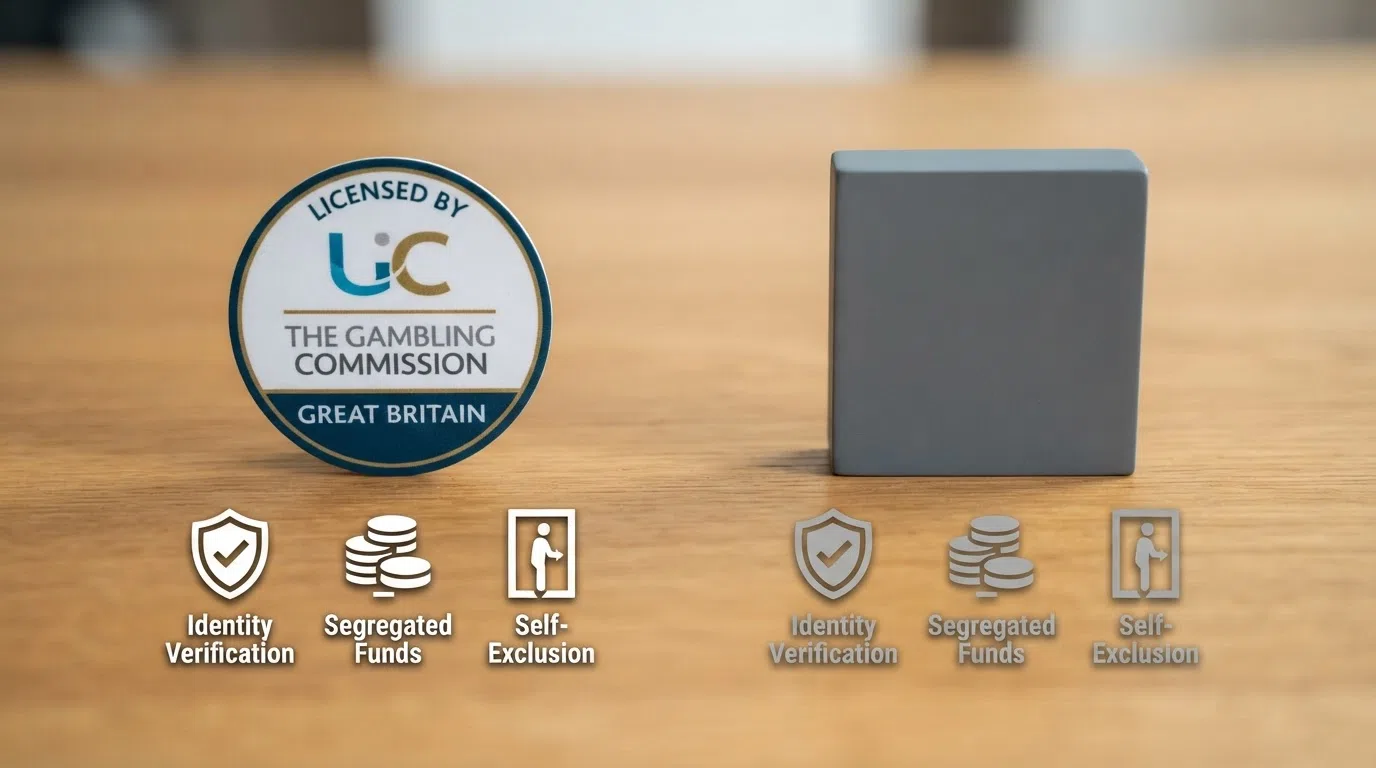
| Protection | UKGC-Licensed Casino | Unlicensed Offshore Casino |
|---|---|---|
| Identity verification | Mandatory before first deposit | None required |
| Segregated player funds | Required by LCCP | Not guaranteed |
| GAMSTOP self-exclusion | Mandatory | Not covered |
| Commission complaints | Yes | No |
| ADR / alternative dispute resolution | Approved ADR available | None |
| Bonus wagering cap | 10× maximum | No statutory cap |
| Stake cap (online slots) | £5 (25+) / £2 (18–24) | No statutory cap |
| Credit card deposits | Banned | Permitted by some operators |
| Reverse withdrawals | Banned | Permitted by some operators |
| British consumer redress | Full | None |
| Financial vulnerability checks | Mandatory at £150 net deposit / 30 days | None |
The table makes the protection gap visible in one place. A player at an unlicensed site has no GAMSTOP, no Commission complaint route, no ADR, no British consumer redress, and no statutory wagering or stake ceiling. The £30 maximum cashout on free spins, the 10× wagering cap, the £5 stake cap and the banned reverse withdrawals exist because the Commission wrote them into the LCCP; an offshore operator is bound by none of them.
The 2026 Rule Changes Every UK Casino Player Should Know
The UK online casino market has been reshaped by a sequence of regulatory changes in 2025 and 2026, and the four that affect a player’s day-to-day experience most directly are these.
Online slots carry a statutory maximum stake per game cycle: £5 for players aged 25 and over (in force 9 April 2025) and £2 for players aged 18 to 24 (in force 21 May 2025), imposed by the Statutory Instrument 2025/215. Two adults at the same casino can face different maximum bets on the same slot.
Bonus wagering requirements are capped at 10× from 19 January 2026 under LCCP Social Responsibility Code 5.1.1. A welcome offer asking for 35× is no longer legal at a GB-licensed casino. Mixed-product promotional offers are banned from the same date — an offer cannot condition a casino bonus on playing a different product type, so “bet £10 on football, get free spins” is over.
The game-design rules from 31 October 2021 are the older layer: auto-play is banned, the minimum spin speed is 2.5 seconds, features that speed up play are banned, losses disguised as wins are banned, and reverse withdrawals are permanently banned. The operators have adjusted; the games still feel familiar, but the mechanics are now constrained by rule.
Financial risk assessments are announced but not yet commenced. The UKGC Board confirmed a staged rollout on 7 July 2026 — Stage 1 would trigger at £5,000 net deposits in 24 hours for players aged 25+ and £2,500 for those aged 18–24 — but a start date has not been set. The £150 net-deposit financial vulnerability check, which uses publicly available data only, has been in force since 28 February 2025.
Staying in Control: Safer Gambling Tools Every UK Player Has
The UK has a layered safer-gambling infrastructure, and the tools are real. GAMSTOP is the national multi-operator self-exclusion scheme, mandatory for every GB-licensed online operator since 31 March 2020. The deposit-limit prompt is mandatory before the first deposit. Reality checks and time-outs are built into every licensed casino. The GamCare helpline is open 24/7, and the NHS runs 15 specialist gambling treatment clinics as of December 2024. The rest of this section walks through the tools and the help available.
GAMSTOP: The Self-Exclusion Safety Net
GAMSTOP is the national multi-operator online self-exclusion scheme covering all GB-licensed online operators, and participation has been mandatory since 31 March 2020. A player registers once, and the exclusion is enforced across every licensed site simultaneously. The exclusion periods are six months, one year, five years, or five years with auto-renewal, and once set, the exclusion cannot be shortened or cancelled before the period ends.
The boundary of GAMSTOP is licence-bound and online-only. It does not cover land-based venues, lotteries, or unlicensed offshore sites. A player who self-excludes via GAMSTOP will be blocked from every UKGC-licensed online casino, online bingo site and online bookmaker, but the exclusion will not stop them from walking into a betting shop or from opening an account with an offshore operator. Self-exclusion is a cooling-off period, not a punishment, and it is the single most powerful control a UK player can activate.
Deposit Limits, Time-Outs and Reality Checks
The deposit-limit prompt is the most visible control. Since 31 October 2025, every operator must prompt a customer to set a financial limit before the first deposit, and a gross deposit limit must be offered with at least equal prominence. The player can refuse or set any level, but the offer must be made. A time-out lets a player block access to the account for a cooling-off period — typically 24 hours to six weeks — without committing to a full self-exclusion. Reality checks are mandatory pop-ups that show time played and net position at set intervals, designed to interrupt long sessions.
Financial vulnerability checks run silently in the background. Once a player’s net deposits cross £150 in a rolling 30-day period, the operator runs a check using publicly available data only — CCJs, IVAs, bankruptcy orders. It is not a credit check, and it does not appear on a credit file. A player who has no public debt markers will not be flagged, and the check itself is a control on the operator’s side rather than a barrier to play.
Where to Get Help — Helplines, Clinics and Support
Free, confidential help is available around the clock. GamCare runs the National Gambling Helpline on 0808 8020 133, free, 24/7, 365 days a year. The NHS operates 15 specialist gambling treatment clinics as of December 2024, and service use rose 130% year-on-year — nearly 2,000 referrals were made between April and September 2024, against 800 in the same period in 2023. GambleAware’s National Gambling Treatment Service treated 11,960 clients in 2024/2025, an 11% increase, and 93% of clients completing treatment saw improvement. One quarter of those clients said their problem gambling started by age 18.
Gamblers Anonymous runs peer-support groups across the UK. The NICE guidance NG248 directs health professionals to use the PGSI-based self-assessment, and GambleAware’s online self-assessment quiz has been completed over 160,000 times, with over half of users going on to take a meaningful action. The prevalence context, for grounding: the Health Survey for England 2024 found 5% of adults scored 1 or more on PGSI (at-risk or problem gambling), and less than 1% scored 8 or more; an estimated 7% of the British population are negatively affected by someone else’s gambling.
How We Selected and Ranked These UK Casinos
The starting set was GB-licensed online casinos whose welcome offers and payment methods are publicly documented. Every operator was verified against the Gambling Commission’s public register, last updated 29 July 2026, and the register carried 2,663 business records at the time of writing. The ranking criteria, in order of weight, were payment-method breadth, welcome-offer quality (free-spin count, wagering burden, per-spin value, validity window), and UKGC licence standing.
No invented weightings sit behind the order. Payment-method breadth was treated as a first-order criterion because the page’s subject is what replaced EntroPay, and a casino that accepts only a debit card is a less useful replacement than one that accepts PayPal, Apple Pay and Trustly alongside. Welcome-offer quality was treated as a second-order criterion, with the 0× wagering offers ranked ahead of the 10× offers within each spin-count tier. UKGC licence standing was the threshold condition: every operator on the list holds an active GB operating licence, and no operator without one was considered.
Sources were the operator’s own terms pages, the Gambling Commission’s public register, and independent affiliate databases. No operator paid for placement. The order reflects the criteria above, not a commercial arrangement.
Your Money, Your Choice: What to Do With This Information
EntroPay is gone, and the alternatives are faster and better protected. The £5-per-spin cap, the 10× bonus wagering ceiling, the mandatory deposit-limit prompt and the GAMSTOP exclusion scheme give a UK player more control than almost any other jurisdiction in the world offers. The next step is to pick a UKGC-licensed casino from the ranking above, set a deposit limit before funding the account, try demo mode first, and keep the GamCare helpline in mind.
The arithmetic behind the bonus offers is the part most marketing pages skip, and it is worth running once. Take Grosvenor’s welcome offer: deposit £20, receive a £40 casino bonus, with 10× wagering on the free-spin winnings. Under the legal 10× wagering cap, the bonus amount of £40 multiplied by 10 gives a required turnover of £400 to clear. At the statutory £5 maximum stake per game cycle for players aged 25 and over, that is 80 game cycles. A slot cycle is roughly 5 seconds, so 80 cycles take around 400 seconds, or roughly 7 minutes of active play. That is the time cost to clear the wagering, not the cost in money. The expected loss is the separate number: a turnover of £400 at a typical online slot RTP of around 96% gives an expected loss of £16, on top of the £20 deposit. £40 in bonus cash therefore costs around £16 of expected play to clear, the arithmetic of which is straightforward once written out: a £40 bonus with 10× wagering at a 96% RTP carries an expected cost close to the bonus amount’s 4% of the required turnover, which is the cost the player is paying for the operator’s “free” money.
The conclusion a reader should draw is that the bonus is paid for in expected play, not in cash, and the time to clear it is short. The “free” part of any casino bonus is the marketing word that does the most work on this page. It deserves a quiet second look every time it appears.
Pick a casino, set the deposit limit, try the demo, and read the wagering terms once. The market is regulated, the options are real, and the player controls are the strongest they have ever been.
Frequently Asked Questions
Are UK casinos that previously accepted EntroPay still licensed?
Yes. UKGC-licensed casinos that accepted EntroPay before July 2019 remain licensed today, verified against the Gambling Commission’s public register of 2,663 business records last updated 29 July 2026. EntroPay itself was discontinued on 1 July 2019, so none of those casinos accept EntroPay as a payment method any longer; the licence status of the casino and the availability of EntroPay are two separate questions, and only the first is still “yes”.
What payment methods do UKGC-licensed casinos accept in 2026?
Debit cards (Visa and Mastercard) are universal. E-wallets — PayPal, Skrill and Neteller — are accepted across most but not all operators and are often excluded from welcome bonuses. Apple Pay and Google Pay are mobile-first and use biometric authentication. Trustly and Open Banking enable direct bank-to-casino transfers. Paysafecard fills the prepaid slot, and Revolut Pay functions as a bank-app rail. Credit cards have been banned for gambling since 14 April 2020.
Is it safe to use virtual prepaid cards at online casinos in the UK?
Yes, subject to two constraints. The prepaid card or voucher must be FCA-authorised for issuing electronic money, and the casino must be UKGC-licensed. Paysafecard is the main current example. Anonymous play is impossible at a GB-licensed casino, so a prepaid card is a payment rail, not an identity shield; the casino will still verify name, address and date of age before the first deposit, regardless of how the deposit is funded.
How do I set deposit limits at a UK-licensed online casino?
The casino must offer a deposit-limit prompt before your first deposit — this has been mandatory since 31 October 2025. The prompt appears during the deposit flow, and a gross deposit limit must be offered with at least equal prominence. You can set any level or decline, and the limit can be changed later, with any increase subject to a cooling-off period. Once set, the limit applies to deposits across the operator’s site; cross-operator limits are not automatic and require setting at each casino individually.
What is the maximum I can stake per spin on online slots in the UK?
The statutory maximum stake per game cycle is £5 for players aged 25 and over (in force 9 April 2025) and £2 for players aged 18 to 24 (in force 21 May 2025), imposed by SI 2025/215. The cap applies to the total staked within a single game cycle on any online slot, and the operator is responsible for enforcing it. Two adults at the same casino can face different maximum bets on the same slot, depending on age. The cap does not apply to table games, live casino or sports betting.
Payments – nonukgc-licensedcasinos
Content created by the «nonukgc-licensedcasinos» team