
How Progressive Jackpot Slots Work at UK-Licensed Casinos
 Available in GB
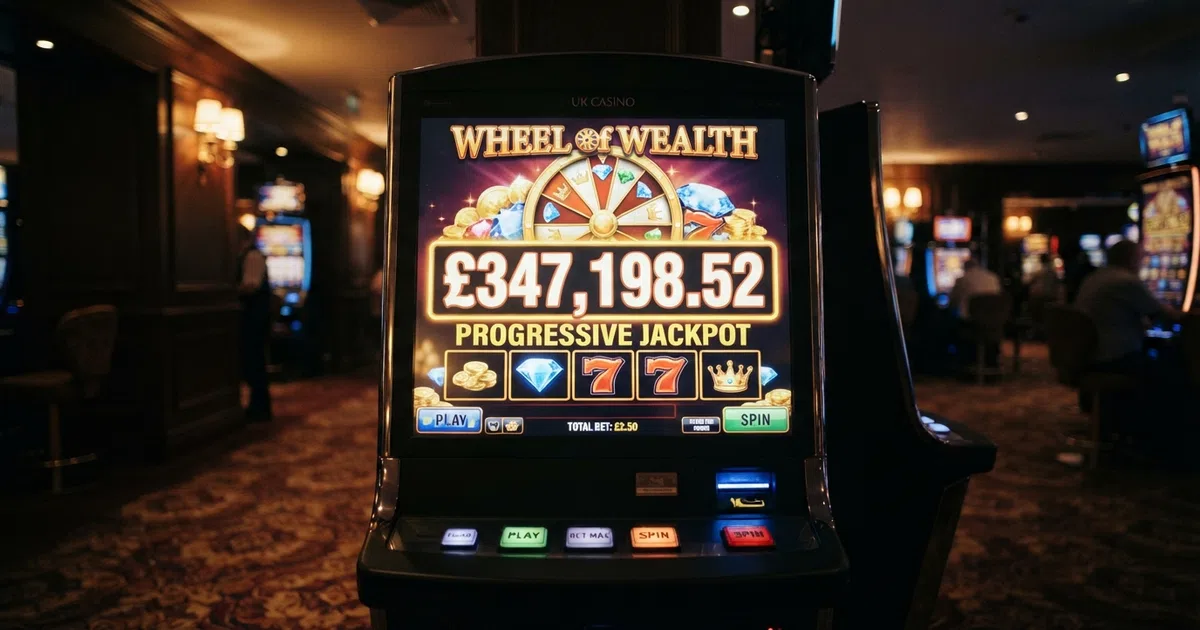
A progressive slot is a game where the top prize is not fixed at the factory. Every wager feeds a shared pool, and the meter on screen ticks upward with every spin from every player on the same network until somebody triggers the payout. That mechanic is the entire reason the category exists, and it is also the reason a progressive slot pays back less, per pound wagered, than a regular slot does. This page is about what that trade looks like in the United Kingdom: which titles carry published RTPs, which GB-licensed operators carry them, how the Gambling Commission’s stake cap reshapes a session, and where the safety net sits when the meter does not stop where you hoped.
Data current as of September 8, 2026 and checked against the Gambling Commission’s public register of licence holders.
How a progressive jackpot actually grows — and where UK players find these slots
What a progressive jackpot slot actually is
A progressive slot is a video slot with a top prize that grows over time rather than paying a fixed maximum. The visual cue is the ticker — a number above or beside the reels that climbs with every spin. The mechanic is straightforward: a slice of every bet is diverted into a jackpot pool instead of returning to the player as base-game winnings. The pool has a floor (the seed), a ceiling on networked titles (where the operator or provider caps the meter before resetting), and a trigger condition that decides when the meter pays out and resets.
The difference from a fixed-jackpot slot is structural. A fixed-jackpot slot pays the same maximum whether the game has been quiet for ten minutes or ten weeks. A progressive slot’s headline prize is whatever the meter shows right now, and the meter moves in real time. That is what creates the seven-figure numbers in the lobby, and it is what lowers the base-game return underneath them.
How the jackpot pool grows: seeds, contributions and meter rises
Three forces drive a progressive meter from its floor to a life-changing sum.
The seed is the guaranteed minimum the operator or provider funds when the pot resets after a win. Mega Moolah’s Mega jackpot seeds at £1 million — when somebody wins, the meter drops, and the provider tops it back up to that floor. A standalone progressive may seed at a few hundred pounds; a wide-area networked progressive seeds in the millions because the same pool is being fed by thousands of machines.
The contribution rate is the percentage of every spin diverted to the pool. Across the category this typically runs from 1% to 5% of the bet. On a 25p spin, that is between 0.25p and 1.25p going to the jackpot rather than to the player’s return. Over thousands of spins across thousands of players, those fractions add up to the seven-figure meters you see on the lobby page.
The meter rise is the visible climb. A networked progressive feeds faster because the same pool is being topped by a much larger player base — every spin on Mega Moolah anywhere in the world, including at GB-licensed sites, contributes to the same four-tier pot. A standalone progressive feeds slowly because only one machine is paying in. The networked structure is why Mega Moolah’s Mega tier can sit above £3 million for weeks at a time while a standalone title’s meter moves in hundreds.
The trigger probability on a networked jackpot runs between roughly 1 in 5 million and 1 in 50 million per spin. That range is the designer’s lever: lower the trigger probability, and the meter grows larger between wins because fewer players are pulling it. Higher it, and the meter stays closer to the seed.
How to play a progressive slot at a UK-licensed site
The steps from registration to first spin at a GB-licensed casino follow a fixed order, and the order is set by the Gambling Commission rather than by the operator.
Before any deposit, free play, or bonus claim, the operator must verify your name, address and date of birth. This rule has been in force since 7 May 2019 and extends to free-to-play demo games on the licensee’s own site, not only to real-money play. The verification is what makes anonymous play impossible at any GB-licensed site and is the first point where the British regulatory model differs from offshore alternatives.
Once verification clears, the operator must present a deposit-limit prompt before you fund the account. From 31 October 2025 this prompt is mandatory before the first deposit, and from 30 September 2026 a gross deposit limit (one based only on money paid in, not net of withdrawals) must be offered with at least equal prominence to any other limit the player might set.
When you load a progressive slot, the game’s own design is constrained by UKGC game-design rules that apply to every licensed title. Auto-play is banned; spin speed cannot be faster than 2.5 seconds per game cycle; reverse withdrawals are banned; the session must display your total losses, total wins and time played. A “game cycle” is the period from spin initiation to the final outcome — a free-spin round within the same slot counts as part of one cycle, which matters for the stake cap.
The stake cap itself is the most distinctive feature of the British model. Players aged 25 and over can stake up to £5 per game cycle; players aged 18 to 24 can stake up to £2 per game cycle. Two adults at the same slot on the same evening face different maximum bets, and a 24-year-old can stake 60% less per spin than a 25-year-old on the identical game. The cap came into force on 9 April 2025 for the older band and 21 May 2025 for the younger band, under SI 2025/215.
Where UK players find progressive jackpot slots today
Every featured operator on this page is confirmed active on the UKGC’s public register, which lists 2,666 businesses and was last updated on 29 July 2026. That register is the single source of truth for whether an operator is legally permitted to take GB customers — and offshore licences from Curaçao, Malta or Gibraltar are not substitutes.
A typical GB-licensed casino carries a mix of progressive titles from several providers. The names recur across the lobby: Mega Moolah (Games Global), Age of the Gods (Playtech), the Jackpot King series (Blueprint), Divine Fortune and Mega Fortune (NetEnt), the WowPot network, and Red Tiger’s Daily Drop must-hit-by jackpots –. Most sites stock between 500 and 1,500 slots in total, of which perhaps a dozen to two dozen are progressive titles. The progressive section is a slice of the lobby rather than the bulk of it.
Mobile access is the same lobby through a browser or app, and the 2.5-second minimum spin speed applies identically on phone and desktop. The UKGC’s session-tracking display — the running total of losses, wins and time played — is built into the game client rather than into the device, so it travels with the player across form factors.
The best progressive jackpot slots we found at UK-licensed casinos in 2026
Every operator below carries an active GB licence on the Gambling Commission’s public register, last refreshed on 29 July 2026. Every welcome offer has been checked against the operator’s published terms as of 2026.
Summary of Featured Progressive Operators
| Operator | Welcome Offer | Wagering Requirement |
|---|---|---|
| bet365 | 500 free spins | 0× (Wager-free) |
| William Hill | 200 free spins | 0× (Wager-free) |
| Sky Vegas | Up to 200 free spins | 0× (Wager-free) |
| Ladbrokes | £50 bonus + 100 free spins | 5× / 10× |
| Paddy Power | 50 free spins + deposit match | 0× (Wager-free) |
| Coral | 100 free spins | 10× |
| Betfred | 200 free spins | 0× (Wager-free) |
| Gala Spins | 100 free spins | 10× |
| Virgin Games | 100 free spins | 0× (Wager-free) |
| Betway | 100% deposit match | 10× |
The progressive jackpot titles worth your attention in 2026
Seven titles define the progressive category for UK players. Each has a published RTP, a known provider and a named jackpot network, and the table below lists what research backs. Volatility data is sparse across the category — only Mega Moolah among these has a published volatility class — so most rows carry an em dash in that column rather than a guess.
| Slot Title | Published RTP | Provider | Jackpot Network | Volatility |
|---|---|---|---|---|
| Mega Moolah | 88.12% (93.42% with jackpot) | Games Global | Mega Moolah / WowPot | Medium |
| Mega Fortune | 96.6% | NetEnt | Wide-area networked | — |
| Age of the Gods | 95.02% | Playtech | Age of the Gods (4 tiers) | — |
| Divine Fortune | 96.6% | NetEnt | Local (3 tiers) | — |
| Jackpot Giant | 94.22% | Playtech | Standalone | — |
| Wheel of Wishes | 93.3% | Games Global | WowPot | — |
| Fishin’ Frenzy Jackpot King | 96.12% | Blueprint | Jackpot King | — |
Two patterns deserve attention. First, the base RTP for a progressive sits below the 96% industry average because 1–5% of every bet is diverted to the pool; the headline 96.6% on Mega Fortune and Divine Fortune is the total return including jackpot contribution, not the base game on its own. Second, Mega Moolah is the only title here with a published volatility class; for the others, the absence of a figure is itself the answer, and a player choosing between them is choosing on jackpot size and theme, not on volatility profile.
bet365 — wager-free spins across 1,000+ slots
bet365 carries a GB remote licence through Hillside (UK Gaming) ENC under account 38721. The welcome offer is 500 free spins credited over ten days, each at £0.10, with zero wagering on anything those spins win. The 0× multiplier means winnings land directly in the withdrawable balance. Each daily allocation carries a 7-day validity.
The progressive range covers Mega Moolah, the Age of the Gods series, the Jackpot King series and Divine Fortune, among others. The wider slot lobby is around 1,000 titles with demo mode available on selected progressive and non-progressive games. Bet365 stands out in this set for offering the largest volume of wager-free spins.
William Hill — 200 wager-free spins and a deep Games Global catalogue
William Hill trades under account 2752/39225 with a remote licence (039225-R-319373-014) confirmed active on the Commission register. The welcome offer is 200 free spins valued at £0.10 each when you deposit and stake £10 on slots. Validity is 7 days from credit.
The progressive line-up mirrors the deep Games Global catalogue: Mega Moolah, Age of the Gods, the Jackpot King series and Fishin’ Frenzy Jackpot King. Total slot count sits around 800 with demo mode available. This £10-stake offer provides a significant Games Global range for anyone prioritising wager-free play.
Sky Vegas — no-wagering spins from a £5 qualifying stake
This brand is a Flutter Entertainment subsidiary with a licence active since 2014. The welcome bonus grants up to 200 free spins, priced at £0.10 apiece, following a £5 qualifying stake. Wagering is zero and the validity is 7 days.
Titles including Mega Moolah, the Jackpot King series and Age of the Gods are available. The slot lobby is around 700 with demo mode. With the lowest qualifying stake in our featured set, this represents a low-cost entry point for testing a site.
Ladbrokes — the biggest slot library and Daily Drop jackpots with full contribution
Ladbrokes trades under account 1611, with remote casino, bingo and betting licences all active on the register. The welcome package is a £50 bonus on a £10 deposit at 5× wagering, plus 100 free spins at £0.10 each at 10× wagering (the UKGC cap). Validity runs 7 days.
The progressive section is where Ladbrokes distinguishes itself: alongside Mega Moolah and the Jackpot King series, it carries Red Tiger’s Daily Drop must-hit-by jackpots at 100% contribution. The wider slot lobby is the largest in the featured set at around 1,500 titles with demo mode. Ladbrokes is a strong choice for Daily Drop players, with full 100% contribution rates on those must-hit-by jackpots.
Paddy Power — wager-free spins and a tight progressive line-up
Paddy Power runs on a Flutter Entertainment platform with a remote licence confirmed active. The welcome offer consists of 50 free spins valued at £0.10 each, plus a deposit match. Validity is 7 days.
The progressive range covers Mega Moolah, the Jackpot King series and Age of the Gods. The slot lobby sits around 700 with demo mode. This is a solid, compact option if you are happy with a smaller spin volume and a wager-free welcome.
Coral — 100 spins with a full month to use them
Coral sits within the Entain group alongside Ladbrokes, with a remote licence confirmed active. The welcome offer is 100 free spins at £0.10 each in exchange for a £10 stake, with 10× wagering at the UKGC cap. Validity is 30 days — the longest window in the featured set.
The progressive range covers Mega Moolah, the Jackpot King series, Age of the Gods and Fishin’ Frenzy Jackpot King. The wider lobby is around 1,200 slots with demo mode. The 30-day validity window makes this the longest-lasting spin offer in our comparison.
Betfred — 200 wager-free spins across a broad progressive range
Betfred’s remote licence is confirmed active. The welcome offer is 200 free spins at £0.10 each in exchange for a £10 stake on slots. Validity is 7 days.
The progressive selection includes Mega Moolah, the Jackpot King series and Age of the Gods. This lobby holds around 800 titles. Betfred provides a parallel choice to William Hill, maintaining a similar high spin count for players.
Gala Spins — 100 spins on a curated slot selection
Gala Spins is part of the Entain group, with a remote licence confirmed active. The welcome offer is 100 free spins at £0.10 each in exchange for a £10 stake on slots, with 10× wagering at the UKGC cap. Validity is 7 days.
The progressive range covers the Jackpot King series, Mega Moolah and Age of the Gods. The wider slot lobby is the smallest in the Entain cluster at around 500 titles, with demo mode on selected games. Gala Spins caters well to players seeking a smaller, more focused library of games.
Virgin Games — wager-free spins at 1p, cash payouts, no wagering
Virgin Games holds a remote licence confirmed active. The welcome offer is 100 free spins on Game of Thrones at £0.01 per spin on 10 lines — a £1 total allocation per spin, the smallest per-spin value in the featured set. Winnings are paid as cash with no wagering requirement. Validity is 30 days.
The progressive range covers the Jackpot King series (including Ted: Jackpot King and Winfall Wishes Jackpot), Mega Moolah and Age of the Gods. The slot lobby is around 400 with demo mode. With cash-only payouts and 1p lines, this operator offers the most transparent terms in our comparison.
Betway — a classic deposit match and the King Millions progressive
Betway’s remote licence is confirmed active. The welcome offer is a 100% deposit match at 10× wagering — the only featured operator offering a percentage match rather than a fixed spin bundle. Free spins are included in promotions on a varying basis. Validity runs 7 to 30 days depending on the promotion.
The progressive range covers Mega Moolah, the Jackpot King series, Age of the Gods and the Gold Blitz King Millions progressive exclusive to the Betway network. The slot lobby is around 600 with demo mode. Betway remains the unique choice for players looking to pair a deposit match with access to a network-exclusive progressive.
The jackpot mechanics that decide when — and whether — a progressive pays
Three ways a progressive pools its money: standalone, local and wide-area
Progressive jackpots differ in how many machines feed the same pool. A standalone progressive is one machine with one jackpot — the smallest pool, the fastest hit frequency, and a seed often in the hundreds. Jackpot Giant is a standalone example. A local progressive links a few machines on the same site or operator network — a mid-sized pool, a moderate hit frequency. A wide-area (or networked) progressive links thousands of machines across operators, often across jurisdictions — the largest pools and the longest individual odds, because the trigger condition has to be met once across a vast player base. Mega Moolah is the canonical wide-area example.
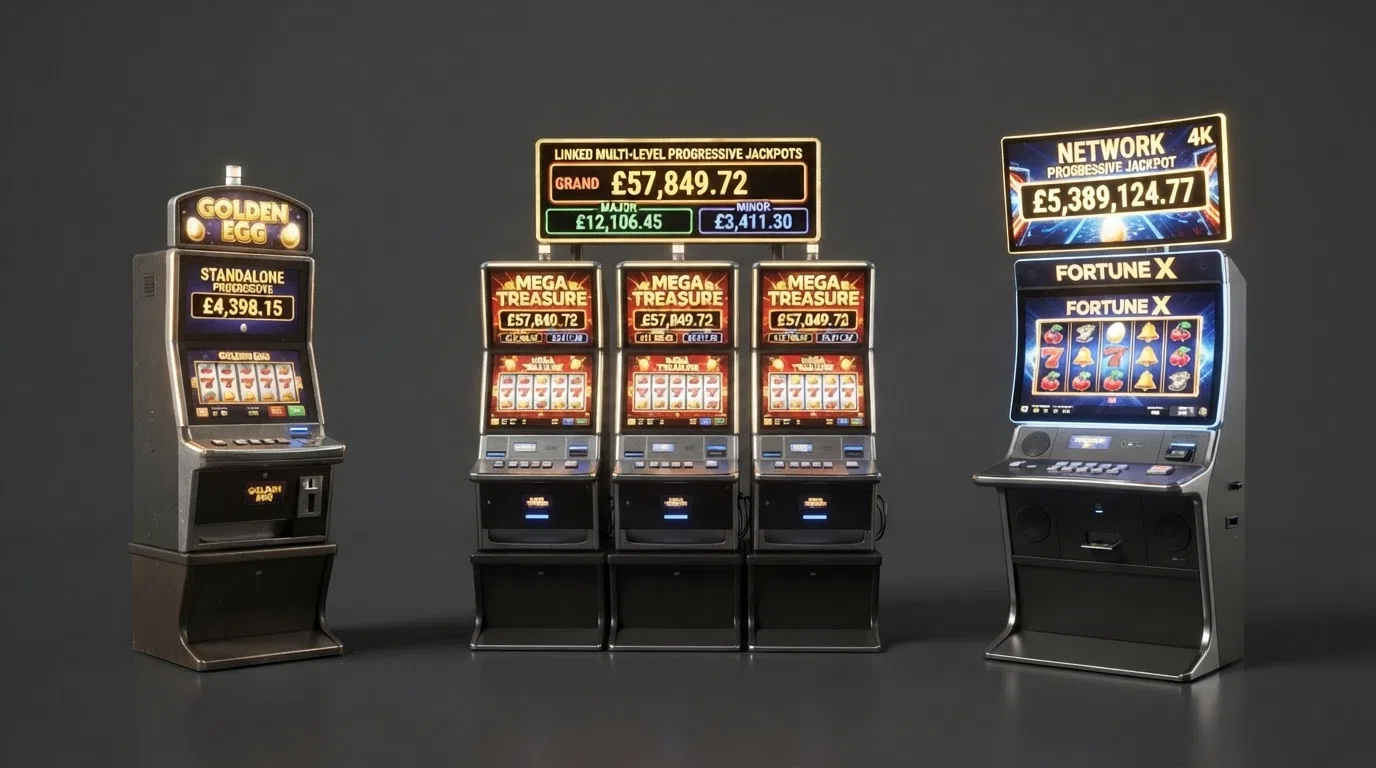
The structural choice is the designer’s trade between prize size and hit frequency. A standalone pays smaller, more often. A wide-area pays life-changing sums, much more rarely.
Mystery vs must-hit-by: two ways a jackpot decides it is time to pay
A traditional progressive uses a fixed trigger condition — a symbol combination on a payline, a bonus wheel, a random pick. The trigger fires when it fires, and the meter can sit at any value when it does.
A mystery jackpot is a progressive where the trigger point is chosen randomly by the game client, somewhere between the seed and a ceiling, and the player does not see a countdown. Must-hit-by progressives are a sub-type where the ceiling is publicly displayed and the game is guaranteed to pay before reaching it. Red Tiger’s Daily Drop is a must-hit-by-by-time format: daily jackpots must pay before midnight, hourly jackpots within the hour. The visible countdown is the marketing surface; the underlying guarantee is what distinguishes must-hit-by from mystery.
For a UK player, must-hit-by titles compress the time horizon. A traditional networked progressive can sit at £3 million for months; a Daily Drop pays out every day by definition.
Video slots, penny slots and the progressive format: what the label actually means
“Progressive” describes the jackpot mechanic, not the slot format. Most progressive titles in the UK lobby are video slots — five-reel games with bonus features and a separate jackpot trigger. Penny slots (or 1p slots) are a stake-size label, and the two can overlap: Divine Fortune is playable from £0.01 per spin at UK casinos, and the £2 or £5 stake cap is the ceiling on what a player can actually stake on that spin, not the floor.
The UK stake cap interacts with minimum-bet progressives in a specific way. A 1p spin on a progressive is well within the £2/£5 cap, but the per-spin cost of the jackpot contribution scales with the bet. A £0.01 spin on a 5% contribution rate sends £0.0005 to the pool; a £5 spin sends £0.25. The contribution is a fraction, and the fraction is the same regardless of the stake — the difference is the absolute number of pennies feeding the meter, and that is what changes the time it takes the pool to grow.
Why a progressive slot’s base RTP is lower — and whether the trade-off is worth it
The base-RTP gap: what a progressive slot costs you that a regular slot does not
The base game on a progressive slot typically returns 88% to 92% of wagers to the player, compared with a 96% industry average on non-progressive video slots. The gap is the jackpot contribution — 1% to 5% of every bet diverted to the pool. On £100 of wagering, a 92% base RTP slot returns £92 in base-game winnings and sends £3 to the jackpot pool; a 96% non-progressive slot returns £96 on the same £100 and sends nothing to a pool.
Mega Moolah illustrates the distinction precisely: its base RTP is 88.12%, and the figure rises to 93.42% when the ~5.3% jackpot contribution is included. Neither figure includes the rare event of the jackpot trigger itself; the trigger is a separate event with a separate payout, layered on top of the base-game return. The published RTP is what a player can statistically expect over a long session, without the jackpot; the figure with contribution is what they can expect including the average drip back from the pool’s smaller tiers.
The arithmetic is unforgiving. On a £100 wagered session, the difference between a 92% base RTP and a 96% RTP is £4 in expected return. The progressive costs £4 in base-game value per £100 staked; the regular slot does not have that cost. Whether the jackpot justifies the cost depends on how the player values the shot at the headline prize.
The odds of hitting a progressive jackpot — and what they actually compare to
The probability of triggering a major progressive jackpot on any single spin runs between roughly 1 in 5 million and 1 in 50 million for networked titles. The range is wide because different networks and different tiers set different trigger conditions, but the order of magnitude is consistent.
For comparison, the UK National Lottery jackpot odds are approximately 1 in 14 million. A 1 in 5 million progressive is roughly three times as likely to hit on any given spin as the lottery is on any given ticket; a 1 in 50 million progressive is roughly four times less likely. The lottery is a useful reference point because most adults understand the scale of the odds, even if they buy tickets anyway.
At the UK stake cap of £5 per spin, a player running 600 spins per hour is making 3,000 wagering decisions per hour. Even at the most generous end of the trigger range (1 in 5 million), the expected time to hit a major jackpot is in the thousands of hours of continuous play. At the longer end (1 in 50 million), the expected time is measured in tens of thousands of hours. The trigger probability is a structural fact about the game, not a budget the player can outrun.
Progressive vs regular slots: when the trade-off makes sense
Three questions sharpen the decision for a UK player. First, the bankroll impact: how much does the lower base RTP cost over the session you actually plan? A £50 session at 92% base RTP costs about £2 more in expected loss than the same session at 96%. That is the price of the ticket. Second, the jackpot size: is the current meter high enough to justify the cost? A progressive sitting at the £1 million seed is not paying for the contribution; a progressive sitting at £5 million is closer to the ceiling where the designer’s lever starts to shift back. Third, the stake cap: at £5 per spin, the worst-case per-spin loss is bounded, but the cumulative cost of chasing a jackpot that may never hit is the RTP gap multiplied by the total wagered.
The defensible position is to treat the RTP gap as the price of a ticket into a lottery-like event, not as a hidden cost. The progressive is a reasonable choice when the player has decided what that ticket is worth and is willing to pay the gap knowingly. It is a poor choice when the player is paying the gap without understanding that the base game is returning less by design.
Player winnings are not taxed in the UK. The full jackpot is the player’s, and operator-side duty does not flow through to the payout. This is a small but real positive: every pound of the headline prize is also the take-home.
What demo mode can and cannot tell you about a progressive slot
How to play progressive slots free at UK-licensed casinos
Every featured operator on this page offers demo mode on at least selected progressive titles, and several offer it across the wider slot lobby. Access requires age verification on the licensed site — since 7 May 2019, GB licensees must verify name, address and date of birth before any gambling activity, and that extends to free-to-play games on the licensee’s own domain. A player who has cleared verification on the operator’s site can load a progressive in demo mode from the game lobby without funding an account.
Demo play runs in-browser without a download at most sites. The same game client loads either way; the difference is the wallet behind the spins. In demo mode, the random number generator runs identically to the real-money game, but the bankroll is virtual and the jackpot contribution is notional.
The limits of free play: what a demo spin leaves out
Three things a demo session cannot show.
The RTP gap is invisible in demo mode. The base-game return and the jackpot contribution both run on the same maths as the real-money game, but no real money is being wagered, so the per-spin cost of the contribution does not register as a loss. A player who learns the game in demo mode and then switches to real money is encountering a new cost line, and the cost is structural.
The psychological weight of real losses is absent. Losses disguised as wins are banned in UK-licensed games, so the audio and visual feedback no longer celebrates a sub-stake return — but a real loss is a real loss in a way a virtual one is not. Demo mode trains the mechanics; it does not train the bankroll pressure.
Session-tracking and deposit-limit prompts are live-site features only. The mandatory session timer, total loss and total win display and the deposit-limit prompt before the first deposit live in the live-site client and do not appear in demo mode. A player who has only ever played a progressive in demo will see these surfaces for the first time when they fund an account, and the first session is the worst time to be surprised by them.
The British regulatory framework every progressive slot operates under
The age-banded stake cap: why your age sets your maximum bet
The most distinctive feature of the UK online slots model is the age-banded stake cap. Players aged 25 and over can stake up to £5 per game cycle; players aged 18 to 24 can stake up to £2 per game cycle. The cap came into force under SI 2025/215 — the £5 tier from 9 April 2025 and the £2 tier from 21 May 2025.
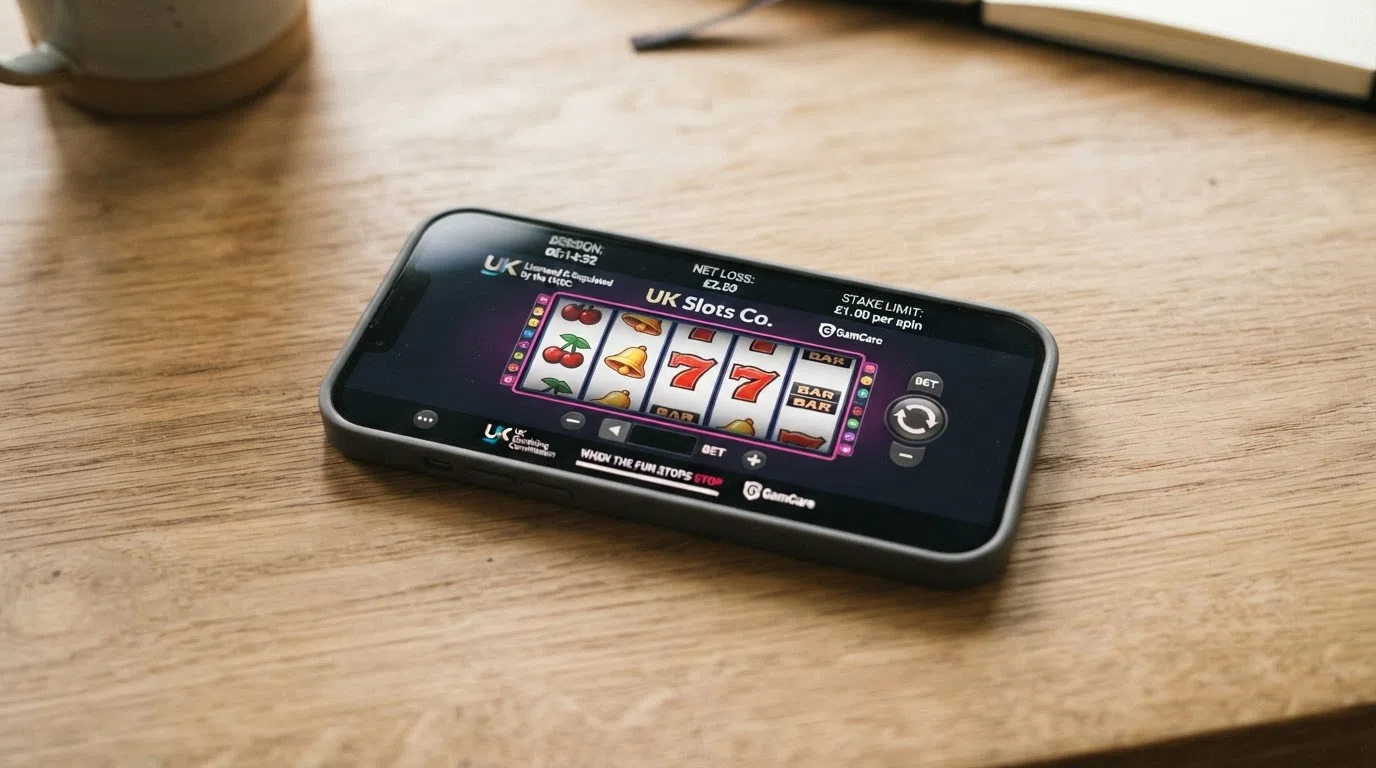
A “game cycle” is the period from initiation to final outcome. Free-spin rounds within the same slot count as part of one cycle, so the cap applies to the total staked within that cycle rather than to each individual button press. Two adults at the same casino on the same evening can face different maximum bets on the identical game, and a 24-year-old can stake 60% less per spin than a 25-year-old on the same slot.
No equivalent cap exists in any other major gambling jurisdiction. The British model is the first to set the maximum stake by player age, and it sits alongside a ban on credit cards, a 10× wagering cap on bonuses, and a session-tracking requirement. The system caps the stake per spin and compels the offer of a deposit limit; it does not impose a nationwide deposit, loss or spend ceiling.
What the UK banned: auto-play, turbo spins and losses dressed as wins
A set of game-design rules came into force on 31 October 2021 that changed how every UK slot session feels, and they apply to progressive titles as much as to non-progressive ones.
Auto-play is banned. Players must press the spin button themselves for each game cycle. Features that speed up play are banned. Spin speed cannot be faster than 2.5 seconds per game cycle. Losses disguised as wins — audio or visual celebration of a return that is at or below stake — are banned. Reverse withdrawals are permanently banned, so a player cannot change their mind about a withdrawal and push it back into the betting balance.
Operators must display total losses, total wins and time played during a slots session. The display is mandatory, and it is what makes the session’s true cost visible to the player as it happens. The combination — no auto-play, no turbo, no disguised losses, no reverse withdrawals, mandatory tracking — is the structural reason a UK slot session plays more slowly and reads more honestly than an unregulated equivalent.
Bonus rules, ID checks and the 10× wagering cap
Three rules shape the welcome offer on a progressive slot at a GB-licensed site.
Wagering requirements on bonus funds are capped at 10× since 19 December 2025, under LCCP Social Responsibility Code 5.1.1. Mixed-product promotional offers — “stake £10 on football, get free spins” — are banned. The cap is on the bonus amount, not the deposit plus bonus, and it is the figure the wagering multiplier in the operator table above is measured against.
Identity verification is required before any deposit or bonus claim since 7 May 2019. The verification covers name, address and date of birth, and it extends to free bets and bonuses. The check is what makes anonymous play impossible at a GB-licensed site.
Direct marketing requires an explicit opt-in per product and per channel since 1 May 2025. The opt-in rule means a player must actively tick to receive promotional communications on each channel they choose — and a tick for slots does not cover sports or bingo.
Crypto, anonymity and progressive slots: the reality inside the UK licensed market
Crypto deposits and anonymous play do not exist inside the GB-licensed system. Cryptocurrency deposits are not supported at GB-licensed sites, and full identity verification makes anonymity impossible at any licensed site. Furthermore, the credit card ban since 14 April 2020 extends to payments routed through e-wallets funded by credit cards — which closes the indirect route to anonymous funding.
The offshore alternative is a different product. Crypto-friendly sites operate without a GB licence, which means a GB customer is gambling on an unlicensed site. Players face no criminal penalty for doing so, but they lose every UK protection: no GAMSTOP, no Commission complaints route, no alternative dispute resolution, no British consumer redress. The offshore site is not a more permissive version of the UK product; it is a separate product with a separate rule set, and the protections the UK has built are exactly what the player gives up.
Offshore sites and the protections a UK player gives up
A GB licence is compulsory for any operator serving GB customers, under the Gambling (Licensing and Advertising) Act 2014’s point-of-consumption reform. A Curaçao, Maltese or Gibraltar licence is not a substitute. Providing gambling facilities without a GB licence is a criminal offence under section 33 of the Gambling Act 2005, carrying up to 51 weeks’ imprisonment, an unlimited fine, or both — the penalty is on the operator, not the player.
The UKGC’s enforcement model is disruption, not blocking. The Commission issues cease-and-desist notices, refers URLs to search engines for delisting, applies pressure to domain registrars and payment providers, and works with international regulators. Between April 2024 and June 2025, the Commission issued 3,140 disruption notices, referred 447,778 URLs to search engines and saw 287,961 removed. Engagement across 160 disrupted sites fell by an average of 32% over the period. The Commission does not currently hold statutory ISP or DNS blocking powers — legislation has been proposed but not enacted.
What a player loses on an unlicensed site is the British safety net: GAMSTOP self-exclusion, the financial vulnerability check at £150 net deposit, the National Gambling Helpline infrastructure, the Commission’s complaints route, and the ADR mechanism. The unlicensed site is not a better deal in any verifiable sense; it is a different deal with the protections stripped out.
The safer-play tools every UK progressive slots player has — and the numbers behind them
The deposit-limit system: what the UK requires before your first spin
Operators must prompt customers to set a financial limit before their first deposit, in force since 31 October 2025. The prompt is mandatory and appears before any deposit can be made. From 30 September 2026, a gross deposit limit — based solely on money paid into the account over a set period — must be offered with at least equal prominence to any other financial limit. The “gross” framing matters: it counts money in, not net of withdrawals, and only that form may be called a deposit limit.
The distinction between a stake cap and a deposit limit is the architecture of the British model. The stake cap is set by the state at £5 or £2 per game cycle. The deposit limit is set by the player, with the state requiring the operator to make the offer. The state does not impose a nationwide deposit, loss or spend ceiling; it caps the spin and compels the offer of a limit, and the level is the player’s call.
GAMSTOP, GamCare and the National Gambling Helpline: where to go
Three pillars of UK player support sit behind every GB-licensed slot session.
- GAMSTOP is the national self-exclusion register. It is mandatory for every GB-licensed online operator since 31 March 2020. Exclusion periods run six months, one year, five years, or five years with auto-renewal. Exclusion cannot be cancelled early, and a registration continues for up to seven years after the minimum period if not actively deactivated.
- GamCare runs the National Gambling Helpline on 0808 8020 133, a 24/7 free and confidential line, and offers counselling, live chat, group chat and forums.
- GambleAware provides self-assessment tools and treatment referral, and funds the National Gambling Support Network. NHS gambling harm clinics are available in England, Scotland and Wales. Gamblers Anonymous runs peer support meetings.
The prevalence data: how many UK players experience harm
The safety infrastructure exists because the prevalence data justifies it. The NHS Adult Psychiatric Morbidity Survey 2023–24 found 0.4% of adults in England experienced problem gambling (PGSI 8+) and 1.6% experienced at least moderate risk gambling (PGSI 3+). GambleAware’s Annual Treatment and Support Survey 2024 found 13.1% of GB adults — approximately 6.8 million people — were classified as experiencing any level of gambling problems (PGSI 1+).
The treatment side shows the demand. The National Gambling Helpline made 996 referrals to treatment and peer-based support services in January 2026, a 48% increase on January 2025’s 674. The National Gambling Support Network treated 11,960 clients between April 2024 and March 2025, an 11% year-on-year increase.
Progressive slots sit inside this safety net, and the prevalence figures are the reason the net is mandatory rather than optional. A session on a progressive at a GB-licensed site carries the same mandatory protections as any other licensed game: stake cap, ID verification, session tracking, GAMSTOP, financial vulnerability checks, and the helpline on speed dial.
How we selected and ranked the progressive slots and casinos on this page
The ten operators are confirmed active on the Gambling Commission’s public register, which lists 2,666 businesses and was last refreshed on 29 July 2026. The slot-title data — RTP, provider, jackpot network — is sourced from SlotCatalog, Rtptrack.com, sportsmole.co.uk and igamingwriter.blog. Bonus terms are checked against each operator’s published offer as of 2026; wagering multipliers, free-spin values, and validity windows are drawn from the operator’s own terms page.
The regulatory facts are sourced from the Gambling Act 2005, the LCCP (Licence Conditions and Codes of Practice), the Remote Technical Standards (RTS), and SI 2025/215. Prevalence data is sourced from the NHS Adult Psychiatric Morbidity Survey 2023–24 and the GambleAware Annual Treatment and Support Survey 2024. Helpline data is from GamCare.
The ranking criteria: active GB licence, progressive slot range across the major providers, bonus terms (wagering multiplier, free-spin count, validity, wager-free status), and demo-mode availability. Operators are listed in the order research ranked them; the comparison table above carries the specific data for each.
What to weigh before you spin: the progressive slot decision
Three numbers hold the decision together.
The RTP gap: a progressive base game at 88–92% versus a 96% industry average means a progressive costs roughly twice as much in expected loss per session as a regular slot at the same stake. The gap is the price of the ticket. The question is whether the player has decided what that ticket is worth.
The odds: a 1-in-5-million to 1-in-50-million trigger probability means most sessions end without a jackpot, and the lower base RTP is the constant rather than the exception. The headline prize is the lottery ticket; the base game is the cost of buying it.
The stake cap: at £5 per spin for the 25-and-over band and £2 for the 18-to-24 band, the worst-case per-spin loss is bounded, but the cost of chasing a jackpot that may never hit is measured in the accumulated RTP penalty across the session. The cap is what makes the worst case calculable; the choice of how long to play is the player’s.
The verdict: a progressive slot is a defensible choice when the jackpot has grown well above its seed and the player is treating the RTP gap as the price of a ticket, not as a hidden cost. It is a poor choice when the gap is being paid unknowingly. Player winnings are untaxed, so every pound of the headline prize is also the take-home, and the operator-side burden is not the player’s problem — but the operator-side burden is also not the player’s compensation for a base game that returns less by design.
Frequently Asked Questions
What is the difference between standalone, local, and wide-area progressive jackpots?
A standalone progressive is one machine with one jackpot — the smallest pool and the fastest hits. A local progressive links a few machines on the same site or operator network, producing a mid-sized pool. A wide-area (networked) progressive links thousands of machines across operators, producing the largest pools but the longest individual odds. The Mega Moolah Mega tier is a wide-area example, while Jackpot Giant is a standalone. The wider the network, the larger the pool and the rarer the hit.
What are the odds of winning a progressive jackpot on a UK slot?
The probability of triggering a major networked progressive jackpot on a single spin typically runs between 1 in 5 million and 1 in 50 million, depending on the title and tier. For context, the UK National Lottery jackpot odds are roughly 1 in 14 million. At the UK maximum stake of £5 per game cycle, even the most generous end of that range implies thousands of hours of play to expect a single hit.
What is the maximum stake allowed on online slots in the UK for under-25s?
Players aged 18 to 24 are capped at £2 per game cycle, in force since 21 May 2025 under SI 2025/215. The cap for players aged 25 and over is £5 per game cycle, in force since 9 April 2025. A “game cycle” covers the period from spin initiation to the final outcome, including free-spin rounds within the same slot. The cap applies to total staked within the cycle rather than to each individual button press.
Do I pay tax on progressive jackpot winnings in the UK?
No. Player gambling winnings are not taxed in the UK; player-side betting duty was abolished in 2001 and the tax burden sits with operators through Remote Gaming Duty and the statutory levy. The full jackpot amount is the player’s, and no tax is deducted at the point of payout. The headline prize is also the take-home prize.
Is it safe to play progressive slots at UK-licensed casinos?
Safety at a GB-licensed site is structural rather than discretionary. The site must hold an active UKGC licence, verify identity before any deposit, cap stakes at £5 or £2 per cycle, display session losses and time, offer a deposit-limit prompt before the first deposit, run GAMSTOP, and apply financial vulnerability checks at £150 net deposit in a rolling 30-day period. Offshore sites do not offer any of these protections, and the protections are the reason to play licensed.
Can I play progressive slots for free in the UK?
Yes, on the demo mode of any GB-licensed site that offers it. The featured operators on this page all offer demo mode on selected progressive titles. Age and identity verification are required before free play on a licensee’s own site, in force since 7 May 2019. Demo mode runs the same game client and the same random number generator, but the bankroll is virtual, the jackpot contribution is notional, and the RTP gap does not register as a real loss. Demo mode is a learning tool, not a predictor of real-money returns.
Slots – nonukgc-licensedcasinos
Content created by the «nonukgc-licensedcasinos» team