
Direct-Banking Casinos in the UK: How Pay by Bank Became the Default
 Available in GB
The credit card vanished from UK casino cashiers in April 2020, and what replaced it was never a like-for-like substitute. Direct banking, the account-to-account payment method that links a player’s bank app to a casino cashier without typing a card number, has quietly become the default way British players fund their accounts. Open Banking payments reached 351 million across the UK in 2025, up 57% on the previous year, and now represent roughly 7.9% of all Faster Payments volume. Within the regulated UK casino footprint, account-to-account Open Banking deposits have moved to a majority share. The fallback for everyone who still wants to type sixteen digits into a web form is a debit card, which leads the deposit method mix at 45%. The e-wallet category sits at 15%, and one of its best-known names, PayPal, has been quietly dropped from bonus eligibility at some operators or removed from the cashier altogether at others.
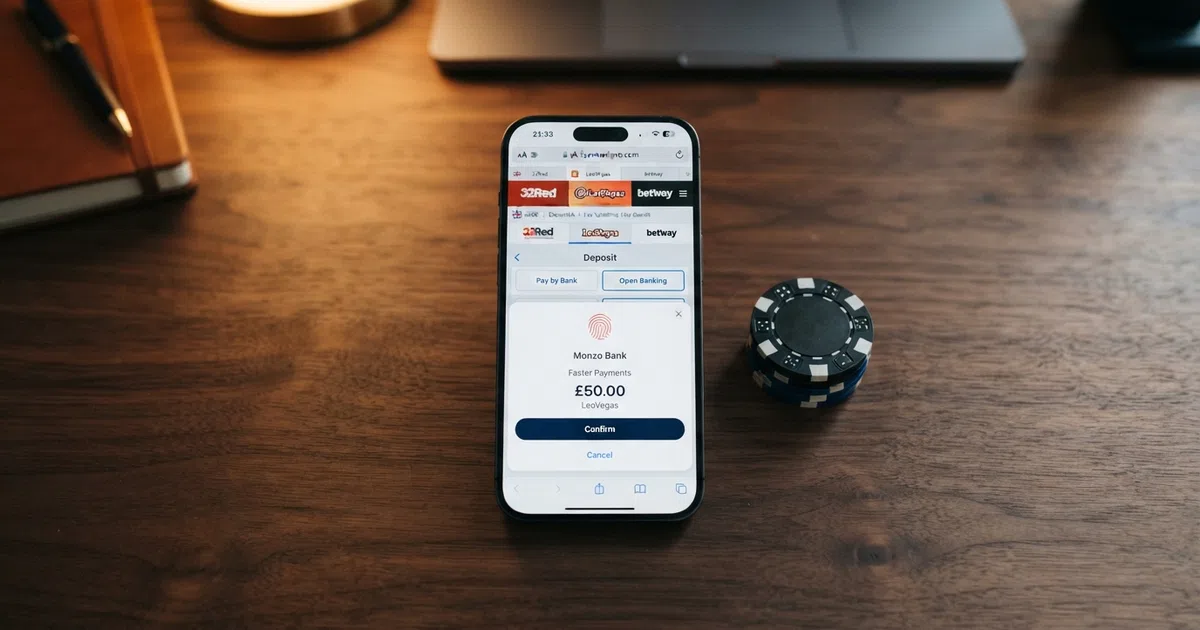
The change matters for anyone comparing welcome offers. The bonuses attached to direct-banking deposits are not the same as the bonuses attached to PayPal, and the difference is often buried in the small print. This page ranks ten UKGC-licensed casino operators on exactly that: confirmed direct-banking integration, welcome-offer value and the terms that decide what a bonus actually costs the player.
*Current as of September 8, 2026 · Licence claims verified against the Gambling Commission’s public register of operating licences.*
Beyond Debit Cards: How Direct Banking Reshaped UK Casino Payments
Direct banking at a UK online casino means an account-to-account payment initiated from the player’s bank app, authenticated by the bank’s own login, and settled through the Faster Payments rail in seconds. The casino never sees a card number, a sort code or an account number. The flow is brokered by a Payment Initiation Service Provider (PISP) — TrueLayer, Tink or Token.io in most cases — and the player confirms the transfer with a fingerprint or face scan on their own phone. The credit card ban of 14 April 2020 forced the shift by closing off the most popular funding method, and direct banking is the rail that took the slack.
The scale of the change is the part most pages understate. Open Banking is no longer a niche payment method. TrueLayer alone processes more than 40% of all UK open banking payments as of July 2025, and 93% of those payments reach merchant accounts in under 15 seconds. Faster Payments runs around the clock, including weekends and bank holidays, which is why a Pay by Bank deposit at two in the morning behaves the same as one at ten past nine on a Tuesday. The number most readers do not see, and the one that explains the rest of this page, is that A2A Open Banking deposits now hold a majority share of regulated UK casino deposits in spring 2026.
Open Banking at a Casino: What It Is and How It Actually Works
The plumbing behind a Pay by Bank deposit is a small stack of services. The casino’s cashier calls a PISP — usually TrueLayer, Tink or Token.io in the UK market — which prompts the player to select their bank and authenticate inside their own banking app. The bank confirms the transfer, the PISP sends a Faster Payments instruction to the casino’s merchant account, and the balance updates in real time. The card number, sort code and account number never leave the player’s own device. The bank authenticates the transaction on its own terms, with its own biometrics, and the casino receives a payment confirmation it can act on immediately.
The detail that decides the rest of the experience is that the rail is Faster Payments, not BACS. Faster Payments settles in seconds; 93% of all open banking payments reach merchant accounts in under 15 seconds in Q1 2025. A traditional bank transfer, by contrast, typically uses BACS for outbound transfers and adds hours to days to the same journey. The provider layer — TrueLayer versus Trustly versus a smaller PISP — is invisible on the casino’s cashier page, but the difference is real. TrueLayer’s market share in UK open banking sits north of 40%, and a cashier powered by TrueLayer will look and feel slightly different from one powered by Trustly. Both settle through the same rail. Neither touches a card.
Every Way to Pay at a UK Online Casino Right Now
The cashier at a UKGC-licensed casino in 2026 offers a familiar mix. Debit cards lead at 45% of deposits, the fallback that survived the credit card ban because debit is not credit. Open Banking and Pay by Bank sit at 25% and growing, the post-ban default that most major operators now promote on the deposit page. E-wallets — PayPal, Skrill and Neteller — account for 15% of deposits, but with a footnote that varies by operator. PayPal is excluded from bonus eligibility at LeoVegas, and Betfred removed PayPal and other e-wallets from the cashier entirely in January 2026. Bank transfer and Apple Pay sit in the long tail: still present, smaller share, useful for the players who prefer them.
The two payment-method rows that matter most for the rest of this page are the Pay by Bank row and the e-wallet row. A player who funds their account through Pay by Bank at an operator that accepts it as a bonus-qualifying method — bet365, LeoVegas, Betfred, Paddy Power, Sky Vegas — gets the welcome offer. A player who funds the same account through PayPal at LeoVegas does not. The deposit clears either way; only the bonus does not.
What a Good Casino Banking Review Actually Tells You — and What Most Leave Out
A banking review that earns its keep names the payment method, the provider behind it and the casino’s own approval window separately. Most affiliate pages collapse all three. “Open Banking” and “traditional bank transfer” are routinely lumped together despite using different rails; the credit card ban is the reason Open Banking adoption surged, but the context is almost never explained; the TrueLayer-versus-Trustly-versus-Volt provider layer is invisible because the cashier page does not surface it.
The two numbers a page should publish, and rarely does, are the deposit completion time and the withdrawal completion time, broken out by payment rail. The deposit time is mostly the rail: Open Banking settles in seconds, debit card deposits clear in minutes, a manual bank transfer takes hours. The withdrawal time is mostly the casino. The rail is fast in both directions, but the operator’s own approval queue — KYC on a first withdrawal, fraud review, a processing timetable that runs on weekdays in office hours — is the variable that decides whether the money lands in two hours or two days. A review that reports the rail speed and the casino speed separately is doing the job. A review that reports only the rail is repeating marketing copy.
Payment Method Breakdown by Operator in 2026
| Casino | Welcome Bonus | Wagering Terms |
|---|---|---|
| Sky Vegas | 200 spins | No wagering |
| LeoVegas | 50 spins | No wagering |
| bet365 | 500 spins | Varies |
| William Hill | 200 spins | 10× wagering |
| Paddy Power | 260 spins | 1× wagering |
| Coral | 100 spins | Not specified |
| Betfred | 200 spins | No wagering |
| Gala Spins | 100 spins | Not specified |
| Betway | 100% match | 50× wagering |
| 888 Casino | 100% match | 10× wagering |
Licence Status Summary
| Casino | Status |
|---|---|
| Sky Vegas | Active |
| LeoVegas | Active |
| bet365 | Active |
| William Hill | Active |
| Paddy Power | Active |
| Coral | Active |
| Betfred | Active |
| Gala Spins | Active |
| Betway | Active |
| 888 Casino | Active |
Sky Vegas — 200 Wager-Free Spins With a Straightforward Trigger
Sky Vegas sits at the top of this ranking for one reason: the bonus is the simplest one in the table. Deposit £10, stake £10, receive up to 200 free spins with zero wagering attached. The winnings are credited as cash, not as bonus funds, which is the difference between a bonus that takes five minutes to understand and a bonus that takes a calculator. Trustly and Open Banking are both supported on the cashier, deposits are instant, and withdrawals are processed within six hours. The seven-day validity from credit is the only constraint — use the spins or lose them within a week.
The arithmetic on Sky Vegas’s offer is the part most reviews skip. A wager-free bonus has no turnover requirement, which means there is no turnover to compute, no expected loss to estimate, and no spin count to time. The £10 deposit and £10 stake are qualifying conditions, not the start of a wagering clock. What the player gets in return is whatever the spins return, paid as cash, withdrawable immediately. The trade-off is the headline: 200 spins sounds smaller than a 100% match up to £100, but the wager-free terms make it worth more in practice. The 10× cap, in force since December 2025, is the regulatory ceiling that no UK bonus can now exceed. Sky Vegas sits well below it, which is the standard for player-friendly offers.
LeoVegas — 50 Wager-Free Spins, Low Barrier, No Strings
LeoVegas offers the lowest-commitment entry in this ranking. Fifty free spins on Big Bass Splash, worth 10p each, with no wagering on the winnings. The minimum deposit is £10 by debit card or Open Banking, and the offer explicitly excludes PayPal. The 7-day claim window and 3-day spin expiry are the only time pressures, and the slot is named on the offer page rather than left to a footnote. The game providers behind the wider lobby — Pragmatic Play, NetEnt, Evolution, Play’n GO — cover the bulk of the UK online casino catalogue.
The PayPal exclusion is the detail that decides who this offer works for. A player funding their account through a debit card or through Open Banking via Pay by Bank gets the 50 spins. A player funding through PayPal — which LeoVegas still accepts as a payment method — does not. The exclusion is published on the offer page, but it is the kind of clause a player skims past, and the cost of missing it is discovering at the spin stage that the bonus has not been credited. Open Banking as a qualifying deposit method is a feature, not a default, and the operator that lists it explicitly is doing the player a favour.
bet365 — The TrueLayer Standard-Bearer With the Deepest Free-Spin Pool
bet365 partnered with TrueLayer to put Pay by Bank at the front of the UK checkout, and the result is the cleanest direct-banking integration in this ranking. Deposits are instant, withdrawals return directly to the player’s bank account, and the cashier promotes Pay by Bank as the recommended option. The welcome offer scales with stake: a £10 stake unlocks up to 500 free spins in the casino, or a £10 sports bet unlocks £30 in free bets. The game providers include Playtech, NetEnt and Microgaming, and the UKGC operating licence number 39569 is confirmed active on the public register.
The variable spin count is the unusual feature of the bet365 offer. A stake of exactly £10 might unlock 100 spins, 200, 300 or the full 500 depending on the eligible game and the moment a player claims. The maximum is the headline; the floor is what the player actually receives. The Pay by Bank recommendation is the structural point: bet365 has built its cashier around the assumption that most UK players will fund through direct banking, and the rest of the offer is designed to be claimed that way. The alternative debit card deposit still unlocks the bonus, but it lacks the direct-banking speed.
William Hill — 200 Spins on Big Bass Splash With a 10× Wagering Hurdle
William Hill is the operator where the arithmetic changes. The headline is 200 free spins on Big Bass Splash at 10p each, which looks identical to Sky Vegas or Betfred on first reading. The difference sits one clause below the headline: 10× wagering on the free-spin winnings, with a 72-hour spin expiry after a 7-day claim window. A £10 deposit and £10 stake are still the qualifying trigger. Open Banking availability is not independently confirmed on William Hill’s own cashier pages this run, and a player specifically choosing Pay by Bank should verify before depositing.
The 10× wagering figure is the regulatory ceiling in force since 19 December 2025. A bonus at 10× is not a violation; it is the maximum the rules now permit. The real cost of a 10× wagering requirement is computed as turnover of bonus × 10. If a player clears all 200 spins and wins £20, the wagering required is £20 × 10 = £200 of additional slot play before withdrawal. At a 96% RTP, the expected cost of clearing that £200 is £8. The bonus is still worth claiming, but the £8 is a number the wager-free alternatives above do not charge. William Hill sits at the cap; the wager-free offers sit below it.
Paddy Power — The Only Featured Operator With Genuinely Deposit-Free Spins
Paddy Power is the only operator in this ranking whose welcome offer begins without a deposit. Sixty free spins, no deposit required, no wagering on the winnings. A further 200 spins are triggered by a £10 deposit and a £10 wager at 1× wagering, and the total headline is 260 spins over a 7-day validity window. Trustly and Open Banking are both supported on the cashier, deposits are instant, and withdrawals are processed within two hours. The game providers include Blueprint and IGT alongside Paddy Power’s proprietary content.
The no-deposit component is the genuinely rare part. Open Banking is a deposit method, not a bypass, and most UK-licensed operators tie their welcome offer to a qualifying deposit. Paddy Power’s 60 deposit-free spins are the only entry in this table that credits before a player has funded the account. The 1× wagering on the deposit-triggered 200 spins is a light-touch requirement compared to the 10× cap; the expected cost of clearing 1× on any winnings is a fraction of the cost at the regulatory ceiling. The 7-day validity is the only pressure, and 2-hour withdrawals set the speed benchmark for the rest of this ranking.
Coral — 100 Free Spins, Low Entry, Unclear Wagering
Coral is an Entain-group mainstay with a 100-free-spin welcome offer triggered by playing £10 on any slot. The spins are worth 10p each on selected games, and the time window is 48 hours to accept and 7 days to use. Where Coral differs from the entries above is the wagering: the requirement is not specified on the public offer page, and the current terms and conditions should be verified before depositing. Open Banking availability is not independently confirmed on Coral’s own cashier pages this run, and debit card is the verified deposit method.
The verification request is the point of the entry. Coral’s licence is active, the game providers under the Entain group platform (Playtech among others) are reputable, and the offer is competitive on the headline. The unknown is the wagering requirement attached to free-spin winnings — a 10× requirement would match the regulatory ceiling, a 1× requirement would be lighter, and the offer page does not say which. Consult the full T&Cs before claiming to avoid an unpleasant surprise on turnover.
Betfred — 200 Wager-Free Spins, TrueLayer-Powered Deposits
Betfred is the wager-free counterpart to William Hill. Two hundred free spins at 10p each with no wagering, triggered by a £10 debit card deposit and a £10 stake. Open Banking is powered by TrueLayer and integrated into the cashier, deposits are instant, and the spin validity runs 7 days. The headline that changed in January 2026 is the cashier itself: PayPal and other e-wallets were removed entirely, leaving debit card, Apple Pay, Open Banking and bank transfer as the funding options.
The TrueLayer integration is the structural point. Where most operators accept Open Banking as one option among many, Betfred has built the cashier around a TrueLayer-powered Pay by Bank flow and pruned the e-wallet category back. The e-wallet removal makes the bonus more accessible rather than less: a player who would have funded through PayPal at a competitor and missed the bonus can now fund through Open Banking and claim it. The 200 wager-free spins sit in the same value tier as Sky Vegas and Paddy Power’s no-deposit component, and the TrueLayer rail is the fastest confirmed withdrawal time in the table at 2 hours.
Gala Spins — 100 Free Spins From the Entain Stable, Banking Details Thin
Gala Spins sits in the Entain group, alongside Coral, and the welcome offer follows the same pattern: 100 free spins at 10p each for a £10 deposit and £10 slot spend on selected featured slots. The 7-day claim-and-use window is the timing constraint, and the wagering requirement is not specified on the public offer page. The Entain group platform supports Open Banking, but Gala-specific confirmation is not available from Gala’s own cashier pages this run, and a player who specifically wants Pay by Bank should verify with the operator before depositing.
The shared Entain platform is the upside. A player who has used Open Banking at Coral or another Entain-group brand is likely to find the same flow at Gala, because the cashier infrastructure is built once and shared. The verification request is the same as for Coral: the bonus trigger is clear, the wagering is not, and the terms should be checked before depositing.
Betway — The Cash-Match Outlier With a Legacy Wagering Figure
Betway is the only featured operator offering a traditional percentage match bonus rather than free spins. The offer is 100% up to £50 on a first deposit of £10 or more, with a 7-day validity. The wagering figure of 50× the bonus amount is the outlier: it exceeds the 10× statutory cap that took effect on 19 December 2025, which means the 50× is either a pre-cap legacy listing or an error that should be checked against current terms. Debit card is the confirmed deposit method; Open Banking availability is not independently confirmed on Betway’s own cashier pages this run.
The 50× figure is the single most important number on this page. If it is current, the bonus is non-compliant with the LCCP cap and the player should not claim it. If it is a pre-cap legacy listing that has not been refreshed, the player should confirm the current wagering requirement before depositing. Either way, the verification step is mandatory. A 50× wagering requirement on a £50 bonus is £2,500 of required turnover, and the expected cost of clearing that at 96% RTP is £100 — exactly the bonus value. The bonus returns zero in expectation at 50×, which is the arithmetic that the 10× cap exists to prevent.
888 Casino — The Highest Cash Match With the Longest Wagering Window
888 Casino is the second of the two cash-match offers in this ranking, and the only one that sits at the regulatory ceiling rather than above it. The bonus is 100% up to £100 on a first deposit of £10 or more, with 10× wagering on selected slots and a 90-day clearance window — the longest wagering window in the ranking. The 48-hour claim window is short; the 90-day clearance is generous. Proprietary Section 8 Studios content runs alongside NetEnt, Playtech and IGT, and the platform supports a wide slot catalogue. Open Banking availability is not independently confirmed on 888 Casino’s own cashier pages this run.
The 90-day clearance is the unusual feature. A player who can spread £100 of bonus wagering across three months has time to wait out variance, play on selected slots only, and meet the requirement without rushing. The trade-off is the short claim window — 48 hours to opt in from registration. A player who does not claim the bonus in the first two days loses it. The 10× wagering is the regulatory maximum, and the bonus arithmetic is the same as for William Hill: at 96% RTP, clearing a £100 bonus at 10× carries an expected cost of £40. The 90 days make that easier to absorb than a 7-day window, but the cost is the same.
Why Your 2026 Casino Withdrawal Is Faster — or Slower — Than You Expect
The deposit half of direct banking is the half every review handles. The deposit clears in seconds because the rail is Faster Payments and the PISP does the heavy lifting. The withdrawal half is the part that decides how the player actually feels about the operator, and the arithmetic is different. Open Banking withdrawals return funds to the player’s bank account over the same Faster Payments rail used for deposits, which means the rail is the same fast rail in both directions. The bottleneck is the casino’s own approval queue. As one industry source puts it, withdrawals are processed “within seconds to a maximum of two hours once the operator approves them”. The two parts of that sentence do different work: the seconds are the rail, the two hours are the operator.
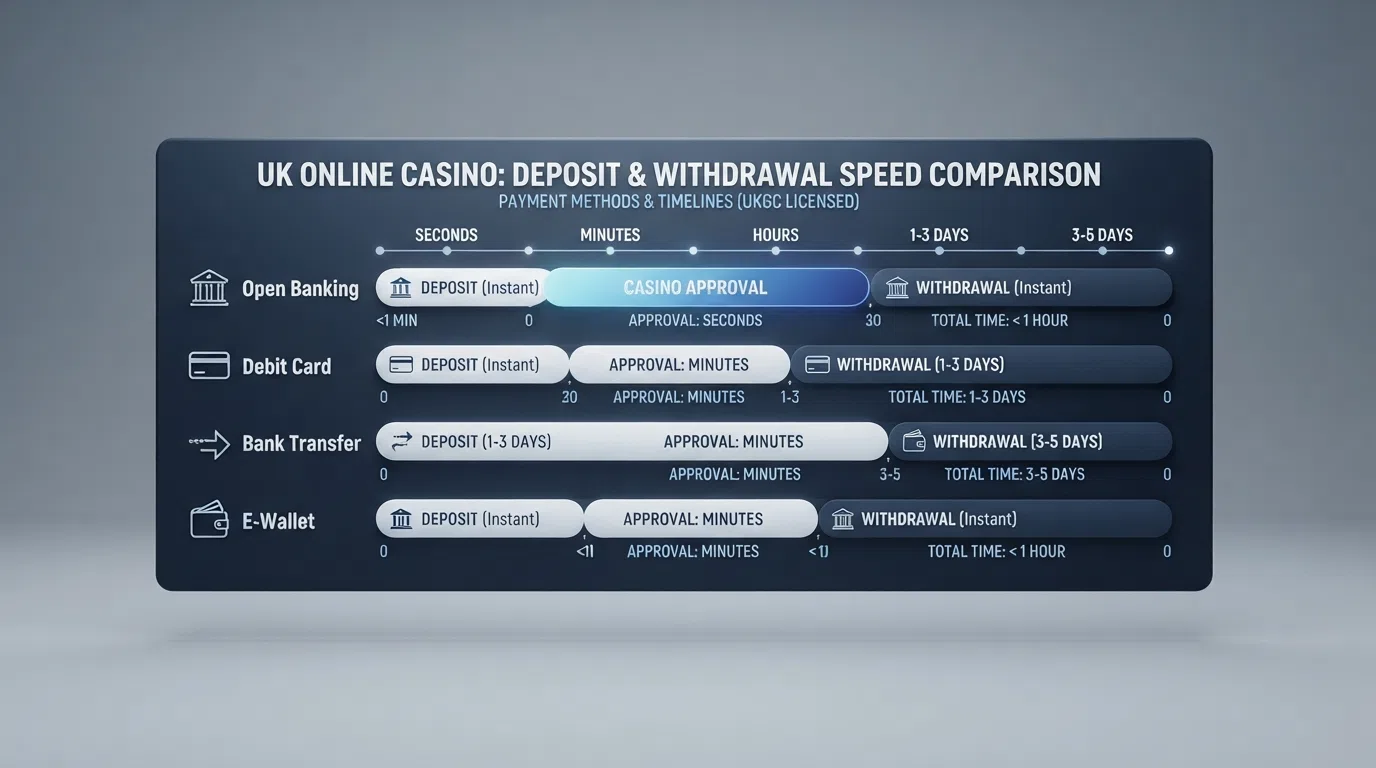
Every withdrawal passes through three stages before the payment rail even matters. First, the player requests the withdrawal from the cashier. Second, the operator’s internal team reviews the request — this is the approval queue, and it is where KYC checks, fraud review and the operator’s own processing timetable live. Third, the rail settles the transfer. The first withdrawal at a new casino is always slower than the second because KYC has not been completed yet. Every UK-licensed casino must verify name, address and date of birth before any deposit or gambling, but a player who has not previously withdrawn from a particular operator can still hit a KYC delay at the withdrawal stage if the original verification used partial data. The rail is the same in both cases. The casino is the variable.
How Direct Banking Deposits Work at UK Casinos
The deposit flow begins at the cashier when the player selects Pay by Bank. The cashier redirects to a PISP page — TrueLayer, Tink or Token.io in most cases — and the player selects their bank. The PISP hands the player off to their own banking app, where the bank authenticates the transaction with the player’s normal login: typically a fingerprint, a face scan, or a PIN. The bank then authorises a Faster Payments transfer from the player’s account to the casino’s merchant account. The PISP confirms the transfer to the casino, the casino’s balance updates, and the player sees the funds available for play. The whole sequence, from cashier click to balance update, completes in under 15 seconds for 93% of payments in Q1 2025.
The detail that matters is what the casino never sees. The card number, the sort code, the account number and the login credentials all stay on the player’s side of the flow. The PISP brokers the transfer; the bank authenticates the player; the casino receives a payment confirmation. This is the structural difference between Open Banking and a debit card payment, where the casino receives card details it must then handle under PCI DSS. The Open Banking flow is simpler, faster, and exposes less surface area for fraud. It is also the flow that 40% of all UK open banking payments now run through, because TrueLayer has built the integration most casinos default to.
Open Banking Withdrawals: The Fastest Route Back to Your Bank Account
A withdrawal is the same rail run in reverse, and that is the part most players do not expect. The casino’s cashier calls the PISP, the PISP initiates a Faster Payments transfer from the casino’s merchant account to the player’s bank account, and the funds arrive in seconds once the operator has approved the request. The rail speed is not the variable. The casino’s own approval is. A player who withdraws at an operator with a 2-hour approval window sees the funds in their bank within two hours of clicking withdraw. A player who withdraws at an operator with a 24-hour approval window sees the funds the next working day, even though the rail would have settled in seconds.
The mandatory KYC step is the other delay that a first withdrawal adds. Every UK-licensed casino must verify name, address and date of birth before any deposit or gambling, and that verification carries over to withdrawals in practice. A player who has already deposited at the casino and provided documents has cleared this step, and a first withdrawal at an existing casino is faster than a first withdrawal at a new one. The “pending” status a player sees in the cashier is the casino’s processing time, not a payment-rail delay. The rail is waiting. The casino is the queue.
Instant Banking vs Traditional Bank Transfer: What the Clock Actually Says
Pay by Bank and a traditional bank transfer are not the same thing, and the difference is the part most affiliate pages get wrong. Pay by Bank uses a PISP to initiate a Faster Payments transfer from inside the casino cashier, with the player authenticated by their own bank app. The flow is automated, the rail is Faster Payments, and the settlement takes seconds. A traditional bank transfer means the player leaves the casino site, logs into their bank’s web portal or app, sets up the payee with a sort code and account number, and sends the funds manually with a reference number. The rail may be the same Faster Payments network, but the initiation is manual and the settlement is slower.
The withdrawal side is the place where the difference narrows. Both methods ultimately use Faster Payments once the casino has approved the withdrawal, because the casino initiates the rail in both cases. The difference is on the deposit side only, and even there the gap depends on the operator. A Pay by Bank deposit at a TrueLayer-integrated cashier settles in under 15 seconds. A manual bank transfer deposit at the same casino takes hours. The label on the cashier button is the variable, not the rail underneath it.
Why Some Withdrawals Take Hours and Others Take Days
Three variables determine how long a casino withdrawal takes, and only one of them is the payment rail. The first is the operator’s internal approval queue — KYC, fraud review and the operator’s own processing timetable. This is the dominant variable for any withdrawal at a UK-licensed casino, because the rail is fast and the operator is the queue. The second is the payment method chosen — Open Banking returns funds fastest, debit cards take one to three working days because they run through the card network’s slower batch settlement, and bank transfers can stretch further on a manual initiation. The third is the day of the week — Faster Payments runs 24/7 including bank holidays, but casino approval teams typically do not. A withdrawal requested at 11pm on a Saturday is unlikely to be reviewed before Monday morning.
The first-withdrawal-versus-repeat-withdrawal gap is the part a player can predict. A player at a new casino has not yet been through the operator’s KYC process, and the first withdrawal will trigger document checks that a repeat withdrawal skips. A player who has already deposited, played and verified their account at the same casino will see repeat withdrawals processed in the operator’s standard window — minutes at the fastest operators, hours at the slower ones. The rail is the same in both cases. The casino is the difference.
What Direct-Banking Bonuses Actually Cost You in 2026
The wagering multiple is the multiplier on the real cost of a bonus, and the regulator has decided what the multiplier can be. Since 19 December 2025, no UK-licensed casino can offer a welcome bonus with wagering requirements above 10× the bonus amount. Mixed-product promotional offers — a casino bonus bundled with a sports free bet, for instance — are banned from the same date. The 10× cap is the regulatory ceiling, and the offers that sit below it are the ones worth comparing. A £50 bonus at 10× wagering requires £500 of turnover before withdrawal, and at a 96% RTP the expected cost of clearing that £500 is £20. A £50 bonus at 50× wagering would require £2,500 of turnover and an expected cost of £100, which is exactly the bonus value. The 10× cap exists because anything above it returns zero or worse to the player in expectation.

The bonus terms that matter more than the headline are the ones most players skip. Game weighting reduces the contribution of certain games to the wagering requirement — slots typically count 100%, but table games and live casino may count 10% or less, and the difference turns a 10× bonus into an effective 100× bonus on the wrong game. Time limits set the window for clearing the requirement, and a 7-day window on a high-turnover bonus is a tight squeeze. Max cashout caps limit how much of the bonus winnings can be withdrawn, and a max cashout of £100 on a “win up to £10,000” headline is the kind of clause a casino does not advertise. Payment-method exclusions are the most common trap: PayPal excluded at LeoVegas, PayPal removed at Betfred, the e-wallet category pruned at other operators.
Welcome Bonuses That Work With Pay by Bank Deposits
Five operators in this ranking confirm Open Banking or Pay by Bank as a qualifying deposit method for the welcome offer: bet365, LeoVegas, Betfred, Paddy Power and Sky Vegas. bet365 promotes Pay by Bank as the recommended option in the UK checkout. LeoVegas explicitly accepts debit card or Open Banking for the 50 wager-free spins. Betfred has built its cashier around a TrueLayer-powered Pay by Bank flow. Paddy Power supports Trustly and Open Banking for instant deposits. Sky Vegas accepts Trustly and Open Banking with withdrawals processed within six hours.
The PayPal exclusion at LeoVegas is the case study in why this matters. A player funding through Open Banking via Pay by Bank gets the 50 wager-free spins. A player funding the same account through PayPal does not, because PayPal is excluded from bonus eligibility. The payment method does not change the deposit, the balance or the games available. It changes whether the bonus is credited. The other five operators in the ranking — William Hill, Coral, Gala Spins, Betway and 888 Casino — list debit card as the qualifying deposit method without explicitly confirming Open Banking eligibility on their own cashier pages this run. Verify the qualifying payment method in the cashier before making that first deposit.
Free Spins Without the Wagering Trap
Wager-free free spins are the highest-value bonus format in the UK market in 2026, and four operators in this ranking offer them. Sky Vegas offers up to 200 wager-free spins, with winnings credited as cash. LeoVegas offers 50 wager-free spins on Big Bass Splash at 10p each. Betfred offers 200 wager-free spins at 10p each. Paddy Power offers 60 no-deposit spins that are wager-free, plus 200 deposit-triggered spins at a 1× wagering requirement. The “wager-free” label is the part that decides the value: winnings from the free spins are credited as withdrawable cash with no turnover requirement, no game weighting to worry about, and no time pressure beyond the basic validity window.
The contrast with William Hill’s offer is the cleanest illustration. William Hill’s 200 spins on Big Bass Splash at 10p each is the same headline as Betfred’s. The 10× wagering on William Hill’s free-spin winnings is the difference. A player who wins £20 on the William Hill spins must wager £200 in additional slot play before withdrawal, with an expected cost of £8 at 96% RTP. A player who wins £20 on the Betfred spins withdraws the £20 as cash with no further play required. The headline is identical. The real value is not.
The No-Deposit Bonus at Direct-Banking Casinos: Rare but Real
No-deposit bonuses are rare at direct-banking casinos, and the reason is structural: Open Banking is a deposit method, not a bypass, and most UK-licensed operators tie their welcome offer to a qualifying deposit. Paddy Power’s 60 no-deposit spins are the only entry in this ranking that credits before a player has funded the account. The spins are genuinely deposit-free, carry no wagering, and the winnings are withdrawable cash. The 200 deposit-triggered spins sit alongside them as a second tier, but the 60 no-deposit spins are the only part of the offer that does not require a deposit or a wager.
The terms to check on any no-deposit offer are the same three. The max cashout cap limits how much of the no-deposit winnings can be withdrawn, and a low cap turns a generous headline into a small print disappointment. The game eligibility clause restricts which slots the spins can be used on, and a wide eligibility list gives the player more choice. The overlap with deposit-triggered offers is the third check — if the same spins are also part of a deposit-triggered package, claiming them as no-deposit first may forfeit the deposit-triggered version. Paddy Power’s offer separates the 60 no-deposit and 200 deposit-triggered spins cleanly, but the separation is not universal.
Your Protections at a UK Direct-Banking Casino — and Where They Run Out
The UK regulatory system provides a safety net that no other jurisdiction matches, and the safety net has real teeth. The Gambling Commission is the single statutory regulator, backed by the Gambling Act 2005 and its 2014 extension, and the three licensing objectives in section 1 of the Act — preventing crime, ensuring fair gambling and protecting children and vulnerable persons — are the legal backbone. The LCCP and Remote Technical Standards are the day-to-day rulebook, covering everything from game design to complaint handling. Every operator in this ranking holds a UKGC operating licence confirmed active on the public register, which is the minimum bar and the only one that matters.
The honest picture is the part most reviews skip. The protections apply only to UKGC-licensed operators. An operator with a Malta, Gibraltar or Curaçao licence is not covered, and a player on an unlicensed site has none of the protections below. A non-GamStop casino is, by definition, an unlicensed site, and the marketing language that frames “non-GamStop” as a feature inverts the truth. The player is not gaining freedom; the player is losing protection.
What a UKGC Licence Actually Guarantees
A UKGC licence is not a rubber stamp. It is a set of binding conditions the Commission enforces with real powers, and the most concrete example of those conditions in action is the credit card ban of 14 April 2020. The ban closed off the most popular funding method for remote gambling overnight, extended to credit-card-funded payments through e-wallets, and forced the shift to direct banking that this whole page traces. The 10× wagering cap that took effect on 19 December 2025 is the most recent major player-protection intervention, and the change is structural: no UK-licensed casino can now offer a welcome bonus with wagering above 10× the bonus amount.
The legal basis is the Gambling Act 2005 and the Gambling (Licensing and Advertising) Act 2014, which extended point-of-consumption licensing to any operator serving GB customers. Section 33 of the 2005 Act makes it a criminal offence to provide facilities for gambling without a licence — up to 51 weeks’ imprisonment, an unlimited fine, or both. The penalty targets the operator, not the player, and the distinction is the one part of the framework the offshore marketing pages prefer to omit. The player is not prosecuted. The player loses protection.
Safety Checks Every Licensed Casino Must Run
Every UK-licensed casino runs a set of identity, financial and game-design checks in the background of every session, and most of them the player never sees. Identity verification has been mandatory since 7 May 2019 — name, address and date of birth must be confirmed before any deposit or gambling, and the check runs against the operator’s own records and third-party databases. Financial vulnerability checks are mandatory at £150 net deposit in a rolling 30-day period from 28 February 2025, and the check is light-touch: publicly available data only, including county court judgments, bankruptcy orders, individual voluntary arrangements and debt relief orders. It is not a credit check, and 97% of checks in the Commission’s pilot were frictionless.
The game-design rules are the part the player feels. Auto-play is banned across all online slots. The minimum spin speed is 2.5 seconds, and any feature that speeds up play is prohibited. Losses disguised as wins are banned — the slot cannot show a “win” of less than the stake as a celebratory moment. Reverse withdrawals are banned permanently — once a player requests a withdrawal, the casino cannot tempt them to cancel it. The statutory slot stake caps that took effect in 2025 sit alongside: £5 per game cycle for players aged 25 and over from 9 April 2025, and £2 per game cycle for players aged 18 to 24 from 21 May 2025. Every rule applies to every licensed operator and is enforced with the same penalty framework.
Non-GamStop Casinos and Direct Banking: What the Risk Really Looks Like
Sites that claim to offer direct banking without GamStop are operating outside the law, and the framing is the part to read carefully. Any operator serving GB customers without a UKGC licence is committing a criminal offence under section 33 of the Gambling Act 2005, and a Malta, Gibraltar or Curaçao licence is not a substitute for a UKGC licence in the British market. GAMSTOP covers only GB-licensed online sites, and a self-excluded British player has zero protection on an unlicensed site. The marketing language that frames this gap as a feature is selling the player the loss of the safety net, not the gain of a freedom.
The UKGC’s enforcement is disruption-based rather than ISP-blocking. Between April 2024 and June 2025, the Commission issued 3,140 disruption notices, referred 447,778 URLs to search engines, and saw 287,961 of those URLs removed. The tools include cease-and-desist notices, search-engine delisting referrals, payment-provider referrals and domain registrar work. The Commission does not currently have statutory ISP or DNS blocking powers, and legislation to grant those powers has been proposed but not enacted. A player who chooses an unlicensed site is choosing to be outside the Commission’s reach, and the only penalty that follows is the loss of GAMSTOP coverage, ADR access and the Commission’s complaints route. The player is not prosecuted. The player is unprotected.
Why No-ID Casino Play Does Not Exist in the Licensed UK Market
“No verification” casino claims are either marketing for unlicensed sites or a misunderstanding of what the law requires. Every UK-licensed casino must verify name, address and date of birth before any deposit or any gambling, and the requirement has been in force since 7 May 2019. Anonymous play is impossible at any GB-licensed site. The licence condition applies universally and is not waivable for marketing purposes, and the KYC step is the load-bearing pillar of age verification, fraud prevention and responsible-gambling intervention alike.
Sites that advertise “no ID verification” are describing one of two things. The first is an unlicensed site, which carries all the risks described in the section above. The second is a licensed site with a fast KYC process, where the ID check completes in minutes rather than days but is still mandatory. The marketing language collapses the distinction because the marketing benefits from collapsing it. A player who wants a UK-licensed casino must complete ID verification. A player who refuses ID verification is choosing an unlicensed site by definition.
New 2026 Casinos With Direct Banking: Fresh Sites, Same Rules
The UKGC licensing process is the same for a new entrant as for a veteran, and there are no shortcuts. A casino that opened its doors in 2026 must hold a full UKGC operating licence before accepting a single British deposit, and the licence grant date is visible on the Commission’s public register. Open Banking and Pay by Bank integration is increasingly standard at new UK casino launches rather than a differentiator — A2A Open Banking deposits hold a majority share within the regulated UK footprint, and a new casino that launched without Pay by Bank in 2026 is behind the curve before it has started.
What to check before depositing at any new casino is the same five-point checklist. First, verify the UKGC licence on the public register — do not accept a badge on the site as proof. Second, check that the cashier lists Open Banking or Pay by Bank and not just debit card. Third, confirm the welcome-offer wagering is at or below 10×, because anything above the cap is either a pre-cap legacy listing or non-compliance. Fourth, look for GAMSTOP registration and the GamCare helpline in the footer — these are mandatory indicators of a real UKGC licence. Fifth, look at the licence grant date: a licence issued within the last twelve months is the new-entrant signal, and a licence from a parent company with a clean compliance history is the further reassurance.
New Open Banking Casinos That Launched in 2026
Research did not surface individually confirmed new-operator names with verified Open Banking support at the time of this review, and that gap is worth naming rather than filling. The new-casino market in 2026 is small relative to the established operators in this ranking, and the operators that have launched with Pay by Bank from day one have generally done so on group platforms shared with their parent brands. A genuinely new direct-banking casino looks like this: a recent UKGC licence grant date visible on the public register, Open Banking or Pay by Bank listed in the cashier, and a welcome offer compliant with the 10× wagering cap. The licence date is the verifiable number; the cashier is the verifiable interface; the bonus terms are the verifiable fine print.
The honest position on a new casino is the same as on any other: verify before depositing. The Commission’s public register is the authoritative source for licence status, and any new operator that has not made its licence number easy to find is a poor signal. The operator’s own “new” claim is the marketing version; the public register entry is the verified version. They should agree, and the gap between them is the space where unlicensed operators sit.
What a New Direct-Banking Casino Must Get Right to Earn Trust
The trust checklist for a new casino is short and verifiable. Verify the UKGC licence on the public register — the licence number, the operator’s legal name, the licence grant date and the licence status are all visible. Check that the cashier lists Open Banking or Pay by Bank, not just debit card — a casino that launched in 2026 without Pay by Bank is behind the market. Confirm the welcome-offer wagering is at or below 10× — anything above the cap is either a pre-cap legacy listing or non-compliance, and either way the player should not claim it. Look for GAMSTOP registration and the GamCare helpline in the footer — these are mandatory indicators, and their absence is a red flag. Look for the deposit limit prompt that operators must offer before the first deposit, in force since 31 October 2025.
The structural point is that the rules apply to every licensed operator regardless of launch date. A new casino that opened in 2026 must meet the same standards as a casino that has held a licence for a decade. The 10× wagering cap, the slot stake limits, the credit card ban, the KYC requirement, the GAMSTOP coverage, the deposit limit prompt — every rule applies. A new casino that fails any of these checks is either not UK-licensed or is not complying with its licence, and either way the player should not deposit. The verification step takes five minutes and prevents the irreversible step that follows.
When the Fun Stops: Tools and Help Every UK Player Should Know About
Approximately 2.4% of adults in Great Britain aged 18 and over had a PGSI score of 8 or more — the threshold for problem gambling — in 2025, a figure stable over three survey years. The Health Survey for England 2024 found 5% of adults at PGSI 1 or more, indicating at-risk or problem gambling, and that figure has also been stable since 2012. The national infrastructure that responds to those numbers is funded, operational and free at the point of use. The tools every licensed casino must provide are the first layer; the helplines, clinics and self-assessment services are the second. Both layers exist for a reason, and both layers are reachable today.
The numbers behind the infrastructure are the part most reviews omit. The National Gambling Helpline received 55,228 calls and online chats in 2023–24, a 25% increase on the previous year. In January 2026 alone, 996 referrals to treatment were made, up 48% year-on-year. The increase is not a marketing claim. It is the gap between the prevalence figures and the treatment figures, measured in real calls and real referrals, and the growth is the reason the support infrastructure exists.
GAMSTOP: How Self-Exclusion Works and What It Covers
GAMSTOP is the national multi-operator self-exclusion scheme, and participation has been mandatory on every GB online operating licence since 31 March 2020. A player who registers with GAMSTOP is blocked from all GB-licensed online gambling sites for the chosen exclusion period: 6 months, 1 year, 5 years, or 5 years with auto-renewal. The exclusion cannot be cancelled early. It continues for up to 7 years after the minimum period if the player does not contact GAMSTOP to lift it. The exclusion is online only — it does not cover land-based gambling — and it does not cover unlicensed sites, which is the structural limitation.
The one important limitation is the unlicensed-site gap. A self-excluded British player who visits a non-GamStop casino has no protection. The self-exclusion does not extend, because the unlicensed site has no GAMSTOP integration to extend to. This is the honest pairing, not a marketing framing. GAMSTOP works as a safety net within the licensed market. The unlicensed market is a separate problem, and the only defence against it is the player’s own decision not to play there.
Deposit Limits, Reality Checks and Time-Outs: The Controls You Set
Every UK-licensed casino must put a set of player-controlled tools in the player’s hands, and the framework expanded materially in late 2025. From 31 October 2025, operators must prompt every customer to set a financial limit before their first deposit, and the offer is mandatory. The player can accept the suggested limit, set a different one, or decline — but the prompt is not optional for the operator. From 30 September 2026, only gross deposit limits (caps on the total amount deposited over a set period) may be called “deposit limits” under RTS 12, which closes a loophole where operators marketed net deposit limits as “deposit limits” to make them sound more generous.
The other tools sit alongside. Reality checks are pop-ups that display time played and money spent, and they are mandatory at all licensed sites. Time-outs run from 24 hours to 6 weeks and offer a short break without the commitment of self-exclusion. Full self-exclusion runs through GAMSTOP. The graduated set of controls — deposit limit, time-out, self-exclusion — is the framework the operator must offer, and the player can step up the level of control as needed. There is no nationwide deposit, loss or spend ceiling set by the state; the limits are customer-set, and the operator’s obligation is to offer them and to honour them.
Where to Get Help: Helplines, Clinics and Support Services
The support infrastructure beyond the casino is free, confidential and available around the clock. The National Gambling Helpline, run by GamCare, is reachable on 0808 8020 133 — free, 24/7, and offering information, support and counselling. The line took 55,228 calls and online chats in 2023–24, up 25% on the previous year, and the staff are trained for gambling-specific concerns. GambleAware provides a self-assessment tool and a local service finder for anyone unsure whether their gambling is a problem, and the assessment takes around five minutes.
NHS gambling harm clinics operate in England, Scotland and Wales, offering specialist treatment free at the point of use. Referrals come through the helpline, through a GP or through self-referral, and the clinics work with both the gambling behaviour and any co-occurring mental health issues. Gamblers Anonymous runs peer-support meetings across the country, with the same fellowship model that has operated for other addictions. NICE guidance NG248 sets the clinical framework for gambling-related harms identification, assessment and management, and the guidance is the reason the NHS clinics follow the protocols they do. The 996 referrals to treatment in January 2026, up 48% year-on-year, are the demand side of the same infrastructure.
How We Picked and Ranked These Direct-Banking Casinos
The evaluation basis for this ranking is the public record and the operator’s own published terms. Every operator was checked against the Gambling Commission’s public register for an active UKGC operating licence, and the licence number is the load-bearing fact. Direct-banking support was verified through operator cashier pages and, where available, third-party payment-provider announcements — TrueLayer’s published partnerships, Betfred’s published cashier details, LeoVegas’s published offer terms. Bonus terms were sourced from operator offer pages and cross-checked against the full terms and conditions. Where the offer page and the T&Cs disagreed, the T&Cs prevailed.
The ranking was ordered by confirmed direct-banking integration and offer value. Operators with verified Open Banking or Pay by Bank support and a wager-free or low-wagering offer placed highest. Operators with verified Open Banking support and the standard 10× wagering placed next. Operators with debit card as the only confirmed deposit method and unclear wagering placed lower, with the verification request explicit in the write-up. The 10× wagering cap, in force since 19 December 2025, is the regulatory benchmark against which every bonus was assessed, and Betway’s 50× figure — which sits above the cap — is flagged in the write-up as a pre-cap legacy listing that needs verification against current terms.
Your Direct-Banking Casino: What to Do With This Ranking
The reader’s choice depends on what the reader values most. If withdrawal speed is the priority, bet365 and Betfred are the two operators with confirmed TrueLayer integration and published withdrawal times, and the first withdrawal at either will take longer than the second because of the KYC step. If bonus value matters more than speed, a wager-free free-spin offer — Sky Vegas, LeoVegas, Betfred, Paddy Power — is worth more than a higher headline number with 10× wagering attached. The arithmetic on a 10× bonus is unfavourable at any RTP; the arithmetic on a wager-free bonus is whatever the spins return. If a cash match is the priority, 888 Casino’s 100% up to £100 with a 90-day clearance is the cleanest offer at the regulatory cap; Betway’s 50× match is the offer to avoid until the wagering figure is verified.
Always verify the operator’s UKGC licence on the public register before depositing — a licence badge on the site is not proof, the register entry is proof. Set a deposit limit before the first session — the operator must offer the prompt, and the player can adjust the limit later. Confirm the qualifying deposit method for the welcome offer — a Pay by Bank deposit qualifies at bet365, LeoVegas, Betfred, Paddy Power and Sky Vegas, and the same deposit at LeoVegas via PayPal does not. The numbers on this page are the basis for a comparison; the verification step is the basis for a decision.
Frequently Asked Questions
Does Open Banking let you cash out casino winnings the same way you paid in?
Yes, and the rail is the same in both directions. The casino initiates a Faster Payments transfer to the player’s bank account through the same PISP used for the deposit, and the funds settle in seconds once the operator has approved the withdrawal. The variable is the operator’s own approval queue, not the rail: withdrawals are typically processed within seconds to a maximum of two hours of approval at UK-licensed casinos, and the first withdrawal at a new casino is slower than subsequent ones because of KYC.
What is the difference between a bank transfer and Open Banking at a casino?
A bank transfer is a manual process: the player leaves the casino, logs into their bank, sets up the payee and sends the funds with a reference. Open Banking is automated inside the casino cashier: the player is redirected to their bank app, authenticates with biometrics, and the PISP initiates a Faster Payments transfer. The deposit difference is hours versus seconds. The withdrawal difference narrows because the casino initiates both rails, but Open Banking remains the faster default.
Are there UK casinos where paying by bank rules you out of the sign-up offer?
No operator in this ranking excludes Open Banking from bonus eligibility. The exclusions that exist are on e-wallets: LeoVegas excludes PayPal from the 50 wager-free spins, and Betfred removed PayPal and other e-wallets from the cashier in January 2026. A player funding through Open Banking or Pay by Bank at any of the ten operators in this ranking will trigger the welcome offer; a player funding through PayPal at LeoVegas will not.
Is credit card gambling banned in the UK — and does Open Banking replace it?
Credit cards have been banned for all remote gambling in the UK since 14 April 2020, and the ban extends to credit-card-funded payments through e-wallets. Open Banking is the rail that took the largest share of the gap, alongside continued debit card use. A2A Open Banking deposits now hold a majority share within the regulated UK casino footprint, and the post-2020 shift to direct banking is the direct consequence of the credit card ban.
Do the deposit-limit tools at UK casinos still work when I pay through Open Banking?
Yes. The deposit limit is a customer-set control on the player’s account at the casino, and it applies to every deposit regardless of the payment method used. From 31 October 2025, operators must prompt the customer to set a financial limit before the first deposit, and the limit covers Open Banking deposits, debit card deposits and every other funding method equally. The limit is a casino-side control, not a rail-side control, and the rail does not bypass it.
Payments – nonukgc-licensedcasinos
Content created by the «nonukgc-licensedcasinos» team