
The UK fruit machine slots worth playing in 2026 — and what the £5 cap and 10x wagering rule actually change
 Available in GB
The reels still show the same fruit they have since the cabinet era, but the cabinet is gone and what sits in its place is a heavily regulated online product. Fruit machine slots in the UK in 2026 are easier to find, harder to over-stake, and cheaper to clear as a bonus than at any point in the licensed online era. The titles that anchor the niche are four old names, the lobbies worth playing at number ten, and the rules that bind them are the £5 stake cap, the 10x wagering ceiling and a deposit-limit prompt that fires before a player has even spent a pound. This page is a working map of all three.
Data current as of September 8, 2026 and verified against the UK Gambling Commission’s published register and guidance.
What pub-reel slots are — and why arcade DNA still governs UK spinning reels
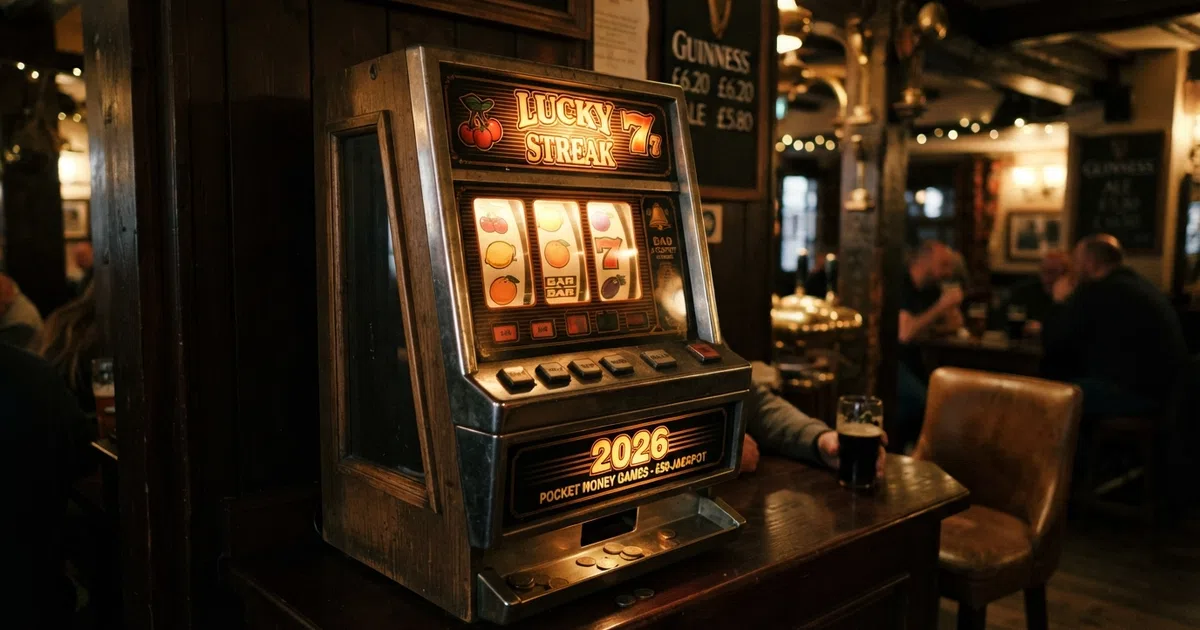
Fruit-themed slots remain the single largest lobby category across UKGC-licensed casino sites in 2026. That is not because the games are new. The reason is that the symbols, reel count and bonus logic of the average online fruit slot still trace back, line by line, to the mechanical cabinet that sat at the end of a pub counter. Anything that wants to call itself a fruit machine in the UK has to clear a low bar of recognition: cherries, lemons, oranges, plums, bells, sevens, and a reel grid that does not require a manual to read.
That aesthetic survived the move from cabinet to browser because the alternative — endless narrative slots with cutscenes, expanding reels and triggered features — does not suit the way a UK player wants to spend five minutes and a few pounds. Fruit machine play is short-cycle, low-friction and high-frequency. The £5 per-spin ceiling, set in April 2025 and detailed in the rules section below, confirms the regulator thinks that is the shape of play it is regulating.
What the niche looks like in volume tells the same story. UK online slots generated £773 million in gross gambling yield in the January to March 2026 reporting period, with 25.1 billion spins placed and 4.8 million monthly active accounts across UKGC-licensed operators. That is a market running on small bets, fast cycles and a very wide player base. The pub cabinet’s DNA was the original template for that product, and online has not strayed far from it.
The pub machine DNA — where UK fruit slots came from
A physical fruit machine in a UK pub did three things: paid out in coins, accepted a stake in coins, and offered a hold-and-nudge feature that let a player refuse the next spin in exchange for a chance to shift a reel into a better position. The hold-and-nudge mechanic is the defining interaction of the genre. Every “feature” on an online fruit slot — the gamble button, the lock-and-spin round, the nudge-trail bonus — is a digital restatement of what a coin-operated cabinet could do mechanically.
The fruit symbol set survived the move to digital unchanged for a simple reason: players recognise it. Cherries, lemons, oranges, plums, bells and sevens are the same six icons the cabinet used in 1980, and they remain the visual shorthand for “this is a fruit slot” across every UK casino lobby in 2026. Operators know it, designers know it, and the player who walked up to a pub machine thirty years ago still walks up to a digital fruit slot expecting to see the same six things land.
The terminology is also UK-specific. British players call them “fruit machines” and the rest of the English-speaking world calls them “slots” or “pokies”. The label matters because a “fruit machine” in the UK carries specific genre expectations — a pub-cabinet heritage, a fruit-symbol palette, and a play style that does not require reading a rulebook. Online fruit slots inherit all three.
Classic, traditional and pub-style — what each variant actually means
The four titles that dominate UK fruit-slot lobbies fall into three recognisable sub-families. Telling them apart takes one look at the reel grid and a count of the paylines.
Classic 3-reel single-payline fruit slots are the closest digital descendants of the original cabinet. Three reels, one payline across the centre, fruit symbols and the occasional bar or seven. The pay-table fits on a single help screen and the maximum win is rarely above 500x stake. These titles are the purist’s choice.
Traditional 5-reel pub-style slots are the format most UK players actually encounter. Five reels, ten to twenty paylines, a simple bonus trail (pick-a-prize, free spins with a multiplier, or a nudge-and-hold round), and the same fruit-symbol palette. Most of the named UK fruit slots — Rainbow Riches, Fishin’ Frenzy, Reel King — live in this format. The trade-off against a 3-reel classic is more ways to win on every spin, balanced against a slightly higher hit frequency and a more cluttered pay-table.
Modern hybrid fruit slots wrap recognisable fruit symbols in newer engines — Megaways reels, cluster-pays, cascading wins, and progressive jackpots. Fruit Shop Frenzy is the clearest example in the current top set: NetEnt’s fruit theme re-laid on a Megaways-style grid with a 10,868x max-win ceiling that no cabinet-era fruit slot ever carried. Hybrid fruit slots are the genre’s response to the wider video-slot market, and they split opinion: pub-machine purists see them as a betrayal of the format, while players chasing a bigger top prize treat them as the natural evolution.
Online vs land-based — what changed when the reels went digital
The mechanical cabinet had a fixed pay-table. The operator set the payout percentage when the machine was commissioned, the player had no visibility into it, and that was the deal. Online fruit slots run on configurable RTP bands — the same game can ship at 94%, 95% or 96% depending on the operator and the jurisdiction. The published help-file RTP is the only one that matters for a UK player, and that figure is now almost always findable.
The cabinet did not have free-spins rounds, gamble features or progressive jackpots. The online version added all three. The trade-off is meaningful: an online fruit slot can pay a single spin 10,000x stake in a way a £500 jackpot pub machine never could, and the bonus rounds give a player something to anticipate. The cost is the same as the cabinet era — the house edge, on average, takes its cut on every spin. Online just makes the wins more visible.
The social dimension is what disappears. A pub fruit machine was a shared-room experience: someone at the bar watching, a queue, the nudge feature played out in front of an audience. The online version strips all of that. A solo player at a phone in a quiet room spins at a faster cadence than any pub machine ever allowed, and reality-check prompts (covered in the safer-gambling section below) exist because that cadence is the thing the regulator decided to slow.
What online did not change is the basic economics. The £773 million GGY figure in the latest UKGC dataset confirms that, even in a heavily regulated market, the house still takes its margin. The genre just takes it on more spins of smaller size.
Real-money fruit slots and what the UK market looks like in 2026
Three numbers carry most of the weight when sizing the UK online slots market in 2026. The first is the £773 million in gross gambling yield from online slots in the January to March 2026 period, up 12% on the same quarter the year before. The second is the 25.1 billion spins in the same period — a 7% rise year on year. The third is the 4.8 million monthly active accounts, up 6% on the year before.
The implied per-spin figure is what those numbers quietly describe. Divide 25.1 billion spins by roughly 4.8 million monthly active accounts and a player is placing, on average, around 175 spins a month across their operator of choice. At an average stake well below the £5 cap, the implied per-account monthly spend sits in low double digits. The market is a long tail, not a whales-and-minnows economy.
The £5 per-spin stake cap for adults 25 and over (and the £2 cap for adults 18 to 24) caps the absolute size of the bet, not the volume. The Q1 2026 numbers say the volume keeps rising even with the cap in place, and the GGY figure says players are still losing enough in aggregate to keep the operator side solvent. A cap on stake does not, on its own, change the direction of the curve.
New and trending fruit machine slots worth your attention
The release calendar for fruit slots in 2026 is dominated by two trends. The first is the Megaways-and-fruit crossover, where established fruit themes get re-laid on Big Time Gaming’s reel engine. The second is the continued dominance of the four legacy titles (covered in detail in the next section), which keeps a ceiling on how much room new fruit IP can take in a UK lobby.
The crossover trend splits opinion. Pub-machine purists see the Megaways treatment as a betrayal of the original format — the appeal of a 5×3 grid is its legibility, and a 6-reel engine with up to 117,649 ways is the opposite of legible. Players who treat fruit slots as one of several genres and want bigger top prizes from a familiar theme tend to welcome it. The fact that Fruit Shop Frenzy’s 10,868x max win is a full order of magnitude above Rainbow Riches’ 500x ceiling is the trade-off in one number.
Seasonal and branded fruit-slot variants (Christmas cherries, Halloween pumpkins, football sevens) tend to fade inside a quarter unless the underlying maths model is strong. The test for a genuinely new fruit slot is whether the provider’s published RTP and max-win figure stand up next to the four legacy titles. If they do, the title holds; if they do not, it disappears from featured lobbies within a release cycle.
The best fruit machine slots to play online in the UK in 2026
The strongest UK fruit-slot titles, by search-result frequency, lobby presence and published provider RTP, are four. The shortlist below is what the rest of the page compares against, and the table that follows is the only place all four are laid out side by side. Any UK player who has spent more than a few minutes in a UKGC-licensed casino lobby will recognise all four.
The metric that does most of the load-bearing work in the comparison is RTP — the theoretical percentage of stake the title returns to players over the long run. A two-point RTP gap between two titles (96.18% versus 94.00%) compounds over a session. A 1,000-spin session at £1 per spin with a 96.18% RTP has an expected loss of £38.20; the same session at 94.00% RTP has an expected loss of £60.00. The numbers below are the published provider figures; the help file on the game itself is the only one that counts at the operator level.
Volatility is the second metric and the one that decides what the session actually feels like. A medium-volatility title produces frequent small wins and the occasional large one. A medium/high-volatility title produces fewer wins with a longer tail toward the top prize. Reel King sits at medium, Rainbow Riches at medium/high, and Fishin’ Frenzy and Fruit Shop Frenzy land in the higher-volatility cluster. The choice between them is a choice about session shape, not about expected return.
Provider pedigree matters because the four names behind the four titles are the studios that ship to almost every UK lobby. Blueprint Gaming (Fishin’ Frenzy) and Barcrest, now part of Light & Wonder (Rainbow Riches), are the two UK-facing studios with the deepest pub-machine heritage. NetEnt (Fruit Shop Frenzy) is the broadest of the major European suppliers. The “Reel King” online build traces back to Apricot/IGT, the original mechanical-reel supplier to UK amusement arcades.
Top fruit slot titles ranked by RTP and playing experience
| Slot Title | Provider | RTP | Volatility | Max Win |
|---|---|---|---|---|
| Fruit Shop Frenzy | NetEnt | 96.18% | — | 10,868x |
| Fishin’ Frenzy | Blueprint Gaming | 96.12% | — | 5,000x |
| Rainbow Riches | Barcrest / Light & Wonder | 95.00% | Medium / High | 500x |
| Reel King | (Apricot / IGT legacy) | 94.00% | Medium | 500x |
Fruit Shop Frenzy is the mathematical outlier. Its 96.18% RTP sits 0.06 of a point above Fishin’ Frenzy, 1.18 above Rainbow Riches and 2.18 above Reel King, and its 10,868x max win is more than twice Fishin’ Frenzy’s 5,000x ceiling. For a player choosing by published figure alone, it is the strongest title on paper. What that figure does not capture is the volatility, which the published material does not assign a clean band to; players should expect a longer wait between wins than the lower-RTP titles.
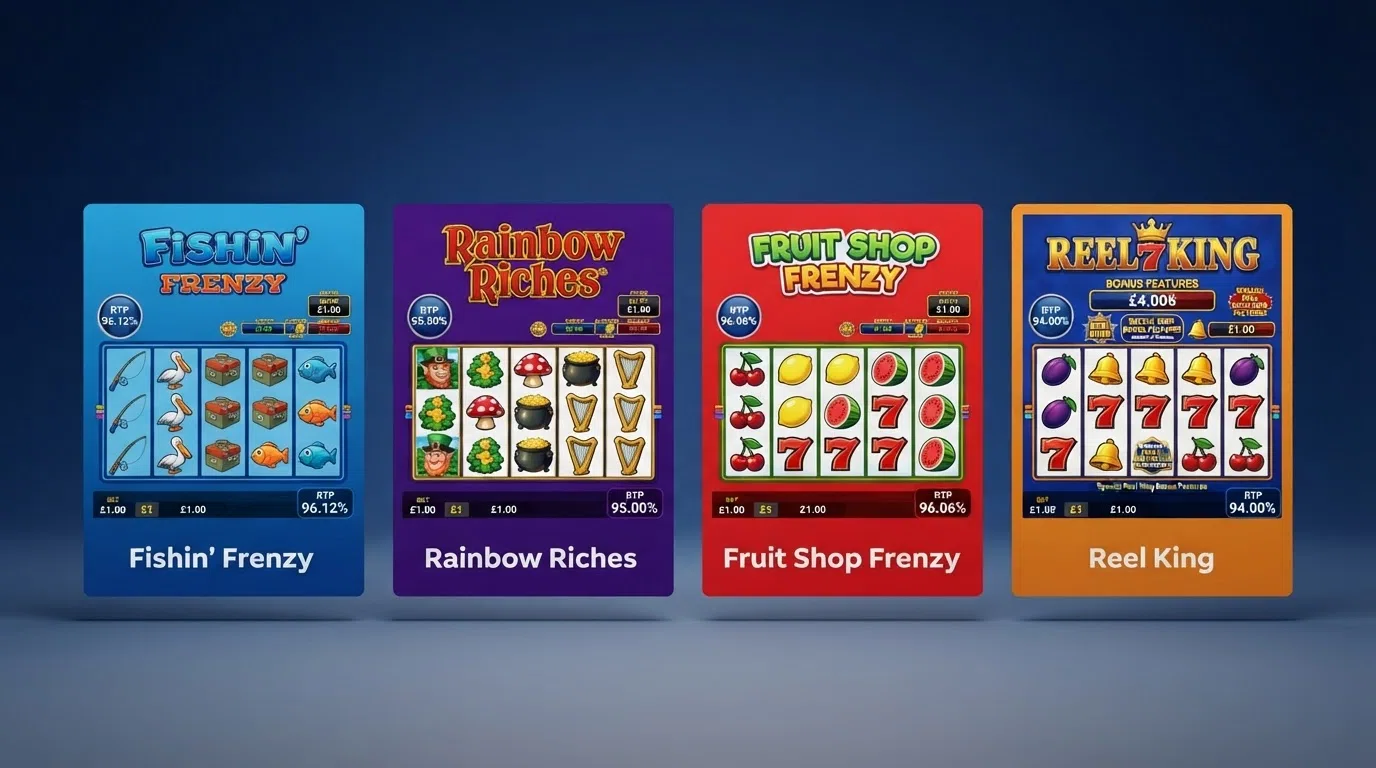
Rainbow Riches is the cultural-recognition title. It is the slot most UK players over 35 think of when they think of fruit machines, the Barcrest original carried across the Light & Wonder acquisition, and the title that the majority of UKGC-licensed lobbies still headline. Its 95.00% RTP and 500x max win sit in the middle of the set; it is not the highest-paying fruit slot by any measure, and it does not pretend to be.
Reel King at 94.00% RTP is the lowest of the four on paper. The trade-off is its medium volatility and a 20-payline 5×3 grid that produces a steadier stream of small wins than the higher-RTP titles. A player who prefers a long session of frequent small returns over a short session of rare big ones will find Reel King’s maths more comfortable than the 96%-plus titles above.
High-payout fruit slots — when RTP translates to real value
The theoretical-return model says a slot returning 96.18% of stake over the long run will, on average, return 96.18 pence for every pound wagered. A 1,000-spin session at £1 per spin on Fruit Shop Frenzy implies an expected loss of £38.20 (turnover £1,000 minus 96.18% return of £961.80). The same session on Reel King at 94.00% RTP implies an expected loss of £60.00 (turnover £1,000 minus 94.00% return of £940.00). The headline gap is £21.80 over a thousand spins — small in absolute terms, large enough to be the only number that should drive the comparison.
The qualifier is volatility. A high-volatility title at 96% RTP can produce a session where the player loses a much larger share of stake than the theoretical model predicts, because the math evens out over many sessions, not one. Two players running the same 1,000 spins at the same stake on the same title can see very different outcomes; both are consistent with a 96% RTP. That is the trade-off the higher-RTP titles carry — better long-run return, wilder single-session return.
The £5 per-spin stake cap changes the absolute size of the RTP gap, not the percentage. The same 2.18-point gap between Fruit Shop Frenzy and Reel King at the regulatory cap of £5 per spin doubles the per-spin loss differential; over a thousand spins at the cap, the difference is £109. That is the upper bound of what the cap-stretching player can lose to the RTP gap. Most players will not be at the cap, which compresses the absolute numbers without changing the conclusion: the higher-RTP title is the cheaper one to play, and the gap is the same percentage whatever the stake.
The published RTP lives in the game’s help file on every UKGC-licensed operator. If the figure is not in the help file, it is not a figure the player can rely on.
Where the strongest casino lobbies for classic reel play sit in 2026
The ten operators below are the strongest UKGC-licensed casino sites for fruit-slot play in 2026, ranked on welcome-offer value, free-spins inclusion, and the depth of the fruit-machine lobby. Every entry is verified against the UK Gambling Commission’s public register for licensing status, and the offer specifics are current at the time of research — operators change welcome terms on a quarterly cadence, so a check on the operator’s own page is worth doing before any deposit.
The split that matters most is no-deposit access versus deposit-triggered. Three of the ten operators (Sky Vegas, Paddy Power Games, Betfair Casino) offer a no-deposit free-spins portion as part of the welcome offer — the player registers, claims the spins, and plays without depositing. The other seven require a deposit before any free play activates. For a player evaluating a site, the no-deposit route is the lowest-cost way to test a lobby before committing funds.
The free-spins wagering condition is the second split. Sky Vegas, Paddy Power Games and Betfair Casino all advertise no-wagering free spins — every penny of spin winnings is withdrawable as cash. Grosvenor Casinos and BetMGM carry wagering terms on bonus winnings. The remaining operators either do not surface wagering terms in their welcome-offer copy or do not apply them to the free-spins portion. The table below shows what is publicly stated at the time of research.
| Operator | Welcome Offer | Free Spins Included | No-Deposit Element |
|---|---|---|---|
| Sky Vegas | Up to 200 free spins, no wagering | Yes | Yes — 50 no-deposit spins |
| MrQ | Up to 300 cash spins + 200 free spins | Yes | — |
| Paddy Power Games | 60 no-deposit + 200 free spins, no wagering | Yes | Yes — 60 no-deposit spins |
| William Hill | Free spins on deposit (Fruit Spin title) | Yes | No — deposit triggered |
| BetMGM | 200 free spins on Big Bass Splash, or 100% up to £50 + 125 free spins | Yes | No — deposit triggered |
| Bet365 Casino | Up to 50 free spins per day for 10 days | Yes | No — £10 deposit required |
| LeoVegas | 50 free spins after £10 deposit | Yes | No — £10 deposit required |
| Betfair Casino | 150 free spins, no wagering | Yes | Yes — 50 no-deposit spins |
| Videoslots | Not publicly listed at research time | — | — |
| Grosvenor Casinos | £20 deposit for £40 bonus + 100 free spins on Big Bass Splash | Yes | No — deposit triggered |
Sky Vegas — no-wagering free spins on a UKGC-licensed slots platform
Sky Vegas runs on a UKGC operating licence under account number 065519 and the welcome offer leads with up to 200 free spins with no wagering attached. The 50 no-deposit portion is the part that tests a lobby without spending; the further spins are released after the player deposits and stakes. Zero-wagering means every penny of free-spin winnings is cash, withdrawable, with no turnover obligation.
The slot catalogue covers Blueprint, Reel Time, Barcrest-era content and the broader aggregator mix, and Fishin’ Frenzy is among the eligible titles at its published 96.12% RTP. For a player evaluating Sky Vegas as a fruit-slot lobby, the no-deposit 50 spins are the cheapest way to test the site’s reel latency, the bonus-feature cadence and the cashier before any money moves. The no-wagering condition is the part that lets the test end with real money in the account, not in a locked bonus balance.
MrQ — cash spins and free spins across a broad slot catalogue
MrQ’s welcome offer is up to 300 cash spins plus 200 free spins, and the cash-spin format is what makes the offer worth reading carefully. Cash spins work like real-money spins: every line landed pays out as cash, with no bonus balance and no wagering. The distinction matters in the comparison table — the bulk of MrQ’s offer is paid as cash, not as a free-spin bonus.
The slot catalogue spans Rainbow Riches, Fishin’ Frenzy, The Big Catch, the Big Bass series, King Kong Cash, Bonanza Megaways and Eye of Horus. That is one of the broader lobbies in the featured set for the four fruit-slot titles and the adjacent sub-genre. The wagering multiplier on the welcome offer is not stated in publicly surfaced materials; a check on the MrQ terms page before claiming is the move.
Paddy Power Games — no-deposit free spins with zero wagering
Paddy Power Games leads with 60 no-deposit free spins plus 200 further free spins, all with no wagering attached. The 60-spin no-deposit portion is a genuine zero-cost entry point: register, claim, play on real-money mechanics. The Paddy Power brand carries the high-street bookmaker heritage, and the casino operation inherits the same UK-facing operator infrastructure.
For a player comparing no-deposit no-wagering offers across the three operators that offer them — Sky Vegas (50 spins), Paddy Power Games (60 spins) and Betfair Casino (50 spins) — Paddy Power’s 60 spins is the highest no-deposit count, and the 200-spin follow-on matches the depth of the other two on the post-deposit side. The combination is the strongest no-deposit no-wagering package in the featured set.
William Hill — a dedicated online fruit machines lobby
William Hill runs on UKGC account number 39225 and has a dedicated “Online Fruit Machines” lobby on its casino site. The named lobby is a curation signal: when a major operator chooses to label a category explicitly, it is a statement that the category matters to its player base. Fruit Spin is the named title in the welcome offer, and the free-spins structure is deposit-triggered.
The deposit-triggered structure is the trade-off. Unlike Sky Vegas, Paddy Power Games and Betfair Casino, William Hill does not offer a no-deposit free-spins entry point. The free spins activate after a qualifying deposit and stake. For a player who already knows they want a William Hill account and a fruit-machine lobby under that brand, the offer is straightforward; for a player still evaluating sites, the lack of a no-deposit portion means testing the lobby costs real money first.
BetMGM — exclusive titles and free spins on Big Bass Splash
BetMGM runs on UKGC account number 39198 and the welcome offer splits into two routes: 200 free spins on Big Bass Splash, or a 100% deposit match up to £50 plus 125 free spins. The provider mix covers Pragmatic Play, Big Time Gaming, Barcrest, NetEnt and a layer of BetMGM exclusives that do not appear on competitor lobbies. BetMGM’s UK market entry is a recent one, and the exclusive-titles layer is the part of the offer that distinguishes the brand from the legacy bookmaker casinos above.
Both offers are deposit-triggered, which removes the no-deposit entry point. The 200-free-spin Big Bass Splash option is the higher free-spin count in the set, conditional on Big Bass Splash being the title the player wants to run. The 100% match plus 125 free spins option is the lower free-spin count but adds the matched deposit; a player depositing £50 to claim the match gets £100 in casino credit plus 125 free spins, where the equivalent deposit on the free-spin route returns 200 spins and no matched credit. The choice is a stake-versus-spin-count one.
Bet365 Casino — daily free spins across a mainstream slot library
Bet365 Casino runs on UKGC account number 39563 and the welcome offer is up to 50 free spins per day for ten days after a £10 deposit. The drip structure is unusual in the featured set: rather than crediting all the spins in one go, the offer releases them across a ten-day window. For a player who plans to log in daily, the structure is fine; for a player who plays in single long sessions, the drip means the bulk of the offer’s value is realised only on repeat visits.
The £10 qualifying deposit threshold is below the £5 per-spin cap by a factor of two — a player depositing £10 can run two spins at the regulatory cap. The mainstream slot catalogue covers the bulk of the four featured fruit-slot titles and the wider UKGC-licensed provider mix. Bet365 is one of the largest UK gambling operators, and the casino operation sits inside the same UKGC licence as the sportsbook.
LeoVegas — mobile-first slot play with Big Bass and Jammin’ Jars
LeoVegas offers 50 free spins after a £10 deposit, and the slot catalogue is headlined by Big Bass slots, Jammin’ Jars and Razor Shark. The mobile-first positioning is what distinguishes LeoVegas from the rest of the set: the platform is built for phone play, and the welcome offer is structured around a single £10 deposit. There is no no-deposit entry point.
For a player who plays on a phone and wants a single-claim welcome offer without the drip structure that Bet365 runs, LeoVegas’s 50-free-spin shape is the cleanest in the set. The 50-free-spin count is at the low end of the deposit-triggered offers, but the wagering terms on those spins are not surfaced in the welcome-offer copy and should be checked on the operator’s terms page before claiming.
Betfair Casino — no-deposit spins and zero-wagering free spins
Betfair Casino runs a welcome offer of 150 free spins with no wagering, of which 50 are no-deposit. The 50 no-deposit spins are the zero-cost entry point and run on real-money mechanics; the further 100 spins release after deposit. The no-wagering condition applies to all 150 spins.
Betfair’s exchange-and-casino dual identity is the brand context: the casino operation sits inside a wider UKGC-licensed operator that also runs the betting exchange, and the casino-side welcome offer is the part relevant to fruit-slot play. The 150-spin total matches the depth of the other no-deposit no-wagering offers in the featured set, and the 50-spin no-deposit portion puts Betfair alongside Sky Vegas and Paddy Power Games on the no-deposit entry point.
Videoslots — a specialist slot platform with one of the UK’s largest libraries
Videoslots is the slot-specialist operator in the featured set, and the library size is the strongest selling point: a very large slot catalogue that covers almost every major UKGC-licensed provider, including the four fruit-slot titles featured above. The specialist positioning means lobby-discovery tools, slot filtering and category depth that sportsbook-led casinos do not match.
The welcome offer was not publicly listed at the time of research, which is the trade-off. A player who values library depth over welcome-offer value can land on Videoslots and check the current terms directly; a player who wants the welcome offer on the page before they click through will need to verify with the operator. The UKGC licensing applies as it does to every other entry in the set.
Grosvenor Casinos — a land-based UK name with a deposit-matched bonus
Grosvenor Casinos runs a deposit-matched offer of £20 in for £40 casino bonus plus 100 free spins on Big Bass Splash. The 10x wagering on spin winnings and the £40 bonus sits at the UK regulatory cap of 10x the bonus amount introduced in January 2026, which means a £40 bonus carries a £400 turnover requirement. The £400 turnover figure is detailed in the bonus-cost section below.
Grosvenor’s land-based casino estate is the brand context: a UK high-street name that has run physical casino floors for decades, and an online operation that inherits the operator infrastructure. The deposit-triggered structure is the trade-off; there is no no-deposit entry point, and the 10x wagering means the £40 bonus is not free money in the way the no-wagering offers above are. For a player who already has a Grosvenor account and values the cross-channel loyalty, the offer is straightforward; for a player evaluating the bonus shape on its own merits, the 10x wagering is the cost the offer carries.
Free play and demo mode — try every fruit slot before you stake a penny
UKGC-licensed casino sites must offer both demo and real-money modes on every slot they publish, and the demo toggle is the strongest bankroll-protection tool a new player has. A demo spin runs on the same maths as a real-money spin, returns the same RTP over the long run, and pays out the same line combinations. The only thing it does not do is produce withdrawable winnings.
The structure of a demo session matters as much as the existence of one. A player who runs 200 demo spins on Fishin’ Frenzy before depositing will see the bonus-round frequency, the volatility feel, and the size of the average base-game win before spending a penny. The same player running zero demo spins will discover all three during the first £20 of real-money play, which is a more expensive way to learn the same lesson.
The regulatory context for demo play is the deposit-limit prompt obligation that took effect on 31 October 2025. Every UKGC-licensed operator must now prompt a player to set a financial limit before their first deposit, which means the player evaluating a site gets a chance to set a ceiling on losses before any money moves. Demo mode is the step that comes before that prompt fires.
Free-play vs real-money mode — what you gain and what you lose
Demo mode delivers the full game with play-money credits and the same RTP maths as the real-money version. A player who runs 500 demo spins at £1 per spin in the help-file RTP window sees the same hit frequency, the same bonus-trigger rate, and the same average return as a real-money player running the same spins. The mechanics are identical; the only difference is the bottom line.
What demo mode does not deliver is withdrawable winnings, progressive-jackpot eligibility, or any bonus or free-spins accrual toward an offer. A progressive jackpot like the MegaJackpot pool on selected Blueprint titles pays only on real-money spins, and a no-deposit free-spins offer only credits to a real-money account. A player who treats demo mode as the entire evaluation will learn the maths but not the cashier.
The psychological difference is the part the maths cannot describe. Play-money spins carry no financial consequence, which changes the decision-making: a player who would never press spin at £5 in real money will press spin at £100 in demo, and the lesson that teaches about the game’s volatility is not the lesson real-money play will teach. Demo mode is the structured evaluation tool; it works best when a player runs a fixed number of spins at a fixed stake and treats the outcome as a maths observation, not as a profit signal.
Popular free fruit slot titles and how to access them
The four titles featured in the table above — Fishin’ Frenzy, Rainbow Riches, Fruit Shop Frenzy and Reel King — are the four consistently available in demo mode across UKGC-licensed casino sites. The demo toggle is usually labelled “Demo”, “Play for Free” or “Try” on the slot’s page, and at most UKGC-licensed operators it does not require registration to access. A player can land on a slot’s page, hit the demo button, and start spinning within seconds.
The provider-level decision that makes a slot available in demo mode is a commercial one: the studio that builds the game chooses whether to ship a demo build alongside the real-money build, and almost every major studio does. Blueprint Gaming, Barcrest/Light & Wonder, NetEnt and the IGT/Apricot legacy all ship demo builds of their fruit-slot titles. The exception is the rare case where a casino’s commercial agreement with the provider restricts demo access to logged-in players, which is a minority of the featured set.
When a desired fruit slot has no demo toggle, the first check is an alternative casino — most UKGC-licensed operators run the same provider catalogue, and a different site will surface the same title in demo. The second check is the provider’s own page, which usually carries a demo build independent of any operator. Contacting the casino’s support is a last resort and rarely necessary.
No-deposit access — playing fruit slots without spending a penny
Three operators in the featured set offer a genuine no-deposit free-spins portion as part of the welcome offer. Sky Vegas leads with 50 no-deposit spins, Paddy Power Games with 60, and Betfair Casino with 50. All three are no-wagering on those spins, which means the player keeps whatever they win. The remaining seven operators require a deposit before any free play activates.
The no-deposit offer in practice: the player registers a new account, verifies their identity (a UKGC-licensed operator cannot credit a bonus to an unverified account), claims the spins from the welcome-offer page, and plays them on the credited titles. The credited titles are usually a small set — the operator chooses which games the no-deposit spins run on, and the player cannot redirect them. Fishin’ Frenzy is among the eligible titles at Sky Vegas; the other two operators’ no-deposit titles are not surfaced in the publicly available materials.
What a no-deposit offer does not give the player is full lobby access. The 50 to 60 no-deposit spins run on a single title or a small selection, and the player cannot use them to evaluate the wider casino. There is also a maximum-cashout cap on most no-deposit offers, even where wagering is zero — the operator states the cap in the offer terms, and any winnings above the cap are removed. The no-deposit offer is the cheapest way to test a site before depositing, but it is not free money without a ceiling.
Bonus offers and free spins for classic reel games — what UK punters actually get in 2026
UK fruit-slot players encounter three bonus shapes: free spins, no-deposit spins, and deposit-match bonuses. Free spins and no-deposit spins work the same way mechanically — the operator credits a fixed number of spins at a fixed stake on a chosen title, and the player keeps the line winnings. Deposit-match bonuses work differently: the operator credits a bonus balance that must be wagered before withdrawal, and the wagering requirement is the cost the player pays to convert the bonus to cash.
The two regulatory shifts that rewrote the bonus economics in 2026 are the 10x wagering cap that took effect on 19 January 2026 and the Remote Gaming Duty increase from 21% to 40% that took effect on 1 April 2026. The wagering cap is the immediate change for players: a £40 bonus at the old 35x wagering required £1,400 of turnover; the same £40 bonus at the 10x cap requires £400. The duty increase is the longer-term change, and its downstream effect on bonus generosity is the open question for the second half of 2026.
The UKGC’s stated rationale for the wagering cap is the public line on the change. Capping wagering to ten decreases the likelihood of harm, reduces complexity and improves transparency while maintaining consumer choice. The intended effect is that bonuses become cheaper to clear and harder to abuse; the unintended effect, the operators may argue, is that welcome offers get smaller.
Welcome bonuses and free spins that work on fruit machine slots
The no-wagering free-spins offers are the strongest bonus shape for a fruit-slot player in 2026. Sky Vegas, Paddy Power Games and Betfair Casino all run zero-wagering free spins on the welcome offer, and the difference between zero wagering and any positive wagering is the difference between a bonus that is a real-money credit and a bonus that is a turnover obligation. A 200-free-spin no-wagering offer at £0.10 stake per spin is £20 of real-money play that pays out as cash; the same offer at 35x wagering would require £700 of turnover to convert.
The deposit-match and free-spins bundles from Grosvenor Casinos, BetMGM and Bet365 carry wagering terms that change the offer’s value. Grosvenor’s £40 bonus at 10x wagering requires £400 of turnover, which at Fruit Shop Frenzy’s 96.18% RTP implies an expected loss of £15.28 across the clearing period — the bonus is worth £40, the cost of clearing it is £15.28, the net value to the player is £24.72 if everything plays to the theoretical model. BetMGM’s 200 free spins on Big Bass Splash is a free-spins offer with wagering terms not surfaced in the welcome copy; Bet365’s 50 free spins per day for 10 days is a drip structure where the cumulative value depends on the wagering terms per tranche.
MrQ’s cash-spin model is a separate shape: up to 300 cash spins, where every line landed pays out as cash with no bonus balance, plus 200 free spins. Cash spins are the closest thing to a free-money offer the UK market has, and the absence of a publicly stated wagering multiplier on the cash-spin portion is the qualifier a player should verify before claiming. The MrQ offer is the highest total spin count in the featured set; what each spin is worth depends on the terms.
The one featured operator whose welcome offer was not publicly listed at research time is Videoslots. The slot-specialist positioning and the very large library are the brand’s selling point, and the current welcome-offer terms are best checked on the operator’s own page.
Bonus terms that matter — wagering, the 2026 cap and real cost
Before 2026, wagering requirements of 35x, 40x or higher were the norm on UK welcome bonuses. A £40 bonus at 35x wagering required £1,400 of slot turnover to convert; a £100 bonus at 40x required £4,000. For a casual fruit-slot player whose session runs a few hundred spins, the turnover required to clear such a bonus was larger than the session the player was likely to run. Most bonuses went uncleared, and the bonus balance expired before the player converted anything to withdrawable cash.
The 10x cap that took effect on 19 January 2026 is the structural change. A £40 bonus at 10x wagering requires £400 of turnover. The same £40 bonus at the old 35x would have required £1,400 — a 71% reduction in the clearing cost. The change is large enough that the bonuses which were previously impractical to clear are now within reach of a single fruit-slot session at moderate stakes.
Game-weighting is the second term that decides what a bonus is worth. A bonus that applies to slots at 100% weighting counts every pound wagered toward the turnover requirement; a bonus that applies to slots at 50% weighting counts only half. The 10x cap applies to the wagering multiple, not the weighting — a bonus with a 10x wagering multiple and 50% slot weighting is worth half the same bonus at 100% weighting. A player should read the weighting schedule on the offer terms before claiming.
The deposit-limit prompt obligation is the companion rule that ties bonus play to a financial ceiling. From 31 October 2025, every UKGC-licensed operator must prompt a player to set a deposit limit before their first deposit, and remind them every six months to review the limit. A player who sets a £100 weekly deposit limit and then claims a £40 bonus with 10x wagering has capped the maximum loss to £100 regardless of how the bonus plays out. The deposit-limit prompt is the safer-gambling backbone that the bonus arithmetic sits inside.
The expected loss on a £40 bonus at 10x wagering, applied to Fruit Shop Frenzy at 96.18% RTP, works out as follows: £400 of turnover at a 3.82% house edge (100% minus 96.18%) implies an expected loss of £15.28 across the clearing period. The bonus is worth £40, the cost of clearing it is £15.28, the net value to the player is £24.72 if the play matches the theoretical model. In practice the actual loss will be higher or lower depending on volatility and session length, but the expected-loss figure is the right number to compare the offer against its headline value. (This is a statistical estimate over many spins under the stated assumptions; it is not a guaranteed outcome for any individual session.)
Are online fruit machine slots legal in the UK? The rules that protect players
Every online fruit machine slot offered to a Great Britain customer sits under a UK Gambling Commission operating licence granted under the Gambling Act 2005. The Commission is the statutory regulator; the Act is the legal backbone; the licence conditions and codes of practice (LCCP) are the operational rules every licensed operator must follow. An offshore-licence-only site is not legal for Great Britain customers, and the Commission’s public register is the free tool every player has to verify the difference.

The three-pillar player-protection framework that took full effect between April 2025 and January 2026 is what distinguishes the current UK market from the pre-2025 one. The first pillar is stake caps — £5 per game cycle for adults 25 and over, £2 for adults 18 to 24. The second is the bonus wagering cap of 10x the bonus amount from 19 January 2026. The third is the deposit-limit prompt and six-month review obligation from 31 October 2025. Each pillar is a separate rule with its own implementation date; together they form the regulatory floor that every UKGC-licensed operator sits on.
UK Gambling Commission licensing — what it means for your play
The UKGC’s licence conditions and codes of practice cover game fairness, anti-money-laundering controls, customer-fund segregation and responsible-gambling obligations. A UKGC-licensed casino is required to publish its game RTPs, segregate customer funds from operating funds, and submit to the Commission’s enforcement action if it breaches the LCCP. The Commission’s public register lists every active licence and is searchable by business name, trading name, domain or account number.
The register is the free verification tool. A player who sees a welcome offer from an unfamiliar operator should check the register before depositing. The fields to check are the business name (which may differ from the trading name shown on the site), the domain (the site address), and the account number (the licence reference). A site that does not show an account number in its footer is a red flag, and a site that shows an account number that does not resolve on the register is a stronger red flag.
What a UKGC licence does not do is guarantee a particular RTP, a particular bonus shape, or a particular player experience. The licence is a regulatory floor, not a quality mark. The Commission does not endorse individual operators or rank them; it sets the rules they must follow. A player who treats the licence as a binary “is this legal to play at” check is using it correctly.
The £2 and £5 stake caps — how the UK’s slot limits work in practice
The two-tier structure is the per-spin stake cap that applies to every online slot spin at every UKGC-licensed casino. Adults aged 25 and over can stake up to £5 per game cycle; adults aged 18 to 24 can stake up to £2 per game cycle. The age check happens at the operator level, and the operator is responsible for applying the right cap to the right account.
The implementation dates are separate. The £5 cap for all adults went live on 9 April 2025; the £2 cap for adults 18 to 24 went live on 21 May 2025. The reason for the staged implementation is that the £2 cap required age-verification work that the £5 cap did not, and the Commission sequenced the change to give operators time to build the verification flow.
“Per game cycle” is the operative phrase. One press of the spin button equals one game cycle, and the cap applies to that single action. Features that cost additional money — the gamble button, the buy-bonus purchase, the double-up round — are subject to the same cap on the additional stake. The cap is on the stake the player commits, not on the line winnings; a £2 spin can return any multiple of stake the game’s maths allows.
The limits apply to online slots only. Roulette, blackjack, baccarat and other casino games are not subject to the £2 or £5 per-game-cycle cap; their stake limits are set by the operator and the table. A player who wants to bet more than £5 per hand moves to a table game, not to a slot.
Advertising rules and the 10x wagering cap — what operators must disclose
The 19 January 2026 wagering cap is an advertising constraint as well as a product constraint. No UKGC-licensed operator may promote a bonus with wagering above 10x the bonus amount, and the offer terms surfaced in any advertisement must reflect the cap. The change is visible in the welcome-offer copy across the featured set: every offer that previously advertised 35x or 40x now advertises at or below 10x, and the offers that always sat below 10x (the no-wagering free-spins offers) have become the structural baseline rather than the premium tier.
The restriction on mixed-product promotions is the related change. A bonus that spans slots and sportsbook cannot apply the same terms to both; the wagering cap applies per product, and an operator running a cross-product welcome must state the terms per product. For a player evaluating a cross-product offer, the terms to check are the slot-specific wagering and the sportsbook-specific wagering; they are no longer the same number.
The deposit-limit prompt regime is the third rule that shapes what a player sees at the cashier. Every UKGC-licensed operator must prompt a financial limit before first deposit and make the limit easy to review and alter; the operator must also remind the player every six months to review their account information. The prompt is a hard stop in the registration flow: the player cannot deposit without acknowledging it, and the limit becomes the ceiling on losses until the player changes it.
The advertising-standards dimension is the broader regulatory frame. The Committee of Advertising Practice (CAP) and the Broadcast Committee of Advertising Practice (BCAP) codes govern how gambling ads describe bonuses, and terms like “no wagering” have a specific regulatory meaning under those codes. A bonus advertised as “no wagering” must actually be no-wagering, with no hidden turnover on the winnings. The codes are the consumer-protection layer that sits above the LCCP for ad copy specifically.
Responsible gaming tools every UK fruit machine player should know
The prevalence context for the safer-gambling framework in the UK is the 2024 Gambling Survey for Great Britain. The Commission’s headline finding is that 2.7% of adults aged 18 and over in Great Britain scored 8 or above on the Problem Gambling Severity Index, a level described as statistically stable compared with 2023. The England-specific treatment need estimate is that around 0.5% of the adult English population experience problem gambling and 3.8% are at elevated risk. The numbers are the backdrop to the safer-gambling tools: a small but non-trivial share of the player base is at meaningful risk, and the mandatory tools are the regulatory response.
The four mandatory tool categories every UKGC-licensed casino must offer are deposit limits, reality checks, time-outs and self-exclusion. They map to different timescales: deposit limits are the financial ceiling, reality checks are the session-level prompt, time-outs are the short break, and self-exclusion is the longer-term block. The £5 stake cap and the 10x wagering cap are the upstream rules that keep each spin and each bonus affordable; the four tools are the player-controlled downstream layer.
Deposit limits and reality checks — the tools every UK player has
The deposit-limit obligation is the financial ceiling. Every UKGC-licensed operator must prompt a player to set a deposit limit before their first deposit, and the player chooses a daily, weekly or monthly ceiling. Once the ceiling is hit, the system blocks further deposits until the limit resets. The player can review and alter the limit at any point after the first prompt, and the operator must remind the player every six months to do so.
A deposit limit is the tool that decides what the worst case looks like. A player who sets a £100 weekly deposit limit and plays through that limit in two sessions has a maximum weekly loss of £100, regardless of what the games do. The limit does not control the outcome of any individual spin, and it does not prevent the player from playing through the limit quickly; it controls the total deposit, which is the only number the player can actually fix in advance.
Reality checks are the session-level companion. A reality check is a pop-up the player sets at a chosen interval — usually every 15, 30 or 60 minutes — that shows time played and money spent since the session started. The pop-up does not stop the session; it asks the player to confirm they want to continue. For fast-cycle fruit slots where a session’s spend can accumulate in minutes, the reality check is the tool that interrupts the cadence and forces a pause. The £5 per-spin cap slows the cadence; the reality check forces the player to look at it.
Time-outs and GamStop self-exclusion — how they work step by step
A time-out is a player-chosen cooling-off period during which the account is locked and marketing communications stop. The typical time-out spans 24 hours to six weeks, and the player sets the duration at the point of activation. A time-out is shorter than self-exclusion, and the player can lift it when the period expires without going through a re-application process.
GamStop is the UK national online self-exclusion scheme. It is a free service that blocks access to all UKGC-licensed gambling sites for a chosen period of six months, one year or five years. The registration is at gamstop.co.uk, the player provides personal details, and the block applies across every UKGC-licensed operator. The block cannot be lifted by the player during the chosen period; it expires automatically at the end.
What GamStop does not cover is the first limitation a player considering registration should understand. GamStop cannot block offshore-licence-only sites — those operators are not on the Commission’s register and are not part of the scheme. A player who has registered with GamStop and tries to access an offshore-licence-only site will not be blocked. GamStop also does not cancel pending withdrawals; a player who has a withdrawal in process when they register will receive the funds, and the block applies from the registration date forward. A player who wants to deposit back into the account during the exclusion period cannot do so at a UKGC-licensed operator, but the offshore route remains technically available.
Where to get help — GamCare, BeGambleAware and the National Helpline
- The National Gambling Helpline, operated by GamCare, is free and confidential on 0808 8020 133, 24 hours a day, 7 days a week. The line is the first point of contact for a player who wants to talk through a problem, and the helpline staff can refer the caller into treatment where appropriate.
- BeGambleAware publishes the gambling-harms self-assessment, a local support finder, and online help resources. The self-assessment takes a few minutes and returns a PGSI-band indication; the local support finder points the player at regional treatment services.
- GamStop is the national self-exclusion scheme covered above. The service is free, registration is at gamstop.co.uk, and the block applies across every UKGC-licensed operator for the chosen period.
- The clinical pathway from a helpline call runs through GamCare’s triage and referral service. A caller who needs structured treatment is referred to the National Health Service or to a commissioned treatment provider, depending on the assessment. The helpline is the front door; the treatment is the back office.
The distinction between helpline support for players and dedicated services for affected family members and friends matters because the people around a problem gambler often need their own support. BeGambleAware publishes resources specifically for affected others, and GamCare’s helpline takes calls from family members as well as from players. The 2.7% PGSI 8+ figure in the prevalence data describes the player share; the people around each of those players are not in the figure, and the support services exist for both groups.
How we selected and ranked these operators
The operator-selection basis is UKGC licensing. Every operator featured on this page is verified against the UK Gambling Commission’s public register, and only operators with an active operating licence for remote casino products to customers in Great Britain are included. The UKGC account number is listed in the operator write-up where the figure is available in the operator’s own published materials; where the figure is not surfaced, the verification is via the public register directly.
The evaluation criteria applied to the featured set are welcome-offer value, free-spins inclusion, no-deposit access, fruit-machine lobby depth, and provider mix. Welcome-offer value is the headline terms (no-wagering free spins versus deposit-match with wagering); free-spins inclusion is the presence and shape of any free-spins component; no-deposit access is the genuine ability to play without spending; fruit-machine lobby depth is the named presence of fruit-slot categories and the four featured titles; provider mix is the breadth of studios shipping to the operator.
The title-selection basis is search-result frequency, UK-casino lobby presence, and the availability of published provider-sourced RTP figures. The four titles featured in the table above are the four that surface consistently across UKGC-licensed casino lobbies and that carry a published RTP figure from the provider or an independent reviewer. Titles that do not carry a published RTP are not in the table; the comparison would be empty without a number to compare on.
The limitations of this page are the ones any single-guide review carries. The featured operator set is ten; the UK market runs to several hundred UKGC-licensed brands. The featured title set is four; the four are the most-referenced, but they are not the only fruit slots worth playing. The page is a working map of the most-prominent names, not an exhaustive market survey. The date-of-research note is the standard caveat: operator offers and game availability were current at the time of research, and a quarterly check against the operator’s own page is the move before any deposit.
What this means for your next fruit machine session
Three decisions follow from what is on the rest of the page, and the strongest play is to make all three in order.
The first decision is which fruit slot to play first. Fruit Shop Frenzy’s 96.18% RTP and 10,868x max win make it the mathematical outlier of the four-title set; Fishin’ Frenzy at 96.12% is the close second; Rainbow Riches at 95.00% is the cultural-recognition choice; Reel King at 94.00% is the medium-volatility steady-return choice. The decision is a stake-versus-spin-count one in part — a player who wants the best long-run return picks Fruit Shop Frenzy; a player who wants a session of frequent small wins picks Reel King; a player who wants the UK pub-cabinet experience picks Rainbow Riches.
The second decision is whether to start with a no-deposit free-spins offer or to deposit. Sky Vegas, Paddy Power Games and Betfair Casino all offer a no-deposit free-spins portion, and the no-deposit route is the lowest-cost way to test a lobby before committing. The player who has not yet decided which lobby to play at should pick one of the three no-deposit offers, run the credited spins, and use the experience to decide whether to deposit at the same site or to test another. The player who already knows they want a deep fruit-machine lobby can deposit at William Hill or Videoslots and use the deposit-triggered free spins to extend the session.
The third decision is what responsible-gambling tool to set before the first spin. The deposit-limit prompt will fire at the cashier regardless, and a player who sets a weekly limit of £100 before the first deposit caps the maximum loss at £100 for the week. A reality-check prompt set at 30 minutes is the session-level companion. For a player who has been running sessions longer than they intended, a 24-hour time-out is the next step up. For a player who has tried to control their play and cannot, GamStop is the next step beyond that.
The central finding the rest of the page supports is that the UK regulatory framework of stake caps, bonus caps and mandatory safer-gambling tools makes a 2026 fruit-slot session safer and more transparent than at any point in the online era. The £5 per-spin cap limits the worst single bet; the 10x wagering cap limits the cost of clearing any bonus; the deposit-limit prompt limits the total stake; GamStop provides the longer-term block. The player who reads the terms, sets the limit, and plays the highest-RTP title they can find is making the strongest possible start. The framework does not remove the house edge, and the math has not changed. What it has done is make every other variable on the page legible.
Frequently asked questions
What makes an online fruit machine different from the cabinet it evolved from?
A digital fruit slot keeps the cabinet’s fruit-symbol palette, simple reel grid and short-cycle play, but ships with configurable RTP bands the cabinet never had and adds free-spins rounds, gamble features and progressive jackpots. The pub-cabinet hold-and-nudge mechanic survives in digital form, and the social dimension — a shared-room experience — is what disappears. The online version runs on the same house-edge economics, just on a faster cycle and with a smaller per-spin ceiling.
Which UK-available fruit slot title carries the highest published RTP right now?
Fruit Shop Frenzy at 96.18% RTP, published by NetEnt, is the highest of the four-title set featured on this page, with a 10,868x max-win ceiling. Fishin’ Frenzy at 96.12% (Blueprint Gaming) is the close second. Rainbow Riches at 95.00% (Barcrest / Light & Wonder) and Reel King at 94.00% (Apricot / IGT legacy) round out the set. The help file on the operator’s game page is the figure that counts at the play level.
Can I try a fruit machine slot without registering or depositing at a UK casino site?
Yes, in two ways. Demo mode runs on the same maths as real-money play with play-money credits and is accessible at most UKGC-licensed casino sites without registration, usually labelled “Demo”, “Play for Free” or “Try”. Three operators in the featured set — Sky Vegas, Paddy Power Games and Betfair Casino — also offer a no-deposit free-spins portion that pays out as real cash with no wagering attached, conditional on the player registering and verifying their identity.
What does the January 2026 ten-times wagering cap mean for a typical welcome offer?
The 10x cap, in force from 19 January 2026, limits wagering requirements on UK gambling promotions to a maximum of 10x the bonus amount. A £40 bonus at 10x wagering requires £400 of slot turnover to convert; under the old 35x norm the same bonus would have required £1,400. The change makes bonuses cheaper to clear, and the UKGC’s stated rationale is that capping wagering decreases the likelihood of harm and improves transparency.
Do the UK’s £2 and £5 per-spin limits apply to every casino game or only to online slots?
The £5 cap (for adults 25 and over) and the £2 cap (for adults 18 to 24) apply to online slots only. The caps do not cover roulette, blackjack, baccarat or other casino table games; those products’ stake limits are set by the operator and the table, not by the Commission. The £5 cap went live on 9 April 2025 and the £2 cap went live on 21 May 2025.
What happens when a UK player registers with GamStop during an active fruit machine session?
GamStop blocks the player from accessing any UKGC-licensed gambling site for the chosen exclusion period (six months, one year or five years) from the registration date forward. Pending withdrawals are processed normally and are not affected by the registration; the player receives the funds. The block does not cover offshore-licence-only sites, which are not on the Commission’s register. The exclusion cannot be lifted early, and the account remains inaccessible until the chosen period expires.
Slots – nonukgc-licensedcasinos
Content created by the «nonukgc-licensedcasinos» team