
120 Free Spins No Deposit UK: What the UKGC Market Actually Offers
 Available in GB
September 8, 2026 · Verified against the UK Gambling Commission’s public register of licensed businesses.
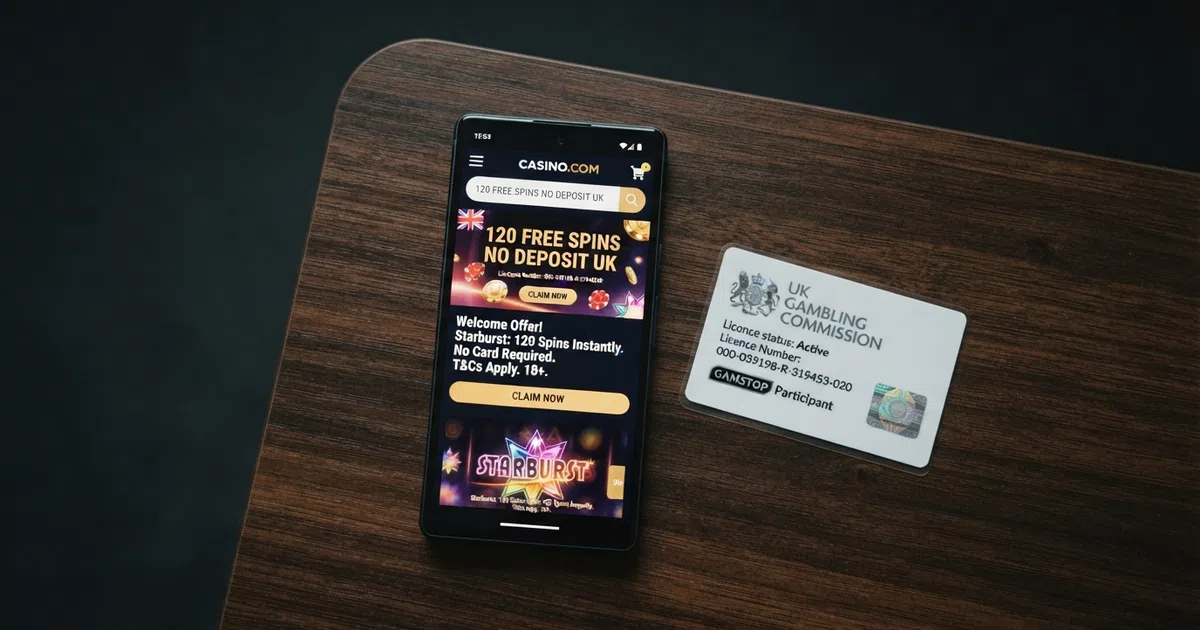
The “120 free spins no deposit” search is one of the most popular queries in UK online casino, and one of the most misleading. A verified, genuinely deposit-free 120-spin offer at a UKGC-licensed casino does not currently exist. The closest verified no-deposit counts sit between 50 and 88 spins; the “120” packages that do appear are deposit-tied bundles where the player’s own money opens the door.
That gap between the headline number and the verified market is the single most important thing to know before spending ten minutes comparing offers. It also frames everything that follows: which no-deposit counts actually exist, why the January 2026 rule change rewrote the bonus landscape, what the 10x wagering cap means in pounds rather than multipliers, and which operators let you keep what you win.
The Fine Print Behind UK Casino Bonuses in 2026
Three words carry the whole search: no-deposit, free, spins. Strip them apart and most of the confusion dissolves. “No-deposit” means the player pays nothing to claim. “Free” means no purchase is required to receive. “Spins” locks the offer to a slot machine rather than a table game, a bingo ticket, or a sports bet. When all three hold, the player is in the rarest corner of the UK bonus market — and the corner has been shrinking.
A 120-spin bundle at £0.10 per spin carries a face value of £12.00. That is what an operator hands over before any wagering, any cap, any game restriction. The honest accounting of what the player ends up with is what comes next — and it depends on three mechanics: whether the operator demands turnover on winnings, what the maximum redeemable figure is, and which slot the spins are locked to.
The search term “120 free spins no deposit UK” is, in part, an artefact of search volume rather than a market reality. Affiliate pages chasing clicks have spent years inflating offer counts to win rankings, and the figure 120 became shorthand for “a big bundle”. SpinHunter’s editorial team could not verify an exact 120-spin no-deposit offer from an operator-grade UKGC source in June 2026 — the same finding that runs through Racing Post, CasinoBuddies, and the British Gambler review pages. What does exist is a layer of smaller no-deposit counts at the top of the market and a layer of 120-spin deposit-tied packages underneath.
The rule that reshaped the market took effect on 19 January 2026. Under LCCP Social Responsibility Code 5.1.1, the Gambling Commission imposed a hard 10x cap on wagering requirements: a casino cannot ask a player to bet more than ten times their bonus winnings before allowing a withdrawal. As BetBond’s write-up of the rule puts it, “in practical terms, this means a casino cannot ask you to bet more than ten times your bonus winnings before allowing a withdrawal.” The same rule change banned mixed-product promotional offers — a casino can no longer condition a bonus on the customer playing a different product type (betting, bingo, casino, lottery).
Alongside the bonus rules, online slots now carry statutory per-spin stake limits that apply to every spin, including free ones. Since 9 April 2025, players aged 25 and over are limited to £5 per game cycle on online slots; since 21 May 2025, players aged 18 to 24 are limited to £2. These limits were imposed by SI 2025/215 and do not apply to table games, live casino, bingo, or sports betting. For a free spin at £0.10, the cap is academic. It matters because it constrains the operator’s ability to bundle a £5-spin slot into a free-spin offer aimed at older players.
What the Offer Actually Delivers
The face value is honest arithmetic: 120 spins at £0.10 each is £12.00 in spin value. What the player ends up with depends on the operator’s wagering terms and any cashout cap. Most no-deposit offers at UKGC operators come with a maximum redeemable figure between £20 and £100, with £50 the most common mid-range. A handful of operators — Sky Vegas, Paddy Power, Betfair, MrQ — state no cashout cap at all on their no-deposit spins, which is the only structural advantage that erases the gap between a 70-spin and a 120-spin headline.
The 120-spin packages that do exist are deposit-tied: LottoGo’s 100% deposit match up to £200 includes exactly 120 spins, but the player must deposit first. The headline count is real; the “no deposit” half of the search term is not. Comparing a 120-spin deposit package to a 70-spin no-deposit one is comparing different products — one is a free try, the other is a first-deposit sweetener that arrives with the player’s own money in motion.
Online Casinos vs High-Street Betting Shops
Free spins are an online-only product. A high-street bookmaker like a William Hill shop or a Ladbrokes branch offers fixed-odds betting terminals, over-the-counter sports bets, and in some locations electronic roulette — but it cannot run a slot machine bonus. Slots themselves are present on the machines, yet the promotional mechanics that turn 70 spins into a “no-deposit welcome offer” are tied to the operator’s online account, its bonus balance, and its wagering ledger. The £5 and £2 per-spin stake limits on online slots are online-specific rules: they do not apply to the betting shop floor.
The channel difference shows up in two places. The first is convenience: a smartphone and a verified account can claim 70 free spins before the kettle has boiled. The second is consumer protection: online operators fall under the full UKGC framework — identity checks, GAMSTOP self-exclusion, the 10x wagering cap, ADR routes. A high-street bookmaker is licensed and regulated, but the bonus product on which a player is comparing offers simply does not exist there.
UK Availability: Why the Exact Number Matters
The “120” in the search term is a search-volume artefact, not a market unit. UKGC bonus rules have narrowed the range of offers a casino can profitably run, and the post-January 2026 landscape rewards structure over headline. The 70, 60, 88, and 50-spin no-deposit offers that survive are smaller, but they pay winnings as cash. A 120-spin deposit-tied offer looks bigger on a comparison page and costs the player £10 (or more) of their own money to reach.
Smaller no-deposit counts dominate the verified list for a reason. Every spin a casino hands over for free is a spin on which the casino earns nothing while still absorbing payment-processing costs, identity-verification overhead, and bonus-balance liability. Capping a no-deposit offer at 50 or 70 spins keeps the liability manageable while still acquiring a customer. A 120-spin no-deposit offer at £0.10 per spin is a £12 liability per new sign-up — and one that the operator cannot recover if the player wins, because the 10x cap limits what the player must wager before withdrawing. The arithmetic does not work at scale, which is why the verified list tops out at 88.
The Honest Truth: No UKGC Casino Offers Exactly 120 No-Deposit Free Spins
State it plainly: a verified 120 free spins no-deposit offer does not currently exist at a UKGC-licensed casino. SpinHunter’s editorial team could not verify one in June 2026 from an operator-grade source. Racing Post identifies LottoGo as the only site offering a “120 free spins” package, and that is a deposit-tied 100% match. The remaining 120-spin pages in the search results are affiliate constructions — terms assembled from the operator’s broader welcome package and presented as a stand-alone headline.
Why do affiliate pages inflate the number? Because the search term is competitive and “120” is a round number that ranks. The closer-to-truth articles acknowledge the gap; the more aggressive ones assemble 50 no-deposit spins + 70 deposit-tied spins and call the bundle “120 free spins”. It is a marketing construction, not a bonus.
The closest genuine alternatives split into two columns. The first is genuine no-deposit offers, where the player pays nothing to claim: Sky Vegas 70 spins, Paddy Power 60 spins, 888casino 88 spins, Betfair 50 spins. All four run on zero or capped wagering. The second is deposit-tied packages that reach or pass 120 spins: LottoGo 120, William Hill Vegas 200, Betfred 200, Gala Spins 100, Coral 100. The player’s £10 is the gate.
To evaluate a smaller no-deposit offer against a larger deposit-tied one, three numbers matter: the spin count, the wagering multiplier (or its absence), and the cashout cap. A 70-spin no-deposit offer with 0x wagering and no cap produces withdrawable cash on every win. A 200-spin deposit-tied offer with 10x wagering and a £30 cap produces a slot session, not a withdrawal — the £10 deposit is the only money the player is reasonably likely to take out, and even that requires running the bonus to completion.
How No-Deposit Free Spins Work in the UK
A no-deposit free spin offer starts before any money changes hands. The player registers an account, completes identity verification, and triggers the offer — either by opting in via a checkbox or by entering a promotional code the operator publishes. The spins are then credited to a bonus balance, not the cash wallet, and are locked to a specific slot or shortlist of slots the operator names in the terms.
The bonus balance is the first point of confusion. Winnings from the spins land in the bonus balance, where they cannot be withdrawn until the wagering requirement is met (or, at 0x-wagering operators, are paid straight into the cash balance). A player who reads “70 free spins” and assumes the winnings sit in cash from the first spin will be surprised when the withdrawal button stays greyed out.
The credit-card ban is the second mechanic that catches players out. Since 14 April 2020, no remote gambling transaction can be funded by a credit card — and the ban extends to credit-card-funded e-wallet payments through Skrill, Neteller, or PayPal. A player who tries to add a credit card at the deposit step is blocked; a player who loads a credit card into PayPal and then deposits via PayPal is also blocked. Debit cards and bank transfers are the standard routes.
Welcome and Sign-Up Offers: What You Really Get
The welcome-offer landscape in mid-2026 rewards structure over count. Four UKGC operators run verified no-deposit counts between 50 and 88 spins, and none of them reach 120. The two largest — Sky Vegas at 70 and Paddy Power at 60 — both run on zero wagering. The third, 888casino, runs 88 spins with a 10x wagering ceiling under the UKGC cap. The fourth, Betfair, runs 50 spins with zero wagering.
Sky Vegas’s 70 spins are valued at £0.10 each, producing a £7.00 face value, with no wagering on winnings. The offer is unlocked by adding a debit card and opting in; no payment is taken. Eleven games are eligible, including Eye of Horus and Fishin’ Frenzy, and the operator does not publish a cashout cap. Paddy Power’s 60 no-deposit spins split 50 across eligible slots and 10 on Paddy’s Mansion Heist, with the same 0x wagering structure and a 7-day validity window. A promo code is required; the terms it unlocks are what matter, not the token. 888casino’s 88 spins arrive on registration, with a 14-day spin validity and a 90-day window for any deposit bonus, and carry the UKGC’s 10x wagering ceiling on winnings. Betfair’s 50 no-deposit spins run under the Flutter zero-wagering model — card registration is required, no payment, and the bonus slot is not specified in the current terms.
The four together produce between 268 and 280 spins of no-deposit value across the Flutter, evoke, and 888 brands. None of them reach 120 individually because the no-deposit 120-spin offer is, at the moment, a market absence rather than a market product.
The 10× Wagering Cap and What It Means for Your Winnings
Before 19 January 2026, UK casino bonuses commonly carried wagering requirements of 20x to 50x. A £10 bonus could demand £200 to £500 of turnover before withdrawal, on slots at 96% RTP — a 4% house edge compounded across the wagering turnover. At 50x, the expected loss on a £10 bonus was £5.00. At 10x, it is £1.00. The cap is not a marketing gesture; it cuts the bonus cost to the player by 80%.
In pounds, the rule works as follows. A no-deposit 70-spin offer at £0.10 produces a £7.00 bonus. The maximum wagering demand is 10x that figure — £70 of turnover before withdrawal. A 120-spin no-deposit offer at the same £0.10 would produce £12.00 of bonus and a maximum £120 of turnover. The cap does not flatten between small and large bonuses; it scales with the bonus value.
What the cap does not touch: cashout limits, game-weighting for table games, eligibility windows, or deposit-tied structure. A casino with the 10x cap can still set a £20 cashout ceiling on no-deposit winnings, and most do. It can still exclude e-wallets from the bonus, and most do. The cap is a ceiling on the multiplier, not a guarantee of player-friendly terms.
Operators that run 0x wagering — Sky Vegas, Paddy Power, Betfair on their no-deposit spins, and Betfred on its deposit-tied spins — bypass the entire question. There is no turnover to clear because the winnings are credited as cash. The 0x structure is clearly superior, removing the turnover requirement entirely for the player.
No-Wagering Free Spins: Keep What You Win
“0x wagering” is the most player-friendly term a UK no-deposit offer can carry. It means the winnings from the free spins are paid as withdrawable cash: what lands in the bonus balance is immediately moved to the cash balance, where the player can withdraw (subject to identity verification) without further play.
In the current set, four operators run 0x wagering on at least part of their free-spin offer. Sky Vegas runs 0x on its 70 no-deposit spins. Paddy Power runs 0x on its 60 no-deposit spins. Betfair runs 0x on its 50 no-deposit spins. Betfred runs 0x on its 200 deposit-tied spins. All four are Flutter or Petfre brands, which suggests the zero-wagering structure is a Flutter group product decision rather than a competitive response to the UKGC cap.
The trade-off is consistent. A 0x-wagering no-deposit offer is smaller — 50 to 70 spins — and the operator compensates by limiting the offer to specific slots. A 10x-wagering no-deposit offer is larger — 88 to 200 spins — and the operator compensates by demanding turnover on winnings. For a player who values certainty, 0x is worth more than a larger headline with 10x attached. A £7 win on a 70-spin 0x offer is withdrawable on demand; a £7 win on a 200-spin 10x offer must be turned into £70 of slot play before withdrawal, with an expected £2.80 lost to the house edge.
Bonus Codes and Promotions: What to Expect
A “bonus code” in the UK free-spin market is rarely a discount token in the coupon sense. It is a string the operator publishes — on its promotion page, in an email, or via an affiliate — that unlocks a specific offer. The string does not change the underlying terms. It triggers them.
Two patterns dominate. The first is a public promo code: Paddy Power’s 60-spin no-deposit offer requires a code, and the code is published on the operator’s site. A player who registers without entering the code will not see the offer in their account. The second is an opt-in checkbox: Sky Vegas’s 70-spin offer is unlocked by adding a card and ticking a box on the registration page. No code, no entry field — a step the player takes rather than a string they type.
Where codes typically appear is the operator’s own site. Third-party coupon aggregators exist, but they tend to recycle expired codes or affiliate tracking links. A code from such a page either works (because the operator still runs the offer) or does not (because the offer has changed). The terms the code unlocks are what matter: wagering, validity, eligible games, cashout cap. The code itself is a key, not a discount.
How to Claim Free Spins Step by Step
The claiming flow runs in five steps. The first is visiting the operator via its own domain — not a redirect from an affiliate link, not a search-engine ad that may lead to a lookalike. The second is registration: name, email, date of birth, address. The third is identity verification, in place since 7 May 2019, which gates the bonus until the operator has matched the registered details to a verified document. The fourth is locating the offer — opt-in checkbox on the registration page for Sky Vegas, a code-entry field for Paddy Power. The fifth is the spins appearing in the bonus balance, locked to a specific slot, with a validity clock that starts immediately.
The clock is the silent trap. Sky Vegas credits the 70 spins and gives 7 days. Paddy Power gives 7 days. William Hill Vegas gives 6 minutes from credit — the tightest window in the set. 888casino gives 14 days on the free spins and 90 days on the deposit bonus. A player who registers on a Friday and returns the following Wednesday has already burned half the Paddy Power clock. The spins do not queue.
New vs Existing Player Eligibility
Welcome offers are the primary vehicle for free spins at UKGC operators. Existing-player promotions — reload bonuses, loyalty free spins, opt-in weekly offers — exist, but they are typically smaller, deposit-tied, and tied to a specific slot the operator is promoting that week. A returning player at Sky Vegas does not see a second 70-spin no-deposit offer; they see a deposit match or a smaller spin bundle with wagering.
The eligibility rule is the one-account-per-household-or-IP restriction. The Flutter and Entain groups share infrastructure across brands: a household that has claimed Sky Vegas’s 70 spins cannot claim Paddy Power’s 60 spins from the same address. The check is automated and runs at the address, payment-method, and device level. A player who tries to claim a second brand’s no-deposit offer from the same home is likely to be flagged for duplicate-account review and have the bonus voided.
The gating logic is commercial. A no-deposit offer is a customer acquisition cost — the operator pays for a sign-up that may or may not convert to a depositing player. Once converted, the same player is worth the cost of a reload, not a no-deposit bundle. The best terms are reserved for the first claim.
UK Free Spin Casinos: Verified Comparison
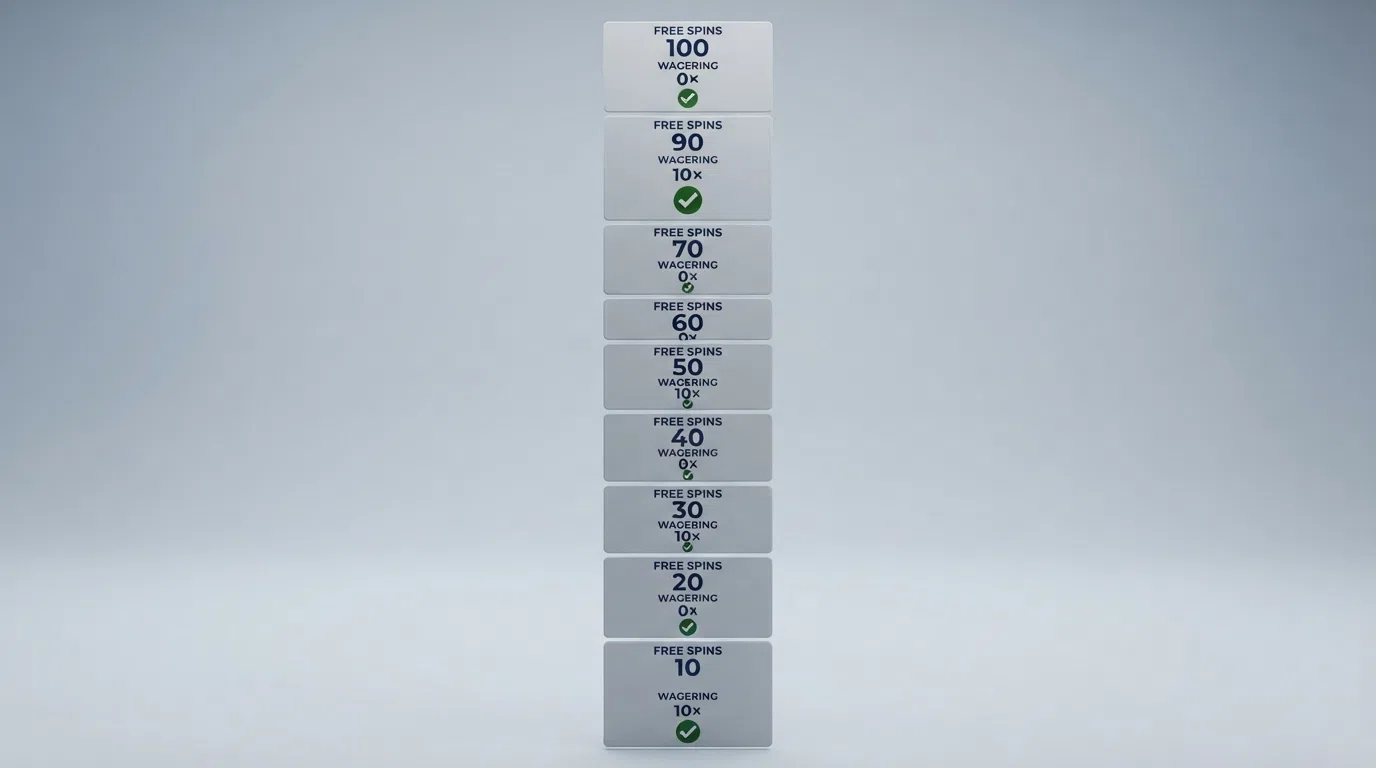
The ten operators below all hold a GB licence on the Gambling Commission’s public register, which was the first screening test. The second was offer-term verification: every spin count, wagering figure, and validity window below was confirmed in June or July 2026 against the operator’s own promotion page or a regulator-grade secondary source. The table is split between four genuine no-deposit offers and six deposit-tied packages, ranked by combined terms.
| Operator | UKGC Licence | Free Spins (Type and Count) | Wagering on Winnings | Spin Value | Validity |
|---|---|---|---|---|---|
| Sky Vegas | GB-licensed (Flutter) | 70 no-deposit | 0× | £0.10 | 7 days |
| Paddy Power Games | GB-licensed (Flutter) | 60 no-deposit + 100 deposit-tied | 0× | £0.10 | 7 days |
| Betfair Casino | GB-licensed (Flutter) | 50 no-deposit | 0× | £0.10 | Not specified |
| 888casino | GB-licensed (evoke) | 88 no-deposit | 10× (UKGC cap) | £0.10 | 14 days |
| William Hill Vegas | GB-licensed (evoke) | 200 deposit-tied | 10× | £0.10 | 72 hours |
| Betfred | GB-licensed (Petfre) | 200 deposit-tied | 0× | £0.10 | 7 days |
| LottoGo | GB-licensed | 120 deposit-tied | 10× | Not confirmed | Not confirmed |
| Gala Spins | GB-licensed (Entain) | 100 deposit-tied | 0× | £0.10 | 7 days |
| Coral | GB-licensed (Entain) | 100 deposit-tied | 10× | £0.10 | 48h to accept, 7 days |
| Ladbrokes | GB-licensed (Entain) | Deposit-tied (count not confirmed) | 10× (UKGC cap) | £0.10 | Not confirmed |
The split is the headline finding. Four of the ten run genuine no-deposit offers; six require a deposit. Within the no-deposit half, three of four carry zero wagering. Within the deposit-tied half, two of six carry zero wagering, and those two — Betfred at 200 spins and Gala at 100 — are the most player-friendly deposit-tied offers in the set. Cashout caps are not consistently published; the operators that omit a cap tend to be the ones running 0x wagering, because the absence of a wagering requirement removes the need for a cap to balance the bonus liability.
Sky Vegas: 70 No-Deposit Spins, Zero Wagering
Sky Vegas’s 70 no-deposit spins are the largest verified no-deposit, no-wagering offer in the current UKGC market. The structure is straightforward: a new customer adds a debit card to their account, opts in via a checkbox on the registration page, and receives 70 spins at £0.10 each, totalling £7.00 in face value. No payment is taken. No deposit is required.
The 0x wagering term is the differentiator. Every winning spin credits cash directly to the withdrawable balance. A player who runs the 70 spins to completion has, on average, between £4.20 and £5.60 in expected returns (depending on the slot selected), and the entire balance is theirs to withdraw. There is no turnover to clear, no game-weighting to navigate, and no cashout cap published in the terms.
Eleven slots are eligible, including Eye of Horus and Fishin’ Frenzy, both of which run at high RTPs. The 7-day validity is a working window, not a rushed one. A player who claims on Monday and plays through the following weekend is comfortably within the clock.
The verdict: for a player who wants to try a real-money slot without depositing, Sky Vegas is the strongest no-deposit offer available at a UKGC operator in 2026. The 70-spin count is smaller than the deposit-tied 200-spin offers, but the absence of wagering and the absence of a cashout cap more than offset the gap.
Paddy Power Games: 60 No-Deposit Spins, Keep Everything
Paddy Power’s 60 no-deposit spins split 50 across eligible slots and 10 on Paddy’s Mansion Heist, Paddy Power’s in-house title. The wagering is 0x, the validity is 7 days, and a promo code is required at registration. The 60 no-deposit spins sit alongside a 100-spin deposit-tied extension unlocked by a £10 deposit via debit card or Apple Pay.
The headline is the 60 no-deposit spins, and the structure mirrors Sky Vegas’s. Winnings are credited as cash, with no turnover to clear. The promo code is the friction: a player who registers without entering the code will not see the offer. The code is published on the operator’s promotion page and is not a discount token — it triggers an offer whose terms are fixed.
The 10 Paddy’s Mansion Heist spins are the brand touch. They run on a proprietary slot rather than a NetEnt or Pragmatic title, which means the RTP and volatility are Paddy Power’s design choices rather than a third-party provider’s. The expected return is comparable; the experience is Paddy-flavoured.
The verdict: Paddy Power’s 60 no-deposit spins are a close second to Sky Vegas’s 70. The smaller count is balanced by the same 0x wagering and the addition of 100 deposit-tied spins at the £10 mark, which makes Paddy Power a stronger choice for a player who plans to deposit anyway. For a strictly no-deposit player, Sky Vegas wins on count; Paddy Power ties on terms.
Betfair Casino: 50 No-Deposit Spins, No Wagering
Betfair’s 50 no-deposit spins complete the Flutter zero-wagering trio. Card registration is required, no payment is taken, and winnings are paid as cash. The bonus slot is not specified in the current terms — a gap that is unusual for the Flutter brands, which usually publish the eligible games list.
The 50-spin count is the smallest of the no-deposit, no-wagering offers. It reflects Betfair’s positioning as a betting-exchange-led brand where the casino is a secondary product. The 0x structure still makes it strictly better than a 10x-wagering offer of comparable count, but the absence of an eligible-games list is a real friction: a player who dislikes the auto-assigned slot has no way to know in advance.
The Flutter group relationship is worth noting. Sky Vegas, Paddy Power, and Betfair sit under the same corporate parent and share the 0x-wagering policy. A household that has claimed one of the three cannot claim the other two from the same address.
The verdict: Betfair’s 50 no-deposit spins are the most modest offer in the Flutter zero-wagering set. The terms are identical to Sky Vegas and Paddy Power; the count is the differentiator. Sky Vegas remains the primary recommendation for those prioritising volume alongside the 0x-wagering structure.
888casino: 88 Spins on Registration
888casino’s 88 free spins are the closest no-deposit count to the 120 in the search term, and the only no-deposit offer in this set that carries the UKGC’s 10x wagering cap on winnings. The structure is registration-only: name, email, date of birth, address, identity verification, and the 88 spins are credited. No deposit, no card registration required at the offer trigger.
The 10x wagering is the cost of the larger count. A player who wins £7.00 on the 88 spins must turn over £70 in slots before withdrawal. At 96% RTP, the expected loss on that turnover is £2.80, leaving an expected £4.20 net of wagering. The arithmetic is the same as a Sky Vegas 70-spin 0x offer with one fewer spin at the start; the difference is the player has to play through the wagering rather than withdrawing on demand.
Starburst is the commonly featured bonus slot, running at the default 96.09% RTP. Section8 Studio, 888casino’s in-house provider, contributes proprietary games to the lobby. The 14-day spin validity is generous, and the 90-day bonus window covers any deposit match a player might opt into.
The verdict: 888casino’s 88 spins are the right offer for a player who wants the largest no-deposit count and is comfortable running 10x wagering. The structure is less player-friendly than the Flutter 0x offers, but the larger count and the 14-day window make it the second-strongest no-deposit option after Sky Vegas. The page subject — 120 no-deposit spins — is closer to 88 than to 70, so 888casino is the natural ranking for a reader scanning for the highest no-deposit count.
William Hill Vegas: 200 Spins, Deposit Required
William Hill Vegas’s 200 free spins are the largest headline count in the set and the second-largest by eligible spins. The structure is deposit-tied: a £10 deposit plus a £10 stake on slots unlocks 200 spins on Big Bass Splash at £0.10 each. The 10x wagering cap applies to winnings, and the clock runs for 17 minutes from credit — the tightest validity window in the set.
The £30 cap on free-spin winnings is the constraint. Even with 200 spins, a player is limited to £30 redeemable from the bonus. The £10 deposit remains withdrawable separately, so the player is not trapped — but the spin winnings are bounded. A player who hits a 200x win on Big Bass Splash sees the bonus balance stop counting toward withdrawal at £30.
Big Bass Splash is the bonus slot, a Pragmatic Play fishing-themed title. Big Bass Bonanza, the parent series, runs at 96.71% RTP in the optimal configuration, with medium-to-high volatility. Big Bass Splash is a variant of the same engine; the RTP is close to the parent but not identical, and the volatility profile is the same.
The verdict: William Hill’s 200 spins are a volume play, not a value play. The £10 deposit and the £30 cap combine to limit the upside, and the 72-hour clock makes the offer feel rushed. Comparatively, the 0x-wagering offers listed elsewhere provide significantly better value for real-money seekers.
Betfred: 200 Spins, Zero Wagering, Deposit Required
Betfred’s 200 free spins carry the same headline count as William Hill but invert the wagering. Winnings are paid as withdrawable cash — 0x — and the only deposit requirement is £10 by debit card plus £10 staked on slots. The 7-day validity is a working window, and there is no published cashout cap on the free-spin winnings.
The debit-card restriction is the trade-off. E-wallets (Skrill, Neteller, PayPal) and prepaid deposits may be excluded from the bonus. A player who prefers PayPal cannot use it for this offer — a common restriction across UK deposit-tied bonuses, but worth flagging because the omission is sometimes only visible at the deposit step.
The selected-slots list is broader than a single-title offer. Where William Hill’s 200 spins are locked to Big Bass Splash, Betfred’s 200 run on a list of eligible slots, and the player can pick. The RTPs vary by game, but the 0x wagering structure means the choice is about preference, not arithmetic.
The verdict: Betfred’s 200 spins are the best deposit-tied offer in the set. The 0x wagering is the structural advantage; the debit-card restriction and the deposit requirement are the costs. This 0x-wagering structure offers a much clearer path to withdrawal than capped-multiplier alternatives.
LottoGo: The Only 120-Spin Package We Found
LottoGo’s welcome package is the only verified “120 free spins” offer in the current UKGC market, and it is a deposit-tied bundle: a 100% deposit match up to £200 plus 120 free spins, with the UKGC’s 10x wagering cap applied. The bonus slot and the per-spin value were not confirmed at review — a gap that is unusual for a headline-count offer and a flag for any player who wants to know the RTP of the slot before depositing.
The 10x wagering is the structural constraint. On a 120-spin offer at £0.10 (an assumption; the exact per-spin value is not published), the face value is £12.00 and the maximum turnover is £120. At 96% RTP, the expected loss is £4.80, leaving an expected £7.20 in net winnings. The arithmetic is the same as a smaller no-deposit offer with the wagering attached.
The deposit match is the second half of the bundle. A player who deposits £200 receives £200 in bonus funds, with its own wagering requirement. The combined bonus liability (deposit match + free spins) is the largest in this set by total face value, and the largest by combined wagering exposure.
The verdict: LottoGo’s 120-spin package is the answer to the page’s headline query, and the answer is “yes, but it is deposit-tied with wagering”. The structure is a standard post-January 2026 welcome package, and the 120-spin count is the largest verified in the UK market. LottoGo is currently the only market option for a 120-spin deposit-tied package; however, those specifically seeking a no-deposit equivalent will not find a verified match.
Gala Spins: 100 Spins After Deposit
Gala Spins’s 100 free spins apply the Entain zero-wagering model to a smaller count. The structure is a £10 deposit plus £10 staked on selected slots, with 0x wagering on free-spin winnings. The 7-day validity and a 7-day claim window from registration bound the offer; the eligible games are selected by Gala.
The 100-spin count is mid-range for a deposit-tied offer. Betfred and William Hill both run 200; Coral runs 100 with 10x wagering. Gala’s 100 at 0x wagering is the cleanest of the three: a player who deposits £10 and stakes £10 receives 100 spins with no turnover to clear, no cashout cap published, and a 7-day window that does not feel rushed.
The Entain group connection is worth noting. Gala, Coral, and Ladbrokes share a corporate parent and an offer-engine. The deposit-tied structures are similar across the three brands, with the difference in spin count and wagering being the points of variation.
The verdict: Gala’s 100 spins are a strong second-tier deposit-tied offer. The 0x wagering is the differentiator from Coral, and the 100-spin count is half of Betfred’s 200. For a player who values structure over count, Gala is the right pick; for a player who wants the maximum spins at 0x, Betfred’s 200 is the larger version of the same proposition.
Coral: 100 Spins, 10× Wagering, Deposit Required
Coral’s 100 free spins apply the UKGC’s 10x wagering cap to a standard Entain structure: £10 deposit plus £10 bet on slots, 10x wagering on free-spin winnings, 48 hours to accept the offer from registration, and 7 days to use the spins once credited. PayPal may be excluded from the bonus — a common Entain restriction that the player discovers at the deposit step.
The 10x wagering is the cost of the smaller count. On a £10 expected return from the 100 spins, the maximum turnover is £100, with an expected £4.00 lost to the house edge. The arithmetic is the same as LottoGo’s 120-spin package scaled down; the cashout cap is not published but the wagering exposure is the binding constraint.
The 48-hour accept window is the operational quirk. A player who registers and does not return within 48 hours loses the offer, regardless of whether the spins have been credited. The 7-day validity on the spins runs from credit, not from registration, so the two clocks are sequential.
The verdict: Coral’s 100 spins are a standard Entain deposit-tied offer. The 10x wagering is the main disadvantage against Gala’s 0x alternative, and the PayPal exclusion is a real friction. For a player with a Coral account history or a preference for the brand, the offer is competitive; for a player choosing between the three Entain brands, Gala’s 0x structure makes it the stronger pick at the same count.
Ladbrokes: Deposit-Tied Free Spins
Ladbrokes’s exact free-spin count was not confirmed at the review window — a gap that places the brand at the bottom of this ranking. The brand runs a deposit-tied welcome offer under the standard Entain structure: £10 deposit, spin count subject to confirmation, 10x wagering cap under the UKGC rule, and the typical provider mix (Playtech, NetEnt, IGT, Pragmatic, Evolution).
The verification gap is the issue. A player who visits Ladbrokes expecting a specific count is reading a number that the operator may or may not honour at the time of registration. Promotional terms at Ladbrokes change with the same frequency as the rest of the Entain brands — roughly every four to six weeks — and the welcome-offer rotation does not always align with what affiliate pages publish.
The provider mix is the brand’s structural advantage. Ladbrokes carries the broadest game selection of the three Entain brands, with Playtech’s full catalogue and Evolution’s live-dealer suite. For a player who values game variety over free-spin count, the brand competes on its library.
The verdict: Ladbrokes’s place in the ranking is provisional, pending confirmation of the current welcome offer. The brand is a UKGC-licensed operator with a strong game library, and the deposit-tied structure is the standard Entain model. A player who chooses Ladbrokes is choosing the brand and the library, not the free-spin count.
Which Slots Your Free Spins Actually Work On
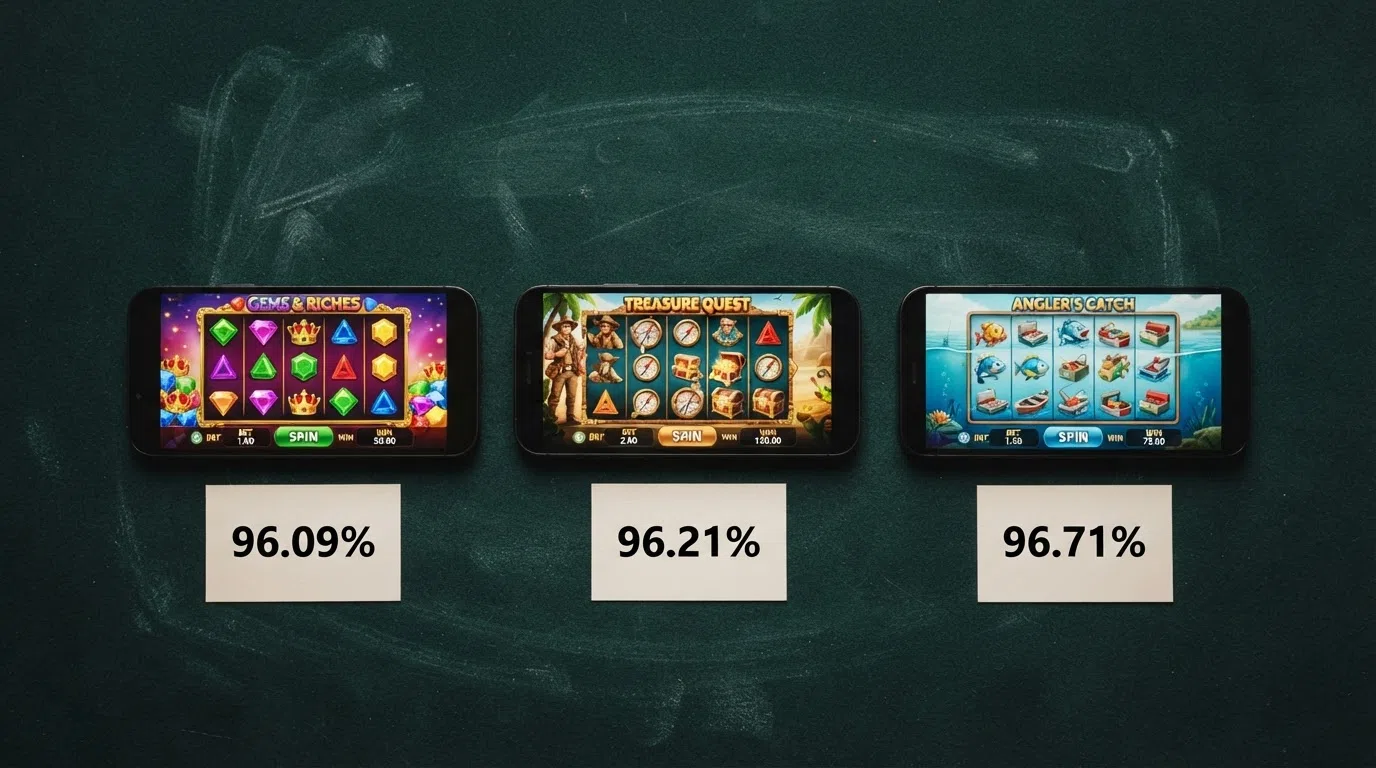
Most free-spin offers in the UK are locked to a shortlist of slot titles. The shortlist is the operator’s choice, not the player’s, and the choice shapes the expected return. Three titles appear across nearly every UK free-spin promotion: Starburst, Book of Dead, and Big Bass Bonanza. Each runs a different RTP and a different volatility, and the combination of the two determines what “120 free spins” actually delivers in pounds.
| Slot Title | Provider | RTP | Volatility | Maximum Win |
|---|---|---|---|---|
| Starburst | NetEnt | 96.09% | Low | 500× stake |
| Book of Dead | Play’n GO | 96.21% | High | 5,000× stake |
| Big Bass Bonanza | Pragmatic Play | 96.71% (optimal) / 94.71% | Medium-high | 2,100× stake |
Starburst is the default low-volatility pick. At 96.09% RTP, the slot returns £96.09 on every £100 wagered over the long run, with low volatility smoothing the variance. A 70-spin bonus at £0.10 produces £7.00 in spin value, with an expected £6.73 in return — most of which arrives in small, frequent wins. The 500× max win caps the upside but also caps the downside: a player is unlikely to lose the full £7.00 before the spins are used.
Book of Dead is the high-volatility alternative. At 96.21% RTP, the long-run return is fractionally higher than Starburst, but the variance is dramatically steeper. A 70-spin bonus at £0.10 has the same £7.00 face value and an expected £6.73 return, but the distribution is bimodal: most sessions return close to zero, and a small minority return the 5,000× max. The cashout cap on most no-deposit offers — £20 to £100 — clips the upper tail, so a player who hits a 1,000× win on Book of Dead sees only the cap.
Big Bass Bonanza is the volume leader. At 96.71% RTP in the optimal configuration (94.71% in a secondary configuration), the slot returns more per pound wagered than either Starburst or Book of Dead. Volatility is medium-high, sitting between the two extremes. The 2,100× max win is a smaller ceiling than Book of Dead’s 5,000× but a much larger one than Starburst’s 500×. Pragmatic Play’s fishing-themed engine is the most-used bonus slot in the UK market, and the 96.71% configuration is what most operators run.
The Slots Most Free Spin Offers Target
The three titles sit at the top of the UK free-spin market for provider reasons as much as game-design reasons. NetEnt, Play’n GO, and Pragmatic Play are the three providers with the broadest UK distribution: every UKGC-licensed casino carries their catalogues, and the commercial terms the operators negotiate with the providers make these three the cheapest slots to bundle into a free-spin offer.
Starburst is the default pick because it is cheap to bundle and predictable to play. The low volatility produces a session where most spins return something, which keeps a new player engaged and produces more wagering turnover for the operator. The 500× max win is high enough to be interesting but low enough that a 70-spin bonus at £0.10 is unlikely to produce a cashout-cap problem.
Book of Dead is the high-volatility alternative for operators that want a “big win” headline. The 5,000× max win is the marketing pull, even though the cashout cap clips it on most offers. A 70-spin bonus that hits a 1,000× win produces £70 in raw return — capped to £50 or £100 depending on the operator — which is the kind of screenshot that drives engagement on social media.
Big Bass Bonanza is the volume leader because Pragmatic Play distributes it at 96.71% RTP in the optimal configuration — the highest of the three — and because the fishing theme is broadly appealing. The slot is also available at 94.71%, a configuration that some operators run. Always check the in-game RTP panel, as configurations can differ significantly even within the same game title.
Selected Slots: Why You Cannot Play Everything
Operators restrict free spins to a shortlist because the slots are licensed from providers, and the provider’s commercial terms govern which titles can be bundled. NetEnt’s games are available at every UK casino; Pragmatic Play’s are nearly as broadly distributed; smaller providers (Hacksaw, Nolimit, Push Gaming) are more selective. The “selected slots” clause is partly a commercial artefact and partly a margin-protection mechanism.
The provider deal is the gate. A casino that has negotiated a flat fee with NetEnt can bundle Starburst cheaply; a casino that has not may not be able to offer it as a free-spin slot. The eligible-games list on Sky Vegas’s 70-spin offer reflects Sky’s existing NetEnt and Pragmatic deals; the list on Paddy Power’s 60-spin offer reflects Paddy Power’s Playtech and proprietary deal.
Margin protection is the second reason. A high-RTP slot (96.71% Big Bass Bonanza) is cheaper for the operator to offer than a low-RTP slot (94% or below). A high-volatility slot (Book of Dead) is also more expensive than a low-volatility slot (Starburst) at the same RTP, because the variance produces occasional large wins that the operator must absorb. The shortlist is the operator’s calculation of which slots balance player appeal against bonus liability.
What RTP and Volatility Mean for Free Spin Value
RTP is the long-run return percentage. A 96% RTP slot returns £96 on every £100 wagered over millions of spins. The figure is a statistical average, not a session guarantee, and it is the only public number that lets a player compare slots. Volatility is the short-run variance: a low-volatility slot produces many small wins and few large ones; a high-volatility slot produces few wins and occasional large ones. The combination of the two determines what a 70-spin bonus actually looks like at the session level.
The arithmetic is straightforward. A 70-spin bonus at £0.10 produces £7.00 in spin value. On a 96% RTP slot, the expected return is £6.72. On a 94% RTP slot, the expected return is £6.58. On a 96.71% RTP slot, the expected return is £6.77. The differences look small, but they compound under wagering: a 10x turnover of £6.72 at 96% leaves £6.45 net of the house edge, while the same turnover of £6.58 at 94% leaves £6.18.
Volatility interacts with the cashout cap. A 70-spin bonus on Starburst at 96.09% RTP is unlikely to produce a win large enough to hit the £20-£100 cap; a 70-spin bonus on Book of Dead at 96.21% RTP may produce a 1,000× win that is clipped to the cap. The cap is the operator’s protection against the variance the volatility creates. A player who values certainty of small wins picks Starburst; a player who values the chance of a big clipped win picks Book of Dead; a player who wants the highest expected return picks Big Bass Bonanza at 96.71%.
When “Free” Still Needs a Deposit: Payment Thresholds Explained
The label “free spins” is honest only when the player pays nothing. Many offers labelled “120 free spins” require a £10 deposit first, and the distinction matters because the deposit is the player’s money at risk. A £10 deposit on a 10x-wagering 200-spin offer produces a session where the £10 is the only money the player is reasonably likely to withdraw, and the rest is bonus liability.
The £10 minimum is the industry standard. William Hill, Betfred, Gala, and Coral all gate their welcome spins on a £10 deposit (plus a £10 stake at William Hill and Betfred). The threshold is high enough to filter out curiosity-driven micro-deposits and low enough to remain accessible. A £20 threshold appears at some PayPal-friendly casinos, where the e-wallet minimum is set above the card minimum.
The credit-card ban is the background rule. Since 14 April 2020, no remote gambling transaction can be funded by a credit card, including credit-card-funded e-wallet payments. A player who tries to deposit £10 by credit card is blocked; a player who loads a credit card into PayPal and then deposits via PayPal is also blocked. Debit cards and bank transfers are the only options for the standard £10 deposit.
£10 Deposit, 120 Free Spins: The Most Common Threshold
The £10 minimum is the gate for nearly every “120-spin” package on the UK market. William Hill’s 200 spins, Betfred’s 200, Gala’s 100, and Coral’s 100 all require a £10 deposit. The deposit is the player’s money — it remains in the cash balance, separate from the bonus — and the spins are the bonus credited on top.
The £10 stake requirement is the second layer. William Hill and Betfred both ask for £10 staked on slots in addition to the £10 deposited, which means the player must wager a total of £20 (the £10 deposit plus £10 of additional slot play) before the spins are credited. The stake requirement is a friction that prevents a player from depositing £10, withdrawing it, and keeping the spins.
What the £10 actually buys: the deposit is the player’s money, withdrawable on demand (subject to the standard identity-verification check). The spins are the bonus, governed by the wagering and cashout terms. A player who runs the spins, clears the wagering, and withdraws the deposit plus the bonus winnings is the best-case outcome. It is often a costly way to play, yielding lower average returns than the initial outlay.
£20 Deposit Offers: More Spins, Higher Stakes
The £20 threshold appears at PayPal-friendly casinos, where the e-wallet minimum is set above the debit-card minimum. A player who prefers PayPal for its buyer-protection mechanics may find a £20 floor at casinos that allow PayPal on the deposit but not on the bonus — the deposit goes through, the bonus is voided.
The £20 deposit does not always buy proportionally more spins. Coral’s 100 spins are gated on a £10 deposit, and a £20 deposit does not unlock 200. The threshold is a minimum, not a multiplier. A player who deposits £20 receives the same 100 spins and a £20 cash balance. The arithmetic on the spin value is unchanged.
The debit-card-only tier is the £20 segment’s trade-off. Betfred’s 200 spins run on debit-card deposits only, and the £10 floor is matched to the standard industry minimum. The additional balance extends playtime, providing more value than the £10 minimum threshold.
Minimum Deposit Terms: What the Small Print Says
The gap between the advertised deposit amount and the real terms sits in three places: the stake requirement, the payment-method exclusions, and the time windows. A player who reads “£10 deposit, 200 free spins” and assumes the £10 is the only friction has missed the stake requirement, the PayPal exclusion, and the 48-hour accept window.
The deposit-versus-stake distinction is the first trap. Putting £10 into a casino account is not the same as betting £10. A £10 deposit sits in the cash balance and can be withdrawn (subject to verification). A £10 stake has been wagered on a slot and is subject to the slot’s outcome. William Hill and Betfred require both: deposit £10 and stake £10. A player who deposits £10 and then withdraws it has not met the stake requirement, and the spins are not credited.
E-wallet and prepaid exclusions are the second trap. Skrill, Neteller, PayPal, and prepaid Visa or Mastercard are commonly excluded from welcome bonuses at Coral, Betfred, and Paddy Power. The deposit may go through, but the bonus is voided. A player who prefers PayPal for its purchase protection must accept that the bonus will not be credited.
The time window is the third trap. Coral gives 48 hours to accept the offer from registration; William Hill gives 72 hours from credit to use the spins; Betfred gives 7 days from credit. A player who registers on a Friday evening and returns the following Wednesday has lost the Coral offer and is at the start of the William Hill clock. The 7-day windows at Paddy Power, Betfred, and Gala are more forgiving, but the offer still expires.
No-Deposit vs Deposit-Required: The Real Difference
A no-deposit offer has zero financial exposure: the player risks nothing, claims a 50- to 88-spin bonus, and either wins something (subject to wagering and cashout terms) or walks away. A deposit-required offer has the player’s £10 at risk: the cash balance is subject to the slot outcomes, the bonus spins are subject to wagering, and the only money the player is reasonably likely to withdraw is the deposit plus any bonus winnings that survive the wagering.
The break-even calculus depends on the wagering structure. A 200-spin deposit-tied offer with 0x wagering and no cap (Betfred) produces an expected return of around £14 on the spins at 96% RTP, plus the £10 deposit. A 200-spin deposit-tied offer with 10x wagering and a £30 cap (William Hill) produces an expected return of around £14 on the spins, of which £13.40 survives the £0.60 expected loss on the £60 turnover — and is then capped at £30. The arithmetic favours the 0x structure at the same spin count.
The psychological difference is the unstated factor. A player playing with “house money” — a no-deposit bonus — behaves differently from a player playing with their own £10. The first can walk away at any time; the second has a sunk cost that encourages more play. Neither is wrong, but the psychology is worth naming: a no-deposit offer is a try-before-you-buy, and a deposit-tied offer is a first-purchase sweetener. The player should choose based on which they want, not on the headline spin count.
Claiming Free Spins on Your Phone: What Works and What Does Not
Mobile claiming is the norm rather than the exception. Eighty-one and a half percent of contacts to the National Gambling Helpline in 2026 disclosed online forms of gambling, up from 72.9% in 2022 — a five-year high that reflects how UK players actually access casino offers. A claim that takes ten minutes on a desktop is a claim that takes three on a smartphone, and the operator’s mobile flow is the version most players will use.
The claiming mechanics are the same on mobile as on desktop. The player visits the operator’s site (via the app or the mobile browser), registers, completes identity verification, opts in or enters the code, and receives the spins. The identity-verification step is the friction point on a small screen: uploading a passport or driving licence photo and a proof of address is a desktop-friendly task that takes longer on a phone.
No featured operator runs a mobile-exclusive free-spin offer distinct from the desktop welcome. The terms are the same; the only difference is the platform. A player who claims 70 no-deposit spins on the Sky Vegas app receives the same offer as a player who claims on the desktop site. The app is a delivery mechanism, not a separate product.
Dedicated Casino Apps vs Mobile Browser Play
Most UK operators offer both an app and a mobile-browser version of the casino. The app delivers push notifications for bonus expiry (a useful feature for a 72-hour William Hill window), stored login credentials, and biometric authentication. The mobile browser delivers the same terms without a download, with faster initial access for a player who has not installed the app.
App-store restrictions are the constraint. The Apple App Store and Google Play Store both apply age-gating to gambling apps, requiring users to confirm they are 18 or older before installation. The age gate is a soft check — the operator is still required to verify identity before play — but it filters out minors at the download step. A player who cannot confirm the age gate in the app store cannot install the app, and must use the mobile browser instead.
The mobile browser experience is what the desktop experience would look like on a smaller screen. The same games, the same terms, the same withdrawal process. Mobile browser play offers a flexible alternative for those who prefer to avoid app installation.
Claiming Free Spins on Your Phone: Step by Step
The mobile claiming flow runs in five steps. The first is landing on the operator’s mobile site or finding the app in the store. The second is registration: a shorter form on mobile than on desktop, with the same identity-verification requirement. The third is the mobile ID-verification flow: a photo of the document, a photo of the player holding the document, and a proof of address uploaded via the phone’s camera. The fourth is the opt-in toggle or promo-code field, which on a small screen can require scrolling past the welcome banner. The fifth is the eligible slot loading, the spin button appearing, and the spins being credited to the bonus balance.
The friction points on mobile are document upload and slot loading. The document upload takes longer on a phone than on a desktop with a scanner. The slot loading depends on the device’s processor and the mobile network — a 4G connection loads a slot in three to five seconds, a 3G connection in eight to fifteen. A player on a poor connection may see a longer load time than a player on Wi-Fi.
New UK Casino Sites and Their Free Spin Offers in 2026
New UK casinos use free spins as a customer acquisition tool. The economics are straightforward: a new operator needs players, and a no-deposit spin offer is a low-cost way to acquire a sign-up. The £0.10-per-spin face value on a 50-spin offer is a £5 liability per new player, against the lifetime value of a converted depositing player.
The UKGC licence is the first test. Any operator serving GB customers must hold a Gambling Commission licence, regardless of where the operator is based. A new casino launched in 2026 that targets UK players without a GB licence is committing a criminal offence under section 33 of the Gambling Act 2005, and the player has no recourse to the UKGC complaints process if a dispute arises. The licence check is the single most important step before registering with a new operator.
The offer count at new casinos rarely hits 120, and rarely runs no-deposit. The combination of a no-deposit 120-spin offer and a new operator is a red flag: the customer acquisition cost of 120 free spins at £0.10 (£12.00 per player) is high enough that only a well-capitalised operator can sustain it, and a new entrant with no revenue history is unlikely to be that operator. A new casino offering 120 no-deposit spins is more likely to be unlicensed than generously licensed.
The Remote Gaming Duty rise to 40% from 1 April 2026 is the structural pressure. The operator tax on online casino profits is now 40%, up from 21%. A new entrant launching in 2026 faces a higher tax bill than one that launched in 2024, and the cost of a free-spin offer is funded from the post-tax margin. Fewer free spins, smaller spin counts, and shorter validity windows are the likely response across the market — and the pressure falls harder on new entrants with thin margins.
New Casino Welcome Offers: What Launch Promotions Look Like
A new UKGC-licensed casino typically launches with a deposit-tied welcome package: a 100% deposit match up to a ceiling (£100 to £200) plus a free-spin bundle (50 to 200 spins) on a selected slot. The structure mirrors the established operators — Entain, Flutter, evoke — because the promotional engine is the same.
A no-deposit welcome offer at a new UKGC casino is rare. The economics are unfavourable: a no-deposit offer converts at a low rate, and the operator pays the spin liability for every sign-up regardless of whether the player deposits. A new casino launching with a 70-spin no-deposit offer is signalling confidence in its conversion model, and a player should verify the licence on the Commission register before claiming.
The cross-check is the public register at gamblingcommission.gov.uk. The register is searchable by business name, trading name, domain name, or account number, and is updated daily. A new casino that does not appear on the register is not licensed for GB play, and any “120 free spins” offer from such a site is a marketing pitch to a deposit the player will not be able to withdraw.
No-Deposit Free Spins at New Casinos: Rare and Worth Verifying
A new casino with a large no-deposit free-spin offer is a red flag. The customer acquisition cost of a 120-spin no-deposit offer at £0.10 is £12.00 per sign-up; for a 50-spin offer it is £5.00. A new entrant with no revenue history cannot sustain that cost across thousands of sign-ups, and a site that claims to is either poorly capitalised or running an offer it cannot pay out.
The Curaçao and Malta licence trap is the standard pattern. An offshore site with a Curaçao or Malta licence targets UK search traffic with “120 free spins no deposit” ads, accepts UK players, and operates without a GB licence. The site is committing a criminal offence under section 33 of the Gambling Act 2005, and the player has no recourse to the UKGC complaints process, no GAMSTOP coverage, and no statutory stake limits.
How to verify: the UKGC public register is the source. Search by domain name; if the site does not appear, the site is not licensed for GB play. A legitimate new-entrant no-deposit offer is smaller (20 to 50 spins), time-limited (a 48- to 72-hour window after registration), and heavily capped (a £10 to £20 maximum redeemable). Anything larger is a marketing pitch.
UKGC Licensing, Age Checks and Your Legal Protections
The Gambling Commission is the statutory regulator for gambling in Great Britain. It is an executive non-departmental public body sponsored by the Department for Culture, Media and Sport, established under the Gambling Act 2005. The Commission’s three licensing objectives, set out in section 1 of the Act, are preventing gambling from being a source of crime or disorder, ensuring gambling is conducted in a fair and open way, and protecting children and other vulnerable persons from harm or exploitation.
The point-of-consumption rule is the second pillar. The Gambling (Licensing and Advertising) Act 2014 extended the GB licence requirement to any operator serving GB customers, regardless of where the operator is based. An operator in Malta, Curaçao, or Gibraltar that accepts GB customers must hold a GB licence. A GB licence is the only licence that gives a UK player access to the Commission’s complaints process, GAMSTOP coverage, and the statutory protections the Act provides.
The public register at gamblingcommission.gov.uk is searchable by business name, trading name, domain name, or account number, and is updated daily. Every operator listed in the comparison table above appears on the register. Quick verification of the licence status is essential for ensuring player protection and regulatory compliance.
Licensed vs Offshore: Why It Determines Everything
A GB licence is the difference between enforceable rights and no recourse. A licensed operator must apply the 10x wagering cap, must verify identity before play, must participate in GAMSTOP, must offer ADR (alternative dispute resolution) for complaints, and must apply the age-banded stake limits. An offshore operator with a Curaçao or Malta licence is not bound by any of these rules.
The criminal offence is the starting point. Section 33 of the Gambling Act 2005 makes it an offence to provide facilities for gambling in Great Britain without a licence, punishable by up to 51 weeks’ imprisonment, an unlimited fine, or both. The Commission has used this against offshore operators targeting GB customers, and the cases that have reached court have produced convictions.
The enforcement methods are disruption-based. The Commission can issue cease-and-desist notices, refer payment providers to the bank’s compliance team, request search-engine delisting, and pursue parallel actions with international regulators. It does not have ISP or DNS blocking power, which means an unlicensed site can remain technically accessible in the UK even after an enforcement action. The player, not the Commission, is the last line of defence.
What an offshore site does not give a UK player: no UKGC complaints route, no GAMSTOP coverage, no statutory stake limits, no ADR provider, no protection under the 10x wagering cap, no credit-card ban enforcement. A player who self-excludes via GAMSTOP and then deposits at an offshore site is not protected; the offshore site does not check the register.
Age Verification, Identity Checks and Deposit Rules
Identity verification has been mandatory since 7 May 2019. A GB remote licensee must verify a customer’s name, address, and date of birth before they can deposit or gamble — with their own money or with a bonus. The previous 72-hour grace period has been eliminated. A player who registers and tries to deposit before verification is blocked.
The minimum age is 18. Verification is the mechanism: a passport or driving licence confirms the date of birth, and the operator’s automated check matches the registered details to the document. A player who is under 18 cannot pass the check and cannot play. A player who falsifies the document commits a criminal offence under the Act.
The credit-card ban has been in force since 14 April 2020. No remote gambling transaction can be funded by a credit card, and the ban extends to credit-card-funded e-wallet payments. A player who loads a credit card into PayPal and then deposits via PayPal is in breach of the rule; the operator is required to detect and block the transaction.
The age-banded stake limits are the slot-specific rule. Players aged 25 and over are limited to £5 per game cycle on online slots (since 9 April 2025); players aged 18 to 24 are limited to £2 (since 21 May 2025). The limits were imposed by SI 2025/215 and apply to online slots only, not to table games, live casino, bingo, or sports betting. For a free spin at £0.10, the cap is academic; the limit matters because it constrains the operator’s ability to bundle a £5-spin slot into a free-spin offer aimed at older players.
Responsible Gambling: Tools and Support That Protect You
Free spins are a gambling product. The UK’s protection infrastructure is the most developed in the world, and every reader should know how to use it. The 2024 GambleAware survey found that 15.6% of GB adults — roughly 8.1 million people — scored PGSI 1+ (any level of gambling problems), up from 13.1% in 2023. The 2026 figures show no sign of reversal: GamCare reported 996 referrals to treatment and peer-based support in January 2026, a 48% year-on-year increase from 674 in January 2025.
The tools every UKGC operator must provide are: deposit limits, time-outs, reality checks, and self-exclusion via GAMSTOP. From 31 October 2025, operators must prompt the customer to set a deposit limit before the first deposit. A decrease request is actioned immediately; an increase request typically carries a 24-hour cooling-off period. Time-outs are short cooling-off periods (24 hours to six weeks) during which the account is locked. Reality checks are pop-up reminders of time spent and money wagered, configurable by the player.
Deposit Limits, Time-Outs and Reality Checks
Setting a deposit limit on registration is now a mandatory prompt. The player cannot make a first deposit without confirming or setting a limit, and the limit applies to gross deposits (money paid in only) from 30 September 2026 under the new RTS 12 definition. A player who wants to set a £50 weekly limit will see the operator block the 51st pound until the week resets.
Time-outs are useful for a player who feels the session is running longer than intended. A 24-hour time-out locks the account for a day; a six-week time-out locks it for the longer period. The lock is irrevocable during the time-out: the player cannot log in, deposit, or play. The account reopens automatically at the end of the period.
Reality checks are the in-session tool. A pop-up appears every 15, 30, or 60 minutes (player-configurable) showing time spent and net position. The check is a nudge, not a block: the player acknowledges and continues. A player who finds themselves extending sessions beyond the configured interval can lower the interval, or set a time-out.
GAMSTOP Self-Exclusion: How It Works
GAMSTOP is the national self-exclusion register for online gambling in Great Britain. Every GB-licensed online operator has been required to participate since 31 March 2020. A player who registers with GAMSTOP is blocked from opening new accounts and from accessing existing accounts at every participating operator for the duration of the exclusion.
The exclusion periods are six months, one year, five years, or five years with auto-renewal. Once the exclusion is confirmed, it cannot be cancelled early. A player who registers for five years and decides after six months to return to gambling must wait the remaining four and a half years. After the exclusion expires, the player has a seven-year tail: if the player does not contact GAMSTOP to confirm they want to resume gambling, the exclusion continues for up to seven further years.
What GAMSTOP does not cover: offshore sites without a GB licence. A self-excluded player who deposits at an unlicensed Curaçao or Malta casino is not protected; the offshore site does not check the register. The player must combine GAMSTOP with a personal commitment to avoid offshore sites, and the limitation is worth naming.
Where to Get Help: GamCare, NHS Clinics and the Helpline
GamCare runs the National Gambling Helpline (freephone, live chat, WhatsApp). The helpline is free, confidential, and available 24 hours a day. A player who wants to talk to someone about their own gambling or someone else’s can call without giving a name. The 48% year-on-year increase in treatment referrals in January 2026 is a measure of how many players are using the service.
NHS gambling harm clinics operate in England, Scotland, and Wales. The clinics offer cognitive behavioural therapy and other evidence-based treatments for gambling harm, free at the point of use. Referral is via the GP or directly via the clinic. Gamblers Anonymous runs peer-support meetings across the UK, modelled on the Alcoholics Anonymous format.
The statutory levy funds the infrastructure. From 6 April 2025, a statutory levy on operators replaced voluntary contributions, set at 1.1% of gross gambling yield for remote casino licences. The levy is collected by the Gambling Commission and split 50% to treatment, 30% to prevention, and 20% to research. The 996 referrals in January 2026 are funded by this mechanism.
How We Selected and Ranked the Operators on This Page
The selection criterion was licence verification first, offer terms second. Every operator in the comparison table holds a GB licence on the Gambling Commission’s public register, which was the threshold for inclusion. The licence check was performed against gamblingcommission.gov.uk in the review window, and the licence status is current as of the date stamp at the top of the page.
The offer-term verification window was June to July 2026. Every spin count, wagering figure, and validity window in the comparison table was confirmed against the operator’s own promotion page or a regulator-grade secondary source (SpinHunter, BetBond, Racing Post, CasinoBuddies, British Gambler) during that window. The verification methodology referenced by SpinHunter — operator-grade UKGC sources only — was the standard applied throughout.
The ranking logic split the ten operators into two groups: genuine no-deposit offers ranked first, deposit-tied packages ranked by combined terms. Within each group, the order was driven by the wagering structure (0x before 10x), the cashout cap (no cap before capped), and the spin count (larger before smaller, all else equal). The order is not a recommendation; it is a presentation of verified terms in a sequence that lets a reader compare the most player-friendly offers at the top.
The sources consulted were the operator’s own promotion pages (for current terms), SpinHunter and BetBond (for the editorial framing of the no-deposit landscape), Racing Post (for the LottoGo 120-spin reference), CasinoBuddies (for the £10 deposit bonus landscape), and British Gambler (for the William Hill and Betfred operator guides). Where the sources disagreed, the operator’s own page was treated as the primary source, with the secondary sources used for context and verification.
How to Pick the Offer That Actually Pays You
The headline finding: zero UKGC casinos offer exactly 120 no-deposit spins. What the market offers is a tier of smaller no-deposit counts (50 to 88 spins) at the top, all with zero or capped wagering, and a tier of 120- to 200-spin deposit-tied packages underneath, all requiring £10 of the player’s own money.
For a player who wants to try a real-money slot without depositing, Sky Vegas’s 70 spins with 0x wagering is the strongest offer. Paddy Power’s 60 spins at 0x and Betfair’s 50 spins at 0x are the same structure with smaller counts. 888casino’s 88 spins at 10x is the largest no-deposit count, but the wagering is the cost.
For a player willing to deposit, Betfred’s 200 spins at 0x wagering is the best deposit-tied offer in the set. The £10 deposit by debit card is the gate; the winnings are withdrawable as cash. William Hill’s 200 spins at 10x with a £30 cap and a 72-hour clock are the volume alternative. LottoGo’s 120-spin deposit-tied package is the closest answer to the search query, but the 10x wagering and the absence of confirmed spin value make it a less attractive proposition than Betfred.
The action step is the same for both routes. Verify the licence on the Commission register before claiming. Set a deposit limit on registration (the operator will prompt for one). Read the wagering terms and the cashout cap before accepting the offer. Use the spins within the validity window — do not let them expire. And if the session stops being fun, GAMSTOP is one registration away.
Frequently Asked Questions
Can I actually get 120 free spins with no deposit at a UK casino in 2026?
No verified 120 no-deposit free-spin offer exists at a UKGC-licensed casino. The closest verified no-deposit counts are Sky Vegas (70 spins), Paddy Power (60), 888casino (88), and Betfair (50), all with zero or capped wagering. The 120-spin packages on the market (LottoGo, Betfred, William Hill) are deposit-tied: the player funds the bonus with their own £10.
What is the most I can actually withdraw from a no-deposit free spin bonus before a cashout cap applies?
The industry norm for no-deposit cashout caps sits between £20 and £100, with £50 the most common. A handful of operators — Sky Vegas, Paddy Power, Betfair, MrQ — do not publish a cashout cap on their no-deposit spins, which means winnings are withdrawable subject only to the wagering requirement (0x at these three) and the standard identity-verification check.
How does the UKGC’s 10× wagering limit change what I actually keep from free spin winnings?
The 10x cap, in force from 19 January 2026, limits the wagering demand to ten times the bonus value. On a £7.00 no-deposit bonus, the maximum turnover is £70. At 96% RTP, the expected loss on that turnover is £2.80, leaving an expected £4.20 net. Operators that run 0x wagering (Sky Vegas, Paddy Power, Betfair) bypass the cap entirely and credit winnings as cash.
Do I have to register a debit card to claim a no-deposit bonus, and does that count as a deposit?
Sky Vegas and Betfair both require card registration to trigger their no-deposit offers, but no payment is taken. Adding a card is an identity-verification step, not a deposit. Paddy Power and 888casino do not require card registration at the offer trigger, but the standard identity-verification check (passport or driving licence) still applies before any withdrawal.
What happens if I try to cash out free spin winnings before meeting the wagering rules?
The withdrawal button is blocked. Winnings from free spins sit in the bonus balance, not the cash balance, until the wagering requirement is met. Attempting to withdraw before clearing the wagering typically forfeits the bonus and any winnings. At 0x-wagering operators, the winnings are credited as cash immediately and the question does not arise.
What is the difference between no-wagering spins and standard wagering-required spins?
No-wagering spins credit winnings as withdrawable cash from the first spin: what you win is yours to keep. Standard wagering-required spins credit winnings to a bonus balance, and the player must turn over the winnings a multiple of times (capped at 10x under the UKGC rule) before the funds move to the cash balance. No-wagering is strictly more player-friendly at the same spin count.
Real-Money Play: Can You Actually Cash Out?
The path from a free spin to a bank transfer runs through three gates. The first is the wagering requirement — or its absence. The second is any cashout cap the operator publishes. The third is the identity-verification step that must complete before any withdrawal, regardless of how the winnings were earned.
Under the 10x cap, a £12 face-value bonus produces at most £120 of required turnover before withdrawal. A casino that previously demanded 30x or 50x must now either drop its terms or exit the UK market — and most have dropped their terms. Operators that already run 0x wagering, where winnings are credited as cash, bypass the gate entirely. Sky Vegas, Paddy Power, and Betfair are the three no-deposit brands in this set that pay free-spin winnings as withdrawable cash with no turnover demanded.
Where wagering is in play, the cashout cap is the second gate. The industry norm sits between £20 and £100, with £50 the most common. The headline is “no-deposit free spins”, but the fine print often reads “no-deposit free spins, up to £50 redeemable”. A player who runs a 70-spin bonus at 96% RTP to a £4.20 expected return never notices the cap. A player who hits a 200x win on a high-volatility slot does — and the cap is the difference between a celebratory screenshot and a capped balance.
Identity verification, in force since 7 May 2019, eliminates the previous 72-hour grace period. The operator must verify the player’s name, address, and date of birth before they can deposit or gamble — with their own money or with a bonus. The check happens once at registration and gates every later withdrawal. A player who has cleared the wagering on a £40 bonus return still cannot withdraw until the operator has matched the registered details to a verified document. The step is friction, but it is friction the operator is legally required to apply.
Slot Games vs Casino Games: What Counts?
Free spins are for slots only. Roulette, blackjack, baccarat, live-dealer tables, bingo, and sports betting are all separate product categories under the UKGC’s regulatory framework, and the 19 January 2026 mixed-product promotional ban reinforces the separation: a casino can no longer condition a bonus on the customer playing a different product type.
The category split is the LCCP’s product architecture, not the operator’s choice. The four categories are betting, bingo, casino, and lottery, and a promotion attached to one cannot require play on another. A casino offering free spins cannot require the player to place a sports bet before withdrawing. A bingo site offering a free ticket cannot require a casino session. The architecture is a player protection, not a marketing preference.
Game-weighting was the pre-2026 mechanism that allowed operators to direct bonus play. A casino could require 100% of wagering on slots but only 10% on table games, encouraging slot play by making table play barely count. The 10x wagering cap does not eliminate game-weighting, but it compresses the player’s incentive to chase weighting: a 4% house edge compounded across 10x turnover is already small enough that weighting matters less than under a 50x cap.
Bonuses – nonukgc-licensedcasinos
Content created by the «nonukgc-licensedcasinos» team