
UK casinos accepting £1, £5, £10 and £15 deposits, ranked
 Available in GB
Current as of September 8, 2026, with all licence claims verified against the UK Gambling Commission’s public register.

A £1 deposit at a UK online casino used to be the entry point. It is nearly extinct now. Most British-licensed operators have pushed their minimum deposit to £5 or £10, and £15 is a ceiling, not a floor. That shift has reshaped which welcome offers a small bankroll can actually claim. This page ranks the ten UKGC-licensed casinos that still take a low deposit, lays out the four tiers, and shows what £5 or £10 actually buys in real play time once the spin speed, stake caps and wagering rules have done their work.
What a £1, £5, £10 or £15 deposit actually unlocks in 2026
What “minimum deposit” means — and why the number varies
A minimum deposit is the smallest amount of real money a casino will accept before letting a player stake anything. The number sits in the cashier, sometimes a £1 field, more often a £5 or £10 one, and it determines whether the sign-up button leads anywhere or refuses to go through. It is set by the operator, not by the Gambling Commission, and the reasons it varies are mostly commercial.
Payment processors charge per transaction, so a £1 deposit can cost a processor more than the operator takes from it. Fraud checks cost more the smaller the amount, because a £1 deposit followed by a £500 withdrawal looks like a stolen card test, and operators weight that risk. Verification rules add to it: since May 2019 every GB remote licensee has to confirm a customer’s name, address and date of birth before they can deposit or gamble at all. That happens once per account, not per deposit tier, but it explains why a brand that does not yet trust a customer will not start them at £1.
No statute sets a single minimum. The state caps the stake per spin, compels the offer of a deposit limit, and bans the credit card. The deposit floor itself is the operator’s call.
£1 deposit casinos: the tier that has nearly vanished
The £1 floor is rare in 2026. DragonBet is the researched exception, accepting genuine £1 deposits when most UK brands now start at £5. The tier has not disappeared because regulators banned it; it has thinned because the economics stopped working for the bigger operators, and the smaller ones have not been allowed to take its place without a UKGC licence.
What a £1 deposit realistically covers is thin. At a £0.10 minimum spin — the floor for the titles this page covers — a £1 deposit runs to ten spins. That is roughly 25 seconds of play at the legal maximum spin speed of 2.5 seconds per game cycle. Any win above the deposit is a genuine payout, since there is no bonus to clear, but the scope for it is small. And the stake caps apply whatever the deposit: £5 per spin for players 25 and over, £2 for those 18 to 24. At £1 in, neither ceiling is anywhere near being tested, which makes the cap a non-issue in practice.
A £1 deposit also rarely unlocks a welcome offer. None of the ten featured brands triggers a bonus on £1, and the bonuses that do exist at the £1 tier — outside the featured set — tend to carry the harshest wagering terms. The £1 floor is therefore best read as a way to test a casino’s cashier and games library, not as a path to bonus value.
£5 deposit casinos: the workhorse entry point
£5 is the common floor. Sky Vegas, Ladbrokes, Coral, William Hill, Betway and Virgin Games all open at £5, and the bonus terms attached to that floor are where the real differentiation starts. Coral takes £5 as the qualifying stake for 100 free spins plus a £10 bonus, which is the lowest qualifying spend in the set. Ladbrokes opens at £5 but its bonus needs £10 staked, so the deposit and the qualifying stake are not the same number. Virgin Games sets the deposit floor at £5 but the bonus threshold at £10.
At £0.10 a spin, a £5 deposit runs 50 spins, which at 2.5 seconds each is just over two minutes of play. That is not enough to evaluate a casino, so most players either top up or accept that the first session is a sampler. The £5 floor is useful precisely because it lets a player try a brand before committing to a £10 deposit, where the welcome offer tends to actually fire.
PayPal complicates this floor. Several brands that accept £5 by debit card set a separate £10 PayPal minimum, because PayPal’s own merchant rules treat very small transactions as uneconomic. Ladbrokes and Coral both carry that split. Players who want to fund with PayPal should read the cashier carefully: a £5 button on the homepage may not extend to the wallet they intended to use.
£10 deposit casinos: where real bonuses begin
£10 is the tier where most welcome offers actually trigger. bet365 Games, Paddy Power, Betfred and 888 Casino all set £10 as the floor, and the bonus terms scale to match. bet365 hands out up to 500 free spins over ten days for a £10 lifetime deposit, with no wagering on the winnings. Paddy Power credits 60 spins on registration and another 200 once a player has deposited and wagered £10. Betfred requires a £10 debit-card deposit to release 200 wager-free spins. 888 Casino runs a 100% match up to £100 instead of free spins, wagered 10×, which the December 2025 cap now makes the maximum the regulator allows.
The reason £10 sits at the bonus sweet spot is arithmetic. Below £10, few welcome offers fire at all, so a £5 player pays the same verification and the same processing cost as a £10 player and gets nothing in return. Above £10, the bonus amount scales linearly but the wagering scales with it, so the extra deposit does not always earn its keep. The 10× wagering cap, in force from 19 December 2025, has tightened that further: no bonus can now demand more than ten times the bonus amount in play, and mixed-product promotional offers are banned outright. That is why the £10 floor reads as a natural ceiling for low-deposit play in the current rules.
A £10 deposit at £0.10 a spin is 100 spins, or roughly four minutes of play. That is still short of a full session, but it is enough to clear a low-tier bonus if the wagering is reasonable, and to leave a player with a meaningful bankroll going into a second deposit.
£15 deposit casinos: the top of the low-deposit ladder
No operator in the featured set uses £15 as its floor. The tier exists as a search term, but in practice £15 is a ceiling on the low-deposit ladder, not a category. A player depositing £15 at a £5 or £10 brand simply tops up the same welcome offer they would have got at £10, and the extra £5 rarely earns a second bonus or a higher tier.
There is a case for £15 where the bonus terms at a particular brand reward a slightly larger first deposit, but the December 2025 wagering cap and the ban on mixed-product offers have flattened that distinction. A 10× wagering requirement on a £15 bonus costs the same proportional effort as a 10× requirement on a £10 bonus. The value-add from going above £10 is, for most players, the difference between two minutes and three minutes of extra play time. That is not nothing, but it is not a category.
The honest reading of £15 in 2026 is as the upper end of “low”. A player with a £15 budget who wants the best welcome offer is usually better off depositing £10 and keeping the £5 for a second session, rather than spending all £15 up front at a brand that does not reward the extra.
How the four tiers line up against each other
The four tiers stack in a way that the cash difference does not always capture. £1 buys ten spins and no bonus. £5 buys fifty spins, sometimes a bonus, occasionally a qualifying stake. £10 buys a hundred spins and unlocks the welcome offer at every brand in the set except Virgin Games, which lifts the bonus threshold to £10 on top of its £5 floor. £15 buys a hundred and fifty spins and the same welcome offer, with no meaningful extra return on the extra £5.
The visible jump in value is from £5 to £10, not from £10 to £15. Below £10, the bonus terms are patchy and the qualifying stake usually matches the deposit. At £10, every brand triggers something. Above £10, the marginal return flattens sharply, and the player is essentially paying more to clear the same wagering requirement.
The table later on this page lists the floor, the welcome offer and the wagering for each of the ten featured brands side by side. Read against the four tiers above, it shows exactly where each brand sits and what a player at that floor can expect to walk away with.
Real-money play at these stakes: what £10 actually runs into
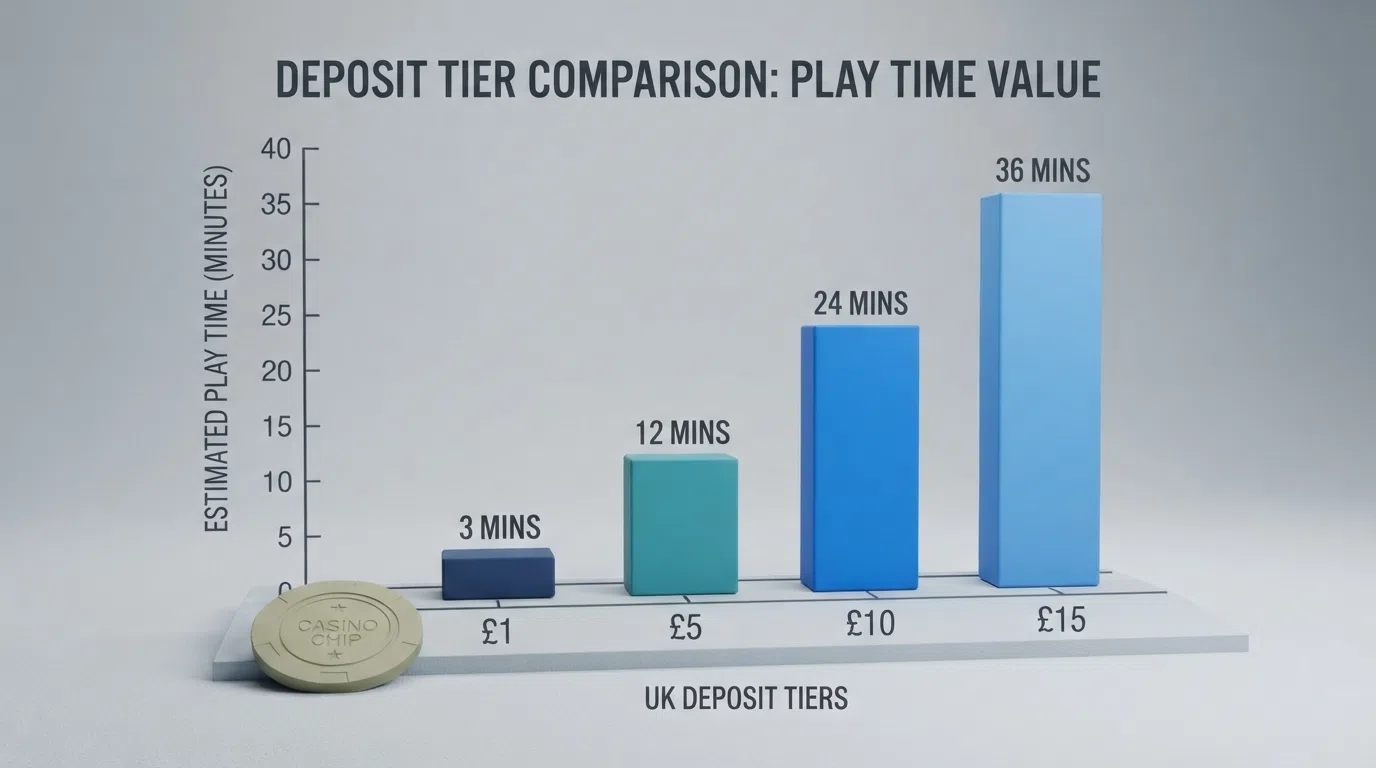
A £10 deposit at the legal minimum bet of £0.10 a spin is 100 spins. Spin speed is capped at 2.5 seconds per game cycle, with auto-play banned, so those 100 spins take roughly four minutes and twelve seconds of continuous play. A £5 deposit halves that. A £15 deposit adds another minute. A £1 deposit runs to about 25 seconds.
These figures assume the player spins at the maximum legal rate without pause. In practice a real session is longer, because the player reads the result, decides whether to spin again, and the game itself runs animations between spins. The 2.5-second cap is a ceiling on how fast the game can run, not a measure of how fast a player will run it. A reasonable session of 200 spins at £0.10 spends £20 and takes closer to fifteen minutes, including the think time.
What matters about these figures is that real-money wins at these stakes are cashable. There is no bonus to clear, no wagering multiplier on a £0.10 stake won from cash balance, and no maximum cashout on winnings from a deposit-funded spin. A player who deposits £10, lands a 50× line win on Starburst, and walks away with £50 can withdraw all of it. That is the key distinction between deposit-funded play and bonus-funded play, and it is what makes the £0.10–£0.20 stake range the natural home for low-deposit sessions.
Trust signals to check before you fund an account
The first check is the licence. Every operator on the public register of the UK Gambling Commission is named, with a licence number that matches the small print in the website footer. The ten featured brands on this page are all on that register, and the licence numbers appear in the comparison table. If a brand does not appear there, it is not licensed to serve Great Britain, and the deposit floor is the smallest of the reasons to avoid it.
The second is verification. Since May 2019, a GB remote licensee has to verify name, address and date of birth before the first deposit goes through. A casino that lets a player deposit before asking for any of those is not following the rule, which usually means it is not licensed at all.
The third is GamStop. Every GB-licensed online operator has to participate, and the scheme lets a player self-exclude across every brand at once for six months, one year, five years, or five years with auto-renewal. A brand that does not show the GamStop logo is either unlicensed or running a loophole, and either way it should not be holding a deposit.
The fourth is the credit-card ban. Since 14 April 2020, no GB-licensed operator can take a credit card for gambling, including credit-card-funded e-wallet payments. A casino that lets a player fund with a credit card, or that accepts an e-wallet topped up by a credit card, is in breach. The deposit floor does not change this rule: a £1 deposit funded by credit is as illegal as a £100 one.
The ten casinos worth your smallest deposit in 2026, ranked
| Operator | UKGC licence | Minimum deposit | Welcome offer | Wagering |
|---|---|---|---|---|
| Sky Vegas | 39411 | £5 | 50 no-deposit spins + 200 spins on £10 spend | 0× |
| bet365 Games | 55149 | £10 lifetime | Up to 500 spins over 10 days | 0× |
| Paddy Power | 39411 | £10 | 60 no-deposit spins + 200 spins on £10 wager | 0× |
| Ladbrokes | 1611 | £5 (£10 PayPal) | 100 spins on £10 stake, or £50 bonus | 0× / 40× |
| Coral | 1611 | £5 (£10 PayPal) | 100 spins + £10 bonus on £5 stake | 10× |
| Betfred | 39544 | £10 debit card | 200 spins on £10 stake | 0× |
| William Hill | 39225 | £5 | 200 spins on Big Bass Splash, £10 stake | 10× |
| Betway | 39372 | £5 | 150 spins on £20 stake, or 100% match to £50 | 0× / 10× |
| Virgin Games | 38905 | £5 (bonus at £10) | 30 spins or £50 bingo on £10 wager | 0× |
| 888 Casino | 39028 | £10 | 100% match to £100 | 10× |
All ten hold a current UKGC operating licence and participate in GamStop. The columns reflect the offer as published on the operator’s site; spin values are £0.10 unless otherwise noted. The ranking is built around the welcome offer first, then the floor, then the wagering, with payout terms as a tiebreaker — the table below that breaks out the wagering and validity in detail.
Sky Vegas
Sky Vegas is the headline of the set. 50 free spins on registration, no deposit required, plus another 200 spins once a player has deposited and spent £10. That is 250 spins at £0.10 each, with no wagering on any of the winnings. The validity is tight: seven days from credit, after which the unplayed spins drop. There is no maximum cashout, so anything the spins land is real withdrawable cash.
The £5 minimum deposit is the lowest in the table, and the bonus terms are the cleanest: 0× wagering, no games excluded from the headline, no token deposit needed to claim the 50 no-deposit spins. The catch is the timing. Seven days is short, and a player who registers and forgets about the offer loses it. The other catch is that the 200 deposit spins need a £10 spend, not a £10 deposit, so the deposit has to be wagered once before the spins credit.
For a small-bankroll player who wants the most spins for the least outlay, this is the strongest offer on the page. The downside is the seven-day window, which demands a quick return visit.
bet365 Games
bet365 Games runs the biggest spin haul of the set. Up to 500 free spins, credited in batches of 5, 10 or 20 across ten days, with 24 hours between each selection and seven days to use each batch. The 0× wagering applies to all of them, and the spin value is £0.10. There is no maximum cashout, and the qualifying condition is a lifetime deposit of £10 — once a player has ever deposited £10 at the brand, the offer is open.
The qualification mechanic matters. A player who has deposited £10 at any point in their bet365 history — sports, casino, games — qualifies for the new-customer offer, which is unusual generosity from a major operator. The downside is the time spread: ten days of daily logins is a commitment, and a player who skips a day loses that batch.
Existing bet365 sports bettors qualify automatically, making this a natural choice for those who already hold an account. New starters should note the 10-day daily login requirement, which adds up to a commitment that casual players may find demanding.
Paddy Power
Paddy Power offers 60 no-deposit spins on registration — 50 on a selected slots game plus 10 on Paddy’s Mansion Heist, the operator’s exclusive — and 200 more spins once a player has deposited and wagered £10. That is 260 spins at £0.10 each, all with 0× wagering and a seven-day validity.
The 60 no-deposit spins are the more striking half. A player can register, verify, claim 60 spins, and play them without ever depositing, which makes this the strongest genuinely-free offer in the set. The 200 deposit spins are standard — wager-free, seven days — and the £10 qualifying condition is the same one Sky Vegas runs.
For a player who wants to test the casino before funding it, the 60 no-deposit spins are a real edge. The seven-day validity still applies, and the bonus game selection on the no-deposit spins is operator-curated, so a player with a strong game preference may find the free half less attractive than the headline suggests.
Ladbrokes
Ladbrokes is the genuine either/or of the set. A player who deposits and stakes £10 on slots gets either 100 wager-free spins, or a £50 bonus with 40× wagering. The 100 spins run at 0×, the £50 bonus runs at 40× — a multiplier that, before the December 2025 cap, would have been the norm, and is now well above the legal ceiling for new offers but remains on this long-standing Ladbrokes promotion.
The 40× on the bonus is the reason to take the spins. £50 of bonus money wagered 40× is £2,000 of slot play, and at £0.10 a spin that is 20,000 spins, or roughly fourteen hours of continuous play at the legal 2.5-second cap. The 100 spins, by contrast, are 10 minutes of play with no clearing requirement.
The PayPal floor is £10, double the £5 debit-card minimum, so a PayPal-only player cannot access the offer at the lower deposit. The validity on the spins is seven days; the bonus has thirty. A small-bankroll player who is happy to take 100 spins and walk away is well-served; a player who wants the bonus has to commit to a long clearing run.
Coral
Coral has the smallest qualifying stake in the set. A £5 deposit and a £5 slot bet unlocks 100 free spins plus a £10 bonus. The bonus carries 10× wagering — the new legal maximum — and the spins and bonus together need to be accepted within 14 days and used within 30. There is no wagering on the spins themselves, only on the bonus.
The arithmetic makes the 10× manageable. £10 of bonus money at 10× is £100 of play, which at £0.10 a spin is 1,000 spins or about 42 minutes at the 2.5-second cap. That is well within a single session, and the 30-day use window gives plenty of slack.
For a player with a £5 budget who wants a bonus to fire, Coral is the cleanest match in the set. The PayPal floor is again £10, so a player funding with PayPal has to deposit twice as much to claim the offer.
Betfred
Betfred’s offer is 200 wager-free spins for a £10 debit-card deposit and a £10 stake. The 0× wagering applies, the spin value is £0.10, the validity is 7 days from credit with 14 days to qualify, and there is no maximum cashout. The debit-card requirement is the catch: an e-wallet or pay-by-phone deposit will not trigger the spins.
For a player with a debit card, the offer is straightforward and competitive. 200 wager-free spins at the legal spin speed is around eight minutes of play, with everything won paid in cash. The debit-card-only rule cuts out a slice of the small-deposit market — players who prefer PayPal or pay-by-SMS — and pushes them towards Betway or Sky Vegas instead.
William Hill
William Hill offers 200 free spins on Big Bass Splash for a £10 deposit and a £10 stake. The wagering is 10×, the spin value is £0.10, and the validity is 72 hours from credit with 14 days to qualify. The maximum cashout from the offer is £30.
The £30 cap is the headline cost. 200 spins at £0.10 with no cashout cap would be a strong offer; the same 200 spins with a £30 ceiling is a strong-looking offer that pays out only a fraction of any large win. Big Bass Splash is a high-volatility title with a 5,000× max win, so a lucky spin can produce a 500× return, and the £30 cap clips that to £30. A player who takes the offer is implicitly trading payout ceiling for spin count.
Casual players seeking modest wins will find the offer perfectly adequate. Those chasing large payouts on high-volatility games, however, will see their gains clipped by the £30 cap.
Betway
Betway runs a second either/or in the set. A player who stakes £20 on slots gets 150 wager-free spins, credited 50 per day over three days. A player who deposits £10 or more and prefers a match bonus can take a 100% match up to £50 at 10× wagering. Both options carry a 7-day validity.
The £20 stake for the spins is heavier than the £10 stake Sky Vegas, Paddy Power and William Hill ask for. A player with a £20 budget can take the spins and have nothing left to play with; a player with a £10 budget can take the match and have £20 to clear the wagering. The 10× on the match is the new legal cap, and the £50 ceiling is modest — at 10× the wagering is £500 of slot play, or 5,000 spins at the minimum bet.
The choice between wager-free spins and a deposit match gives players useful flexibility. The higher £20 stake for the spins is a notable hurdle, however, effectively limiting the offer to a larger initial budget.
Virgin Games
Virgin Games offers 30 free spins or £50 in bingo tickets for a £10 deposit and a £10 wager. The 0× wagering applies to both routes, the validity is 30 days from registration to claim and 30 days after that to use the spins, and the minimum balance to withdraw is £10.
The offer is the smallest in the set by spin count. 30 spins at £0.10 is £3 of slot play, which is about 75 seconds at the legal spin speed. The bingo alternative is a route for players who prefer the bingo room, but the headline value of 30 spins is light compared to the 100 to 500 spins at the other brands.
The 30-day claim window is the friendliest in the set, twice the seven days at Sky Vegas or Paddy Power, and that matters for a player who does not want to be pushed back into the casino. For a player who wants the most spins for the smallest outlay, this is the weakest of the ten; for a player who values breathing room over volume, it is the most comfortable.
888 Casino
888 Casino is the only entry in the set without a free-spin offer. The welcome is a 100% match up to £100, wagered 10×, with a 90-day validity and a £10 minimum deposit. There are no spins, no no-deposit credit, and the bonus is paid in bonus funds, not in cash.
The 10× wagering is at the new legal cap, and the 90-day window is the longest in the set — the operator is acknowledging that clearing a £100 bonus at 10× is a serious commitment. £100 of bonus money at 10× is £1,000 of play, or 10,000 spins at the minimum bet, which is roughly seven hours at the legal spin speed. A small-bankroll player can clear that over weeks rather than days.
For a player who wants a deposit match rather than free spins, 888 is the only option in the set. For a player who wants the most spins per pound, the absence of a free-spin offer makes 888 a hard sell against Sky Vegas, Paddy Power or bet365.
How to weigh each column before you deposit
The deposit floor decides whether a player can fund an account at all; it is the gate, not the value. The welcome offer decides what the deposit buys, and the wagering decides what the offer costs in time. Cashout caps decide what a lucky spin is actually worth, and validity decides how long the player has to claim it.
For a player with £5 to spend, Coral is the only brand that fires a welcome offer at that floor. For a player with £10, every brand except Virgin Games’ bonus threshold triggers something. For a player with £20, the field is fully open, and the deciding factor is whether the player wants spins (Sky Vegas, Paddy Power, Betfred, bet365, Ladbrokes, Coral, William Hill, Betway, Virgin Games) or a match bonus (Betway, 888 Casino). The 0× wagering offers cost the least in time but pay out only what the spins land. The 10× offers at Coral, William Hill, Betway and 888 cost more time but allow a higher effective return on a large win.
The cells in the comparison table come from the operator’s own published terms. Where a number is not in those terms, the cell carries a dash rather than a guess, and the operator’s own site settles the question. The licence numbers are taken from the public register and have been cross-checked against the operator’s footer.
Why a tiny deposit rarely earns a big welcome bonus
The £1 to £15 floors do not gate which casino a player can join — they gate which welcome offer a player can claim. Below £5, no offer in the featured set fires. At £5, Coral fires; Ladbrokes, William Hill, Betway and Virgin Games require a higher qualifying stake. At £10, every brand except 888’s match bonus fires, and 888’s match fires only on a £10+ deposit. Above £10, the offers do not scale — the bonus amount may rise, but the wagering scales with it, and the December 2025 10× cap has flattened the curve.
Welcome bonuses by deposit tier
The £5 brands and their terms split into two camps. Coral takes £5 as both the deposit and the qualifying stake, and the offer fires at the floor. Ladbrokes, William Hill, Betway and Virgin Games all open at £5 but require a £10 stake or deposit to claim the welcome offer. A player depositing £5 at those four gets the account but not the bonus.
The £10 brands and their offers are more uniform. bet365, Paddy Power, Betfred and 888 all set £10 as the floor, and all four fire their welcome offer at that deposit. Paddy Power’s 60 no-deposit spins and Sky Vegas’s 50 no-deposit spins credit before the deposit, so a player can land part of the bonus at any deposit size and only needs £10 to unlock the deposit-funded half.
888’s match at £10+ is the only deposit-match offer in the set that fires at the low-deposit floor. The 10× wagering is the legal maximum now in force, and the 90-day validity is the longest in the field. A player with a £10 budget who wants a match rather than spins has no other option in the set.
No welcome offer in the featured set fires on a £1 deposit. The £1 tier is for testing the cashier and the games, not for claiming a bonus.
No-deposit bonuses: what “free” actually means
Two offers in the set include a genuinely deposit-free component. Sky Vegas credits 50 free spins on registration, before any deposit, with no token required. Paddy Power credits 60 — 50 on a selected slot and 10 on Paddy’s Mansion Heist. Both run at 0× wagering, with 7-day validity, and winnings are paid as cash.
A no-deposit spin is not free in the sense of being costless to the operator, but it is free in the sense of requiring no money from the player. Verification still applies: a player has to confirm name, address and date of birth before the spins credit. There is no token deposit, no £1 minimum, no requirement to enter card details. The 50 or 60 spins credit to a new account and can be played without funding the cashier at all.
The other “no deposit” claims in the wider market often turn out to be deposit-required. A 100-spin offer that needs a £10 deposit to credit is not no-deposit; it is deposit-gated. The two offers above are the only ones in the set that genuinely credit before the deposit, and the distinction is worth checking carefully.
Wagering on low-deposit bonuses: the 10× ceiling
From 19 December 2025, no UK-licensed casino can run a welcome offer with a wagering requirement above 10×. The cap is in LCCP Social Responsibility Code 5.1.1, and it applies to all new promotional offers from that date. Mixed-product offers — a bonus that combines casino spins with sports free bets, for example — are banned outright.
For a player, that means the worst-case wagering at a GB-licensed casino is now 10× the bonus amount. Most of the offers in the featured set are 0×, which is the operator’s choice rather than the legal maximum, and that choice is competitive pressure: the cleaner the wagering, the more attractive the offer looks next to a 10× rival.
The Coral, William Hill, Betway and 888 bonuses run at 10×, the legal ceiling. Ladbrokes’ £50 bonus alternative runs at 40×, which is a legacy term from before the cap and is grandfathered in for the duration of the existing promotion. A player comparing the two Ladbrokes routes should take the 0× spins over the 40× bonus every time, and the comparison table reflects that.
Bonus eligibility by deposit size
A £1 deposit at the featured brands opens the account but does not trigger a welcome offer at any of them. A £5 deposit opens the account and triggers Coral’s 100 spins and £10 bonus, plus the cashier at Sky Vegas, Ladbrokes, William Hill, Betway and Virgin Games — though the bonus terms at those five require a £10 stake or deposit. A £10 deposit triggers the welcome offer at every brand in the set except Virgin Games’ bonus, which requires a £10 deposit plus a £10 wager. A £15 deposit triggers everything a £10 deposit triggers, and leaves the player with £5 of unallocated bankroll.
The pattern is consistent. The £5 floor is a sampler, the £10 floor is the bonus tier, and the £15 ceiling adds nothing the £10 floor does not. The Virgin Games bonus is the only edge case where the £5 floor and the £10 bonus threshold both apply, and a player at Virgin who wants the offer has to deposit and wager £10 even though the platform accepts £5.
How to move £5 in and your winnings out, fast
The payment side of low-deposit play is where most of the friction lives. The deposit method determines the floor at some brands, the verification step applies to the first deposit regardless of size, and the withdrawal side is what determines whether a small win actually arrives.
PayPal deposits at low minimums
PayPal is accepted broadly across the featured set, but the floor is not always the headline number. Ladbrokes and Coral both set a £10 PayPal minimum, even though their debit-card floor is £5. The reason is PayPal’s own merchant rules, which treat very small transactions as uneconomic, and the operator passes that floor on.
The other rule that affects PayPal deposits is the credit-card ban. Since 14 April 2020, GB-licensed operators cannot accept a credit card for gambling, and the ban extends to e-wallet payments funded by a credit card. A player whose PayPal account is topped up from a credit card will have the deposit refused at the cashier, even though the PayPal account itself is in good standing. Funding the PayPal account from a debit card or a bank transfer keeps the deposit clear.
For a small-deposit player, PayPal is fastest on the deposit side — the money arrives in seconds — and the verification step happens once per account, not per deposit. On the withdrawal side, PayPal payouts are usually faster than debit-card withdrawals, often arriving the same day once approved, where a debit card can take one to three working days.
Pay-by-SMS and mobile billing
Pay-by-SMS deposits charge the deposit to the player’s mobile phone bill, and the floors are low enough to fit a £1 to £5 budget. The daily cap is what limits the size of a deposit, not the cashier’s minimum — most pay-by-SMS providers cap a single transaction at £5 or £10, and a daily limit at £30 or so. A player who wants to deposit £15 by SMS will usually need to split it across two transactions.
The cost is the catch. Pay-by-SMS is not free: the mobile carrier charges a fee on top of the deposit, which can be 10% to 15% of the amount. A £5 SMS deposit can cost £5.75 once the carrier fee is added. For a small-bankroll player, the convenience of paying with the phone bill is real, but the fee is a flat drag on every deposit.
Verification still applies. A player has to confirm name, address and date of birth before the first SMS deposit goes through, and the carrier checks the phone number against the player’s account. The pay-by-SMS method is best read as a fallback for the smallest deposits, not as the default for regular play.
Deposit methods by tier
Debit card is the default at £5 and £10 across the featured set, and the floor is the same regardless of the card issuer. PayPal carries a £10 floor at Ladbrokes and Coral, and a £5 floor at the other brands where research has the terms. Pay-by-SMS is offered by some brands at the £1 to £5 level, with a carrier fee on top.
The credit-card ban covers all three methods. A direct credit-card deposit is refused at the cashier. A PayPal deposit funded by a credit card is refused once the operator traces the funding source. A pay-by-SMS deposit is, by definition, billed to a phone account rather than a card, and is not caught by the credit-card rule, though the carrier’s own terms apply.
A player choosing a deposit method at a £5 or £10 floor is choosing between debit card (lowest floor, broad acceptance), PayPal (fast payout side, sometimes higher floor), and pay-by-SMS (lowest floor, carrier fee, daily cap). For most players at the £5 to £10 tier, debit card is the natural default.
Withdrawal speed and payout limits
The withdrawal side is where the small-deposit story changes shape. A player who deposits £5, runs it to £15, and tries to withdraw £15 will find the cashier has a minimum withdrawal threshold, often £10, and a verification step on the first withdrawal. Verification happens once per account, not per withdrawal, so the second withdrawal is faster than the first.
The £30 maximum cashout at William Hill is the only payout cap in the set that bites at low-deposit play. A player who lands a 200× spin on Big Bass Splash at William Hill sees a £20 win clipped to £30 by the cap — at that scale the cap does not bind — but a player who lands a 1,000× spin sees a £100 win clipped to £30, and the cap is the difference between a memorable payout and a token one. The other nine brands have no published cap on free-spin winnings.
Reverse withdrawals are banned across the set, in force since 31 October 2021. A player cannot withdraw £15, change their mind, and put the £15 back into play. Once the withdrawal is requested, it is in flight. That is a player-protection rule rather than a payment rule, and it removes the temptation to chase losses with money already on its way out.
Which slots stretch a small deposit the furthest
The arithmetic of a low-deposit session comes down to three numbers: the deposit, the minimum bet, and the return-to-player percentage of the slot. A £5 deposit at £0.10 a spin is 50 spins. On Starburst, with an RTP of 96.09% and low volatility, those 50 spins return on average £4.80. On Book of Dead, with an RTP of 96.21% and high volatility, those 50 spins return on average £4.81, but with much wider swings between sessions — most sessions will return less, a few will return more. The expected return is similar; the experience is not.
| Slot | Provider | RTP | Volatility | Min bet |
|---|---|---|---|---|
| Starburst | NetEnt | 96.09% | Low | £0.10 |
| Book of Dead | Play’n GO | 96.21% | High | £0.10 |
| Big Bass Splash | Pragmatic Play | 96.71% | High | £0.10 |
| Big Bass Bonanza | Pragmatic Play | 96.71% | Medium-high | £0.10 |
The four titles above are the ones the research covers by name. The wider slot library at each brand runs into the hundreds, and the headline RTP figures here are representative rather than exhaustive. A £10 deposit at £0.10 a spin on Big Bass Splash, with an RTP of 96.71%, returns on average £9.67 over 100 spins. The same £10 on Starburst returns £9.61. The difference is small per spin, but it compounds across a session.
The session cost is the more useful number for a small-deposit player. A £10 deposit, 100 spins at £0.10, on a slot with a 96.09% RTP, costs the player on average £0.39 in expected loss. The same 100 spins on Big Bass Splash, at 96.71% RTP, cost on average £0.33. Over a longer session of 1,000 spins — which would require topping up the £10 deposit — the expected loss on Starburst is £3.90 and on Big Bass Splash is £3.29. That is the cost of a session in real money, and the two slots carry different volatility profiles that change how the cost is felt even when the average is similar.
The legal cap matters here. For a player aged 25 or over, the maximum stake per game cycle is £5, and the £0.10 minimum is well below it. For a player aged 18 to 24, the cap is £2, still above the £0.10 floor. Neither ceiling affects a small-deposit player running at minimum stakes, which is why the £0.10–£0.20 range is the natural home for this kind of session.
Slot sites by deposit tier
Every featured brand runs low-stake slots at £0.10 minimum bets, and the slots library at each is wide enough that a £5 to £15 deposit finds something to play. 888 Casino’s library runs to 1,500+ games, the largest in the set, and the others cluster between several hundred and a thousand. NetEnt, Playtech, Pragmatic Play and Blueprint appear in most of the libraries, which is why the four slots in the table above are playable across the set.
The deposit floor does not change the slot floor. A £5 deposit at Sky Vegas still plays Starburst at £0.10 a spin, and the same is true at 888 Casino on a £10 deposit. The difference is the number of spins the deposit buys, not the per-spin cost. A player choosing between brands is choosing between libraries, themes and bonus structures, not between minimum bets.
Minimum bet vs minimum deposit: the two floors
A £10 deposit is not a £10 spin. The deposit floor is what the cashier accepts; the bet floor is what the slot accepts. The two numbers are independent. A £5 deposit at a £5-floor casino plays 50 spins at £0.10 a spin, 25 spins at £0.20, or 10 spins at £0.50. The deposit does not constrain the bet, but the bankroll does: a player with £5 cannot afford to spin at £0.50 for long.
The statutory stake cap is the third number in the system, and it sits well above the minimum bet. For a player aged 25 or over, the maximum is £5 per game cycle; for a player aged 18 to 24, the maximum is £2. The £0.10 minimum at the four slots above is well below either ceiling, which is why a small-deposit player never approaches the cap. A player who tops up to £20 and starts spinning at £1 a spin is still below the cap, and a player at £5 a spin is at the cap and cannot go higher.
Play time per deposit follows from the spin count. A £5 deposit at £0.10 a spin is 50 spins, or about two minutes at the 2.5-second cap. A £10 deposit is 100 spins, four minutes. A £15 deposit is 150 spins, six minutes. None of these are long sessions; a real session of 42 minutes takes a £75 bankroll at the minimum bet. The low-deposit model is for short sessions and for testing a casino, not for an evening’s play.
Popular low-stake slots and their real RTP
Starburst is the slot that defines the low-volatility end of the market. NetEnt publishes an RTP of 96.09%, the volatility is low, and the game pays out small amounts frequently. A £10 bankroll lasts longer on Starburst than on any of the other three titles, and the experience is steady rather than dramatic. The max win of 500× is the ceiling, but most winning spins return less than the stake.
Book of Dead is the high-volatility counterpoint. Play’n GO’s published RTP is 96.21%, fractionally higher than Starburst, but the volatility is high, which means longer dry spells punctuated by larger wins. A £10 bankroll on Book of Dead can vanish in 20 spins or survive 200; the average is similar to Starburst, but the variance is not.
Big Bass Splash and Big Bass Bonanza both come from Pragmatic Play’s fishing series, and both publish an RTP of 96.71%, the highest of the four. Big Bass Splash is the higher-volatility of the two, with a 5,000× max win; Big Bass Bonanza is medium-high, with a 2,100× max win. Both are the slots that produce the memorable payout on a small deposit, and both are the slots that can drain a small bankroll fastest when the features do not land.
For a player who wants the longest play time from a £5 to £15 deposit, Starburst is the right slot. For a player who wants the chance of a larger win at the cost of a higher variance, Big Bass Bonanza is the middle ground. Book of Dead and Big Bass Splash are for the player who is happy to lose the deposit for a shot at a 5,000× return.
Playing low-stake casino games from your phone
The same £5 to £10 floors apply on mobile. No featured brand runs a separate mobile deposit floor; the cashier on the phone carries the same minimum as the cashier on the desktop. What changes is the method of access, and the practical question of whether the player wants a native app or the mobile browser.
Mobile casinos by deposit tier
The £5 to £10 floors on mobile match the floors on desktop. Sky Vegas, Ladbrokes, Coral, William Hill, Betway and Virgin Games all open at £5 on the phone, and bet365, Paddy Power, Betfred and 888 open at £10. Payment methods are the same: debit card, PayPal, and at some brands pay-by-SMS. The verification step that applies before the first deposit applies on mobile as well, and the credit-card ban applies on mobile too.
The mobile cashier is the one place where the floor can shift in practice. Some mobile cashier interfaces default to a £10 or £20 button and hide the £5 option behind a “set custom amount” link, and a player who clicks the default without reading the screen can deposit more than they intended. The fix is the same on mobile as on desktop: read the amount before confirming.
App vs mobile browser: what changes
Native apps and mobile browsers run the same games, the same bonuses, and the same cashier. The differences are in the experience. A native app loads faster once installed, sends push notifications for bonus offers, and stores the login so a returning player does not have to retype credentials. A mobile browser is instant — no download — and works on any device with a browser, but does not store the session as cleanly.
For a small-deposit player, the practical difference is small. A £5 deposit via the app takes the same three taps as a £5 deposit via the browser, and the welcome bonus crediting does not depend on which method the player used. Verification happens once, regardless of platform. The native app’s edge is convenience rather than value, and a player who is not sure whether they will return to a brand is better off starting in the browser.
Game performance is comparable across both. Slots are HTML5 or native builds, and the same 2.5-second spin cap applies on mobile. The phone’s screen is smaller, which can make some slot layouts harder to read, but the games themselves run at the same speed. Live casino games, where the player interacts with a dealer, work better on a larger screen but are not the focus of a small-deposit session.
Low-deposit mobile play in practice
A £10 deposit on a phone at £0.10 a spin is 100 spins, or about four minutes of play. The player can top up mid-session if the bankroll runs out, and the cashier on the phone handles top-ups the same way the desktop does. The 2.5-second spin cap is enforced at the game level, not the device level, so the speed is the same.
Session limits are easier to set on the app. Most native apps let the player set a deposit limit, a time limit, or a reality-check interval, and the limit applies across both the app and the desktop. A player who wants to keep a £10 session to £10 of deposits can set a hard limit and walk away when it binds. The reality-check pop-up, which fires after a set period of play, is the equivalent of a forced break.
For a player who is depositing on the go, the phone is the natural fit. The verification step happens before the first deposit, so subsequent deposits are quick. A £5 top-up on the bus is a 30-second operation once the app is installed, and the cashier remembers the payment method.
Why new UK casinos chase players with low deposits
The economics of the UK online casino market have shifted. The statutory levy took effect at 1.1% of gross gambling yield for remote casino from 6 April 2025, and Remote Gaming Duty rose from 21% to 40% from 1 April 2026. Both numbers eat into the operator’s margin, and the response from new launches has been to compete on the entry point — the deposit floor — to attract players who would otherwise stay with an incumbent.
New casinos by deposit tier
New UK launches in the research cluster at £5 to £10 floors. The pattern is consistent: a new brand sets a floor at or just below the dominant £10, runs an aggressive welcome offer to fund acquisition, and leans on the licence to claim legitimacy. DragonBet is the £1 outlier in the wider market, and its floor is a marketing choice rather than a regulatory carve-out.
For a player, the question with a new brand is whether the licence is current and the verification rules are being honoured. Both are checkable on the UKGC’s public register, and a new brand with a current licence is not higher-risk than an established one. The risk is operational: a new cashier is more likely to have teething problems than an established one, and a small-deposit player has less margin to absorb a slow payout.
The newest UK operators worth watching
A 2026 UK launch has to clear a high bar. The mandatory deposit-limit prompt has been in force since 31 October 2025, so the cashier cannot accept a first deposit without showing a limit-setting screen. Financial-vulnerability checks fire at £150 net deposit in a rolling 30-day period, which sits well above the low-deposit tier but applies to any brand that grows a player’s bankroll over a month. GamStop participation is mandatory for every GB online licence, and the logo has to be visible on the homepage.
For a small-deposit player, the practical test is the same as for an established brand: check the licence number, check the verification flow, check the GamStop logo. A new brand that ticks all three is operating to the same standard as an incumbent, and the deposit floor is the smallest difference between them.
Why new casinos offer low deposits
The economics of low-deposit play for the operator are tight. The 1.1% levy applies to gross gambling yield, which is stakes minus winnings paid out, and the 40% Remote Gaming Duty applies to the same base. Both are calculated after bonuses are paid, so a welcome offer that hands out 200 free spins at £0.10 each costs the operator £20 in expected RTP, plus the duty and the levy on the resulting play. A £5 deposit does not generate enough yield to cover the acquisition cost at most operators.
The reason new brands offer low deposits anyway is the long-tail value. A player who deposits £5 and returns for a £100 deposit a month later has generated positive lifetime value, and the acquisition cost of the £5 deposit is the marketing spend the operator judged acceptable. Established brands can rely on brand recognition to acquire players at a higher deposit floor; new brands cannot, and the low floor is the price of entry.
The stake caps still apply. A new brand at a £1 floor cannot escape the £5 and £2 per-spin caps, and the 2.5-second spin speed is enforced at the game level. A player at a new low-deposit casino is playing the same game as a player at an established brand, and the deposit floor is the only meaningful difference. Whether that difference is worth chasing depends on the welcome offer, and the December 2025 10× wagering cap has flattened the offer landscape enough that the new-casino edge is narrower than it was a year ago.
The licence that makes a low-deposit casino legitimate
A UK online casino is legal because the Gambling Commission has issued it a licence. The Commission’s public register lists every operator, every licence number, and the trading name attached to each. A player who wants to verify a brand types the licence number from the website footer into the register, and either the brand appears or it does not. The process takes a minute and settles the question.

UKGC licensing in plain terms
The Gambling Commission is the single statutory regulator for gambling in Great Britain. It is an executive non-departmental public body sponsored by the Department for Culture, Media and Sport, and it licenses operators, key personnel and software under the Gambling Act 2005. The 2014 Act extended the regime to remote operators, requiring a GB licence for any operator serving GB customers regardless of where the operator is based.
The licensing objectives in section 1 of the Act are three: preventing gambling from being a source of crime or disorder, ensuring gambling is conducted in a fair and open way, and protecting children and other vulnerable persons from being harmed or exploited. Every licence condition is meant to advance one of those three, and the conditions are enforced through licence review, financial penalties and revocation.
The public register is the tool a player can use. The register lists the licence number, the trading name, the status (active, surrendered, revoked), and the licensed activities. A brand that does not appear on the register is not licensed for GB play, and any deposit the player makes to that brand is at the player’s own risk.
The ten featured brands on this page appear on the register, and their licence numbers are in the comparison table. The numbers are also in the small print of each brand’s website footer, where the licence is a statutory disclosure. A mismatch between the footer and the register is the surest sign that something is wrong.
GamStop, self-exclusion and the non-GamStop question
GamStop is the UK’s national multi-operator self-exclusion scheme. A player who registers with GamStop is blocked from every GB-licensed online operator for the period they choose — six months, one year, five years, or five years with auto-renewal. The exclusion cannot be cancelled early. Participation in GamStop has been a mandatory condition of every GB online operating licence since 31 March 2020.
A “non-GamStop casino” is a casino that is not on the GamStop register. The phrase appears in marketing aimed at players who have self-excluded and want to keep playing. From the player’s point of view, a non-GamStop site is not a workaround — it is an unlicensed site for the purposes of GB play, and the player loses the protection that comes with a UKGC licence. The site does not enforce the deposit limit, the reality check, the stake cap, or the time-out. The site’s ADR process is whatever the operator chooses to offer, and the player has no recourse to the Commission if the site fails to pay out.
The marketing pitch — that non-GamStop means “more freedom” — is the wrong way around. The player is gaining the freedom to be exploited by an operator that is not bound by the British rules, and the player is losing the protection of those rules. The two sides do not cancel out.
How to check a casino’s UKGC licence yourself
The register is at the Gambling Commission’s website. A player types the licence number from the website footer into the search field, and the register returns the trading name, the status, the licensed activities and the address. The process takes under a minute, and it is the single most reliable way to tell a legitimate casino from an unlicensed one.
The ten featured brands on this page all appear on the register. Sky Vegas, Paddy Power and a number of others share licence 39411 because they are operated by the same company under different trading names — a single licence can cover multiple brands, and the register shows the trading name as well as the licence holder. A player who sees 39411 in two different footers is not looking at a duplicate licence; they are looking at two brands under one operator.
If the licence number is missing, the register does not return a result, or the status reads “surrendered” or “revoked”, the brand is not currently licensed. The credit-card ban and the verification rules are the other two tells. A casino that lets a player deposit by credit card, or that does not ask for name, address and date of birth before the first deposit, is in breach of the licence conditions that bind every GB-licensed operator.
What playing off-GamStop actually means
The honest read on offshore play is that it is illegal for the operator, not the player. Section 33 of the Gambling Act 2005 makes providing gambling facilities without a GB licence a criminal offence, carrying up to 51 weeks’ imprisonment, an unlimited fine, or both. The penalty applies to the operator, not to the player. No penalty has been established for a player who merely gambles on an unlicensed site.
What the player loses is protection. The stake cap, the spin-speed cap, the wagering cap, the deposit limit, the reality check, the GamStop block, the verification step, the credit-card ban — none of these apply at an unlicensed site. The site’s terms are its own, and the player has no recourse to the Commission if the site refuses to pay out. The Commission’s tools are disruption, not blocking: in the period from April 2024 to June 2025 the Commission issued 3,140 disruption notices and referred 447,778 URLs to search engines, with 287,961 of those URLs ultimately removed. That is the regulator’s response, and it is the only response the player can rely on.
For a player who has self-excluded through GamStop and is looking for a way to keep playing, the unlicensed offshore site is not a workaround — it is a removal of the safeguards the player signed up to. The right route is to keep the GamStop exclusion in place, and to use the help services listed in the next section if the exclusion is being tested.
Staying in control when the minimum deposit is tiny
A £1 deposit is still a deposit, and a £15 deposit is still money that has to come from somewhere. The British model does not impose a state-level deposit ceiling, but it does require the offer of a limit, a financial-vulnerability check at a defined threshold, and a national self-exclusion scheme. The infrastructure is there; the player has to use it.
Deposit limits and reality checks
From 31 October 2025, every GB-licensed online operator has to prompt a player to set a financial limit before the first deposit. The prompt is mandatory, and the player can either set a limit or actively decline to. A player who declines is recorded as having declined, and the operator can prompt again. A request to decrease a limit has to be actioned immediately; a request to increase a limit carries a 24-hour cooling-off period.
From 30 June 2026 — extended to 30 September 2026 — only a gross deposit limit, based solely on money paid into the account, may be called a “deposit limit”. The point of the change is to remove the confusion that has built up around net-deposit limits, where a withdrawal reduces the running total and effectively raises the ceiling. A gross deposit limit is what it sounds like: a cap on the total amount paid in over a period, regardless of withdrawals.
At the £150 net deposit threshold, the operator runs a light-touch financial-vulnerability check. The check has been mandatory since 28 February 2025, and it covers patterns of play, deposit frequency, and chasing behaviour. A player at the £5 to £15 tier will not hit the threshold through a single deposit, but a player who returns daily and tops up will, and the check is what catches that pattern.
GamStop self-exclusion
GamStop is the multi-operator block. A player registers once, chooses an exclusion period, and is blocked from every GB-licensed online operator for the duration. The periods are six months, one year, five years, or five years with auto-renewal. None of them can be cancelled early.
The mandatory participation rule, in force since 31 March 2020, means every GB-licensed online casino has to check new registrations against the GamStop database and refuse to open an account for a self-excluded player. A player who has registered with GamStop and finds a way to open a new account at a GB-licensed casino is a sign that the casino is not checking properly, and that is a serious breach.
For a player who feels their play is getting away from them, the right step is to register with GamStop before the next deposit. The exclusion begins at registration, and the operator cannot override it. The £1 to £15 deposit tier is not exempt from the rule, and the smallness of the deposit is not a reason to delay.
How common problem gambling really is
The headline prevalence number for problem gambling in England is 0.4% of adults (PGSI 8+), with another 1.6% at moderate risk or above (PGSI 3+). Both figures come from the NHS Adult Psychiatric Morbidity Survey 2023–24. The 0.4% is the population that meets the clinical threshold for problem gambling; the 1.6% is the population showing some of the warning signs. Together, the two figures cover about 1.2 million adults in England.
In the wider population, 47% of adults in Great Britain had gambled in the past four weeks, and 38% had gambled online, according to the Gambling Survey for Great Britain 2025. The volume of play is the backdrop against which the 0.4% problem-gambling figure sits: most adults who gamble do not develop a problem, and the small-deposit model is part of the reason — a player who deposits £5 and walks away is not on the path to harm.
The treatment side has grown. NHS gambling clinic referrals in England reached 4,355 in 2024/25, up from 2,284 in 2023/24 — a near-doubling in twelve months. The National Gambling Helpline, run by GamCare, took over 52,000 calls in 2024/25, and four out of five contacts who disclosed a form of gambling in 2026 cited struggles with online gambling specifically. GamCare’s January 2026 figures show 996 referrals to treatment and peer-based support, up 48% year-on-year from the same month in 2025.
The picture is mixed. Most adults gamble without harm, but the share of those who do develop problems is rising, and the share of treatment-seeking is rising faster. A small-deposit player is not in the at-risk group by virtue of the deposit size, but the deposit is a real-money transaction and the safeguards apply.
Where to get help
The National Gambling Helpline is 0808 8020 133, free and confidential, available 24 hours a day, run by GamCare. The helpline takes calls from players, from family members, and from professionals, and it routes callers to the right local service.
GamCare runs the National Gambling Support Network, the free counselling service funded by GambleAware. NHS gambling treatment clinics offer specialist psychological therapy, and self-referral is available. There are regional clinics — the NHS National Problem Gambling Clinic in London, and the Northern Gambling Service covering the north of England — and the waiting time has come down as the service has expanded.
Blocking software is the other route. Gamban and Betblocker are free for UK residents, and they block access to gambling sites and apps at the device level. The blocks apply regardless of the casino’s licence, so they cover offshore sites as well as GB-licensed ones. For a player who wants a hard backstop, blocking software is the strongest tool available, and it sits alongside GamStop rather than replacing it.
Gamblers Anonymous runs peer-support meetings across the country, and the GA website lists local groups. The meetings are free, and the only requirement for attendance is a desire to stop gambling. For a player who is not ready to call a helpline, the meetings are often the first step.
How these ten casinos were chosen and checked
The ten featured brands were selected from online search results for the keyword, with the comparison-table sites, the operator pages and the UKGC’s public register as the three sources. Each brand was checked against the register to confirm the licence number and the status. The minimum deposit and welcome offer were taken from the operator’s own published terms, cross-referenced against the review sites that cover the same brands. Where the operator’s terms and the review sites diverged, the operator’s terms were used.
The criteria that ordered the ranking were the welcome offer, the wagering, the deposit floor, the cashout cap and the validity. The weighting is heaviest on the offer and the wagering, with the floor as the gate and the validity as the tiebreaker. The result is the table earlier on this page, and the per-brand write-ups above it.
What was excluded: any brand that does not appear on the UKGC’s public register, any brand whose welcome offer was not verifiable from the operator’s own site, and any brand whose minimum deposit sits above £15. The exclusion is what keeps the ranking narrow. A wider ranking would dilute the comparison; a ten-brand ranking is what current market research supports, and what the page can defend with sources.
The licence numbers, the deposit floors, the offer terms and the wagering are all current as of the date stamp at the top of the page. The numbers in the comparison table should be checked against the operator’s own site before any deposit is made, because welcome offers change, and the page is a snapshot, not a contract.
The deposit size that’s actually worth starting with
A £1 deposit is real but vanishing. DragonBet is the researched exception, and even there the practical play time is about 25 seconds. A player who wants to test a casino’s cashier and games library can do so at £1, but the welcome offers that the page is built around do not fire at that floor.
A £5 deposit opens most doors in the set. Coral’s 100 spins plus £10 bonus fires at £5; Ladbrokes, William Hill, Betway and Virgin Games take £5 as a deposit but require a £10 stake to claim the bonus. A player with a £5 budget who is happy to test the casino without a bonus is well-served by the floor; a player who wants the bonus is one tier short.
A £10 deposit triggers the welcome offer at every brand in the set except Virgin Games’ bonus threshold, which sits at £10 on top of the £5 floor. The 100 to 500 free spins, the £50 match at Betway, the £100 match at 888 — all fire at £10. The wagering caps at 0× for most of the spin offers and at 10× for the match offers, both within the December 2025 legal maximum. This is the floor at which a small-bankroll player gets the full value of the ranking.
A £15 deposit adds nothing the £10 floor does not. The extra £5 buys another minute or so of play time, and the welcome offer terms do not scale. A player with a £15 budget is better off depositing £10 and keeping the £5 for a second session, rather than spending the lot up front.
The verdict, then: a player with a small bankroll who wants the best welcome offer in the set should deposit £10. A player who wants to test a casino before committing to a bonus should start at £5. A player looking for a £1 deposit should accept that the tier is a sampler, not a path to value, and treat it accordingly. The £15 ceiling is the upper bound of the low-deposit ladder, and the page’s ranking is built around the £5 and £10 floors where the offers actually fire.
Frequently asked questions
What is the lowest minimum deposit at a UK online casino in 2026?
The lowest researched floor in the GB-licensed market is £1, accepted by DragonBet. Every other featured brand on this page starts at £5 or £10, and most of the welcome offers require a £10 deposit or stake to fire. The £1 floor is best read as a sampler for the cashier and games, not as a path to a welcome bonus.
Can I get a welcome bonus if I only deposit £1 or £5?
No featured brand on this page triggers its welcome offer on a £1 deposit. At £5, Coral’s 100 spins plus £10 bonus is the only offer that fires; Ladbrokes, William Hill, Betway and Virgin Games take £5 as a deposit but require a £10 stake to claim the bonus. At £10, every brand in the set except Virgin Games’ bonus threshold fires its welcome offer.
Are £1 minimum deposit casinos safe and UKGC licensed?
A £1 deposit casino is safe in the regulatory sense only if it appears on the UK Gambling Commission’s public register. The deposit floor does not change the licence requirement. A player should check the licence number from the website footer against the register before depositing, and a brand that is not on the register is not licensed to serve Great Britain, regardless of the floor it advertises.
Which payment methods can I use for a £5 deposit at a UK casino?
Debit card is the default at the £5 floor across the featured set. PayPal is accepted at most brands, but Ladbrokes and Coral set a £10 PayPal minimum, double the debit-card floor. Pay-by-SMS is offered by some brands at the £1 to £5 level, with a carrier fee of around 10% to 15% on top. Credit cards are banned for all gambling, including credit-card-funded e-wallet deposits.
What is the maximum I can stake per spin on online slots in the UK?
The maximum stake per game cycle is £5 for players aged 25 and over, in force since 9 April 2025, and £2 for players aged 18 to 24, in force since 21 May 2025. The cap applies to online slots only; sports betting, live casino and bingo are not covered by the same instrument. The cap is set in a statutory instrument, and no GB-licensed operator can offer stakes above it.
How does the £150 financial vulnerability check affect low-deposit players?
A single £5 to £15 deposit will not trigger the £150 net-deposit threshold, which has been in force since 28 February 2025. A player who returns daily and tops up will reach the threshold within a few weeks, and the operator will then run a light-touch check on deposit patterns, frequency and chasing behaviour. The check is not a ban, and a player who passes it continues to play; the check is a flag for the operator to monitor the account more closely.
Limits – nonukgc-licensedcasinos
Content created by the «nonukgc-licensedcasinos» team