
Best UK mobile casinos that accept phone credit — ranked for 2026
 Available in GB
Phone credit is the deposit method that lets you fund a casino without typing a single card number. The charge lands on your next mobile bill, or comes off prepaid airtime, and the casino balance updates inside seconds. It is not the biggest deposit channel in Britain, and it is not trying to be. Its appeal is narrower and more deliberate: players who want a hard ceiling on what they can spend in a single tap, who do not want their gambling transactions appearing on a bank statement, or who simply never open a casino on a desktop. For that reader it is the cleanest answer the market has.
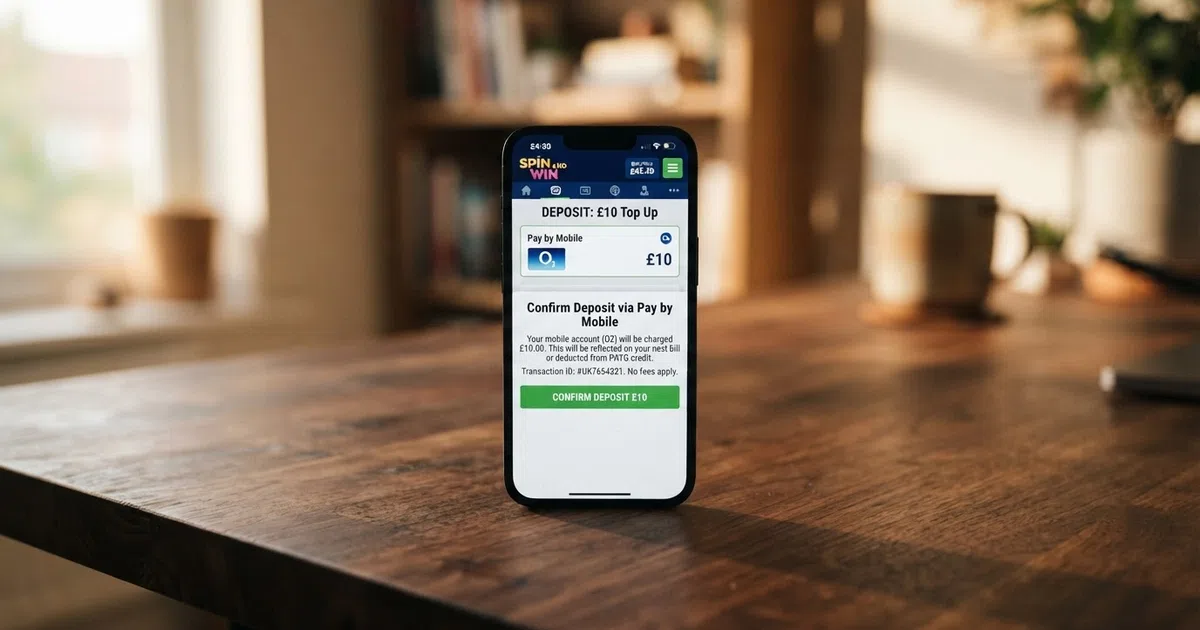
This page ranks ten UKGC-licensed casinos that accept phone-credit deposits in 2026, explains how the method actually works underneath the marketing, and shows where it ends — because phone credit is deposit-only, and the winnings still need somewhere to go. Data is current as of September 8, 2026, cross-checked against the UK Gambling Commission public register and the operator terms published at that date.
Pay by phone credit keeps your card in your wallet — here is how it works
Carrier billing has been around for decades, long before anyone thought to use it for casino deposits. The infrastructure was built for digital goods: ringtones, app subscriptions, premium SMS content. It settled one small charge to a monthly phone bill, or deducted it from prepaid airtime, and the buyer confirmed with a six-digit SMS code. The Phone-paid Services Authority (PSA) wrote the rules. Then the Payment Services Regulations 2017 carved out an electronic-communications exclusion, and a payments partner like Boku or Fonix plugged that rail into a casino cashier. What looks like a one-tap deposit on the casino side is, on the back end, a regulated carrier-billing transaction.
Two structural features shape everything that follows. First, the per-transaction ceiling: £30 is the Boku default, with some casinos raising it to £40, and the £30 cap acts as an automatic brake that no debit card offers. Second, the regulatory class: under the PSA framework and the Payment Services Regulations 2017, a carrier-billing payment must stay inside the statutory limits to fall under the electronic-communications exclusion. That is the architecture that keeps the method cheap, fast and small.
What “pay with phone credit” actually means at a UK casino
A player opens the cashier, picks “Pay by Mobile” or “Phone”, enters an amount between £5 and £30, and either types a six-digit SMS code (Boku) or is authenticated silently by the carrier (Fonix). The casino balance updates instantly. The charge appears on the next mobile bill or is deducted from prepaid credit. No card network is involved, no 16-digit number is exchanged, and no sort code or account number ever reaches the casino.
Two consequences sit underneath that simplicity. The first is a hard ceiling: the £30 per-transaction limit is method-specific, not a player choice, so a £50 deposit is impossible by design. The second is structural one-wayness: the same carrier-billing rail does not carry money back. There is no UK mobile network that supports crediting casino winnings to a phone bill, because the rail was built for content purchases, not two-way payments. Every player who uses phone credit to fund a session must, separately, register and verify a debit card or bank account before the first withdrawal. The privacy gain is real but partial.
Phone credit vs card and e-wallet — why the difference matters
A debit card shares a 16-digit number, an expiry date, a CVV and a cardholder name with the casino. A bank transfer shares a sort code and an account number. An e-wallet shares an account ID that resolves, behind the scenes, to one of those two. Phone credit shares a phone number and an SMS confirmation. None of those card numbers ever reach the casino, and the bank statement never shows a casino transaction. For a player who has had a card declined by their bank on a gambling payment — a routine side-effect of the 2020 credit-card ban — or who simply prefers gambling to stay off a joint bank statement, that difference is the whole point.
It comes at a price. The £30 ceiling is lower than most debit card minimums ask for. Withdrawals cannot return to the phone bill, so a debit card or bank account has to be registered anyway for the eventual cashout. And no phone-credit deposit can fund a £200 session in a single tap — five or six small deposits is the practical answer. The trade is privacy and a low ceiling in exchange for a few minutes of cashier friction.
Who phone-credit casino deposits suit best
Four player profiles get real value from phone credit. The privacy-conscious player, who does not want casino transactions appearing on a bank statement. The low-stakes player, who wants a hard monthly ceiling without negotiating willpower. The mobile-only player, who never opens a casino on desktop and treats the phone as the entire gaming surface. And the new player testing a site, who wants to put £5 or £10 through it before committing full KYC to a second payment method. For everyone else — a high-stakes player, someone who wants to withdraw to the same method, anyone chasing a bonus with a high minimum deposit — debit card or e-wallet is the better fit.
A useful self-test: a player who never deposits more than £240 a month on gambling and is happy to register a debit card for the eventual cashout is the textbook phone-credit user. Anyone above that line is bumping into the carrier’s monthly cap and may find the friction outweighs the privacy.
Your deposit lands in seconds but your winnings take a different route home
Phone credit looks instantaneous on the way in. The way out is shaped by what the carrier-billing rail cannot do.

How a phone-credit deposit works, from tap to balance
The flow is four short steps. The player selects pay-by-mobile at the cashier, enters an amount between £5 and £30, receives a six-digit SMS code (Boku) or is authenticated in a single tap (Fonix), and the casino balance updates before the next animation finishes. The carrier settles the charge on the next billing cycle or deducts it from prepaid airtime. The whole interaction takes seconds, and the casino sees only the deposit confirmation — no PAN, no sort code, no account number.
The two providers produce different user experiences. Boku adds the SMS step but works across every major UK network (EE, Vodafone, O2 and Three). Fonix removes the step and lets the carrier authorise in the background, which is faster and slightly less intrusive — but Fonix is accepted at fewer casinos, so the player needs to check the cashier rather than assume.
Deposit limits: the £30 ceiling, the £240 monthly cap, and what they mean in practice
Three limit layers stack on top of each other. The carrier cap: £30 per transaction is the Boku default, with some casinos extending it to £40. The daily cap: £30 to £40, depending on the provider and the network. The monthly network-side cap: roughly £240 to £300 per mobile subscriber, set by the carrier and reset on the billing date. A player who hits the monthly cap cannot bypass it with another phone-credit deposit — the limit is method-specific, not account-specific — but can switch to a debit card and keep playing.
A second layer sits beside the carrier limits. Since 31 October 2025, every UKGC-licensed casino must prompt the player to set a financial deposit limit before their first deposit. That limit is voluntary in the sense that the player sets it, mandatory in the sense that the casino must ask. A decrease takes effect immediately; an increase may be delayed. And from 30 September 2026 only gross deposit limits may be called a “deposit limit” — a casino that adds net-of-bonus or net-of-withdrawal adjustments behind a “deposit limit” label will be in breach.
The two layers serve different jobs. The carrier cap is a friction ceiling that applies regardless of the casino’s own setting. The casino’s deposit limit is a player-controlled brake that the player can set tighter than the carrier — for example, a £10-per-day casino limit on top of a £30-per-transaction carrier cap. They are independent levers, not the same lever dressed in two colours.
Why your winnings cannot go back to your phone bill
The reason is structural rather than regulatory. No UK mobile network offers a merchant refund route that credits casino winnings to a phone bill. The carrier-billing rail was built for digital-content purchases — one direction, end of month settlement. There is no settlement infrastructure for the return journey, and no UK network has built one. The casino cannot hold winnings hostage waiting for a method that will never arrive; it must offer a debit card or bank transfer cashout from day one.
The practical consequence is that every phone-credit player registers a debit card or bank account before the first withdrawal. The phone number handles the deposit. The card or the account number handles the cashout. Two payment methods, not one. The privacy gain from phone credit covers the deposit, not the withdrawal.
Boku, Fonix and the legacy of PayForIt — the three funding routes
Three names appear on every comparison list, and each describes a different flow on the same underlying carrier-billing rail. Boku is the established player: SMS-confirmed, six-digit code per transaction, available on EE, Vodafone, O2 and Three. Fonix is the newer seamless route: one-click authentication, no SMS step, accepted at MrQ, Duelz, Hot Streak Casino and a smaller set of brands. PayForIt was the original trust-mark for the six-digit-code flow and was retired in 2019, but the carrier-billing infrastructure behind it is unchanged — the mark disappeared, the rail did not.
For the player, the difference is one step and one set of accepted casinos. Boku adds an SMS confirmation but works on every UK network. Fonix removes the SMS step but is accepted at fewer brands. A player who keeps a shortlist of two or three Fonix-accepting casinos gets the cleaner experience; a player who wants the broadest brand coverage gets Boku’s wider acceptance.
The best phone-credit casinos for UK players in 2026
Ten UKGC-licensed casinos accept phone-credit deposits and form the shortlist for this ranking. They are ranked by no-deposit value first, by wagering fairness second, and by slot catalogue breadth third — because the no-deposit offer is the most concrete advantage a phone-credit player can claim before any money moves.
Five of the ten give the player genuinely deposit-free spins. The other five require a deposit to unlock the welcome package. The split is what the table below sets out; the write-ups below it explain the operator-by-operator picture.
| Operator | UKGC Licensed | Welcome Offer | No-Deposit Free Spins | Game Providers |
|---|---|---|---|---|
| Sky Vegas | Yes (Flutter, 2014) | 50 no-deposit spins + 200 spins after £10, 0× wagering | 50 | NetEnt, Pragmatic Play, Play’n GO, Microgaming, Evolution |
| Betfair | Yes (Flutter, 2014) | 50 no-deposit spins + 100 spins after £10, 0× wagering | 50 | Playtech, NetEnt, Pragmatic Play, Evolution |
| MrQ | Yes (Lindar Media) | 5 no-deposit spins + 30 spins after £10 on Starburst, 0× wagering | 5 | NetEnt, Red Tiger, Pragmatic Play, Play’n GO, Blueprint |
| The Phone Casino | Yes (Lindar Media) | 20 no-deposit spins, 10× wagering, £50 max cashout | 20 | NetEnt, Pragmatic Play, Evolution, Red Tiger |
| William Hill | Yes (888 / evoke) | 10 no-deposit spins monthly for existing customers, 0× wagering | 10 | NetEnt, Playtech, Pragmatic Play, Microgaming, Evolution |
| Casino Kings | Yes (ProgressPlay) | 100 spins on Big Bass Splash after £20 deposit | — | Microgaming, NetEnt, Evolution, Pragmatic Play |
| 32Red | Yes (Kindred, ref 39430) | Welcome bonus — check current site | — | Microgaming, NetEnt, Evolution, Pragmatic Play |
| LeoVegas | Yes (LeoVegas Gaming plc / MGM Resorts) | Welcome package — check current site | — | NetEnt, Pragmatic Play, Play’n GO, Microgaming, Evolution |
| Virgin Games | Yes (Bally’s / Gamesys, 2019) | Welcome bonus — check current site | — | Microgaming, NetEnt, Evolution, Pragmatic Play, Play’n GO |
| Peachy Games | Yes (ProgressPlay) | Welcome bonus — check current site | — | Pragmatic Play, Play’n GO, NetEnt |
Sky Vegas: 50 no-deposit spins with zero wagering — the heaviest no-deposit welcome on this list
Sky Vegas opens with the largest genuinely deposit-free spin count in this ranking and the cleanest wagering structure the market offers. Fifty free spins land on registration, with no deposit and no wagering. A further 200 spins arrive after a £10 deposit and a £10 wager, again at 0×. The Goonies Jackpot King is the headline slot. Spin validity runs seven days from registration. Sky Vegas is UKGC-licensed since November 2014 under Flutter Entertainment. Pay-by-mobile runs via Boku and Fonix. Game providers include NetEnt, Pragmatic Play, Play’n GO, Microgaming and Evolution.
The wager-free structure is the headline. The December 2025 statutory ceiling is 10×, and Sky Vegas sits well below it at 0× — every penny of spin winnings is cash, withdrawable as soon as the standard verification is done. For a phone-credit player, that means the no-deposit 50 spins can be claimed, played, and withdrawn without ever registering a deposit method. The catch is the seven-day window: spins expire if unclaimed within a week. Worth setting a reminder.
Betfair: 50 no-deposit spins, also wager-free, from the same Flutter stable
Betfair’s welcome mirrors Sky Vegas at the top end and diverges on the deposit top-up. Fifty free spins on registration, no deposit, no wagering. A further 100 spins after a £10 deposit and wager, again at 0×. The Goonies Jackpot King is the headline slot. UKGC-licensed since November 2014 under Flutter Entertainment. Pay-by-mobile runs via Fonix and Boku. The provider bench adds Playtech to the same NetEnt / Pragmatic / Evolution mix, which means a distinct slot catalogue from its Flutter sibling — a player who wants both libraries under one owner gets the closest thing here.
The decision between Sky Vegas and Betfair is rarely about the bonus — both deliver 50 wager-free no-deposit spins — and almost always about which library a player prefers. Playtech’s age-of-the-gods, deal-or-no-deal and live-game-show titles sit only on Betfair. Pragmatic Play’s full Drops & Wins catalogue sits on both. Worth opening both before deciding.
MrQ: 5 no-deposit spins on Starburst, zero wagering, and zero deposit fees
MrQ’s no-deposit count is the smallest on this list at five spins, but the slot is named and its RTP is on record. Five free spins on Starburst (96.09% RTP, Low volatility, ~500x max win) with no deposit and 0× wagering. A further 30 spins on Starburst after a £10 deposit, also wager-free. The Fonix pay-by-mobile route carries no deposit fee. A £50 max-conversion cap applies to no-deposit winnings, with 30 days to claim and 24 hours to use the spins once claimed. UKGC-licensed under Lindar Media. Providers include NetEnt, Red Tiger, Pragmatic Play, Play’n GO and Blueprint.
The Starburst choice is deliberate. A 96.09% RTP on a known slot removes one variable from the calculation — a player knows what the slot pays back over the long run before the first spin. The 5-spin count is low because the wager-free, fee-free, named-slot combination is more expensive per spin than a 50-spin bundle on a jackpot title. The £50 max-conversion cap bites hardest here: a player landing the 500x ceiling on Starburst during no-deposit play keeps £50 and leaves the rest. Read the small print before clicking claim.
The Phone Casino: 20 no-deposit spins, 10× wagering — the name says it, the terms test it
The Phone Casino is the brand built around the deposit method, and its welcome offer reflects that focus. Twenty no-deposit free spins for new UK players, with debit card verification required before the spins unlock. Wagering on spin winnings is 10× — the maximum permitted under the December 2025 LCCP rules. A £50 max-conversion cap applies to bonus funds, meaning real-withdrawable winnings stop at £50. UKGC-licensed under Lindar Media. Pay-by-phone is the primary deposit method. Providers include NetEnt, Pragmatic Play, Evolution and Red Tiger.
The 10× wagering is the ceiling the regulator allows, not a sign of generosity. A player winning £10 from the no-deposit spins must place £100 in qualifying bets before the £10 converts to withdrawable cash. The £50 cap then applies to the converted amount. The debit card verification requirement is method-driven: phone credit cannot receive winnings, so a debit card must be on file before the first cashout is possible. Worth treating the 20 spins as a test of the cashier, not a path to a payout.
William Hill: 10 no-deposit spins every month — the only recurring no-deposit offer on this list
William Hill is the established high-street name, and its phone-credit-friendly casino carries a perk no rival on this list matches: 10 no-deposit free spins per month for existing customers on a rotating “slot of the month,” winnings fully withdrawable with no wagering. New-customer welcome offers sit alongside the monthly perk, but the recurring monthly free spins are what make the brand distinctive on this ranking. UKGC-licensed under 888 Holdings / evoke plc. Pay-by-mobile is confirmed. Providers include NetEnt, Playtech, Pragmatic Play, Microgaming and Evolution — the widest bench on this list.
The monthly recurring offer changes the economics. A player who registers, plays, withdraws, and comes back next month finds another 10 wager-free spins waiting on a new title. The headline spin count is low — 10 spins, not 50 — but the compounding over a year turns it into a loyalty perk rather than a welcome bonus. For a phone-credit player who wants the method plus a regular reason to return, William Hill is the only answer on this list.
Casino Kings: 100 free spins on Big Bass Splash after a £20 deposit — no deposit-free route
Casino Kings runs the largest spin count on this list but gates it behind a £20 deposit, so there is no deposit-free route in. Deposit £20, receive 100 free spins on Big Bass Splash (high volatility, with a max win roughly 2,000x the stake in the Big Bass series). Minimum deposit at the cashier is £10. UKGC-licensed via the ProgressPlay platform. Pay-by-mobile is confirmed via Fonix. Providers include Microgaming, NetEnt, Evolution and Pragmatic Play. Wagering terms were not confirmed in the available snippet, so the figure should be checked live before depositing.
The £20 deposit sits inside the Boku £5–£30 window — a single phone-credit transaction clears it without hitting the monthly cap. The 100-spin headline is the largest on this list, but the deposit gate moves Casino Kings into the “bonus for a deposit” half of the ranking rather than the no-deposit half.
32Red: a Kindred-group veteran with phone-credit acceptance and a long UK track record
32Red is one of the longest-running UK-facing casino brands, and its operator profile is the draw rather than the welcome offer. UKGC-licensed under Kindred Group / 32Red Ltd, licence reference 39430. Pay-by-mobile acceptance is confirmed across multiple comparison sources. Providers include Microgaming, NetEnt, Evolution and Pragmatic Play — Microgaming’s exclusive catalogue is the brand’s strongest slot differentiator, and it is the only major UK brand carrying the full Microgaming library in this ranking.
The current welcome offer should be checked on-site before depositing. 32Red’s terms change more often than the licence, and the comparison sources do not always carry the live offer.
LeoVegas: the mobile-first brand with a UKGC licence and MGM Resorts backing
LeoVegas built its reputation on mobile play, which makes phone-credit deposits native territory for the brand. UKGC-licensed under LeoVegas Gaming plc, now part of MGM Resorts. Pay-by-mobile is confirmed via Boku across multiple comparison lists. Providers include NetEnt, Pragmatic Play, Play’n GO, Microgaming and Evolution. The brand typically offers free spins on first deposit, but the current welcome offer should be checked on the live site before committing.
For a player who lives on a phone screen and wants a brand whose design language assumes that, LeoVegas is the obvious choice on this list. The £5 stake cap applies on LeoVegas slots as on every UKGC site — no slot game cycle exceeds £5 per spin, regardless of the brand.
Virgin Games: the Bally’s-owned brand with a 2019 UKGC licence and phone-credit support
Virgin Games is the consumer brand that became a casino, and the licence is the asset here. UKGC-licensed under Gamesys Operations Limited / Bally’s Interactive, account 38905, active since May 2019. Pay-by-mobile deposits are confirmed. Providers include Microgaming, NetEnt, Evolution, Pragmatic Play and Play’n GO. The current welcome offer should be verified on-site before depositing.
The five-provider bench is one of the wider on this list, putting Virgin Games in the same tier as William Hill on slot catalogue depth. The brand familiarity helps a player who wants a recognisable name behind the cashier.
Peachy Games: a ProgressPlay white-label with ~700 slots and phone-bill deposits
Peachy Games is the broadest slot library on this list at around 700 titles. UKGC-licensed via the ProgressPlay white-label platform. Phone-bill deposits are confirmed. Providers include Pragmatic Play, Play’n GO and NetEnt. Welcome terms should be checked live on the site.
The slot count is the differentiator. A player who values catalogue depth over no-deposit value gets more from Peachy Games than from any other operator in this ranking. The ProgressPlay platform is shared with Casino Kings, so the underlying infrastructure is the same; the surface product is different.
Why your phone-credit welcome offer is not as free as it looks
The headline numbers — 50 spins, 100 spins, 200 spins — sound like gifts. They are not. Each is a marketing wrapper around a regulated bonus with its own terms, and the terms do most of the work in deciding what the offer is actually worth.
No-deposit free spins you can claim with a phone credit account
Five operators on this list give the player spins before any money moves. Sky Vegas and Betfair open with 50 wager-free spins each. MrQ adds 5 wager-free spins on a named slot. William Hill gives 10 wager-free spins monthly for existing customers. The Phone Casino adds 20 spins at 10× wagering — the maximum the regulator permits. Every one of the five requires registration and identity verification, and every one requires a debit card on file for the eventual withdrawal, because phone credit cannot carry winnings back.
The wager-free four — Sky Vegas, Betfair, MrQ and William Hill’s monthly spins — convert winnings directly to cash. The Phone Casino sits at the regulatory ceiling and demands 10× playthrough before winnings convert. A player who wants certainty about what the spins are worth should treat the wager-free four as the shortlist, with The Phone Casino as a deliberate choice for the higher spin count at the cost of the wagering.
£5 minimum-deposit offers and how they work with phone credit
The Boku £5–£30 window and the casino’s own minimum are two different numbers, and the welcome bonus lives at their intersection. Sky Vegas and Betfair trigger their full 200/100-spin top-up at £10 — a £5 phone-credit deposit sits inside the Boku window but misses the casino threshold. MrQ triggers its 30 bonus spins at £10. Casino Kings requires £20. A player who deposits the minimum the carrier allows must check whether that minimum unlocks the bonus, because the two are independent settings.
The phone-credit deposit method works at the lower end, but the bonus is gated by the casino’s own threshold. A £5 deposit at Sky Vegas is valid as a deposit but does not trigger the 200-spin top-up. Worth reading both numbers before tapping confirm.
How to claim a phone-credit bonus without losing half of it to the terms
Three questions answer most of what a phone-credit bonus is worth. First, what is the wagering multiple? Sky Vegas, Betfair, MrQ and William Hill’s monthly spins sit at 0×. The Phone Casino sits at 10×, the legal maximum. Second, which games count toward wagering? Slots typically count 100%; table games often contribute 5–10% or are excluded entirely. Third, how long is the validity window? Sky Vegas gives 7 days. MrQ gives 30 days to claim and 24 hours to use the spins once claimed. A bonus that expires before the player uses it is a bonus that did not exist.
A bonus rule the December 2025 LCCP changes made material: mixed-product bonuses are banned. The casino cannot bundle a casino-spin offer with a sports free bet or a bingo ticket. If an offer looks like it crosses product lines, that is a flag, not a perk.
Cashout caps and the max-conversion fine print
Two of the five no-deposit operators cap what a player can withdraw from bonus winnings. MrQ caps at £50. The Phone Casino caps at £50. The cap applies to the converted amount, not the headline spin win — a player who lands a 500x win on a no-deposit Starburst spin keeps £50 and leaves the rest with the casino. The cap is in the small print, not the headline, and the only honest way to handle it is to know it exists before claiming.
Sky Vegas and Betfair do not publish a max-conversion cap on their wager-free no-deposit spins in the available terms. That is the wager-free trade: zero wagering means the cap is rare or non-existent, because every penny of winnings is cash.
Five slots worth your phone credit — with the RTPs that back them up
The choice of casino matters less than the choice of slot. A £30 phone-credit deposit buys a fixed number of spins, and what those spins return depends almost entirely on the title’s RTP and volatility — not on the brand sitting behind the cashier.

A worked example. A 100-spin session at the £5 stake cap on a slot with a 96.4% RTP (the average of the five titles below) costs £500 in turnover, against an expected return of £482, for an expected loss of £18. The arithmetic: turnover × (1 − RTP) = expected loss, the formula the prescribed calculation uses. The number is an average across many spins under the stated assumptions — no single session will return exactly £482, and a single high-volatility title can swing sharply in either direction.
The slot sites that accept phone credit today
Every operator on this ranking accepts phone credit and carries a slot catalogue. The differentiator is breadth. Peachy Games leads on raw count at around 700 slots. Sky Vegas and Betfair cover NetEnt, Pragmatic Play, Play’n GO and Microgaming under one Flutter roof. William Hill adds Playtech to the same mix — the widest provider bench on this list. LeoVegas and MrQ match the big-four providers. 32Red brings the Microgaming exclusive catalogue. Virgin Games spans five providers. The Phone Casino carries four. The phone-credit deposit method works identically across all of them; the slot library is the differentiator.
The £5 stake cap applies uniformly across every UKGC-licensed slot. A 100-spin session costs at most £500 in turnover regardless of title — the slot choice shapes the return, not the spend.
Five slot titles worth your phone credit — RTP, volatility and max win compared
The table below compares the five titles with verified per-title RTP, volatility and max-win data on this ranking. Each title is available at multiple casinos on this list.
| Slot Title | Provider | RTP | Volatility | Max Win |
|---|---|---|---|---|
| Starburst | NetEnt | 96.09% | Low | ~500x |
| Big Bass Bonanza | Pragmatic Play | 96.71% | Medium | ~2,100x |
| Book of Dead | Play’n GO | 96.21% | High | 5,000x |
| Gates of Olympus | Pragmatic Play | 96.5% | High | 5,000x |
| Sweet Bonanza | Pragmatic Play | 96.48% | High | 21,175x |
The RTP is the long-run return. A session can deviate sharply, especially on the high-volatility titles. Low-volatility Starburst at 96.09% returns more consistently than high-volatility Sweet Bonanza at 96.48%, even though Sweet Bonanza carries the higher headline RTP and the much larger max win. The choice between them is a choice between session-to-session stability and the chance of a rare, large payout — not a choice between good and bad returns.
A note on the stake cap. The £5-per-game-cycle cap applies to all five titles at every UKGC casino on this list. The 100-spin session referenced in the calculation above costs £500 at the cap regardless of which of the five titles the player chooses. The cap does not change between slots; what it spends on does.
What changed for UK slot players in 2026
Three structural rules reshaped every UK online slot session in 2026, and the £5 stake cap is only one of them. The stake cap has two age tiers: £5 per game cycle for players aged 25 and over (in force 9 April 2025), and £2 for players aged 18 to 24 (in force 21 May 2025). The cap applies only to online slots — live casino, roulette, blackjack and sports betting products have no statutory stake cap. The second rule has been in force longer: auto-play has been banned since October 2021, spin speeds cannot be faster than 2.5 seconds, and features that disguise losses as wins are banned. The third rule changes the operator’s tax bill, not the player’s: Remote Gaming Duty rose from 21% to 40% from 1 April 2026. None of this changes phone-credit deposits directly. All of it changes what a phone-credit stake can buy.
The practical consequence for a phone-credit player is that the slot session is shorter than it used to be — fewer spins per pound of deposit at the lower stake cap — and the game-design features that used to speed up play are gone. A 100-spin session is now a 100-spin session in real time, not a 200-spin session in compressed auto-play. The arithmetic in the calculation above already accounts for the cap.
The UKGC rules that protect your phone-credit deposit — and the gaps they leave
The UK Gambling Commission is the only regulator that gives a British player legal recourse. A Curaçao, MGA or Gibraltar licence is not a substitute for a GB player — and the Gambling (Licensing and Advertising) Act 2014 made that explicit by extending the licensing requirement to any operator serving GB customers regardless of where it is based. Every operator on this ranking holds an active GB casino remote licence. That is the floor.
UKGC licensing — why it is the only licence that matters for UK phone-credit play
The UKGC licenses every operator serving GB customers under the Gambling Act 2005 as extended by the Gambling (Licensing and Advertising) Act 2014. The three licensing objectives are written into section 1 of the Act: preventing gambling from being a source of crime or disorder, ensuring gambling is conducted fairly and openly, and protecting children and vulnerable persons. A UKGC-licensed casino must offer alternative dispute resolution, must honour GAMSTOP, must submit to the Commission’s enforcement. An unlicensed operator gives the player none of these.
The penalty for unlicensed operation is in section 33 of the Act — a criminal offence carrying up to 51 weeks’ imprisonment, an unlimited fine, or both. The Commission uses disruption powers rather than ISP blocking: cease-and-desist notices, search-engine referrals, domain referrals. Between April 2024 and June 2025 the Commission issued 3,140 disruption notices and referred 447,778 URLs to search engines, of which 287,961 were removed. Between October 2024 and September 2025 it took 208,088 enforcement actions. The Commission does not have statutory power to impose ISP or DNS blocking — a real gap that an unlicensed site can sit behind.
The practical check is the UKGC public register. Every operator on this ranking is on it. A player who wants to verify a brand before depositing types the operator name into the register and confirms the licence is active for casino remote operation. That check takes thirty seconds and is the difference between a deposit that is covered by British law and one that is not.
Age and identity checks — what happens before your first deposit
Since 7 May 2019, a remote licensee must verify name, address and date of birth before the customer can deposit or gamble — with their own money or with any bonus. Phone credit feels casual because the deposit is small and the confirmation is one SMS, but the identity check behind it is the same as the check that runs for a debit-card deposit. Anonymous play is not possible at any licensed GB site. The phone number may be used as one verification factor, but it is never sufficient alone.
A separate check runs alongside. Since 28 February 2025, financial vulnerability checks are mandatory at £150 net deposit in a rolling 30-day period. They use publicly available data only — CCJs, IVAs, bankruptcy orders — and are not credit checks. Phone credit’s low caps keep most casual play below this threshold, but a player who combines phone credit with a debit card and clears £150 net in a month will trigger the check.
Stake caps, the credit card ban and the deposit-limit rules that shape every session
Four rules define what a phone-credit session can cost. Online slot stakes are capped at £5 per game cycle (players 25+) and £2 (players 18–24), in force from April and May 2025 respectively under SI 2025/215. The cap applies only to online slots; live casino, roulette, blackjack and sports betting carry no statutory cap. Credit cards have been banned for all remote gambling since 14 April 2020 — a ban that extends to credit-card-funded e-wallet deposits. Operators must prompt every customer to set a financial deposit limit before their first deposit, from 31 October 2025. From 30 September 2026, only gross deposit limits may be labelled “deposit limit” — a casino that nets bonus credits or withdrawals out of the displayed limit is in breach of RTS 12B.
A decrease in the player-set deposit limit takes effect immediately; an increase may be delayed. The voluntary limit (player-set) and the statutory cap (regulator-set) run in parallel. A player who sets a £10 daily casino limit is operating well inside the £5-per-spin stake cap, and a single phone-credit deposit of £10 will fail to clear if the limit is at zero. The carrier cap and the casino cap are independent levers; both must be respected.
GamStop and the offshore gap — what self-exclusion does and does not cover
GAMSTOP has been a mandatory condition of every UKGC online licence since 31 March 2020. Exclusion periods are 6 months, 1 year, 5 years, or 5 years with auto-renewal. Exclusion cannot be cancelled early — a player who registers and changes their mind must wait out the period. As of mid-2026, 614,738 consumers are actively self-excluded. GAMSTOP registrations rose 16% year-on-year in the first half of 2026, with May 2026 setting a new monthly record and under-25 registrations up 26% year-on-year.
The offshore gap is the limit of the system. GAMSTOP is GB-licence-bound. An unlicensed offshore site accepting UK players via phone credit sits entirely outside the register. A player who self-excludes through GAMSTOP and then opens an account at an unlicensed phone-credit casino has lost the protection they thought they had. The UKGC disrupts unlicensed operators via cease-and-desist notices and search-engine referrals, but it does not have statutory power to block ISPs. The player’s only reliable check is the UKGC public register.
The tools that keep phone-credit gambling from running away from you
The deposit method and the player-protection tools operate on different layers, and both need to be in place. Phone credit’s £30 ceiling is one brake. The casino’s deposit limit is another. GAMSTOP is a third, harder brake. The help infrastructure is what catches the player when the brakes fail.
Deposit limits, session limits and reality checks — the tools you control
Every UKGC-licensed casino must offer player-set deposit limits (daily, weekly, monthly), session time limits, and reality checks that pop up at intervals the player chooses. A limit decrease must be actioned immediately; an increase may be delayed. The carrier’s £30-per-transaction cap is the second independent lever, and a player who sets the casino limit lower than £30 has a tighter brake on either side. From 31 October 2025 the casino must prompt every new player to set a limit before the first deposit.
Reality checks are the under-appreciated tool. A player who sets a 30-minute reality check sees a pop-up every 30 minutes showing time played and net position. The pop-up does not stop the session — it informs it. Used honestly, it is the difference between a session that ends at the player’s chosen time and one that ends when the bankroll does.
GamStop self-exclusion — how it works and what it cannot reach
GAMSTOP registration runs through gamstop.co.uk. The player submits name, date of birth, email and postal address, chooses an exclusion period, and the system blocks access to every UKGC-licensed gambling site within 24 hours. Exclusion cannot be cancelled early even if the player changes their mind within days. The exclusion is the strongest player-side control available — but, as the legality section covers, the offshore gap means the player must also verify that any phone-credit casino they join appears on the UKGC public register. GAMSTOP registration alone is not a guarantee; the licence is.
A self-excluded player who tries to register at a UKGC site is blocked at the registration stage. A self-excluded player who registers at an unlicensed site is not blocked anywhere — that is the gap.
Where to get help — GamCare, the National Gambling Helpline and NHS clinics
Three services every UK phone-credit player should know about. The National Gambling Helpline, operated by GamCare on 0808 8020 133, is available 24/7 by phone and live chat and handles more than 130,000 contacts a year. GamCare itself is the primary UK charity for gambling treatment, counselling and advice, and runs the National Gambling Support Network. NHS gambling harm clinics operate in England, Scotland and Wales and provide specialist treatment for gambling disorder. GambleAware funds research and prevention. Gamblers Anonymous runs a peer-support network. The numbers behind the demand: GamCare recorded 996 referrals to treatment and peer-based support services in January 2026, a 48% year-on-year increase. Approximately 0.5% of the adult English population experience problem gambling, and 3.8% are at elevated risk. Around 81.5% of National Gambling Helpline contacts in 2026 cited online forms of gambling. Roughly 7% of the British population are negatively affected by someone else’s gambling.
A phone-credit player who feels the session running away from them should call the helpline before the next deposit. The line is free, the line is 24/7, and the call is the same shape as any other call for help.
How we picked and ranked these phone-credit casinos
The ten operators on this ranking come from the UKGC public register, cross-referenced against published pay-by-mobile acceptance lists from OLBG, Casino.org, talkSPORT, Racing Post and other comparison sources. The register was last checked on 29 July 2026. Every operator on the ranking holds an active GB casino remote licence and accepts phone-credit deposits at the time of research.
The ranking prioritises genuine no-deposit value first — deposit-free spins with wager-free terms — because that is the most concrete advantage a phone-credit player can claim before any money moves. Wagering fairness is second: a 0× wagering requirement is materially better than 10× under the December 2025 LCCP ceiling. Game-provider breadth is third, because the slot library shapes what the deposit actually buys. Phone-credit provider support (Boku versus Fonix) is a tiebreaker, not a primary criterion. No operator paid for placement. No operator’s commercial relationship with any comparison source was a factor in the rank.
The operator write-ups state the welcome offer where research confirmed it and describe it qualitatively where research did not. The current welcome offer should always be checked on the live site before depositing; published comparison sources do not always carry the latest terms.
What your choice of phone-credit casino actually comes down to
No single operator wins on all three priorities — no-deposit value, game library breadth, brand track record. The ranking reflects that.
If no-deposit value is the priority, the wager-free four are the shortlist: Sky Vegas, Betfair, MrQ and William Hill’s monthly spins. The choice between them is spin count versus slot quality — 50 spins on a jackpot title against 5 spins on Starburst at a known 96.09% RTP. If game library breadth is the priority, Peachy Games and William Hill pull ahead — ~700 slots at Peachy Games, five providers including Playtech at William Hill. If brand trust and a long UK operating record matter most, 32Red and William Hill are the established names. If the deposit method itself is the draw, The Phone Casino is the only operator built around phone-credit deposits.
The one thing no player should do is join an unlicensed site because the deposit method looks the same. A phone-credit deposit at an unlicensed casino carries none of the UKGC protections this ranking is built on: no GAMSTOP coverage, no Commission complaints route, no ADR access, no deposit-limit tooling, no stake cap enforcement. The UKGC badge is not a marketing stamp. It is the only thing that gives a British player legal recourse if the operator fails to pay out.
A phone-credit player with a £30-per-session ceiling and a debit card on file for cashout has the cleanest answer the market offers: a hard brake on the deposit, a known slot catalogue at a UKGC-licensed operator, and a withdrawal path that does not depend on the carrier-billing rail. The ten operators above are the shortlist. The wager-free four are the front of it.
Frequently asked questions
Can I withdraw my casino winnings back to my phone credit or phone bill?
No. Pay by phone credit is deposit-only in the UK — no mobile network supports a merchant refund route that credits casino winnings back to a phone bill. Withdrawals must use a separate method such as a verified debit card or a bank transfer, so every phone-credit player needs to register one of those before their first cashout.
What is the minimum and maximum deposit with pay by phone credit at UK casinos?
The minimum is typically £5 across Boku and Fonix. The per-transaction maximum is £30 at Boku-accepting casinos, with some casinos extending it to £40, and the carrier-side monthly cap sits around £240 to £300 per mobile subscriber — so the limit is method-specific rather than account-specific.
Which UK mobile networks support pay by mobile casino deposits?
EE, Vodafone, O2 and Three all support Boku SMS-confirmed pay-by-mobile deposits. Fonix’s one-click seamless flow is accepted at fewer casinos, including MrQ, Duelz and Hot Streak Casino. PayForIt was retired as a trust-mark in 2019, but the underlying six-digit-code carrier-billing infrastructure continues.
Are bonuses and free spins available when I deposit using phone credit?
Yes — five operators on this ranking offer genuinely deposit-free free spins (Sky Vegas, Betfair, MrQ, William Hill’s monthly spins, and The Phone Casino), and several offer deposit-triggered welcome packages. Wagering requirements are hard-capped at 10× under LCCP rules in force from December 2025, and wager-free offers remain common.
Does GamStop cover pay-by-phone casinos?
GAMSTOP covers every UKGC-licensed casino that accepts phone credit, because GAMSTOP registration has been a mandatory condition of every UKGC online operating licence since March 2020. GAMSTOP does not reach unlicensed offshore sites — a player who self-excludes and then joins an unlicensed phone-credit casino has lost the protection.
What are the wagering rules for phone credit casino bonuses in the UK?
Wagering requirements on bonuses are hard-capped at 10× under LCCP social responsibility code 5.1.1, in force from 19 December 2025, and mixed-product bonuses are banned. Many phone-credit welcome offers sit well below the cap at 0× wagering, while The Phone Casino’s 20 no-deposit spins sit at the ceiling.
Payments – nonukgc-licensedcasinos
Content created by the «nonukgc-licensedcasinos» team