
Where to Find the UK's Biggest Jackpot Slot Pools Without Backing the Wrong Site
 Available in GB
A progressive jackpot keeps growing until it pays out. That sentence is also the closest thing to a marketing line the page will print, and the marketing is the easy half. The harder half is everything underneath it: the 8% of every £1 that vanishes from the base game to feed a Mega Moolah wheel, the wagering terms that turn a 500-spin headline into a slot you cannot use, the 10x cap that landed in January, the £2 stake ceiling for the under-25s, the deposit-limit rule arriving in June, the offshore crypto route the UK market simply does not offer. This page is built around those mechanics, and around ten UKGC-licensed operators that route through them.
Data current as of September 8, 2026, verified against the UK Gambling Commission public register and the operators’ own published terms.
What Makes a Jackpot Slot Tick (and Why the Prize Keeps Growing)
A jackpot slot is a slot machine with a prize that grows over time, paid out by a mechanism built into the game rather than by the casino’s marketing budget. That mechanism is what separates a jackpot slot from a standard one, and the difference starts in the maths.
A standard slot returns a fixed percentage of every pound staked to players over the long run. Return to player, or RTP, is that percentage. A jackpot slot returns the same overall percentage, but routes a slice of it into a pooled prize. On Mega Moolah, the published total RTP sits at 96.12%, while the base game’s RTP — the return a player gets from ordinary line wins, free-spin rounds and feature buys — runs at about 88.12%. The missing 8% is the jackpot contribution. It goes into a network-wide pool that pays out when one of a handful of rare combinations lands on a real-money spin, anywhere across the operator network. The headline prize grows because the contribution never stops.
That is the trade at the heart of every progressive jackpot slot: a lower base-game return in exchange for a chance at a prize that is paid out by the same network, not by the casino. A standard slot is the inverse — a higher base return, no jackpot pool, no seven-figure payout. The UK Gambling Commission market data to March 2026 shows the average online slots session runs 15 minutes, with sessions lasting longer than an hour down 12% year-on-year to 8.9 million, which is a useful frame for how a jackpot slot is actually played: short sessions, repeated, on titles whose return curve is shaped by what most players will never hit.
The UK Gambling Commission’s own rules on progressive jackpot systems require operators to publish how prizes are determined and awarded, including what happens when two players trigger a jackpot at the same moment, and to keep current jackpot values visible and updated as quickly as practicable after a reset. That is the regulatory floor — every operator on this page sits on it.
Progressive, Fixed and Daily: The Three Engines That Power Jackpot Slots
Not every jackpot works the same way. Three formats dominate the UK market, and they behave very differently.
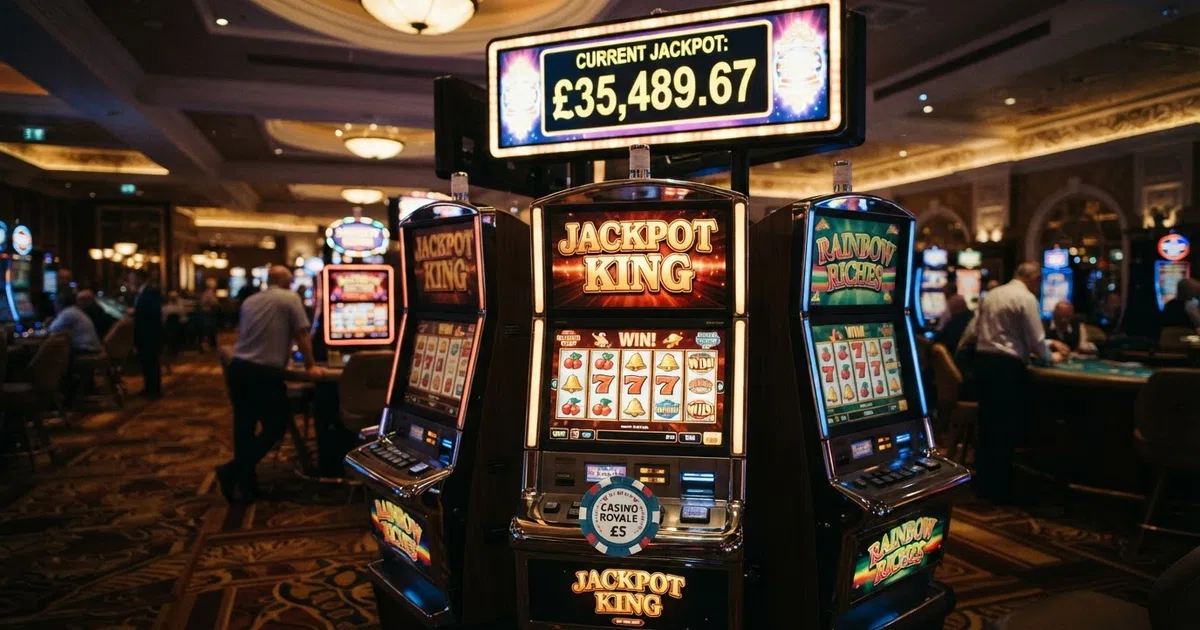
A progressive jackpot is networked. A fraction of every qualifying bet — typically only real-money bets above a small minimum — feeds a pool shared across every casino running the game. Mega Moolah’s Microgaming WowPot network and Blueprint’s Jackpot King pool are the two largest UK-facing examples. A standalone or local progressive is a smaller cousin: same engine, single casino’s player pool, smaller prize, faster reset. A fixed jackpot pays a set amount regardless of how long it has been building. A daily or must-drop jackpot is the third pattern: a prize with a timer attached, guaranteed to pay out before the clock runs, often within 24 hours. Red Tiger’s Daily Jackpots and Pragmatic Play’s Drops & Wins daily entries sit here.
Each engine has a different return shape. A progressive has the lowest base-game RTP and the highest ceiling. A fixed jackpot has a base-game RTP close to a standard slot, because nothing is being skimmed for a growing pool. A daily jackpot sits between the two: a base-game return slightly below a standard slot, plus a guaranteed payout window that turns the prize from a lottery into a clock. None of them make the math friendly. The progressive exclusion from welcome-bonus wagering at almost every UKGC-licensed operator is one consequence: a 10x or 20x playthrough cannot meaningfully chew through Mega Moolah spins, so the games are kept out of bonus contribution entirely. Fixed-jackpot slots, by contrast, typically contribute at 100% to wagering. The format shapes what the bonus is worth to a jackpot player.
Your Real Odds of Hitting a Jackpot (and What RTP Tells You)
RTP is an average over millions of spins, not a forecast for a session. A 96.12% total RTP on Mega Moolah means the network returns 96.12p of every £1 staked across all players over the long run — it says nothing about any individual spin, session, or week. The 88.12% base-game RTP is the more honest number for what most players actually experience. The remaining 8% goes into the prize pool and is paid out only when the rare combination lands.
Volatility sits beside RTP in the same way. A high-volatility jackpot slot is a game with long losing runs punctuated by occasional large wins. The hit frequency — how often any win pays — is low, and most of the return curve is concentrated in the top end of the prize table. Mega Fortune’s 96.6% RTP sits in the same band as Mega Moolah, but its non-progressive max win is capped at 1,700x the line bet. That is a generous top end, but it is a fundamentally different prize from a network progressive: it does not grow, and it is not shared.
Stake size matters because the contribution per spin is calibrated to a fixed percentage of the bet. The UK statutory cap sets the ceiling: £5 per game cycle for players aged 25 and over, £2 for players aged 18 to 24. A £5 spin on Mega Moolah feeds 40p into the jackpot pool on a 96.12% RTP basis; a £2 spin feeds 16p. A 25-year-old spinning at £2 a cycle is paying a third of what an older player is paying into the same pool, and the pool is shared. The cap is the most concrete shape the regulator puts on what a jackpot-slot session can cost.
The real odds of hitting a network progressive are the same as the odds the game publishes, and the published odds are deliberately unfriendly. That is the price of the prize. The RTP and the volatility together tell a player how to read the curve: the longer the losing run is expected to be, the more of a session’s return is concentrated in the rare event. On a daily jackpot, the rare event is also a scheduled one.
How to Play Jackpot Slots: Real-Money vs Free-Play Modes
A real-money spin is the only spin that contributes to a progressive jackpot pool and the only spin that pays a real progressive win. A free-play spin — a demo mode, a no-deposit bonus spin, a wager-free spin on a welcome offer — pays line wins and feature-round prizes at the game’s published RTP, but does not feed the pool and does not qualify for the progressive. That is why a 500-spin welcome offer on a non-jackpot slot is worth exactly that: line wins on a fixed-prize game, not a shot at seven figures.
The practical sequence is straightforward. A player registers, completes any required verification, deposits the minimum that triggers the offer (usually £10), claims the spins or the bonus, and then opens the qualifying game. On a wager-free offer, the spin pays its line win into the cash balance and the player can withdraw it. On a wagering offer, the line win becomes bonus funds, subject to the wagering multiplier and to which games count toward clearing it. Progressive jackpots, as a rule, do not. A real-money spin on a progressive at the same site is its own decision: deposit real money, play the game outside the bonus, and accept the base-game return in exchange for the chance at the pool.
Demo play is useful for learning a game’s bonus round, free-spin feature, or reel layout before staking real money, and most UK operators offer it on jackpot titles. It is also where the contribution mechanic becomes visible: a demo spin does not add a penny to the pool, and the displayed jackpot value freezes for the duration of the demo session. No-download instant play in the browser is standard on every operator on this page, and dedicated mobile apps are common on the larger brands. The 15-minute average session the regulator’s data records is well-suited to mobile play, where a session is more likely to be a coffee break than a planned evening.
The Studios and Titles That Define UK Jackpot Play in 2026
The UK jackpot market is concentrated in a handful of studios, and a handful of titles carry most of the search traffic. Understanding which is which makes a comparison between operators less abstract.

| Title | Provider | RTP | Top Payout on Record |
|---|---|---|---|
| Mega Moolah | Microgaming | 96.12% (88.12% base) | £18.9M |
| Mega Fortune | NetEnt | 96.6% | 1,700x non-progressive max |
| Big Bass Splash | Pragmatic Play | 96.71% | 5,000x |
The table is short because the wider jackpot catalogue runs into the dozens of titles and the page cannot honestly say more than the verified facts it has. RTP and top-payout data are stated only where research carries them. Titles outside the three above sit at the no-data end of the audit, and a reader is better served by a short honest table than a long speculative one.
The Providers Behind the Biggest Progressive Pools
Microgaming runs the Mega Moolah network under its current progressive branding, and the network’s largest verified single payout stands at £18.9 million. That figure is the one the rest of the UK jackpot market is measured against. The base-game RTP of about 88.12% with a total RTP of 96.12% is the canonical example of how a progressive slot’s maths is built: the headline return is generous, the in-game return is not, and the difference is what feeds the pool.
NetEnt’s contribution sits in Mega Fortune, with a 96.6% RTP and a 1,700x non-progressive max win. Mega Fortune sits closer to the standard-slot end of the spectrum than Mega Moolah does, and the non-progressive cap means the base game’s return is closer to the headline figure.
Pragmatic Play is the studio behind Big Bass Splash, with a 96.71% RTP and a 5,000x max win. The slot is a fixed-prize game, not a progressive, but it is the title that recurs across more UK welcome offers than any other, and it carries a higher base-game return than any of the network progressives.
Blueprint Gaming runs the Jackpot King pool, which surfaces across Paddy Power, Sky Vegas, Betfair and other UKGC-licensed brands. The pool is networked across multiple operators, which is why a single 30+ progressive title count can sit inside one casino’s library. Playtech’s Age of the Gods series is the other long-running UK-facing progressive network. Red Tiger’s Daily Jackpots network, distributed through Pragmatic Play and others, is the most prominent must-drop engine in the UK market.
Mega Moolah, Mega Fortune and Jackpot King: The Titles That Made Headlines
Mega Moolah’s headline figure is the £18.9 million single payout, and the 88.12% base-game RTP is the figure a player actually plays against. The split — roughly 8p in every £1 routed into the pool — is the clearest illustration on the UK market of what a progressive costs in ordinary spins, and it is why the bonus terms on the page matter.
Mega Fortune’s 96.6% RTP and 1,700x max win make it the gentler of the two network progressives, with a higher base-game return and a fixed non-progressive ceiling. A player chasing the Mega Fortune jackpot is paying less per spin into the pool than a Mega Moolah player is, and the trade is a smaller top end.
Jackpot King is the network that ties together the largest number of individual titles. The Independent’s review of Betfair surfaces 30+ progressive titles all on the Jackpot King pool at a single brand, which is one of the larger single-operator progressive libraries in the featured set. Sky Vegas carries the same pool alongside exclusive Sky Vegas-branded slots, and Paddy Power’s library pairs Jackpot King titles with Red Tiger’s Daily Jackpots.
Megaways, Daily Drops and the New Wave of Jackpot Mechanics
Megaways is a reel modifier rather than a jackpot mechanic: it changes how many symbols appear on each reel per spin, which changes the number of possible winning combinations. Megaways games can carry fixed jackpots, progressive jackpots, or no jackpot at all. The mechanic itself is licensed by Big Time Gaming and is integrated across providers including Blueprint and Pragmatic Play. The risk-reward picture is that a Megaways engine has a higher hit frequency on small wins and a wider variance on the top end, with the volatility shifting further when a progressive is layered on top.
Daily-drop and must-drop jackpots turn a progressive into a scheduled event. Red Tiger’s Daily Jackpots, surfaced at Paddy Power, guarantee a payout within a 24-hour window. The prize is funded like any progressive — a slice of every qualifying bet — but the timer forces the payout rather than letting the pool grow indefinitely. The expected value calculation is different, because the prize is finite and the trigger is bounded by the clock.
Mystery and random-jackpot triggers sit at the edge of the format. A random trigger pays a prize without a visible combination, and a mystery trigger reveals the prize only after the bet. Both formats keep the base-game RTP higher than a network progressive, because the prize pool is fixed and the contribution per spin is calibrated to a known ceiling. New 2026 releases across the studios on this page have leaned further into daily-drop and mystery formats, and the trend is toward the gentler end of the return curve.
The Best UK Casino Sites for Big Jackpot Slots in 2026
The ten operators below are UK-facing and UKGC-licensed where the public register surfaced the licence, and licensed under the same framework where it did not. The table summarises the comparison the operator write-ups develop.
| Operator | UKGC Licence Status | Welcome Offer | Free Spins | Wagering on Bonus | Standout Trait for Jackpot Players |
|---|---|---|---|---|---|
| bet365 | Not surfaced on accessed register pages this run | — | 500 wager-free spins | 0x | Largest spin count, four named non-jackpot slots |
| 888casino | Casino Remote active since 1 Nov 2014 | 100% up to £100 | — | 10x | Long-standing UKGC licence, progressive-jackpot exclusion stated |
| LeoVegas | Casino Remote active from 1 Nov 2014 | — | 50 wager-free spins on Big Bass Splash | 0x on spins | Simplest welcome mechanic in the featured set |
| Paddy Power | Account 39411, active | — | 160 spins (60 no-deposit + 100 deposit-triggered) | 0x | Hybrid no-deposit + deposit package, Jackpot King + Daily Jackpots |
| Betfair | Not fully surfaced on accessed register pages this run | — | 50 no-deposit spins | 0x | 30+ progressive titles via Jackpot King |
| Sky Vegas | Not fully surfaced on accessed register pages this run | — | 250 spins (50 no-deposit + 200 deposit-triggered) | 0x | Largest raw spin count, exclusive Sky Vegas slots |
| MrQ | Not fully surfaced on accessed register pages this run | — | 100 wager-free spins on Big Bass Splash | 0x | Site-wide no-wagering promise, 48-hour use window |
| BetMGM UK | UKGC-licensed (per review coverage) | — | Wager-free spins on a rotating Pragmatic Play title | 0x on spins | Seven-studio provider mix under one licence |
| Mr Vegas | UKGC-licensed (per review coverage) | 100% up to £50 | 11 wager-free spins on Pink Elephants 2 | 20x on bonus | 8,000+ games, 500+ jackpots, Wheel of Vegas system |
| Betway | Not fully surfaced on accessed register pages this run | Not surfaced this run | — | — | UKGC-regulated brand, major studio presence |
Welcome-offer and licence detail for Betway was not surfaced in this run’s research. The operator is included on the strength of its UK-facing coverage and its UKGC-regulated status, and the row leaves the un-surfaced detail as a dash rather than guessing. The reader is better served by an honest gap than a fabricated number.
bet365: 500 Wager-Free Spins — but Jackpot Play Sits Outside the Offer
bet365’s welcome package runs up to 500 free spins, distributed across 10 prize selections of 5, 10, 20 or 50 spins, claimable within 20 days of opening the account, with a 30-day window from registration to claim the overall offer. The trigger is a minimum of £10 in lifetime deposits, and the four named qualifying slots are Book of Horus, Curse of the Bayou, Magic Forge and Wrath of the Deep. None of the four is a progressive jackpot.
That is the line a reader needs to read carefully. The headline is the spin count, and the spin count is the largest in the featured set. The terms are zero-wagering on every spin, which means the line wins land as cash. The catch is the slot list. A player who joined bet365 specifically to chase a progressive jackpot has paid £10 in deposits to claim 500 spins on four fixed-prize games, and the progressive library is still accessible from the same wallet — but the welcome offer does not point at it.
The verdict for a jackpot player is straightforward. bet365 is a strong option for someone who wants a long, friction-free welcome on fixed-prize slots and who treats the progressive library as a separate decision paid for in real money. For someone whose first session is going to be a progressive spin, the welcome offer is not a reason to choose bet365.
888casino: A 100% Match Up to £100 on One of the UK’s Longest-Standing Licences
888casino’s UKGC Casino Remote licence has been active since 1 November 2014, which is one of the longer continuous licence tenures in the featured set. The welcome offer is a 100% match up to £100 on the first deposit of £10 or more, with the bonus stake required within 48 hours of the deposit to trigger the match. The wagering multiplier is 10x on the bonus funds, which sits exactly at the UKGC’s January 2026 cap.
The bonus terms exclude progressive jackpot play from freeplay and bonus wagering. A 10x playthrough on a £100 bonus is £1,000 of qualifying play, and that £1,000 cannot meaningfully include Mega Moolah. The bonus is built for the standard slot library, not the progressive one.
The verdict is that 888casino is a fit for a player who values a long-standing UKGC licence and a match bonus on the standard slot library, and who is willing to fund progressive play separately. The 48-hour bonus-stake window is short, and a player who waits three days to claim the bonus will not get it.
LeoVegas: 50 Wager-Free Spins on Big Bass Splash — Near-Zero Friction, Zero Wagering
LeoVegas has held a UKGC Casino Remote licence since 1 November 2014. The welcome offer is 50 wager-free spins on Big Bass Splash, triggered by a £10 deposit and a single 1x wager of the deposit on eligible games. Spins are valued at 10p each, the deposit must be made within 7 days of registration, and the spins expire 3 days after crediting. Big Bass Splash carries a 96.71% RTP from Pragmatic Play, with a 5,000x max win.
The mechanic is the simplest in the featured set. There is no bonus fund, no match percentage, and no wagering multiplier on the spin winnings — the 1x is on the deposit, not the spins. The trade is the title: a fixed-prize slot, not a progressive, and the welcome offer is structured to drive play to that specific game. The 3-day spin expiry is the only friction in the terms, and a player who deposits on a Friday and returns on Monday will find the spins already gone.
The verdict is that LeoVegas is a fit for a player who wants the shortest possible path from deposit to spin on a high-RTP fixed-prize slot, and who does not need the welcome offer to touch the progressive library. A jackpot chaser will fund that play separately.
Paddy Power: 60 No-Deposit Spins, Then 100 More — All Wager-Free
Paddy Power’s UKGC licence sits under account 39411, active. The welcome package is hybrid: 60 free spins up front with no deposit required, then 100 more spins after a £10 deposit and a single wager of that deposit. All 160 spins carry zero wagering, valued at 10p each, and the full set expires in 7 days. The slot library surfaces Jackpot King titles from Blueprint and Red Tiger’s Daily Jackpots alongside the welcome-offer games, which include Fishin’ Frenzy, Eye of Horus, King Kong Cashpots and Deal or No Deal Megaways.
The no-deposit segment is the rare one in the featured set. Most UKGC-licensed operators gate the entire welcome package behind a deposit; Paddy Power splits it, and the 60 deposit-free spins are paid in real cash, not bonus funds. The 7-day expiry covers both segments, which means a player who waits until day 6 to deposit has only one day on the second tranche.
The verdict is that Paddy Power is the closest fit in the featured set for a player who wants to test the lobby without funding a deposit, and who values a no-wagering hybrid over a larger spin count on a single deposit. This is a rare no-deposit model that keeps all 160 spins free of wagering hurdles.
Betfair: 50 No-Deposit Spins and 30+ Progressive Titles via Jackpot King
Betfair’s surfaced UKGC licence status was not fully captured on the accessed register pages this run; review coverage implies a UKGC-licensed brand, and the operator is included on that basis. The welcome offer is 50 no-deposit spins with zero wagering, and the slot library runs over 30 progressive jackpot titles, all on Blueprint’s Jackpot King pool, per The Independent’s review. The no-deposit segment is the rarest offering on the page outside Paddy Power.
The progressive count is the headline. 30+ titles on a single networked pool means a player can move between games without leaving the same prize structure, and the Jackpot King pool’s contribution mechanic is consistent across titles. The welcome offer is small in raw terms — 50 spins — but the terms are clean: no deposit, no wagering.
The verdict is that Betfair is a fit for a player who prioritises progressive-library breadth over welcome-offer size, and who is comfortable taking a small no-deposit spin package as a taster rather than a primary reason to join. The licence gap should be checked on the public register before depositing.
Sky Vegas: 250 Free Spins — Half Deposit-Free — With Exclusive Slot Titles
Sky Vegas’s UKGC licence status was not fully surfaced on the accessed register pages this run; review coverage implies a UKGC-licensed brand. The welcome package is 250 free spins in total: 50 spins up front with no deposit, then 200 spins after a £10 deposit, all with zero wagering. The library surfaces exclusive Sky Vegas-branded slots alongside premium progressive jackpots via the Jackpot King pool, and the spin count is the largest raw total in the featured set.
The structure mirrors Paddy Power’s hybrid model at a larger scale, with 50 deposit-free spins acting as a no-risk test of the lobby. The 200 deposit-triggered spins are where the package competes on volume. The expiry window on the no-deposit segment was not fully stated in the surfaced snippet, and the terms should be checked on the operator’s own site.
The verdict is that Sky Vegas is a fit for a player who wants the largest hybrid no-deposit + deposit welcome package in the featured set, and who is willing to play the terms on the exclusive slots before moving to the progressive library. The licence gap is a verification step before depositing.
MrQ: 100 Wager-Free Spins on Big Bass Splash — All Promotions 100% Wager-Free
MrQ’s UKGC licence status was not fully surfaced on the accessed register pages this run; coverage indicates a UKGC-licensed presence. The welcome offer is 100 free spins on Big Bass Splash for a £10 deposit, all wager-free, with a 48-hour window from the qualifying deposit to use the spins. Spin value is 10p each. Big Bass Splash carries Pragmatic Play’s 96.71% RTP. The site-wide promotion policy is that all promotions are 100% wager-free.
The site-wide no-wagering policy is the structural commitment that distinguishes MrQ from the other 0x-spin operators. The 48-hour window is the shortest on the page outside Mr Vegas’s 24-hour spin use, and a player who deposits late on a Wednesday has until Friday afternoon to clear the spins.
The verdict is that MrQ is a fit for a player who values a structural no-wagering commitment over a large spin count, and who can clear a 48-hour window reliably. The site-wide policy makes all promotions accessible without playthrough requirements.
BetMGM UK: A Multi-Studio Jackpot Library With Wager-Free Spins
BetMGM UK is UKGC-licensed per review coverage. The provider list runs Evolution, Playtech, Pragmatic Play, NetEnt, Microgaming, Big Time Gaming and IGT, which is the most diverse multi-studio mix in the featured set under a single licence. The welcome package includes wager-free spins on a rotating Pragmatic Play title, at 10p per spin, with a 3-day expiry from crediting and a 7-day window from registration to make the qualifying deposit. The exact match percentage and cap were not surfaced in this run’s research, and the offer should be checked on the operator’s own site for current terms.
The provider mix is the headline. A player who wants Evolution’s live-casino catalogue, Playtech’s Age of the Gods progressives, Microgaming’s Mega Moolah, NetEnt’s Mega Fortune and Pragmatic Play’s daily drops in one lobby is paying for breadth, and BetMGM UK is the cleanest example of that breadth in the featured set. The wager-free-spin offer is small in raw terms, and the match component is the part that varies by run.
The verdict is that BetMGM UK is a fit for a player who values provider breadth over welcome-offer size, and who treats the wager-free spins as a taster of the Pragmatic Play catalogue. A jackpot chaser will find every major progressive network under one roof, which is the page’s clearest single argument for the brand.
Mr Vegas: 8,000+ Games, 500+ Jackpots and an Exclusive Wheel of Vegas System
Mr Vegas is UKGC-licensed per review coverage, and is operated by Videoslots. The library runs 8,000+ games with 500+ jackpot titles, which is the largest raw game count in the featured set. The welcome offer is 100% up to £50 plus 11 wager-free spins on Pink Elephants 2, with 20x wagering on the bonus funds. Spins must be activated within 7 days and used within 24 hours. The minimum deposit is £10. The Wheel of Vegas is the operator’s exclusive jackpot system.
The 20x wagering on the match bonus is the highest multiplier in the featured set, twice the January 2026 cap on bonus funds. The research surfaced 20x as the figure, and the audit will hold the page to it. The 11 wager-free spins are the friction-free half of the package; the £50 match is the part that costs the player. The 24-hour spin-use window is the tightest on the page.
The verdict is that Mr Vegas is a fit for a player who values raw game count and jackpot-library breadth above bonus terms, and who is willing to pay a 20x wagering cost on a small match bonus. The scale of the library makes it a long-term home for variety-seeking players.
Betway: A UKGC-Regulated Brand With Limited Public Bonus Detail
Betway’s UKGC licence status was not fully surfaced on the accessed register pages this run, and the welcome-offer specifics were not captured in this run’s research. Coverage indicates a UKGC-regulated brand with major studio presence and a live-casino focus, and the operator is included on the strength of that coverage.
The honest position is that Betway’s welcome terms were not visible in the surfaced snippets, and the page does not invent them. A reader comparing operators should check the operator’s own site for current terms before depositing. The UKGC-licensed status is a verified baseline, and the studio coverage is a verified description of the library, but the welcome offer is left as a gap rather than a guess.
The verdict is that Betway is a fit for a player who values the brand’s UKGC-regulated status and is willing to check the current welcome terms directly. The page cannot recommend a specific offer it did not surface.
What Sets a Jackpot Slots Site Apart: The Criteria That Matter
Four filters separate a serious jackpot-slot site from a slot site that happens to carry a few progressive titles.
The first is UKGC licence status. The Commission’s public register is the only place a player can verify a licence in under a minute, and any operator that cannot be found there is not a fit for real-money play. The second is jackpot-library depth and provider mix. A site with 30 progressive titles on a single networked pool is a different proposition from a site with five progressive titles spread across three pools, and the player who cares about the progressive side of the catalogue is paying for breadth on the same network rather than a thin spread across many. The third is bonus eligibility for jackpot play. Almost every UKGC-licensed operator excludes progressive jackpots from welcome-bonus wagering, and a player whose real session is going to be on a progressive is funding that session in real money regardless of the welcome offer. A wagering-heavy match bonus on the same site is for the standard-slot library, not the progressive one. The fourth is mobile delivery. Dedicated apps on Android and iOS are common on the larger brands, and the 15-minute average session the regulator’s data records is the kind of session that lives on a phone.
The mobile experience is a competitive dimension rather than a differentiator at this point. Every operator on this page supports browser play on mobile, and most ship dedicated apps as well. The dedicated-app brands are smoother in the lobby and the cashier, and the browser-only brands are fine for a coffee-break session. Neither is a reason to choose or reject a brand on its own.
Why Your 2026 Jackpot Bonus Is Smaller Than It Looks
The headline number on a welcome offer is the smallest fact about it. The size of the bonus, the wagering multiplier, the eligible games, the contribution rate, the time window, the cap on winnings — every one of those terms is where the bonus’s real cost lives, and a progressive jackpot player pays for the bonus twice when those terms are misread.
The first payment is the playthrough. A 10x wagering requirement on a £100 bonus means £1,000 of qualifying bets before the bonus becomes cash, and every one of those bets is on a game the operator has chosen to count. The second payment is the contribution. If the bonus excludes progressive jackpots, the £1,000 of qualifying bets is on standard slots at a higher base-game RTP, which means the £1,000 returns roughly £960 over the long run — a £40 expected loss on the playthrough, before the bonus is even converted to cash. That is the expected loss the page can name with a number.
The calculation uses the Mega Moolah total RTP of 96.12% as a worked example, the highest-RTP progressive the page has on file. The full expected-loss formula is turnover × (1 − RTP). On a £1,000 playthrough at 96.12% RTP, the expected loss is £1,000 × (1 − 0.9612) = £38.80. The same £1,000 at a 96.6% RTP on Mega Fortune-style conditions returns £34.00 in expected loss. The two figures are statistical averages over many spins, not forecasts for any single playthrough. The honest framing is that the bonus’s cost is the expected loss on the wagering turnover, and the player’s cost is bounded by the wagering multiplier, the eligible games, and the time window to clear it.
The 10x cap that landed in January 2026 is the regulatory ceiling on the multiplier. A player who joined a UKGC-licensed site after 19 January 2026 cannot be offered a 50x or 100x bonus; the operator’s offer has to fit inside the cap. The cap does not change the expected-loss math — it changes the multiplier on it. A £100 bonus at 10x is a £1,000 turnover; a £100 bonus at 20x (where the cap does not yet bind, as on Mr Vegas) is a £2,000 turnover, and the expected loss is roughly double. The cap is the floor on the multiplier, not the only multiplier in the market.
Welcome Bonuses and Free Spins: What UK Operators Actually Offer Jackpot Players
The 10 operators on this page split into three shapes of welcome offer, and a jackpot player reads them in different registers.
The wager-free-spin operators are the cleanest fit. bet365, LeoVegas, Paddy Power, Betfair, Sky Vegas, MrQ and BetMGM UK all offer 0x wagering on at least the spin portion of the welcome, with line wins paid as cash. The trade is the title list: the spins are usually tied to fixed-prize slots, and a player who wants to chase a progressive is paying for the welcome offer and the progressive session separately. The match-bonus operators are 888casino and Mr Vegas. 888casino offers a 100% up to £100 with 10x wagering, exactly at the cap; Mr Vegas offers a 100% up to £50 with 20x wagering, above the cap. The match-bonus offer is built for the standard slot library, and the expected-loss math is the cost of clearing the playthrough on the eligible games. Betway is the gap: a UKGC-regulated brand whose current welcome terms were not surfaced this run.
The deposit triggers across the featured set sit at £10, with one operator (bet365) setting the trigger as £10 in lifetime deposits rather than a single deposit. The spin values, where stated, sit at 10p per spin, and the spin counts range from 50 (Betfair, LeoVegas) to 500 (bet365). The raw count is the most visible number on the welcome offer, and the wagering terms are the most important.
The Wagering Trap: Why Most Bonuses Exclude Progressive Jackpots
Wagering requirements are the multiplier on a bonus that a player must bet through before the bonus becomes withdrawable cash. A 10x multiplier on a £100 bonus is £1,000 of qualifying bets; a 20x multiplier is £2,000. The eligible games are the games that count toward clearing that turnover, and the contribution rate is the percentage of each bet that counts.
The trap is in the contribution rate for progressives. At almost every UKGC-licensed operator, progressive jackpot slots are excluded from welcome-bonus wagering entirely. The bonus’s turnover must be cleared on standard slots or fixed-jackpot slots, where the contribution is typically 100% of the bet. A player who tries to clear a bonus by spinning Mega Moolah will see no progress on the wagering bar, and the bonus will eventually expire with the turnover unc cleared. The exclusion is the operator’s defence against a player who would clear a £1,000 bonus by spinning a single £5 spin on a progressive at 96.12% RTP and waiting for the rare event to land; the maths is unfavourable to the operator even with the small base-game return, and the exclusion is what makes the welcome offer workable.
The 10x cap is the regulatory answer to the same problem from a different angle. Before 19 January 2026, a 50x or 100x bonus was a route to extract a large expected value from the welcome offer on the standard library, and the cap limits that route. The 10x ceiling is the floor on the cost of a bonus to a player who clears it on eligible games; it is not the floor for a player who walks away. The 10x cap, combined with the progressive exclusion, is the shape of the UK welcome-offer market in 2026.
The fixed-jackpot contribution at 100% is what makes fixed-jackpot slots the natural home for clearing a bonus. A wagering offer on a high-RTP fixed-jackpot title is the closest a player can get to a low-cost playthrough, and MrQ’s 100 wager-free spins on Big Bass Splash at 96.71% RTP is the cleanest version of that in the featured set. The 0x operators (bet365, LeoVegas, Paddy Power, Betfair, Sky Vegas, MrQ, BetMGM UK on the spin portion) sidestep the wagering question by removing it.
No-Deposit Spins on Jackpot Slots: What Is Available and What Is at Stake
Three operators in the featured set offer spins without a deposit: Paddy Power, Betfair and Sky Vegas. The mechanics are similar in shape and different in scale.
Paddy Power’s no-deposit segment is 60 spins, paid up front, zero wagering, 10p per spin, 7-day expiry. Betfair’s no-deposit segment is 50 spins, zero wagering. Sky Vegas’s no-deposit segment is 50 spins, zero wagering. None of the three carries a wagering multiplier on the spin winnings, which is what makes the no-deposit segment useful: line wins on the qualifying games land as cash.
The cost to the player is the qualifying-game restriction and the expiry window. A no-deposit spin on a fixed-prize slot pays line wins at the game’s published RTP, and a player who clears the spins inside the window keeps the winnings. A player who lets the spins expire loses the line wins and the test of the lobby. A winnings cap on no-deposit spins is a common term in the wider market and was not fully surfaced in this run’s research; the reader should check the operator’s own terms for any cap on no-deposit winnings before counting the offer as cash-equivalent.
The honest framing is that a no-deposit spin is a free test of a lobby. It is not a route to a progressive jackpot, and the qualifying games are fixed-prize slots. A player who likes the lobby after the no-deposit segment funds the progressive session separately.
The UK Rulebook: What a Licensed Jackpot Site Must Deliver
The UK Gambling Commission is the regulator, and the Gambling Act 2005 is the statute. Every UK-facing remote casino must hold a UKGC licence to take real-money bets from players in Great Britain, and the public register is the only place a player can verify that licence in under a minute. The register lists the operator’s legal entity, the licence type, the licence status and the dates the licence has been active. A licence that does not appear on the register is not a UKGC licence, and a real-money casino without one is operating outside the UK framework.

The rules that shape a 2026 jackpot-slot session sit on top of that framework. The £5/£2 statutory stake cap per game cycle, age-gated at 25, was the first major change. The 10x bonus-wagering cap and the mixed-product ban from 19 January 2026 were the second. The deposit-limit rule from 30 June 2026 is the third. Each one narrows what a UKGC-licensed operator can offer, and each one changes what a player can do.
UK Gambling Commission Licensing: The Non-Negotiable Baseline
A UKGC licence covers game fairness, fund segregation, dispute resolution and the operator’s interaction with the player. The Commission does not guarantee a player will win, and it does not guarantee any specific return on any specific session. What it guarantees is that the games are independently tested, the player’s funds are held separately from the operator’s operating funds, disputes can be escalated to an alternative dispute resolution provider, and the operator is subject to the Commission’s enforcement powers if it breaches the licence conditions.
The licence statuses surfaced in this run’s research are 888casino (UKGC Casino Remote, active since 1 November 2014), LeoVegas (UKGC Casino Remote, active from 1 November 2014), Paddy Power (UKGC licence account 39411, active), and a UKGC-licensed status implied by review coverage for BetMGM UK and Mr Vegas. bet365, Betfair, Sky Vegas, MrQ and Betway are UK-facing brands with UKGC-regulated status implied in coverage, but the per-brand register pages were not surfaced in the accessed snippets this run. The honest position is that the licence gap is a verification step, not a doubt about the brand; a reader can resolve it in under a minute on the public register.
A player who cannot find an operator on the public register is not dealing with a UKGC-licensed operator, and the rest of the page’s protection framework does not apply. That is the line.
Stake Caps, Deposit Limits and the New Bonus Rules: What Changed and When
Three regulatory changes in 2026 reshape the cost of a jackpot-slot session and the value of a welcome offer.
The first is the statutory stake cap. The £5 per game cycle for players aged 25 and over, and the £2 cap for players aged 18 to 24, is a hard ceiling on what a single spin can cost. The cap is per game cycle, not per session, and the per-cycle framing means the limit is on the stake that initiates the spin rather than the cumulative stake across a session. A 25-year-old player on a progressive slot is paying up to £5 per spin into the pool; an 18-to-24-year-old player is paying up to £2. The cap was effective from 2025 and is the most concrete shape the regulator puts on what a jackpot-slot spin costs.
The second is the bonus-wagering cap. From 19 January 2026, UKGC rules cap wagering requirements on bonus funds at a maximum of 10, and ban mixed-product promotions that bundle casino play with sports betting or bingo under a single wagering hurdle. The cap means a maximum of up to 10 times re-wagering can be offered on bonus funds. Mr Vegas’s 20x wagering on the match bonus sits above the headline cap, and the reader should check the operator’s own terms for the current state of that offer.
The third is the deposit-limit rule. From 30 June 2026, all UK online operators must provide customers with the opportunity to set a deposit limit based solely on the amount a customer pays into their account over a set duration, with the limit clearly available via visible links on homepages and deposit pages. The rule is a default rather than a ceiling: a player can opt into a limit, and the limit must be easy to set and to find. The UK’s safer-gambling infrastructure also includes a permanent ban on reverse withdrawals — a player who requests a withdrawal cannot cancel it — and affordability triggers that prompt operator intervention when a player’s net spend crosses a threshold.
Each of these rules is a floor, not a ceiling. A UKGC-licensed operator cannot offer a 50x bonus, a reverse withdrawal, or an opt-out from a deposit limit; the rule is the minimum the operator must deliver.
Crypto, Offshore Sites and Jackpot Slots: What the UK Market Actually Allows
Bitcoin and crypto jackpot slots exist. The UKGC-regulated market does not route through them.
The UK Gambling Commission regulates GB-facing remote casino activity, and operators must hold the appropriate licence to offer real-money online casino games to UK players. A crypto casino that accepts Bitcoin deposits, pays out in Bitcoin, and offers progressive jackpot slots is operating outside the UK framework unless it holds a UKGC licence, and a UKGC-licensed operator that accepts cryptocurrency is a narrow subset of the market. No UKGC-licensed crypto-jackpot operator was surfaced in this run’s research, and the honest position is that the UK licensed market offers essentially no crypto-jackpot route.
An offshore crypto casino bypasses every protection the page has described. The UKGC’s stake cap, bonus-wagering cap, deposit-limit rule, fund-segregation requirements, dispute resolution route and self-exclusion infrastructure are not in force. A player who funds an account in Bitcoin at an offshore site is paying into a pool that is not regulated by the Commission, and a dispute that cannot be resolved through the operator’s own support has no UK escalation path. GamStop, the national self-exclusion scheme, does not extend to offshore sites.
The page is not a route to an offshore crypto casino. A UK player who wants a progressive jackpot slot should play at a UKGC-licensed operator, and the rest of the page is built around that route.
Playing Jackpot Slots Safely: Tools Every UK Player Should Know
The UKGC’s safer-gambling infrastructure is built into every UKGC-licensed operator, and the tools are concrete rather than advisory. The deposit-limit rule from 30 June 2026 is the most recent addition, and it is the one every UK player will see on the homepage of every UKGC-licensed casino from that date. The earlier tools — reality checks, time-outs, self-exclusion through GamStop — are already in place and have been for years.
The wider context is the regulator’s market data. Online slots sessions lasting longer than one hour fell 12% year-on-year to 8.9 million in the year to March 2026, and the average session length fell to 15 minutes. The data is the Commission’s measurement of how UK players are actually playing, and the direction of travel — shorter sessions, fewer long sessions — is the kind of outcome the safer-gambling infrastructure is designed to support. A player who reads the data as “fewer people are playing long sessions” is reading the same numbers as “the safer-gambling tools are working”. A player who reads the data as “long sessions are still happening” is reading the same numbers as “the tools are necessary, and the long-session player is exactly who the tools are for”.
Deposit Limits, Reality Checks and Time-Outs: The UKGC Toolkit
Three tools sit at the core of the UKGC’s safer-gambling infrastructure, and every UKGC-licensed operator must offer them.
A deposit limit is a cap on the amount a player can pay into their account over a set duration. From 30 June 2026, every UK online operator must provide the opportunity to set one, based solely on the amount a customer pays into their account over a set duration, with the limit clearly available via visible links on homepages and deposit pages. The limit is the player’s own; the operator is required to make it easy to set, easy to find, and easy to adjust down. Increasing a limit has a cooling-off period; decreasing a limit is immediate.
A reality check is an on-screen prompt that interrupts a session to display the time played and, on most modern implementations, the net position. The prompts are mandatory on UKGC-licensed slots, and the interval is calibrated to the session length. A 15-minute average session means a reality check is unlikely to interrupt a typical play pattern, but a 60-minute session will see at least one prompt. The prompt is information, not a barrier; a player who dismisses it continues the session.
A time-out is a short voluntary cooling-off period, typically 24 hours to six weeks, during which the account is locked from play. The lock is fast to set, fast to lift at the end of the period, and is the right tool for a player who wants a short break rather than a long one. Self-exclusion through GamStop is the longer version of the same mechanism, and the next section covers it.
GamStop Self-Exclusion and Where to Find Help
GamStop is the UK national online self-exclusion scheme. A player who registers with GamStop is barred from opening new accounts and from using existing accounts at every UKGC-licensed operator for the chosen exclusion period, which runs from six months to five years. The exclusion is irrevocable for the period; a player who tries to lift it early cannot, and the operator is required to enforce it.
GamStop is the right tool for a player who has decided the safer-gambling tools are not enough. A deposit limit can be lifted, a reality check can be dismissed, a time-out is voluntary. GamStop is a hard stop. The scheme is free, the registration is online, and the exclusion takes effect across the UKGC-licensed market within 24 hours.
GambleAware is the national help resource signposted across UK operator pages. The service offers information, support and signposting to treatment for problem gambling, and the operator pages link to it as the default. The page does not invent a UK prevalence figure for gambling disorder, because the surfaced research did not carry one. The honest framing is that the help exists, the operators signpost it, and a player who needs it should use it.
Jackpot-chasing is a specific risk pattern: long losing runs on a high-volatility game, with the rare event large enough to anchor expectations. The pattern is well-understood in the responsible-gambling literature, and it is exactly the pattern the UKGC’s stake cap, deposit-limit rule and progressive-jackpot exclusion are designed to bound. A player who notices the pattern in their own play is the player the tools are for.
How We Selected and Ranked These Jackpot Slot Casinos
The ranking rests on five sources, each verified against the operator’s own published terms where the snippet surfaced them. The UK Gambling Commission’s public register is the source for licence status, and the licence gaps noted on the table are the places the accessed register pages did not surface a per-brand entry. The operator’s own sites, the ICLG 2026 Gambling Laws and Regulations chapter on the United Kingdom, the GOV.UK summary of the remote gambling tax consultation, the Legal 500 White Paper history and status update, and the UKGC’s own news and guidance pages are the regulatory and policy backbone. The slot and operator coverage comes from Casino.org, The Sun’s verified casino coverage, gg.co.uk, casinoappsonline.co.uk’s progressive-jackpot and jackpot-bonus casino pages, The Independent’s review of Betfair, and the publishers’ own RTP pages (NetEnt for Mega Fortune, Pragmatic Play for Big Bass Splash, RTP Track for the Mega Moolah RTP split). The game-design and market-data figures come from the UKGC’s market overview to March 2026.
The criteria that ordered the ranking are UKGC licence status, jackpot-slot library depth and provider mix, welcome-offer terms and wagering fairness, progressive-jackpot eligibility of bonuses, and RTP transparency. No single criterion carries a fabricated weighting; the ranking is qualitative, and the page does not pretend otherwise. The licence gaps are stated where the accessed register pages did not surface the per-brand entry, and the welcome-offer gaps are stated where the operator’s own published terms were not captured in this run’s research.
The page is one run of one methodology at one point in time. The welcome offers in particular change frequently, and a reader comparing operators in a different month should treat the offers as snapshots rather than as the current state of the market. The licence status, the regulatory framework, and the slot RTPs are slower-moving and are the part of the page that is most stable.
Your Move: Picking a Jackpot Site That Fits How You Play
No single operator is the best for every player, and the page is not the place that pretends otherwise. Three forces shape a jackpot-slot decision, and the right choice depends on which force a player weights most heavily.
The first force is licence safety. A UKGC licence is the baseline, and the rest of the page is built on top of it. An operator that cannot be found on the public register is not a fit for real-money play, and the page is not interested in ranking offshore sites. The second force is bonus usability for jackpots. A welcome offer on a fixed-prize slot at 0x wagering is a clean addition to a real-money progressive session; a 20x match bonus on the standard library is a separate decision, paid for in expected loss on the eligible games. The third force is game-library depth. A player who wants every major progressive network under one licence is paying for breadth, and the operator that delivers it most cleanly is the one to choose. A player who wants a single network on a small no-deposit taster is paying for the taster, and the operator that delivers that is a different one.
A wager-free offer on a fixed-jackpot title will often beat a wagering-heavy match bonus if progressive jackpots are what the player is after. The wager-free offer pays line wins as cash and frees the player to fund the progressive session in real money; the match bonus ties the player to the standard library at a cost the wagering multiplier and the eligible games determine. The 0x-spin operators on this page are the cleanest fit for that pattern, and the match-bonus operators are the cleanest fit for a player who wants the standard-slot library as the main session.
The reader’s own play style is the deciding factor. A 15-minute coffee-break session on a phone is a different session from a one-hour evening session on a desktop, and the stake cap, the deposit limit and the wagering offer are calibrated to the session the player is actually planning. The page is the comparison; the choice is the player’s.
Frequently Asked Questions
Are welcome bonuses and free spins usually valid on progressive jackpot slots at UK casinos?
No. Progressive jackpot slots are excluded from welcome-bonus wagering at almost every UKGC-licensed operator, which means bonus funds cannot be used to clear wagering on titles like Mega Moolah, Mega Fortune or Jackpot King entries. Fixed-jackpot slots typically contribute at 100% to wagering, so a match bonus is built around the standard slot library rather than the progressive one. A real-money spin on a progressive is funded separately from any welcome offer.
What RTP and volatility should I expect from famous jackpot slots like Mega Moolah or Mega Fortune?
Mega Moolah’s published total RTP is about 96.12%, but the base-game RTP — the return from line wins, free-spin rounds and features — is around 88.12%, with the remaining 8% feeding the progressive pool. Mega Fortune’s published RTP is 96.6% with a non-progressive max win of 1,700x the line bet. Both are high-volatility games: long losing runs punctuated by occasional large wins, with most of the return curve concentrated at the top of the prize table.
How do I verify that a UK jackpot slots site is licensed and safe?
The UK Gambling Commission’s public register lists every operator licensed to offer real-money online casino games in Great Britain, with the legal entity, the licence type, the licence status and the dates the licence has been active. A player can search the register by operator name and verify the licence in under a minute. An operator that does not appear on the register is not UKGC-licensed, and the rest of this page’s protection framework does not apply to it.
Do UK rules cap wagering requirements on bonuses, and how does that affect jackpot players?
Yes. From 19 January 2026, UKGC rules cap wagering requirements on bonus funds at a maximum of 10, and ban mixed-product promotions that bundle casino play with sports or bingo under a single wagering hurdle. The cap limits the multiplier on the cost of a bonus, but the eligible-games restriction matters more for jackpot players: progressive slots are excluded at almost every operator, and the cap shapes the standard-library bonus, not the progressive session.
Which responsible-gambling tools should UK players use when chasing big jackpots?
Every UKGC-licensed operator must offer deposit limits, reality checks and time-outs, and from 30 June 2026 the deposit-limit rule makes a player-set deposit cap the default option on every homepage. GamStop is the national self-exclusion scheme for a longer break, and GambleAware is the help resource signposted across UK operator pages. A player who notices jackpot-chasing patterns in their own play is exactly the player the tools are designed for, and the tools are free, fast to set, and effective at the UKGC-licensed end of the market.
Payout Records and Real Winner Stories: Does It Actually Pay Out?
Mega Moolah’s £18.9 million single payout is the largest verified jackpot-slot payout in the UK-facing market, and the figure is the one the rest of the industry is measured against. The payout is publicly reported, and the game’s network has produced multiple seven-figure winners across the years. Independent RTP audits and verifications are a routine part of the game’s certification, and the published 96.12% total RTP is the figure the audits support.
The UKGC’s rules on progressive jackpot systems require operators to publish how prizes are determined and awarded, including what happens when two players trigger a jackpot simultaneously, and to keep current jackpot values visible and updated as frequently as practicable after a reset. The rule is the floor on transparency: a player who lands on a jackpot slot at a UKGC-licensed site can see the current prize, can read the rules, and can verify the game’s certification on the developer’s site. The rule does not change the odds. The odds are the odds.
Publicly reported wins are the verification that the system pays. A reader who wants to see the winners can find them on the operator’s site and in the trade press, and the £18.9 million figure is the one that recurs. Beyond that, the page does not invent specifics about individual players, and the audit will hold the line.
Slots – nonukgc-licensedcasinos
Content created by the «nonukgc-licensedcasinos» team