
Playing Outside the UKGC: The Real Cost of a Non-UK Registered Casino
 Available in GB
Current as of September 8, 2026 and verified against the Gambling Commission’s public register of operating licences and the Curaçao Gaming Authority register.

A “non-UK registered casino” is, on its surface, a simple description: an online gambling site that does not hold an operating licence from the Gambling Commission of Great Britain. The phrase has become a near-synonym for “not on GamStop” in affiliate copy, but the two labels are not the same thing, and the difference is the entire reason this page exists. One describes a licence gap. The other describes a self-exclusion status. The overlap is large; the concepts are not.
This page ranks ten offshore operators the British market actually encounters, explains what the absence of a UKGC licence takes away, lays out the payment landscape no regulated alternative can match, and sets out the self-protection tools that still work when GAMSTOP cannot reach the site. It is not a recommendation to play offshore. The arithmetic of stepping outside the licence is the point, and the reader who runs it will not need anyone to tell them what to do.
What “Non-UK Registered” Actually Means — and What It Doesn’t
The Gambling (Licensing and Advertising) Act 2014 extended the Gambling Commission’s reach to any operator taking custom from customers in Great Britain, regardless of where the company is incorporated. The licence requirement now sits at the point of consumption, not the point of supply. A site operated from Curaçao, Malta, Anjouan or Costa Rica, serving a player sitting in Manchester, is providing facilities for gambling in GB without the required licence. Under section 33 of the Gambling Act 2005 that is a criminal offence carrying up to 51 weeks’ imprisonment, an unlimited fine, or both — and the risk runs to the operator, not the player. No UK player has been prosecuted for merely gambling on an offshore site. The protection the player loses, however, is total.
The Commission’s own framing is blunt: a Curaçao-licensed operator “is not permitted to offer gambling services within the UK without a license from us.” A seal at the bottom of a casino homepage stating “Licensed and Regulated” carries a different meaning depending on whose register issued it. The rest of this section is the working definition of what those differences cost the person funding the account.
Non-UK registered vs not on GamStop — the distinction that matters
GAMSTOP is the national multi-operator self-exclusion scheme for Great Britain, mandatory for every UKGC online operating licence since 31 March 2020. An excluded player is blocked at every GB-licensed site for the period they chose. The exclusion cannot be cancelled early. Periods run six months, one year, five years, or five years with auto-renewal. If the player does not contact GAMSTOP after expiry, the exclusion continues for up to seven further years.
A non-UK registered casino, by definition, has no GB licence — and therefore no GAMSTOP obligation. The two labels describe overlapping but distinct categories. A site can be both non-UK-registered and not on GamStop; it can be one and not the other. The label “non-UK registered” describes a regulatory status, while “not on GamStop” describes a feature of the site’s exclusion coverage. A self-excluded British player using an offshore site is unprotected: no British regulator can compel that site to refuse them, and no British complaints route exists if a withdrawal is withheld.
How offshore casinos operate outside the UKGC framework
The Commission’s enforcement approach is disruption, not blocking. The regulator holds no statutory power to compel ISP or DNS blocks; legislation has been proposed but never enacted. The work is done through pressure: search-engine referrals, cease-and-desist letters, payment-service routing. Between April 2024 and June 2025 the Commission issued 3,140 disruption notices and referred 447,778 URLs to search engines for removal, achieving an average 32 per cent fall in engagement across 160 disrupted sites. Between January 2025 and February 2026 it issued a further 260 cease-and-desist notices to advertisers offending under section 330 of the Gambling Act 2005, with the response deadline cut from 14 days to 48 hours. The result is partial suppression, not a wall. Offshore sites continue to operate, continue to advertise, and continue to accept British deposits.
What you give up when you step outside the UK licence
The list is not a menu from which a player can pick and choose. It is a single package, and the package disappears in its entirety the moment a deposit is made at a site without a GB operating licence. There is no GAMSTOP coverage, no access to an approved ADR provider, no Commission complaints route, no fund-segregation requirement and no British consumer redress if funds are withheld. The detailed product rules that shape the UK online slots experience are equally absent. There are no statutory stake caps (£5 per game cycle for adults 25 and over, £2 for 18-to-24-year-olds under SI 2025/215). There is no 10× wagering ceiling on bonuses. There is no autoplay ban and no 2.5-second spin-speed floor. There is no ban on losses disguised as wins, no permanent ban on reverse withdrawals, and no mandatory pre-deposit prompt to set a financial limit. Credit card deposits are still permitted offshore, including credit-card-funded e-wallet payments that have been prohibited at UKGC sites since 14 April 2020.
The UKGC-licensed alternative at a glance
The regulated route is not a marketing alternative. It is a different product. Identity is verified — name, address, date of birth — before any deposit or wager is accepted, a rule in force since 7 May 2019. Bonuses are capped at 10× wagering, with mixed-product offers banned, both since 19 December 2025. Online slots carry the age-banded stake cap that has applied since April and May 2025. Autoplay, fast spin, losses-disguised-as-wins and reverse withdrawals have been banned since 31 October 2021. GAMSTOP participation is mandatory. A financial-vulnerability check is triggered when net deposits reach £150 over a rolling 30 days. The price of these protections is a smaller game catalogue, slower withdrawal queues, and a bonus ceiling that the offshore market does not impose.
Top Non-UK Registered Casinos Compared
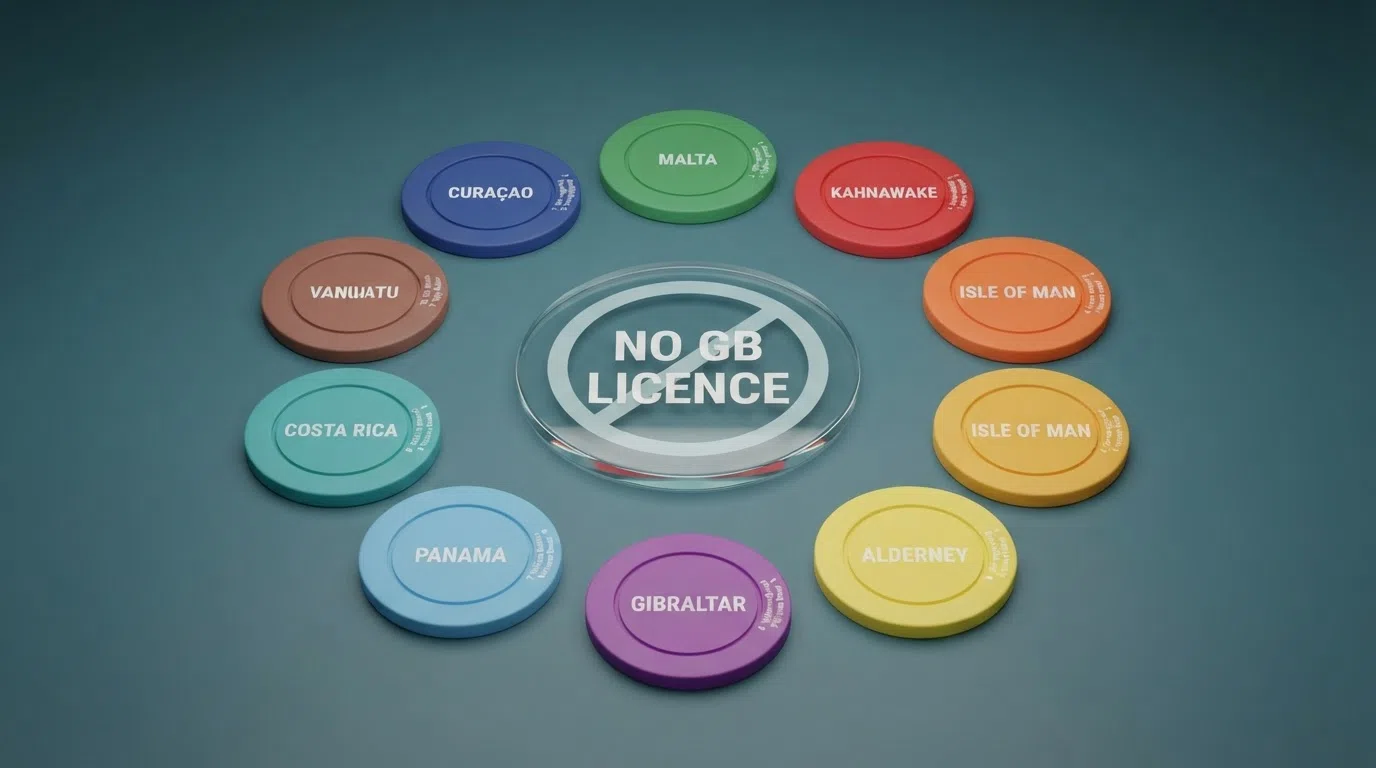
The ten operators below were checked against the Gambling Commission’s public register of operating licences. None of them is on it. Each one is described on the data research could confirm; what research could not confirm is left absent, because a guess about a bonus or a licence jurisdiction is the kind of guess a player ends up paying for. The table that follows is the at-a-glance view; the operator notes beneath it are the substance.
How we compare them: criteria that matter
UKGC standards do not apply, so the comparison is built on the four signals a player can actually verify themselves: licence jurisdiction and whether the regulator is one the player can search, offer terms where the operator discloses them, the payment mix including crypto support, and the operator’s longevity and company transparency. The GB register is searched first for every brand; nothing on this page is on it. The Curaçao Gaming Authority register is then searched by company name, not brand name, and the domain is matched against the authorised-domains list. Anything that does not check out is flagged in the operator note.
At-a-glance comparison table
| Operator | Offshore licence | GB-licensed? |
|---|---|---|
| GQbet | — | No |
| MyStake | Curaçao (reported) | No |
| Rolletto | Curaçao | No |
| Goldenbet | — | No |
| Rollino | — | No |
| DonBet | Curaçao (reported) | No |
| MadCasino | — | No |
| Emperia Casino | Curaçao (Fortuna Games N.V.) | No |
| ZetCasino | — | No |
| CasinOK | Curaçao CGA (Ryker B.V., reported) | No |
GQbet
GQbet is the thinnest profile in the set. Research sourced no bonus data, no game-provider list, and no confirmed licence jurisdiction this run. The site is offshore, it is not on the Gambling Commission’s register, and nothing more concrete can be said about it until its licence is independently confirmed against the relevant regulator’s own portal. That is the right way to treat any brand the data does not cover: as unverified, not as a clean bill of health. A reader who wants to use GQbet should run the four checks set out in the responsible-gambling section before depositing anything.
MyStake
MyStake is reported Curaçao-licensed and carries a confirmed 30× wagering multiplier on its welcome offer. A 30× multiplier is at the bottom of the offshore range rather than the top, which is worth noting because the UKGC ceiling now sits at 10× — a threefold gap on the same mechanic, with no other protection changing underneath. The brand surfaces in enough independent coverage to make the licence claim plausible, but “plausible” is not the same as verified; the CGA register should be checked by company name before any deposit, and the match against the domain confirmed.
Rolletto
Rolletto is the largest welcome package in the featured set: up to £5,500 plus 200 free spins across the first three deposits, with 30× wagering on the bonus. The offer is deposit-triggered, not no-deposit, and the size is the draw. The wagering multiplier is identical to MyStake’s, and the 30× number is now the floor at which a serious offshore offer clears — which tells the reader something about how the offshore market prices its acquisition. The Curaçao licence is reported in independent review coverage; the verification step is the same as for any other Curaçao brand in this list.
Goldenbet
Goldenbet sits in the sports-betting-first cluster with a casino running alongside. No bonus data, no game-provider list, and no confirmed licence jurisdiction were sourced this run. The brand is offshore, it does not appear on the GB register, and the only honest summary is that the casino is the secondary product of a sportsbook. Players drawn to Goldenbet for the casino side should know they are reading a sportsbook with a casino tab, not a casino with a sportsbook tab.
Rollino
Rollino leads with 425 free spins and a reported 9,000+ game library. The catalogue number is at the high end of what any operator on either side of the licence line claims. No wagering multiplier was sourced for the free spins or any deposit bonus, which matters because free-spin terms vary widely offshore — the spin value, the eligible games and the conversion cap are the three things a player needs before a 425-FS headline means anything to them. The licence jurisdiction is unconfirmed this run.
DonBet
DonBet is reported Curaçao-licensed and built around crypto deposits. No bonus amount or wagering multiplier was sourced; the operator’s positioning as crypto-native is the strongest verified claim. Crypto-friendly does not mean anonymous — KYC still applies at withdrawal thresholds on every credible operator — but it does mean the deposit and withdrawal experience is shaped around on-chain payment rather than card rails.
MadCasino
MadCasino accepts six cryptocurrencies (Bitcoin, Ethereum, Litecoin, USDT, DOGE and XRP) alongside e-wallets. The crypto list is unusually wide; the brand is positioning for the player who treats the wallet, not the bank account, as the funding source. No bonus data or independently confirmed licence jurisdiction was sourced this run. The crypto-first framing is the verifiable hook; the rest is absent.
Emperia Casino
Emperia is the newest brand in the featured set with a verifiable launch year (2026), a Curaçao licence held by Fortuna Games N.V., a £3,000 + 325 free spins welcome package across four deposits, and a 12,000+ game catalogue with a Pragmatic Play tournament partnership. That is more verified data than any other operator on the list carries. The package is deposit-triggered, the offer is materially smaller than Rolletto’s, and the catalogue is the largest. The trade-off is the standard offshore trade-off: more game variety, no UKGC protections, a brand with one year of operating history at most.
ZetCasino
ZetCasino is the second-thinnest profile in the set. Offshore, no GB licence, no bonus data, no licence jurisdiction sourced. The brand has been around long enough to appear on multiple affiliate pages, which is a weak signal of operating continuity and nothing more. A reader interested in ZetCasino should treat it as an unverified brand and run the licence check before depositing.
CasinOK
CasinOK launched in 2025, is reported as Curaçao CGA-licensed via Ryker B.V., and is built around crypto. The launch year is recent enough to be both a feature (modern site, current games) and a flag (no long-run payout history). No bonus amount or wagering multiplier was sourced. A new-entrant profile: verify the licence, read the bonus terms, deposit the minimum and test the withdrawal before committing any meaningful bankroll.
Offshore vs UKGC: what the numbers say
The comparison is the most honest thing this page can offer, because the difference is mechanical rather than editorial. At a UKGC-licensed casino the wagering requirement on a bonus is capped at 10×. At Rolletto and MyStake it is 30×. At Goldenbet, DonBet, MadCasino, ZetCasino, Emperia, CasinOK and Rollino the wagering figure is not in the public-facing data at all. A 10× ceiling is the price a UKGC licence has bought the player; a 30× floor is the price the offshore market charges for the same bonus. Stake caps do not exist offshore. The age-banded £5/£2 limit, the spin-speed floor, the autoplay ban, the losses-disguised-as-wins ban, the reverse-withdrawal ban, the mandatory deposit-limit prompt, the financial-vulnerability check at £150 — none of these apply. None of them is opt-in. The trade is not bonus size versus protection; it is one product against another, with the product names written on different sides of the licence line.
The Legal Reality: No UK Licence Means No UK Protections
The offshore market is not illegal in the sense the player fears. No UK player has been prosecuted for using an offshore casino, and there is no realistic prospect of that changing. What is illegal is the operator’s activity under section 33 of the Gambling Act 2005, and the law is enforced against the operator, not the customer. The legal reality that matters to the player is different: the protections British players take for granted are not portable, and the regulator in London has no authority to recover a withheld withdrawal or adjudicate a complaint at a Curaçao-licensed site. The Court of Justice of the European Union confirmed in case C-77/2024 that a gambling licence issued in one jurisdiction provides no defence against prohibitions in another. An MGA licence in Malta is not a defence in GB; a Curaçao licence is not a defence in GB; a Gibraltar licence is not a defence in GB. The point-of-consumption rule is the law of the place where the player sits.

Curaçao-licensed casinos: what the seal actually means
A Curaçao licence is real regulation, not the absence of it. The Curaçao Gaming Authority maintains a public register at portal.cga.cw, and operators are required to display a clickable verification seal linking to that register. The register entry shows the licensed company name, the licence number, the current status and the list of authorised domains. Verification is a four-step process a player can run in under two minutes: search by company name (not brand name), match the domain to the authorised-domains list, confirm the status is current, and cross-check the licence number against the seal on the site. The seal at the bottom of the page is not decoration. It is a hyperlink that should resolve to a register entry that names the company that owns the site.
What the CGA register does not provide is UK consumer protection. There is no ADR provider a British player can compel into a binding decision. There is no fund-segregation requirement equivalent to the LCCP. There is no Commission complaints route. The licence is a regulatory floor; the GB licence is a regulatory ceiling. Both are real, and they cover very different ground.
Malta, Anjouan and other licensing jurisdictions
The Malta Gaming Authority is the most established of the offshore regulators, with a longer enforcement history and a more developed player-complaints process than the alternatives. Anjouan has emerged as a lower-cost jurisdiction in recent years, with a lighter compliance load and a smaller public register. Costa Rica does not licence online gambling at all; operators based there typically hold a data-processing permit and operate without a gambling-specific licence. The CJEU’s 2024 ruling is the legal backdrop to all of them: a licence in one Member State provides no cross-border protection, and the same logic applies — more sharply — to licences issued outside the EU. None of these jurisdictions substitutes for a UKGC licence for a British player. Some of them substitute better than others, and the difference is in the strength of the regulator’s own consumer-protection machinery, not in any portability of the licence itself.
UKGC-registered casinos: the regulated route
The Gambling Commission publishes a single public register at gamblingcommission.gov.uk, and that register is the only place a GB licence claim can be verified. The licensing objectives set out in section 1 of the Gambling Act 2005 frame the regulator’s work: preventing gambling from being a source of crime, ensuring it is conducted fairly and openly, and protecting children and other vulnerable persons. The product rules follow from those objectives. The age-banded stake cap is a child-and-vulnerable-person protection. The autoplay ban and the 2.5-second spin-speed floor are fair-and-open protections. The mandatory financial-vulnerability check at £150 in 30 days is a vulnerable-person protection. The 10× wagering cap is, in regulatory language, a fair-and-open protection. The LCCP is the document that turns those objectives into operating conditions. It is the reason a UKGC site looks and feels the way it does, and it is the entire reason a non-UK site does not.
Gamban, BetBlocker and GamStop: self-exclusion tools compared
GAMSTOP is the most familiar tool and the one with the sharpest limits. It is licence-bound, online-only, and cannot reach an operator that does not hold a GB licence. An excluded player using an offshore site is unprotected by GAMSTOP and there is nothing the scheme can do about it. Gamban is different: it operates at device level and blocks thousands of gambling sites and apps worldwide, including offshore ones. It is free for UK residents via GamCare and TalkBanStop, and it works across operating systems. BetBlocker is also free, with scheduling features and no expiry. TalkBanStop layers all three — GamCare emotional support, GAMSTOP self-exclusion, Gamban device blocking — and the independent evaluation published in June 2026 found that combining the three produced stronger gambling-behaviour outcomes than using any single tool alone. The distinction matters on this page because GAMSTOP alone does nothing at an offshore casino, and a player who relies on it as their only line of defence is relying on a tool that cannot reach the site they are using.
“Licensed and registered”: what the terms actually mean in practice
The word “licensed” on a casino footer is a marketing claim until it is checked. The check is a five-second visit to the relevant regulator’s register. The CGA register, the MGA register, the Anjouan register, the UKGC register — each one is searchable by company name, and each one tells the player what the licence actually covers. The three things a real regulator provides, regardless of jurisdiction, are alternative dispute resolution, fund segregation and enforcement power. ADR is the route a player can take when a withdrawal is withheld. Fund segregation is the rule that keeps customer balances separate from operating capital. Enforcement is the regulator’s ability to act against a licensee that breaks its rules. The UKGC provides all three with British consumer-redress reach. The CGA provides the first two with materially weaker scope. Some Anjouan-licensed operators provide neither. “Licensed” is the word on the page; the register entry is what the word means.
Getting Money In and Out When GamStop Isn’t in the Picture
The payment landscape at offshore casinos is the part of the offer UKGC-licensed sites cannot match, and the part that comes with the most caveats. The same freedom that lets a Curaçao-licensed operator accept credit cards, crypto and a wider e-wallet mix is the freedom that lets a player fund an account in ways the British regulator has ruled too risky for the GB-licensed market. The decision to use those methods is a decision to step outside the protections the regulator built around them.
Key Payment Methods
| Method | Availability | Typical Speed | Key Feature |
|---|---|---|---|
| Crypto | High | Minutes | Traceability/Speed |
| E-wallets | Medium | Near-instant | Familiarity |
| Bank Cards | Widely Available | 3-5 Business Days | Direct Transfers |
PayPal casinos without GamStop
PayPal is the method British players search for by name, and its availability at offshore casinos is uneven. Many offshore operators route payments through Skrill, Neteller or MiFinity instead, which are e-wallets that UKGC sites still accept but which PayPal itself has pulled from UK-facing gambling in past years. The credit-card-via-e-wallet ban that has applied at UKGC sites since 14 April 2020 does not extend offshore, and an offshore casino can accept a credit-card-funded PayPal deposit that a UKGC site would have to refuse. PayPal’s own buyer protection does not extend to gambling transactions regardless of where the merchant is licensed. The combination of those two facts is the entire reason a careful player reads the deposit-methods page before funding an account.
Boku and pay-by-mobile options
Pay-by-mobile deposits let a player fund an account by charging the deposit to a mobile phone bill or to a prepaid balance, with Boku as the most common carrier. The method is available at selected non-GamStop casinos, and the friction is the point: a small, capped deposit that does not require a card or a wallet. The typical caps are lower than card or crypto methods, which is both the appeal and the limit. A player who wants to deposit £200 in one go will not get there by mobile. A player who wants to deposit £30 on a Friday night without touching a bank card is exactly the use case the method was built for.
Crypto as the dominant offshore payment method
Offshore casinos are built for crypto in a way UKGC sites are not. Bitcoin, Ethereum, USDT, Litecoin, DOGE and XRP all appear at one or more operators in the featured set. Crypto deposits clear in minutes, crypto withdrawals clear in minutes, and there is no chargeback mechanism once a transaction is on-chain — the payment is final, the same way cash is final. The anonymity is partial. KYC still applies at withdrawal thresholds on every credible operator in the set, and the wallet address is recorded against the player account. The deal the player is making is speed and finality for traceability. There is no recourse to a chargeback if the operator withholds a withdrawal. There is also no chargeback fraud for the operator to defend against, which is part of why crypto-friendly casinos are willing to clear withdrawals faster.
Deposit speed and withdrawal timelines
Crypto deposits clear in minutes. E-wallet deposits are near-instant. Card deposits are standard, with the usual bank-side delay. Withdrawal timelines are operator-dependent and rarely sourced with precision; the time-to-payout figures affiliate pages quote are aspirational until they are checked against player-forum data. The single piece of advice this section can offer is the one that applies to every offshore site in the featured set: deposit the minimum, request a withdrawal before committing meaningful play, and treat any unverified payout-speed claim as the marketing word it is.
The Same Games Without the UKGC Handcuffs
The games are the same titles. The rules governing how a player plays them are not. Pragmatic Play, NetEnt, Evolution, Hacksaw Gaming, NoLimit City, Playson and Yggdrasil all appear across the licence line; the difference is in what the operator is allowed to wrap around them.
Slot sites and online slots without GamStop
Slot catalogues at the featured operators range from unreported to 12,000+ titles, with Emperia at the top end and Rollino at 9,000+. RTP and volatility data are rarely published by offshore operators and were not consistently sourced this run. The honest version of the claim is that offshore casinos tend to carry a wider catalogue than UKGC sites, and the player who wants a specific niche title is more likely to find it offshore. The corollary is that the data a careful player relies on to choose a slot — the RTP, the volatility band, the max win — is often absent, and the player is choosing by theme and provider rather than by numbers. Bonus Buy slots, which UKGC sites have restricted, are available offshore without the same constraint. The same is true of the autoplay feature, the fast-spin mode, and the turbo mode that the 2.5-second spin-speed floor prohibits in GB.
Live dealer casinos outside UK regulation
Evolution and Pragmatic Play Live supply the live-dealer games at offshore casinos and at UKGC sites. The studio the feed comes from may differ between the two — providers run separate studios for regulated and less-regulated markets, and the game catalogue is not identical. The fairness guarantee is provider-side, not operator-side: the live game runs on the provider’s own platform and the player bets through the casino. That separation is the reason a live-dealer game at an offshore casino can still be a fair game. It is also the reason the regulatory oversight of the live studio is governed by the provider’s own licence rather than the casino’s, and a player who wants to check the live-dealer compliance chain is checking the provider, not the casino.
Game providers available on non-GamStop platforms
Pragmatic Play is the strongest verifiable link on this page, through the tournament partnership at Emperia Casino. Evolution is the dominant live-dealer provider on both sides of the licence line. NetEnt, NoLimit City, Hacksaw Gaming and Playson are commonly cited at non-GamStop casinos, but provider lists were not consistently reported in the data this run, and a player who wants a specific studio’s games should check the lobby before depositing rather than rely on a review-page claim. The pattern across the affiliate market is that provider breadth is asserted more often than it is verified, and a 12,000-game headline is rarely broken down by studio.
What’s different: autoplay, Bonus Buy and features UK players lost
The product differences are mechanical and traceable. Autoplay has been banned at UKGC sites since 31 October 2021, the same date that brought the 2.5-second spin-speed floor, the ban on losses disguised as wins, the permanent ban on reverse withdrawals, and the requirement that operators display total losses and time played during a slots session. Bonus Buy slots have been restricted at UKGC sites on a provider-by-provider basis. None of these restrictions apply offshore. A player who left the UK market in 2021 and returned in 2026 would find a UKGC slot lobby materially quieter than the one they remember, and an offshore slot lobby materially closer to the pre-2021 experience. The product difference is real, and the protection difference is the price of the product.
How to Separate a Safe Offshore Casino from a Risky One
A non-UK casino is not unsafe in a way the player can detect by feel. The site can look professional, pay out small withdrawals on time, and run for years before a single withheld payout reveals what it was. The job of the careful player is to run the four checks the regulator would have run for them, before the deposit, while the operator still has an incentive to be on best behaviour.
Safety and reputation signals to check
The first check is the licence. Search the relevant regulator’s register by company name, not brand name; match the domain to the authorised-domains list; confirm the licence status is current; cross-check the licence number against the seal on the site. The second check is the company. The operator should disclose a registered company name, a registration number, and a physical address — and those details should resolve to a real entity on the relevant corporate registry. The third check is the player forums. Search by brand name and look for patterns of withheld withdrawals rather than single complaints; one complaint is a customer-service issue, ten complaints over a year is a payout-policy issue. The fourth check is the test withdrawal. Deposit the minimum, request a withdrawal before committing real play, and time the operator on the round trip. A casino that pays the test withdrawal quickly is a casino worth using at higher stakes. A casino that delays, conditions or invents reasons is a casino to leave before the first big win.
Trusted vs untrusted operators: the signals that separate them
Operator longevity is a weak but usable signal. The two newest brands in the featured set — Emperia and CasinOK — launched in 2025 and 2026 respectively, which is too short a window to judge a payout policy by. The other eight carry more years of operating history, which is not the same as a track record of paying out but is at least a track record of existing. Transparent company structure beats opaque ownership every time; an operator that publishes its corporate registration, its licence details and its complaints procedure is one that has decided the player can find those things anyway. Responsive customer support is a proxy for operational health: a casino that answers pre-deposit questions within hours is a casino that has staff, and a casino that has staff is a casino that has process. The strongest negative signal is the withdrawal-complaint pattern, and the strongest positive signal is the test withdrawal the player runs on day one.
Mobile compatibility as a selection factor
A casino that works poorly on a phone is one most British players will never use. The baseline at offshore casinos is mobile-browser compatibility, with no app download required. Dedicated apps are rare offshore and the affiliate pages rarely specify one. Game-load speed, lobby navigation, and the deposit flow on a phone are the three things a player should test before funding an account, because the most common reason a player abandons an offshore site within the first week is that the mobile experience is poor, and the most common reason a player stays is that the mobile experience is good. The test takes five minutes and saves a wasted deposit.
Seven-point evaluation checklist before you deposit
- Verify the licence on the regulator’s own register, by company name, not brand name.
- Confirm the operator’s domain is on the authorised-domains list of the licence record.
- Check for a published company name, registration number and physical address that resolve to a real entity.
- Search player forums for withdrawal complaints by brand name, and look for patterns rather than single incidents.
- Confirm the deposit and withdrawal methods, including the minimums, the fees and the per-transaction caps.
- Test customer support with a pre-deposit question, and time the response.
- Set a personal deposit limit in your own banking app or crypto wallet before the first transfer.
New Non-UK Casinos: Fresh Choice or Fresh Risk?
New offshore casinos launch every month. A fresh bonus and a modern site are not the same as a safe operator, and the data a player would normally have — payout history, player-forum record, complaint patterns — does not yet exist. The deposit the player makes is the data point the operator uses to decide whether it is going to pay out.
Newest non-GamStop casinos for 2026
Two operators in the featured set launched within the last eighteen months. Emperia Casino launched in 2026 under a Curaçao licence held by Fortuna Games N.V., with a 12,000+ game catalogue and a Pragmatic Play tournament partnership. CasinOK launched in 2025 under a reported Curaçao CGA licence via Ryker B.V., with a crypto-friendly payment mix. Both are too new for a track record. Both carry the standard new-entrant trade: a modern site with current games, a short operating history, and a licence that has not yet been tested against a large withdrawal complaint.
What to watch for with newly launched operators
A new casino has no payout history, no forum record, and no pattern a player can check. The licence may be provisional, the bonus terms may change as the operator finds its economics, and the customer-support operation may still be staffing up. None of those is a reason to avoid a new casino on its own. They are reasons to start with the minimum deposit, to test the withdrawal process early, and to escalate in steps rather than committing the full bankroll on day one. A new casino that pays the first three withdrawals quickly is one worth using further. A new casino that delays the first withdrawal is one to leave.
Evaluating a brand-new site before depositing
The first step is the licence check, run against the relevant regulator’s own register. The second step is the bonus terms, read in full — the wagering multiplier, the game-weighting table, the maximum bet during wagering, the maximum cashout cap on free-spin winnings. The third step is the test withdrawal, made before any meaningful play, on the minimum deposit. A new casino that survives the three steps has earned a larger deposit. A new casino that fails any of them has earned a closed account.
Responsible Gambling When the UK Safety Net Isn’t There
The British responsible-gambling infrastructure is real, it is large, and it does not reach an offshore casino. The 0.4 per cent of British adults who are problem gamblers (PGSI 8+) and the 1.6 per cent at moderate risk or above (PGSI 3+) are not a separate population; they are a cross-section of the same population that includes the reader of this page. The men-to-women split is 2.9 per cent versus 0.4 per cent at moderate risk or above, on NHS England’s Adult Psychiatric Morbidity Survey 2023–24 figures. The National Gambling Support Network treated 11,960 clients in 2024–25, an 11 per cent year-on-year increase, with 93 per cent of those completing treatment showing improvement. GamCare’s National Gambling Helpline took 55,228 contacts in 2023–24, a 25 per cent year-on-year increase, and made 996 referrals to treatment in January 2026 alone, a 48 per cent year-on-year jump. The infrastructure is being used at scale, and the offshore market is the place where the infrastructure does the least of its work.
Self-exclusion tools beyond GamStop: Gamban, BetBlocker and TalkBanStop
GAMSTOP is the line of defence British players know best, and it is the one that does not work on this page. It is licence-bound, online-only, and incapable of reaching an offshore site. The two tools that do reach offshore sites are Gamban and BetBlocker. Gamban is device-level software that blocks thousands of gambling sites and apps worldwide, including offshore ones, and is free for UK residents through GamCare and TalkBanStop. BetBlocker is also free, with scheduling features and no expiry. TalkBanStop combines Gamban and GAMSTOP with GamCare’s emotional-support service, and the independent evaluation published in June 2026 confirmed that combining the three produces stronger outcomes than any single tool alone. A player who needs to stop gambling and is using offshore sites is not without options. They are without GAMSTOP, which is different.
Setting deposit and session limits on offshore sites
UKGC sites must prompt a player to set a financial limit before the first deposit, must action a decrease immediately, and must offer a gross deposit limit at equal prominence. Offshore sites carry no such requirement, and the limit-setting the player does is self-managed. The honest version of the situation: a player who funds an account at an offshore casino is the limit-setting mechanism, and the limit needs to be set before the first deposit rather than after. The hard backstop is the limit set in the player’s own banking app or crypto wallet — a deposit cap that the casino cannot override, because the funds never reach the casino in the first place. Reality-check and time-out features are not guaranteed offshore, and a player who relies on them is relying on a tool the operator may not provide.
Signs of problem gambling and where to get help
The signs are well-documented and worth stating plainly. Chasing losses, hiding gambling activity, spending beyond means, lying about time spent, and borrowing to fund play are the patterns that mark a transition from recreational to problematic gambling. The support infrastructure is large and free.
- The National Gambling Helpline is 0808 8020 133, operated by GamCare, available 24 hours a day, 7 days a week, free and confidential, with live chat and WhatsApp access.
- The National Gambling Support Network provides structured treatment through regional providers across England, Scotland and Wales.
- NHS gambling harm clinics offer specialist treatment within the NHS in all three nations.
- Gamblers Anonymous runs peer-support meetings in person and online.
- TalkBanStop is the layered self-exclusion and emotional-support partnership that the June 2026 evaluation found produced stronger outcomes than any single measure alone.
How We Evaluated Every Non-UK Casino on This List
The ranking is built on the data research could confirm, ordered by licence transparency first and offer substance second. The Gambling Commission’s public register at gamblingcommission.gov.uk was searched for every brand; none of the ten is on it, and the absence is the precondition for inclusion. The Curaçao Gaming Authority register at portal.cga.cw was searched by company name for every brand reported as Curaçao-licensed, with the domain matched to the authorised-domains list. Where a brand is reported as Curaçao-licensed without an independent register match, the licence is flagged as reported rather than confirmed. Where research could not source a bonus, a wagering multiplier, a game-provider list or a payment detail, the field is left absent. A missing field is information. The reader learns that the operator does not publish the data, and the reader can decide what to do with that.
The criteria, in order, are: licence jurisdiction and verifiability; offer terms where disclosed; payment mix and crypto support; game breadth where reported; operator longevity and company transparency. The ranking is qualitative rather than scored. No composite score, no weighted average, no league table that pretends a 30× wagering multiplier is comparable to a 12,000-game catalogue. The reader runs their own weighting, and the data on the page is what they weigh.
Your Next Move: Protection, Not Just a Bonus
The offshore market exists because UK regulation has tightened. The age-banded stake cap, the 10× wagering ceiling, the autoplay and spin-speed rules, the losses-disguised-as-wins ban, the reverse-withdrawal ban, the financial-vulnerability check at £150, the mandatory deposit-limit prompt, the credit-card ban — each of these is a protection the player has and each of these is a feature the offshore market does not impose. The trade is not bonus size versus protection. The trade is the entire product on one side of the licence line versus the entire product on the other.
The tools to protect a player offshore exist. Gamban and BetBlocker reach the sites GAMSTOP cannot. Licence verification against the regulator’s own register takes two minutes. A personal deposit limit set in the player’s own banking app or crypto wallet is a backstop the casino cannot override. The TalkBanStop evaluation confirmed that combining self-exclusion, blocking and emotional support produces stronger outcomes than any single measure alone. None of these tools is automatic. All of them require the player to use them.
The reader who has run the arithmetic in this page — the 10× versus 30× wagering gap, the £5/£2 stake cap that does not exist offshore, the absence of fund segregation, the absence of ADR, the absence of a Commission complaints route — does not need this page to tell them what to do. The reader who has decided to play offshore despite the arithmetic needs the verification checklist, the responsible-gambling tools, and the helpline number. Both readers have what they need in the section above. The page picks no operator for either of them.
FAQ
Are non-UK registered casinos legal for British players to use?
Using an offshore casino from Great Britain is not a criminal offence. No UK player has been prosecuted for gambling on a non-UK-licensed site. The legal risk under section 33 of the Gambling Act 2005 sits with the operator, not the player. What the player loses is the entire UKGC protection package — GAMSTOP coverage, ADR access, fund-segregation requirements, the Commission complaints route, and British consumer redress if a withdrawal is withheld.
What protections do I lose by playing at a casino without a UKGC licence?
Every UKGC protection ceases to apply the moment a deposit is made at a non-UK site. There is no GAMSTOP coverage, no ADR provider a British player can compel, no fund-segregation requirement, no Commission complaints route, no stake cap (£5 for 25+ and £2 for 18–24 in GB), no 10× wagering ceiling, no autoplay ban, no 2.5-second spin-speed floor, no ban on losses disguised as wins, no reverse-withdrawal ban, no mandatory deposit-limit prompt, and no financial-vulnerability check at £150. The protections are a package, not a menu.
What licence do most non GamStop casinos hold, and how do I verify it?
Most operators in this category hold a Curaçao licence, with a smaller number licensed in Malta, Anjouan or other jurisdictions. Verification is a four-step process against the relevant regulator’s own register. For Curaçao, search portal.cga.cw by company name (not brand name), match the domain to the authorised-domains list, confirm the status is current, and cross-check the licence number against the seal on the site. For Malta, the MGA register at mga.org.mt works the same way. A seal at the bottom of a casino page is only as reliable as the register entry it links to.
Can I use PayPal or crypto to deposit at non-UK casinos?
Yes to both, with caveats. PayPal availability at offshore casinos is uneven, and many operators route through Skrill, Neteller or MiFinity instead. PayPal’s buyer protection does not extend to gambling transactions. Crypto is the dominant offshore payment method: Bitcoin, Ethereum, USDT, Litecoin, DOGE and XRP all appear at one or more featured operators, with deposits clearing in minutes and no chargeback mechanism once a transaction is on-chain. KYC still applies at withdrawal thresholds on every credible offshore operator, and crypto is not anonymous at the cashout point.
Do non GamStop casinos offer the same slots and live dealer games as UK sites?
The same providers — Pragmatic Play, NetEnt, Evolution, Hacksaw Gaming, NoLimit City, Playson, Yggdrasil — supply both sides of the licence line, and the game titles overlap heavily. Offshore catalogues tend to be larger (Emperia at 12,000+ and Rollino at 9,000+ are the verifiable numbers this run), and offshore sites can offer features UKGC sites cannot — autoplay, Bonus Buy, fast spin, turbo mode. The live-dealer experience is provider-side, and the studio the feed comes from may differ between the regulated and offshore markets. Game fairness is provider-guaranteed; regulatory oversight is not.
How do wagering requirements at non GamStop casinos compare to UKGC-licensed sites?
The gap is threefold at the verified end. UKGC wagering requirements are hard-capped at 10× since 19 December 2025. The two offshore operators in the featured set with sourced wagering data — Rolletto and MyStake — both sit at 30×. The other eight do not publish their wagering multipliers in the data research could verify. A 30× requirement is roughly three times the GB ceiling, with no UKGC protection changing underneath to compensate. The headline bonus size is the trade the offshore market offers, and the wagering multiplier is what the headline actually costs.
Are my winnings taxed if I play at an offshore casino from the UK?
No. The player pays no tax on gambling winnings in the UK, regardless of where the operator is licensed. The operator pays Remote Gaming Duty — which rose from 21 per cent to 40 per cent from 1 April 2026, announced at the Autumn Budget 2025, applying to accounting periods beginning on or after that date. The tax status of the winnings does not change based on the operator’s licence jurisdiction, and a player who wins at a Curaçao-licensed site is in the same tax position as a player who wins at a UKGC-licensed one. The differences that matter are at the withdrawal stage, not the tax stage.
Account – nonukgc-licensedcasinos
Content created by the «nonukgc-licensedcasinos» team