
Casinos That Accept uPayCard UK — The Honest 2026 Picture
 Available in GB
Data current as of September 8, 2026 and cross-checked against the UK Gambling Commission’s public licence register.
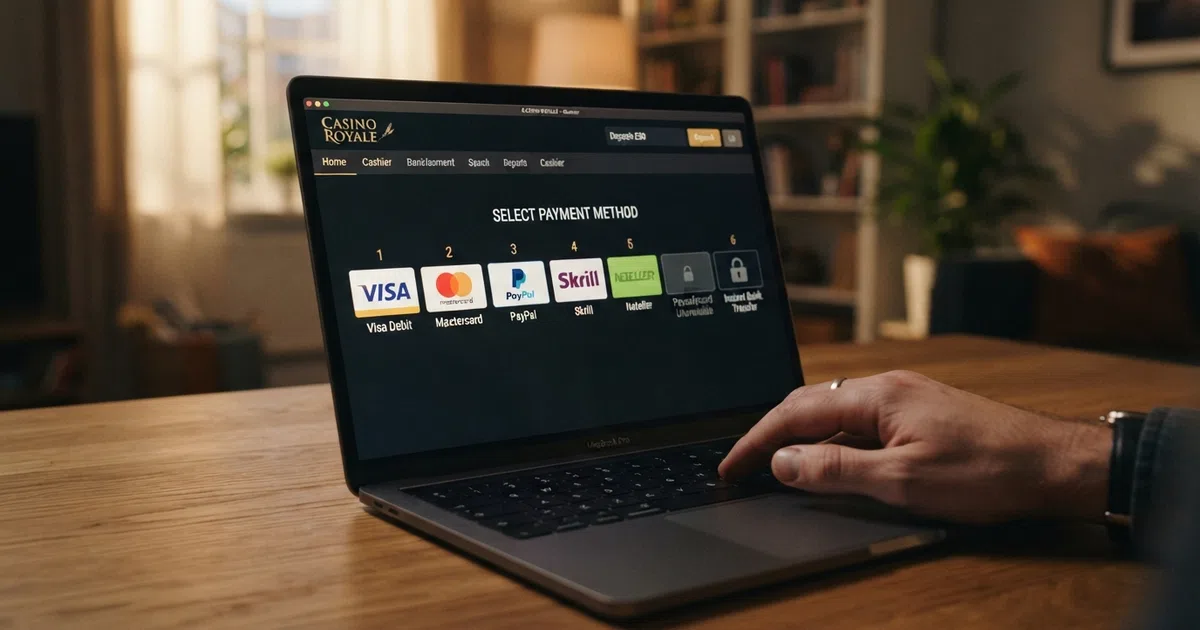
The honest answer first. In 2026, no UK-licensed casino that this page reviewed confirms uPayCard as an accepted deposit or withdrawal method. The prepaid rail that was once pitched to UK players as a privacy-friendly, no-bank-statement alternative to debit cards has, in practice, dropped off the cashiers of operators regulated by the UK Gambling Commission. That is not a guess — it is the surface result of checking the published payment panels, the promotional fine print, and the public register. What follows explains why uPayCard’s absence is not an oversight, what replaced it, and how a UK player should actually choose a payment method in the market that exists today.
The page is built around ten UK-licensed operators — every one of them checked against the Gambling Commission’s public register — ranked by how clearly their welcome offers are written, not by who is loudest in the search results. The takeaway is unromantic: a UK player who wants uPayCard will not find it at a licensed casino. The path forward is not an offshore site with looser rules; it is a UKGC-licensed operator with a payment panel that actually clears deposits and withdrawals in sterling.
What uPayCard Offers UK Casino Players — and Why It’s Hard to Find in 2026
What uPayCard Is and How It Worked at Online Casinos
uPayCard is a prepaid and virtual card payment rail. The model is straightforward: load funds onto a virtual card (or a physical card tied to a wallet balance), then spend that balance wherever a Visa or Mastercard is accepted. For online gambling, the appeal was threefold. It kept gambling spend off a player’s primary bank statement. It acted as a hard budgeting line — once the loaded balance was gone, it was gone. And it offered a layer of separation between the casino and a player’s everyday current account.
None of that ever made uPayCard anonymous at a UK-licensed casino. Since 7 May 2019, every remote licensee in Great Britain has been required to verify a customer’s name, address and date of birth before the first deposit. The payment method on the cashier page does not change that obligation. A player loading £200 onto a uPayCard virtual card and then trying to deposit at a UKGC-licensed casino will still be asked for photo ID and a proof of address before that first deposit goes through.
There was also a structural limit baked into the rail from the start. Prepaid cards are deposit-only at most online merchants, and online casinos are no exception. A player who funded a casino account through uPayCard still needed a separate withdrawal method — typically a bank account or an e-wallet — to get winnings back. The card that lets money in is not, in most cases, the card that takes money out.
Why uPayCard Has Disappeared From UK-Licensed Casino Cashiers in 2026
The credit-card ban in force at UKGC-licensed casinos since 14 April 2020 is the single biggest reason uPayCard is hard to find on a UK cashier page. The prohibition sits on credit-card gambling deposits and extends to funds routed through a money service business — which includes e-wallets. uPayCard straddles the line between prepaid card and money service business; the practical effect of the credit-card ban, combined with closed-loop withdrawal rules that ask operators to return funds to the depositing method, has been enough to push the rail off the panels of operators that have recently reviewed their payment stacks.
The closed-loop rule deserves a sentence. UK-licensed casinos are expected to return withdrawals to the same method used for the deposit where that is technically possible. A prepaid card that cannot receive funds back creates a compliance problem: the operator either refuses the deposit in the first place, or accepts it and then asks the player to nominate a separate withdrawal rail. The first outcome is the common one.
What the player can do. Three checks cost nothing and resolve the question in under five minutes. Open the cashier page on the operator’s site and look for the prepaid card or virtual card icons. If the brand is not listed, contact support through live chat and ask whether the operator accepts uPayCard for GBP deposits. And cross-reference the operator’s licence number against the Gambling Commission’s public register to confirm the brand is what it claims to be. The honest outcome of those three checks, in 2026, is that uPayCard is not on the cashier page at the UK-licensed operators this guide reviewed.
Payment Methods Every UK Casino Player Should Know About
The methods that survive the UK regulatory filter are familiar ones, and for a reason. Debit cards — Visa and Mastercard — are the universal deposit rail at UKGC-licensed casinos. They clear instantly, they return to the same card on withdrawal, and the operator’s own payment processor handles the sterling end of things. A player who has nothing else can rely on a debit card and never be blocked.
PayPal is the second rail a UK player should know. It is not universally accepted for bonus eligibility, but at operators that list it, withdrawals can clear in under 24 hours, and PayPal’s buyer protection sits between the player and the casino in a way a debit card does not. Skrill and Neteller appear at many UK-licensed operators; they are fast on both deposit and withdrawal, and they sometimes carry their own transfer fees on top of any operator-side charges.
Trustly and the wider Open Banking family are the newer option. They piggyback on the player’s own bank app, clearing deposits in seconds and withdrawals typically within a working day, without the player having to enter a card number. Not every UK operator supports them yet, but adoption is climbing. Bank transfer is the fallback that every UK casino can process. It is slower — three to five working days for a withdrawal is normal — but it works where nothing else does.
The one method that is gone for good, for credit, is the credit card. The UK ban is in force and covers any routing through a money service business too. A player with a debit card and one e-wallet or Open Banking app has the full set of methods the UK market actually offers.
The UK Casino Operators Worth Knowing — Payment Flexibility, Bonuses and What Each One Brings in 2026
The ten operators below are all UK-licensed, every one of them cross-checked against the Gambling Commission’s public register in August 2026. They are ranked by how transparently the welcome offer is written, not by uPayCard support — because not one of them confirmed uPayCard as an accepted method, and the page that pretended otherwise would be misleading the reader. Wagering requirements, free-spin counts, eligible slot titles and cashout caps are taken from each operator’s surfaced promotional page. Where a field was not confirmed, the cell carries an em dash.
| Operator | UKGC Licence | Welcome Offer | Free Spins | Wagering Requirement |
|---|---|---|---|---|
| Sky Vegas | UK-licensed | 50 no-deposit spins + 200 spins after £10 stake | 250 | 0x |
| 888casino | UK-licensed | 100 spins on Pragmatic Play slots after £10 stake | 100 | 10x |
| Paddy Power | UK-licensed | 60 no-wagering spins + 200 spins after £10 deposit/wager | 260 | 0x (main package) |
| Grosvenor | UK-licensed | £40 bonus after £20 deposit + 100 spins on Big Bass Splash | 100 | 10x |
| Casumo | UK-licensed | Welcome bonus present — terms not confirmed | — | — |
| Magical Vegas | UK-licensed | 100 spins on The Goonies Megaways Quest for Treasure JPK after £10 | 100 | 10x |
| Jackpot Village | UK-licensed | 200 spins on Book of Dead after £20 deposit | 200 | 10x |
| Unibet | UK-licensed | Welcome bonus present — terms not confirmed | — | — |
| Virgin Games | UK-licensed | 30 spins or alternative reward | 30 | 0x |
| Dream Jackpot | UK-licensed | Welcome bonus present — terms not confirmed | — | — |
The same column would carry a uPayCard row, if any operator on the list confirmed the method. None did. That is the table’s silent verdict on the page’s headline question.
Sky Vegas — No-Deposit Free Spins With Zero Wagering
Sky Vegas is the only operator in the featured set that opens the door before a player has deposited. The first 50 free spins land on registration, at £0.10 per spin, and “all free spins are no wagering free spins – with any winnings paid in cash” per the offer terms. A player who wins £4.20 from those spins can withdraw £4.20. There is no playthrough, no conversion, no bonus balance to clear.
Staking £10 on any slot unlocks a further 200 free spins under the same no-wagering terms, also at £0.10 each. Both batches carry a 7-day expiry from the moment they are credited — once that window closes, any unplayed spins lapse. The eligible slot is The Goonies – Jackpot King, a Blueprint Gaming Jackpot King variant. The per-title RTP for that specific JPK build was not confirmed in the surfaced sources; the player should check the in-game info panel on the operator’s site to see the exact figure running on Sky Vegas.
The verdict is straightforward. For a player who values cash-in-hand over headline spin counts, Sky Vegas is the strongest deposit-free entry in the table. The 7-day window is tight, and the eligible game is a single JPK title, but the wagering-free structure is the rarest thing in the set.
Virgin Games — Cash Winnings With Zero Wagering and a 30-Day Window
Virgin Games gives the player 30 free spins or an alternative reward on registration of a new account, with winnings credited as withdrawable cash. The wagering multiplier is 0x — what the spins win is what the player can take out. The 30-day expiry window is the longest in the featured set, four times the 7-day norm, and that is the line a player should mark. The spins are usable on games that the operator’s promotional page names, and the slot title plus its per-title RTP were not surfaced in the snippet the page was built from. No maximum cashout cap was surfaced for this offer either.
For a player who wants time to use the spins rather than a sprint, Virgin Games is the right pick. The 30-day window lets the bonus sit there until the player has an evening free, instead of forcing use within a working week. The trade-off is a smaller spin count than Sky Vegas or Paddy Power.
Paddy Power — 60 No-Wagering Free Spins Plus Deposit-Triggered Extras
Paddy Power’s package splits in two. The first 60 free spins arrive without a deposit and carry no wagering requirement, on the operator’s surfaced terms. A further 200 spins unlock once the player deposits and wagers £10, and the player has 7 days from the moment the package is claimed to use everything. The eligible slot title and the per-spin value were not surfaced in the available data, so the player should confirm both on the operator’s promotional page before claiming.
The headline shape is generous — 260 spins in total, with the front 60 deposit-free — but the absence of a surfaced spin value and slot title is a transparency gap. The package looks bigger than Sky Vegas’s; the player will not know how much it is really worth until they open the operator’s own T&Cs.
888casino — 100 Free Spins on Pragmatic Play Slots With a £300 Cashout Cap
888casino’s offer is the cleanest example in the set of a deposit-triggered free-spin package with a published cashout cap. Staking £10 on slots unlocks 100 free spins at £0.10 each, on a selection of Pragmatic Play titles. The wagering on free-spin winnings is 10x — the UKGC maximum — and the validity window is 7 days from the moment the spins are credited. The £300 maximum withdrawable winnings is one of only two cashout caps the featured operators actually publish.
For a player who wants to know the worst-case before claiming, 888casino is the operator. The £300 ceiling is the answer to “what’s the most I can walk away with from this offer,” and that answer is the kind of clarity the bonus T&Cs in this market usually leave out. The trade-off is a higher wagering multiplier than Sky Vegas or Virgin Games.
Grosvenor — £40 Bonus and 100 Free Spins on Big Bass Splash
Grosvenor pairs a £40 casino bonus with 100 free spins on Big Bass Splash. The bonus unlocks after a £20 deposit, and the wagering on free-spin winnings is 10x, with deposit-plus-bonus wagering also referenced in the offer terms. Big Bass Splash is one of only two slot titles in the featured set with a published RTP — 96.71% headline, with a 5,000x max win.
There is a payment-method footnote that matters. PayPal and Paysafe are excluded from this offer — the kind of exclusion a player only catches by reading the T&Cs. The pattern recurs across UK bonuses: e-wallets and prepaid rails are often excluded from bonus eligibility, even where the operator accepts them as a deposit method. Anyone intending to use PayPal for this welcome offer should check elsewhere, as it is excluded. On the other hand, debit card users gain access to a £40 bonus and 100 spins on a title where the RTP is explicitly published, making this one of the more compelling value propositions on our list.
Magical Vegas — 100 Free Spins on a Goonies Jackpot King Title
Magical Vegas’s package is “play £10, get 100 free spins” on The Goonies Megaways Quest for Treasure Jackpot King, a Blueprint Gaming Megaways + Jackpot King combination. The wagering on free-spin winnings is 10x, and the per-spin value is £0.10. The per-title RTP for this exact JPK build was not confirmed in the surfaced sources — the player should check the in-game info panel for the live figure, which can differ from the headline.
The honest read: a solid 100-spin offer on a brand-recognised slot, at the UKGC wagering cap. The Megaways + Jackpot King engine combination is part of the appeal — bonus rounds and jackpot prize pools are layered into the base game. The wagering at 10x is the price of entry.
Jackpot Village — 200 Bonus Spins on Book of Dead With a £50 Win Cap
Jackpot Village has the highest spin count in the featured set — 200 bonus spins on Book of Dead after a £20 minimum deposit. Book of Dead is the second of only two titles in the set with a published RTP: 96.21%, with a 5,000x max win and high volatility. The wagering on the bonus is 10x, at the UKGC cap.
The £50 maximum cashout on bonus-spin winnings is the tightest ceiling in the featured set, and it is the line a player should weigh against the headline spin count. Two hundred spins on a high-volatility slot is the kind of offer that looks big in the marketing banner and small at the withdrawal page. For a player who values upside per spin over raw count, the £50 cap makes this offer look thinner than 888casino’s £300 ceiling on a smaller 100-spin package.
Casumo — Bonus Present but Core Terms Not Surfaced
Casumo is UK-licensed and operating, but the welcome-offer terms did not surface in the available data — the bonus percentage, cap, free-spin count, wagering multiplier, validity window, eligible slot and cashout cap all returned blank. The operator’s own promotional page is the next step for any player considering this brand.
The honest read: a UKGC licence is the floor of the comparison, not the ceiling. Casumo clears that floor. A player who wants to evaluate the welcome offer properly should open the operator’s own T&Cs, the bonus page, and the cashier before signing up.
Unibet — A UK-Licensed Name With an Unconfirmed Welcome Package
Unibet is a recognisable UK brand with a confirmed UKGC licence, but the welcome bonus percentage, cap, free-spin count, wagering, validity, eligible slot, cashout cap, spin value and deposit-free status all returned blank from the surfaced sources. The operator’s promotional page is the only place to find the current numbers, and a player who plans to claim should treat the absence of surfaced detail as a reason to read the T&Cs carefully.
Unibet remains a familiar name for many UK bettors, and its licence is the essential baseline for inclusion. However, without surfaced welcome-offer terms, new players looking for a bonus-first operator may find the brand harder to evaluate against the more transparent alternatives in this table.
Dream Jackpot — UK-Licensed With an Unsurfaced Welcome Offer
Dream Jackpot is the tenth operator in the featured set, and the pattern is the same as the two above: UKGC licence confirmed, every bonus field blank in the available data. The takeaway for a player is the same. A UK licence guarantees the regulatory floor — verification before first deposit, GAMSTOP integration, the 10x wagering cap, the credit-card ban — but a brand that does not publish its welcome terms is harder to compare against the others on this page.
How UK Casino Payments Actually Work — Deposits, Withdrawals, Speed and the Real Cost of Your Payment Method
How to Deposit at a UK Online Casino — Methods, Steps and What to Expect
The deposit flow at a UK-licensed casino has a fixed front step that most players only notice once: the identity check. Since 7 May 2019, every remote licensee in Great Britain must verify a customer’s name, address and date of birth before the first deposit, the first bet, or the first bonus use. That means a player who registers an account and tries to deposit before uploading a photo ID and a recent proof of address will be blocked at the cashier. The check has to come first.
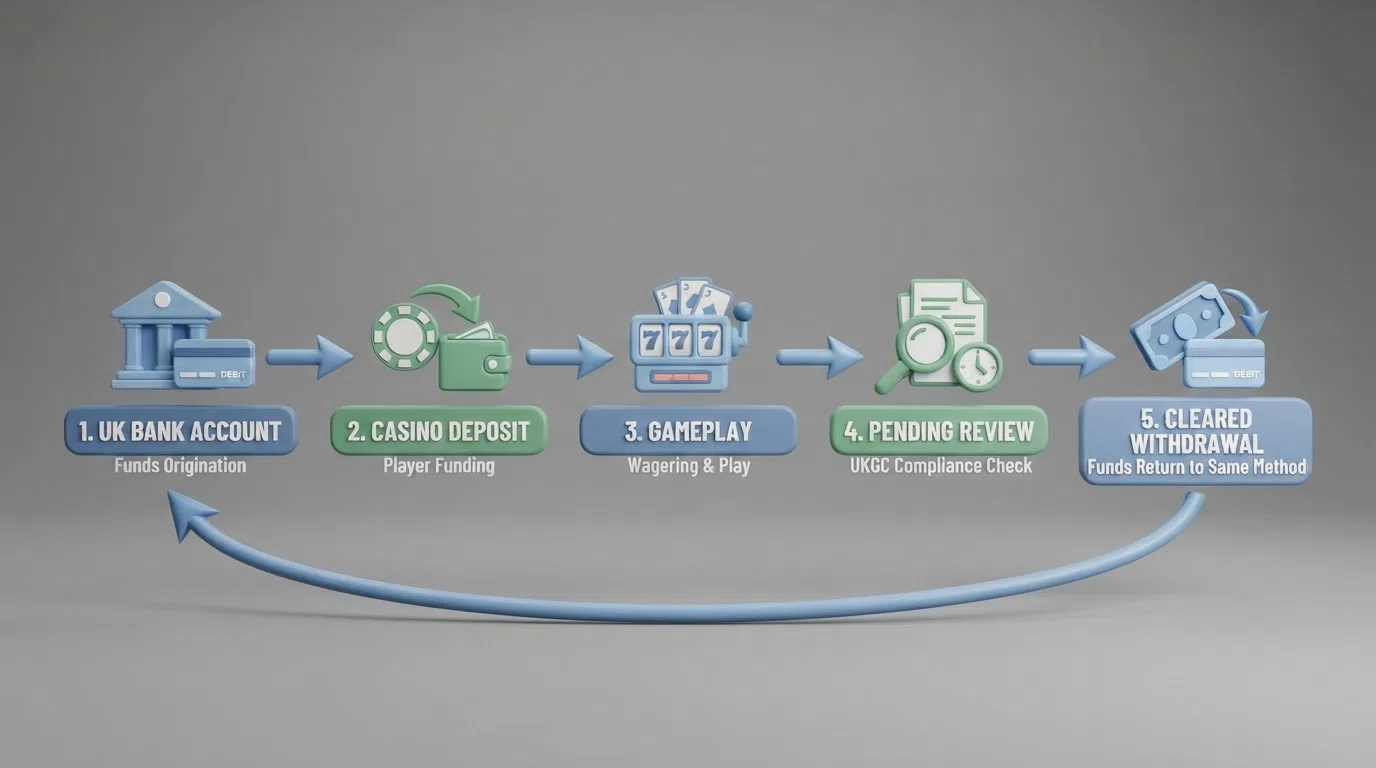
After verification, the deposit itself is quick. Login, open the cashier, pick a method, enter the amount, confirm. A Visa or Mastercard debit card deposit typically clears in seconds. A PayPal, Skrill or Neteller deposit clears in seconds too, with the e-wallet handling the balance on its side. A Trustly or Open Banking deposit routes through the player’s bank app and clears on confirmation. A bank transfer is the slowest — typically same-day to next-working-day for deposits, three to five working days for withdrawals.
The practical issue for a player who specifically wanted uPayCard is that the deposit-only nature of the rail means a separate withdrawal method still has to be nominated anyway. The card that lets the money in is not, in most cases, the card that takes the money out.
Withdrawal Options, Processing Times and What Actually Determines Speed
The closed-loop principle sits at the centre of UK withdrawal handling. A UK-licensed casino is expected to return funds to the same method used for the deposit where that is technically possible. A player who deposited with a Visa debit card will normally see the withdrawal return to that same Visa debit card. A player who deposited with PayPal will see the funds go back to PayPal. The norm is not absolute — some operators split withdrawals across methods or ask the player to nominate a bank account for a first withdrawal — but it is the rule the UK market operates under.
Method-by-method, the windows are predictable. Debit card withdrawals typically clear in one to three working days after the operator’s internal review. E-wallet withdrawals are the fastest, often under 24 hours and frequently within a few hours of approval. Bank transfer is the slowest, three to five working days, and the method every UK casino can process as a fallback. Open Banking and Trustly withdrawals fall somewhere between e-wallets and cards, and are generally faster than standard bank transfers.
The internal review is the variable that catches players out. Most UK operators run a pending period — typically 24 to 48 hours — during which the withdrawal sits in the account and can, in some cases, be reversed. Reverse withdrawals are now permanently banned under UK rules, but the pending review itself has not gone away, and a player who wants the fastest possible cash-out should pick an operator that processes withdrawals continuously rather than in batches. KYC and source-of-funds checks can also delay a first withdrawal — the operator may ask for additional documents the second time around, even where the original deposit cleared quickly.
Minimum Deposits, Deposit Limits and What UK Rules Require
A £5 or £10 minimum deposit is the norm at UK-licensed casinos, and most of the operators in this set sit at the £10 or £20 threshold for welcome-offer eligibility. That operator-set minimum is different from the UK-mandated deposit-limit framework, and the difference matters.
From 31 October 2025, every UK-licensed operator must prompt a customer to set a financial deposit limit before the first deposit. The prompt is compulsory, the limit is customer-set, and any decrease request must be actioned immediately. The framework also defines a “gross deposit limit” — a limit based solely on money paid into the account, not on net position or winnings. That definition was originally set to come into force on 30 June 2026, and the Gambling Commission has since extended the implementation date to 30 September 2026. A player who sets a £200 weekly deposit limit at a UK-licensed casino is setting a gross limit, and the operator cannot later redefine it as a net limit.
The UK model caps the per-spin stake, not the monthly budget. There is no nationwide deposit, loss or spend ceiling at the player level. The compulsion is the prompt, the customer-set limit, and the immediate-action rule for decreases. Financial vulnerability checks sit alongside: from 28 February 2025, operators must run a check at a £150 net-deposit threshold in a rolling 30-day period, and at £500 since 30 August 2024, using publicly available data only.
Casino Payment Fees — Which Methods Cost Nothing and Where Charges Hide
The operator-side norm is that most UK-licensed casinos do not charge deposit or withdrawal fees on standard methods. The fee load, when it appears, comes from elsewhere. Currency conversion on a non-GBP transaction is the most common charge — a player funding a sterling account from a euro or dollar e-wallet will see the e-wallet’s own conversion margin. E-wallet intermediaries (Skrill and Neteller in particular) may levy their own transfer fees on top of any operator-side charge, and those fees live in the e-wallet’s own pricing, not in the casino’s T&Cs. Dormant-account administration fees exist at some UK operators, but they typically apply only after months of inactivity and are usually refunded on contact with support.
The UK tax position is clean for the player. Gambling winnings are not taxed in the UK — the operator pays. Remote Gaming Duty on relevant online gaming profits rose from 21% to 40% from 1 April 2026, and that tax is paid by the operator, not by the player. A £1,000 withdrawal at a UK-licensed casino lands as £1,000 in the player’s account. The only deductions are method-side fees, where they exist, and the very rare operator-side fee disclosed in the cashier T&Cs.
Casino Bonuses, Free Spins and the Payment-Method Fine Print
Payment-method exclusions are the detail that turns a welcome offer into a non-event. The UKGC bonus framework, in force under SR Code 5.1.1, caps wagering requirements at 10x the bonus value and bans mixed-product promotional offers. That framework is the regulatory ceiling; the floor is set by the operator’s T&Cs, and the T&Cs are where the payment-method exclusions live.
The pattern is consistent. PayPal is excluded from bonus eligibility at several UK operators, including Grosvenor’s £40 bonus plus 100 free spins package. Paysafe is excluded from the same offer. E-wallets more broadly are often restricted on welcome offers, even where the operator accepts them as a deposit method. The rule of thumb: a player who plans to claim a welcome bonus should fund the deposit with a debit card or bank transfer, not an e-wallet, unless the operator’s T&Cs explicitly confirm e-wallet eligibility.
Free-spin mechanics deserve a separate read. The per-spin value at UK-licensed casinos is typically £0.10, and that figure is usually stated in the offer terms. The eligible slot title is named in most cases, and the wagering treatment varies — the strongest offers credit free-spin winnings as withdrawable cash, with no playthrough. The Independent’s coverage of the Sky Vegas welcome offer, for instance, frames the structure as “all free spins are no wagering free spins – with any winnings paid in cash” at £0.10 per spin. That is the cleanest version of the structure in the set, and it is the standard a player should measure the others against.
Your Protections as a UK Casino Player — Licensing, Safety Rules and Where to Get Help
How the UK Gambling Commission Licenses and Supervises Online Casinos
The Gambling Commission is the single statutory regulator for gambling in Great Britain, sponsored by the Department for Culture, Media and Sport. The legal framework is the Gambling Act 2005, extended by the Gambling (Licensing and Advertising) Act 2014, which made a GB licence compulsory for any remote operator serving GB customers. The Act’s three licensing objectives sit at the top of the rule book: preventing gambling from being a source of or associated with crime, ensuring gambling is fair and open, and protecting children and vulnerable persons from harm or exploitation.
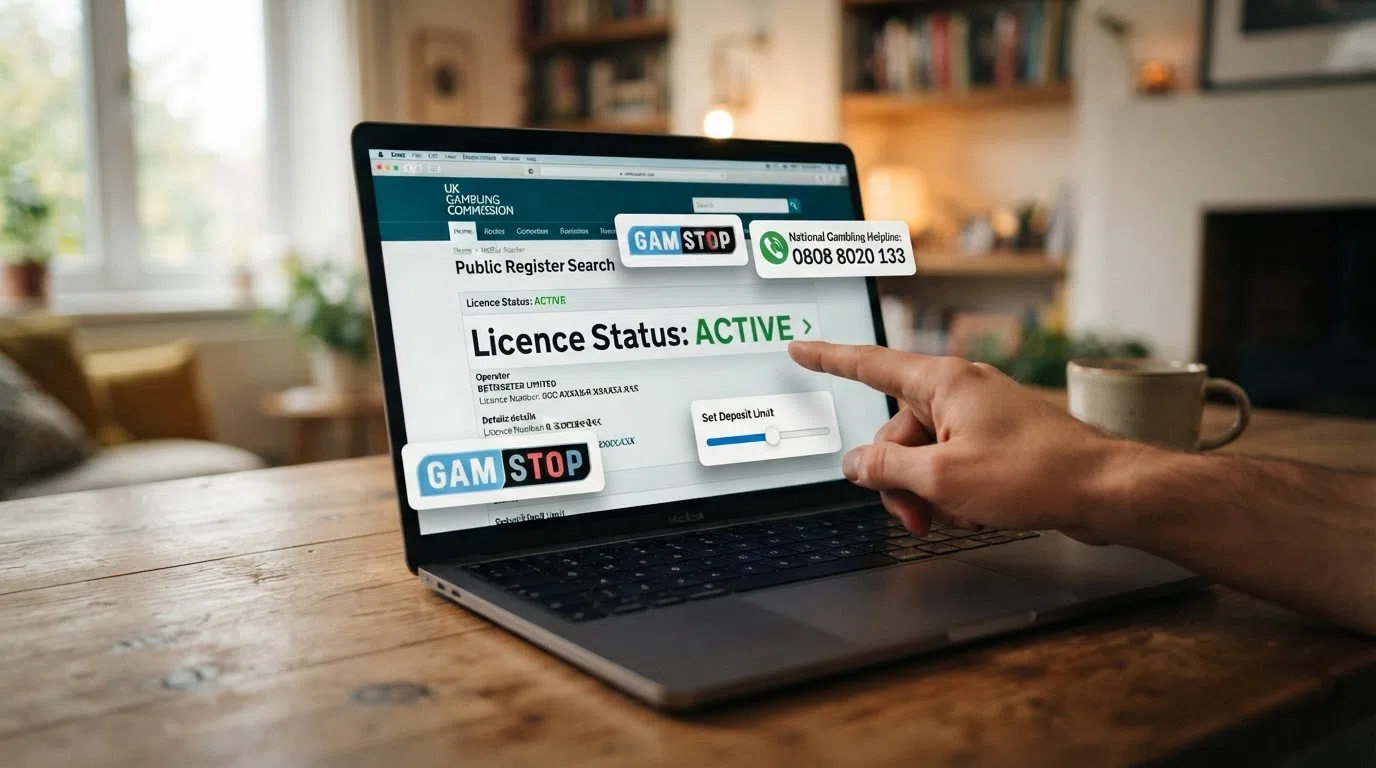
The day-to-day rule book is the Licence Conditions and Codes of Practice (LCCP) and the Remote Gambling and Software Technical Standards (RTS). The LCCP carries the social responsibility codes — the bonus framework, the deposit-limit prompt, the financial vulnerability checks, the credit-card ban. The RTS carries the technical and product standards — the slot-stake cap, the spin-speed limit, the auto-play ban. A UKGC licence binds the operator to both.
The penalty for serving GB customers without a GB licence is criminal. Section 33 of the Gambling Act 2005 makes operating without the required licence an offence, and the Commission enforces it through disruption rather than ISP or DNS blocking. The model uses cease-and-desist notices, search-engine delisting referrals, registrar and host action, and payment-provider referrals. For October 2024 to September 2025 the Commission reported 208,088 enforcement actions on illegal online gambling, with search-engine referrals the largest single category. Across April 2024 to June 2025, the disruption activity included 3,140 notices, 447,778 search-engine URL referrals, 287,961 URLs removed, and an average 32% fall in engagement across 160 disrupted sites. The point is that the offshore sites that advertise UK payment methods without a UK licence are operating against the law, and the Commission’s response is targeted at every layer of their infrastructure.
GamStop Self-Exclusion — How It Works, What It Covers and Its Limits
GAMSTOP is the national multi-operator online self-exclusion scheme for Great Britain, and every GB online operating licence has been required to participate since 31 March 2020. A player who registers with GAMSTOP is excluded from every UK-licensed online gambling operator for the chosen period, and the operator’s registration system is required to refuse the player’s account access and deposits.
The exclusion periods are fixed. A player can choose six months, one year, five years, or five years with auto-renewal. Early cancellation is not possible — once the exclusion is in place, the player sits it out. After the chosen period expires, the exclusion can continue for up to a further seven years if the player does not contact GAMSTOP to lift it. The structure is built to make the decision stick.
GAMSTOP does not reach offshore operators. A player who self-excludes through GAMSTOP is still able, in principle, to deposit at a Curaçao-licensed or Malta-licensed casino that does not participate in the scheme. The UK regulatory framework has no power over those sites’ registration systems, and that is the limit a player needs to be honest about when weighing the choice.
Non-GamStop and Offshore Casinos — The Real Risks for UK Players
A Curaçao, Malta or Gibraltar licence is not a substitute for a GB licence under UK law. Operating without the required GB licence is a criminal offence under section 33 of the Gambling Act 2005, and the Commission’s disruption model is targeted at exactly that category of operator. For a UK player, the practical difference is not a marketing detail — it is the loss of every UK statutory protection in one move.
The list of what is given up at a non-UKGC site is long. No GAMSTOP coverage. No mandatory deposit-limit prompt. No UK slot-stake cap. No 10x wagering cap. No enforcement of the credit-card ban. No access to UK alternative dispute resolution. No source-of-funds check under the same UK standard, and no recourse to the Commission’s enforcement if a withdrawal goes wrong. A player who is specifically seeking a non-GAMSTOP site to bypass a self-exclusion is removing every UK protection in a single decision, and the Commission has been clear about the enforcement posture that follows.
The honest assessment. Some players search for non-GamStop sites because their exclusion is recent and they want to keep playing. The decision to bypass self-exclusion is a personal one; the consequence is that the UK regulatory framework no longer applies to the gambling activity. Offshore operators offer payment methods that UK sites do not, but the trade is the loss of every UK protection that makes a complaint, a delayed withdrawal, or a bonus dispute resolvable in the player’s favour.
Responsible Gambling — The Tools, the Numbers and Where to Get Help
The harm data is the first line. NHS England Digital reports that in 2024, 5% of UK adults scored 1 or more on the PGSI — the Problem Gambling Severity Index — placing them in the at-risk or problem-gambling categories. Less than 1% scored 8 or more, the problem-gambling threshold. The Gambling Commission’s participation statistics for Wave 4, covering September 2025 to January 2026, put past-four-week online gambling participation at 37% of UK adults. The market is large, the harm is real, and the support infrastructure is built to match.
The mandatory player-protection tools at UK-licensed casinos cover the basics. Operators must prompt every customer to set a deposit limit before the first deposit, from 31 October 2025. Reality checks and session loss/win displays have been required since 31 October 2021. Financial vulnerability checks run at £150 and £500 net-deposit thresholds in a rolling 30-day period, using publicly available data only. The 10x wagering cap and the credit-card ban sit on top of those obligations.
The help lines are open. The National Gambling Helpline, operated by GamCare, is free, confidential, and available 24 hours a day, 7 days a week on 0808 8020 133, with live chat and WhatsApp also available. The Gambling Commission lists the National Gambling Helpline in its public guidance as a confidential advice and support service, alongside the National Gambling Treatment Service and NHS gambling-harm clinics in England, Scotland and Wales. GamCare’s own framing is that it offers “the easiest and quickest way for most people to connect with the service(s) or support that can best help them.” For a player who is reading this page and is worried about their own play or someone else’s, that number is the place to start.
Casino Gaming on the Go — What Mobile Play for UK Players Actually Looks Like
App Download vs Instant-Play Browser — Which Works Better for Real-Money Casino Play
The two routes to mobile play at a UK-licensed casino are a dedicated app and a mobile browser. Both run on the same UKGC licence — there is no separate mobile-licensing regime, and the regulatory obligations on the operator are identical across channels. The differences are in the experience.
The app experience stores payment details, surfaces push notifications for bonuses, and launches faster. The trade-off is storage footprint, occasional friction with Apple’s and Google’s app-store policies on gambling apps, and a payment panel that is locked to whatever the app was last configured to accept. Switching payment methods inside an app typically means re-entering the new card or e-wallet details, and the cashier experience on mobile can feel less complete than the desktop equivalent.
The mobile-browser experience is the more flexible option. No download, instant access, identical game catalogue to the desktop site, and the same payment panel as the desktop cashier. The cost is that payment details have to be re-entered each session unless the browser is configured to remember them, and the launch time is slower. For a player who switches between payment methods or who values identical cashier access across devices, the mobile browser is the more useful route. The single UKGC licence covers both, and the player protections are the same on each.
Android and iOS Compatibility for UK Casino Players
Both platforms work. Google Play permits real-money gambling apps in the UK, subject to UKGC licensing and geo-restriction checks. Apple’s App Store permits UK-licensed casino apps with the same regulatory gate. The practical outcome is that both platforms run the same HTML5 casino games in-browser regardless of app policy, and the in-browser deposit flows are identical across Android and iOS.
The one real difference is in the app-store gatekeeping. Apple and Google enforce their own policies on gambling apps, and the operator’s app may or may not be visible in the regional store depending on the licence. A player who cannot find the app in the local store can always use the mobile browser instead — the cashier, the game catalogue and the licence obligations are the same. There is no device-specific regulatory carve-out in UK gambling law, and the operator’s UKGC licence binds it to identical player protections on Android, iOS, and the desktop site.
Crypto and uPayCard Together — Why UK Rules Keep the Two Rails Apart
Bitcoin Casinos That Also Accept Prepaid Deposit Methods
A small number of operators advertise both Bitcoin and prepaid-card deposits. The first question to ask of any of them is the licence question — does the operator hold a UKGC licence, or does it run on a Curaçao, Malta or Gibraltar authorisation? In 2026, the operators that combine Bitcoin deposits with prepaid-card acceptance are, in practice, offshore. A UK player searching for that combination is likely to find only non-UKGC sites, and the offshore status comes with the trade-off spelled out earlier — no GAMSTOP, no 10x wagering cap, no enforced credit-card ban, no UK ADR.
The UK position is consistent. A GB licence is compulsory at the point of consumption, and a non-GB licence is not a substitute. The Commission’s disruption model is targeted at offshore operators that target GB customers, and the enforcement volume is meaningful. For a UK player, the answer when a casino accepts both Bitcoin and prepaid cards is to check the licence register before depositing. If the operator is not on the UKGC public register, the player protections the rest of this page describes do not apply.
How Crypto and Card Payments Compare for UK Players
The differences are sharper than the marketing makes them sound. Crypto deposits are typically irreversible, settle on-chain with variable confirmation times, and offer no chargeback route. Card deposits are reversible under UK consumer law through the chargeback mechanism, settle instantly through regulated payment rails, and offer the consumer protections that come with regulated banking. The regulatory gap is the deeper cut. UK-licensed casinos operate under strict KYC and anti-money-laundering rules that make anonymous crypto deposits incompatible with the licence — a player who deposits Bitcoin at a UKGC-licensed casino is still going through the same identity verification as a debit-card depositor.
The bottom line for a UK player. A debit card at a UKGC-licensed casino offers more protections than a Bitcoin deposit at an unlicensed site, full stop. The credit-card ban does not reach a crypto deposit, but the UK regulatory framework does not reach a non-UKGC operator. The two facts cancel out for the player who values the UK protections. The clean comparison is debit card at a UK-licensed casino against crypto at an offshore casino, and the UK option wins on every consumer-protection axis that matters.
The Casino Games Worth Your Time — Slots, Tables and Live Dealer Titles With Real Data
Online Slots — RTPs, Volatility and the Titles That Carry Published Numbers
The UK slot-stake cap is the regulatory ceiling every slot player has to plan around. For players aged 25 and over, the maximum stake per game cycle is £5, in force since 9 April 2025. For players aged 18 to 24, the maximum is £2, in force since 21 May 2025. The cap attaches to a “game cycle” and cannot be defeated by splitting a spin. Game-design rules sit on top of the stake cap — auto-play is banned, the minimum spin speed is 2.5 seconds, features that speed play and losses disguised as wins are banned, and operators must display session losses, wins, and time played.
The two slot titles in the featured set with surfaced per-title RTP data are worth a side-by-side look.
| Slot Title | RTP | Provider | Volatility |
|---|---|---|---|
| Book of Dead | 96.21% | Play’n GO | High |
| Big Bass Splash | 96.71% | Pragmatic Play (Reel Kingdom) | — |
Book of Dead is a 5-reel, 10-payline slot with high volatility, a published 96.21% RTP, and a 5,000x max win. Big Bass Splash carries a 96.71% headline RTP and a 5,000x max win, with volatility not surfaced in the available data. Both figures are headline rates — the same slot can run at a lower RTP setting chosen by the operator, and the live figure for the player’s session is in the in-game info panel, not the developer’s marketing page.
A session at the UK stake cap on Book of Dead, played at the £5 maximum, costs the player £5 per spin at a 96.21% RTP. Over an hour of play at the 2.5-second minimum spin interval, that is roughly 1,440 spins and a total stake of about £7,200. The expected loss, calculated as stake times (one minus RTP), works out to roughly £278 across that hour — a statistical average over many sessions, not a guaranteed outcome. The figure illustrates the cost of the stake cap’s ceiling: at the maximum bet, a high-volatility slot will, on average, take several hundred pounds off the player in a single hour of continuous play. At the £2 stake cap that applies to players aged 18 to 24, the same arithmetic works out to roughly £111 in expected loss over an hour — the same proportional cost at a smaller absolute number.
Blackjack, Roulette and Table Games at UK Online Casinos
The £5 and £2 slot-stake caps do not apply to RNG table games or live-dealer tables. A player at an online blackjack table can stake more per hand than at a slot, and the RTP profile is very different. A standard online blackjack hand, played with basic strategy, returns roughly 99.5% to the player over time — a full 3.5 percentage points better than a 96% RTP slot. The house still has the edge, but the edge is much smaller, and the player who learns basic strategy closes more of the gap than at any slot.
Roulette sits lower than blackjack. A European roulette wheel with a single zero returns about 97.3% to the player on every bet except the five-number basket, and the American double-zero wheel drops that figure to about 94.7%. The RTP difference is the entire reason European roulette is the version a serious table-game player picks.
The bonus interaction is the part most players miss. Table games often contribute a lower percentage — or zero — toward bonus wagering requirements at UK casinos. A player who claims a 10x-wagering welcome offer and tries to clear it at a blackjack table may find that only a fraction of each stake counts toward the playthrough. The 10x cap is the UK ceiling; the per-game contribution rate remains operator-set, and the T&Cs are where it lives.
Live Dealer Games and Bingo — The Social Casino Experience
Live dealer play is a real-time streamed table game with a human dealer — roulette, blackjack, baccarat, and the game-show formats that have grown around the product. Stakes are typically higher than the RNG equivalent, the pace is slower, and the experience is closer to a physical casino floor. The games fall under the casino licence for UKGC purposes, and the same consumer protections apply.
Online bingo is a separate product category under the UKGC framework, with its own licence conditions. Many of the operators in the featured set hold both a casino licence and a bingo licence, and the same cashier handles deposits for both. The bonus eligibility and the contribution rates can differ between the two product categories, and the T&Cs are again where the detail lives.
For a player choosing between slots, table games, live dealer, and bingo, the question is the same as the one this page started with. Pick the product whose rules you understand, whose RTP profile you can calculate, and whose payment method supports both deposit and withdrawal. The UK regulatory framework will hold the floor under any of them.
New UK Casino Sites in 2026 — What Fresh Operators Bring and What to Watch For
The Newest UK Casino Sites Accepting Alternative Payment Methods
A UK casino that launched this year is, by definition, a UKGC-licensed operator — the Gambling Commission’s licensing process applies to every new entrant, and there is no fast-track route that bypasses the social responsibility and financial fitness checks. The payment panel at a new UK casino, however, is often narrower than the panel at an established operator. A fresh site typically launches with Visa and Mastercard debit, one e-wallet (most often PayPal or Skrill), and bank transfer. Trustly and the wider Open Banking rails tend to arrive in the months after launch, as the operator’s payment team builds out the integration.
For a player whose preferred method is a standard UK rail — a Visa debit card, a PayPal account, a UK bank account on Open Banking — a new UK casino is a perfectly reasonable choice. The cashier will be there, the licence will be there, and the responsible-gambling tools will be there. For a player who specifically wants a less common method, the safer bet is an established operator that has had time to build out the full payment panel. A new casino’s marketing page is not the place to verify payment support; the cashier page is.
What to Check Before Joining a Casino That Launched This Year
A short checklist catches most of what matters. First, the UKGC licence: a new site should display its licence number in the footer, and the player should cross-check the number against the Gambling Commission’s public register. A licence that does not appear on the register is not a licence, whatever the footer says. Second, payment methods: confirm which methods are supported for both deposit and withdrawal, not just deposit — a method that clears the deposit can be useless if the operator will not return funds to it on withdrawal. Third, the bonus T&Cs: the wagering multiplier (0x or 10x in the UK market), the game contribution rates, any payment-method exclusions, and the cashout cap. Fourth, the ADR provider and the complaints process — a UK-licensed operator must offer an independent dispute resolution route, and the provider should be named. Fifth, the responsible-gambling tools: deposit limits, reality checks, session timers, and the GAMSTOP integration. The checklist is not exhaustive, but it catches the issues that surface most often in disputes.
How We Selected and Ranked the Casinos on This Page
The ten operators in the comparison table are all UK-licensed, every one of them verified against the UK Gambling Commission’s public register in August 2026. The bonus terms — wagering multiplier, free-spin count, eligible slot, validity window, cashout cap — are taken from each operator’s publicly surfaced promotional page. Where a field was not confirmed, the table carries an em dash rather than a guess.
The ranking criterion was bonus fairness and offer transparency, not uPayCard support. The reason is the page’s central finding: not one operator in the featured set confirmed uPayCard as an accepted method, and a ranking that pretended otherwise would be misleading the reader. The order on the table reflects how clearly each welcome offer is written — the 0x wagering packages at the top, the offers with confirmed eligible slot titles and stated cashout caps in the middle, and the operators whose bonus terms were not surfaced at the bottom. A player who disagrees with the order can rearrange the same set of facts; the data is the same.
What this page does not do. It does not rank by revenue share, affiliate preference or advertising spend. It does not pick a single “best” operator for the reader. It does not pretend that any of the featured operators accept uPayCard when the surfaced data does not confirm it. The job is to present the facts the reader needs to make their own call, in the order that the facts support, and to say plainly where the data stops.
What UK Casino Players Should Actually Do Next
The page’s core finding, restated. In 2026, no UKGC-licensed casino in the featured set confirmed uPayCard as an accepted deposit or withdrawal method, and the broader UK-licensed market shows no sign of the payment rail’s return. The credit-card ban and the closed-loop withdrawal norm have combined to make prepaid cards an awkward fit for the UK regulatory environment, and operators that previously listed uPayCard appear to have dropped it from their cashiers rather than work around the compliance issue.
The practical path forward. Choose a UKGC-licensed operator based on three filters. First, bonus fairness — look for 0x wagering where it exists (Sky Vegas, Virgin Games, Paddy Power’s main package), or the 10x UKGC cap where it doesn’t, and weigh the cashout cap against the headline spin count. Second, payment-method flexibility — confirm the preferred deposit method AND the preferred withdrawal method are both listed in the cashier before signing up. Third, responsible-gambling tools — deposit-limit prompt, reality checks, GAMSTOP integration, and the ADR provider.
The payment-method decision in one line. A Visa or Mastercard debit card is accepted everywhere, costs nothing to deposit, and returns withdrawals to the same card. It is the baseline against which every alternative should be measured, and for most UK players it is also the answer.
The UK regulatory framework guarantees the floor. Identity verification before the first deposit. A mandatory deposit-limit prompt. The 10x wagering cap on bonuses. The £5/£2 slot-stake cap, age-banded. GAMSTOP access for self-exclusion. The credit-card ban. The National Gambling Helpline on 0808 8020 133, free, confidential, 24/7. None of these protections is available at an offshore operator, and that is the line a player should hold when the search results start offering alternatives.
The one action to take before depositing anywhere. Open the UK Gambling Commission’s public register, check the operator’s licence status, and confirm the payment method is listed in the cashier for both deposit and withdrawal. The check takes five minutes and it is the single most useful five minutes a UK player can spend before signing up.
Frequently Asked Questions
Which UK-licensed casinos currently accept uPayCard for deposits and withdrawals?
None of the UK-licensed operators this page reviewed confirmed uPayCard as an accepted deposit or withdrawal method in 2026. The prepaid rail has effectively dropped off the cashiers of UKGC-licensed operators, and the broader UK-licensed market shows no sign of its return.
Do uPayCard deposits qualify for welcome bonuses and free spins at UK casinos?
The question does not arise in practice, because no UK-licensed operator in the featured set accepts uPayCard. Where similar prepaid or virtual card rails do appear at UK operators, they are typically excluded from bonus eligibility — the same pattern that excludes PayPal and Paysafe from some welcome offers.
Is uPayCard safer than debit cards or PayPal for UK casino payments, and what verification is required?
uPayCard does not change the verification obligation. Every UKGC-licensed casino must verify a customer’s name, address and date of birth before the first deposit, the first bet, or the first bonus use, regardless of the payment method on the cashier page. A debit card or PayPal at a UK-licensed casino also sits under the UK regulatory framework, which is the actual source of the player protection.
What can I use instead of uPayCard if a UK casino does not support it?
A Visa or Mastercard debit card is the universal option — accepted at every UK-licensed operator, instant on deposit, returning to the same card on withdrawal. PayPal, Skrill and Neteller are available at many UK operators, with e-wallet withdrawals typically clearing faster than card withdrawals. Trustly and Open Banking are the newer bank-app-based option. Bank transfer is the universal fallback that every UK casino can process.
Are there fees for using uPayCard at UK casinos, and what are the usual minimum and maximum limits?
The fees question is not live at UK-licensed casinos, because uPayCard is not on the cashiers of the operators this page reviewed. At the methods that do clear, most UK-licensed operators do not charge deposit or withdrawal fees on standard rails. The fees that do appear live in the e-wallet’s own pricing, in currency-conversion margins, or in the operator’s dormant-account T&Cs. The minimum deposit is typically £5 or £10 at UK operators, and the welcome-offer minimums in the featured set sit between £10 and £20.
Payments – nonukgc-licensedcasinos
Content created by the «nonukgc-licensedcasinos» team