
Pay by Phone Bill at UK Online Casinos
 Available in GB
Pay by phone bill is the casino deposit method that asks for a mobile number instead of a sort code. The casino never sees your bank or card. The charge lands on your mobile account — a line item on your next bill if you are on contract, or a deduction from your prepay balance within seconds. For privacy and built-in spend-capping, it is the cleanest deposit rail available to UK players in 2026. For anything else — high deposits, withdrawals, bonus eligibility on some sites — it is the wrong tool.
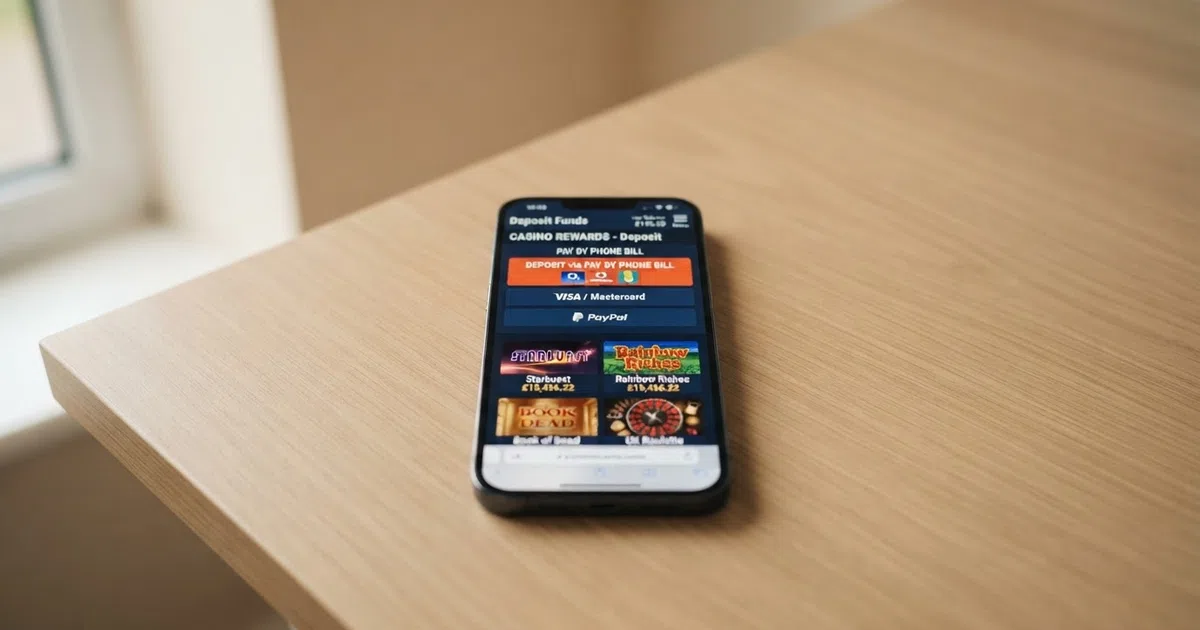
This guide covers how the method works, the statutory limits that define it, the providers that power it, the ten UKGC-licensed operators that take it (and the one major brand that does not), and the safer-gambling infrastructure that surrounds every phone-bill deposit. The central finding: phone billing is a deposit-only rail with a £40-per-transaction and £240-per-month ceiling, and every player who uses it needs a verified alternative for cashouts.
*Current as of September 8, 2026 · Licence and bonus terms verified against the UK Gambling Commission’s public register and each operator’s published T&Cs.*
What “Pay by Phone Bill” Means at a UK Online Casino
A pay-by-phone-bill casino deposit is a charge routed through your mobile network operator, not your bank. The transaction chain runs casino → payment provider (Fonix, Boku, Siru Mobile, or PayViaPhone) → your mobile network → your phone account. What reaches your statement is a generic charge to your mobile account, not a casino name. That is the privacy proposition in one line.
The privacy advantage is real. No bank details, no debit card numbers, no e-wallet linking — the casino only receives confirmation that a verified mobile number has authorised a deposit. For a player who does not want gambling transactions appearing on a bank statement, or who is funding play from a prepay balance, that is the point. talkSPORT puts it plainly: pay by mobile lets you deposit without sharing any bank or card details, “making it one of the more privacy-friendly options available.” That quote is also a useful summary of what phone billing is not designed to do — it cannot be used to withdraw, “so you always need a secondary method set up for cashing out.”
The withdrawal limitation is non-negotiable. Phone billing is a one-way rail. The carrier-billing system was built for digital content purchases — app store top-ups, ringtone downloads, premium-rate services — where the merchant needs to collect money, never to send it back. Gambling operators bolt onto that infrastructure, but they bolt onto it as a deposit channel only. Every UKGC-licensed casino that accepts phone-bill deposits will require a verified alternative — debit card, bank transfer, or e-wallet — before the first withdrawal. The verification happens regardless. Identity checks are mandatory at every UK-licensed casino before the first deposit proceeds, and the alternative payment method is verified at cashout. Phone billing saves you from entering card numbers at the deposit stage. It does not exempt you from the compliance chain.
A short summary: phone billing is a privacy-first, deposit-only rail with a hard monthly ceiling. Treat it as one half of a two-method setup, not as a standalone way to play.
The Providers Behind the Payment: Boku, Fonix, and the Rest
The brand you see in the casino cashier is rarely the company that actually moves the money. Four providers power UK phone-bill casino deposits in 2026, and they differ on fees, flow, and the networks they support.
Fonix is the newer of the major providers, used by MrQ and others. The flow is one-click once the mobile number is verified, with two-factor authentication via an SMS PIN sent to the handset. The mobile network operator holds the KYC and identity data on the subscriber — Fonix itself does not store it. That division is why a Fonix deposit feels near-instant: the network already knows who you are, and the SMS PIN is the second factor the regulation requires.
Boku is the established name. No Boku account is required, the flow is straightforward across all major UK networks, and the per-transaction ceiling sits at the statutory £40 with a £240 monthly cap. Boku powers a large share of UK casino phone-bill deposits, and you will see it in the cashier at Peachy Games and other featured operators.
Siru Mobile is the provider behind Videoslots and Mr Vegas phone-bill deposits. It carries a higher processing fee — OLBG notes the fee runs at roughly 25%, which means a £4 base deposit is charged as £5.12. The fee is not a casino markup; it is Siru’s revenue model. If you deposit at the lower end of the scale, Siru is the most expensive of the four, but the trade-off is access to operators whose cashier routes through it.
PayViaPhone is the ProgressPlay option, used at Fruity King and sister brands. Processing fees may apply, with one source noting 15%. Check the on-screen confirmation before authorising — the fee, if any, is shown at the PIN stage.
Payforit deserves a mention only because outdated guides still cite it. Payforit was retired as a trust-mark in 2019. The underlying carrier-billing technology continues under Boku and Fonix, but the Payforit brand no longer operates. Any listicle calling out “Payforit casinos” is recycling 2018 branding.
The UK direct carrier billing (DCB) sector is forecast to reach £355m in 2025, with 12% year-on-year growth. The revenue splits three ways: 65% to content providers (the casinos, in this case), 25% to the mobile network operators, and 10% to the technology layer. That split explains why networks do not block the channel — they earn a quarter of every transaction — and why providers like Fonix have invested in the streamlined one-click flow that makes phone-bill deposits viable at scale.
Online vs High-Street: Where Phone Billing Actually Fits
Phone-bill deposits are an online-only proposition. There is no chip purchase at a land-based casino that lands on your mobile bill; the high-street equivalent is paying the cashier in cash or by card. When a UK player searches for a “pay by phone bill casino,” they are looking for a remote site or app that accepts charge-to-mobile as a deposit method. The distinction matters because the statutory limits — £40 per transaction, £240 per month — apply only to the charge-to-mobile rail, enforced by the Financial Conduct Authority under PSD2 Schedule 1 Part 2(l). Cash purchases in a brick-and-mortar casino carry no such cap.
The practical effect: the phone-bill experience lives entirely in the mobile-web browser or the casino app. A desktop player funding an account from a laptop can still use phone billing — the SMS PIN arrives on their handset, the charge lands on their mobile account, the casino balance updates within seconds. But the rail is built around the mobile-first flow, and the best experience is the in-app cashier, where the verified mobile number is pre-stored and the one-click path is shortest.
The One Thing to Know Before You Deposit: No Withdrawals to Your Phone Bill
Every phone-bill depositor hits the same wall on the way out. You cannot withdraw a penny back to your phone bill. The carrier-billing system does not support outbound payments to consumers; it was designed to bill, not to refund. That limitation is not a casino policy or a provider choice — it is a structural property of the rail.
The consequence for the player: before the first withdrawal, every UKGC-licensed casino requires a verified alternative method — a debit card, a bank transfer, or an e-wallet — to be on file. The verification step is the same one any player goes through at a UK-licensed site, and it is independent of how the deposit was funded. A phone-bill-only depositor will still need to enter bank details at the withdrawal stage. If privacy is the reason for choosing phone billing in the first place, the privacy advantage disappears at cashout.
There is no workaround. Some offshore sites may advertise phone-bill withdrawals, but they are not UKGC-licensed and the protection that comes with a UKGC licence — segregated player funds, ADR access, GAMSTOP coverage — does not apply. The honest framing: phone billing is half a banking relationship. Pair it with a verified debit card or bank account and the limitation is manageable. Use it as a standalone method and the first withdrawal will be the moment the setup reveals its gap.
Funding Your Account by Phone: The Deposit Flow Step by Step
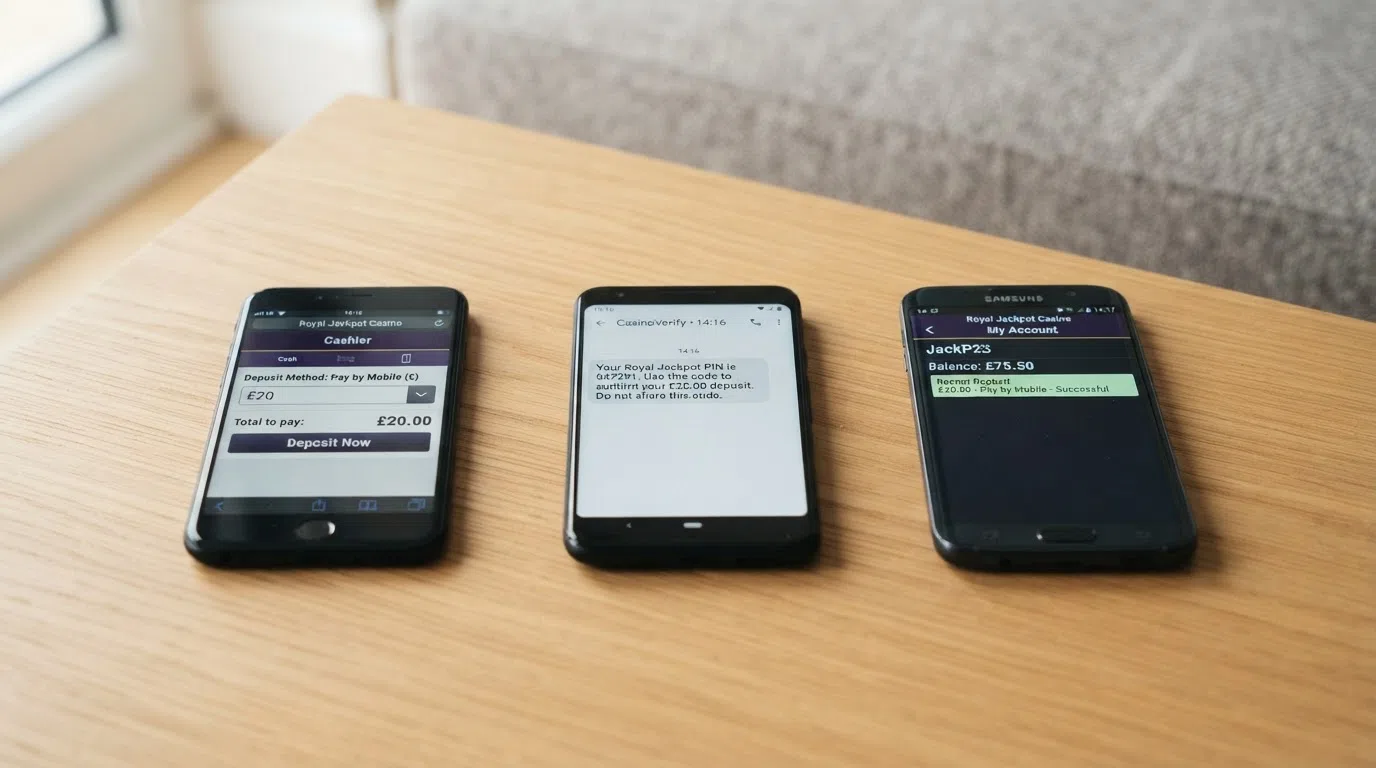
The deposit mechanics are simple by design. From the casino cashier, a phone-bill deposit takes three actions and under thirty seconds: enter the amount, confirm the mobile number, enter the SMS PIN. The flow is identical whether you are on a monthly contract or PAYG, and whether you are funding from a mobile browser or a casino app.
The Deposit Flow: From Casino Lobby to Confirmed Balance
The first step is selecting the method. In the cashier, the option appears as “Pay by Phone Bill,” “Pay by Mobile,” or — depending on the provider — “Fonix,” “Boku,” or “Siru Mobile.” Select it and enter the deposit amount. Most operators set a minimum between £5 and £10 and a per-transaction ceiling of £30 to £40, with £30 the more common practical limit even though the statutory cap is £40.
Enter your mobile number next. The casino (or the provider it routes through) sends an SMS PIN to the handset. Two-factor authentication via SMS is mandatory under PSD2 for charge-to-mobile transactions, and both Boku and Fonix use this flow as standard. The PIN arrives within seconds and is entered on the casino’s deposit confirmation screen.
The final step is confirmation. Once the PIN matches, the deposit is authorised. The amount appears in the casino balance immediately — and either deducts from PAYG credit on the spot or lands on the next monthly contract bill as a premium-rate or carrier-billing charge. The mobile network operator holds the KYC and identity data on the subscriber, which is why no further identity verification is triggered at the deposit stage. Identity verification at UKGC-licensed casinos happens at account opening, not per deposit, and the MNO-held subscriber data is what satisfies the requirement.
Which UK Mobile Networks Let You Deposit by Phone Bill
Phone-bill deposits work across the four major UK networks and most of the MVNOs running on their infrastructure. The list is wider than most guides acknowledge.
- O2, EE, Vodafone, Three — the four major networks, all supporting charge-to-mobile casino deposits.
- Sky Mobile, Virgin Mobile, Tesco Mobile, giffgaff — MVNOs running on major-network infrastructure; phone billing works.
- BT Mobile — support status depends on the current wholesale arrangement; check with BT before depositing.
- PAYG and contract — both billing types are supported on the major networks and most MVNOs.
David Foord at OLBG summarises the network side: “Pay By Mobile is available on all major UK Networks, so O2, EE, Vodafone and Three. If you’re planning to try it out, it’s best to check with your network provider to ensure that premium-rate services can be added to your phone bill.” That last point matters. Some networks require the subscriber to enable premium-rate services on the account before a charge-to-mobile transaction will go through. A first deposit that fails at the PIN stage is more often a premium-rate block than a provider problem.
Top-Up by Phone Bill: How Prepay and Contract Differ
The mechanics differ at the billing stage. A contract customer sees the deposit appear on the next monthly bill as a premium-rate or carrier-billing charge. A PAYG customer sees the deposit deducted immediately from the available prepay balance. The casino balance is credited at the same speed either way — within seconds of PIN confirmation — but the path the money takes to leave the player’s pocket is different.
The statutory caps are the same for both. The £40 per-transaction and £240 monthly limits set by PSD2 apply regardless of contract type. A PAYG customer is not exempt from the monthly ceiling because the deduction is immediate; a contract customer is not bound to a higher ceiling because the charge is deferred. The cap is per mobile subscriber, not per billing arrangement.
The PAYG failure mode is worth noting. A deposit that exceeds available prepay credit simply fails at the transaction stage. The casino balance is not credited, the player is not charged, and the SMS PIN authorisation returns a decline. That outcome is preferable to a partial deduction, but it does mean a PAYG player cannot “top up” their prepay balance by attempting a phone-bill deposit larger than their available credit. The phone-bill rail is a deduction, not an advance.
The Real Deposit Limits: Why £30 Stops You (and £240 Caps Your Month)
The numbers that define a phone-bill casino deposit come from consumer-protection regulation on premium-rate services, not from gambling law. The Payment Services Regulations 2017 (Schedule 1, Part 2(l)) set a per-transaction ceiling of £40 and a monthly cap of £240 per subscriber. The Financial Conduct Authority enforces both. The UK Gambling Commission does not set these limits; it does not need to. The payment rail’s own regulation does the job.
The practical ceiling is lower than the legal one. Most UK casinos and providers cap the per-transaction deposit at £30, even though the statutory ceiling permits £40. The £30 figure is a market norm, not a regulatory floor, and it exists partly to keep the deposit comfortably below the regulatory ceiling (giving the casino margin in case the limit is revised downward) and partly to discourage the kind of impulsive large deposit that consumer-protection regulation is designed to prevent. If a casino’s cashier refuses a £35 deposit, the £40 cap is not the cause; the casino’s own setting is.
The minimum deposit varies by operator. Most phone-bill casinos set the floor at £10. Some — Videoslots and Mr Vegas, via Siru Mobile — set it lower, with the £5.12 figure reflecting a £4 base plus Siru’s processing fee. A £5 deposit is possible at those sites; at a Fonix- or Boku-powered operator, £10 is the more common starting point.
The monthly cap aggregates across every site. The £240 ceiling is per mobile subscriber, not per casino. A player who deposits £120 at MrQ and £120 at LeoVegas in the same month has hit the cap; a third deposit attempt will be declined at the payment-rail level, regardless of which casino initiates it. The aggregation is enforced by the mobile network operator, not by the casino.
The Game Library a Phone-Bill Credit Opens Up: Slots to Live Dealer
A phone-bill deposit credits a casino account the same way any other deposit method does. The balance is universal — once it is in the account, it funds any game category the casino offers, subject to the same stake caps and game-design rules that apply to every UK-licensed product.
Slots You Can Spin With a Phone-Bill Deposit
Slots are the core phone-bill game category. Every phone-bill casino in the UK features them, and the welcome offers at most of the operators reviewed here are structured around specific slot titles.
Big Bass Splash and Big Bass Bonanza are Pragmatic Play titles that dominate the featured-operator welcome offers. Both carry a provider-default RTP of 96.71% and high volatility, with a max win of 2,100×. They are the spin-on-signup game at MrQ, BetUK, LeoVegas, and Peachy Games, and the consistency is a signal: when four operators route the same game into their headline offer, the slot has earned a reputation for converting free-spin value into real cashout volume at zero wagering.
Book of Dead is Play’n GO’s high-volatility staple, sitting at the centre of the PlayGrand welcome offer. Provider-default RTP is 96.21%, with a 5,000× max win — the highest of the Pragmatic Play titles in the rotation, and a slot whose bonus rounds are the reason the wagering multiple is the relevant cost rather than the spin price. Book of Dead has five operator-selectable RTP settings, and operator-specific variants can run lower than the 96.21% figure, so the published RTP should be checked on the casino’s own game information page before treating it as settled.
Starburst is NetEnt’s low-volatility classic, featured at Videoslots and Mr Vegas. Provider-default RTP is 96.09%, max win 500×. The game is the de facto benchmark for low-volatility slot play — frequent small wins, long sessions, modest variance — and its appearance in the welcome offer is a signal that the operator is targeting players who prefer sustained play over bonus-round hunting.
Sweet Bonanza and Gates of Olympus round out the high-ceiling Pragmatic Play cluster. Sweet Bonanza’s provider-default RTP sits at 96.48–96.51% with a 21,100× max win — the highest figure in the table — and Gates of Olympus comes in at 96.50% RTP with a 5,000× max win. Both are medium-to-high volatility, and both are present in the wider libraries of the featured operators even where they are not the headline free-spin game.
| Slot | Provider | RTP | Volatility | Max Win |
|---|---|---|---|---|
| Big Bass Splash | Pragmatic Play | 96.71% | High | 2,100× |
| Big Bass Bonanza | Pragmatic Play | 96.71% | High | 2,100× |
| Book of Dead | Play’n GO | 96.21% | High | 5,000× |
| Starburst | NetEnt | 96.09% | Low | 500× |
| Sweet Bonanza | Pragmatic Play | 96.48–96.51% | Medium–High | 21,100× |
| Gates of Olympus | Pragmatic Play | 96.50% | High | 5,000× |
The stake caps that apply to these titles come from outside the operator. Since 9 April 2025, online slots have carried a statutory maximum stake of £5 per game cycle for players aged 25 and over; the cap is £2 per cycle for players aged 18 to 24, in force from 21 May 2025. A “game cycle” runs from the initiation of play to the delivery of all winnings, and the cap applies to the total staked within that cycle. Auto-play is banned, spin speed may not exceed 2.5 seconds per cycle, and losses disguised as wins are prohibited. The rules apply to every online slot at every UKGC-licensed casino — phone billing does not place a player outside them.
Demo Mode: Playing for Free Before You Deposit a Penny
Most UKGC-licensed casinos offer demo or fun-mode versions of their slots without requiring a deposit. Demo play lets a player test a slot’s volatility, hit frequency, and bonus-round behaviour before committing phone-bill funds — useful for the high-volatility Pragmatic Play titles, where a £30 deposit can be exhausted in a single bonus round.
The limitation is the live-dealer floor. Live-dealer tables are never available in free-play mode; the studio costs and the dealer time mean demo play is a slots-only feature at every UK-licensed site. Table games — RNG roulette, blackjack, baccarat — are usually available in demo mode, but the live experience is gated behind a real-money balance.
Demo mode is also a responsible-gambling tool. The game-design rules — auto-play ban, spin-speed minimum, losses-disguised-as-wins ban — apply to real-money play only, which means demo play is the only environment in which a player can see the raw game without UKGC-mandated interventions. Whether that is an advantage or a disadvantage depends on what the player is testing. For mechanics, it is useful. For the real-money experience, it is not representative.
The Best Pay-by-Phone Operators in the UK: Ranked and Compared
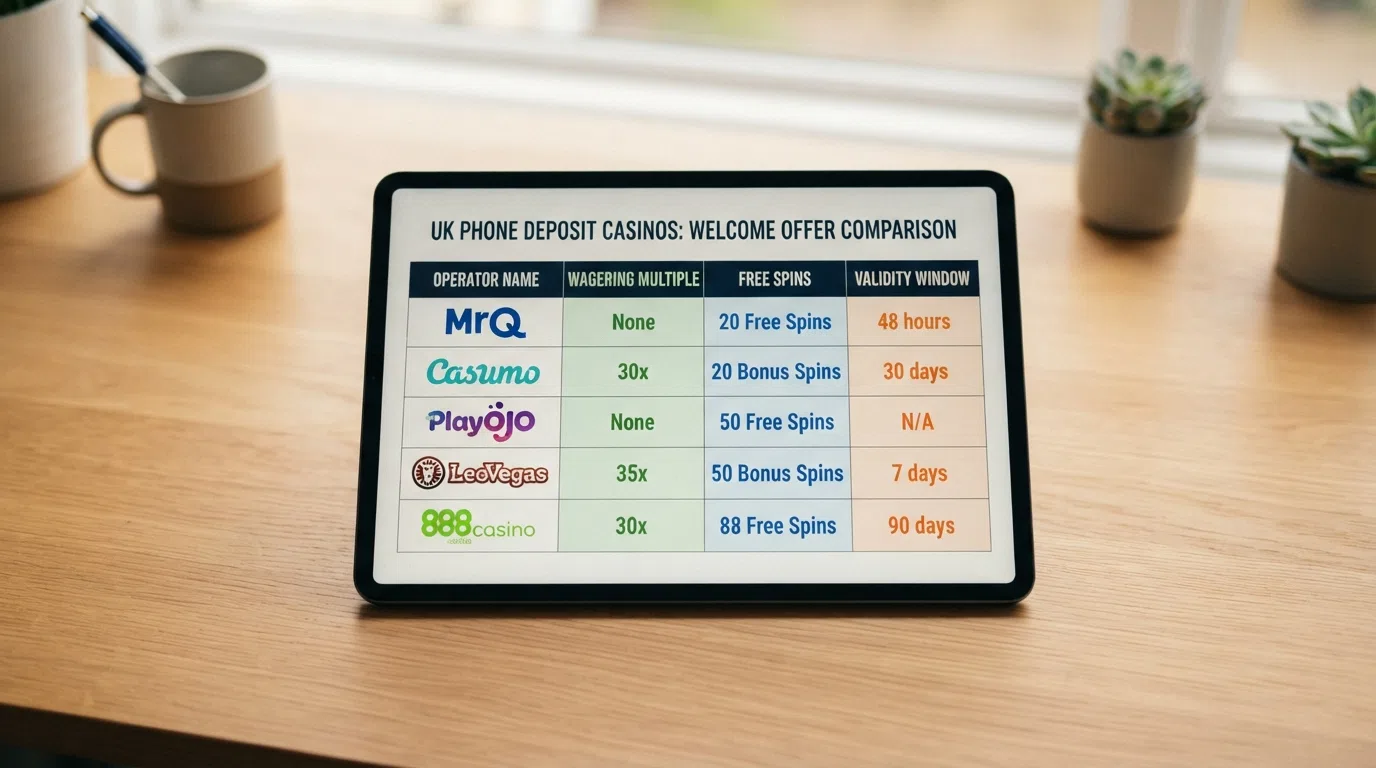
Ten UKGC-licensed operators were reviewed for pay-by-phone-bill support, bonus eligibility, and the offer a phone-bill deposit actually unlocks. The ranking is built on three checks: licence status verified, phone-bill deposit support confirmed, and bonus terms compared on wagering multiplier, validity window, game eligibility, and cashout caps using each operator’s published T&Cs in 2026.
| Operator | Phone Bill Deposit | Min Deposit | Welcome Offer | Wagering | Bonus Validity |
|---|---|---|---|---|---|
| MrQ | Yes (Fonix) | £10 | 100 FS on Big Bass Splash | 0× | 48 hours |
| Sky Vegas | Yes (excluded from bonus) | £5 (debit) / £10 (phone) | 200 FS | 0× | 7 days |
| Peachy Games | Yes (Boku-style) | £10 | 100% match + 100 FS | 10× | 48h FS / 30d bonus |
| Videoslots | Yes (Siru Mobile) | £5.12 | 100% up to £200 + 11 FS Starburst | 10×–20× | 30 days |
| Betway | No (debit card only) | £10 | 100% up to £50 or 150 FS | 10× / 0× | 7 days |
| BetUK | Yes (Pay by Mobile) | £10 | 50 FS on Big Bass Splash | 0× | 7d wager / 3d FS |
| LeoVegas | Yes (Pay by Mobile) | £10 | 50 FS on Big Bass Splash | 0× | 7d deposit / 3d FS |
| PlayGrand | Yes (Pay by Mobile) | £10 | 70 FS on Book of Dead | 10× | 10d FS / 30d bonus |
| Fruity King | Yes (PayViaPhone) | £10 | 100% up to £100 + 50 FS | 10× | 30d bonus / 7d FS |
| Mr Vegas | Yes (Siru Mobile) | £5.12 | 100% up to £200 + 11 FS Starburst | 35× | 30 days |
The headline finding is that wager-free bonuses dominate the top of the list, but phone-bill deposit eligibility varies sharply. MrQ, BetUK, and LeoVegas — the three top-ranked operators on bonus quality — all support phone-bill deposits for the welcome offer, and all three route the free spins through Big Bass Splash with zero wagering. Sky Vegas offers the largest free-spin count (200) at zero wagering, but phone-bill deposits are excluded from the welcome bonus; the offer is reachable only via debit card or Apple Pay. The statutory wagering cap of 10× (in force from 19 December 2025) is the hard ceiling across the list, and the operator that breaks it — Mr Vegas, with a 35× multiple on the deposit bonus — should be treated as a figure that needs verification against Mr Vegas’s current terms before a player commits.
MrQ — Wager-Free Spins With No Cashout Cap
MrQ is the standout phone-bill offer in the reviewed set. One hundred Big Bass Splash spins valued at 10p apiece, zero wagering, winnings credited as real cash with no maximum cashout limit. The wagering multiple is 0× — well below the statutory 10× ceiling that took effect on 19 December 2025. Fonix powers the phone-bill deposit, and the minimum is £10. The free-spin validity is 48 hours from crediting, which is short — a player who delays the second session forfeits the spins — but the absence of a wagering requirement and a cashout cap is the trade.
The game library runs to 300-plus slots from Pragmatic Play, NetEnt, and Play’n GO. Live dealer is present, and the same universal balance applies — the phone-bill deposit credits the account and the funds are fungible across categories. For a player who wants the cleanest version of the phone-bill welcome offer, MrQ is the operator to start with. The verdict: best wager-free phone-bill welcome in the reviewed set, with a 48-hour clock that demands a same-evening session rather than a weekend plan.
BetUK — 50 Wager-Free Spins From the LeoVegas Group
BetUK is part of the LeoVegas group and shares much of the parent brand’s structure. The welcome offer is 50 free spins on Big Bass Splash at 10p each, zero wagering, winnings withdrawable. The deposit and the 1× wager must be completed within 7 days, and the free spins expire 3 days after crediting — a tighter window than MrQ’s 48 hours from crediting, but the wagering step is minimal at 1×.
The phone-bill deposit is via Pay by Mobile at a £10 minimum, and there is no cap on free-spin winnings. The 0× wagering sits at the floor of the market, and the Big Bass Splash choice is the same Pragmatic Play title featured across the wager-free cluster. The 3-day free-spin expiry is the cost: a player who credits the spins on a Friday evening has until Monday evening to use them, and any unused spins are forfeit.
For a LeoVegas group player who wants a slightly different welcome offer from the parent brand’s, BetUK is the relevant comparison. The verdict: a leaner version of LeoVegas’s offer, with a shorter free-spin fuse and the same zero-wagering advantage.
LeoVegas — Mobile-First Brand With Wager-Free Spins
LeoVegas built its reputation on the mobile experience, and the welcome offer for 2026 fits that positioning. Fifty free spins on Big Bass Splash at 10p each, zero wagering, winnings withdrawable. The 7-day deposit-and-wager window and the 3-day free-spin expiry after crediting are the same as BetUK — the two operators share a parent group and a similar bonus structure.
The £10 minimum deposit is via Pay by Mobile, and the game library is broader than BetUK’s: NetEnt, Play’n GO, Pragmatic Play, and Evolution live-dealer tables, with thousands of titles across slots, table games, and live casino. The 0× wagering sits comfortably below the 10× statutory cap.
The trade-off versus MrQ is the shorter free-spin window. MrQ gives 48 hours from crediting; LeoVegas gives 3 days. Both are tight, but the 3-day window is more forgiving. The verdict: the mobile-first brand with a wager-free welcome, and a 3-day free-spin window that suits a player who can plan the session.
Sky Vegas — 200 Wager-Free Spins, but Phone-Bill Deposits Are Excluded From the Bonus
Sky Vegas offers the largest free-spin count in the reviewed set — 200 spins at 10p each, zero wagering. The 7-day expiry applies from crediting, and the Flutter Entertainment group backing means the game library runs to 700-plus titles from NetEnt, Pragmatic Play, and Playtech. On bonus quality alone, this is the headline number.
The phone-bill complication is decisive. Sky Vegas accepts phone-bill deposits for general play at a £10 minimum, but the welcome bonus is not reachable via phone bill. Debit card or Apple Pay is required. A phone-bill depositor who clicks “200 free spins” on Sky Vegas’s landing page and funds the account by phone will deposit, play, and miss the bonus — the spins will not be credited. Sky Vegas’s own support page confirms the exclusion.
For a player who holds a debit card and is willing to fund the welcome offer by card, Sky Vegas’s 200 wager-free spins are the largest zero-wagering offer in the reviewed set. For a player whose only payment method is phone billing, the offer is not available, and the operator competes on its general game library rather than its welcome. The verdict: the best wager-free count in the set, gated behind a payment-method restriction that phone-bill-only players will hit immediately.
Peachy Games — 100% Match and 100 Free Spins at the Statutory Wagering Ceiling
Peachy Games runs a traditional welcome package: 100% deposit match plus 100 free spins on Big Bass Splash at 10p each, with 10× wagering on the bonus funds. The 10× multiple is the statutory maximum — the same ceiling imposed across the UK market from 19 December 2025 — and Peachy Games uses it fully. The free-spin validity is 48 hours, the bonus-funds validity is 30 days.
The phone-bill deposit is via Boku-style Pay by Phone at a £10 minimum, and the game library runs to 700-plus titles from Pragmatic Play, Play’n GO, and NetEnt. For a player who wants a matched deposit and a free-spin bundle, Peachy Games is a complete package — but the cost is the 10× turnover on the bonus funds, which is the heaviest wagering burden in the wager-free cluster’s neighbourhood.
The 48-hour free-spin window is the same short fuse as MrQ’s. The 30-day bonus window is more forgiving. The match component is the reason Peachy Games is here rather than in the wager-free cluster: a player who values a deposit match over zero wagering will find the trade-off acceptable, and the 10× multiple is the market ceiling. The verdict: the full welcome package at the maximum legal wagering, for a player who wants a match plus spins and accepts the turnover.
Videoslots — The 7,000-Game Library With Siru Mobile Access
Videoslots runs the deepest game catalogue in the reviewed set — 7,000-plus titles from NetEnt, Microgaming, Play’n GO, and Pragmatic Play. The welcome offer is 100% match up to £200 plus 11 wager-free welcome spins on Starburst. Wagering on the deposit bonus is reported between 10× and 20× across sources, and players should verify the current figure against Videoslots’ own terms before committing. The bonus validity is 30 days.
The phone-bill deposit is via Siru Mobile at a £5.12 minimum — the £4 base plus Siru’s roughly 25% processing fee. The fee is the cost of access to the catalogue, and at the low end of the deposit scale it is the most expensive in the reviewed set. At higher deposits, the fee’s share drops, and the catalogue depth is the offset.
For a player who values game-library breadth over welcome-bonus simplicity, Videoslots is the operator to compare. The wagering uncertainty is a yellow flag rather than a red one, and the fee structure rewards larger deposits. The verdict: the deepest library in the set, accessible by phone bill at a fee, with a welcome offer whose wagering figure needs checking against current terms.
PlayGrand — Book of Dead Free Spins With a £100 Bonus Cashout Cap
PlayGrand’s welcome offer is 70 bonus spins on Book of Dead, with 10× wagering on the bonus funds. The 10-day free-spin validity and 30-day bonus validity are standard. The phone-bill deposit is via Pay by Mobile at a £10 minimum, and the game library covers Play’n GO, NetEnt, and Pragmatic Play.
The cashout cap is the relevant cost. Free-spin winnings at PlayGrand are subject to a £100 maximum cashout from bonus funds — a hard ceiling that wager-free offers do not carry. Book of Dead’s 5,000× max win is theoretical against this cap: a single bonus round on the slot can produce a return well above £100, and the cap means the excess is forfeit. The wagering step is 10×, and the bonus funds are subject to the same ceiling.
For a player who values Book of Dead as a specific game and accepts the £100 cap, PlayGrand is a focused choice. The cap is the structural difference from the wager-free cluster, and it should be read before the first spin. The verdict: a Book of Dead-focused offer with a wagering step and a hard cashout cap that wager-free alternatives lack.
Fruity King — 100% Match and Free Spins on the ProgressPlay Platform
Fruity King is a ProgressPlay platform brand. The welcome offer is 100% match up to £100 plus 50 free spins, with 10× wagering on the bonus funds and 10× on free-spin winnings within 7 days. The free-spin validity is 7 days, the bonus validity is 30 days. The phone-bill deposit is via PayViaPhone at a £10 minimum.
The conversion cap is the structural cost. Free-spin winnings are subject to a conversion cap of 1× the bonus amount or £20 from free spins — a tight ceiling that limits the upside of the spin bundle. The 10× wagering on bonus funds sits at the statutory maximum, and the 7-day free-spin validity is the shortest in the matched-deposit cluster.
For a player who values the ProgressPlay platform structure and is comfortable with the conversion cap, Fruity King is a reasonable choice. For a player who wants matched-deposit value with a lighter ceiling, the wager-free alternatives are the comparison. The verdict: a ProgressPlay welcome with a tight conversion cap and the statutory-maximum wagering.
Mr Vegas — Siru Mobile Access With the Highest Wagering in the List
Mr Vegas shares the Siru Mobile gateway with Videoslots and offers a comparable welcome: 100% match up to £200 plus 11 welcome spins on Starburst. The minimum deposit is £5.12 (£4 plus fee), the bonus validity is 30 days, and the game library runs to 7,000-plus titles.
The wagering figure is the problem. OLBG reports 35× wagering on the deposit bonus — by a wide margin the heaviest in the reviewed set. From 19 December 2025, the statutory wagering cap is 10× across all UK bonuses. A 35× multiple conflicts with the regulatory ceiling and should be treated as a figure that needs verification against Mr Vegas’s current terms. The bonus may have been updated to comply with the cap, or the figure may reflect an outdated snapshot.
For a player considering Mr Vegas, the verification step is non-negotiable: confirm the current wagering multiple against the operator’s own T&Cs before depositing. The Siru Mobile fee is a known cost, but the wagering figure is the unknown that decides whether the offer is worth taking. The verdict: an offer whose wagering multiple conflicts with the current statutory cap and must be verified against current terms before commitment.
Betway — No Phone-Bill Deposit Support, Included for Completeness
Betway is the operator in the reviewed set that does not accept pay-by-phone-bill deposits. The site’s own deposit terms page confirms debit-card-only funding, and the credit card ban (in force since 14 April 2020 under LCCP 6.1.2) means a credit card is not an alternative. The welcome offer is a choice: 100% match up to £50, or stake £20 and receive 150 free spins with zero wagering. The match bonus carries 10× wagering, the free spins carry 0×, and the registration window is 7 days.
The phone-bill exclusion is the whole point of including Betway. A reader who searches for a pay-by-phone-bill casino and lands on a list that does not flag Betway’s absence will waste a registration attempt on an operator that cannot accept their payment. The match offer is competitive on its own terms, but it is not reachable by phone bill.
For a player whose only payment method is phone billing, Betway is not a viable option regardless of the welcome offer’s quality. For a player with a debit card who is comparing wager-free free-spin offers against matched deposits, Betway’s 150-spin alternative is a relevant data point. The verdict: included for completeness, but excluded for phone-bill depositors; the offer is competitive, the payment-method gap is structural.
The Law Around Carrier-Billing Casino Payments in Britain
Two regulators govern a phone-bill casino deposit in the UK, and most guides name only one. The UK Gambling Commission licences the operator and enforces the rules of the product — game design, stake caps, bonus caps, identity verification. The Phone-paid Services Authority oversees the payment rail itself — billing disputes, premium-rate service complaints, consumer protection on the charge. The statutory deposit limits that define phone-bill play come from a third body entirely: the Financial Conduct Authority, enforcing PSD2’s premium-rate services ceiling. Three regulators, three remits, one transaction.
UK Gambling Commission Licensing: What It Means for Phone-Bill Players
A UK Gambling Commission operating licence is compulsory for any operator serving customers in Great Britain. The point-of-consumption reform under the Gambling (Licensing and Advertising) Act 2014 closed the previous offshore-licence loophole: a Gibraltar- or Malta-licensed operator serving GB customers is required to hold a GB licence, and the UKGC publishes a public register at gamblingcommission.gov.uk where any player can verify a licence.
The licence binds the operator to three licensing objectives under Section 1 of the Gambling Act 2005: preventing gambling from being a source of crime or disorder, ensuring gambling is conducted in a fair and open way, and protecting children and other vulnerable persons from harm or exploitation. The conditions are operationalised through the Licence Conditions and Codes of Practice (LCCP) and the Remote Gambling and Software Technical Standards (RTS), which set the rules on game design, stake caps, bonus caps, and player protection that this guide has cited throughout.
The criminal-law backdrop is real. Operating without a GB licence is an offence under Section 33 of the Gambling Act 2005 — up to 51 weeks’ imprisonment, an unlimited fine, or both. The penalty sits with the operator, not the player, but the consequence for the player is the loss of every protection a UKGC licence guarantees: no segregated player funds, no ADR access, no GAMSTOP coverage, no dispute resolution through the Commission. Every operator in the reviewed set is UKGC-licensed, and the public register is the verification step behind that fact.
The Phone-paid Services Authority: The Regulator Every Guide Overlooks
The Phone-paid Services Authority regulates premium-rate services and charge-to-mobile payments in the UK. The PSA’s remit is the payment rail, not the gambling product — it oversees how the money moves from the subscriber to the merchant, not what the merchant does with it. The PSA provides a complaints mechanism for billing disputes, separate from the casino’s own ADR scheme, and it is the body a player contacts when a charge-to-mobile transaction goes wrong at the network level rather than the casino level.
The £40 per-transaction and £240 monthly caps are not PSA-set, however. They are set by the Payment Services Regulations 2017 (Schedule 1, Part 2(l)) and enforced by the Financial Conduct Authority under PSD2. The PSA oversees the premium-rate services layer; the FCA sets the ceiling. Both regulators are relevant to a phone-bill deposit, and a player who has a billing dispute will likely find themselves dealing with the PSA, while a player who has a gambling dispute will find themselves dealing with the UKGC’s ADR route or the Commission’s complaints process.
The PSA’s role is consumer protection on the payment rail. A misdescribed charge, an unauthorised transaction, a network billing error — these are PSA matters, not UKGC matters. For the player, the practical consequence is that there is a regulator for the payment side of a phone-bill deposit, and it is not the Gambling Commission.
The Credit Card Ban and Phone Billing: A Grey Area the Industry Sidesteps
The credit card ban (LCCP 6.1.2, in force 14 April 2020) prohibits credit card deposits for all remote gambling in Great Britain. The ban extends to credit-card-funded e-wallet payments — funding a Neteller or Skrill account with a credit card and then using the e-wallet to deposit at a casino is also prohibited. The rule is one of the clearest in UK gambling regulation.
Phone billing creates a grey area. A monthly-contract phone bill paid by credit card produces an indirect chain: the player deposits at the casino by phone bill, the charge lands on the contract account, the contract bill is settled by credit card. The Gambling Commission’s position — cited via industry commentary — is that the charge is to the mobile account, not directly to the credit card, and the phone-bill deposit is therefore not a credit card deposit for the purposes of LCCP 6.1.2. The credit card is paying the network, not the casino.
The grey area is why some operators exclude phone-bill deposits from bonuses. Sky Vegas and Betway do not accept phone-bill deposits at all, and other operators in the reviewed set route phone-bill funding away from the welcome offer. The exclusions are not a UKGC requirement; they are the operators’ own decision to avoid the ambiguity. For the player, the practical consequence is that the bonus terms should be checked before depositing by phone bill — the welcome offer may not be reachable on the rail the player wants to use.
Player Fund Protection and Dispute Resolution
UKGC licence conditions require operators to hold player funds in segregated accounts. The protection means a player’s balance is not part of the operator’s corporate assets if the company becomes insolvent; the funds are held by a separate custodian and returned to players in a defined order of priority. The level of segregation varies — “basic” segregation offers no formal protection, while “medium” or “high” protection puts the funds in a trust or independent custodianship — and the operator’s player-fund protection rating is published on the UKGC register.
Dispute resolution runs through an approved Alternative Dispute Resolution (ADR) provider. Every UKGC-licensed operator must subscribe to an ADR scheme — typically IBAS or a similar body — and a player who cannot resolve a complaint directly with the casino can escalate to the ADR provider at no cost. The UKGC also operates a complaints process for issues that fall within its regulatory remit. For phone-bill-specific billing disputes, the PSA route runs alongside the casino’s ADR scheme.
The protection that does not exist is the protection an unlicensed site would never provide. No UKGC licence means no segregated player funds, no ADR access, no Commission complaints, no GAMSTOP coverage. A player on an offshore site has no statutory route for a dispute and no guarantee that the balance will be returned in any circumstance. The UKGC licence is the single fact that unlocks every other protection in this section.
How the £240 Monthly Cap Becomes a Safer-Gambling Ceiling
The £240 monthly carrier-billing cap was not designed to limit gambling losses. It was designed to protect consumers from runaway premium-rate-service charges — the kind of billing shock that the Phone-paid Services Authority was created to prevent. The fact that it functions as a de facto responsible-gambling ceiling for phone-bill-only players is a side effect, and a useful one.
The £240 Monthly Cap: An Accidental Responsible-Gambling Tool
For a player whose only deposit method is phone billing, the £240 monthly cap is a hard ceiling on play. The statutory limit is set by PSD2 and enforced by the FCA, not by the UKGC, but the practical effect is the same: once the cap is reached, no further phone-bill deposits can be authorised that month. The cap is per mobile subscriber, not per casino — it aggregates across every site that uses the same phone number, and a player who hits the cap at one operator cannot top up at another.
The combination of the £240 cap and the credit card ban is what makes the rail a structural safer-gambling tool. A player cannot use credit to exceed the limit: the credit card ban means no credit card deposit, and the £240 cap means no phone-bill deposit above the ceiling. The two rules together close the credit-funded path to chasing losses, at least on the phone-bill rail. A player with a debit card can still deposit by card, but a phone-bill-only player is constrained by the cap.
The cap is not a substitute for player-set deposit limits. UKGC rules require operators to prompt every customer to set a financial deposit limit before the first deposit, and that player-set limit is the primary safer-gambling tool. The £240 cap is a backstop — a ceiling that applies regardless of what the player has set, and a useful one for players who want a hard monthly maximum without having to set and enforce a personal limit.
GAMSTOP and Phone Billing: How They Interact
GAMSTOP is the national self-exclusion scheme, mandatory at every UKGC-licensed casino since 31 March 2020. Exclusion periods are six months, one year, five years, or five years with auto-renewal; the exclusion cannot be cancelled early, and it continues for up to seven years after the minimum period expires if the person does not contact GAMSTOP. The exclusion blocks account creation at every UKGC-licensed operator, regardless of payment method.
Phone billing does not offer a route around GAMSTOP. A self-excluded player who attempts to deposit by phone bill will be blocked at the identity-verification stage, not at the payment stage — GAMSTOP catches the registration before the deposit is initiated. The mobile network operator’s subscriber data is not a workaround; the MNO’s KYC feeds the casino’s onboarding process, and the GAMSTOP check runs against the player’s verified identity, not their payment instrument. The exclusion applies at the person level, not the method level.
For a player who has self-excluded, the relevant detail is the minimum exclusion period. Six months is the shortest, and the exclusion cannot be reversed during that period. Five years with auto-renewal is the longest, and the only one that does not require an active renewal decision. A player who has self-excluded and is now past the minimum period must contact GAMSTOP to reactivate — the exclusion does not lapse automatically in the way a cooling-off period does.
Deposit Limits, Reality Checks, and Session Tracking
UKGC rules require every operator to prompt customers to set a financial deposit limit before the first deposit, in force from 31 October 2025. Decreases to the limit take effect immediately; increases are subject to a cooling-off delay. A player who wants to lower a £200 weekly limit to £100 can do so at any time, and the new limit applies from the next deposit. A player who wants to raise a £50 weekly limit to £200 must wait for the cooling-off period to elapse, which gives a built-in pause for reconsideration.
Mandatory reality checks run during every session. The on-screen display must show net losses and wins and time played, and the operator must prompt a reality-check pop-up at intervals defined in the licence conditions. The display is continuous, not a pop-up that can be dismissed and forgotten, and the time-played counter is the same one the player will see on the cashier’s session-history page.
Financial vulnerability checks trigger at a £150 net deposit in a rolling 30-day period, in force from 28 February 2025. The check uses publicly available data only — CCJs, bankruptcy orders, IVAs — and is designed to flag players who may be in financial distress without requiring intrusive data sharing. The 97% frictionless-completion rate from the pilot suggests the check does not interrupt play for the vast majority of players, but it is a regulatory backstop for the cases where it does.
Where to Get Help: GamCare, BeGambleAware, and the NHS
Four frontline services are available to a UK player who is concerned about their gambling.
- National Gambling Helpline (GamCare) — 0808 8020 133. Available 24/7, over 52,000 calls per year, with 996 referrals to treatment in January 2026 alone — a 48% increase year-on-year. The helpline is the first point of contact for most players and operates as a confidential, non-judgemental listening and signposting service.
- NHS gambling clinics. Operating in England, Scotland, and Wales. NHS referrals rose from 2,284 in 2023/24 to 4,355 in 2024/25 — a 90.7% increase in a single year. The clinics offer structured treatment, including cognitive behavioural therapy, for players whose gambling has reached a clinical threshold.
- GambleAware. Funds research, education, and treatment through the National Gambling Support Network. GambleAware also hosts a free online self-test tool, alongside GamCare’s own self-assessment, for players who want to gauge their own gambling behaviour before deciding whether to seek help.
- Gamblers Anonymous. Peer-support groups across Great Britain, run on a fellowship model. Gamblers Anonymous is the longest-running gambling-specific support group in the UK and operates independently of the NHS and GamCare.
The numbers behind these services explain why they matter. Problem gambling prevalence in England is 0.4% of adults (PGSI 8+), with at-risk gambling at 1.6% (PGSI 3+). Among men, the rate is 2.2%; among 25–34 year olds, it is 3.5% — the highest in the survey. Of those who disclosed a form of gambling to the National Gambling Helpline in 2026, 82% cited online gambling specifically — the highest rate since 2021. The phone-bill deposit rail does not cause these patterns, but it sits inside a market where the patterns are real, and the help infrastructure is what surrounds the rail.
How We Chose and Ranked the Ten Operators
The ranking rests on three checks, each of which can be reproduced by a reader.
The first check is the UKGC public register. Every operator in the reviewed set was verified for an active remote casino operating licence at gamblingcommission.gov.uk. The licence is the floor: an unlicensed site is not eligible for inclusion, regardless of the welcome offer or the phone-bill support.
The second check is phone-bill deposit support confirmed via the operator’s own cashier or support documentation. Third-party guides that list “Payforit casino” or “Boku casino” without naming the operator are not a verification — the operator’s own deposit-terms page is. Where a brand’s site confirms phone-bill support, the operator is included. Where the site excludes phone-bill deposits from the welcome offer (Sky Vegas) or excludes them entirely (Betway), the limitation is noted in the write-up rather than used to disqualify the operator.
The third check is bonus terms compared on wagering multiplier, validity window, game eligibility, and cashout caps using each operator’s published T&Cs in 2026. The 10× statutory wagering cap (in force from 19 December 2025) is the benchmark, and offers at or below that ceiling are ranked ahead of offers above it. The £40 per-transaction and £240 monthly PSD2 limits apply to every phone-bill deposit in the reviewed set; no operator offers a higher limit, and no operator should.
The fourth consideration is the presence of a phone-bill payment provider — Fonix, Boku, Siru Mobile, or PayViaPhone — and whether phone-bill deposits qualify for the welcome offer. MrQ, BetUK, LeoVegas, and Peachy Games offer wager-free or near-wager-free bonuses on phone-bill deposits. Sky Vegas, Betway, and Mr Vegas carry phone-bill complications — either exclusion from the bonus, exclusion from the operator, or a wagering figure that conflicts with the current statutory cap. The ranking reflects these checks in order, and the write-ups flag the complications rather than smoothing them over.
When Phone-Bill Deposits Make Sense for Your Casino Play — and When They Don’t
Phone billing is the most privacy-preserving casino deposit method available to UK players. No bank details, no card numbers, no e-wallet linking — the casino receives a deposit confirmation keyed to a verified mobile number, and the charge lands on the phone account. For a player who does not want gambling transactions on a bank statement, or who is funding play from a prepay balance, the rail is the cleanest option.
The trade-off is the hard ceiling. £40 per transaction, £240 per month — and no withdrawal path. Every player who uses phone billing needs a verified alternative for cashouts, and the alternative is a debit card, a bank transfer, or an e-wallet that will appear on a bank statement. The privacy advantage at the deposit stage is reversed at the withdrawal stage, and the player who chose phone billing for privacy will hand over bank details anyway at cashout.
Phone-bill deposits make sense for the casual player who values privacy and wants a built-in spend ceiling. The £240 cap is a hard monthly maximum that applies regardless of the player’s own discipline, and the rail is a structural limit on chasing losses — a player cannot deposit more than the cap, and the cap is reached before the bank balance is. For a player who sets a personal deposit limit at the casino level, the rail is a useful backstop; for a player who does not set personal limits, the rail is the only limit that applies.
Phone-bill deposits do not make sense for the high-stakes player. The £40 per-transaction ceiling is below the stake cap on most table games and live-dealer titles, and the £240 monthly ceiling is below a serious slot player’s monthly turnover. A player who wants to run a £500 bankroll through a casino will hit the cap inside a week, and the rail stops being useful.
The bonus-exclusion problem is the structural surprise. Sky Vegas’s 200 wager-free spins are the headline offer in the reviewed set, and phone-bill depositors cannot claim them. Betway does not accept phone-bill deposits at all. Mr Vegas carries a wagering multiple that conflicts with the current statutory cap. The best offer on the page may not be the offer a phone-bill depositor gets, and the bonus T&Cs should be checked before funding.
The verdict: use phone billing for its strengths — privacy and automatic spend-capping — and pair it with a verified debit card or bank account for withdrawals, because the phone bill is a deposit rail and nothing more.
Frequently Asked Questions
Do I qualify for a welcome bonus if I deposit by phone bill?
It depends on the operator. MrQ, BetUK, LeoVegas, Peachy Games, Fruity King, and PlayGrand all support phone-bill deposits for the welcome offer, though wagering terms and free-spin games differ. Sky Vegas explicitly excludes phone-bill deposits from the welcome bonus — debit card or Apple Pay is required. Betway does not accept phone-bill deposits at all. Check the operator’s deposit-terms page before funding, because the welcome headline may not apply to your payment method.
Is pay by phone bill safe for UK casino deposits?
Yes, at UKGC-licensed operators. The payment rail is regulated by the Phone-paid Services Authority and the Financial Conduct Authority under PSD2, and the casino itself is licensed by the UK Gambling Commission. The deposit flow uses two-factor authentication via SMS PIN, and the mobile network operator holds the KYC data on the subscriber. The privacy advantage — no bank or card details shared with the casino — is real, and the rail is structurally safer than credit card deposits (which are banned) for players who want to keep gambling transactions off bank statements.
Does using pay by phone bill count as a credit card deposit?
No, not directly. The charge is to the mobile account, not to a credit card, and the UKGC’s position is that the phone-bill deposit is not a credit card deposit for the purposes of the LCCP 6.1.2 ban. The grey area arises when a monthly contract phone bill is paid by credit card, creating an indirect chain from credit card to casino. The Gambling Commission treats the mobile account as the payment instrument, but some operators exclude phone-bill deposits from bonuses to avoid the ambiguity. If your contract is paid by credit card, check the bonus T&Cs before depositing.
What is the maximum I can deposit using pay by phone bill at UK casinos?
The statutory ceiling is £40 per transaction and £240 per month, set by the Payment Services Regulations 2017 (Schedule 1, Part 2(l)) and enforced by the FCA. The monthly cap is per mobile subscriber and aggregates across every casino using the same phone number. Most operators set the practical per-transaction limit at £30, even though the statutory ceiling permits £40, and the minimum deposit is typically £5 to £10 depending on the operator. The caps apply equally to PAYG and contract customers.
Can pay-as-you-go customers use pay by phone bill at casinos?
Yes. PAYG customers can deposit by phone bill at every major UK network and most MVNOs. The deposit is deducted immediately from the available prepay balance, rather than appearing on a next-month bill, and the same £40 per-transaction and £240 monthly caps apply. A deposit that exceeds available prepay credit simply fails at the transaction stage — the casino balance is not credited and the player is not charged. The minimum deposit is typically £5 to £10, and PAYG customers should check that premium-rate services are enabled on their account before the first deposit.
What is the minimum deposit at a pay by phone bill casino in the UK?
Most phone-bill casinos set the minimum deposit at £10. Siru Mobile-powered operators (Videoslots and Mr Vegas) set the minimum lower, at £5.12, which reflects a £4 base deposit plus Siru’s roughly 25% processing fee. The minimum is set by the operator and the payment provider, not by statute — the £40 per-transaction and £240 monthly caps are maximums, not minimums. A player looking to deposit less than £5 by phone bill will find very few UKGC-licensed operators willing to accept the transaction.
Paying via Casino Apps: Does Phone Billing Work on Mobile?
The mobile-app experience is the best version of the flow. Most UKGC-licensed casino apps support phone-bill deposits natively in the cashier, and the experience is smoother than the mobile-web equivalent for one reason: the app stores the verified mobile number after the first deposit, so subsequent deposits skip the number-entry step. The flow shortens to amount, PIN, confirmation.
The SMS PIN verification is identical across providers and platforms. Boku and Fonix both route the PIN to the handset via the mobile network’s own SMS channel, and the PIN is entered on the app’s deposit screen. The funds clear into the casino balance within seconds, and the charge lands on the mobile account the same way it would on a desktop-initiated deposit.
The processing speed is a genuine advantage of the rail. Card deposits can take longer in the cashier — 3-D Secure checks, fraud-screening holds — while a phone-bill deposit authorised by SMS PIN has no equivalent step. The friction is in the network’s premium-rate check, which the subscriber resolves once at account setup, and the PIN entry, which takes a few seconds. After that, the deposit is live.
Live Dealer and Table Games: Does Phone Billing Reach the Full Casino?
A phone-bill-funded balance reaches the full game library. Roulette, blackjack, baccarat, game shows, and live-dealer studios are all available, and the balance is fungible across categories. The stake caps that apply to online slots do not extend to table games or live dealer — the £5/£2 per-cycle cap is a slots-only rule.
The live-dealer studios at the featured operators are largely the same suppliers. Evolution and Pragmatic Play Live power most of the live-dealer floors at LeoVegas, Betway, Videoslots, and the other major sites. The minimum stakes at live-dealer tables typically start at £0.50 or £1 per bet, but a single hand of blackjack or a spin of live roulette consumes the balance faster than a slot spin does — a £30 phone-bill deposit is enough for thirty slot spins at £1 or, at a 50p live-roulette minimum, sixty bets. The deposit ceiling is the same regardless of which game the player chooses; the depletion rate is not.
The game-design rules extend to non-slots products from 17 January 2025. The minimum game cycle is five seconds for non-slots casino games, and the same display requirements — net losses/wins and time played — apply during every session. The rules were written for slots first and rolled out to the wider online casino product afterwards; the player experience is the same enforcement, just at a different cadence.
Payments – nonukgc-licensedcasinos
Content created by the «nonukgc-licensedcasinos» team