
Where to Play Dice Games at UK Casinos — and What the Maths Actually Costs You
 Available in GB
A dice game at a UK online casino is not one product. It is three — two-dice Craps, three-dice Sic Bo and its multiplier-stacked variants, and live-dealer tower games such as Evolution’s Lightning Dice — and each one sits in a different corner of the casino floor with a different house edge attached. The slot lobbies that dominate the UKGC-licensed market do not advertise this. They bury the dice tables under a single sub-heading, even when the maths on offer is better than anything in the slots library above them. This guide is for the player who has noticed that and wants to know what is actually behind the link, and what it costs.

Current as of September 8, 2026; operator licence claims verified against the UK Gambling Commission’s public register.
What Are Casino Dice Games?
Dice are the oldest gambling implements in human history, and the maths has not changed since the Roman army played them on campaign tents. What the digital casino added was not new odds. It added delivery — a video stream, a random number generator, a betting grid that lights up the moment the dice stop — and three distinct families of games that sit between the slots floor and the card tables.
The first family is two-dice table games, led by Craps and its live-dealer Evolution variant. Two dice, a come-out roll, a point to chase, and the deepest bet-selection layer of any casino game on the floor. The second family is three-dice games, dominated by Sic Bo and the live-dealer reinventions that Evolution and Pragmatic Play have built on top of it — Super Sic Bo, Mega Sic Bo — where three dice settle and a betting grid pays according to the total or the specific combination. The third family is the live-dealer tower format, where Lightning Dice and a handful of similar titles drop three dice through a transparent vertical structure, with random multipliers striking selected totals as the dice fall. The rules are not what the third family adds. The drama is.
These three families sit in a specific place in the casino ecosystem: more skill-shaped than slots, because the player chooses between bets with different house edges, and faster than card tables, because a round resolves in seconds rather than the minute or so a blackjack hand can take. That positioning is the reason a serious dice player picks a casino for its Craps and Sic Bo coverage, not its slot catalogue. The slots are a side benefit.
The fundamental difference between a dice table game and a dice-themed slot is the one to hold on to. A dice table game lets you pick from bets with different house edges — the Pass Line at 1.41% in Craps, Big/Small at 2.78% in Sic Bo, with the Odds Bet at a true 0% in Craps. A dice-themed slot — Dice Roll, Dice and Roll, the rolling-dice titles in provider catalogues — is a reel-spinning game with a single fixed return-to-player percentage, and the dice imagery is decoration. The numbers on the symbols do not change the maths. The maths is slot maths, with a standard return of around 96% rather than the 98.59% a Craps Pass Line bet returns on a winning round.
The Dice Game Types Available at UK Casinos
Two-dice games at UK casinos are essentially Craps. The game’s structure is two-stage: a come-out roll that either resolves the bet immediately (on a 7 or 11 for Pass Line backers) or sets a “point” number (4, 5, 6, 8, 9 or 10) that the next rolls chase. Hit the point before a 7, the Pass Line wins; see a 7 first, it loses. This is the structure that makes Craps unique among casino dice games, and the structure that gives it the lowest house edge on the floor when played correctly. Evolution’s live Craps at Bet365, William Hill, Ladbrokes, Betfair, Coral, Sky Vegas, Betfred, Grosvenor, BetMGM UK and BoyleSports carries a Pass Line return of 98.59% (1.41% house edge) and a Don’t Pass return of 98.64% (1.36% house edge), with the Odds Bet — placed behind the line once a point is set — paying true odds with a 0% house edge. The Odds Bet is the only zero-edge wager in any casino game, anywhere, and it is the reason Craps is structurally the cheapest dice game to play.
Three-dice games at UK casinos are Sic Bo in its various guises. The standard Sic Bo betting grid runs from the safest bets (Big, 11 to 17; Small, 4 to 10) at a 2.78% house edge, through specific triples and doubles at much higher edges, to the specific-total bets that pay 6 to 180 to 1 depending on the total. The 2.78% baseline is the one to anchor to. Evolution’s Super Sic Bo adds random multipliers of up to 1,000× to selected winning combinations every game round, which lifts the headline payout ceiling and drags the worst bets further into lottery territory — Super Sic Bo’s full RTP range runs 95.02% to 97.22% depending on which bet the multiplier strikes. Pragmatic Play’s Mega Sic Bo runs the same play with a similar multiplier feature and a 95.47% to 97.22% RTP range.
Lightning Dice is the live-dealer tower format that Evolution built specifically for the three-dice sum, with no individual combination betting — only the total. Three dice drop through stacked transparent levels, and random multipliers of up to 1,000× strike selected totals before the dice land. The game’s standard RTP is 96.03% to 96.21% across most bet types, with Triple bets returning 96.57%. Volatility is high — the multipliers drive the upside, and the bulk of the bets lose small. Lightning Dice is Evolution’s product at Bet365, William Hill, Ladbrokes, Betfair, Sky Vegas, Betfred, Grosvenor, BetMGM UK and BoyleSports.
The divide that actually matters for a UK player is live-dealer versus RNG. The maths is identical. The Odds Bet pays the same in both. What changes is the delivery — a video stream with a human dealer for live, an animation driven by a random number generator for RNG — and the pace. A live dice round takes longer because the dealer runs the table, the dice are physical, and the studio rhythm sets the tempo. An RNG round resolves the moment the player presses the button. British Gambler put it directly: “Craps is less common online than slots, but UK players can play it at UKGC-licensed casinos in two forms: live dealer craps (such as Evolution’s live craps) and RNG craps.” Both are legal, both are licensed, both carry the same house edge. Pick by temperament, not by odds.
How Dice Games Work: Rules and Gameplay
A Craps round starts with the come-out roll. The shooter — the player rolling the dice, or in live-dealer Craps the studio’s automated dice launcher — throws two dice. Pass Line backers win immediately on a 7 or 11 and lose immediately on a 2, 3 or 12. Any other number — 4, 5, 6, 8, 9, 10 — becomes the point. From that point on, the shooter rolls until either the point number comes up again (Pass Line wins) or a 7 comes up first (Pass Line loses). The Don’t Pass bet inverts the logic: win on 2 or 3, lose on 7 or 11, push on 12, and from the point onward, the Don’t Pass wins if a 7 comes up before the point does. The two bets are the foundation of everything else on the layout, and the only sensible ones for a player who cares what the wager costs them.
The Odds Bet is what a Craps player adds once a point is set, and the reason Craps is the cheapest game on the floor. The Odds Bet pays true odds — 2 to 1 on a point of 4 or 10, 3 to 2 on 5 or 9, 6 to 5 on 6 or 8 — and the house takes no edge on the payout. A 0% house edge is not common in casinos. It is, in fact, not present anywhere else. The reason casinos offer it is that the Odds Bet can only be placed behind a Pass Line or Don’t Pass bet, which carries the edge. The Odds Bet is the side; the line bet is the cut the house always takes.
Sic Bo plays out on a betting grid that lists every possible three-dice outcome in front of the player. The dice settle, and every bet that matches the result pays according to its posted odds. Big and Small are the simplest: Big wins on any three-dice total of 11 to 17 (excluding triples, which lose), Small wins on 4 to 10 (also excluding triples), and both pay 1 to 1 with the 2.78% house edge already baked in. Specific triples — betting that all three dice show, say, a 4 — pay 180 to 1 but carry a house edge in the high teens. Specific doubles pay 10 to 1. Specific totals pay between 6 to 1 and 50 to 1 depending on how probable the total is. Super Sic Bo and Mega Sic Bo add the random multiplier: any winning combination can be lifted by a 5×, 10×, 50×, 100× or 1,000× multiplier drawn before the round. The multipliers strike often enough to keep the headline ceiling real and rarely enough to make the worst bets statistically worse. The 2.78% Big/Small anchor remains the right place to be.
Lightning Dice is a single bet type — the three-dice total, from 3 to 18 — with random multipliers attached. Each round, the studio draws a handful of lucky numbers and assigns each a multiplier; if a die total lands on a lucky number, the player’s winning bet on that total is multiplied by the posted figure. Evolution’s house wording: “Our Super Sic Bo is the classic, simple dice game that we’ve re-invented and made super exciting by adding random multipliers of up to 1000x in every game round.” The same logic applies to Lightning Dice. The high multipliers look generous in the marketing; in the maths, they shift returns between bet types rather than lifting the average. Triple bets return 96.57% because they are the rarest outcome; standard totals return 96.03% to 96.21% because they are the most common.
RNG dice and live dice share identical rules and identical probabilities. The difference is the experience: live dealer dice is a social, paced, video-streamed game with a human presence (even if the dice launcher is automated), and RNG dice is a click-and-resolve product that feels closer to a slot. Both run under the same UKGC licence conditions, both pay the same odds, both report the same RTP to the regulator. There is no edge-quality argument for one over the other.
Dice Game Odds, Strategy and Payouts
The house edge is the price the player pays for the bet, expressed as a percentage of every pound staked over a long run. A 1.41% house edge means the player loses, on average, £1.41 for every £100 wagered. The longer the session, the closer the actual loss lands on that figure. The shorter the session, the wider the spread around it. A player who bets £10 once and wins £18 has beaten the house edge for the round. A player who bets £10,000 across an evening is mathematically certain to land close to losing 1.41% of it.
The four numbers that frame dice strategy at a UK casino are these:
- Craps Pass Line: 1.41% house edge (RTP 98.59%) — the lowest-edge dice bet on the floor.
- Craps Don’t Pass: 1.36% house edge (RTP 98.64%) — fractionally lower than Pass Line, but plays against the table, which most players find unsociable.
- Craps Odds Bet: 0% house edge — the only zero-edge wager in any casino game, added behind a line bet once a point is set.
- Sic Bo Big/Small: 2.78% house edge (RTP 97.22%) — the lowest-edge three-dice bet.
Anything else on the Craps layout — proposition bets, the Field, hardways, the Any Seven bet — carries a house edge of 5% to 16%. A proposition bet on a specific triple (three 6s, say) returns 30 to 1 and costs the player about 13.9% of every pound staked over time. A Field bet pays 2 to 1 on 12 and roughly even money on most other totals, with a house edge around 5.5%. These bets are not a strategy. They are a lottery ticket, paid for at a higher price than the National Lottery charges for its lowest-tier draws.
On the Sic Bo grid, the same pattern holds. Big/Small at 2.78% is the bottom rung. Specific triples at 16% or so. Specific doubles at 18.75%. The Super Sic Bo and Mega Sic Bo multiplier features do not change the house edge on Big/Small — they only modify the payout ceiling on the worst bets. Big/Small remains the right place to anchor, with the multipliers a separate game the player is free to ignore.
Lightning Dice’s 96.03% to 96.21% standard RTP and 96.57% on Triple bets sits between Craps and the lower-edge Sic Bo bets. The multipliers do not improve the average; they redistribute the variance. A player who bets only on low-probability totals with multipliers attached will see more dramatic payouts and faster drawdowns. A player who bets on common totals will see the 96% RTP land more predictably. The first profile is entertainment, the second is closer to how dice is played as a numbers game.
The strategy that emerges from the maths is the same one the professional dice community repeats. Stick with the low-house-edge main bets — Pass Line, Don’t Pass, the Odds Bet, Sic Bo Big/Small — and treat the high-multiplier side bets as occasional entertainment, not a profit plan. The casino’s edge is not negotiable, but the cost of play is. A player who bets only the main bets at a 1.41% or 2.78% edge will lose a small, predictable slice of bankroll over a long evening. A player who chases Lightning Dice multipliers on every round will lose a larger slice, faster, with the consolation of a few large payouts that do not on average offset the cost.
The 10 UK Casinos With the Richest Dice Game Selection in 2026
The ten operators below are all confirmed active on the UK Gambling Commission’s public register, which held 2,663 records at the time of writing. The ranking looks at four things in order: licence status, dice-game variety, live-dealer dice presence, and welcome bonus fairness. Slot-library depth is a secondary factor because dice players will use the slots lobby for free-play practice and for the welcome spins, not as the primary reason to choose a casino.
| Operator | UKGC Licence | Dice Games Available | Welcome Bonus | Slot Count |
|---|---|---|---|---|
| Bet365 | Active, public register | Evolution Craps Live, Sic Bo, Lightning Dice | Up to 500 free spins, no wagering on winnings; min £10 lifetime deposit | 1,000+ |
| William Hill | Active, public register | Craps, Sic Bo, Lightning Dice, Bac Bo | 200 free spins, 10p each, 10× wagering on winnings, £30 cap, 72h expiry | 800+ |
| Ladbrokes | Active, public register | Craps, Sic Bo, Bac Bo, Lightning Dice, game-show variants | 100 wager-free spins on £10 deposit and stake | 1,500+ |
| Betfair | Active, public register | Craps, Sic Bo, Lightning Dice | 50 no-wagering spins + 100 more with £10 stake | 500+ |
| Coral | Active, public register | Sic Bo, Craps (Playtech) | 100 wager-free spins, 10p each, on £10 deposit and stake | 1,000+ |
| Sky Vegas | Active, Flutter group, public register | Craps, Sic Bo, Lightning Dice | 50 no-deposit free spins + 200 on £10 deposit and spend, no wagering on winnings | ~350 |
| Betfred | Active, public register | Sic Bo, Craps, Lightning Dice | 200 wager-free spins on £10 stake, selected titles | 600+ |
| Grosvenor (Rank Group) | Active, public register, plus land-based casino licences | Sic Bo, Craps, Lightning Dice | Deposit £20, get £30 bonus, 10× wagering | 500+ |
| BetMGM UK | Active, public register | Sic Bo (Pragmatic Play Live with Mega Multiplier), Lightning Dice, Craps | 100 free spins on £10 deposit | 1,000+ |
| BoyleSports | Active, public register | Sic Bo, Craps, Lightning Dice | Up to 100 free spins, 10p each, £20–£100 stake, 72h expiry, incl. Snakes and Ladders Megadice | 400+ |
What Makes a Dice Casino Worth Your Time
UKGC licensing is not a marketing line at a UK-facing casino. It is the prerequisite for every other claim the operator makes. A licence on the public register means the operator has passed the Commission’s fit-and-proper tests, has segregated player funds, has an approved alternative dispute resolution provider, submits to the Commission’s enforcement and contributes to the statutory levy that funds treatment and research. Every operator in this ranking is verified active on the public register. None of them is operating on a Curaçao licence, an MGA licence, or any other regulatory framework. A UK player who chooses one of these ten is operating inside the British consumer protection regime. A UK player who chooses a Curaçao-licensed crypto dice site is not. The difference is not theoretical — it is the difference between having a complaint route and not having one.
Dice-game count and variety separate the strong from the weak. A casino that carries Craps, Sic Bo and Lightning Dice gives a player the full dice library. A casino that carries only one of the three is a slot casino with a dice afterthought. The featured set splits roughly down the middle: Bet365, William Hill, Ladbrokes, Betfair, Sky Vegas, Betfred, Grosvenor, BetMGM UK and BoyleSports all carry at least three of the major dice games, with William Hill and Ladbrokes running the widest variant counts through the inclusion of Bac Bo and dice game-show formats.
Live-dealer availability and provider quality matter because the best live dice is on Evolution, with Pragmatic Play a credible second. Evolution powers Craps Live, Super Sic Bo and Lightning Dice — the three products that define what live dealer dice looks like in 2026. Pragmatic Play powers Mega Sic Bo, the alternative multiplier-stacked format. A casino powered by both — Bet365, Ladbrokes, Coral, Sky Vegas, BetMGM UK and BoyleSports among them — gives the player more live-dice options than a casino on one or the other.
Welcome bonus terms are where most UK players go wrong, and the section below covers the maths in detail. The short version: free spins with no wagering on winnings (Ladbrokes, Coral, Betfred, Betfair’s first 50, Sky Vegas, Bet365) are worth more per spin than free spins with 10× wagering on winnings (William Hill). A deposit-match bonus on bonus funds with 10× wagering (Grosvenor) sits in between, and the cost of clearing the bonus depends on the game’s RTP at the casino where it is cleared.
Bet365
Bet365 is the market heavyweight in the featured set, and its live casino lobby is the most complete for dice: Evolution Craps Live, Sic Bo and Lightning Dice are all present, plus the standard Pragmatic Play Live tables. The slot library runs to 1,000-plus titles with demo mode on selected games, which means a player can test an unfamiliar dice-themed slot before staking real money. The welcome offer is up to 500 free spins on the “Drops and Wins” selection of slots, with no wagering on the winnings and a £10 minimum lifetime deposit to qualify — among the strongest headline numbers in the UK market.
The standout feature for a dice player is the depth of the live casino. Bet365 sits at the centre of the Evolution distribution network in the UK, which means new Evolution dice titles (and the occasional new variant of Craps or Sic Bo) tend to land here first. For a player who wants the full live-dice catalogue under one roof, Bet365 is the cleanest answer.
William Hill
William Hill carries four live dice variants in its live casino — Craps, Sic Bo, Lightning Dice and Bac Bo — which puts it at the widest dice-variant count in the featured set alongside Ladbrokes. The 800-plus slot library offers practice play, and the welcome offer is 200 free spins on a £10 deposit and stake at 10p per spin, with 10× wagering on the winnings, a £30 cap and a 72-hour expiry window.
The 10× wagering on winnings is the part to read carefully. A player who hits the maximum £30 cap at the end of the wagering cycle will turn £30 into £30 only if the wagering lands — the 72-hour expiry also forces the use of the spins within three days, which compresses the practical value of the offer. For a player who plays the dice tables seriously and treats the welcome spins as a slot-side experiment, William Hill’s dice coverage is the draw. The bonus is the second tier of the proposition, not the first.
Ladbrokes
Ladbrokes carries Craps, Sic Bo, Bac Bo and Lightning Dice in the live casino, with game-show variants carrying dice elements confirmed in the operator’s own blog content. The 1,500-plus slot catalogue is the largest in the featured set, and demo mode is available on selected titles. The welcome offer is 100 wager-free spins on a £10 deposit and stake.
For a player who treats the slots library as seriously as the dice lobby — and the size of the Ladbrokes slot catalogue does invite that — this is the operator to start at. The wager-free welcome is a clean, no-conditions-on-winnings offer, which is the format the market has been moving towards since the 10× bonus cap came in. The 100 spins are the lower end of the wager-free range; the slot count makes up for the headline.
Betfair
Betfair carries Craps, Sic Bo and Lightning Dice in the live casino and runs a smaller 500-plus slot library with practice play available. The welcome offer is split: 50 free spins with no wagering on winnings, plus 100 more spins triggered by a £10 stake. Two bites at a wager-free welcome, the second contingent on the player staking rather than depositing.
The split structure is unusual in the featured set. The 50-spin tranche is unconditional on stake; the 100-spin tranche requires a £10 stake before it triggers. For a player who plans to stake anyway, the second tranche is free. For a player who only intended to deposit and play demo dice, the second tranche adds a cost. Worth reading the trigger carefully before the deposit.
Coral
Coral is the operator on the featured set whose dice lobby is built on a different provider backbone. Sic Bo and Craps are confirmed in the Playtech-powered table games section — a less common configuration than the Evolution-dominated set around it. The slot library is 1,000-plus titles with demo mode available, and the welcome offer is 100 wager-free spins on a £10 deposit and stake at 10p per spin.
A player who has already played every Evolution Craps table and is looking for a Craps variant on a different studio’s platform will find what they want at Coral. The 100 wager-free spins are the headline value. The Playtech dice products are the differentiator.
Sky Vegas
Sky Vegas sits inside the Flutter group and is UKGC-licensed on the public register. The dice lobby lists Craps, Sic Bo and Lightning Dice. The slot library is a curated ~350 titles, the smallest in the featured set, with demo mode on selected games. The welcome offer is the standout: 50 no-deposit free spins plus 200 free spins on a £10 deposit and spend, all with no wagering on winnings.
The 50 no-deposit spins are the only no-deposit offer in the featured set. A player who wants to test a casino’s slots before committing a deposit has a clean path here. The 200-spin deposit tranche is the second-largest wager-free offer in the set. The smaller slot library is a constraint — Sky Vegas is a curated casino, and the 350 titles are picked rather than encyclopaedic.
Betfred
Betfred carries Sic Bo, Craps and Lightning Dice in the live casino and a 600-plus slot library with practice play available. The welcome offer is 200 wager-free spins on a £10 stake, on selected titles. This is the highest free-spin count among the wager-free offers in the featured set, and the selected-titles restriction is the only friction.
The 200 wager-free spins at Betfred are the headline number. The “selected titles” condition means the player does not get to pick which slots the spins land on, which is a real constraint for a player who had a specific game in mind. The wager-free structure means winnings are paid in cash, which makes the headline number honest in a way the William Hill offer is not.
Grosvenor (Rank Group)
Grosvenor is the only operator in the featured set that holds both land-based casino licences and an online dice product. The online casino carries Sic Bo, Craps and Lightning Dice in the live casino, with 500-plus slots and demo mode on selected titles. The welcome offer is a deposit-match bonus — deposit £20, receive a £30 bonus — subject to 10× wagering on the bonus funds.
The deposit-match is the one cash-style bonus in the featured set. The 10× wagering is at the current UKGC cap. The £30 bonus is the largest nominal bonus value in the set, but its real cost depends on the game it is cleared on — and the section below walks through what that costs in practice. The land-based heritage is the differentiator for a player who already knows the Grosvenor name from a high-street casino.
BetMGM UK
BetMGM UK is the newer UK entrant on the featured set. Sic Bo is confirmed in the live casino, with Pragmatic Play Live’s Mega Sic Bo (the Mega Multiplier variant) on the platform alongside Lightning Dice and Craps. The slot library runs to 1,000-plus titles with demo mode on selected games. The welcome offer is 100 free spins on a £10 deposit.
The Pragmatic Play Live presence is the draw. A player who has played every Super Sic Bo table on Evolution and wants to compare the Mega Multiplier version on Pragmatic Play’s platform will find it at BetMGM UK. The 100-spin welcome is a standard free-spin offer without the wager-free or no-deposit framing of the strongest offers in the set.
BoyleSports
BoyleSports carries Sic Bo, Craps and Lightning Dice in the live casino and a 400-plus slot library with demo mode on selected titles. The welcome offer is up to 100 free spins on a £20 to £100 stake at 10p per spin with a 72-hour expiry, on selected titles including Snakes and Ladders Megadice — a dice-themed slot that appears in the welcome terms of this operator only.
The Snakes and Ladders Megadice tie-in is the standout for a player who has been looking for a dice-themed slot connected to a welcome offer. The 72-hour expiry and the selected-titles restriction are the same kind of friction BoyleSports shares with William Hill — useful, but not a wager-free offer. The Irish bookmaker heritage carries over to the casino product.
From Craps to Lightning Dice — Every Dice Game Worth Your Time
The dice games UK online casinos actually carry in 2026 break into four families: Craps and its live-dealer variants, Sic Bo and its multiplier-stacked reinventions, Lightning Dice and other live-dealer tower formats, and dice-themed slot machines that share the imagery but not the maths. The table below summarises the headline numbers; the prose that follows goes through each family in the order a player is likely to encounter them.
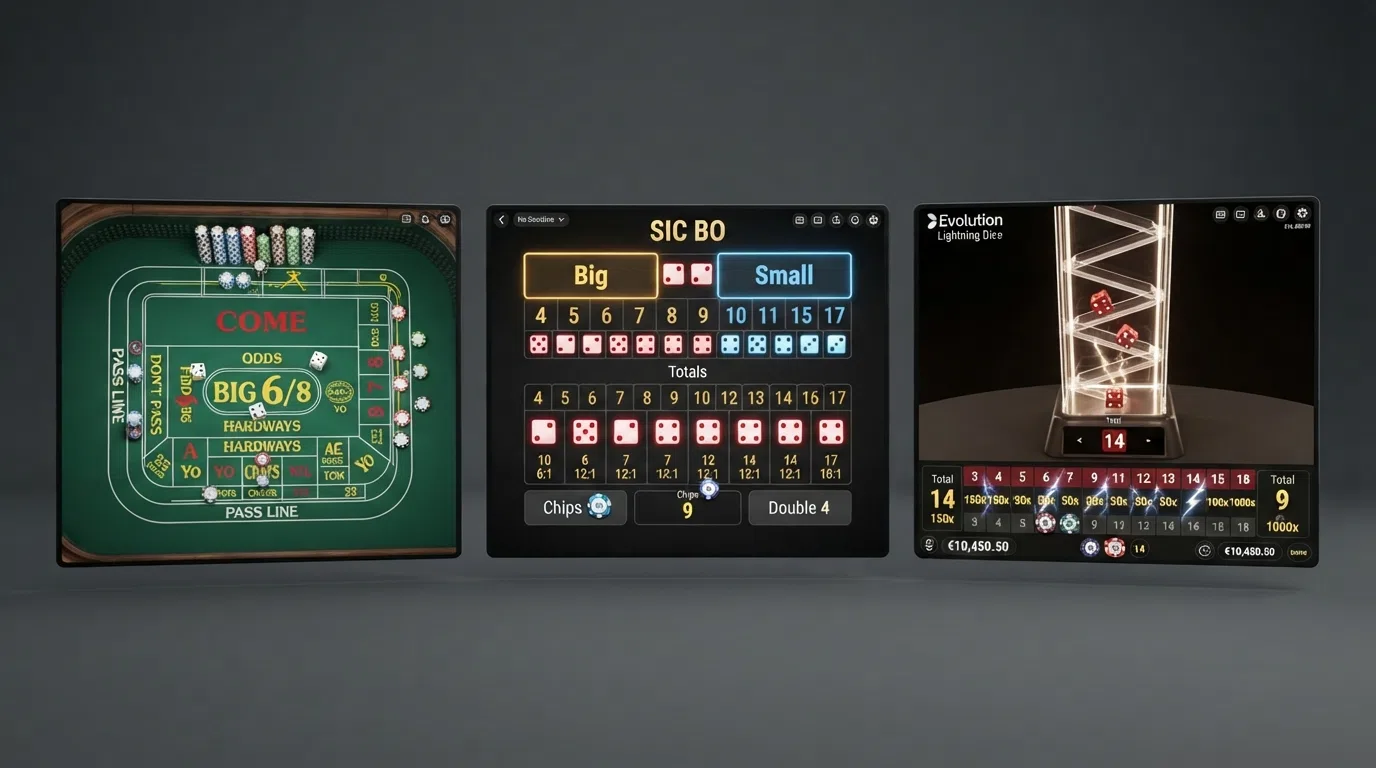
| Game | RTP | House Edge | Max Win Multiplier | Provider |
|---|---|---|---|---|
| Craps Live (Pass Line) | 98.59% | 1.41% | — | Evolution |
| Craps Live (Don’t Pass) | 98.64% | 1.36% | — | Evolution |
| Craps Live (Odds Bet) | 100% | 0% | — | Evolution |
| Super Sic Bo (Big/Small) | 97.22% | 2.78% | 1,000× | Evolution |
| Super Sic Bo (full range) | 95.02%–97.22% | 2.78%–4.98% | 1,000× | Evolution |
| Mega Sic Bo (full range) | 95.47%–97.22% | 2.78%–4.53% | 1,000× | Pragmatic Play |
| Lightning Dice (standard bets) | 96.03%–96.21% | 3.79%–3.97% | 1,000× | Evolution |
| Lightning Dice (Triple bets) | 96.57% | 3.43% | 1,000× | Evolution |
Craps: The Classic Two-Dice Casino Game
Craps is the two-dice classic with the deepest strategy layer and the lowest house edge on the casino floor. The game’s come-out and point-phase structure is unique among dice games: a single roll can end the round or open a chase that lasts several more rolls, and the player who understands the difference between Pass Line, Don’t Pass and the Odds Bet is playing a different game from the player who does not. The Pass Line at 1.41% and Don’t Pass at 1.36% are the two core bets, and the Odds Bet — placed behind the line once the point is set — pays true odds with a 0% house edge. That 0% is the only zero-edge wager in any casino game, and it is the structural reason Craps is the cheapest game a UK player can play, in house-edge terms, at any UKGC-licensed casino.
The proposition bets — the specific triples, the hardways, the Any Seven — carry house edges of 5% to 16%. The Field bet runs around 5.5%. A player who treats these as strategy is paying 5 to 15 times the cost per round they would pay at the Pass Line, with no upside the maths supports. The professional guidance, which holds at every UKGC-licensed casino in the featured set, is to treat the proposition bets as a lottery ticket. Buy one occasionally if the table feels dull. Do not build a session around them.
British Gambler frames the UK availability directly: “Craps is less common online than slots, but UK players can play it at UKGC-licensed casinos in two forms: live dealer craps (such as Evolution’s live craps) and RNG craps.” The two forms are functionally identical. RNG Craps is faster and quieter; live Craps is slower and more social. The maths is the same.
Sic Bo: The Three-Dice Casino Game
Sic Bo is the three-dice staple, and the Big/Small bet is its 2.78% house-edge baseline. Big (11 to 17, excluding triples) and Small (4 to 10, excluding triples) both pay 1 to 1, and either is the right place to start for a player who has never placed a Sic Bo bet. Everything else on the Sic Bo grid carries a higher house edge, and the gap grows fast: specific triples pay 180 to 1 at around 16% house edge, specific doubles pay 10 to 1 at 18.75%, and specific totals pay between 6 to 1 and 50 to 1 with edges that vary by total.
The multiplier-powered variants change the visual drama of the grid without changing the basic bet economics. Evolution’s Super Sic Bo adds random multipliers of up to 1,000× to selected winning combinations every game round, with the studio’s own framing: “Our Super Sic Bo is the classic, simple dice game that we’ve re-invented and made super exciting by adding random multipliers of up to 1000x in every game round.” The multiplier strikes happen often enough to make the worst bets on the grid more volatile — a 180-to-1 specific triple that wins with a 1,000× multiplier is the kind of result the marketing screenshot is built around, and it is also a result that lands a tiny fraction of the time. Pragmatic Play’s Mega Sic Bo is the same play with a similar feature, branded Mega Multiplier. The Mega Multiplier version runs on the same 1,000× ceiling and the same 95.47% to 97.22% RTP range.
The honest framing: Big/Small is the right anchor. Super Sic Bo and Mega Sic Bo are the same game with a multiplier on top. The multipliers do not improve Big/Small; they modify the payout ceiling on the bets a player should not be making anyway.
Lightning Dice and Live Dealer Dice Games
Lightning Dice is the live-streamed tower-drop game where three dice fall through a transparent vertical structure and random multipliers strike selected totals as they fall. The spectacle is the point of the product — a physical dice drop captured on a multi-camera studio setup — and the betting grid is deliberately simpler than Sic Bo’s. The player bets on the three-dice total only, from 3 to 18, with the multipliers attached to specific totals before the drop. Standard bet types return 96.03% to 96.21% RTP, with Triple bets (all three dice the same) at 96.57%. Maximum win is 1,000× the stake. Volatility is high, which is the studio’s way of saying the multipliers drive the upside and the bulk of the bets land on a small loss.
The live-dealer divide that matters in this corner of the floor is between Lightning Dice and the older live-dealer Sic Bo. Lightning Dice is a single bet type (the total) with multipliers; live Sic Bo is a full grid with or without multipliers. A player who wants the deepest bet-selection layer plays live Sic Bo. A player who wants the drama of the drop and the multiplier spectacle plays Lightning Dice. Both run at the same UKGC-licensed casinos, on Evolution’s studio platform, with the same deposit and limit infrastructure underneath.
The wider live-dealer dice space is thin. Evolution’s Craps Live, Super Sic Bo and Lightning Dice carry the floor at most UKGC-licensed operators. Pragmatic Play Live’s Mega Sic Bo is the alternative at BetMGM UK and other Pragmatic-Play-stocked sites. Bac Bo, a two-dice baccarat-dice hybrid, appears at William Hill and Ladbrokes and is its own category — closer to baccarat in structure than to Craps or Sic Bo. The table above does not list Bac Bo because it is a hybrid, not a dice-table game in the strict sense.
Dice-Themed Slot Machines
A dice-themed slot looks like a dice game. It is not. The reels spin, the RNG determines the outcome, the bonus features trigger on symbol combinations, and the return to player is set in the 95% to 97% range most slots occupy. The dice imagery — the rolling cubes, the dots, the pips arranged on the symbols — is decoration. The maths is slot maths.
The keyword cluster names a handful of these titles — Dice Roll, Dice and Roll, and the rolling-dice family — and they sit in the slots libraries of the featured operators, not in the table games or live casino sections. Provider catalogues carry the titles, and per-game RTPs are not always published on the operator’s game-info page. A player who searches the slots lobby for a “dice” title will find the dice-themed slots easily; a player who treats the result as a dice game will be playing a slot at a slot’s cost, not a Craps bet at Craps’ cost.
The RTP gap is the practical takeaway. A Craps Pass Line bet returns 98.59% on a winning round. A dice-themed slot returns whatever the slot is set to return — typically 95% to 96% — and the symbol combinations, the wilds, the scatters, the bonus rounds and the volatility profile all sit on top of that base return. A player who is choosing between the two for the same stake will lose less per round at Craps, on average, than at a dice-themed slot. The slot has a place: it is the format the free spins land on in the welcome offers, and a player who enjoys the dice imagery is free to enjoy it. The math is the math.
Why Your Dice Casino Bonus Is Smaller Than It Looks
The headline number on a UK casino welcome offer — “200 free spins”, “up to 500 free spins”, “deposit £20, get £30” — is the easy half. The other half is what the bonus costs the player to claim, and the arithmetic is the part most players skip. Three terms do most of the work: the wagering multiple, the game contribution percentage, and the expiry window and win cap. The 19 December 2025 LCCP change capped wagering requirements at 10× on bonus funds and banned mixed-product promotional offers, which simplified the picture but did not erase it.
A wagering requirement is the number of times a player must turn over the bonus (or in some cases the deposit plus the bonus) before winnings become withdrawable. The 10× cap on bonus funds means a £30 bonus carries a £300 turnover requirement before withdrawal. The turnover is not a fee — it is a target. The cost is the expected loss the player incurs while generating that turnover at the casino’s house edge. On a slot at 96% RTP, the cost of £300 turnover is £300 × 0.04 = £12. On Lightning Dice at 96.03% RTP, the cost is £300 × 0.0397 = £11.91. The calculation is the bonus’s real cost, not the bonus’s headline value.
Take the Grosvenor welcome offer as the worked example, because it is the only cash-style bonus in the featured set. Deposit £20, receive a £30 bonus, clear it at 10× wagering on the bonus funds. The required turnover is £30 × 10 = £300. If the player clears the wagering entirely on Lightning Dice at 96.03% RTP, the expected loss is £300 × (1 − 0.9603) = £300 × 0.0397 = £11.91, assuming only the bonus amount is wagered. The £30 bonus is worth £30 in headline value and roughly £18.09 in expected value to the player after the cost of clearing it. That is the real number behind the marketing. It is also the best case — the player’s actual session will land above or below £11.91 of loss, depending on variance, but the average over many players is the figure the maths produces.
Table-game contribution is the second clause to check. Most UK casino bonuses restrict or zero out the contribution of table-game play (including dice) toward wagering requirements. Slots typically contribute 100%; table games often contribute 10% to 20%, or 0% in the worst case. A player who tries to clear a £300 wagering requirement by betting on Craps at 10% contribution has to generate £3,000 of Craps turnover, not £300. The expected loss at the Craps Pass Line edge (1.41%) is then £3,000 × 0.0141 = £42.30, which is more than the bonus itself. The structure of the bonus is set up to push the player toward slots for clearing. The dice player who wants to clear the bonus efficiently is a slots player for the duration of the wagering cycle, with the Craps table as the destination after.
Expiry windows and win caps are the third cost-shifting clause. William Hill’s 200 free spins carry a 72-hour expiry, a £30 cap on winnings, and 10× wagering on the winnings. A player who claims the spins and lets the 72 hours pass loses the spins. A player who wins £50 on the spins but hits the £30 cap pockets £30, not £50. A player who wins £20 on the spins must wager £200 on slot games before withdrawing — at 96% RTP, the expected cost of that clearing is £8. Sky Vegas’s 200 wager-free spins avoid the wagering clause but still carry the 72-hour pattern in some operators. The headline spin count is the easy number; the expiry and cap shape what is left at the end.
How to read a bonus’s key terms before claiming: the wagering multiple, the game contribution percentage for the games the player actually wants to play, the validity period, and the win cap. The arithmetic the previous paragraph walks through is the only way to compare two offers fairly. A 500-free-spin offer with 10× wagering and a £100 cap is not the same as a 100-free-spin wager-free offer; the expected value per spin differs by a factor that the headline does not capture.
How Welcome Bonuses Work for Dice Players
The typical welcome bonus in the featured set is a free-spin offer, not a cash bonus for the dice tables. Free spins land on slot titles, and the wagering requirement (where it applies) is cleared on slots. A dice player who claims a welcome offer is, in practice, playing slots to clear the bonus and only then moving to the Craps or Sic Bo table for the real session. The bonus is a side benefit tried on slots after depositing, not a bankroll boost for the dice lobby.
The Grosvenor deposit-match is the one cash-style bonus in the featured set: deposit £20, receive a £30 bonus, 10× wagering on the bonus funds. For a dice player, this is the closest a UK welcome offer comes to a table-game bankroll, and even here the contribution clause is the question. A dice player who can clear the £300 wagering on slots at full contribution can move the cleared funds to the dice lobby afterwards. A dice player whose Grosvenor terms restrict table-game contribution to 0% must do the entire clearing on slots before touching the dice. Reading the contribution table on the operator’s bonus page is the only way to know.
The £10 deposit floor is common across the featured operators. It is the price of entry to the welcome offer, and it is also the minimum amount a player needs to fund a live-dealer dice session at most live studios’ table minimums. A player who plans to stake on dice at the table minimum (£1 or £2 at most live Sic Bo tables, depending on the operator) will need to deposit more than £10 to make a reasonable session. The £10 floor is the entry to the welcome, not the recommended bankroll for the dice floor.
No-Deposit Offers and Free Spins on Dice-Themed Slots
Sky Vegas’s 50 no-deposit free spins are the only no-deposit offer in the featured set. No deposit is required, no wagering applies to the winnings, and the spins land on a Sky Vegas-curated slot list. The 50-spin no-deposit offer is the cleanest “try before you fund” path to a UKGC-licensed casino in the featured set, and for a player who wants to test the casino’s slots library before committing a deposit, it is the obvious route.
The free-spin values across the featured set typically sit at 10p per spin. A 500-free-spin offer at 10p per spin is worth £50 in nominal slot stake; a 100-free-spin offer at 10p per spin is worth £10. The cap on winnings — £30 at William Hill, no formal cap at the wager-free operators — is the second constraint after the spin value. A player who hits the maximum payout on a 10p spin with a £30 cap pockets £30; the rest is forfeited. The 10p-per-spin pricing is the standard for UK-facing free-spin offers, and it is the reason the headline number on a free-spin offer is not the offer’s real value.
The 72-hour expiry window on William Hill and BoyleSports spins compresses the practical value of the offer. Three days is enough to use the spins at a normal pace; it is not enough to forget about them and come back. A player who claims the spins and plays the dice tables first will likely lose the offer. The correct order is: claim the spins, use them within 72 hours, withdraw any winnings (after meeting the wagering, where applicable), then fund the dice session.
Free spins land on slot titles. The slot may be a dice-themed one — Snakes and Ladders Megadice at BoyleSports, for example — but it is still a slot, with slot maths, and the result is decided by RNG on a reel, not by dice on a betting grid. The free spins are the casino’s marketing way to land a player on a slot for the first time. They are not a route to a free dice session.
Crypto Dice Casinos Look Tempting — Here Is What UK Players Risk
A crypto dice casino markets itself on three things: provably fair cryptographic verification of each roll, instant crypto deposits and withdrawals, and the absence of the identity checks a UKGC-licensed casino requires at signup. The first is real — provably fair is a verifiable cryptographic check that each die roll was generated without operator manipulation — and the UKGC-licensed market has no equivalent. The second is real, in the same way any crypto payment is fast: blockchain settlement is faster than card processing. The third is true at the offshore sites and not at the UKGC-licensed ones, which are required to verify customer identity under anti-money-laundering rules.
The licence reality is where the pitch collapses. The major crypto dice platforms — Stake, Gamdom, WinDice, and the smaller Bitcoin, Ethereum, Litecoin, Dogecoin and Bitcoin Cash variants in the same space — operate under Curaçao licences. A Curaçao licence is not a UKGC licence. The Gambling Commission is the only statutory regulator for Great Britain under the Gambling Act 2005, and the 2014 point-of-consumption reform made a GB licence compulsory for any operator taking GB players, wherever the operator is based. Operating without a required licence is a criminal offence under section 33 of the Gambling Act 2005 (up to 51 weeks’ imprisonment, unlimited fine, or both) — for the operator, not the player. The UKGC’s enforcement targets operators, advertisers and intermediaries: 3,140 disruption notices were issued between April 2024 and June 2025; 447,778 URLs were referred to search engines; 287,961 URLs were removed.
A UK player who deposits at a Curaçao-licensed crypto dice casino is not committing a criminal offence. The Gambling Commission has confirmed no player penalty exists for individual play. What the player loses is the entire UK regulatory safety net: GAMSTOP coverage, the Gambling Commission’s complaints route, ADR access, British consumer-law redress, deposit-limit infrastructure, financial vulnerability checks, and the segregation of player funds the UKGC requires from its licensees. Stake’s terms block UK players; WinDice lists the United Kingdom among its restricted countries. The sites that do not block the UK are operating in a grey area, and the player who uses them has no UK-side remedy if funds are withheld or the site closes.
Bitcoin and Altcoin Dice Casinos
Bitcoin dice casinos are led by Stake, which is Curaçao-licensed and blocks UK players in its terms — the largest brand in the space, and the one that established the provably fair pitch. Stake is the brand the smaller Bitcoin, Ethereum, Litecoin, Dogecoin and Bitcoin Cash platforms have built their positioning against. WinDice, a smaller crypto dice site, explicitly lists the United Kingdom among its restricted countries. Gamdom runs the same Curaçao licence model as Stake and operates in the same altcoin space.
The provably fair cryptographic verification these sites offer is the core appeal, and the UKGC-licensed market has no equivalent. A player who places a bet on Stake can verify the cryptographic hash of the roll against the server seed after the round closes; the maths proves the operator did not change the result after the bet was placed. It is a real protection against operator manipulation. It is not a protection against the operator simply refusing to pay out, closing the account, or disappearing with the funds. The UKGC’s protections cover that second category; the Curaçao licence does not.
The UKGC has no published list of approved payment methods, and no specific rule this cycle permits or prohibits cryptocurrency deposits at GB-licensed operators. Some GB-licensed operators accept crypto deposits through payment processors; some do not. The crypto dice experience the offshore sites sell — direct Bitcoin wallet-to-wallet, no intermediary, no identity check — is not the same product the GB-licensed operators offer even where they do accept crypto.
Crypto vs Fiat: What UK Players Lose When They Leave the Licensed Market
GAMSTOP is the first thing that disappears. GAMSTOP registered 117,756 new exclusions in 2025, with 561,983 active exclusions at the end of the year — and every one of those exclusions covers every GB-licensed online operator, which is the entire UK-regulated market. None of the Curaçao-licensed crypto dice sites is part of the GAMSTOP coverage. A player who has self-excluded through GAMSTOP and then opens an account on Stake has circumvented the self-exclusion. The offshore site has no obligation to honour a GAMSTOP registration it never opted into. This is the single largest protection loss and the one that matters most for a player who has recognised a problem.
The Gambling Commission’s complaints route disappears with the licence. A UK player who has a dispute with a UKGC-licensed operator can escalate through the operator’s internal process, then through the operator’s ADR provider (every UKGC licensee must subscribe to an approved alternative dispute resolution service), and finally through the Commission itself. A UK player with a dispute against a Curaçao-licensed crypto dice site has the operator’s internal process and whatever the Curaçao Gaming Control Board offers — and the Curaçao process has historically been slower and less effective than the UK process.
The credit card ban does not reach the offshore sites. Since 14 April 2020, all UKGC-licensed remote operators have been prohibited from accepting credit card payments, a ban that extends to credit-card-funded e-wallet payments. A UK player depositing at a Curaçao-licensed crypto dice site with a credit card is using a payment method the UK regulator has banned at the licensed casinos, on a site the UK regulator does not oversee. The deposit-limit infrastructure — customer-set limits, gross deposit limits from 30 September 2026, financial vulnerability checks at the £150 rolling-30-day threshold — does not apply offshore. The player who wants these protections has them at the UKGC-licensed casinos. The player who leaves the licensed market leaves them behind.
The honest legal position for the individual UK player: it is not illegal to play at a Curaçao-licensed crypto dice site. The Gambling Commission’s enforcement targets operators, advertisers and intermediaries. The player is not the target. That is not the same as saying the play is safe. The play is unprotected in every material sense — no GAMSTOP coverage, no UK complaints route, no ADR, no British consumer-law redress, no deposit-limit infrastructure, no fund segregation. The crypto and the provably fair verification are real, and they are not nothing. They are also not the safety net the UK regulatory framework provides.
Try Before You Bet: Free Dice Games at UK Casinos
Every one of the ten featured operators offers demo mode on selected titles. Demo mode is the no-registration, no-deposit route to an RNG dice game: the casino loads a play-money balance, the player places bets on the demo table, and the round resolves with the same RNG the real-money table uses. The wins do not pay out. The losses do not cost anything. The pace, the betting grid, the round structure, the bonus features — they are all identical to the real-money product, because the underlying game is the same.
The live-dealer divide is the one that catches players out. Live tables from Evolution and Pragmatic Play are never in demo mode. A player can watch the stream — most live casino lobbies let unregistered players observe the table without betting — but the player cannot place a bet without an account and a deposit. The Craps Live, Super Sic Bo, Mega Sic Bo, Lightning Dice and Bac Bo tables fall on the live side of this divide. A player who wants to practice the betting grid before staking real money needs to use the RNG version, not the live version.
What demo play reveals that a rules page cannot: the pace of a Craps round, the rhythm of the point-chase, the way the table responds to a 7-out, the speed at which a Sic Bo betting grid can be filled and the result delivered, the moment in a Lightning Dice drop when the multipliers appear. None of this is information a static rules page carries. It is information the player’s hands carry after twenty minutes at the demo table. The same goes for the more abstract bets — the proposition bets in Craps, the specific-total bets in Sic Bo — that look like good ideas on the betting grid and feel very different once the player has placed ten of them and watched the house edge collect.
Demo Mode and Free-Play Dice Games
The ten operators in the featured set all carry demo mode on selected titles. The selection is the operator’s, not the player’s, and a few caveats apply. The dice games available in demo mode are typically the RNG versions: RNG Craps, RNG Sic Bo, and any dice-themed slot the casino has flagged as demo-eligible. The live-dealer dice titles (Lightning Dice, Craps Live, Super Sic Bo, Mega Sic Bo, Bac Bo) are not in demo mode at any UKGC-licensed casino in the featured set.
The access path varies by operator but follows the same pattern. A player who clicks on a demo-eligible game from the lobby loads the game with a play-money balance. The balance replenishes on reload. The player does not need to register or deposit. The winnings cannot be withdrawn — they are virtual — but the player can play for as long as the balance lasts. The practical limit on a demo session is boredom rather than budget. Most players reach a clear sense of the game’s pace and structure in twenty to thirty minutes, which is the recommended pre-deposit investment.
What demo play does not reveal: the psychological difference between play-money bets and real-money bets. The same round of Lightning Dice feels different when the £5 bet is real money and when it is a £5 play-money balance. The bet selection tightens, the risk tolerance shifts, and the temptation to chase losses changes the player’s behaviour. Demo play teaches the rules. Real money teaches the player’s own behaviour. Both are needed before a serious dice session.
Free-Play vs Real-Money: What Changes When the Stake Is Real
The RNG outcomes are identical between demo and real modes. The random number generator does not know whether money is attached to the bet. A Lightning Dice round that lands on a 7 in demo mode is the same draw as a Lightning Dice round that lands on a 7 in real-money mode, generated by the same algorithm with the same seed. The maths is the same. The bet resolution is the same. The only thing that changes between demo and real-money is what the result means to the player.
The psychological gap is the part the rules page cannot train. Betting real money changes risk tolerance: a player who is happy to bet £10 on a Lightning Dice Triple in demo mode will hesitate at £10 in real money, and the hesitation either sharpens the bet selection (good) or pushes the player toward lower-edge bets that feel safer (also good, in a different way). A player who is down £50 in a real-money session is in a different psychological state from a player who is down £50 in a demo session, and the response to the loss — the chase bet, the conservative bet, the walk-away — is a function of the stake, not the maths.
How a demo session can help: it teaches Craps round structure without financial pressure, which is the single biggest barrier to new Craps players. The point-chase is unfamiliar to anyone who has not seen it before, and the first time a player experiences a 7-out after a long point-roll in real money is a costly lesson. A demo session of thirty minutes on RNG Craps gets the round structure into the player’s head before the first real-money bet is placed. The same applies to Sic Bo, where the betting grid is wider than Craps and the worst bets are easy to fall into without practice.
The recommendation that follows: use demo mode as a learning tool before depositing. It is the closest thing to a free dice education the UK market offers. The first thirty minutes at the RNG dice tables will save the player more than £30 in mis-placed bets at the live tables afterwards — a return on investment the welcome bonus does not match.
Are Dice Casinos Legal in the UK? The Licensing Reality
Dice casinos are legal in the UK at any operator licensed by the Gambling Commission. The framework is the Gambling Act 2005, extended to remote operators by the Gambling (Licensing and Advertising) Act 2014, which made a GB licence compulsory for any operator taking GB players, wherever the operator is based. A UK player who plays Craps, Sic Bo or Lightning Dice at Bet365, William Hill, Ladbrokes, Betfair, Coral, Sky Vegas, Betfred, Grosvenor, BetMGM UK or BoyleSports is playing at a UKGC-licensed casino inside the British regulatory framework.
The UKGC is the single statutory regulator for Great Britain (England, Scotland and Wales), sponsored by DCMS. Northern Ireland is not covered by the UKGC and runs on a separate, older legal framework. This article covers Great Britain only. The three licensing objectives in Section 1 of the Gambling Act 2005 shape every rule the Commission makes: preventing gambling from being a source of crime or disorder, ensuring gambling is conducted in a fair and open way, and protecting children and other vulnerable persons from being harmed or exploited. Dice games at UKGC-licensed casinos are designed to fit those objectives in a way the offshore sites are not.
The stake-cap carve-out is the bit the slots-focused coverage misses. The £5 (25+) and £2 (18–24) per-spin stake caps that came into force under SI 2025/215 apply to online slots only. Online table games — including Craps, Sic Bo and Lightning Dice — carry no statutory stake cap. A player can stake £500 a hand on a live Craps table at a UKGC-licensed casino if the table’s own maximum allows it. The Commission’s argument is that table games require active player decisions, which mitigates the harm the slot cap targets. The practical effect for a dice player is that the 96% Lightning Dice RTP can be played at whatever stake the table takes, with no regulatory ceiling above the operator’s own table maximum.
The operator-side taxes that fund regulation and treatment are the part the player does not see. Remote Gaming Duty on online casino rose from 21% to 40% from 1 April 2026, the highest rate the UK has applied to remote gambling. The statutory levy, separate from duty, took effect on 6 April 2025 at 1.1% of gross gambling yield for remote casino and remote bingo licence holders, with the proceeds split 50% to treatment, 30% to prevention and 20% to research. The player pays no tax on gambling winnings in the UK. The operator pays both duty and levy on the gross yield, which is why the UK-regulated market is more expensive for the operator than the offshore markets, and why the UK-regulated market offers the protections it does.
UKGC Licensing for Dice Casinos
A UKGC licence means an operator has met the Commission’s licensing objectives and is bound by the LCCP (Licence Conditions and Codes of Practice) and the RTS (Remote Gambling and Software Technical Standards). For a dice player, the practical consequences are: the operator is required to verify customer identity, segregate player funds, submit to the Commission’s enforcement, and offer the safer-gambling tools the LCCP mandates. The operator’s dice games — Craps, Sic Bo, Lightning Dice and the dice-themed slots — are tested for fairness as table games, with separate RTS provisions from slots. The auto-play ban, the spin-speed minimum, the “losses disguised as wins” ban, and the reverse-withdrawals ban that apply to slots do not transfer to table games. A table game is a table game under the Commission’s rules.
The public register is the verification tool any player can use. The UKGC public register of gambling businesses, last updated 29 July 2026, contains 2,663 records. The register is searchable by operator name and shows licence status. The ten operators in this ranking are all confirmed active on the public register. A UK player who wants to verify an operator’s status before depositing can do so in under a minute at the Commission’s website. The register does not show licence issue dates — only current status — which is a known limitation and the reason the operator write-ups above note “active, confirmed on public register” rather than quoting an issue date.
The Northern Ireland caveat matters because the UK is not one regulatory regime. Northern Ireland runs on the Betting, Gaming, Lotteries and Amusements (Northern Ireland) Order 1985, a separate and older framework that predates the Gambling Act 2005 and is not administered by the UKGC. Online casinos that hold a UKGC remote licence can generally accept players from Northern Ireland, but the regulatory framework is different and the Commission’s enforcement reach is different. The featured set is licensed for Great Britain, not for Northern Ireland specifically, and a player in Northern Ireland who has questions about the regulatory framework should look at the Department for Communities’ guidance rather than the UKGC’s.
Player Protections and Dispute Resolution Under UK Regulation
The deposit-limit regime is the front-line protection. From 31 October 2025, every UKGC-licensed operator must prompt the customer to set a financial limit before the first deposit. From 30 September 2026, the operator must offer a gross deposit limit (based solely on money paid into the account, with bonuses and winnings excluded) and only that form may be called a “deposit limit” — the term “spend limits” is replaced with “stake limits” under RTS 12B. A decrease in the deposit limit is actioned immediately. An increase may be subject to a delay. The structural design is to make it easier to reduce a limit than to raise one.
The credit card ban is the second pillar. Since 14 April 2020, all UKGC-licensed remote operators have been prohibited from accepting credit card payments (LCCP 6.1.2), and the ban extends to credit-card-funded e-wallet payments. A player cannot fund a UKGC-licensed casino account with a credit card directly, and cannot route a credit card through an e-wallet to do so. The ban does not reach offshore sites, which is one of the protections that disappears when a UK player leaves the licensed market.
The financial vulnerability check is the third. From 28 February 2025, a light-touch financial vulnerability check is triggered when a player makes net deposits of £150 or more in a rolling 30-day period. The check uses publicly available data — county court judgments, bankruptcy orders, individual voluntary arrangements, debt relief orders — and does not require the player to submit documents. It is not a credit check and it does not pull the player’s credit file. A player who triggers the check is asked to confirm they are in a position to continue gambling at the current level. A player who cannot confirm is steered toward setting a lower deposit limit or self-excluding.
The ADR obligation is the dispute route. Every UKGC-licensed operator must subscribe to an approved alternative dispute resolution provider. A player who has a dispute with a UKGC-licensed operator that the operator’s internal process cannot resolve can escalate to the ADR provider free of charge. The ADR provider’s decision is binding on the operator (though not always on the player). If the ADR route fails, the player can escalate to the Gambling Commission itself. The combination of internal process, ADR, and Commission escalation is the route that does not exist at offshore sites.
The full financial risk assessment (affordability check) regime has been announced but not yet commenced. Stage 1 thresholds are £5,000 net deposits in 24 hours (25+) and £2,500 (under 25); the final thresholds are £1,000/£3,000 (25+) and £750/£2,000 (under 25). The start date is not confirmed at the time of writing. When the regime commences, the checks will be more thorough than the current vulnerability checks and will require operators to assess whether the player can afford the level of gambling.
Safer Gambling: The Protection Tools a UK Casino User Can Activate Today
The safer-gambling context in 2026 is the reason the protection tools exist. The Gambling Survey for Great Britain (Wave 1, 2025) found that 47% of adults had gambled in the past four weeks, and 2.5% of adults are experiencing problem gambling (PGSI 8+). The NHS gambling clinic network in England saw 4,355 referrals in 2024/25, up from 2,284 in 2023/24 — a near-doubling in a single year. The National Gambling Helpline, run by GamCare, received over 130,000 calls and online messages between April 2024 and March 2025, with 7,100 referrals into further treatment services and an average wait of 1.3 days for treatment. GAMSTOP registered 117,756 new exclusions in 2025, with the sharpest rise in the 16–24 age group. The infrastructure is built because the demand is real.
The mandatory safer-gambling toolkit at every UKGC-licensed operator is the front line. Deposit limits, reality checks, time-outs, and self-exclusion are the four tools the LCCP requires. A player who wants to set any of them can do so through the responsible gambling section of any of the ten featured operators, usually without contacting customer support. The tools are not optional extras. They are the regulatory minimum.
Deposit Limits, Reality Checks and Session Controls
Deposit limits are the simplest and the most-used. A player sets a maximum deposit amount over a chosen period (daily, weekly, monthly), and the operator enforces the limit at the cashier. From 30 September 2026, the gross deposit limit is the only form that may be called a “deposit limit” — it counts only money paid in, with bonuses and winnings excluded. Decreases take effect immediately. Increases may be subject to a delay (typically 24 hours to 7 days depending on the operator), so the limit is easier to lower than to raise.
Reality checks are session-time prompts. The operator’s software interrupts play at a set interval (typically 30 minutes to 1 hour) and displays session time and net position. The player can continue, log out, or set a session time limit. The prompt is mandatory under the LCCP, and the operator cannot disable it at the player’s request. A player who wants shorter intervals can usually configure them in the responsible gambling settings.
Time-outs are short-term self-exclusions. A player who wants to step away for 24 hours, 7 days, 30 days or another period can lock the account for that window. The time-out is shorter than a full self-exclusion and cannot be reversed early. After the time-out expires, the account is unlocked automatically. Time-outs are useful for a player who has noticed a session running long and wants a forced break.
Self-exclusion through the operator is longer than a time-out, typically 6 months to 5 years. The account is locked, the player cannot deposit or play, and the exclusion cannot be reversed early. The operator removes the player from marketing lists during the exclusion. Operator-level self-exclusion covers only the operator where it is set. GAMSTOP covers the entire GB-licensed market.
Self-Exclusion, GAMSTOP and Where to Get Help
GAMSTOP is the nuclear option. Registration is free, covers every GB-licensed online operator, and is available in four periods: 6 months, 1 year, 5 years, or 5 years with auto-renewal. The exclusion cannot be cancelled early once set — this is the part the marketing pages do not always emphasise, and it is the part that makes GAMSTOP a serious commitment. A player who registers for the 5-year period and wants to gamble after 18 months cannot reverse the registration until the period ends. At the end of 2025, 561,983 active exclusions were in place, with 117,756 new registrations during the year.
The help infrastructure behind the tools is what the tools cannot do on their own. The National Gambling Helpline, run by GamCare, is the first call for a UK player who wants confidential advice. The 2024/25 figures — over 130,000 contacts, 7,100 referrals into treatment, an average 1.3-day wait — describe a service that is operating near capacity. NHS gambling clinics in England, Scotland and Wales take referrals from the helpline and from GPs; the 4,355 referrals in England during 2024/25 (up from 2,284 in 2023/24) reflect the rising demand. GamCare’s online self-assessment tool is the lower-commitment entry point, and the GambleAware-funded National Gambling Support Network covers treatment providers outside the NHS.
The service the player does not want to need is the one that matters most when it is needed. A player who has registered with GAMSTOP and is still trying to find a way to play is the player GAMSTOP is designed to interrupt. A player who has not registered but is starting to notice session-time creep, deposit-limit exceptions, or the first arguments about gambling with family is the player the deposit limits and reality checks are designed to catch. The tools are layered: deposit limits and reality checks at the front, time-outs in the middle, GAMSTOP and the helpline at the back. The earlier the layer, the less disruptive the intervention.
How We Selected and Ranked the Best Dice Casinos
The ranking is built on the UKGC public register, which held 2,663 records at the time of writing (last updated 29 July 2026). Every operator in the featured set was confirmed active on the register. Licence status is the non-negotiable baseline. A UKGC licence is the prerequisite for inclusion; the rest of the ranking is structured comparison, not invented weightings.
The four evaluation criteria, in order of weight: UKGC licence status, dice-game variety and live-dealer availability, slot-library depth for dice-themed slots and demo-mode access, and welcome bonus fairness measured by wagering requirements and win caps. Slot-library depth matters less than the dice criteria, but it matters because a player who wants to test a dice-themed slot in demo mode needs the slot in the operator’s library, and a player who has not used a free-spin welcome offer will need the offer’s selected titles to be present. The bonus-fairness criterion uses the 10× cap on bonus funds that came in on 19 December 2025 as the benchmark.
The operator set is drawn from the UK market’s established casino brands with confirmed dice-game offerings across Evolution and Pragmatic Play Live lobbies. The set is not exhaustive — the UK market has more than ten UKGC-licensed casinos with dice games — but the ten in the featured set cover the breadth of the live-dice offering available at the time of writing. The ranking is qualitative, structured on what each operator provides rather than on a numeric weighting that would imply a precision the underlying data does not support.
What the UK Dice Casino Player Should Do Next
Start at any of the ten featured operators in demo mode. RNG Craps and RNG Sic Bo are both available in demo at every featured operator; the live-dealer dice titles are not, but the live stream is watchable without a deposit at most operators. Thirty minutes at the RNG tables teaches the round structure of Craps and the betting grid of Sic Bo well enough that the first real-money session will not be the first time the player has seen the table.
Pick the game type that matches the player’s tolerance. Craps is the deepest strategy game with the lowest house edge on the floor (1.41% Pass Line, 1.36% Don’t Pass, 0% on the Odds Bet). Sic Bo is the simpler three-dice game with a 2.78% Big/Small anchor and multiplier-stacked variants that trade higher volatility for the 1,000× payout ceiling. Lightning Dice is the live-dealer spectacle with 96.03% to 96.21% RTP and high volatility. The choice between them is a choice between strategy depth, simple betting, and multiplier drama. All three are available at the featured operators.
Choose a UKGC-licensed operator with the dice games the player wants and set deposit and session limits before funding the account. The 10× bonus-funds wagering cap that came in on 19 December 2025 limits but does not eliminate the cost of a welcome offer; the gross deposit limit from 30 September 2026 is the cleanest form of deposit cap the player can set. Setting the limit before the first deposit is the single best behavioural protection a UK player can build in.
Stick with the low-house-edge main bets. The Craps Pass Line at 1.41% and the Sic Bo Big/Small at 2.78% are the right anchors at every featured operator. Treat the proposition bets, the field bets, the specific triples, and the high-multiplier side bets as occasional entertainment, not a profit strategy. The house edge on those bets is 5% to 16%, which means the player pays 5 to 15 times more per round than at the main bets, with no mathematical upside.
Remember that no dice bet wins over time. The house edge is the price of the game, not a problem to be solved. The goal of a serious dice player is to pay as little of the house edge as possible for the play they want. Craps at 1.41% on the Pass Line is the lowest cost the UK market offers. Lightning Dice at 3.97% on standard bets is the highest cost of the major dice games. The arithmetic is the same at every UKGC-licensed casino; the player’s choice is how much of the price they want to pay.
Frequently Asked Questions
Is craps available at UKGC-licensed online casinos?
Yes. Craps is available at every UKGC-licensed casino in the featured set in two forms: live dealer (Evolution’s Craps Live) and RNG. Pass Line returns 98.59% (1.41% house edge), Don’t Pass returns 98.64% (1.36% house edge), and the Odds Bet placed behind the line pays true odds with a 0% house edge. The Pass Line and Don’t Pass are the two foundational bets; the Odds Bet is added once a point is set.
Which wagers on a Sic Bo layout give the player the fairest odds?
Big (11 to 17, excluding triples) and Small (4 to 10, excluding triples) both pay 1 to 1 with a 2.78% house edge, which is the lowest edge on the Sic Bo betting grid. Specific triples pay 180 to 1 at a house edge in the high teens. Specific doubles pay 10 to 1 at 18.75%. Specific totals pay between 6 to 1 and 50 to 1 with edges that vary by total. The Big/Small anchor is the only bet on the grid with an edge below 3%.
Can I play dice games with a real dealer through a live video stream at UK casinos?
Yes. Evolution’s Craps Live, Super Sic Bo and Lightning Dice are streamed live from Evolution’s studios to every featured operator. Pragmatic Play Live’s Mega Sic Bo is streamed to BetMGM UK and other Pragmatic-Play-stocked sites. The maths on the live and RNG versions is identical. The live format adds the dealer, the video stream and the social rhythm of a real table; the RNG format resolves faster.
What percentage does Evolution’s Lightning Dice return to players over time?
Lightning Dice’s standard RTP is 96.03% to 96.21% across most bet types, with Triple bets returning 96.57%. The maximum win multiplier is 1,000× and the volatility is high — the multiplier drama is concentrated in a small fraction of rounds. The 96% average sits between Craps at 98.59% and Sic Bo’s Big/Small at 97.22%.
How do I block access to every licensed dice gambling site in Great Britain at once?
Register with GAMSTOP, the national self-exclusion scheme. Registration is free, covers every GB-licensed online operator (including every featured operator in this guide), and is available in four periods: 6 months, 1 year, 5 years, or 5 years with auto-renewal. The exclusion cannot be cancelled early. GAMSTOP does not cover offshore sites, which is one of the protections that disappears when a UK player leaves the licensed market. The National Gambling Helpline (run by GamCare) and the NHS gambling clinics in England, Scotland and Wales provide treatment and support for a player who is self-excluding because of a recognised problem.
Slots – nonukgc-licensedcasinos
Content created by the «nonukgc-licensedcasinos» team