
The Ten Foreign Casinos That Still Take British Players — And What You Quietly Sign Away
 Available in GB
A British player types “best foreign casinos” into a search bar and gets a thousand promises. Bigger welcome packages. No stake caps. Crypto-friendly banking. The pitch works because it answers to a real frustration: the UK market has tightened, and a 600% headline reads like a reward for stepping outside it. The reading this page is built from is the opposite direction. The product on offer at these ten sites is unlicensed gambling under British law. Nothing in this guide recommends signing up. It sets out what the offer actually consists of, what each one costs in time and money, and what the player quietly gives up by taking it.

*Verified against the UK Gambling Commission’s public licence register on September 8, 2026.*
Offshore, foreign, non-UK — the labels behind one kind of site
Five search words name one product. “Foreign casinos”, “offshore casinos”, “non-UK casinos”, “overseas casinos” and “international casinos” all point at the same kind of site: an online casino licensed somewhere outside Great Britain that nonetheless accepts registrations from British players. The same gap shows up under two more labels, depending on which side of it the searcher stands. “Non-GamStop” describes the absence of the British self-exclusion scheme. “Non-UKGC” describes the absence of the Gambling Commission licence. Both names mean the same thing in practice — a site the British regulator does not touch.
The Gambling (Licensing and Advertising) Act 2014 drew the line. From that point on, any operator providing gambling facilities to customers in Great Britain needs a Gambling Commission licence, regardless of where the operator itself sits. A Curacao, Maltese or Gibraltar licence does not substitute. Nine of the ten operators on this page sit under Curacao, with one under Anjouan, and none holds a UKGC licence.
How “foreign” became the umbrella word for these sites
The synonym family works because no single word is exact. “Foreign” reads as the player’s perspective — somewhere not here. “Offshore” reads as the operator’s perspective — somewhere off the British shore. “Non-UK” reads as a regulatory gap. “Overseas” reads as distance. “International” reads as the operator’s positioning. The five collapse into one because they all describe the same legal position: an operator licensed outside Great Britain, accepting British players without a British licence. The same search dated to this year, last year or next year is the same query with a year pinned on. The product is unchanged.
Casino sites vs online casinos: the difference that barely matters
“Casino sites” and “online casinos” are two phrases for one thing — a browser-and-phone product, played in real time against the house. The wording difference is stylistic, not structural. This page treats both phrases as one subject, because every operator reviewed here runs the same kind of site: a sign-up form, a cashier, a slots lobby, a live-dealer lobby and a withdrawal button.
Who can register: what “accepting UK players” actually means
All ten take UK registrations despite holding no British licence. Acceptance is a business decision, not a legal permission. The operator needs the British licence; the player needs none. “For UK players” describes a marketing stance — the site is configured to take GBP, the deposit page accepts UK cards and the welcome banner targets British searches. It is not the Gambling Commission’s approval. The Commission actively disrupts these sites through search-engine delistings, payment-provider referrals and cease-and-desist notices. None of those notices stops a player from registering; they simply increase the operator’s business risk.
The slots UK players chase at these houses
The head cluster behind this search runs on slots. Pragmatic Play, Play’n GO, NetEnt, Hacksaw Gaming and Evolution supply the bulk of the libraries at the ten operators, and a handful of titles recur across the whole set. Big Bass Bonanza by Pragmatic Play runs at 96.71% RTP with high volatility and a 2,100× max win. Book of Dead by Play’n GO runs at 96.21% RTP with high volatility and a 5,000× max win. Starburst by NetEnt runs at 96.09% RTP with low volatility and a 500× max win. Gonzo’s Quest by NetEnt runs at 95.97% RTP with medium volatility and a 2,500× max win. These are well-known titles in any regulated market; their RTP and volatility figures travel with them to offshore houses unchanged, because the game maths is set by the developer.
Beyond slots: live dealer and table games
The same providers supply the live dealer and table libraries. Evolution and Pragmatic Play run the live-dealer studios that show up across the set. BC.Game lists 6,500-plus games in total. The other houses carry libraries in the same range. Catalogue breadth is a selling point — a player who likes one type of game can switch without leaving the site. It is not a safety signal. A larger library does not mean a more trustworthy operator.
Ten operators that take British players, ranked by bonus fine print
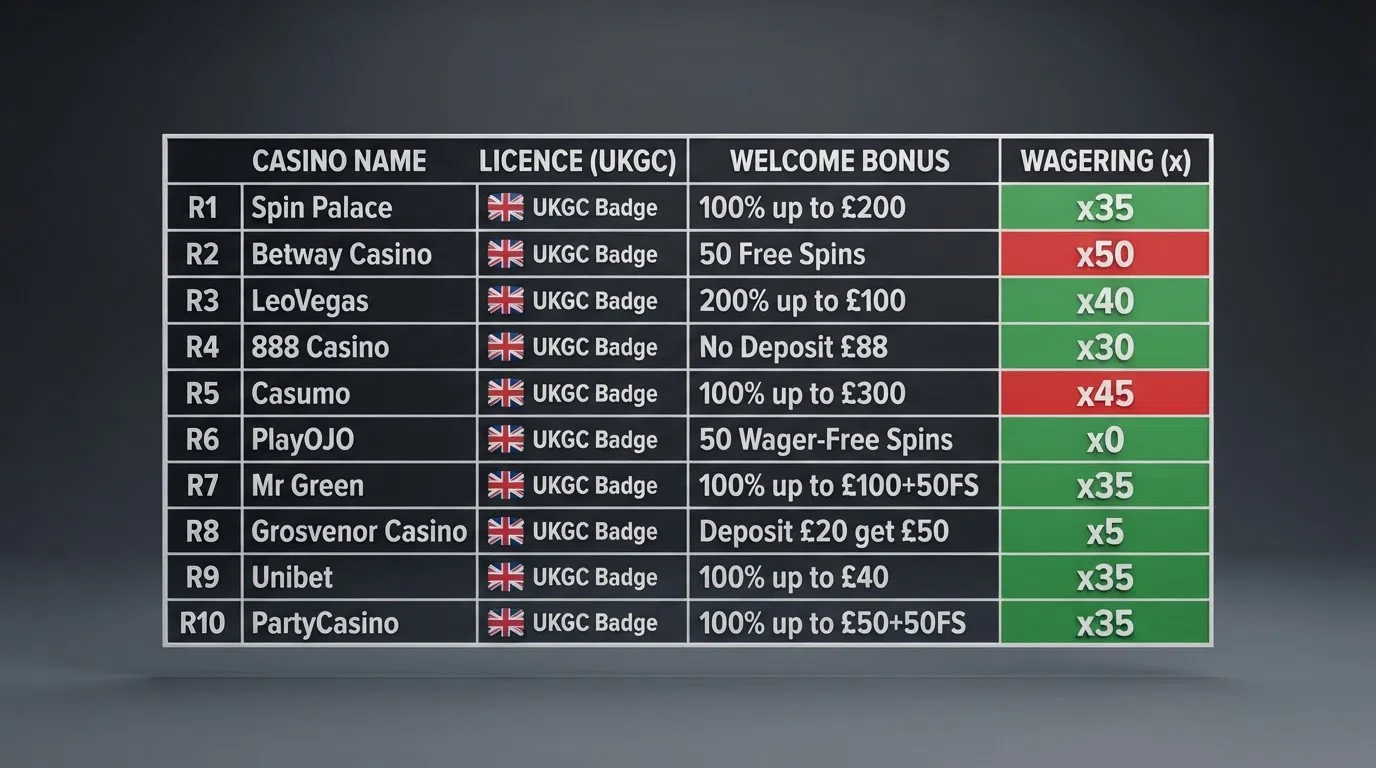
The ranking below orders the ten by how far each welcome offer really stretches — match percentage, wagering multiple, free-spin terms and cashout caps — not by an editorial score. None holds a UKGC licence. None of the ten is recommended as a place to play; the table is a comparison.
| Casino | Licence | Welcome bonus | Wagering | Free spins |
|---|---|---|---|---|
| Stake | Curacao (CGA) | 200% up to $2,000 | 40× bonus | — |
| BC.Game | Curacao (GCB) | 380% up to $4,000 across 4 deposits | 40× bonus | 400–460 (100 per deposit) |
| MyStake | Curacao | 150% / 100% / 50% up to £1,500 | 30× (deposit + bonus) | 30 no-deposit on registration |
| Goldenbet | Curacao | 300% up to £1,500 across 3 deposits | 35× (deposit + bonus); 1× on FS winnings | 100 on Book of Witches |
| Freshbet | Curacao | 300% up to £3,000 across 3 deposits | 30× bonus | 200 across 3 deposits + 25 no-deposit |
| Donbet | Anjouan | 150% up to £750 | 30–35× bonus | 50 on Book of Dead |
| Seven Casino | Curacao | 450% up to €7,500 across 4 deposits | 10× bonus | — |
| Winstler | Curacao | 600% up to £9,500 | Not specified | — |
| Velobet | Curacao | 330% up to €/$2,000 | 30× first deposit; 40× later deposits | 300 over 5 days |
| BetPanda | Curacao | 100% match (headline ~$90,000) | 80× in 7 days | Via VIP |
Two numbers sit at opposite ends of this list. Winstler’s 600% match up to £9,500 is the largest headline. Seven Casino’s 10× wagering on the bonus is the smallest multiple — one of the lowest wagering figures in the offshore market. The wagering multiple, not the match percentage, is the figure that determines what the bonus actually costs the player. The Prescribed Calculation further down this page works one of these bonuses through to a final figure.
The welcome bonuses side by side: 100% to 600%, 10× to 80× to clear
The headline number and the wagering multiple are two different promises. Winstler’s 600% sounds generous. Seven Casino’s 10× sounds light. They sit at the opposite corners of the same grid, and a player choosing between them is choosing between two different ways of parting with money — one asks for a bigger deposit, the other asks for more rounds of play at smaller stakes. From 19 December 2025, UKGC-licensed sites are capped at 10× wagering. Seven Casino’s 10× sits at that exact line. Winstler’s wagering is not specified in the sources reviewed here, which is itself information — the largest headline in the set comes without a published playthrough.
How you can pay: crypto everywhere, cards and PayPal not guaranteed
Payment rails split the set sharply. Stake is crypto-only — BTC, ETH, LTC, USDT, DOGE, XRP, TRX and BNB. BC.Game accepts 79-plus cryptocurrencies and is crypto-focused. MyStake, Goldenbet, Freshbet, Donbet and Velobet all list Visa, Mastercard, Skrill and Neteller alongside crypto. Debit cards and PayPal are not universal offshore. PayPal acceptance is the exception rather than the rule at these sites, because PayPal’s own terms restrict its use for unlicensed gambling in many jurisdictions. Crypto at these houses typically settles faster than card rails — Stake has been tested with a $525 Litecoin withdrawal in 8 minutes — but speed is not the same as recourse, and a fast payout on a casino with no ADR provider leaves a player with the same complaint surface as a slow one.
Free spins: the no-deposit kind against the deposit-locked kind
Two kinds of spins carry different strings. MyStake offers 30 free spins genuinely deposit-free on registration; Freshbet offers 25 on the same terms. These cost nothing to claim. BC.Game’s 400–460 free spins are tied to four deposits — each 100 after a deposit — and expire 24 hours after crediting. Velobet’s 300 spins are released over five days. No-deposit spins typically carry 35×–60× wagering on winnings and cashout caps in the £50–£200 band. Deposit-locked spins sit on top of a welcome bonus and inherit its wagering rules. The cost of claiming a no-deposit spin is the wagering on whatever it returns; the cost of claiming a deposit-locked spin is the deposit, the bonus wagering and the spin wagering in turn.
Cashout caps and withdrawal reality
The fine print that shrinks a headline win. Seven Casino caps maximum win at 10× the original bonus amount — a £1,000 bonus becomes a £10,000 ceiling, regardless of how the spins land. Velobet caps withdrawal from free spins at €100. Stake processes crypto withdrawals near-instantly once verified, with $525 in Litecoin tested in 8 minutes. Winstler processes crypto withdrawals in under 24 hours. The offshore speed of payout comes with a smaller set of recourse options than a UKGC-licensed site offers — the cashout cap sits in the operator’s terms, not in a regulator’s rule.
Stake
Curacao licence. No UKGC licence. The biggest name that left the British market. TGP Europe, which operated Stake UK under a white-label arrangement, surrendered its GB licence after being told it needed to pay a £3.3 million penalty for failing to carry out sufficient checks on business partners and breaching anti-money-laundering rules. The Commission directed TGP to shut down the Stake GB platform by 11 March 2025. The offshore Stake remains. Welcome bonus 200% up to $2,000 at 40× wagering. Crypto-only deposits — BTC, ETH, LTC, USDT, DOGE, XRP, TRX, BNB. No free spins in the standard welcome. The product and the payment rail are both offshore; the speed is fast, and the recourse is not British.
BC.Game
Curacao GCB. No UKGC licence. The four-deposit package with the shortest spin clock. 380% up to $4,000 across four deposits, with 100 free spins per deposit — 400 to 460 in total. Wagering 40× on the bonus, 30 days to clear it, and the free spins expire 24 hours after crediting. The 24-hour spin window is the tightest in the set — a player who deposits and walks away for a day forfeits the spins. Game library over 6,500 titles. Crypto-focused cashier with 79-plus cryptocurrencies.
MyStake
Curacao. No UKGC licence. Thirty genuinely deposit-free spins on a 30× package. Three-deposit welcome totalling 150% then 100% then 50% up to £1,500, with 30 no-deposit free spins on registration. Wagering 30× on deposit plus bonus, £20 minimum deposit, 30-day validity. The payment rails are the broadest in the set — Visa, Mastercard, Skrill, Neteller, crypto and bank transfer. A 10-tier VIP scheme runs alongside. For a player who values a wide cashier and a no-deposit spin on the side, MyStake is one of the more accessible offers in the table; for a player who values a UKGC licence, it offers none.
Goldenbet
Curacao. No UKGC licence. One hundred spins on a named slot, with the winnings at 1×. 300% up to £1,500 across three deposits, with 100 free spins on Book of Witches. Wagering 35× on deposit plus bonus; 1× on spin winnings — a lower playthrough than the typical 35×–60× on no-deposit spin winnings at other houses. £5 maximum bet during the bonus, 30-day match validity and 7-day spin validity. Game library 4,000-plus. Visa, Mastercard, Skrill, Neteller, crypto and bank transfer listed at the cashier. The combination of a named slot and a 1× playthrough on spin winnings is the unusual feature of this offer.
Freshbet
Curacao. No UKGC licence. Twenty-five no-deposit spins on top of a 300% package. Three-deposit welcome totalling 300% up to £3,000, with 200 free spins across the three deposits and 25 no-deposit spins on registration. Wagering 30× on the bonus amount, £20 minimum deposit. Visa, Mastercard, crypto, Skrill and Neteller listed. The no-deposit spins sit on top of a sizeable package, and they are the only genuinely free part of it.
Donbet
Anjouan Gaming Board. No UKGC licence. The Anjouan licence in a Curacao-dominated list. 150% up to £750 plus 50 free spins on Book of Dead — the Play’n GO title at 96.21% RTP with high volatility and a 5,000× max win. Wagering 30–35× on the bonus amount, £20 minimum deposit, 30-day bonus validity, £5 maximum bet while the bonus is active. The payment rail is the broadest of any operator reviewed here — BTC, ETH, LTC, USDT, XRP, BCH, DASH, Monero, USDC, DOGE, Visa, Mastercard, Skrill, Neteller, Apple Pay and bank wire. Anjouan is a weaker regulatory jurisdiction than Curacao’s reformed CGA, and the difference matters when a dispute goes wrong.
Seven Casino
Curacao. No UKGC licence. The lowest wagering in the set, with a max-win ceiling. Four deposits totalling 450% up to €7,500, with 10× wagering on the bonus — one of the lowest wagering figures in the offshore market. Maximum win capped at 10× the original bonus amount. Maximum bet €2. The low wagering and the max-win cap are two sides of the same trade — the operator lets the player clear the bonus quickly, then caps what the bonus can pay out. For a player who wants the wagering out of the way, Seven Casino is the cleanest offer in the table; for a player chasing a single big hit, the ceiling is the binding constraint.
Winstler
Curacao. No UKGC licence. The 600% headline with the thinnest term sheet. 600% up to £9,500 with a £20 minimum deposit. Crypto withdrawals under 24 hours in testing. The wagering requirement is not specified in the sources reviewed here. The largest headline in the set ships without a published playthrough, and the absence of that figure is itself information — a player comparing offers cannot run the calculation without it.
Velobet
Curacao. No UKGC licence. Three hundred spins, but the spin cashout stops at €100. 330% up to €/$2,000 plus 300 free spins over five days. Wagering 30× on the first deposit and 40× on subsequent deposits. Free spin winnings capped at €100 withdrawal. Minimum deposit £10–£20. Visa, Mastercard, Skrill, Neteller, crypto and SEPA bank transfer. SEPA withdrawals incur currency conversion fees for GBP. The 300-spin headline is large; the €100 cashout ceiling makes sure of it.
BetPanda
Curacao. No UKGC licence. The $90,000 headline nobody clears in seven days. 100% match with a headline cap advertised to about $90,000. Wagering 80× in 7 days — described in the source reviews as extremely hard to clear. VIP level-up rewards include free spins with no wagering. Crypto-focused cashier with BTC Lightning for near-instant deposits. A no-KYC option at registration. The headline is the largest in the set by bonus value, and the wagering window is the tightest; the two together describe an offer designed to be impressive on the page and difficult to convert on the balance.
Legal for you, illegal for them — what a UK player quietly gives up
The split is asymmetric. The Gambling (Licensing and Advertising) Act 2014 makes a Gambling Commission licence compulsory at the point of consumption. None of the ten operators holds one. The offence under section 33 of the Gambling Act 2005 — providing facilities for gambling without the required licence — sits with the operator, not the player. No criminal penalty for a player who merely gambles at an unlicensed site has been traced in this research; every sanction is aimed at operators, advertisers and intermediaries. What the player loses is protection, not liberty.
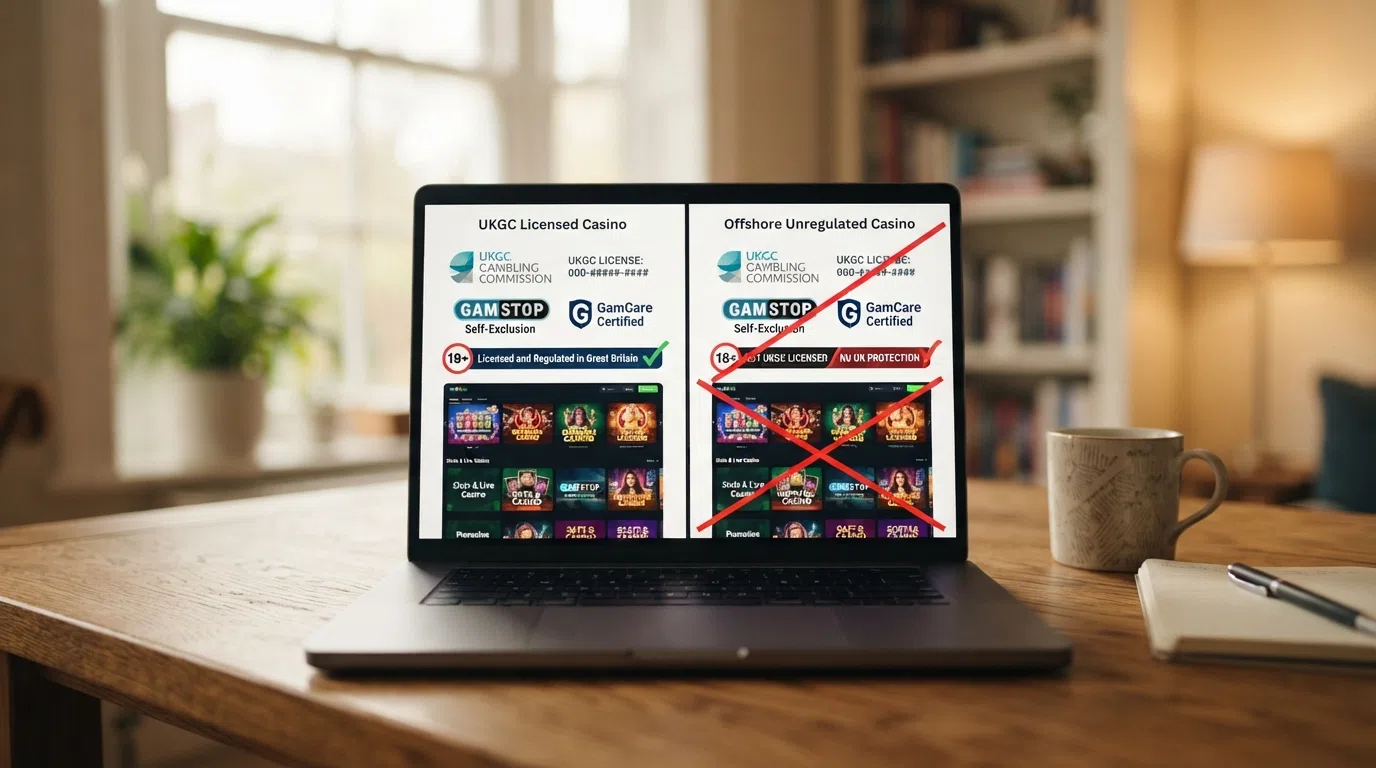
The protection the player loses is the substance of the trade. No UKGC complaints route. No approved ADR provider — there is no independent British body to escalate a complaint to if the operator’s own resolution fails. No statutory fund protection — GB licensees must safeguard customer funds at levels set by their licence condition, and offshore operators have no such British obligation. The player’s recourse on a dispute is the offshore regulator, which varies sharply in effectiveness. An MGA-licensed site sits closer to British protection than a Curacao one — segregated funds, mandatory dispute resolution and a working Player Support Unit. A Curacao site under the reformed CGA has more teeth than the legacy four-master model, but the teeth are still shorter than the MGA’s. Anjouan has even less published enforcement.
A GB licence is the only licence that counts here
The 2014 Act’s point-of-consumption rule is the only legal test that matters for this page’s subject. A Curacao, Maltese or Gibraltar licence is not a substitute. A GB operating licence is required regardless of where the operator sits, and none of the ten holds one. The product the ten offer to UK players is unlicensed gambling under British law.
No criminal penalty for the player — the law targets the operator
The player’s exposure is loss of protection, not prosecution. The sanctions the Act carries — up to 51 weeks’ imprisonment, a level 5 fine, or both — apply to operators, advertisers and intermediaries, not to consumers. What the player signs away by registering at a non-UKGC site is the British redress framework, the fund protection rules and the GAMSTOP coverage that follow from a GB licence. Once a player crosses that border, they are essentially on their own.
The redress you give up: no complaints route, no ADR, no fund protection
When a dispute goes wrong, the British routes are closed. The UKGC cannot investigate a complaint about an operator it does not regulate. There is no approved ADR provider for unlicensed sites. There is no statutory fund protection — the British rules that require customer funds to be safeguarded at defined levels do not reach an offshore operator. The player’s recourse is the offshore regulator, and the effectiveness of that recourse depends on which regulator it is. A Malta licence is the strongest of the non-UK options, with segregated funds, mandatory dispute resolution and real oversight, so an MGA site is far closer to UK protection than a Curacao one. Curacao’s reformed CGA has more enforcement than the legacy sub-licence model, but the gap to MGA remains. Anjouan trails further behind.
The licences behind these foreign casinos: MGA, Curacao, Anjouan
Not all offshore licences are equal. Nine of the ten operators in this ranking sit under Curacao — eight under the CGA, one under the GCB (BC.Game). One sits under Anjouan — Donbet. The Curacao Gaming Authority has been issuing direct B2C licences under the LOK reform, replacing the legacy four-master sub-licencing model; 616 active licences are tracked as of 2026. The reform gives Curacao more regulatory teeth than it had under the old model, but the teeth are still shorter than the MGA’s. The MGA’s segregated funds and ADR and oversight make it the strongest non-UK option; the MGA also restricts its licencees’ interactions with British consumers in ways that exclude most of the operators in this ranking. Anjouan’s regime has the least published enforcement of the three.
Enforcement is real: notices, delistings and surrendered licences
The UKGC disrupts rather than blocks. From April 2024 to June 2025, the Commission issued 3,140 disruption notices and referred 447,778 URLs to search engines for delisting; 287,961 URLs were removed, with an average 32% fall in engagement across 160 disrupted sites. Between January 2025 and February 2026, the Commission issued 260 cease-and-desist notices to advertisers for committing an offence under section 330 of the Gambling Act 2005, with the notice period cut from 14 days to 48 hours. The Commission does not currently hold statutory ISP or DNS blocking powers — legislation has been proposed that would let it apply to a court for a blocking order, but it is proposed, not enacted. The TGP Europe surrender in March 2025 is the highest-profile example of the Commission’s leverage: a white-label operator was told to pay a £3.3 million penalty and to shut down the Stake GB platform by 11 March 2025. The offshore Stake.com continued; the British front door closed.
What the licensed market caps that offshore casinos don’t
| Protection | UKGC-licensed casino | Foreign non-UKGC casino |
|---|---|---|
| Online slots stake cap | £5 (25+) / £2 (18–24) | No statutory cap |
| Wagering requirements | 10× maximum from 19 December 2025 | 10×–80× typical; not capped |
| Credit cards | Banned since 14 April 2020 | Commonly accepted |
| Auto-play | Banned since 31 October 2021 | Allowed |
| Minimum spin cycle | 2.5 seconds since 31 October 2021 | Set by the operator |
| Mixed-product promotions | Banned from 19 December 2025 | Allowed |
| Identity verification | Required before first deposit | Operator’s discretion |
| Financial vulnerability check | At £150 net deposit in 30 days | None |
| ADR provider | Required | None |
| Fund protection | Required by licence condition | None |
| GAMSTOP coverage | Participating sites | Not covered |
The licensed market’s guardrails are the contrast that makes foreign bonuses look bigger. The stake caps (£5 at 25+, £2 at 18–24) shrink the maximum any single spin can cost. The 10× wagering cap from 19 December 2025 reduces the playthrough on any bonus. The credit-card ban since 14 April 2020 removes one funding rail. The autoplay and 2.5-second spin ban since 31 October 2021 slows the pace of play. The mixed-product promotion ban from 19 December 2025 prevents welcome packages from being bundled across casino, sports and other products. Identity verification before first deposit and the £150 net-deposit vulnerability check are the entry and the mid-play friction. Foreign sites operate completely outside these British consumer safeguards.
The tax and levy the licensed side pays — and the offshore side skips
The licensed market hands over a chunk of its yield; the offshore side does not. Remote Gaming Duty rose from 21% to 40% from 1 April 2026, announced at the Autumn Budget 2025. A separate statutory levy took effect on 6 April 2025, at 1.1% of gross gambling yield for remote casino licences, split 50% to treatment, 30% to prevention and 20% to research. None of that cost is paid by an offshore operator serving British players. The licensed side’s costs fund the help infrastructure and the regulator; the offshore side is free of both. The player pays no tax on winnings either way — gambling winnings in the UK are not treated as income and are outside capital gains tax.
The safety net that isn’t there — playing safe at a foreign casino
Offshore play means supplying your own limits. GAMSTOP does not reach these sites — the scheme is licence-bound and covers participating GB-licensed sites only. An excluded British player who registers at an unlicensed site is unregistered there. The tools the UKGC’s LCCP requires — a pre-first-deposit limit prompt from 31 October 2025, reality checks, time-outs, deposit limits — are operator-optional at these houses. The help infrastructure that exists in Britain works regardless of where the player plays.
GamStop won’t catch you here
GamStop covers participating GB-licensed sites only. Exclusion periods run 6 months, 1 year, 5 years, or 5 years with auto-renewal; they cannot be cancelled early. None of the ten operators in this ranking participates in GamStop. A player who has self-excluded and then registers at a non-GamStop casino has self-excluded only on the licensed side of the market.
Deposit limits and time tools: what offshore sites offer
No mandatory pre-first-deposit limit prompt, no mandated reality check or time-out, no mandated financial vulnerability check. Any limits these sites offer are the operator’s own rather than the LCCP’s. The licensed market’s structure — a prompt on first deposit, a check at £150 net deposit, an affordability assessment above that — does not transfer.
How widespread the problem is in the UK
The prevalence behind the safer-gambling beat. In 2024, 5% of adults in England had PGSI scores of 1 or more, indicating at-risk or problem gambling — men at 7% and women at 3%, stable since 2012. Almost 1.6 million adults in England who gamble may benefit from some type of treatment or support. Nearly 1 in 3 (30%) adults who gamble and are experiencing any level of problems want treatment, support or advice — almost doubling from 17% in 2020.
Where to get help
Help that exists regardless of where the player plays:
- GamCare’s National Gambling Helpline on 0808 8020 133 — 996 referrals in January 2026, up 48% YoY; 81.5% of contacts in 2026 cited online gambling
- GambleAware and the National Gambling Support Network
- NHS gambling harm clinics in England, Scotland and Wales
- Gamblers Anonymous for peer support
How we chose and checked these ten casinos
The operator reviews cited throughout this page are the source material. Each of the ten brands has been checked against the UK Gambling Commission’s public register, the single verification source for whether a brand holds a GB licence. None does. The ranking orders the operators by the terms research carries — match percentage, wagering multiple, free-spin terms and cashout caps — rather than by an editorial score. The seven offshore jurisdictions most often cited in this market are not interchangeable, and the ranking does not treat them as such: Anjouan sits at a different regulatory level than Curacao’s reformed CGA, which sits at a different level than MGA.
The page does not weight the operators against each other on safety or trustworthiness, because the comparison it is built to make is about the offer terms, not about the underlying operator. Where a brand’s profile cuts against the page’s own subject — for example, an offshore casino that nonetheless runs strict verification on its players — that mismatch is named in the operator write-up.
Decide with the trade-off in front of you
The trade-off is the substance of this page. Bigger bonuses and no stake caps on one side. No GAMSTOP, no ADR, no fund protection and no British complaints route on the other. The bonus figure on the offer page is a purchase price, not a gift — and the price can be worked through to a final figure. On Donbet’s £750 bonus at 35× wagering, assuming only the bonus amount is wagered, required turnover is £750 × 35 = £26,250. Against Book of Dead at 96.21% RTP, the expected loss on that turnover is £26,250 × (1 − 0.9621) = £995. That is what clearing the bonus costs, on average, before any spin is taken for the chance of a win. The bonus is the entry price for playing the wagering requirement. The win is the upside; the £995 is the cost the house takes on the way.
The licensed side’s 10× wagering cap from 19 December 2025 shrinks that cost sharply. Seven Casino’s 10× on a £750 bonus would set turnover at £7,500, with an expected loss on the same slot of about £284 — roughly a quarter of the Donbet figure. That gap is what the licensed market caps and the offshore market does not. A 600% match looks like generosity until the wagering multiple sits beside it.
No operator in this ranking is recommended as a place to play. The ranking is a comparison. The decision sits with the player who has read what each offer really consists of, what each one costs in time and money, and what registering at a non-UKGC site gives up.
Frequently Asked Questions
Are foreign online casinos legal for UK players to use?
UK law does not criminalise the act of a player accessing an unlicensed gambling site; every sanction under the Gambling Act 2005 is aimed at the operator, advertiser or intermediary. A British player can register, deposit and play without facing prosecution. The product on offer is unlicensed under the Gambling (Licensing and Advertising) Act 2014, and the player gives up British consumer protections by taking it.
Do non-GamStop casinos accept UK debit cards and PayPal?
Debit cards are accepted at most of the ten — MyStake, Goldenbet, Freshbet, Donbet and Velobet all list Visa and Mastercard. PayPal acceptance is the exception rather than the rule, because PayPal’s own terms restrict its use for unlicensed gambling in many jurisdictions. Crypto is the most universally available rail, and Stake is crypto-only.
Is it safe to play at Curacao-licensed or MGA-licensed casinos from the UK?
An MGA-licensed site is closer to British protection than a Curacao one — segregated funds, mandatory dispute resolution and a working Player Support Unit. Curacao’s reformed CGA has more enforcement than the legacy sub-licence model but trails the MGA. Anjouan trails further. None of the three is a substitute for a UKGC licence, and none grants access to GAMSTOP, the UKGC complaints route or British ADR.
What happens if a foreign casino refuses to pay out my winnings?
The British complaints route is closed at a non-UKGC site. The UKGC cannot investigate a dispute with an operator it does not regulate; there is no approved British ADR provider for unlicensed sites; and there is no statutory fund protection. Recourse is to the offshore regulator, whose effectiveness depends on the licence — an MGA complaint goes through a structured process, a Curacao complaint goes through a thinner one, and an Anjouan complaint has the least published enforcement.
How fast are withdrawals at offshore casinos compared to UK-licensed sites?
Crypto at offshore sites is typically fast — Stake has been tested with a $525 Litecoin withdrawal in 8 minutes, Winstler processes crypto withdrawals in under 24 hours. UKGC-licensed sites have introduced friction (vulnerability checks, source-of-funds reviews) that slows payouts. Speed is not recourse, and a fast payout at a site with no ADR provider leaves the same complaint surface as a slow one.
Can I self-exclude from foreign casinos if I’m on GamStop?
GamStop covers participating GB-licensed sites only. None of the ten operators in this ranking participates. A British player who has self-excluded through GamStop and then registers at a non-GamStop casino is unregistered there. Self-exclusion at the offshore site is a separate process — typically an in-account tool or a request to support — and it depends on the operator honouring it, with no British scheme to enforce.
Licence – nonukgc-licensedcasinos
Content created by the «nonukgc-licensedcasinos» team