
Non UK Regulated Casinos — The Protection Gap a UK Player Should See Before Signing Up
 Available in GB
*Data current as of September 8, 2026; licence and offer claims verified against the UK Gambling Commission public register and operator promotions pages.*
The word “regulated” does a lot of quiet work in casino marketing. It suggests someone is watching. It suggests a player has somewhere to turn when a payout stalls or a bonus term turns out to mean something narrower than the headline. In Great Britain, that someone is the UK Gambling Commission, and the framework that backs it — the Gambling Act 2005, the Licence Conditions and Codes of Practice, GAMSTOP, the statutory levy, the dispute-resolution routes — is dense, audited, and enforceable. A non-UKGC casino offers no equivalent. It may still be licensed, but the licence sits elsewhere, and the further “elsewhere” sits from Whitehall, the thinner the net a UK player can actually reach.

This page works the subject from the licence outward. It sets out what GB regulation actually delivers, what falls away the moment a UK player steps outside it, and why the free-spin welcome offers inside the regulated market look, in 2026, more honestly priced than the glossier numbers an offshore site will put in a banner. The comparison that follows is built on operators the UKGC register confirms as active.
What a Regulated Casino Actually Protects
Regulation, in the casino context, is a list of obligations the operator has taken on, with a regulator holding the operator to them. In Great Britain that regulator is the UK Gambling Commission, the framework is the Gambling Act 2005 and the LCCP that operationalises it, and the obligations touch every point a player’s money passes through. A short definition does not survive the topic, so the next three sections break the framework down — what the three licensing objectives actually enforce, how a licence is won and policed, and why “best regulated” is not the same thing as “most advertised”.
The Three Pillars Every Casino Regulator Enforces
Section 1 of the Gambling Act 2005 names three licensing objectives. They are not slogans. They are duties a GB-licensed operator has to design its product around, and the design choices show up in the player’s account.
The first is preventing gambling from being a source of crime or disorder, and from being associated with crime or disorder. In practice this means anti-money-laundering controls, source-of-funds checks at the right thresholds, and the kind of identity verification that stops one person running dozens of accounts to abuse bonuses. A GB-licensed operator cannot onboard a player anonymously. Since 7 May 2019 it has to verify name, address and date of birth before any deposit and before any gambling — including a free bet or a bonus — and free-to-play games on the same site are age-gated. That is what “no anonymous play” looks like in code.
The second is ensuring gambling is conducted in a fair and open way. This is the objective a player notices in a different way. Return-to-player percentages are independently tested, game logic is audited, and the operator’s published terms have to match what the product actually does. If a slot advertises a 96% RTP, the regulator expects the math to back it, and an ADR route stands behind the player if it ever does not.
The third is protecting children and other vulnerable persons from being harmed or exploited by gambling. This is the broadest of the three, and it is the one that produces the deposit-limit prompt before the first deposit, the reality checks during a session, the GAMSTOP integration, and the treatment funding that runs through the statutory levy. The Gambling Commission’s most recent participation wave, fielded between 22 September 2025 and 18 January 2026, recorded gambling participation over the prior four weeks at 47% of the GB adult population. The regulator is designing a product that nearly half of adults use, and the third objective is what makes the design cautious. The same body of evidence notes that around 0.5% of the adult English population experience problem gambling, 3.8% are at elevated risk, and an estimated 7% of the British population are negatively affected by someone else’s gambling. The protection pillar is the regulator’s response to those numbers.
How Casino Licensing Works — From Application to Audit
A GB operating licence is not a sticker. The operator has to satisfy the Commission that it is suitable — fit and proper at the level of the company, the directors, the people with significant control — and the suitability test is not a one-off. Once licensed, the operator is bound by the LCCP, by social responsibility code provisions, and by a stream of reporting duties that include safer-gambling data, AML data, and the kind of incident reports that surface a problem before a player has to file a complaint.
Enforcement follows when the operator slips. The Commission issues cease-and-desist notices, runs test purchases to confirm age controls, refers URLs to Bing and Google for delisting, and works with registrars, hosts, payment providers and affiliate networks to choke the routes a non-compliant operator uses to find customers. Between April 2024 and June 2025, the UKGC issued 3,140 cease-and-desist or disruption notices and referred 447,778 URLs to Bing and Google, of which 287,961 were subsequently removed.
The criminal-law floor sits beneath all of that. Section 33 of the Gambling Act 2005 makes it an offence to provide facilities for gambling without the required licence, punishable by up to 51 weeks’ imprisonment (six months in Scotland), a fine at level 5 — in practice unlimited — or both. Advertising unlawful gambling is a separate offence. The penalty is aimed at the operator, not the player. What the player loses by stepping outside the regime is not the risk of prosecution; it is the protection, the dispute route, and the safety net that made the prosecution worth the regulator’s effort in the first place.
Why “Best Regulated” Does Not Mean “Most Popular”
The casino comparison pages that rank highest for UK searchers tend to optimise for two variables: the size of a welcome bonus and the familiarity of the brand name. Both are legible. Both are easy to compare. Neither is what the regulator is for. The UKGC’s public register, by contrast, tells a player the licence status, the licence type, the conditions attached, and any active regulatory action. It is the filter that turns a long list of branded sites into a short list of sites with a statutory backstop.
A strong licence is the reader’s first safety filter, and it does not have to be the most popular brand on the list. The bigger-name operators on the comparison pages do tend to hold GB licences, but the more useful question is which operator the register confirms as licensed today, with what conditions, and what the regulator has done about that operator in the recent past. The rest of the marketing is decoration.
Non UK Regulated Casinos — What UK Players Leave Behind
A “non UK regulated” casino, in the sense a UK player means it, is a casino serving GB customers that does not hold a Gambling Commission remote operating licence. It may hold a Malta Gaming Authority licence, a Curaçao licence, a Gibraltar licence, or no licence a reader can verify. The point of the definition is what happens to the protection inventory the section above described. A GB licence, at the point of consumption, is compulsory. MGA, Curaçao and Gibraltar licences are not substitutes. A UK player using a non-UKGC site is outside every one of the routes the sections below describe.
UKGC vs the Rest — The Protection Gap in One Place
| Regulator | GB Legal Substitute? | Player Protection Framework | GAMSTOP Scope | Dispute Resolution Route |
|---|---|---|---|---|
| UK Gambling Commission (UKGC) | Yes — point-of-consumption licence | Section 1 objectives; stake caps; deposit-limit prompt; product-design controls; bonus rules; GAMSTOP; credit-card ban; statutory levy funding treatment | Mandatory for all GB-licensed online operators | ADR via IBAS / ecog; UKGC complaints function |
| Malta Gaming Authority (MGA) | No — not a substitute for a GB licence at the point of consumption | EU-style player-protection framework; no GB-specific remit; no automatic UK dispute route | Not applicable on GB-facing sites | MGA complaints function; EU consumer routes; weaker for a UK-based player |
| Curaçao (post-reform) | No — not a substitute for a GB licence at the point of consumption | Reformed 2024+ structure (LOK, GCB); framework thinner than MGA; player protection weaker in practice | Not applicable on GB-facing sites | Curaçao GCB; limited UK-side enforceability |
The four columns the table carries are the four a UK player loses when the licence moves. The stake caps are a clear example. From 9 April 2025 the maximum online slot stake per game cycle is £5 for players aged 25 and over; from 21 May 2025 the cap for 18 to 24-year-olds is £2. A “game cycle” starts when the player initiates a game and ends when staked money is lost or winnings are delivered — the regulator is capping the size of a single decision, not the size of a session. An offshore casino is not bound by either cap, and the spin button takes whatever the player types.
The product-design controls sit in the same row. A GB-licensed slot cannot run auto-play, cannot spin faster than one cycle every 2.5 seconds, cannot disguise losses as wins, and cannot let the player reverse a withdrawal the player has already requested. The session screen has to show cumulative wins, losses, and time played. None of these are defaults the offshore market ships with by default.
The bonus rules are the third row, and they are the most relevant to a comparison like this. From 19 December 2025, the maximum wagering multiplier on bonus funds at a GB-licensed casino is 10x. Mixed-product promotions — bet on a football match to claim casino free spins, for instance — are banned. Direct marketing has to be opt-in by product and channel, with the opt-in box unticked by default, since 1 May 2025. An offshore operator is not bound by any of this, which is why a non-UKGC welcome page can advertise wagering multiples of 30x, 40x or higher and call it a feature.
The dispute resolution row is the one that matters when something has already gone wrong. A GB-licensed player with an unresolved complaint can take the case to an ADR provider — IBAS and ecog are the named examples — and the ADR ruling is binding on the operator under the LCCP. A player dealing with a non-UKGC casino has to rely on the offshore regulator’s framework, which is weaker in practice and further away. The route that ends in a binding decision is shorter inside the GB system than outside it.
Offshore Licences — What Curaçao and Malta Actually Deliver
Three non-UKGC licences dominate the marketing a UK player will see. The Malta Gaming Authority is the most familiar: an EU-recognised regulator with a player-protection framework, fit-and-proper tests for operators, and complaint handling. For a UK-based player, it does two things and not a third. It offers a framework that is meaningfully stronger than the loose-jurisdiction end of the market, and it provides a route for a complaint. What it does not do is substitute for the GB licence the player would otherwise be using. The dispute resolution is Maltese; the consumer law is Maltese; the operator’s primary obligation is to the MGA, not the UKGC.
Curaçao’s framework changed materially in 2024 and after. The old master licence structure gave way to a directly-licensed regime under the Curaçao Gaming Control Board, with sub-licence holders now licensed in their own right. The reform tightened the framework, but “tighter than the previous Curaçao” is not the same as “equivalent to the UKGC”. A UK player dealing with a Curaçao-licensed site still has a thinner protection inventory than at a GB-licensed site, and the consumer-protection distance from London to Willemstad is real.
Gibraltar is the third name that recurs. Gibraltar-licensed remote operators are regulated by the Gibraltar Gambling Commissioner and have a long-standing reputation for rigour, but a Gibraltar licence is not a substitute for a GB licence at the point of consumption. A UK player using a Gibraltar-licensed site is, again, outside the GB framework.
The structural point is the same for all three. A non-UKGC licence is not a replacement for a GB licence; it is a different licence, with a different regulator, a different dispute route, and a different scope of obligation to the UK-based player. The closer the offshore regime is to the UKGC in design, the smaller the gap; none of them closes it.
GAMSTOP Stops at the UK Border — What Self-Exclusion Actually Covers
GAMSTOP is the UK’s national multi-operator self-exclusion scheme, mandatory for every GB-licensed online operating licence since 31 March 2020. A player registers once, chooses an exclusion period — six months, one year, five years, or five years with auto-renewal — and the registration is enforced across every GB-licensed casino and bingo and slot operator. The exclusion cannot be cancelled early, and the registration continues for up to seven years after the chosen period ends if the player does not make contact.

For a player enrolled with GAMSTOP, the scheme is the strongest single safeguard in the UK system. The reason it works is that the obligation is on the operator. A GB-licensed site has to check GAMSTOP before allowing a new account, and a registered player is turned away. The whole net relies on every operator inside the net being GB-licensed.
The moment a player opens an account at a non-UKGC casino, the GAMSTOP registration is no longer enforced. The offshore operator has no integration with the UK scheme, no obligation to honour it, and no way to know the player has self-excluded unless the player tells them. A self-exclusion that stops at the UK border is only half a safeguard. Operator-level self-exclusion — a tool an individual casino provides to let a player lock themselves out of that one site — is a separate, weaker layer. It helps; it does not replace GAMSTOP; and it does not exist on every offshore site.
Life Inside the UKGC Rulebook — The Rules That Shape Every GB-Licensed Casino
A player does not need to read the LCCP to feel it. The rules show up in the account, on the slot, in the cashier, and in the marketing email. The four areas below are the ones a player meets first.
Age-banded online slot stake caps. From 9 April 2025 the maximum stake is £5 per game cycle for players aged 25 and over, and from 21 May 2025 the cap for 18 to 24-year-olds is £2. The cap is on the size of a single decision, not the size of a session, and an operator’s product has to enforce it. A player who tries to stake above the cap is stopped at the input.
Mandatory deposit-limit prompt. From 31 October 2025 a GB-licensed casino has to prompt the player to set a financial limit before the first deposit. The player can proceed without setting one, but the prompt has to fire. Once a limit is set, a request to decrease it is actioned immediately; a request to increase it carries a cooling-off period. A standardised “gross deposit limit” has to be offered under RTS 12, with the original 30 June 2026 implementation extended to 30 September 2026. The framework is built around the assumption that the player is better off deciding in advance how much they can afford to lose in a session.
Bonus rules. From 19 December 2025 the maximum wagering multiplier on bonus funds at a GB-licensed casino is 10x. Mixed-product promotions — a sportsbook bet that triggers a casino bonus, for example — are banned. Free-to-play games are age-gated. The effect is to shrink the gap between the offer and the actual cost of clearing it, and to cut out the cross-product promotions that pull a player from one vertical into another.
Credit card ban. Since 14 April 2020, gambling with a credit card has been banned at GB-licensed operators, including credit-card-funded e-wallet routes. The non-remote lottery is the only remaining exception. The rule does not stop a player from gambling; it stops the player from gambling on credit, which is a different risk profile. A non-UKGC casino is not bound by the ban and may accept a credit card deposit without challenge.
Unregulated Casinos — The Red Flags No Player Should Ignore
The phrase “unregulated” is doing the same quiet work in the opposite direction. It does not mean a casino is illegal; it means a casino is outside the GB framework. The red flags below are the ones the GB framework was built to make unnecessary. A site that hits more than two of them is a site the player should think about more carefully than the welcome banner is asking them to.
- No verifiable GB licence, or a licence from a jurisdiction with no player-protection record a UK reader can confirm. The UKGC’s public register is the verification route; an operator whose name does not come back from a register search, or whose licence has been surrendered or revoked, is not a GB-licensed operator.
- No GAMSTOP integration and no ADR route. A self-exclusion request that the operator does not honour, or a complaint that has nowhere to escalate, is a complaint that ends with the player.
- Aggressive or opaque bonus terms with no wagering cap. Wagering requirements above 10x, maximum cashout caps hidden in the small print, and bonus terms that change after opt-in are the territory the GB cap was written for.
- Missing or unenforced KYC and age-verification checks. A site that lets a player deposit and play without verifying name, address and date of birth is a site operating outside the GB rulebook.
Each flag is a missing protection. The point of listing them together is to give the reader a single check: how many of these can the operator address in writing, on the operator’s own site, before the player has handed over any money?
How to Verify a Casino Licence in Under a Minute
The UKGC’s public register is the single most reliable safety step a UK player can take, and it does not require a phone call or an account. The steps are short, and the answer is in the first screen.
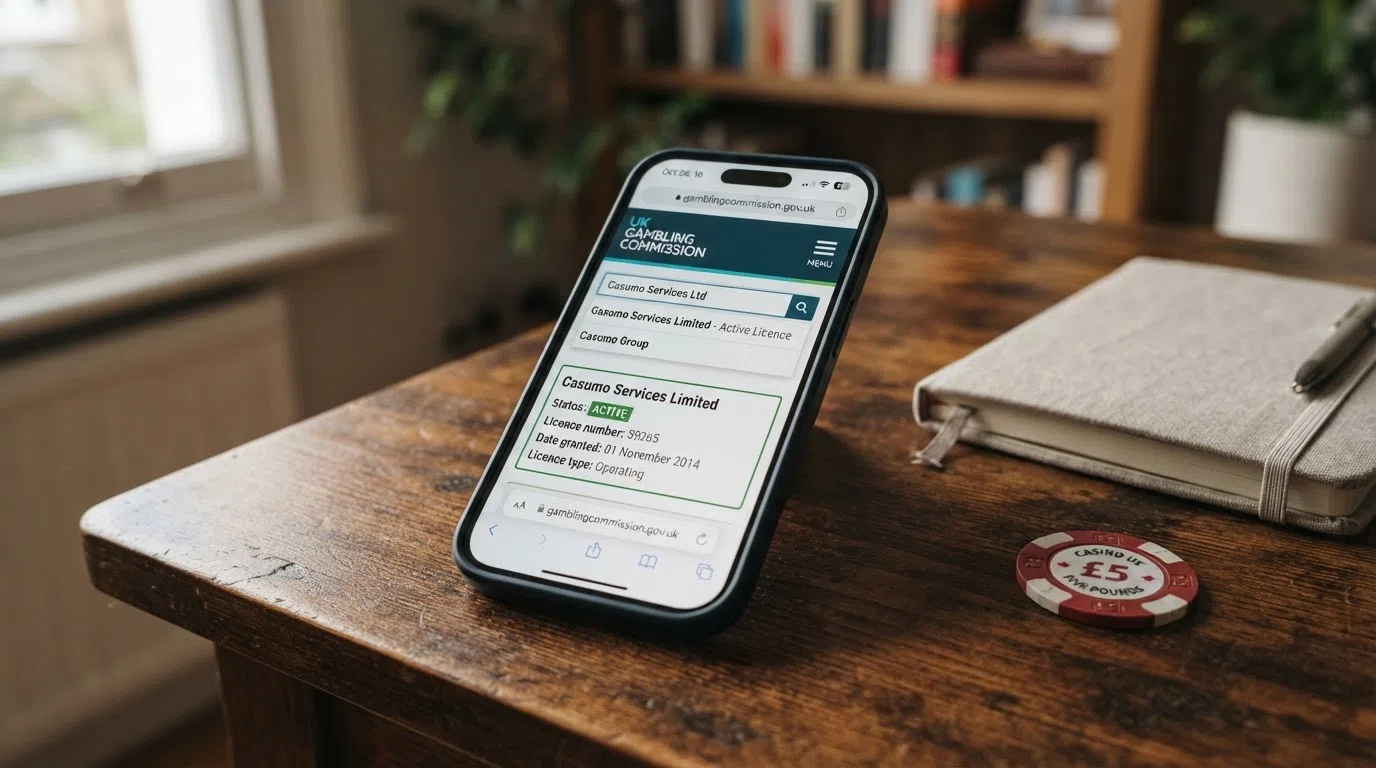
- Open the UK Gambling Commission’s public register. The register is the Commission’s own list of every operator it has licensed, with the current status of each licence.
- Search by the operator’s name or by the licence number the operator’s site footer claims. Both should return the same record.
- Read the licence status. Active, suspended, revoked, or surrendered is the four-way answer that matters; anything other than active means the operator is not currently licensed to serve GB customers.
- Read the licence type and any conditions. A remote operating licence is the one that covers casino play; conditions attached to the licence narrow what the operator can do.
- Cross-check the operator’s footer. The licence number the operator publishes on its own site should match the number the register returns. A mismatch is a flag.
A register check costs the player a minute. It is the filter that turns the marketing comparison into a real one.
Slots, Crypto and Product-Specific Regulation Under the Microscope
Two product areas show the UKGC vs non-UKGC divide most sharply, because the GB rulebook is at its most specific in both.
Online slots. The age-banded stake caps, the auto-play ban, the 2.5-second spin-speed floor, the ban on speed-up features, the ban on losses disguised as wins, and the mandatory session display are all slot-specific controls. The design intent is to slow the product down, to make the cost of a decision visible, and to cap the size of any single decision in line with the evidence on harm. The product a GB-licensed player sees is the regulated version of the slot; the product a non-UKGC player sees is the unregulated version, with the spin speed, the auto-play, the loss-disguised-as-win animations, and the stake cap all reset to the manufacturer’s defaults.
Crypto casinos. No UK Gambling Commission-licensed casino accepts cryptocurrency deposits in 2026. The position is unambiguous. A “crypto casino” serving UK customers is, by definition, a non-UKGC casino, and the protection inventory above is absent. The crypto route also adds two product-level risks that have nothing to do with the gambling: the volatility of the asset, and the irreversibility of the transaction. A chargeback that a player might have used at a card-accepting GB-licensed operator is not available on a blockchain transfer.
The offshore market’s product is not the GB market’s product with the regulator cut out. The regulator is part of the product, and the section above lists the parts.
UKGC-Licensed Casinos — How Their Free-Spin Offers Stack Up in 2026
The ten operators below are the comparison set for this page. Each one is confirmed on the UKGC public register as holding an active remote operating licence. The welcome-offer terms are drawn from published reviews and the operators’ own promotions pages, all in 2026. The ranking favours transparency and low-friction terms — zero-wagering offers, genuine no-deposit spins, and reasonable validity windows — over headline spin count alone. A 200-spin offer with 10x wagering and a £30 cap is not the same value as a 50-spin offer with no wagering, and the table below shows why.
| Operator | UKGC Licence | Welcome Offer | Free Spins | Wagering on Winnings | Bonus Validity | No-Deposit Component |
|---|---|---|---|---|---|---|
| bet365 | Yes | Up to 500 free spins | Up to 500 | 0x | 30 days to deposit; 7 days to use spins | None (lifetime £10 deposit required) |
| William Hill | Yes | 200 free spins (10p each) | 200 | 10x, capped at £30 | 72 hours from credit | None (£10 deposit and stake within 7 days) |
| Sky Bet | Yes | £30 in free bets | None | 0x (sportsbook) | 30 days | None (qualifying bet required) |
| Ladbrokes | Yes | Not verified in this run | Not verified | 10x max (UKGC cap) | Not verified | Not verified |
| Paddy Power | Yes | Not verified in this run | Not verified | 10x max (UKGC cap) | Not verified | Not verified |
| Coral | Yes | Not verified in this run | Not verified | 10x max (UKGC cap) | Not verified | Not verified |
| Betfred | Yes | 200 free spins | 200 | 0x | 7 days to use spins; 14 days to deposit/stake | None (£10+ debit card stake required) |
| Gala Bingo | Yes | 100 free spins (10p each) | 100 | Not stated by operator | 7 days from credit | None (£10 deposit + £10 slot spend required) |
| Sky Vegas | Yes | Up to 250 free spins | Up to 250 | 0x | 7 days from credit (spins); 30 days to deposit/stake (second tranche) | First 50 spins no-deposit |
| Betfair | Yes | 50 no-deposit + 100 on £10 deposit/wager | Up to 150 | 0x | 7 days from credit | First 50 spins genuinely no-deposit |
Three operators — Ladbrokes, Paddy Power and Coral — are included in the comparison because they hold GB licences, but the welcome-offer terms were not sourced for this run. The 10x figure in the wagering column is the statutory cap, not an offer-specific multiplier; the reader is directed to each operator’s promotions page and to the UKGC register for the current terms. The point of including them is to keep the table honest. A list of GB-licensed operators that quietly drops the ones without a current verified offer is a list that has been pruned for the comparison’s benefit, not the reader’s.
The Betfair and Sky Vegas rows carry genuinely no-deposit spins. That is the single feature that separates the cleanest welcome offers from the rest, because a no-deposit spin is a spin the player can use without committing a deposit first. The wagering column does the second bit of work. A 10x multiplier on winnings, capped at £30, is the offer that looks generous in the headline and pays out at the bottom of the small print. A 0x multiplier on winnings is the offer that pays what it advertises. The cap matters at smaller spin counts more than at larger ones, because the cap and the spin count together determine the maximum a player can walk away with.
bet365 — Up to 500 Free Spins, Zero Wagering
bet365’s welcome package is the largest in the comparison on raw spin count, and the wagering treatment is the cleanest available. The package runs up to 500 free spins on selected titles — Book of Horus, Curse of the Bayou, Magic Forge and Wrath of the Deep — with 0x wagering on whatever the spins produce. The player does not have to playthrough the winnings, which is the single largest determinant of an offer’s real value.
The friction is in the deposit. A minimum lifetime £10 deposit is required before the spins are accessible, and the deposit has to happen within 30 days of registration. The spins themselves carry a 7-day use window once credited. The combination — a real-money deposit to unlock, 0x wagering on the result — is the structure of an offer the player can actually evaluate. There is no playthrough figure to discount against, and the cap is whatever the slot pays out, not a fixed ceiling. The deposit requirement is the price of the absence of wagering; for a player who would deposit anyway, the trade is a fair one.
William Hill — 200 Free Spins, Capped Winnings
A recognised high-street name with a 200-spin welcome, but the wagering treatment is the comparison’s clearest example of how the headline can mislead. The 200 spins are credited at 10p each on Big Bass Splash, with 10x wagering on winnings and a £30 maximum cashout. The 72-hour validity from credit is the shortest in the comparison by a margin.
The arithmetic is straightforward. A £30 cap on winnings from 200 free spins is a per-spin yield of 15p before the cap bites, and a 72-hour window is short enough to lose a tranche of spins to a busy week. The £10 deposit and stake requirement has to be completed within 7 days. William Hill is a serious operator, and the offer is real, but the offer as priced is the kind of welcome a player should read twice before claiming.
Sky Bet — Free Bets, Not Free Spins
Sky Bet’s welcome offer is sportsbook free bets, not casino free spins, which puts it in the comparison for completeness rather than as a like-for-like. The offer is £30 in free bets for new customers, with 0x wagering on free-bet returns and a 30-day validity. A qualifying bet is required.
A player looking at the page’s headline subject — non-UKGC alternatives and how the GB-licensed market compares — needs to know that Sky Bet’s headline number is sportsbook, not casino. The operator is GB-licensed, the offer is real, and the wagering treatment is clean; the offer is simply a different product.
Ladbrokes — UKGC-Licensed, Offer Not Verified
Ladbrokes holds an active GB licence, which is what the row in the table is anchored on. The specific welcome-offer terms — the spin count, the wagering multiplier on the offer, the validity window, the deposit requirement — were not sourced in this run, and the table shows the gap. The operator is subject to the statutory 10x wagering cap and to all the UK bonus rules covered earlier, which is a bound on the offer rather than a description of it.
A reader who wants the current terms should check the Ladbrokes promotions page and the UKGC public register. The row in the table is there to mark the operator as part of the GB-licensed comparison, not to put a number in a cell the research did not verify.
Paddy Power — UKGC-Licensed, Offer Not Verified
Paddy Power holds an active GB licence, and the specific welcome-offer terms were not sourced in this run. The same caveat applies: the operator is bound by the 10x wagering cap and the rest of the UK bonus framework, and the specific numbers are the reader’s to confirm on the Paddy Power promotions page. The operator is in the comparison because the licence is verified; the offer row is empty because the research is empty, and a guessed number would be a worse cell than the em dash.
Coral — UKGC-Licensed, Offer Not Verified
Coral holds an active GB licence, and the welcome-offer terms were not sourced in this run. The 10x cap, the mixed-product ban, the credit-card ban and the rest of the UK framework apply. The reader is directed to the Coral promotions page for the current terms, and to the UKGC public register for the licence record. The gap in the row is the same gap as the previous two — the operator is in the comparison because the licence is confirmed, and the offer details are the part the research did not pin down.
Betfred — 200 Free Spins, Zero Wagering on Winnings
Betfred matches William Hill on the headline spin count — 200 free spins — and matches bet365 on the wagering treatment: 0x on free-spin winnings. The 7-day spin-use window is more generous than William Hill’s 72 hours, and the qualifying deposit window is 14 days. The deposit requirement is £10 on a debit card, with some payment methods excluded.
The selected-titles structure means the player does not choose the slot, and the restrictions on the eligible games are the operator’s choice. The wagering treatment is the point. A 200-spin offer with 0x on winnings is the same kind of offer as bet365’s, at a smaller scale, with a tighter title list. For a player comparing the two on value, the wagering column is the only one that matters.
Gala Bingo — 100 Free Spins, Wagering Not Stated
Gala Bingo’s 100-spin offer is the comparison’s transparency gap. The spins are credited at 10p each on selected games, with a 7-day validity from credit, and a £10 first deposit plus £10 slot spend is required. The wagering multiplier is not stated by the operator, which is a flag a player should check before claiming, because the absence of a stated multiplier is the absence of a number the player needs to evaluate the offer.
The 10x UKGC cap is the ceiling, but the offer-specific multiplier could be lower, higher, or zero. The row in the table carries the em dash because the research did not find a number to put in the cell, and a guessed number would be a worse cell than the gap.
Sky Vegas — Up to 250 Free Spins, First 50 No-Deposit
Sky Vegas splits its welcome offer into two tranches, and the split is the point. The first 50 free spins are genuinely no-deposit; the remaining 200 require a £10 deposit and stake. Both tranches carry 0x wagering on free-spin winnings, and the validity windows are 7 days from credit for the spins and 30 days to deposit and stake for the second tranche. The 10p per spin value applies to the first eligible game loaded, which is operator-defined rather than player-chosen.
The 50 no-deposit spins are the single most useful test of a welcome offer. A player can register, claim the first tranche, and walk away with whatever the spins produce, without depositing a penny. That is the comparison’s cleanest no-strings component, and it sits inside a GB-licensed operator, with all the framework that implies.
Betfair — 50 No-Deposit Spins, Zero Wagering
Betfair’s welcome offer is the cleanest no-strings offer in the comparison. The first 50 free spins are no-deposit, with 0x wagering on winnings and a 7-day validity from credit. An additional 100 free spins are credited after a £10 deposit and wager, also at 0x wagering, on Crabbin’ For Cash Extra Big Catch Jackpot King or selected Jackpot King games, at 10p per spin. The full welcome is 150 spins, with 50 of them genuinely free.
The arithmetic on this offer is the most favourable in the table. A no-deposit tranche with 0x wagering is a free option; the deposit-triggered second tranche is a standard clean-wagering offer. The 7-day validity on both is tight but workable. For a player ranking welcome offers on value, Betfair’s structure is the one the others are measured against.
Staying in Control — the Safety Net Only a Regulated Market Provides
The responsible-gambling tools inside the UK system exist because the regulator requires them, and the support services exist because the statutory levy funds them. Both are absent on a non-UKGC site, and the absence is structural rather than incidental. The sections below walk through the in-session tools, the national self-exclusion scheme, and the treatment and support infrastructure a UK player can actually use.
Beyond GAMSTOP — Deposit Limits, Reality Checks and Session Controls
Self-exclusion is the headline, but the wider toolkit is what a GB-licensed casino has to put on screen during a session. The mandatory deposit-limit prompt fires before the first deposit, from 31 October 2025, and the player is asked to set a financial limit even if they intend to keep playing. Once a limit is set, a request to decrease it is actioned immediately. The standardised “gross deposit limit” under RTS 12, with the original 30 June 2026 implementation extended to 30 September 2026, is the shape the limit has to take.
In-session, the operator has to show total wins, total losses, and time played. Reality checks fire at intervals; time-out functions lock the account for a chosen cooling-off period. Operator-level self-exclusion sits beneath the GAMSTOP layer and gives the player a per-site lock. None of these are options an offshore site is required to provide, and the comparison above is the comparison of two products that have different mandatory components.
Where to Get Help — NHS Clinics, Helplines and Support Networks in Great Britain
The support infrastructure in Great Britain is funded, named, and showing measurable demand. NHS England gambling harm clinics recorded 4,355 referrals in 2024/25, up from 2,284 in 2023/24. The National Gambling Helpline, run by GamCare, made 996 referrals to treatment and peer-based support services in January 2026, up from 674 in January 2025 — a 48% year-on-year increase. The National Gambling Support Network, the treatment and support infrastructure formerly run under the National Gambling Treatment Service brand, sits behind the helpline, and the wider network of NHS gambling harm clinics covers England, Scotland and Wales. GambleAware and Gamblers Anonymous complete the picture.
The numbers matter because they show that the support system is being used. A reader who needs it is not a one-off outlier; the referrals are large enough to mean the system is built for throughput, not for rare cases. The statutory levy, at 1.1% for remote casino, bingo, betting and software licences from 6 April 2025, with the proceeds split 50% to treatment, 30% to prevention and 20% to research, is the funding mechanism. A non-UKGC operator does not pay into this, and a UK player on a non-UKGC site does not have the same network behind them.
How We Selected and Evaluated These Casinos
The ten operators in the comparison are the shortlist this page was built around. Each one was drawn from the UK market-share shortlist and confirmed on the UKGC public register as holding an active remote operating licence; an operator without an active GB licence does not appear on the page. The welcome-offer terms are drawn from published reviews and from the operators’ own promotions pages, all from 2026, with the named sources being Livescore, Racing Post, The Independent, BritishGambler and the Gala Bingo promotions page.
The evaluation criteria, in order of weight, are: licence status, wagering multiplier on winnings, no-deposit component, validity window, deposit requirement, and headline spin count. A 50-spin no-deposit offer with 0x wagering ranks above a 500-spin offer with 10x wagering and a £30 cap, because the first number is the one the player actually keeps. The ranking favours transparency and low-friction terms over headline size, and the three “not verified” rows are kept in the table to mark the gap rather than smoothed over. The per-brand licence issue dates were not sourced from the UKGC register in this run, and the register check is left to the reader.
Playing It Safe — What the UK Regulatory Umbrella Actually Means for Your Money
The choice between a UKGC casino and a non-UK-regulated alternative is a choice between a full statutory safety net and none. Inside the GB system, the player’s stake is capped, the wagering requirement is capped, the session is displayed, the deposit limit is prompted, the self-exclusion is enforced, the credit card is banned, the dispute is routed to a binding ADR, and the treatment and support infrastructure is funded by the operator’s levy. Outside it, none of these are guaranteed. The offshore licence may have a framework, and the framework may be a serious one, but the framework is not the UK framework, and the UK player is not the framework’s primary customer.
The arithmetic on the welcome offers tells the same story from a different angle. The cleanest offers inside the GB system are zero-wagering and, in two cases, no-deposit. The most aggressively marketed offers outside the GB system carry wagering multiples above the 10x UK cap, with the cap removed and the spin value reset to whatever the slot pays. A higher headline number is not a higher real number; the multiplier and the cap and the deposit requirement are where the real number lives.
The reader’s decision is not about access. The non-UKGC market is reachable from a UK IP address, and the offshore sites accept UK customers. The decision is about which side of the regulatory line the player’s money is safer on, and the line is the one the UKGC’s public register draws. The free-spin comparison is the most legible version of that choice. The wider market comparison — the stake caps, the product-design controls, the GAMSTOP integration, the dispute routes, the levy-funded treatment network — is the same choice, at a larger scale.
Frequently Asked Questions
Are casinos not regulated by the UK Gambling Commission legal for UK players to use?
Casinos not regulated by the UK Gambling Commission are not automatically illegal for a UK player to use, but the operator is in breach of section 33 of the Gambling Act 2005 if it provides facilities for gambling to GB customers without the required GB licence, and the player loses every UK protection route described on this page. The UKGC’s disruption work — cease-and-desist notices, search-engine delisting referrals, payment-provider pressure — is aimed at the operator, not the player, but the practical effect is the same.
What protections do I lose if I play at a casino not licensed by the UKGC?
The full GB protection inventory falls away. There is no age-banded stake cap on online slots, no 2.5-second spin-speed floor, no auto-play ban, no mandatory deposit-limit prompt, no 10x wagering cap, no ban on mixed-product promotions, no credit-card ban, no GAMSTOP integration, no IBAS or ecog ADR route, and no statutory-levy funding for NHS clinics or the National Gambling Helpline. The player is dependent on the offshore regulator’s framework, which is thinner in practice for a UK-based customer.
Are crypto casinos regulated in the UK in 2026?
No UK Gambling Commission-licensed casino accepts cryptocurrency deposits in 2026. A “crypto casino” serving UK customers is, by definition, operating outside the GB licence regime, and the protections above are absent. The crypto route also adds asset-volatility risk and the irreversibility of the transaction, neither of which has a GB-side safeguard.
What is the maximum wagering requirement allowed at UK-licensed casinos?
The statutory maximum is 10x on bonus funds, in force at GB-licensed casinos from 19 December 2025. The cap is set under the LCCP Social Responsibility Code 5.1.1, and a GB-licensed operator cannot legally advertise or apply a higher multiplier on a casino welcome offer. Mixed-product promotional offers — a sportsbook bet that triggers a casino bonus, for example — are banned separately.
Do UK players pay tax on gambling winnings?
No. Gambling winnings are not subject to UK income tax or capital gains tax for the player, regardless of the game or the stake. The tax is collected at the operator level: Remote Gaming Duty rose from 21% to 40% from 1 April 2026. General Betting Duty: new 25% rate for remote betting from 1 April 2027. Bingo Duty was abolished from 1 April 2026. The statutory operator levy, at 1.1% for remote casino, bingo, betting and software licences from 6 April 2025, is a separate contribution that funds treatment, prevention and research.
Can the UK Gambling Commission block access to illegal gambling websites?
The UKGC’s current enforcement model is disruption, not ISP blocking. The Commission issues cease-and-desist notices, runs test purchases, refers URLs to Bing and Google for delisting — 447,778 URLs between April 2024 and June 2025, of which 287,961 were removed — and works with registrars, hosts, payment providers and affiliate networks to choke the routes a non-compliant operator uses. ISP and DNS blocking powers have been proposed but are not enacted. The enforcement model works on the operator’s reach, not on the player’s connection.
Account – nonukgc-licensedcasinos
Content created by the «nonukgc-licensedcasinos» team