
Casinos That Accept MiFinity in the UK: What's Real and What's Offshore
 Available in GB
The honest version of “casinos that accept MiFinity UK” is shorter than the marketing would have it. MiFinity is a real, FCA-authorised e-wallet. The casinos that list it in the cashier are almost entirely licensed outside the UK. That is the whole page, in two sentences — and the rest of what follows is the working-out.
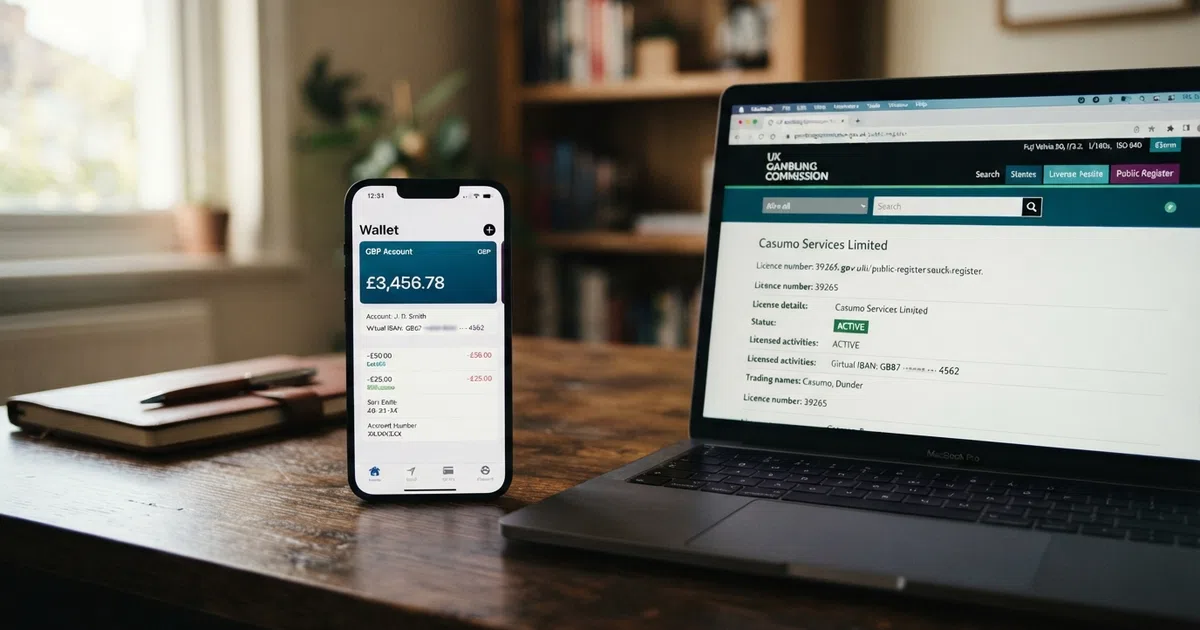
Current as of September 8, 2026 against the UK Gambling Commission’s public licence register and MiFinity’s published fees page.
What MiFinity casinos are — and why they’re not UK-licensed
The e-wallet behind the casinos
MiFinity UK Limited sits on the Financial Conduct Authority’s register as an authorised Electronic Money Institution under the Electronic Money Regulations 2011, with the firm reference that puts it in the same regulatory tier as a UK bank account for the safekeeping of customer funds, headquartered in Belfast. The FCA authorisation covers the payment product itself, the e-wallet, not the merchants that accept it.
The e-wallet is a proper piece of financial plumbing. It supports 18 currencies including sterling, is available in 225-plus countries, and integrates with more than 80 payment methods on the way in and out. Verified UK and EEA customers get a free Virtual IBAN — a real GBP account number and sort code, or a euro IBAN — that lets a UK bank push money into the wallet with no MiFinity fee and same-day SEPA settlement. There is a mobile app on Google Play and the Apple App Store with biometric sign-in and up to nine currency wallets on one screen. The product does what it says on the tin.
The e-wallet is also the payment rail of choice for a long list of online gambling sites that operate outside UK regulation. The FinTelegram MiFinity compliance report from January 2026 — independent, not industry-funded — found MiFinity processing payments across 650-plus gambling websites, with “many operating without adequate local licensing in regulated markets.” That figure is the one that matters for the rest of this page. FCA-authorisation of a payment service does not transfer to the shops that take it.
How MiFinity fits into UK online gambling — and where it doesn’t
Walk through the cashiers of the major UKGC-licensed names — bet365, William Hill, Sky Vegas, Ladbrokes, Coral, Betfred — and MiFinity is not there. What you find is debit cards, Apple Pay, Trustly, PayPal, Google Pay and the occasional bank transfer. MiFinity’s absence from the licensed mainstream is not an oversight. It is the answer to the same question the rest of the page is asking.
The reason is structural rather than commercial. Since the Gambling (Licensing and Advertising) Act 2014, any operator serving customers in Great Britain needs a UKGC operating licence. A Curaçao, MGA or Gibraltar licence does not substitute. MiFinity is integrated into offshore-licensed casinos that take UK players as a grey-market product. The UKGC and the FCA regulate different things in this picture: the FCA supervises the e-money institution, the UKGC supervises the gambling operator. They are not jointly vetting the merchant list.
The trade-off is the one a UK player has to price in. Offshore licensing gives the operator a wider payments menu, lighter bonus restrictions, looser onboarding, and a UK-facing marketing presence without a UK point-of-consumption licence. It also removes the things a UKGC licence is most visibly for: GAMSTOP coverage, the UKGC complaints route, an approved alternative dispute resolution provider, segregation of player funds, and the responsible-gambling toolset the LCCP mandates. Whether that trade is acceptable is a personal call. The rest of this page makes sure it is an informed one.
The MiFinity casino experience: what to expect
The mechanics are the same at every site, regardless of who licensed it:
- Sign up at the casino with the standard email, password, currency, and address. Offshore sites ask less up front than UKGC ones, but identity verification still happens — usually before the first withdrawal, sometimes before the first deposit, depending on the operator.
- Fund the MiFinity wallet first, then deposit from it. The cheapest path is a UK bank transfer to the free Virtual IBAN: zero MiFinity fee, same-day settlement. A Visa or Mastercard EEA deposit is 1.8%. Crypto loads the wallet at 1.8%.
- Open the cashier at the casino, pick MiFinity, enter the deposit. Minimums cluster around £15 to £20 across the operators reviewed here. Maximums range from £2,500 to £5,000 per transaction at the data-rich end.
- Play. The slot library, live dealer tables, and the rest run on the casino’s own platform; MiFinity is just a deposit button.
- Withdraw back to the same MiFinity wallet, then onward to a UK bank via the IBAN, or to a card, or to crypto.
What is different from a UKGC casino is what sits around the deposit button. No GAMSTOP coverage. No UKGC complaints process. No ADR. No fund segregation. The site can run a 500-free-spin welcome with a 40-times wagering term and an offshore max-cashout cap and the UKGC has nothing to say about it. The section on UK law and the protection gap spells out each of those in turn.
The best MiFinity casinos we found for UK players in 2026
Every operator below accepts MiFinity deposits and reaches UK players. None of them holds a UKGC licence. That is the single most important fact about the table — and the reason licence jurisdiction is the column it leads with.
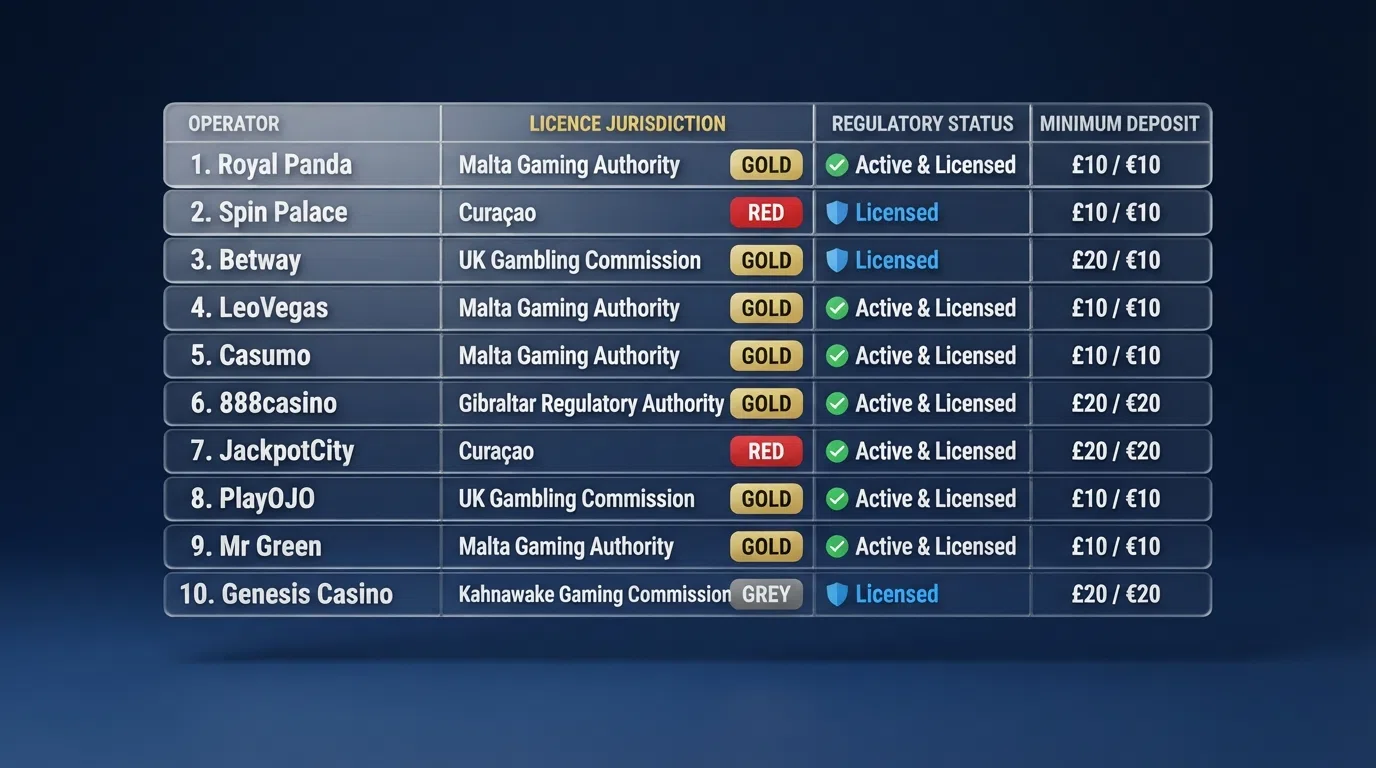
| Operator | Licence jurisdiction | UKGC-licensed? | Min MiFinity deposit |
|---|---|---|---|
| Bilucky Casino | Costa Rica | No | £20 |
| Boho Casino | MGA (Malta) | No | ~€20 |
| Betti Casino | MGA (Malta) | No | €20 |
| Bankonbet Casino | Offshore | No | €20 |
| Legzo Casino | Offshore | No | €20 |
| Woo Casino | Offshore | No | $/€20 |
| Casinochan | Offshore | No | $/€20 |
| Slots Gallery | MGA (Malta) | No | — |
| Just Casino | MGA (Malta) | No | — |
| Slotbox Casino | MGA (Malta) | No | — |
The full per-operator free-spin count, maximum deposit and withdrawal-time data is laid out in the write-ups that follow, and again in the comparison of bonuses further down. Where a cell is blank, research did not confirm a figure this run — not a zero, a gap, and a flag to verify directly on the operator’s cashier before depositing.
How these MiFinity casinos stack up
The columns are ordered for a reason. Licence jurisdiction comes first because every other decision a UK player makes depends on it. A UKGC licence means a player walks into the protections listed in the comparison further down: GAMSTOP coverage, a financial vulnerability check at £150, a UKGC complaints route, a slot stake cap of £5 or £2 depending on age, a 10-times wagering ceiling on bonuses, segregated funds, and a responsible-gambling toolset that includes deposit limits the operator is required to prompt for. The UKGC’s own position is unambiguous: “Any operator that provides facilities for gambling to customers in Great Britain needs a Gambling Commission licence regardless of where it is based — a Curaçao, Maltese or Gibraltar licence is not a substitute.”
The minimum-deposit column says something different. £15 to €20 is the standard MiFinity entry point — the wallet works the same way regardless of the operator’s licence, and the cost of funding it is set by MiFinity’s published fees. The minimum tells you how cheaply a player can sample a site before committing. It does not tell you what that sample is worth, which is the question the rest of the article takes up.
The bonus and free-spin data are scattered across the write-ups on purpose. A welcome offer that looks generous can come with a 40-times wagering requirement, a game weighting that strips most of the value back, and a max-cashout clause the small print hides. A UKGC casino, by contrast, is bound by a 10-times hard cap on bonus wagering since 19 December 2025, and a ban on mixed-product offers that try to push a player from slots into a different product. The two regimes are not in the same universe on this.
Bilucky Casino
Bilucky is the standout on payout speed and transaction ceiling — and the only operator in the set under a Costa Rica licence, the lightest of the licence tiers. Min £20, max £4,000 per transaction, deposits instant, withdrawals up to one hour.
That one-hour claim is the headline number. It is faster than the rest of the field, and worth interrogating. “Up to one hour” is a ceiling rather than a typical — most UK-facing reviewers describe the actual Bilucky withdrawal flow as minutes to a few hours, depending on the KYC status. A UK player with a fresh account can expect to clear the first verification step before the first withdrawal clears at all, which can take longer than the subsequent ones. The £4,000 ceiling is also a single-transaction cap rather than a daily one: a player can run several in a row, subject to the operator’s own rules.
The Costa Rica licence is the largest single trade. A Costa Rica licence is a business-registration licence rather than a gambling-specific regulatory regime — there is no Costa Rican gambling commission in the UKGC sense, no ADR route through an approved provider, no fund segregation standard, and no automatic GAMSTOP cover. Bilucky is one of the operators a UKGC-self-excluded player can reach; that is part of why it appears on these lists and is the reason it is worth naming plainly.
Verdict: the fastest cashout in the ranking, with the lightest regulatory scaffolding. The trade is between speed and protection, and the answer depends on which a player values more.
Boho Casino
Boho runs under a Malta Gaming Authority licence — the strongest regulatory pedigree in the ranking after UKGC, with an EU-grade complaints and dispute framework, an MGA audit regime, and segregated player funds. Min deposit sits around €20 via MiFinity.
The trade is that the MGA is not the UKGC. Boho does not list as a UKGC-licensed operator, which means none of the UK-specific protections (the £150 vulnerability check, the age-banded stake limits, the 10x bonus cap, GAMSTOP) apply. The MGA’s own player-protection regime is real, and an MGA dispute is workable, but a UK player who wants the UKGC route is not in the right place.
Bonus and free-spin data specific to MiFinity-funded accounts was not confirmed this run. MGA-licensed sites tend to be more conservative on bonus terms than their offshore cousins — the welcome offer is usually a smaller, cleaner deposit match with clearer weighting.
Verdict: a credible MGA-licensed option for a player who has decided to play outside the UKGC framework and wants the strongest non-UK regime to do it under.
Betti Casino
Betti is the second MGA-licensed entry in the ranking and the first with a confirmed welcome offer: 150 free spins included in the package. MiFinity deposits run from €20 to €2,500 per transaction.
The 150 free spins sound generous until they are set against the wagering terms — which, at an MGA-licensed offshore site, are not capped at the 10x UKGC ceiling. Free-spin winnings at this tier commonly carry 35x to 50x wagering, often with a max-cashout clause, and the wagering target is frequently restricted to specific slot titles. The 150 figure is the headline; the actual conversion rate is the relevant number, and that one is hidden in the terms.
MGA licensing still applies, with its own segregation, dispute and audit requirements. MGA does not equal UKGC. The absence of GAMSTOP and the absence of UKGC complaints are the same as at every other entry in this table.
Verdict: a reasonable mid-table pick with a real welcome offer, where the 150 free spins need to be read in the small print before they are valued.
Bankonbet Casino
Bankonbet doubles the free-spin count: 200 free spins included with the welcome package, against MiFinity deposits of €20 to €5,000. Licence status is offshore without a specific regulator named in research this run.
A €5,000 per-transaction ceiling is one of the larger in the set — it lets a higher-stakes player move size in fewer transactions. The trade is the same one Bilucky offers, with a different name on it: the looser the regulator, the looser the bonus, and the thinner the safety net. 200 free spins against offshore wagering terms can mean a 40x playthrough, a game-restricted list, and a max-cashout that clips the upside.
Verdict: a higher-deposit option with a heavy welcome offer and an offshore licence that gives the operator more room to set its own terms — for or against the player.
Legzo Casino
Legzo carries the largest free-spin count in the ranking: 500 free spins in the welcome package, against €20 to €5,000 MiFinity deposits. It also has the slowest confirmed withdrawal window: one to five days.
The 500 free spins and the one-to-five-day withdrawal are two different pieces of information about the same operator, and they fit together. An offshore casino offering a very large free-spin bundle on a smaller deposit has to fund that bundle somewhere — usually through heavier wagering requirements, a max-cashout cap, or a longer payout queue. The slower withdrawal window can also reflect manual review at the back end rather than automated processing.
Verdict: the biggest free-spin headline in the ranking, balanced by the slowest confirmed payout, and worth pricing in as a single trade rather than two separate numbers.
Woo Casino
Woo is an established offshore brand with a $/€20 MiFinity minimum. Free-spin and bonus data were not confirmed this run, which is a meaningful gap — Woo has run substantial welcome offers historically, but the specific MiFinity-funded terms were not pinned down.
An “established” offshore brand is not the same as a regulated one. Longevity tells a player the operator has not collapsed under payout pressure or a regulator’s action; it does not tell them which jurisdiction governs a dispute, or whether the operator holds player funds in segregated accounts.
Verdict: a known name with thin MiFinity-specific data, where the gap is itself a flag — confirm the bonus terms and the licence details on the cashier page before depositing.
Casinochan
Casinochan launched in 2019, which makes it the longest track record in the offshore set. MiFinity minimum sits at $/€20. Bonus and free-spin data specific to MiFinity funding were not confirmed this run.
Six years in operation is meaningful for an offshore brand. It suggests the operator has weathered at least one full bonus cycle, several payment-rail changes, and a regulatory environment that has tightened around it rather than against it. None of that is a substitute for a UKGC licence. What it does is lower the operator-failure risk and raise the likelihood that a complaint eventually finds an answer somewhere.
Verdict: the longest track record in the ranking, with the same offshore gap on protections and the same need to confirm current MiFinity terms before depositing.
Slots Gallery
Slots Gallery is MGA-licensed and slots-first by name and positioning. MiFinity-specific deposit limits and bonus data were not confirmed this run.
A “slots-first” casino is one where the live-dealer and table-game library is a smaller second wing. That fits the research gap on MiFinity terms: the operator is real, the MGA licence is real, and the specifics of the cashier for a MiFinity deposit this month were not pinned down. MGA’s regulatory floor still applies, which gives Slots Gallery a stronger base than the bare-offshore entries, but it does not convert the licence into UKGC protection.
Verdict: an MGA-licensed slots-focused option where the MiFinity-specific terms need direct verification at the cashier.
Just Casino
Just Casino is the second MGA-licensed entry where research was unable to confirm a MiFinity deposit limit, free-spin count, or bonus specific to the wallet this run. The MGA licence is the only confirmed anchor.
Two operators in a row with no confirmed MiFinity data is a flag worth naming. A research run that pins down ten operators and finds three with gaps in the data is one thing. Two adjacent gaps, both at MGA-licensed sites, suggests the MiFinity integration is either newer or quieter at these brands than at the data-rich end of the ranking.
Verdict: a credible MGA licence with the thinnest data in the set, where the due-diligence burden falls entirely on the player before depositing.
Slotbox Casino
Slotbox is the third MGA-licensed entry with no confirmed MiFinity deposit limits, and the one with the widest free-spin range: 20 to 200 free spins per the Chipy listing from July 2026.
A 20-to-200 range is itself information. A 200-free-spin welcome at a different operator is a fixed number. A 20-to-200 range at Slotbox means the actual offer depends on the bonus code, the deposit size, or the timing of the visit — and the player who arrives looking for 200 may find 20. MGA licensing applies; UKGC protections do not.
Verdict: an MGA-licensed option with a variable free-spin welcome, where the player should read the current offer terms before valuing the headline number.
What MiFinity deposits and withdrawals really cost you
MiFinity is not free to use, and the cost depends on the rail. A UK player who funds the wallet with a Visa or Mastercard issued in the EEA pays a 1.8% deposit fee — a £100 deposit costs £101.80. A UK player who funds it with a UK bank transfer to the free Virtual IBAN pays nothing on the way in. A player who loads with crypto pays 1.8%. The card route is the default and the most expensive.
On the way out, the picture is different. A withdrawal to a Visa EEA card costs a flat €1. A withdrawal to a Mastercard EEA card costs €1.75. A crypto withdrawal costs 1.8%. A bank-to-bank withdrawal via the Virtual IBAN route typically arrives without a MiFinity fee, though the receiving bank may charge its own. The FX conversion fee is 2.99% — the number to remember for any transaction that crosses currencies, including the euro/sterling boundary at the MGA-licensed sites.
The asymmetry is the point. Deposits through cards are the most expensive path, the path most players take by default, and the path the marketing copy tends to hide. The Virtual IBAN exists specifically to make the cheaper path available, and a UK player who is going to use MiFinity regularly should learn it.
Funding your MiFinity wallet: every route and its fee
The cheapest path is a UK bank transfer to the free Virtual IBAN: no MiFinity fee, same-day SEPA settlement, and the player is not exposed to the 1.8% card levy or the 2.99% FX margin. A SEPA transfer from a eurozone bank is also free. Crypto funding is 1.8% and makes sense when the casino also settles in crypto — otherwise the wallet has to convert on the way out, and that conversion takes the 2.99% FX margin.
The card path is the one most players land on first. It is convenient, the wallet stores the card, and the fee is small enough to ignore on a single deposit. It is also 1.8% on every load, which over a year of regular play becomes a meaningful sum, and a sum that does not exist on the IBAN route.
Getting your money out: withdrawal times at MiFinity casinos
The two operators with confirmed withdrawal data in this ranking are at opposite ends of the window. Bilucky advertises withdrawals up to one hour — the fastest in the set, with the Costa Rica trade explained above. Legzo sits at one to five days, the slowest confirmed window, against a 500-free-spin welcome and a €5,000 ceiling. The other eight operators did not surface a confirmed withdrawal window this run.
The reason the gap matters is that there is no UK-mandated payout deadline outside the UKGC. UKGC sites cannot allow reverse withdrawals — a player can cancel a pending withdrawal and have it returned to the playable balance — and the operator has a duty to process withdrawals promptly. Offshore sites run on their own house rules. Some process inside an hour, some batch daily, some sit on withdrawals during weekends and anti-fraud reviews.
The honest read: a player choosing between Bilucky and Legzo on withdrawal speed is choosing between a Costa Rica licence with sub-hour payouts and an offshore licence with up to five-day payouts. Both are offshore, both lose UKGC protection, and the speed difference is real. The other eight need direct verification.
MiFinity payment alternatives for UK casino deposits
UKGC-licensed casinos do not take MiFinity, and the alternatives for a UK player who wants to stay inside the regulated perimeter are well-defined: debit cards, Apple Pay, Trustly, PayPal, Google Pay, and bank transfers. Skrill and Neteller are accepted at many UKGC sites as well, and they are the closest e-wallet analogues to MiFinity — though they come with their own bonus-restriction clauses, since some UKGC operators exclude Skrill and Neteller deposits from welcome bonuses.
Two further points to keep the comparison clean. Credit cards have been banned for all remote gambling in Great Britain since 14 April 2020, and the ban extends to credit-card-funded payments routed through e-wallets — Skrill, Neteller or PayPal loaded from a credit card does not work. And no e-wallet choice restores the protections a UKGC site offers. The choice at the UKGC end is between debit card, Trustly, PayPal and Apple Pay; the choice outside it is between MiFinity and the wider offshore e-wallet market.
MiFinity casino bonuses worth claiming — and the ones that aren’t
The headline numbers are where offshore casinos do their best work, and where the player’s arithmetic matters most. A UKGC casino is hard-capped at 10x wagering requirements on bonuses since 19 December 2025, with mixed-product promotional offers banned outright. A £100 bonus at a UKGC site has to clear £1,000 of wagering before withdrawal. An offshore MiFinity casino can — and commonly does — set the same £100 bonus against 40x or higher, with game restrictions and a max-cashout clause. The two systems are not comparable on headline size.
Welcome bonuses and deposit matches at MiFinity casinos
The welcome offers in the ranking cluster around two shapes: a deposit match (typically 100% to 200% on the first deposit) plus a free-spin bundle, or a multi-stage welcome across the first three or four deposits. The match is the easy number to read. The wagering term, the game weighting, the time limit and the max-cashout clause are the four numbers that decide what the offer is actually worth.
A player valuing a 100% match up to €200 with 40x wagering on the bonus at a 96% RTP slot is looking at clearing €8,000 of qualifying play for a maximum withdrawal of €200 plus the original deposit — minus the house edge, which at 4% on €8,000 of turnover is €320 of expected loss against a €200 bonus. The arithmetic usually does not close for the player. The point of the bonus is to extend playtime and lock the bankroll into the operator’s game weighting, and the only honest framing is to read it as a longer session rather than a cash extraction.
The UKGC’s 10x cap exists for a reason. It changes the ratio. The same arithmetic at a UKGC site with a 10x wagering term and a £100 bonus is £1,000 of qualifying play at 4% expected loss, or £40 of loss against a £100 bonus. The bonus clears at a quarter of the turnover for the same bonus size. That is what the 10x cap is doing.
Free spins with MiFinity deposits
Three operators in the ranking confirm a free-spin welcome: Betti at 150, Bankonbet at 200, Legzo at 500, and Slotbox at a 20 to 200 range. The other six did not surface a confirmed free-spin bundle this run.
The 500-free-spin headline at Legzo is the largest in the set, and the largest in the set should always be the first to be questioned. Free spins at offshore sites typically carry the following terms: a wagering requirement of 30x to 50x on the spin winnings, a max-bet-per-spin cap during wagering, a list of eligible games that may exclude the highest-RTP titles, and a max-cashout clause that turns a 500-spin haul into a fixed ceiling. The “up to” framing of free spins is also worth reading — the spin value (the per-spin stake) is often fixed at a low amount, and the “500 free spins” headline is 500 spins at €0.10 each rather than 500 spins at €1.
A useful working rule: count the wagering target, multiply it by the house edge at the eligible game’s RTP, and compare that to the headline bonus. The number that comes out is what the offer is worth in expected terms, and it is almost always less than the headline.
No-wagering bonuses and no-deposit offers: the MiFinity reality
No operator in the ranking surfaced a confirmed no-wagering or no-deposit MiFinity bonus this run. “No-wagering” bonuses do exist at offshore sites — the term is on offer at some MGA and Curaçao brands — but they tend to be smaller, time-limited, and restricted to specific games. A “no-wagering” welcome is usually a token rather than a headline.
The keyword-level promise and the operational reality sit in different places. The honest framing: a no-wagering MiFinity bonus is rare, and the player who sees one should still read the eligible-game list, the max-bet-per-spin, and the withdrawal cap before assuming the offer is as advertised. The UKGC’s 10x cap, by contrast, means a no-wagering offer is closer to the norm at UKGC sites than the exception, which is another way the two regimes diverge on value.
The games you can play at MiFinity casinos
Offshore MiFinity casinos carry wide game libraries: several thousand slot titles, a full live-dealer suite from Evolution and Pragmatic, a smaller table-game wing, sometimes bingo, scratch cards, crash games, and the rest. The breadth is a real draw for players who feel constrained by the UKGC product rules, and it is the most visible upside of playing outside the UKGC perimeter.
The UKGC’s product rules are specific. Online slot stake limits are age-banded: £5 per game cycle for players aged 25 and over since 9 April 2025, and £2 for players aged 18 to 24 since 21 May 2025, imposed by SI 2025/215. Auto-play is banned. Spin speed cannot be faster than 2.5 seconds. Features that speed up play are banned. Losses disguised as wins — slot animations that celebrate a payout smaller than the stake — are banned. Reverse withdrawals are banned: a player cannot cancel a pending withdrawal and return the funds to the playable balance. None of those rules apply offshore.
The absence of the rules is the product. A player who finds the £2 stake cap restrictive at age 23, or who wants the auto-play feature, or who wants the reverse-withdrawal flexibility, is the player the offshore casino is built for. The same player has to live with the rest of the offshore model: no UKGC complaints route, no ADR, no fund segregation, no GAMSTOP.
Slots at MiFinity casinos: real-money play and demo mode
Slot libraries at offshore MiFinity casinos run to several thousand titles. Demo mode is widely available — usually on the same games, in the same lobby, without an account. Real-money play is gated by sign-up and a deposit. The provider mix is wide: NetEnt, Pragmatic Play, Play’n GO, Hacksaw, Nolimit City, and the rest of the usual supplier list, with regional studios layered on top.
The UKGC stake cap, where it applies, sits on top of the slot rather than the operator. At a UKGC casino, a 25-year-old cannot stake more than £5 on a single game cycle of a slot. At an offshore casino, the same player can stake whatever the operator accepts, with some operators setting their own voluntary caps and others declining to. The Q1 2026 market data from the UK Gambling Commission shows slots GGY up 12% year-on-year, against total online GGY of £1.55 billion up 7% — the licensed market is not contracting under the new rules.
The provider list is largely the same in both regimes. The difference is the rules around the games, not the games themselves.
Live dealer and table games with MiFinity
Live dealer availability is qualitative rather than operator-specific in this ranking — research did not pin down a per-operator live table count this run. The general picture at offshore MiFinity casinos is a full Evolution and Pragmatic Live suite: roulette, blackjack, baccarat, game shows, dice games, and the regional variants. Table games in the RNG wing cover the same product set with synthetic dealing.
The mechanics are identical to a UKGC live casino. The difference is what surrounds them. A live-dealer dispute at a UKGC site can be raised with the operator, escalated to the approved ADR provider, and (in serious cases) referred to the UKGC. A live-dealer dispute at an offshore site is between the player and the operator, with the operator’s licensing jurisdiction as the backstop — workable at an MGA site, harder at a Costa Rica site, and never equivalent to the UKGC route.
MiFinity casinos on mobile: how they hold up
The MiFinity mobile app is well-built and well-reviewed. It is free on both stores, supports biometric sign-in, holds up to nine currency wallets on one screen, and is the cleanest way to move money into and out of an offshore casino from a phone. The wallet works on its own merits.
The casinos it connects to are more variable. Offshore casino sites are mostly built on mobile-first HTML5 platforms, and they run in a phone browser without a dedicated app. A few — particularly the longer-established brands — have Android APKs that can be side-loaded, and a smaller number have iOS apps, but the App Store’s gambling restrictions make iOS apps a minority. The pattern is browser play, with the MiFinity app for funding on the side.
Playing on your phone: mobile browser vs casino apps
The trade between a mobile browser and a casino app is rarely a clean win. A native app can be faster, can hold the session, and can keep biometric login for the casino itself. A mobile browser session avoids the install step, avoids iOS App Store restrictions on gambling apps, and updates without a download. Most offshore MiFinity casinos are built around the browser path, and the experience is competent on a current-generation phone.
The MiFinity app sits alongside the casino rather than inside it. A UK player using the wallet on a phone keeps the wallet open in one app, switches to the casino in the browser (or in the casino’s own app, where one exists), and approves the deposit from the wallet. Biometric sign-in makes the wallet side a single tap, which is the part of the flow that genuinely improves the experience.
New MiFinity casinos in 2026: fresh faces, same offshore reality
New MiFinity-accepting casinos launch regularly. The pattern across the last two years is consistent: a new brand, an offshore licence (most commonly Curaçao or Anjouan, occasionally Costa Rica), a MiFinity integration in the cashier, and a UK-facing marketing presence without a UKGC licence. The pattern is the product.
The UKGC public register lists 2,665 active business records as of August 2026, searchable at gamblingcommission.gov.uk/public-register/businesses. A new offshore MiFinity casino is not on that list. The check is one search box, and it is the single highest-leverage thing a UK player can do before depositing at a brand they have not seen before. The casino’s own footer usually names a regulator; cross-check the name and the licence number against the register, and walk away from anything that does not match.
The “new” framing in marketing is often a feature, not a fact. A new casino has a new bonus budget and a thinner reputation — the operator is more aggressive on the welcome offer and more likely to be the one that disappears with the player balance in two years’ time. The newness is part of the deal, and the deal is the same one the rest of this page has been spelling out.
Crypto and no-registration MiFinity casinos: more promise than delivery
MiFinity supports crypto on both sides of the wallet, and several offshore MiFinity casinos accept crypto-funded deposits from the wallet. The no-registration or no-verification claim is a different story: under UK law, any operator serving GB customers — whether licensed or not — is subject to anti-money-laundering requirements that mean identity verification before the first deposit. A truly anonymous casino play is not available to a UK resident, regardless of the payment rail.
The crypto rail itself is straightforward. MiFinity’s published fees are 1.8% on both the deposit and the withdrawal — symmetric, predictable, and above the bank-transfer cost. A UK player who holds crypto and is willing to pay 1.8% twice (in and out) for the convenience of settling in a stablecoin at a crypto-accepting offshore casino has a working path. The conversion at the casino end and the conversion at the wallet end are the two friction points, and the FX margin sits at 2.99% on either side.
Bitcoin and crypto deposits via MiFinity
The 1.8% on each side is the cost. The value depends on whether the casino settles in crypto. A casino that holds balances in BTC or USDT removes the FX margin and makes the rail cleaner. A casino that converts on receipt re-introduces the spread. The MiFinity-published fee is not the total cost of a crypto deposit — it is the cost of the rail, and the conversion is on top.
The regulatory gap on a crypto-funded offshore MiFinity deposit is the same as on any other MiFinity deposit at an offshore casino: no UKGC licence, no UKGC complaints route, no ADR, no GAMSTOP, no fund segregation. The crypto rail does not add protection, and the offshore status does not subtract it. The protection is the same as for a sterling deposit at the same operator.
MiFinity casinos and UK law: the protection gap
The Gambling (Licensing and Advertising) Act 2014 requires a GB operating licence for any operator serving customers in Great Britain, wherever the operator is based. The UKGC’s own position is the one already quoted: “Any operator that provides facilities for gambling to customers in Great Britain needs a Gambling Commission licence regardless of where it is based — a Curaçao, Maltese or Gibraltar licence is not a substitute.” Every MiFinity casino in the ranking falls on the wrong side of that statement.
The criminal side of the law is on the operator, not the player. Section 33 of the Gambling Act 2005 makes it an offence to provide facilities for gambling without a licence, with penalties of up to 51 weeks’ imprisonment, an unlimited fine, or both. There is no comparable penalty traced to a player who merely gambles on an unlicensed site. The asymmetry is not a green light to play; it is a recognition that the law targets the supply side and that the player is the one who loses the protections rather than the one who faces prosecution.
The UKGC’s enforcement is disruption rather than blocking. Between April 2024 and June 2025, the Commission issued 3,140 disruption notices, referred 447,778 URLs to search engines, and saw 287,961 URLs removed, with a 32% average fall in engagement across 160 disrupted sites. There is no statutory ISP or DNS blocking power currently — legislation has been proposed. The result is that an unlicensed site can be hard to find one week and easy to find the next, and the player’s recourse if something goes wrong is the operator’s own complaints process and the operator’s licensing jurisdiction.
What a UKGC licence actually guarantees
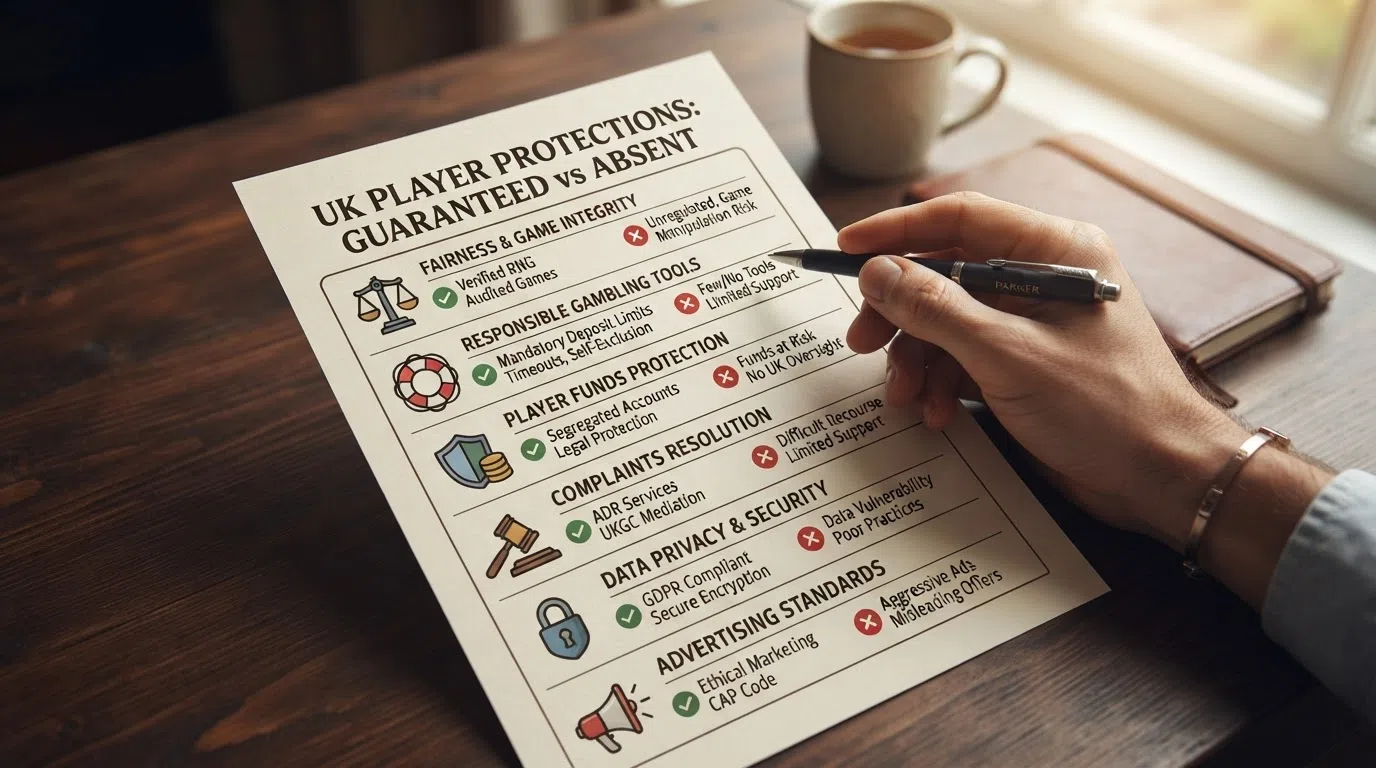
The full comparison is the table below. The point is what each row does, not what each cell says — but the cells say it.
| Protection | UKGC-licensed casino | Offshore MiFinity casino |
|---|---|---|
| UKGC operating licence | Yes | No |
| GAMSTOP self-exclusion | Mandatory, all customers | Not covered |
| Financial vulnerability check at £150/30 days | Mandatory | Not required |
| Slot stake cap (£5 for 25+, £2 for 18–24) | Yes (SI 2025/215) | No |
| Auto-play ban, 2.5s spin minimum | Yes | Not required |
| Reverse withdrawals banned | Yes | Not required |
| Bonus wagering cap (10x) | Yes (since 19 Dec 2025) | Not capped |
| Mixed-product bonuses banned | Yes | Not required |
| UKGC complaints route | Yes | No |
| Approved ADR provider | Yes | Operator-dependent |
| Segregated player funds | Yes | Operator-dependent |
| Direct-marketing opt-in per product | Yes (since 1 May 2025) | Operator-dependent |
| Statutory levy (1.1% GGY to treatment, prevention, research) | Paid | Not paid |
A UKGC licence funds the treatment infrastructure too. The 1.1% statutory levy on gross gambling yield — split 50% to treatment, 30% to prevention, 20% to research — sits on top of Remote Gaming Duty (40% from 1 April 2026, up from 21%). Offshore operators pay neither. The levy is the line that pays for the National Gambling Helpline, the NHS gambling harm clinics and the research base the prevalence figures come from. A player using an offshore MiFinity casino pays no levy, and the infrastructure that supports problem-gambling treatment in the UK is funded by players who do.
GamStop and self-exclusion: why MiFinity casinos sit outside the net
GAMSTOP is the mandatory national self-exclusion scheme for all GB-licensed online gambling operators. It has been mandatory since 31 March 2020. The exclusion periods are six months, one year, five years, or five years with auto-renewal. The exclusion cannot be cancelled early. The scheme is online-only and licence-bound.
“Licence-bound” is the operative phrase. GAMSTOP applies to operators with a UKGC licence. An offshore MiFinity casino does not have one, and the GAMSTOP registration is meaningless against its player account. A player who has self-excluded through GAMSTOP and then opens an account at an offshore MiFinity casino has not broken the GAMSTOP terms — there is no contract with GAMSTOP that prevents the offshore account — but has also not been prevented from doing what the GAMSTOP exclusion was for. The self-exclusion does not travel with the player to the offshore site.
This is one of the main reasons offshore MiFinity casinos exist as a category, and one of the main reasons a UKGC-self-excluded player looking for MiFinity will find a market waiting. The pattern is well known to operators and to the regulators. The player deciding whether to use it is making the same call a hundred thousand other UK players have made; the only thing that has changed since GAMSTOP became mandatory is that the offshore market has grown to absorb them.
Offshore vs UK-licensed: what you lose at a MiFinity casino
What is lost in the offshore model is the full row of the table above. GAMSTOP coverage, the UKGC complaints route, an approved ADR provider, British consumer redress, fund segregation, the responsible-gambling toolset the LCCP mandates, the slot stake cap, the spin-speed floor, the auto-play ban, the losses-disguised-as-wins ban, the reverse-withdrawal ban, the 10x bonus wagering cap, the mixed-product ban, the financial vulnerability check at £150, the per-product direct-marketing opt-in, and the statutory levy. Every row disappears.
What is gained is the offshore model: a wider payments menu (including MiFinity), looser bonus terms, lighter onboarding, a UK-facing marketing presence without a UKGC licence, the ability to play if self-excluded via GAMSTOP, and (at some sites) a higher deposit ceiling per transaction. The wider slot library and the absence of the game-design rules are part of the same package.
The trade is the trade. A player who values the UKGC protections and has not self-excluded has no reason to be at an offshore MiFinity casino, and the answer to “should I use MiFinity at an offshore casino?” is “use MiFinity at a UKGC site” — except that MiFinity is not at a UKGC site, which is the structural reason the offshore market exists. The honest answer to the question is the structural one: the product is built for the player the UKGC framework is built against, and the choice is between protections and access.
Safer gambling tools: what offshore MiFinity casinos won’t give you
The UKGC’s player-protection framework is layered. Customer-set deposit limits, prompted before the first deposit since 31 October 2025. Reality checks and session time displays. A financial vulnerability check at a £150 net deposit in a rolling 30-day period, using publicly available data only — CCJs, bankruptcy orders, IVAs, DROs — from 28 February 2025. Financial risk assessments, announced but not yet commenced, with Stage 1 thresholds of £5,000 net deposits in 24 hours for players aged 25 and over and £2,500 for under-25s, and final thresholds of £1,000 and £3,000 for 25-plus and £750 and £2,000 for under-25s, confirmed by the UKGC Board on 7 July 2026 with a start date still to be set in formal consultation response.
None of that is mandatory offshore. An offshore MiFinity casino is not required to offer deposit limits, is not required to prompt for one, is not required to run a vulnerability check, and is not required to run a financial risk assessment at any threshold. Some operators offer voluntary versions of all four. The player is the one who has to ask.
UKGC player-protection rules: what a licensed casino must do
The mandatory toolkit at a UKGC casino covers, at minimum:
- A deposit limit the player sets themselves, prompted before the first deposit since 31 October 2025, actioned immediately on a decrease request
- Reality checks during play (session time and net position displays)
- The £150 net deposit / 30-day financial vulnerability check, from 28 February 2025
- GAMSTOP registration and exclusion enforcement
- Self-exclusion at the operator level, with cooling-off periods on return
- Time-out facilities
- Access to safer-gambling information on every page
The financial risk assessment framework is the next layer. The UKGC Board’s announcement on 7 July 2026 confirmed the staged thresholds, with Stage 1 at £5,000/24h for 25-plus and £2,500 for under 25, final at £1,000/£3,000 for 25-plus and £750/£2,000 for under 25, and a start date pending the formal consultation response. The RTS 12B gross deposit limit framework — “only that form may be called a deposit limit” — comes into effect from 30 September 2026. The full framework is the most aggressive affordability regime of any major jurisdiction, and the offshore MiFinity casino does not run on it.
Where to get help: UK gambling support services
The support infrastructure in Great Britain is real and reachable. The National Gambling Helpline, run by GamCare, is on 0808 8020 133 — free, 24/7, confidential. In January 2026, the helpline made 996 referrals to treatment and peer-based support, a 48% increase year-on-year from 674 in January 2025. GambleAware runs the National Gambling Support Network, with over 52,000 calls to the helpline annually and treatment waiting times under two weeks. The NHS runs gambling harm clinics in England, Scotland and Wales. Gamblers Anonymous runs local support groups on the 12-step model. The Primary Care Gambling Service is a national service for anyone experiencing gambling-related harms. GamLearn is the Gambling Lived Experience and Recovery Network. GAMSTOP itself is reachable at gamstop.co.uk.
The problem gambling prevalence figures in England, from the NHS Adult Psychiatric Morbidity Survey 2023–24, are the baseline. 0.4% of adults score PGSI 8+ (problem gambling). 1.6% score PGSI 3+ (moderate risk). Men (2.2%) are more than twice as likely as women (1.0%) to score 3+. The 25–34 age band carries the highest prevalence at 3.5%. The same survey estimates around 6.8 million GB adults at any level of gambling problems (PGSI 1+), and 15% of GB adults participate in problem gambling or elevated-risk gambling (NICE guideline / BMJ 2025).
The point of naming the numbers is not to imply that any particular player is at risk. The point is that the support infrastructure exists, is funded by the licensed market, and is reachable from anywhere in Great Britain, regardless of whether the gambling that prompted the call took place at a UKGC site or an offshore one.
How we evaluated MiFinity casinos for UK players
The ranking is built from the operator’s own site, the aggregator pages (CasinoBee, Chipy.com, SportingPedia, Independent-casinos.org.uk, Irishlucky.com), the FinTelegram MiFinity compliance report, and the UKGC public register. The UKGC register, at gamblingcommission.gov.uk/public-register/businesses, was the licence-status cross-check for every operator in the table — and is where the absence of every featured operator is confirmed, since none appears on it.
The criteria that ordered the ranking were, in order: licence jurisdiction (UKGC first, then MGA, then Curaçao / Anjouan / Costa Rica), confirmed MiFinity deposit terms, confirmed free-spin and bonus data, and confirmed withdrawal time. Where research did not pin down a figure, the cell is blank in the table and the operator’s write-up flags the gap.
The limits of the evaluation are also the limits of the inputs. No per-operator game-library count was confirmed this run. No UKGC-licensed major operator was confirmed to accept MiFinity, and the major-brand cashiers were cross-checked rather than inferred. The FinTelegram compliance report is an independent publication, not an industry-funded one, and the figure of 650-plus gambling sites is the report’s own. The bonus terms cited in the write-ups are the visible welcome offers, not the small print, and a player who proceeds to a specific operator should re-read the small print for that operator before valuing the headline.
Should you use MiFinity at an online casino? The 2026 verdict
MiFinity is a legitimate, FCA-authorised payment service. The e-wallet does what the company says it does, the Virtual IBAN works, the fees are published, and the mobile app is competent. The question is not whether MiFinity is legitimate — it is — but whether the casinos that list it in the cashier are the casinos a UK player wants to be at.
The honest answer is structural. A UKGC-licensed casino cannot accept MiFinity, because MiFinity is not in the cashiers of the major UK brands. A UK player who wants the full UKGC perimeter — GAMSTOP, the £150 vulnerability check, the slot stake cap, the 10x bonus cap, the ADR route, the segregated funds, the responsible-gambling toolset — does not use MiFinity. They use a debit card, Trustly, PayPal, or Apple Pay at a UKGC site, and the absence of MiFinity is the trade they have already accepted by being inside the perimeter.
A UK player who has self-excluded via GAMSTOP and is looking for a way back into the market is the player the offshore MiFinity casino is built for. The product is for them, the marketing finds them, and the protection gap is the price. The arithmetic of a free-spin welcome and a fast payout against the absence of every protection in the table is the calculation the player has to do, and the rest of this page is the input to it.
A player who decides to proceed should check the licence jurisdiction and the licence number on the operator’s footer, cross-check the number against the UKGC public register (or the MGA register, for the MGA-licensed entries), read the bonus terms in full before valuing the headline, confirm the MiFinity deposit minimum and maximum at the cashier, and set a personal deposit limit that the operator is not required to enforce. The National Gambling Helpline is on 0808 8020 133. The call is free, and the line is open.
Frequently asked questions about MiFinity casinos in the UK
Is MiFinity a safe and legal payment method for UK online casino deposits?
MiFinity UK Limited is FCA-authorised as an Electronic Money Institution, headquartered in Belfast, and the e-wallet itself is a regulated payment product. The casinos that accept it are predominantly licensed outside the UK, and the UK Gambling Commission has stated that a Curaçao, MGA or Gibraltar licence is not a substitute for a GB licence. The safety of the wallet and the safety of the casino are separate questions, and they have different answers.
How do I deposit at a casino using MiFinity?
Open a MiFinity account, verify your identity to unlock the free Virtual IBAN, push money from a UK bank into the wallet, then choose MiFinity in the casino cashier and enter the deposit. UK bank-to-wallet top-ups via the Virtual IBAN are free and settle same-day; card top-ups cost 1.8%. The casino deposit minimums cluster around £15 to €20, and the maximums at the data-rich end of this ranking run from £2,500 to £5,000 per transaction.
Do MiFinity deposits qualify for casino welcome bonuses?
Yes, in most cases. Welcome bonuses at offshore MiFinity casinos generally accept the wallet as a qualifying deposit method, unlike some UKGC sites that exclude Skrill and Neteller. The relevant numbers are the wagering requirement (commonly 35x to 50x offshore, versus a UKGC cap of 10x since 19 December 2025), the game weighting, the time limit, and the max-cashout clause. The headline bonus size is the least informative figure in the small print.
Is MiFinity covered by GamStop for UK players?
No. GAMSTOP is mandatory for GB-licensed online operators since 31 March 2020, with exclusion periods of six months, one year, five years, or five years with auto-renewal, and the scheme cannot be cancelled early. Offshore MiFinity casinos do not hold GB licences, do not participate in GAMSTOP, and a self-exclusion registered at a UKGC site does not travel to an offshore account. A player who has self-excluded and then opens an offshore account has not breached the GAMSTOP terms, but the self-exclusion does not extend.
What are the best alternatives to MiFinity for UK casino deposits?
Inside the UKGC perimeter, the e-wallet alternatives are Skrill, Neteller and PayPal, plus Trustly for instant bank transfers, Apple Pay and Google Pay, and the standard debit-card route. Skrill and Neteller carry the same bonus-exclusion risk they do at UKGC sites that accept them. Credit cards have been banned for all remote gambling in GB since 14 April 2020, and the ban extends to credit-card-funded e-wallet payments. The best alternative for a UK player who wants to stay inside the perimeter is any of the above at a UKGC-licensed site, where the protections spelled out earlier in the page apply.
Payments – nonukgc-licensedcasinos
Content created by the «nonukgc-licensedcasinos» team