
Curacao casino licence and UK players: the legal reality, the protections forfeited, and the operators still serving British customers
 Available in GB
A Curacao casino licence looks like a stamp of approval on a casino footer. For a UK player, it is more like a sign that the operator has never applied for the licence they would actually need. The two regulatory worlds do not overlap, and a British player sitting at a Curacao-licensed table is gambling with none of the protections the Gambling Commission spent fifteen years building.

Verified against the Curacao Gaming Authority public register on September 8, 2026, cross-checked with the UK Gambling Commission’s 2026 FOI response on offshore supply.
What a Curacao casino licence actually is — and why it appears in UK search results
A Curacao casino licence is an offshore eGaming authorisation, issued by a regulator on a Caribbean island of roughly 150,000 people, that permits the holder to supply gambling services from Curacao to players in markets that do not require their own local licence. The UK is not on Curacao’s restricted country list. That is the whole reason British players keep encountering these sites: the licence does not stop them from accepting UK customers, and the UK regulator cannot stop every operator from trying.
The Curacao register is large. As of early 2026, the CGA’s public portal at Cga.cw lists more than 300 active B2C Online Gaming Licence (OGL) entries. Hundreds of operators, dozens of affiliate routes in, no shortage of search-result placements. The volume matters: the licensing bar sits well below what the UKGC, the Malta Gaming Authority or other Tier-1 regulators demand. A seal at the foot of a homepage is the start of a check, not the end of one.
The Curacao licence: from the 1996 eGaming framework to the LOK reform
The Curacao system most articles still describe is the one that ended. From 1996 through late 2024, Curacao operated under the NOOGH/LBH framework — a master-licence regime in which four master licence holders issued sub-licences to operators with only loose oversight from the Gaming Control Board (GCB). The sub-licence was cheap, fast, and light on individual operator scrutiny; the framework’s reputation across the industry was that almost anyone could get one.
That changed on 24 December 2024, when the National Ordinance on Games of Chance (LOK) entered into force. The LOK replaced the master/sub-licence model with a single direct regulator — the Curacao Gaming Authority (CGA) — issuing B2C and B2B OGL licences itself. The fee structure moved with it: a B2C application now costs EUR 4,592, with an annual fee of EUR 24,490. Initial licences were provisional for six months, extendable by a further six months subject to compliance, before settling into the standing OGL.
The reform raised the floor. It did not raise the ceiling to where UKGC, MGA or other Tier-1 regimes sit. A LOK OGL is an offshore authorisation with extraterritorial reach into unregulated markets; it is not a substitute for a GB licence and was never intended to be.
UK-facing Curacao casinos: how British players encounter and access them
The route from a Google search to a Curacao casino footer runs through three channels. Affiliate comparison guides cluster around terms like “best Curacao casino” and “Curacao casinos not on GamStop”, filling search results with ranking articles that earn commission on sign-ups. Forum threads on Reddit and dedicated gambling communities pass brand names between users who have already bypassed the UKGC framework. And direct brand searches take the rest — players who have heard a name in a stream or a podcast end up typing it into a browser.
Once a player lands on the site, the experience looks much like any other online casino: GBP-denominated balances where the operator chooses to offer them, English-language support, slot and live-dealer libraries stacked with Pragmatic Play, Evolution, Hacksaw and Nolimit City titles. The differences sit below the surface — in the licence number, in the absence of GAMSTOP, in the credit-card field that UKGC sites have disabled since 2020.
There is a generational split on the operator side worth naming. New entrants are launching under the LOK framework, holding a fresh CGA OGL issued after 24 December 2024. Legacy operators — many of the biggest names by traffic — are transitioning from the old GCB-issued sub-licences into the new regime, and the dates on the CGA register will tell a reader which path each brand took.
The UK legal reality: a Curacao licence means zero UKGC protections for the player
The legal position is unambiguous and worth stating in full. The Gambling (Licensing and Advertising) Act 2014 introduced the point-of-consumption rule: any operator serving customers in Great Britain needs a Gambling Commission licence, regardless of where the operator is based. The UKGC confirmed the position in a 2026 FOI response: “A licensed operator (or an operator applying for a license) based in Curaçao is not permitted to offer gambling services within the UK without a license from us.”
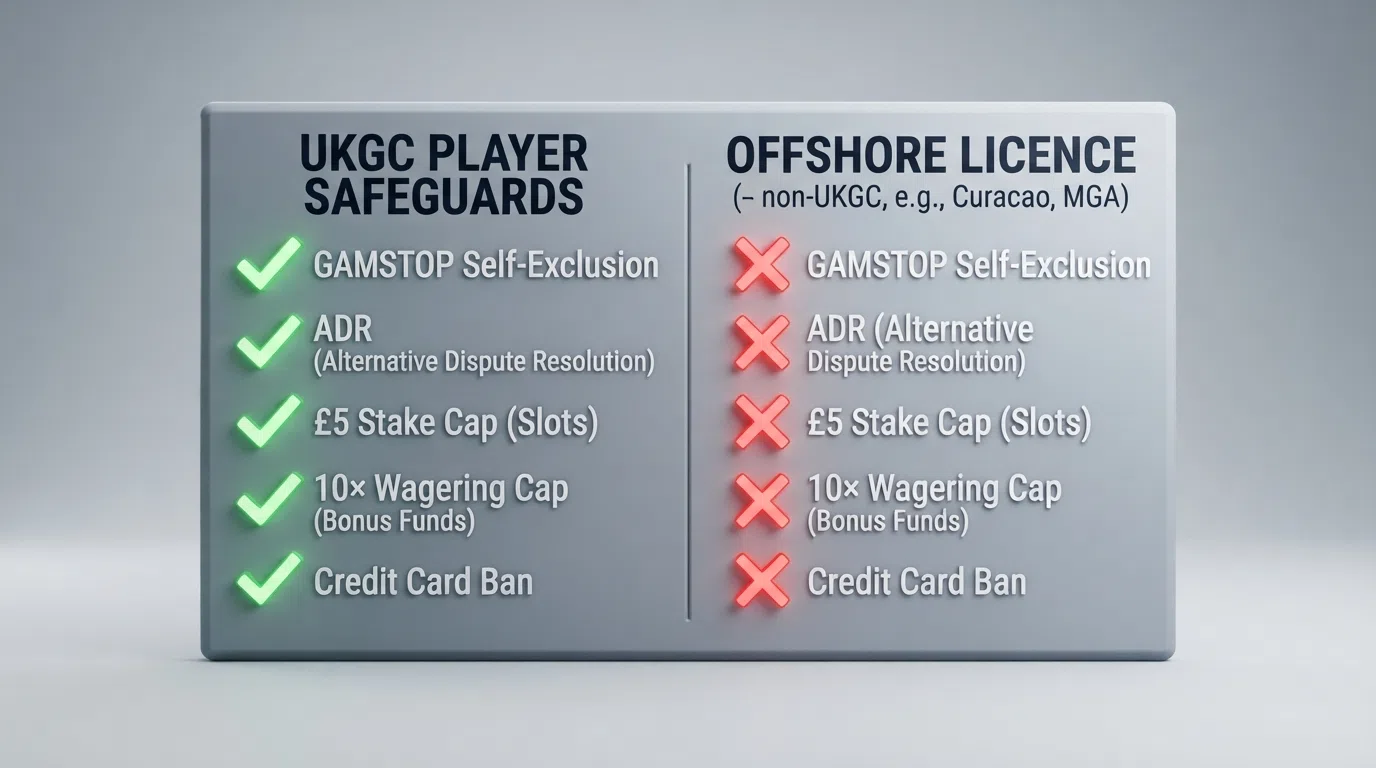
Section 33 of the Gambling Act 2005 sets the criminal penalty on the operator side — up to 51 weeks’ imprisonment, an unlimited fine, or both. No penalty has ever been traced on the player side; every sanction targets operators, advertisers and intermediaries. But “not prosecuted” is not the same as “protected”. By choosing a Curacao casino, a UK player leaves behind the entire infrastructure of UKGC safeguards, forfeiting a comprehensive array of consumer protections.
What the Curacao licence framework delivers — and what it does not
The CGA’s remit is systemic compliance. The LOK framework requires a public register of OGL-licensed entities, mandatory ADR (alternative dispute resolution) certification, AML/CFT compliance obligations, and direct supervisory powers including licence revocation. Operators have to meet these standards to keep their OGL.
What the CGA does not do is handle individual player complaints. The CGA Player Complaints Policy v1.1 puts it plainly: “The CGA does not handle individual complaints — it is not a civil court.” There is no player compensation fund, no individual refund order, no binding dispute resolution by the regulator itself. A player with a withheld withdrawal can escalate to a CGA-certified ADR provider — but that ADR operates without the UKGC’s enforcement track record, without the reciprocity a UK ruling would carry, and with no equivalent of the Financial Ombudsman Service at the end of the line.
That gap matters because the LOK reform improved the framework’s structure without changing the player-side ceiling. A Curacao OGL is now verifiable on a public register and supervised by a single named regulator. It is not, and was never designed to be, a UKGC licence.
How to verify a Curacao licence under the new LOK framework
The CGA register at Cga.cw is the single source of truth. The portal allows lookup by licence number, company name or operator name, and each entry shows the OGL number, the licensee entity, the effective date and the expiry date. As of January 2026, the register snapshot showed over 300 active B2C licences — a number worth holding in mind when assessing what the licensing bar actually is.
The certificate at cert.cga.cw confirms the licence as it stood at the moment the certificate was issued. A seal on a casino footer is not enough on its own — players should cross-check the register directly. The red flags are simple: an OGL number that does not appear on the register, a company name that does not match the operator’s footer text, an effective date that has already passed the expiry date, or no OGL number at all. Any one of these means the licence cannot be confirmed from the regulator’s own records.
Are Curacao casinos safe? Legitimacy, dispute resolution and what the CGA will not do
The word “regulated” carries different weight under different regulators. Under the LOK, a Curacao OGL means AML/CFT compliance, game-fairness certification, ADR membership and direct CGA supervision. The reform raised the floor compared with the pre-LOK sub-licence regime. It did not raise the ceiling to where Tier-1 regulators sit.
The practical dispute path runs through a CGA-certified ADR provider. A player with a withheld withdrawal can lodge a complaint, the ADR reviews the case, and — in theory — the operator complies with the ADR’s finding. In practice, the CGA does not order refunds, there is no player compensation fund, and pursuing a cross-jurisdiction claim against an offshore operator is expensive enough to deter most players from starting. A UK player has no British consumer redress, no UKGC ADR route, no Financial Ombudsman Service access. The LOK has improved Curacao’s framework. It has not brought a Curacao licence into equivalence with a UKGC or MGA licence.
The UK legal position: operator offence, no player penalty — but a long list of forfeited protections
The operator serving UK players from a Curacao licence commits a criminal offence under section 33 of the Gambling Act 2005. The player is not prosecuted. What the player loses is the full set of UKGC licence conditions — and that set is longer than the marketing language suggests.
GAMSTOP coverage goes first. The UKGC’s credit card ban (LCCP 6.1.2, in force since 14 April 2020) does not apply; Curacao sites commonly accept credit card deposits because they sit outside the UKGC framework, and a UK consumer walking into credit-card debt on a gambling site is using a payment method their home regulator banned for exactly that reason. The age-banded online slots stake cap under SI 2025/215 — £5 per game cycle for players 25 and over, £2 for 18–24-year-olds — does not apply offshore. The wagering requirement cap of 10× (LCCP Social Responsibility Code 5.1.1, in force 19 December 2025) does not apply offshore; Curacao sites commonly apply 30× to 45×.
The game-design rules since 31 October 2021 do not apply either: no auto-play ban, no 2.5-second minimum spin speed, no ban on losses disguised as wins, no reverse-withdrawal ban. The financial vulnerability check at the £150 net deposit threshold in a rolling 30 days, in force at UKGC sites from 28 February 2025, is not conducted at Curacao casinos. The pre-deposit financial limit prompt required at UKGC sites from 31 October 2025 is not required at Curacao casinos.
The UKGC’s enforcement machinery is real even if it does not reach every operator. Between April 2024 and June 2025 the Commission issued 3,140 disruption notices, referred 447,778 URLs to search engines for delisting, and achieved 287,961 removals with an average 32% fall in engagement across 160 disrupted sites. The Commission does not currently hold statutory ISP or DNS blocking powers — legislation has been proposed but not enacted — so enforcement runs through disruption notices, delisting referrals and payment-provider pressure rather than network-level blocks.
GamStop: why Curacao casinos sit outside it — and what a UK player gives up
GAMSTOP is a free self-exclusion scheme covering every GB-licensed online gambling site. It has been a mandatory condition of every UKGC online operating licence since 31 March 2020. Players choose between six months, one year, five years, or five years with auto-renewal — and the auto-renewal exclusion cannot be cancelled early. A player who has self-excluded via GAMSTOP is, in practice, locked out of every UKGC-licensed site for the period they selected.
Curacao-licensed operators sit outside the UKGC framework, and GAMSTOP does not reach them. A self-excluded player can still register, deposit, and play at any Curacao-licensed casino. That is the practical effect, and it is the reason most affiliate guides targeting this keyword exist at all. The secondary loss sits in the supporting tooling — no Gamban or bank-level gambling-block integration is mandated by the Curacao licence, so a player who wants device-level or account-level blocking has to set it up independently.
Curacao-licensed casinos that accept UK players: the landscape in 2026
The ranking below covers ten casinos that are Curacao-licensed, or were Curacao-licensed at the point of their welcome offer, and that accept or have accepted UK players. None holds a GB licence from the UKGC. Every operator on this page operates outside the UKGC licensing framework, and a UK player at any of them forfeits the protections detailed in the section above.
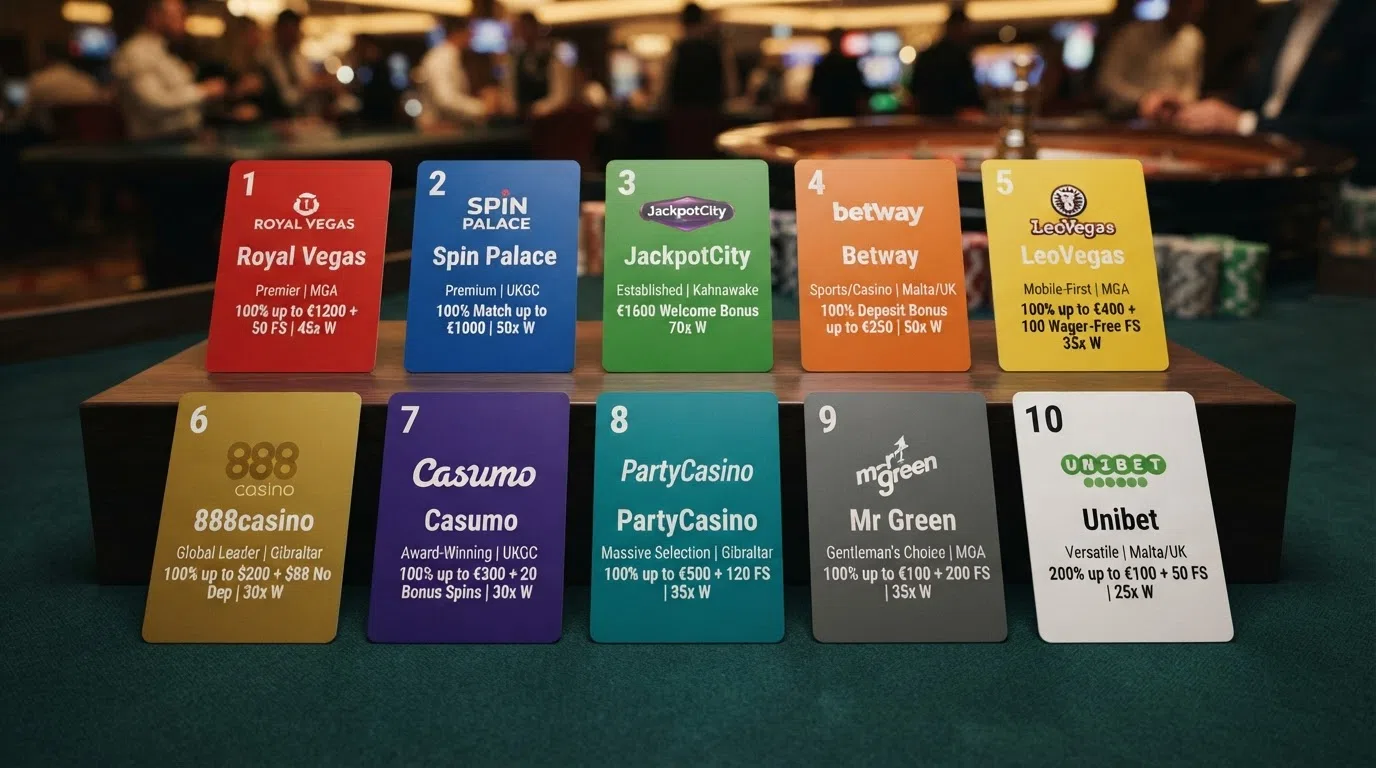
The crucial caveat sits at the top of this section: accepting UK players is not the same as being licensed to do so. The comparison table ranks all ten side by side on licence status, welcome bonus and wagering multiplier — three columns the data set supports. Individual write-ups follow with the detail a single row cannot carry.
| Casino | Licence status in UK | Welcome bonus | Wagering multiplier |
|---|---|---|---|
| Stake | OFFSHORE — Curacao OGL/2024/1451/0918 (Medium Rare N.V.); surrendered UKGC licence March 2025 | 200% up to $2,000 (USD) | 40× on bonus |
| Duelbits | OFFSHORE — Curacao OGL/2024/1507/0838 (Liquid Entertainment N.V., #153298); not UKGC-licensed | Up to 500 free spins | 0× on free-spin winnings |
| MyStake | OFFSHORE — Curacao GCB-licensed (Santeda International B.V.); not UKGC-licensed | 150% up to £750 (300% up to £1,500 across 3 deposits) + 30 FS no-deposit | 30× on deposit + bonus |
| FreshBet | OFFSHORE — Curacao-licensed (European Entertainment N.V.); not UKGC-licensed | 250% up to £1,500 or 300% up to £3,000 + 200 FS across 3 deposits + 25 FS no-deposit | — |
| GoldenBet | OFFSHORE — Curacao GCB-licensed (Santeda International B.V.); not UKGC-licensed | 300% up to £1,500 across 3 deposits + 100 FS | 35× on bonus |
| BetFury | OFFSHORE — Curacao GCB-licensed (Universe B Games B.V.), OGL/2024/1494/0942 effective 31 Jan 2026, expires 31 Jul 2026; not UKGC-licensed | 590% up to $10,500 + 225 FS across 3 deposits | 40× on bonus, $10 max bet while clearing |
| TrustDice | OFFSHORE — Curacao-licensed; not UKGC-licensed | Up to 3 BTC + 25 FS across 3 deposits | 40× on bonus |
| Flush Casino | OFFSHORE — Curacao-licensed; not UKGC-licensed | — | — |
| Jackbit | OFFSHORE — Curacao-licensed; not UKGC-licensed | — | — |
| BC.Game | FORMERLY Curacao — migrated to Anjouan ALSI-202410011-FI1 (Twocent Technology Limited, Belize) in December 2024; UKGC licence revoked December 2024 | 380% up to $4,000 across 4 deposits + 400 FS | 40–45× on deposit + bonus |
| Protection | UKGC-licensed casino | Curacao-licensed casino |
|---|---|---|
| GAMSTOP self-exclusion | Mandatory (since 31 March 2020) | Not provided |
| ADR route for complaints | UKGC-approved providers | CGA-certified ADR only; CGA does not order refunds |
| Credit card deposits | Banned (since 14 April 2020, LCCP 6.1.2) | Commonly accepted |
| Online slots max stake | £5 (25+), £2 (18–24) under SI 2025/215 | No statutory cap |
| Wagering requirements | Capped at 10× (since 19 December 2025) | Commonly 30–45× |
| Auto-play on slots | Banned (since 31 October 2021) | Permitted |
| Minimum spin speed | 2.5 seconds | Not regulated |
| Financial limit prompt before first deposit | Required (from 31 October 2025) | Not required |
| Financial vulnerability check | £150 net deposit threshold (from 28 February 2025) | Not conducted |
How we evaluate and rank Curacao casinos accepting UK players
Four criteria order the comparison table.
- Licence verifiability — is the OGL active on the CGA register at Cga.cw, with a matching company name, effective date and expiry date.
- Bonus fairness — the wagering multiplier, whether winnings from free spins carry wagering requirements, and what the max-cashout cap is.
- Game quality — provider count and the presence of studios with UK name recognition (Pragmatic Play, Evolution, Hacksaw, Push Gaming, Nolimit City).
- Complaints and dispute resolution — whether the operator has a documented pattern of unresolved player complaints and what ADR provider it names.
No weightings or numerical scores are assigned. The data set is too heterogeneous to support one, and an invented score would tell the reader less than the gaps in the table.
Red flags, complaints and what to watch for at Curacao casinos
A Curacao licence alone is not a quality mark. Common complaint patterns across Curacao-licensed casinos include withheld withdrawals citing unverified KYC, bonus terms invoked to void winnings after play, and slow or non-responsive support once a withdrawal is in motion. The CGA can revoke a licence for systemic non-compliance — that is the regulator’s stated power — but it does not order refunds to individual players. The CGA Player Complaints Policy v1.1 is explicit on this point.
Practical due diligence runs through three checks. First, the CGA register at Cga.cw: is the OGL active, does the company name match the footer, are the dates current. Second, player forums: a five-minute search for unresolved complaints will surface patterns the marketing language does not. Third, the ADR provider named on the casino’s terms page — is the ADR named on the CGA’s list of certified providers, and what is its enforcement record. The UKGC enforcement context sits in the background — 3,140 disruption notices and 287,961 URL removals between April 2024 and June 2025 — but it operates against unlicensed operators as a class, not against individual complaints.
Stake — the highest-profile exit from the UK market, still Curacao-licensed globally
Stake surrendered its UKGC licence in March 2025 following the TGP Europe white-label investigation and exited the UK market as of that date. The brand remains one of the largest Curacao-licensed operators worldwide under OGL/2024/1451/0918 issued to Medium Rare N.V.
The welcome offer is a 200% deposit match up to $2,000, USD-denominated, with 40× wagering on the bonus amount. The game library runs to 4,500+ titles from Pragmatic Play, Evolution, Hacksaw, Push Gaming and Nolimit City — a stack that matches the UK’s largest licensed operators on provider quality. The signature trait is structural rather than promotional: a 3.5% lifetime rakeback model rather than a free-spin welcome. Stake bets on retention over acquisition, and the rakeback reflects that. Accessing Stake from the UK is an offshore gamble, conducted entirely outside the regulatory perimeter that UKGC licences provide.
Duelbits — 500 free spins with zero wagering under a CGA licence
Duelbits holds a Curacao Gaming Authority OGL — OGL/2024/1507/0838 under Liquid Entertainment N.V., Curacao company #153298 — and is not UKGC-licensed. The welcome offer runs to up to 500 free spins unlocked in three stages, credited as real cash with zero wagering requirements. Winnings are withdrawable immediately, which is the player-friendly end of the bonus design spectrum and the lowest effective cost to the player among the featured operators.
The game library is 4,000+ titles on a crypto-first platform covering slots, live dealer and sportsbook. The signature trait is the zero-wagering model itself: most operators in this space put the wagering multiplier at the centre of the welcome, and Duelbits removes it from free-spin winnings entirely. The result is a welcome offer whose true cost the player can estimate by reading one line of terms rather than running a multiplier through a stake.
MyStake — 30 free spins no-deposit and a £750 welcome match
MyStake is one of the few featured operators offering a genuine no-deposit free-spin entry point alongside a deposit match. The licence is a Curacao GCB authorisation under Santeda International B.V. — the same operator group that runs GoldenBet — and MyStake is not UKGC-licensed.
The welcome structure combines a 150% match up to £750 on first deposit, a 300% package up to £1,500 across three deposits, and 30 free spins credited on registration with no deposit required. Wagering runs at 30× on deposit plus bonus, with a £20 minimum deposit on the matched offer. The game library spans slots, live dealer and sportsbook. The signature trait is the combination: a GBP-denominated deposit match paired with a no-deposit free-spin gateway that lets a player test the platform before committing funds.
FreshBet — 25 no-deposit spins, a 250% welcome boost and a sprawling sister network
FreshBet combines a no-deposit free-spin offer with one of the largest percentage matches among featured operators. The licence is a Curacao authorisation under European Entertainment N.V. — and the sister-site network runs to MyStake, GoldenBet, Jackbit, Cosmobet and Donbet, the largest operator group on this page.
The welcome package is a 250% match up to £1,500 or a 300% match up to £3,000 plus 200 free spins across three deposits (150% up to £1,500 plus 100 FS / 100% up to £1,000 plus 50 FS / 50% up to £500 plus 50 FS). The wagering multiplier is not specified in the researched data, and the absence is a gap the reader should know about before committing. The deposit-free offer is 25 free spins on registration with no deposit required — a separate offer from the welcome package. The headline percentage is the highest among featured operators with a no-deposit side offer, and the sister-site network gives the brand more operator-group weight than its standalone data suggests.
GoldenBet — 300% across three deposits with 35× wagering from the MyStake group
GoldenBet shares its operator group with MyStake — both run under Santeda International B.V. — and the welcome package sits at a 300% match up to £1,500 across three deposits plus 100 free spins, with 35× wagering on bonus funds. The game library spans slots, live dealer and sportsbook.
The signature trait is the combination: a 300% headline match with a 35× multiplier — five turns above MyStake’s 30× but still below the 40× ceiling common among featured operators. A UK player choosing between MyStake and GoldenBet is choosing between two brands in the same operator group, distinguished mainly by wagering multiplier and free-spin count.
BetFury — 8,000+ games and a 590% headline bonus under a dated CGA OGL
BetFury holds the largest game library among featured operators and the largest headline bonus percentage. The licence is a Curacao GCB authorisation under Universe B Games B.V., with OGL/2024/1494/0942 effective 31 January 2026 and expiring 31 July 2026 — a six-month provisional window worth noting on the register.
The welcome package is a 590% match up to $10,500 plus 225 free spins across three deposits, with 40× wagering on the bonus and a $10 max bet while clearing. The game library runs to 8,000+ titles across slots, live casino, in-house originals and sportsbook. The 590% headline is the highest on the page, but the 40× multiplier and the $10 max-bet ceiling mean the clearance path is longer than the percentage alone suggests. A reader attracted by the headline needs to read the multiplier and the max-bet cap before committing.
TrustDice — Bitcoin-first with a 3 BTC welcome cap and 40× wagering
TrustDice structures its welcome offer in Bitcoin and adds in-house dice games to the standard casino line-up. The licence is a Curacao authorisation and TrustDice is not UKGC-licensed.
The welcome package runs to up to 3 BTC plus 25 free spins across three deposits, with 40× wagering on bonus funds. The game library spans slots, live casino, in-house dice games and sportsbook. The signature trait is the BTC denomination: the 3 BTC cap is the page’s highest nominal value, and its real sterling equivalent fluctuates with the Bitcoin price. A reader who wants a stable-currency comparison should convert at the current rate before assessing whether the headline is large or small.
Flush Casino — Curacao-licensed with a live-dealer focus and thin public data
Flush Casino holds a Curacao licence and is not UKGC-licensed. The welcome offer — bonus amount, free-spin count and wagering multiplier — is not detailed in the researched sources, and the absence is the operator’s most important characteristic for a reader comparing this set. The game’s library covers slots, live casino and table games, with a live-dealer emphasis that sets the brand apart from slots-heavy competitors.
For specifics on the current welcome package, the reader should route to the operator’s own terms page rather than rely on third-party summaries that may be out of date. Without published bonus terms the operator’s value proposition is harder to assess than the rest of the featured set, and a reader who values a known wagering multiplier will find more transparent options elsewhere in this ranking.
Jackbit — crypto-first sister brand in the MyStake group with unpublished welcome terms
Jackbit is part of the largest sister network on this page — the same operator group as MyStake, FreshBet and GoldenBet — but its public bonus data is thin. The licence is a Curacao authorisation and Jackbit is not UKGC-licensed. The game library spans slots, live casino, sportsbook, and the platform is crypto-focused.
The welcome offer — bonus amount, free-spin count and wagering multiplier — is not detailed in the researched sources. The signature trait is structural: a crypto-first interface backed by the page’s largest sister network, which gives the brand more operator-group weight than its own standalone data suggests. For current welcome terms, the operator’s own terms page is the only reliable source until third-party data catches up.
BC.Game — no longer Curacao-licensed: migrated to Anjouan in December 2024
BC.Game is on this page as a caution, not a recommendation. The brand withdrew from Curacao in December 2024 and migrated to an Anjouan (Comoros) licence — ALSI-202410011-FI1 — under Twocent Technology Limited (Belize). The UKGC licence was revoked in December 2024. BC.Game is not Curacao-licensed as of 2026.
The welcome package is a 380% match up to $4,000 across four deposits plus 400 free spins, with 40–45× wagering on deposit plus bonus combined and free spins paid in $10-per-batch caps. The game library runs to 8,000+ titles with 150+ cryptocurrencies accepted — the broadest crypto roster on this page. BC.Game’s migration is the clearest signal that a Curacao licence is not permanent: a brand can leave the framework entirely, and the CGA register will show the change. The verification section above is the place to start when checking any operator’s current licence status.
Why your Curacao casino bonus looks bigger but costs more to clear
Curacao welcome bonuses carry larger headline figures than UKGC offers — and larger wagering hurdles to match. The headline gap is real: Curacao casino welcome bonuses commonly advertise 150%–590% matches versus the typical UKGC-licensed offer. The wagering requirement is where the gap becomes a cost.
The UKGC capped wagering at 10× from 19 December 2025 under LCCP Social Responsibility Code 5.1.1. Curacao sites commonly impose 30× to 45×. The arithmetic is straightforward. A £100 bonus at 10× wagering requires £1,000 in turnover before any withdrawal. The same £100 bonus at 40× requires £4,000 — four times the playthrough, four times the house edge exposure, and a clearance path that runs into hours of play rather than minutes.
The no-deposit offers that appear at several featured operators change the calculation but not the structure. MyStake’s 30 free spins on registration and FreshBet’s 25 free spins on registration let a player test the platform before committing a deposit — useful as a screen, but the wagering on any winnings follows the same multiplier as the matched bonus. Duelbits’ 500 free spins with zero wagering is the structural exception: the player keeps the winnings with no playthrough required, which is why the bonus cost on this page runs from zero (Duelbits) to four-figure turnover (BetFury, Stake, BC.Game).
Welcome bonuses, no-deposit offers and free spins at Curacao casinos
The range of welcome structures across the featured operators runs from the player-friendly end to the high-turnover end.
Duelbits sits at the player-friendly end — 500 free spins with zero wagering, winnings credited as real cash and withdrawable immediately. MyStake combines a no-deposit entry with a matched offer — 30 free spins on registration plus a 150% match up to £750, with 30× wagering on deposit plus bonus. FreshBet runs a similar combination — 25 free spins on registration alongside a 250% match — but the wagering multiplier on the matched offer is not specified in the researched data.
The high-turnover end belongs to BetFury and BC.Game. BetFury’s 590% headline sits at 40× wagering with a $10 max bet while clearing. BC.Game’s 380% across four deposits runs at 40–45× on deposit plus bonus combined, with free spins paid in $10-per-batch caps. The structural truth is simple: the larger the headline percentage, the larger the turnover requirement. A reader attracted by 590% needs to multiply by the wagering multiplier and divide by the average stake before the headline translates into a real cost.
Wagering requirements: 30×, 40× and why the UKGC cap is 10×
The wagering multiplier is the real price of a Curacao bonus. A 30× requirement on a £100 bonus means £3,000 in turnover before any withdrawal is possible. A 40× requirement on the same bonus means £4,000. The UKGC capped wagering at 10× from 19 December 2025 across all GB-licensed operators, which makes the Curacao norm three to four-and-a-half times higher.
The featured operators’ multipliers: MyStake 30×, GoldenBet 35×, Stake 40×, BetFury 40×, TrustDice 40×, BC.Game 40–45×, and Duelbits 0× on free-spin winnings. The higher multipliers exist offshore because no statutory cap applies — the UKGC’s 10× cap and the mixed-product bonus ban are LCCP conditions that only bind GB-licensed operators. A Curacao-licensed operator sits outside that framework, and the bonus design follows.
Getting money in and out: payment methods at Curacao-licensed casinos
Curacao casinos accept payment methods UKGC sites cannot — and process crypto withdrawals in minutes. The payment landscape spans crypto (BTC, ETH, LTC), e-wallets (Skrill, Neteller, Trustly), prepaid vouchers (Paysafecard) and credit cards. The credit card line is the one that does not appear at UKGC sites: the UKGC banned credit card deposits at GB-licensed sites from 14 April 2020 under LCCP 6.1.2. Curacao casinos commonly accept credit cards because they sit outside the UKGC framework, and a UK player walking into credit-card debt on a gambling site is using a payment method their home regulator banned for exactly that reason.
Crypto withdrawals at Curacao casinos typically process within hours or minutes — a structural speed advantage over the 24–72 hour standard at UKGC sites using traditional methods. The CGA’s June 2026 crypto policy sets the rules for how operators handle those withdrawals: crypto must be accepted for gambling only, withdrawals default to the same wallet and same asset, and operators must not act as an exchange or convert crypto to fiat for customers.
E-wallets, prepaid cards and bank transfers at Curacao casinos
E-wallets — Skrill, Neteller and Trustly — are broadly accepted across Curacao casinos and offer faster withdrawals than bank transfers. The speed premium is real: e-wallet withdrawals typically clear within 24 hours versus 3–5 banking days for wire transfers. Paysafecard provides a deposit-only option with no bank linkage, useful for players who want to cap their exposure without linking a current account. Trustly connects directly to a UK bank account for real-time deposits; the withdrawal path is operator-dependent.
The credit card anomaly sits apart from the rest. A UK player cannot deposit by credit card at a UKGC-licensed site but can at a Curacao casino. The flag here is consumer credit risk, not feature: a credit card deposit is a loan, and gambling on borrowed money sits outside the consumer-credit protections the UK regulator built precisely to prevent it.
Crypto gambling under a Curacao licence: the CGA’s June 2026 rules
The CGA issued its first dedicated crypto gambling policy in June 2026, and the provisions change what a Curacao-licensed crypto casino can do with a deposit. Operators must accept crypto for gambling only. They must not act as an exchange — no crypto-to-fiat or crypto-to-crypto conversion for customers. Withdrawals default to the same wallet and same asset. Operators must comply with the FATF Travel Rule.
The practical effect: a Curacao casino cannot convert a Bitcoin deposit into a dollar balance, and cannot return winnings in a different cryptocurrency from the one deposited. The structural speed advantage remains — crypto withdrawals at Curacao casinos typically process within hours or minutes, compared to 24–72 hours for traditional methods at UKGC sites. Bitcoin, Ethereum and Litecoin are the dominant currencies accepted across the featured operators; BC.Game’s 150+ cryptocurrency roster shows the upper bound.
Same game studios, none of the UK stake caps: slots and live games at Curacao casinos
Curacao casinos carry the same Pragmatic Play, Evolution, Hacksaw, Push Gaming and Nolimit City titles as UKGC-licensed sites. The provider overlap is near-total at the studio level. The difference sits in the rules the games run under.
UK online slots carry a statutory maximum stake per game cycle under SI 2025/215: £5 for players aged 25 and over (in force 9 April 2025), £2 for 18–24-year-olds (in force 21 May 2025). Neither cap applies at a Curacao casino. The game-design rules that sit behind the stake cap also do not apply offshore: no auto-play ban (UKGC banned auto-play from 31 October 2021), no 2.5-second minimum spin speed, no ban on losses disguised as wins, no reverse-withdrawal ban.
The library scale reflects the absence of the same product restrictions. BetFury’s 8,000+ game library and Stake’s 4,500+ count are larger than most UKGC-licensed casinos. The studios are the same; the rules around them are not.
Responsible gambling when GamStop is not in the room
The UK has one of the world’s most developed safer-gambling infrastructures, and none of it reaches a Curacao casino. The UK framework runs through GamCare’s National Gambling Helpline (freephone 0808 8020 133, available 24/7), GambleAware as the commissioning body for prevention and treatment, NHS gambling harm clinics in England, Scotland and Wales, and Gamblers Anonymous peer-support groups. The National Gambling Support Network treated 11,960 clients in 2024–25.
The prevalence data sits in the background. The Health Survey for England 2024 found 5% of adults in England scored PGSI 1+ (at-risk or problem gambling), with 0.4% at PGSI 8+ (problem gambling), and a split of 7% for men against 3% for women. The statutory levy that funds much of this infrastructure — 1.1% of gross gambling yield from remote casino operators since 6 April 2025, split 50% treatment, 30% prevention, 20% research — does not apply to operators outside the UKGC framework. None of this funding reaches a Curacao-licensed operator’s safer-gambling provision.
GAMSTOP is mandatory at every UKGC site since 31 March 2020, and a UK player who has self-excluded is, in principle, locked out of the GB-licensed market. A Curacao casino is not part of that market. The self-exclusion does not travel.
Self-exclusion and player protection tools at Curacao casinos
What Curacao-licensed casinos typically offer sits at the operator level: deposit limits, session limits, time-out periods and account-level self-exclusion. Each tool applies to that operator only, with no cross-operator self-exclusion scheme equivalent to GAMSTOP.
The UK contrast runs the other way. From 31 October 2025, all GB-licensed operators must prompt customers to set a financial limit before their first deposit, and from 30 September 2026 the gross deposit limit becomes mandatory — only that form may be called a “deposit limit”. No equivalent obligation exists under the Curacao licence. The financial vulnerability check at the £150 net deposit threshold in a rolling 30 days, in force at UKGC sites from 28 February 2025, is not conducted at Curacao casinos.
The blocking tools a UK player can use independently — Gamban, BetBlocker and the bank-level gambling transaction blocks offered by most UK banks — work regardless of where a casino is licensed. They are the closest substitute for GAMSTOP at a Curacao casino, and a player who has self-excluded via GAMSTOP and is considering an offshore site should set up at least one of them before depositing.
How we selected and ranked the casinos on this page
The primary sources for this ranking run through the CGA public licence register at Cga.cw for licence status and dates, the UKGC public register for GB licence status, operator terms pages for bonus and wagering data, and player-forum complaint histories plus affiliate review sites for qualitative assessment. Every operator on this page was checked against the CGA register for an active OGL, a matching company name and a current effective date. BC.Game fails all three checks — it is no longer Curacao-licensed — and is present in the ranking as a caution.
The ranking criteria, in order: licence verifiability first, then bonus fairness (wagering multiplier and max-cashout terms), then game quality (provider count and studio reputation), then complaint resolution track record. No weightings or percentage scores are assigned — the data set is too heterogeneous to support a numerical score, and an invented one would tell the reader less than the gaps in the comparison table.
What a UK player should actually do with this information
The decision is the player’s alone. The arithmetic is the page’s to state, and it points one way.
A Curacao casino bonus that advertises 300% carries a 30–40× wagering requirement that wipes out the headline gain for most players before any withdrawal is possible. The UKGC framework exists to cap that arithmetic — the 10× wagering cap, the £5/£2 stake limits, the GAMSTOP safety net and the ADR route are protections a Curacao casino does not carry and cannot offer. A player choosing between the two is choosing between a regulated market and an unregulated one, and the choice carries the legal position described above: the operator serving UK customers from a Curacao licence is committing a criminal offence under section 33 of the Gambling Act 2005.
Curacao casinos exist because there is demand from players who want higher stakes, bigger bonuses or a route outside GAMSTOP. None of those desires changes the legal reality on the operator’s side, and none of them restores the protections on the player’s side. The practical steps before depositing: check the CGA register for an active OGL with a matching company name and current dates; read the bonus terms for the wagering multiplier and the max-cashout cap; set a deposit limit before the first deposit; and, if self-exclusion is the goal, use a blocking tool such as Gamban, BetBlocker or a bank-level transaction block — GAMSTOP will not cover the site being considered.
The page does not pick an operator and does not send anyone to one. The information here is the protection the UKGC framework would otherwise provide.
Frequently asked questions
Is it legal for UK players to use a Curacao-licensed casino?
UK players are not prosecuted for gambling on an unlicensed site — every sanction under section 33 of the Gambling Act 2005 targets operators, not players. The operator serving GB customers without a UKGC licence is committing a criminal offence. Accepting UK players is not the same as being licensed to do so.
What does a Curacao gaming licence actually protect — and what does it not?
A Curacao OGL confirms AML/CFT compliance, ADR certification and direct CGA supervision. It does not provide a player compensation fund, individual refund orders from the regulator, or dispute resolution by the CGA itself. The CGA Player Complaints Policy is explicit: the CGA does not handle individual complaints and is not a civil court.
Can a UK player get their money back if a Curacao casino refuses to pay?
A player can escalate a withheld withdrawal to a CGA-certified ADR provider, but the CGA does not order refunds and there is no UKGC complaints route, no approved UK ADR provider and no Financial Ombudsman Service access. Pursuing a cross-jurisdiction claim against an offshore operator is expensive enough to deter most players from starting.
Are crypto deposits at Curacao casinos safe and anonymous?
Crypto deposits are not anonymous — blockchain transactions are public and traceable. Under the CGA’s June 2026 crypto policy, operators must accept crypto for gambling only, cannot act as an exchange, and must comply with the FATF Travel Rule. Withdrawals default to the same wallet and same asset.
What happened when the UKGC confirmed a Curacao licence is invalid for the UK market?
In a 2026 FOI response, the UKGC stated: “A licensed operator (or an operator applying for a license) based in Curaçao is not permitted to offer gambling services within the UK without a license from us.” The position has been clear since the 2014 point-of-consumption reform; the FOI response restated it as a matter of public record.
How do I verify that a casino genuinely holds a Curacao licence under the new LOK framework?
The CGA register at Cga.cw is the single source of truth. Look up the operator by licence number, company name or operator name. Each entry shows the OGL number, licensee entity, effective date and expiry date. Cross-check the register directly rather than relying on the seal in a casino footer.
What are the wagering requirements and bonus caps typical of Curacao casinos accepting UK players?
Curacao sites commonly impose 30× to 45× wagering on deposit bonuses — three to four-and-a-half times the UKGC’s 10× cap. Welcome packages range from zero-wagering free spins (Duelbits) to high-percentage deposit matches with 40× turnover (BetFury, Stake, TrustDice, BC.Game). The bonus cap is operator-set; there is no statutory ceiling offshore.
Licence – nonukgc-licensedcasinos
Content created by the «nonukgc-licensedcasinos» team