
The Best Progressive Jackpot Slots in the UK, Ranked
 Available in GB
A progressive jackpot slot is built on a simple promise: every spin from every player feeds a single prize pool until one spin empties it. The mechanic has produced the largest online slot payouts ever recorded, including a £18.9 million Mega Moolah win and an £11.5 million win on a £1.50 spin at Betfred in June 2025 — the biggest UK online slots jackpot in two years. This page ranks the progressive jackpot titles worth playing at UK-licensed casinos in 2026, explains how the prize mechanics actually work, and lays out what a UK player gives up by stepping outside the regulated market.

Verified against the Gambling Commission’s public register of licence holders on September 8, 2026.
What Progressive Jackpot Slots Are — and Why Their RTP Tells Only Half the Story
How Progressive Jackpots Work: Seeds, Contributions and Triggers
Every progressive jackpot slot runs on the same three-part chain: a seed, a contribution rate, and a trigger.
The seed is the floor. When a jackpot drops, the pool resets to a guaranteed starting value — £1,000,000 for the Mega Moolah Mega tier, $10,000 for Divine Fortune’s Mega, £250,000 for Major Millions. The seed is the operator’s guarantee that the prize is worth chasing from the very next spin.
The contribution rate is the slice of every bet that goes into the pool. Most progressive slots divert between 1% and 4% of each wager into the progressive fund. Blueprint’s Jackpot King network diverts 0.65% to 1.5% across its three tiers, with the percentage varying by game. Mega Moolah diverts roughly 8% — the heaviest contribution on the mainstream market, and the reason its jackpots climb into eight figures faster than any rival network.
The trigger is the condition that empties the pool. Random triggers award the jackpot on any spin at a probability the provider sets — usually between 1 in 5 million and 1 in 50 million for the top tier. Must-drop jackpots guarantee the prize will pay before the pool reaches a stated ceiling: the Jackpot King Regal tier must drop before €4,000, the Royal before roughly €40,000, and the top Jackpot King tier is uncapped. Daily drops reset on a 24-hour clock. After a jackpot pays, the cycle restarts from the seed.
Why Progressive Jackpot RTP Looks Lower (and What That Actually Means)
A slot advertising 94% total return may pay only 88% to 90% through the base game, with the remaining slice diverted into the progressive pool. The headline RTP includes the jackpot contribution; the RTP a player actually experiences across a single session usually does not.
The split matters because expected value is not the same across a session and a jackpot cycle. In a single session, a player is paying 1% to 4% of every spin into a prize they are overwhelmingly likely not to win — the expected value of the contribution per spin is a tiny fraction of a penny. Over thousands of sessions across millions of players, the pool grows. The base-game RTP is what a player actually feels; the jackpot contribution is the lottery ticket bundled into every spin. The total RTP only means what the marketing word “RTP” suggests once the cycle is long enough for the jackpot to be triggered somewhere in the network.
If the network hits a major progressive at roughly 1 in 50 million spins, the pool has to climb into the tens of millions before the expected value of the contribution a player forgoes is recovered. Below that threshold, the player is paying for a possibility rather than a near-term return.
The Biggest Progressive Jackpot Wins on Record
- Mega Moolah — £18.9 million. The all-time record for a single online slots payout.
- Mega Moolah at Betfred — £11.5 million (June 2025). A UK player won from a £1.50 spin, the biggest UK online slots jackpot in two years.
- Games Global network — May 2026. More than £11 million paid across over 77,000 jackpot wins in a single month, with three William Hill players each clearing £1 million on King Millions titles.
Mega Moolah holds both the world record and the current UK record. The Games Global figure shows the underlying volume: tens of thousands of jackpots paying every month, with the headline-grabbing top tier sitting on top of a much wider network of smaller progressive prizes.
Progressive vs. Fixed Jackpot Slots: What Changes
A fixed jackpot slot pays what the paytable says, no more. A progressive trades base-game return for a prize pool that compounds until won. The structural trade-off is straightforward: a fixed jackpot slot returns a higher percentage through the base game and never offers a life-changing payout; a progressive sacrifices a few percentage points of that return for the possibility of an eight-figure prize.
The base-game RTP is lower than non-progressive alternatives, the jackpot odds are astronomically long, and the expected value of the contribution per spin is a tiny fraction of a penny. Players choose progressives for the same reason an occasional lottery ticket gets bought — because the possibility of a life-changing payout, however remote, adds a dimension of excitement that fixed-payout games do not offer. The player who values session-after-session return should sit with a fixed-payout game. The player who values a single long-shot payout plays the progressive and accepts the base-game haircut.
Real-Money vs. Free-Play Progressive Slots
Real-money play is the only mode that pays the jackpot. Every featured operator in this ranking is UKGC-licensed, and UKGC rules require identity verification before a first deposit, so anonymous play is not available on any of them. The verification takes minutes: name, address, date of birth. Once it is done, real-money progressive play is open.
Free-play or demo mode runs the full game on a play-money balance — same reels, same features, same base-game return — but the progressive ticker is animated rather than live and no jackpot pays out. Demo mode is the right place to learn a title’s rhythm, volatility and feature frequency before staking real money on it. The section on demo play later in this guide covers where to find one.
The UK’s Best Progressive Jackpot Slots in 2026 — and What Changed This Year
Our Editor’s Picks: The Best Progressive Jackpot Slots Overall
Four titles earn their place at the top of any UK ranking on merit, and the merits are not interchangeable.
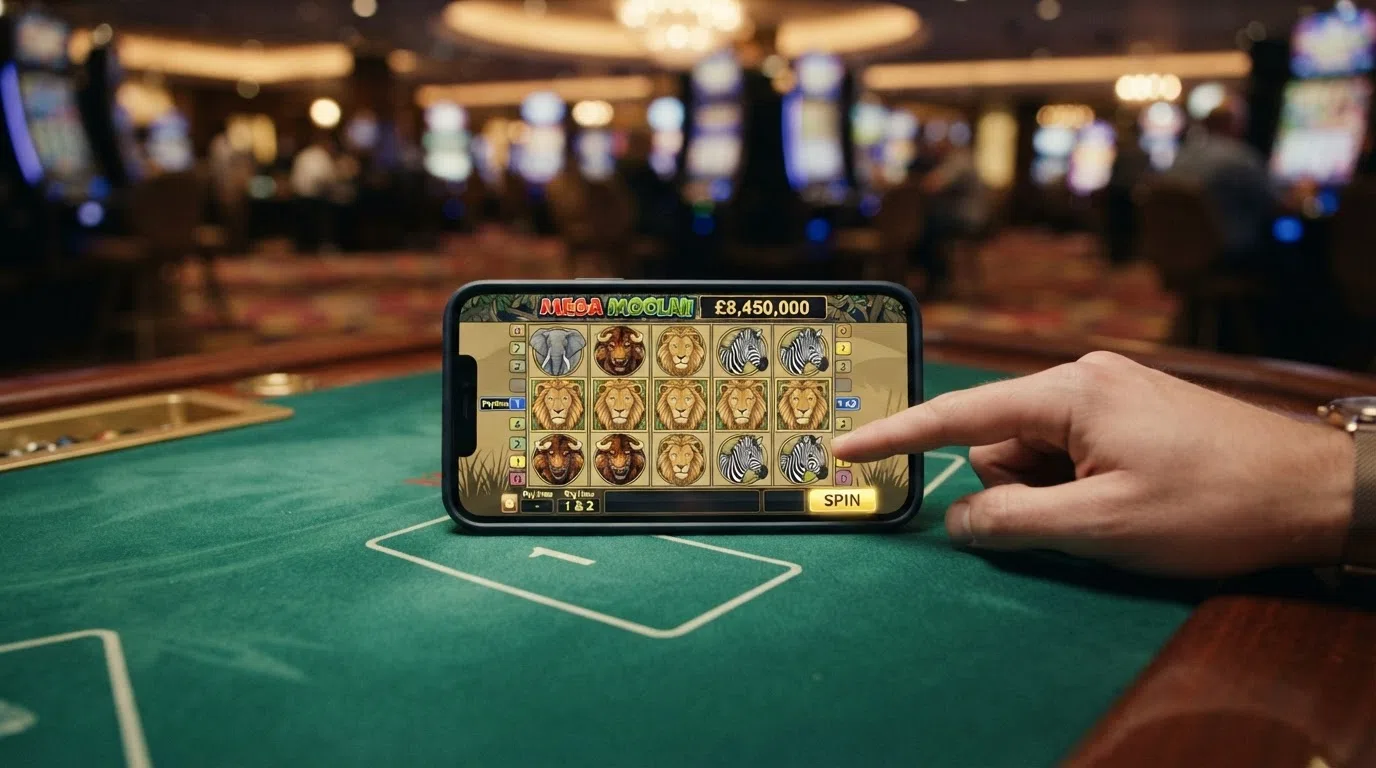
Mega Moolah is the cultural reference point. The 5×3, 25-payline slot from Games Global has paid the largest online slot jackpot in history (£18.9 million) and the largest UK win in two years (£11.5 million, June 2025). Total RTP is 88.12% with roughly 8% going to the progressive contribution. Volatility is low, which means the base game pays smaller amounts more often — the grind is the point, because every spin is funding a chance at the headline prize. The Mega Jackpot seeds at £1,000,000 after every drop.
Jackpot King is a network, not a single slot. Blueprint Gaming’s three-tier system — Regal must-drop before €4,000, Royal before ~€40,000, and the uncapped Jackpot King tier — sits on top of dozens of base games including Fishin’ Frenzy Jackpot King. RTP across Jackpot King titles ranges from 93.02% to 94.75%, with 0.65% to 1.5% diverted to the progressive. The must-drop tiers make Jackpot King the network a UK player picks when they want a clearer sense of when each prize is likely to pay than a single uncapped progressive offers.
Hall of Gods is NetEnt’s networked progressive with a higher base-game return than Mega Moolah: roughly 95.70% RTP, average jackpot around £6.37 million, and four tiers (Mini, Midi, Major, Mega) triggered randomly. The higher base RTP costs the player less in the session-by-session sense; the four-tier structure means smaller prizes pay more often than Mega Moolah’s headline tier.
Divine Fortune is NetEnt’s local progressive — not networked, which is the key distinction. The 96.59% RTP is the highest in this group, volatility is low-to-medium, and the Mega Jackpot seeds at $10,000. The trade-off is ceiling: a local progressive cannot reach the eight-figure totals of a wide-area network. This game caters to players who prioritise session-by-session smoothness and more frequent, smaller jackpot drops.
The Biggest Progressive Jackpot Slots by Current Jackpot Size
By pool size, the ranking runs: Mega Moolah’s Mega tier (seed £1,000,000, with active pools climbing into seven or eight figures), Hall of Gods (average ~£6.37 million), Jackpot Giant (average £4–6 million, maximum exposure above £9 million), and Fishin’ Frenzy Jackpot King (average ~£2.3 million). Major Millions sits lower, with a Mega seed of £250,000.
These are network averages, not guarantees on a given day. The current Mega Moolah ticker at any UK-licensed casino will show the live pool. What the averages tell a player is the structural ceiling: Mega Moolah and Hall of Gods are the wide-area networks built for eight-figure payouts; Jackpot Giant and Fishin’ Frenzy Jackpot King are tier-or-two-below, paying more often and for less.
The Most Popular Progressive Jackpot Slots Among UK Players
The Gambling Commission recorded 25.1 billion spins and 4.8 million average monthly active accounts in Q4 FY 2025/26 — the scale of the UK online slots market at the latest reading. Within that volume, Mega Moolah remains the cultural reference point after the Betfred win, the Jackpot King network is the broad-availability choice across dozens of Blueprint base games, the NetEnt progressives hold a loyal base for their higher RTP, and the Games Global network — Mega Moolah, WowPot, King Millions, Major Millions — accounts for over 77,000 jackpot payouts in May 2026 alone. Popularity here is volume: where the spins are happening and where the jackpots are paying.
Top-Rated Progressive Jackpot Slots: What Players Say
Player sentiment clusters around the base-game experience. Mega Moolah players describe the grind: low volatility, 25 paylines, a session that pays small amounts often while the headline prize builds elsewhere in the network. Jackpot King players cite the must-drop tiers as the appeal — the certainty that a Regal will pay before €4,000 makes the prize feel closer. Divine Fortune players describe a smoother ride: 96.59% RTP and low-to-medium volatility produce fewer of the long dry spells that progressive chasing otherwise carries. Hall of Gods players value the multi-tier structure: a Mini, Midi, Major or Mega drop is more frequent than the single top-tier prize on Mega Moolah, and the higher base RTP is felt session to session.
What Changed in 2026: New Titles and Shifting Rankings
Two pieces of regulation have reshaped how UK players experience progressive slots in 2026.
The first is the £5 / £2 stake limit, in force from 9 April 2025 for players aged 25 and over (£5) and 21 May 2025 for players aged 18–24 (£2). At a £5 max spin feeding a 1–4% contribution, a single spin adds at most 20p to the pool. A player who wants to fund the jackpot at scale no longer can — the limit is a per-spin cap, not a session cap, and it removes the high-stakes progressive play that built the largest pools fastest on offshore sites. The practical effect for UK play is that progressive jackpots still climb, but the climb is funded by spin volume rather than by stake size.
The second is the 10× wagering cap, in force from 19 January 2026 under LCCP Social Responsibility Code 5.1.1. The pre-cap norm was 35× to 50× wagering on casino bonuses; the cap has rewritten the cost of clearing a bonus. The section on bonus terms below works through the numbers.
Within those rules, the 2026 ranking is also shaped by new Games Global progressive titles gaining traction and the emergence of King Millions as a premium tier, with three William Hill players each clearing £1 million on the network in May 2026.
Where to Play: UK Casino Sites for Progressive Jackpot Slots Compared
| Operator | UKGC Licence | Progressive Jackpot Titles | Game Providers |
|---|---|---|---|
| Betway Casino | Confirmed active | 100+ | Games Global, NetEnt, Playtech, Blueprint |
| Bet365 Casino | Confirmed active | 200+ | Playtech, NetEnt, Games Global, Blueprint, Red Tiger |
| Ladbrokes Casino | Confirmed active | 100+ | Playtech, NetEnt, Games Global, Blueprint |
| Betfred Casino | Confirmed active | Extensive | Games Global, Playtech, Blueprint, IGT |
| Casumo | Confirmed active | Part of 3,000+ total slots | NetEnt, Games Global, Playtech, Blueprint, Red Tiger |
| Virgin Games | Confirmed active | — | Gamesys proprietary, NetEnt, Games Global, Blueprint |
| Coral Casino | Confirmed active | Part of 1,800+ total slots | Playtech, NetEnt, Games Global, Blueprint, Red Tiger |
| Jackpotjoy | Confirmed active | Focused selection | Gamesys proprietary, NetEnt, Blueprint |
| MrQ | Confirmed active | — | Games Global, NetEnt, Blueprint, Red Tiger |
| 888 Casino | Confirmed active | 100+ | NetEnt, Games Global, Playtech, Blueprint, Red Tiger |
Bet365 carries the widest progressive selection at 200+ titles. Betway, Ladbrokes and 888 cluster at 100+. Betfred’s selection is described as extensive and carries the distinction of being the site of the £11.5m UK record. Coral and Casumo give the player 1,800+ and 3,000+ total slot catalogues respectively, with the progressive share a subset of those. Jackpotjoy and Virgin Games run on Gamesys proprietary content alongside the major network providers. MrQ sits on a Games Global, NetEnt, Blueprint, Red Tiger core.
Betway Casino
Betway’s progressive library runs 100+ titles anchored by Games Global’s Mega Moolah network, with NetEnt, Playtech and Blueprint filling out the rest of the catalogue. The UKGC licence is confirmed active. Welcome offer terms should be verified on the operator site; wagering is capped at the 10× UKGC maximum. For a UK player whose priority is Mega Moolah access on a long-established brand, Betway is one of the more direct choices.
Bet365 Casino
Bet365 carries the widest progressive selection in the UK market at 200+ titles, with Playtech, NetEnt, Games Global, Blueprint and Red Tiger on the provider roster. The UKGC licence is confirmed active. Verify current offer terms on the operator’s site before signing up. Bet365 provides the broadest single-site access to every major progressive network, including Jackpot Giant, Hall of Gods, Mega Moolah, and the Jackpot King titles.
Ladbrokes Casino
Ladbrokes runs 100+ progressive titles with full Jackpot King access, on a Playtech, NetEnt, Games Global and Blueprint provider roster, under a confirmed active UKGC licence as part of the Entain group. The current confirmed welcome offer is Bet £10 Get 100 Free Spins, deposit-gated, with 10× wagering on the free-spins winnings. A player chasing Jackpot King titles specifically, with a small initial deposit and a free-spins entry point, gets a clean match here.
Betfred Casino
Betfred is the site of the £11.5 million Mega Moolah win in June 2025 — the biggest UK online slots jackpot in two years. The UKGC licence is confirmed active, and the progressive library draws on Games Global, Playtech, Blueprint and IGT. See the site directly for current bonus terms, where wagering is capped at 10×. Betfred is a clear choice for any player prioritising the Mega Moolah network on the platform where the record win occurred.
Casumo
Casumo runs 3,000+ total slots — the widest general catalogue in this ranking — with the progressive share drawing on NetEnt, Games Global, Playtech, Blueprint and Red Tiger. The UKGC licence is confirmed active. The current confirmed welcome offer is £150 Welcome Bonus + 100 Free Spins, deposit-gated, with 10× wagering. Casumo is a natural destination for players seeking a deep general catalogue alongside a full range of Games Global and NetEnt progressives.
Virgin Games
Virgin Games runs on the Gamesys / Bally’s group, with Gamesys proprietary content alongside NetEnt, Games Global and Blueprint. The UKGC licence is confirmed active. The exact progressive count should be verified on the operator site. For a player who values the Gamesys content layer — a smaller library of branded slots — alongside the major progressive networks, Virgin is the more distinctive option on this list.
Coral Casino
Coral is the second Entain-group brand in the ranking, with 1,800+ total slots on Playtech, NetEnt, Games Global, Blueprint and Red Tiger, and a confirmed active UKGC licence. The current confirmed welcome offer is Bet £10 Get 100 Free Spins, deposit-gated, with 10× wagering. A player choosing between Ladbrokes and Coral for a £10 deposit and 100 free spins is choosing between two Entain-group progressive libraries on similar terms.
Jackpotjoy
Jackpotjoy runs on the same Gamesys / Bally’s group as Virgin Games, with a focused progressive and daily jackpot selection on Gamesys proprietary content, NetEnt and Blueprint. The UKGC licence is confirmed active. Always check the operator’s site for current welcome offers. Jackpotjoy is the primary option for those specifically prioritising Gamesys-branded progressives and daily jackpot formats.
MrQ
MrQ runs on Lindar Media, with Games Global, NetEnt, Blueprint and Red Tiger under a confirmed active UKGC licence. The exact progressive count should be verified on the operator site. MrQ is known for typically offering 0× wagering on free spins — a rarity in UK casino bonuses — and the current terms should be verified on the operator site. For a player who values the wagering structure as much as the progressive library, MrQ is the standout on this list, on the assumption the no-wagering policy still applies at the time of deposit.
888 Casino
888 Casino runs 100+ progressive titles on NetEnt, Games Global, Playtech, Blueprint and Red Tiger, under a confirmed active UKGC licence as part of evoke plc. Welcome offer terms should be verified on the operator site; wagering is capped at 10×. A player looking for established evoke-group operation with the four major progressive networks finds a standard offering here.
How We Compare Progressive Jackpot Casinos
The ranking is built on three layers. The first is progressive jackpot title count, which measures the breadth of choice at a single site: 200+ at Bet365 dwarfs a focused catalogue, and a player who plays multiple networks benefits from the wider selection. The second is the provider roster, which measures network access: a casino running Games Global, Blueprint, NetEnt and Playtech covers Mega Moolah, Jackpot King, Hall of Gods / Divine Fortune and Jackpot Giant on one site. The third is the UKGC licence, which is the non-negotiable baseline for player protection, stake-limit enforcement and ADR access. Welcome offer terms sit beneath those three as a secondary differentiator, with the 10× wagering cap now a uniform ceiling across the regulated market. No weighting or scoring model is claimed: the ranking is a qualitative editorial assessment across the ten operators the searches surfaced.
Meet the Games and Providers Behind Britain’s Biggest Progressive Jackpots
Mega Moolah: The Slot That Made Progressive Jackpot History
Mega Moolah is the world’s most famous progressive. The 5×3, 25-payline slot runs at 88.12% total RTP with roughly 8% diverted to the progressive contribution, low volatility, and a Mega Jackpot that seeds at £1,000,000 after every drop. The base game pays smaller amounts more often; the headline prize is the lottery-ticket bundled into every spin. Mega Moolah holds the all-time online slots record at £18.9 million and delivered the UK’s biggest online slots jackpot in two years — £11.5 million from a £1.50 spin at Betfred in June 2025. The Mega Moolah network anchors the Games Global progressive portfolio and connects the same prize pool across hundreds of operator sites.
Jackpot King by Blueprint: Three Tiers, One Growing Prize Pool
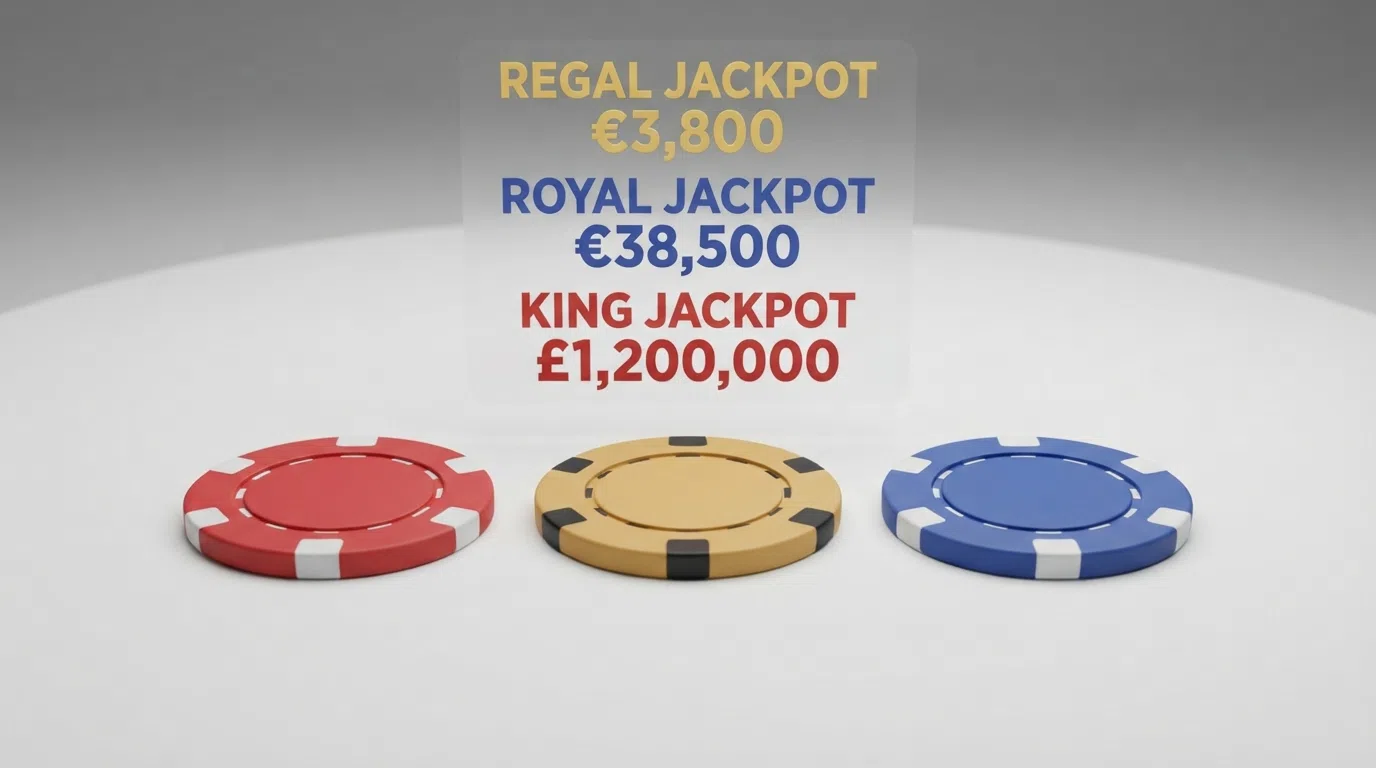
Blueprint’s Jackpot King is a network, not a single game. The three-tier structure gives a player three different prize dynamics on the same base game. The Regal tier must drop before €4,000 — frequent, small, certain to pay within a short window. The Royal tier must drop before roughly €40,000 — less frequent, mid-sized, certain to pay before the ceiling. The Jackpot King tier is uncapped — rare, large, the headline prize. RTP across Jackpot King titles runs 93.02% to 94.75%, with 0.65% to 1.5% diverted to seed and top up the pots.
Fishin’ Frenzy Jackpot King is a flagship of the network, at roughly 93.32% RTP and an average jackpot of around £2.3 million. The must-drop tiers make the network a more predictable proposition than a single uncapped progressive: a player who wants a clear sense of when each prize will pay finds it here. The same network runs on dozens of Blueprint base games, so the catalogue of titles is wider than the headline name suggests.
Hall of Gods and Divine Fortune: NetEnt’s Progressive Duo
NetEnt runs two progressives at opposite ends of the trade-off. Hall of Gods is the networked, higher-prize option at roughly 95.70% RTP and an average jackpot of around £6.37 million, with Mini, Midi, Major and Mega tiers triggered randomly. The base-game return is higher than Mega Moolah’s, the four tiers mean smaller prizes pay more often, and the headline Mega tier is the one that climbs into the seven-figure range.
Divine Fortune is the local progressive, not networked, which is the key distinction. The 96.59% RTP is the highest of the four headline titles here, volatility is low-to-medium, and the Mega Jackpot seeds at $10,000. A local progressive cannot reach the eight-figure totals of a wide-area network — the prize pool is funded by spins at a single operator or a small cluster. The trade-off is base-game return: a smoother session, more frequent smaller jackpots, and a ceiling that sits well below the networked alternatives. Divine Fortune appeals to players who prefer that balanced session profile over the extreme volatility of a global progressive.
Jackpot Giant and the Playtech Progressive Network
Playtech’s Jackpot Giant runs at roughly 91.5% RTP with average jackpots of £4–6 million and a maximum exposure above £9 million. The slot is networked across Playtech’s UK operator footprint, sitting alongside the wider Playtech progressive ecosystem. The Jackpot Giant ceiling is the second-highest among the headline titles in this ranking — below Mega Moolah’s record but above Hall of Gods’ average and well above the Jackpot King tier. The Playtech network is a credible alternative for a player who has played the Games Global and NetEnt networks extensively and wants a different pool to chase.
Absolootly Mad: Mega Moolah, Major Millions and More Games Global Progressives
The Games Global portfolio runs wider than the original Mega Moolah. Absolootly Mad: Mega Moolah, by Triple Edge Studios for Games Global, sits at 92.02% RTP, medium volatility, 243 ways to win, and connects to the same Mega Moolah network with a Mega Jackpot seed of £1,000,000. A player who wants the Mega Moolah progressive on a higher-RTP, medium-volatility base game finds it here. Major Millions, the original Microgaming progressive, runs at 89.37% RTP on 15 fixed paylines with a £3.00 fixed bet and a Mega seed of £250,000. The lower ceiling is the trade for the lower stake and the older, simpler base game.
The Games Global network at the May 2026 reading: more than £11 million paid across over 77,000 jackpot wins in a single month, with three William Hill players each clearing £1 million on King Millions titles. The network scale is the structural advantage — more players, more spins, faster pool growth, more frequent drops across the full tier structure.
The Providers Driving Progressive Jackpot Innovation
| Slot Title | Provider | RTP | Progressive Network | Volatility |
|---|---|---|---|---|
| Mega Moolah | Games Global | 88.12% | Mega Moolah (wide-area) | Low |
| Absolootly Mad: Mega Moolah | Triple Edge Studios / Games Global | 92.02% | Mega Moolah (wide-area) | Medium |
| Major Millions | Games Global | 89.37% | Major Millions (wide-area) | Low |
| Jackpot King titles (e.g. Fishin’ Frenzy Jackpot King) | Blueprint Gaming | n/a | Jackpot King (networked, three tiers) | Varies by base game |
| Hall of Gods | NetEnt | ~95.70% | NetEnt networked | Low |
| Divine Fortune | NetEnt | 96.59% | Local progressive | Low-to-medium |
| Jackpot Giant | Playtech | ~91.5% | Playtech networked | Low |
Games Global runs the widest portfolio across Mega Moolah, WowPot, King Millions and Major Millions — the largest pooled networks on the UK market. Blueprint runs Jackpot King across dozens of base games with the must-drop three-tier structure. NetEnt splits between local (Divine Fortune) and networked (Hall of Gods), giving the player a higher-RTP local option or a lower-RTP networked option under the same provider. Playtech runs Jackpot Giant and the wider Age of the Gods-style network. A player choosing between providers is choosing between contribution rates, base-game volatility, and the tier structure of the pool.
Progressive Jackpot Bonuses: Why the Terms Matter More Than the Headline Number
Welcome Bonuses and Deposit Matches for Progressive Play
The standard UK welcome offer is a deposit match plus a free-spins bundle. Casumo’s confirmed welcome is £150 Welcome Bonus + 100 Free Spins, deposit-gated, with 10× wagering. Ladbrokes and Coral run Bet £10 Get 100 Free Spins, deposit-gated, with 10× wagering. A free-spin stake sits within the £5/£2 stake limit, so the per-spin value is small. The thing to check is whether progressive jackpot titles contribute to the wagering requirement at all — many welcome bonuses exclude progressives or attribute a reduced percentage. Verify on the operator site before depositing: the welcome page lists the eligible games, the wagering multiplier, and the maximum stake during the bonus period.
The 10× wagering cap, in force from 19 January 2026 under LCCP Social Responsibility Code 5.1.1, has rewritten the cost of clearing a bonus. The pre-cap norm was 35× to 50×. A £150 bonus at 50× wagering required £7,500 of play; at 10× it requires £1,500. The cap is a real, calculable improvement in what a bonus costs the player who clears it.
No-Deposit Bonuses for Progressive Jackpot Slots
No featured operator in this ranking currently carries a confirmed no-deposit bonus specifically for progressive jackpot slots. Genuine no-deposit offers on progressive titles are rare in the UK market — the combination of an uncapped or near-uncapped prize pool and a free-play entry point does not survive the maths for the operator. Ladbrokes, Casumo and Coral are deposit-gated, with the free spins or matched bonus triggered by an initial deposit. If an operator advertises a no-deposit progressive offer, the things to check are the wagering multiplier (now capped at 10×), the maximum cashout from the offer, and the game eligibility. The distinction between a deposit-free and a deposit-gated offer is the distinction between keeping your £10 and not getting the free spins.
Free Spins on Progressive Jackpot Games
Ladbrokes and Coral confirm 100 Free Spins on a £10 qualifying deposit, with 10× wagering on winnings. Casumo confirms 100 Free Spins on a deposit-gated welcome, with 10× wagering. The value of a single free spin on a progressive slot is the minimum stake — typically 10p to 20p per spin, well within the £2/£5 stake limit. MrQ typically offers 0× wagering on free spins, the standout term on this list, and the current status should be verified on the operator site.
Before the 10× cap came in, free-spins wagering on progressive slots was the most punitive part of the welcome offer. The 10× rule has flattened the worst of it: free-spin winnings still need to be cleared, but the clearing cost is now a single-digit multiple of the bonus rather than a 35× to 50× grind. A player reading a free-spins offer should weigh the per-spin value, the wagering multiple, the eligible games, and the time window — in that order.
Wagering Requirements, Caps and What the 10× Rule Changed
The 10× cap, in force from 19 January 2026, sets a hard ceiling on how punitive a UK bonus can be. The pre-cap norm of 35× to 50× turned a £150 bonus into a £5,250 to £7,500 clearing requirement, with a base-game RTP of 88% to 94% meaning the expected loss on the clearing volume was hundreds of pounds. The 10× cap turns the same £150 bonus into a £1,500 clearing requirement, with an expected loss over a tenth of the pre-cap level.
The cap does not mean bonuses are free. A £150 bonus at 10× wagering on a 92% base game still has an expected loss, and the section on the cost of a session below works the numbers for a representative progressive. The 10× cap means the cost of clearing a bonus is now calculable rather than punitive — the player can read the offer, do the arithmetic, and decide whether the bonus is worth taking on those terms. That is the change the December 2025 rule produced.
Why You Should Try Progressive Jackpot Slots for Free Before You Stake
Free Progressive Jackpot Slots: No Download, No Registration
UKGC-licensed operators are required to offer demo play on slot titles, and progressive jackpots are no exception. Demo mode runs in the browser without a download, and most UKGC-licensed sites do not require an account to access it — the slot loads as a guest, the play-money balance is supplied, and the full game runs as it would in real-money mode. The progressive ticker animates but does not pay; the base game, features, and paylines all behave as in real play. Identity verification is required before the first deposit, not before a demo session, so a player can load a progressive slot, learn the rhythm, and walk away without leaving any personal information behind.
Practice Mode vs. Real-Money Progressive Play
Demo mode teaches the base game. A player running 200 demo spins of Mega Moolah sees the low-volatility grind in full — small base-game wins, frequent feature triggers, the steady contribution of 8% of every spin flowing into a pool that does not pay. The same 200 spins on Hall of Gods show a higher-RTP base game paying more often, with the progressive ticker climbing more slowly. The same 200 spins on Fishin’ Frenzy Jackpot King show a higher-RTP base with the must-drop tiers visibly approaching their ceilings.
What demo mode cannot simulate is the psychological weight of real-money stakes. The “one more spin” impulse is the same gamble regardless of stake size, but the felt cost of each spin at £5 real money is different from 10p in demo. The excitement dimension that real-money play adds is precisely what demo cannot replicate. A player who has spent an hour in demo mode has learned the base game. They have not learned how they will respond when a £5 spin loses — and that response is the variable that determines whether progressive chasing stays affordable.
Where to Find Demo Versions of Progressive Jackpot Slots in the UK
UKGC-licensed casino sites — all ten operators in this ranking — carry demo versions of the progressive titles on their rosters, accessible without an account. Provider sites — Games Global, Blueprint, NetEnt, Playtech — often host their own demos on the game-launch pages, with no operator in the middle. The thing to check before loading a demo is that the site is UKGC-licensed (the operator footer carries the licence number and a link to the public register), that no deposit is required, and that the demo is the real game rather than a stripped-down variant. The progressive titles in this ranking are widely available as demos; a player who wants to learn a slot before staking has no shortage of places to do it.
Progressive Jackpot Slots on Mobile: What Works and What Still Doesn’t
Mobile Browser vs. Native Casino Apps for Progressive Play
HTML5 progressive slots run in a mobile browser without a download and on every UKGC-licensed operator site. The progressive experience on a browser is identical to the desktop experience in terms of game mechanics, RTP, and progressive access — the slot does not know it is being played on a phone. Native casino apps from UKGC-licensed operators add push notifications, stored login, and in some cases smoother performance, but the underlying game is the same HTML5 build. The £5/£2 stake limit and the 2.5-second minimum spin speed apply identically on mobile and desktop. Regardless of the device choice, the jackpot pools and return-to-player remain consistent for every user.
iOS and Android: What Progressive Jackpot Players Need to Know
HTML5 progressive slots run natively on both iOS and Android browsers. App Store and Google Play carry real-money gambling apps from UKGC-licensed operators, with the same games as the browser build. The performance difference between platforms is negligible for slot games; the feature set is identical. There is no progressive jackpot game available on one mobile platform and not the other. A player on an iPhone and a player on a Pixel see the same Mega Moolah, the same Hall of Gods, the same Jackpot King titles.
What Changes When You Play Progressive Jackpots on a Smaller Screen
Three things change on a phone. The progressive jackpot ticker is smaller and may sit above the reels rather than in a sidebar, which is fine for the headline figure but harder to read at a glance. The stake selector needs to fit a touch target within the £5/£2 limit — the per-tap precision is lower than on a desktop dropdown. The 2.5-second minimum spin speed feels different on a handheld device, where the tactile gap between spins is shorter than the visual gap on a larger screen.
The UKGC rules that apply on mobile are the same as on desktop: total losses, wins and time played during a slots session must be displayed; the stake limit and spin speed are unchanged. A player who has set a deposit limit on desktop sees the same limit on mobile. A session that runs to £200 in losses on mobile is the same £200 the operator would have shown on desktop — the figure is just rendered in a smaller font.
Progressive Jackpot Slots Without GamStop — and What You Really Risk
What GamStop Means for Progressive Jackpot Players
GamStop is the UK’s national multi-operator online self-exclusion scheme, mandatory for every GB-licensed online operator since 31 March 2020. A player who registers for GamStop chooses one of four exclusion periods: six months, one year, five years, or five years with auto-renewal. The exclusion cannot be cancelled early. During the exclusion period, every UKGC-licensed operator is required to refuse the player’s account opening, deposits, and gameplay. The mechanism covers every progressive jackpot slot at every featured operator in this ranking.
What GamStop does not cover is unlicensed sites. A Curaçao-, Malta- or Gibraltar-licensed casino operating without a GB licence is not in the GamStop database, and the exclusion does not reach it. The self-exclusion gap is the reason a search for “progressive jackpot slots not on GamStop” exists: it is the search an excluded player runs to find a site that does not check. The result is a site without UKGC protection, which is the subject of the rest of this section.
Progressive Jackpot Slots Not on GamStop: What Is Available
Offshore sites carry the same Games Global, NetEnt, Blueprint and Playtech progressive networks as UKGC-licensed operators — the game providers license the same titles to multiple operators across multiple jurisdictions. A player on a Curaçao-licensed site can load Mega Moolah, Hall of Gods, Fishin’ Frenzy Jackpot King, and the wider Jackpot King catalogue. The progressive pools are often shared across the offshore network, and the headline jackpots look the same.
What the offshore site does not carry is the UKGC framework. The £5/£2 stake limit does not apply. The 10× wagering cap does not apply. The 2.5-second minimum spin speed and the auto-play ban do not apply. The mandatory deposit-limit prompt does not apply. The session loss/time display does not apply. The progressive jackpot RTP and the network fairness have not been independently audited by the UKGC. The operator is not on the public register, the player has no UKGC complaints route, and there is no British ADR for disputes. A Curaçao, Maltese or Gibraltar licence is not a substitute for a GB licence; the Gambling (Licensing and Advertising) Act 2014 made a GB licence compulsory for any operator taking GB players, wherever the operator is based.
The Real Risks of Playing at Non-GamStop Casinos
The player who plays at a non-GamStop casino is not committing a criminal offence — no penalty has been identified for a player who merely gambles on an unlicensed site. What the player loses is protection, and the protection inventory is the part to read carefully.
No GamStop coverage: an excluded player has no safety net on the offshore site. The whole point of a self-exclusion is the multi-operator coverage, and an unlicensed site is outside the coverage. No UKGC complaints process or ADR route for disputes: a payout dispute on an offshore site is heard under that site’s own terms, in that site’s own jurisdiction, against that site’s own regulator (where one exists). No guarantee of fair RNG or independently audited RTP: the UKGC’s RTS 9 requires jackpot systems to be configured with adequate fairness and security, with rules describing funding, seed, and ceiling values; an offshore site is not bound by RTS 9. No segregation of player funds requirement: UKGC rules require operators to keep customer funds in segregated accounts; an offshore site is not bound by the same rule. No British consumer redress: the player cannot take a complaint to the UKGC, an ADR provider, or the small-claims court in the player’s home jurisdiction in a way the operator is bound to honour.
The provider of unlicensed gambling to GB players commits a criminal offence under section 33 of the Gambling Act 2005 — up to 51 weeks’ imprisonment, an unlimited fine, or both. The Gambling Commission uses disruption powers rather than ISP-level blocking: between April 2024 and June 2025, the Commission issued 3,140 disruption notices, referred 447,778 URLs to search engines, and saw 287,961 URLs removed. The Commission does not currently hold ISP or DNS blocking powers — the legislation has been proposed but not enacted. Choosing an offshore site entails stepping outside the UK regulator’s enforcement perimeter, where player protection mechanisms do not reach.
UKGC-Licensed Play vs. Offshore Alternatives: What You Lose
A UKGC-licensed casino provides, in one package: GamStop self-exclusion, £5/£2 stake limits, 2.5-second minimum spin speed, the auto-play ban, the 10× wagering cap, mandatory deposit-limit prompts, identity verification at first deposit, the credit card ban, the session loss/time display, eCOGRA-style independent RNG auditing, segregated player funds, and the Gambling Commission’s complaints and ADR route. An offshore casino provides: the same progressive slot titles, often on the same network, without any of the above.
The two are not equivalent products. They look the same on the game screen. They diverge entirely on what happens when something goes wrong — a delayed payout, a bonus dispute, a self-excluded account that should not have been opened. The UKGC-licensed site has a regulator the player can complain to, an ADR route the player can escalate to, and segregated funds the player can recover from. The offshore site has whatever its own terms and its own jurisdiction provide, which may be a great deal less.
Crypto and Bitcoin Progressive Jackpot Casinos
Crypto progressive jackpot slots work the same way fiat ones do — a slice of every spin feeds a pool, a trigger empties it — except the bet and the payout are denominated in bitcoin or another cryptocurrency. Most crypto casinos are not UKGC-licensed. The anonymity trade-off is the structural pitch: no identity verification on deposit, no bank trail, no credit card involvement. The UKGC framework bans credit cards for all gambling, including e-wallets funded by credit cards; crypto sits outside that framework.
For a GB player, a crypto casino is an unlicensed site by default. The point-of-consumption rule means a GB licence is compulsory for any operator taking GB players; an unlicensed crypto casino is not a legal alternative. The currency risk is layered on top: a jackpot that pays 10 bitcoin is worth whatever 10 bitcoin is worth at the moment of payout, and the volatility of the cryptocurrency adds a second variable to a prize already subject to the 1-in-50-million odds. Players interested in gambling with crypto face both regulatory and currency risks, making a UK-regulated fiat casino the safer alternative for progressive play.
How to Protect Yourself While Chasing Progressive Jackpots
Setting Deposit and Session Limits Before You Spin
Every UKGC-licensed casino is required, from 31 October 2025, to prompt a customer to set a financial limit before the first deposit. A decrease in the limit takes effect immediately. An increase is delayed — the operator is required to apply it after a cooling-off period rather than at the player’s next click. A gross deposit limit — the new line above which the operator is required to refuse deposits — comes into force from 30 September 2026, with the limit to be given at least equal prominence to other financial limits on the cashier page.
A financial vulnerability check fires when a customer’s net deposits cross £150 in a rolling 30-day period. The check is light-touch, uses publicly available data (CCJs, bankruptcy orders, IVAs, DROs), and is not a credit check. It is the operator’s first line of automated affordability signalling. The full financial risk assessment — with stage 1 thresholds of £5,000 in 24 hours for players aged 25 and over (£2,500 for under-25s) — has been announced but has not yet commenced. Do not describe the affordability check as in force.
The £5/£2 stake limit is the built-in brake on per-spin exposure, and the 2.5-second minimum spin speed caps the spin rate. At the maximum rate, a player can run roughly 1,440 spins per hour. At £5 per spin, that is £7,200 of stake per hour at the upper bound — a number that exists as a cap rather than a target. A session limit set on the operator’s responsible-gambling page is the player’s own ceiling; a deposit limit is the floor.
Recognising Problem Gambling in Jackpot-Chasing Behaviour
Online slots players with a PGSI score above 8 — the threshold for problem gambling — are more than five times the average for all people who have gambled in the last 12 months. In 2026, 81.5% of contacts to the National Gambling Helpline cited online gambling, the highest rate since 2021. The two figures sit alongside the market data — 25.1 billion spins in Q4 FY 2025/26 across 4.8 million average monthly active accounts — and the conclusion is that the population most exposed to progressive slot play is also the population most likely to be experiencing harm.
The specific traps progressive jackpot play creates are well-defined. The “jackpot must be due” fallacy is gambler’s fallacy applied to progressive RNG: each spin is independent, the jackpot is no more likely to trigger on spin 5,000,000 than on spin 1, and a recent near-miss on a feature wheel has no predictive value. Chasing losses through larger stakes up to the £5 cap is the second trap: the base game RTP is 88% to 94%, the expected loss scales with stake, and a session that started at £1 spins is the same expected loss as one at £5 spins, scaled. Session creep is the third: the 2.5-second minimum spin speed still enables hundreds of spins per hour, and a “one more spin” loop is the most common escalation pattern in the helpline data.
A player who finds themselves increasing stakes to recover losses, extending sessions past a planned end, hiding play from family or partners, or borrowing to fund a session has crossed one or more of the lines the PGSI screen measures. The screen is the place to start; the helpline is the place to call.
UK Help Resources: GamStop, GamCare and Where to Call
- GamCare National Gambling Helpline — 0808 80 20 133, free, 24 hours a day, 365 days a year. The front door for confidential support.
- GAMSTOP — the national multi-operator self-exclusion scheme. Exclusion periods of six months, one year, five years, or five years with auto-renewal; exclusion cannot be cancelled early. Self-exclusion from every GB-licensed online operator in one registration.
- GambleAware — funds research, prevention and treatment across Great Britain.
- NHS gambling harm clinics — specialist treatment in England, Scotland and Wales, free at the point of use.
- Gamblers Anonymous — peer-support meetings, fellowship model, free to attend.
The statutory levy that funds much of this infrastructure is set at 1.1% of gross gambling yield for remote casino licences, in force from 6 April 2025. The proceeds split 50% to treatment, 30% to prevention, and 20% to research — a deliberate weighting toward the front-line services. The levy replaced the previous voluntary contribution system, and the difference is enforcement: the 1.1% is collected, not pledged.
How We Chose and Ranked the Best Progressive Jackpot Slots
The ranking draws on four input layers. First is Gambling Commission market data, which provides scale figures like spin volume and monthly active accounts. Second is operator-level review, confirming UKGC licence status and surfacing welcome offer terms. Third is provider-published RTP, jackpot size, and game specifications. The fourth is competitive analysis of the pages that currently rank for the keyword, which establishes the structural norms this guide follows.
The ranking criteria are: progressive jackpot title count (breadth of choice at a single site), provider roster quality (network access across Mega Moolah, Jackpot King, NetEnt and Playtech pools), RTP transparency (published figures that the player can read), and bonus terms within the UKGC regulatory framework (10× wagering cap, eligible games, stake limits during bonus play). The UKGC licence is the non-negotiable baseline; the operator ranking is filtered to UKGC-licensed brands only.
The Gambling Commission public register of licence holders was not fetched this run per the operator-sweep constraint. Each operator’s UKGC licence status is confirmed from non-affiliate review sources in the search results, and licence dates should be verified against the register before publication. Welcome offer terms for seven of the ten operators were not confirmed in the available research and should be verified on the operator site; the three confirmed terms (Ladbrokes, Casumo, Coral) come from a single affiliate source and carry the same verification caveat. No weighting or scoring model is claimed: the ranking is a qualitative editorial assessment across the ten operators the searches surfaced, and the relative ordering reflects breadth of progressive selection, provider roster, and operator standing in the UK market.
Your Progressive Jackpot Strategy: What to Remember Before You Spin
The trade-off at the heart of progressive jackpot play is not hidden, and it is the same on every title: a lower base-game return in exchange for a chance at a life-changing payout. Mega Moolah’s 88.12% total RTP is around 8 percentage points lower than a typical non-progressive slot. The 1-in-50-million trigger probability is the cost of that chance. A player who values session-after-session return should sit with a fixed-payout game; a player who values a single long-shot payout plays the progressive and accepts the base-game haircut. Both positions are honest. The dishonest one is the marketing word that promises the base game and the jackpot in equal measure.
The slot title matters more than the casino. The progressive network is the product — Mega Moolah, Jackpot King, NetEnt, Playtech — and the operator is the delivery. Bet365’s 200+ titles, Betway’s 100+, Ladbrokes’ full Jackpot King access, Betfred’s site of the UK record win: these are delivery choices, and the network behind them is what determines the prize. A player choosing a casino is choosing where to access a network they have already chosen.
The £5/£2 stake limit means a single spin adds at most 20p to the pool at a 4% contribution rate. The jackpot is not built on a single session — it is built across millions of spins from millions of players. A session contributes a fraction of a fraction of a fraction of the headline prize, and the prize is built by the network rather than by the individual player. The 10× wagering cap, in force from January 2026, is a real improvement that makes bonus-clearing calculable rather than punitive, and the welcome offers that used to require 35× to 50× turnover now require 10×. A player who reads the offer terms, does the arithmetic, and decides whether the bonus is worth taking is operating with the tools the regulator built.
The non-GamStop option exists. It is the offshore, unlicensed alternative, and the section above sets out what a UK player gives up by taking it. The decision is the player’s own. What is owed the player is honesty about what sits on the other side: no GamStop coverage, no UKGC complaints route, no ADR, no segregated funds, no independent audit guarantee. A player who reads the protection inventory and decides to step outside it has made an informed decision; a player who steps outside it without knowing what the step costs has not.
The one action that belongs before the first real-money spin is universal: set a deposit limit on the cashier page, try the demo first to learn the base game, and verify the operator on the Gambling Commission’s public register of licence holders. The deposit limit is the floor, the demo is the lesson, and the register check is the only way to confirm the licence is what the marketing page claims. None of those steps costs anything. All of them are what a regulated market was built to enable.
Frequently Asked Questions
What makes a progressive jackpot prize pool keep growing?
A percentage of every bet — typically 1% to 4% of each wager, or roughly 8% on Mega Moolah — is diverted from the base game’s return and added to a shared prize pool. The pool keeps climbing until a player triggers the jackpot, at which point it resets to a seed amount and the cycle restarts. The wider the network, the faster the pool grows; the higher the contribution rate, the more each spin adds.
How is a standard slot different from one with a growing top prize?
A standard slot pays what the paytable says: a fixed top prize, a fixed RTP, no compounding pool. A progressive slot diverts a slice of every spin into a shared pool that grows until won. The trade-off is base-game return — a progressive’s base game typically returns 88% to 94%, while a non-progressive slot of comparable feature set returns closer to 96% — in exchange for a top prize that has no fixed ceiling.
What is the RTP of Mega Moolah and is it worth playing?
Mega Moolah’s published total RTP is 88.12%, with roughly 8% diverted to the progressive contribution. The base game is low volatility with 25 paylines on a 5×3 grid. The RTP is lower than a non-progressive slot of similar quality, but the trade is the chance at the Mega Jackpot, which seeds at £1,000,000 after every drop and has paid out £18.9 million at the world record and £11.5 million to a UK player at Betfred in June 2025.
What are my chances of winning a progressive jackpot?
The probability of triggering a major progressive jackpot on a single spin is typically between 1 in 5 million and 1 in 50 million. For Mega Moolah, estimates place the top-tier trigger at roughly 1 in 50 million spins. At that probability, the jackpot has to climb into the tens of millions before the expected value of the contribution a player forgoes is recovered; below that threshold, the player is paying for a possibility rather than a near-term return.
Do progressive jackpots pay less in the base game than standard slots?
Yes. A progressive slot advertising 94% total return may pay only 88% to 90% through the base game, with the remaining slice diverted into the progressive pool. The base-game return is what a player experiences across a single session; the total RTP is what the marketing figure represents once the cycle is long enough for the jackpot to be triggered somewhere in the network.
What is the maximum I can stake on an online slot in the UK?
The maximum stake per game cycle on an online slot in Great Britain is £5 for players aged 25 and over (in force from 9 April 2025) and £2 for players aged 18–24 (in force from 21 May 2025), imposed by SI 2025/215. The limit applies to the total staked within a game cycle and cannot be defeated by splitting a spin. The per-spin maximum is the same across every UKGC-licensed operator and across desktop, mobile browser and native app.
What Is a Progressive Jackpot Slot?
A progressive jackpot slot is a slot machine whose top prize grows with every bet placed across a network of casinos, rather than sitting at a fixed value. The defining feature is the compounding prize pool: a small slice of every spin — the contribution — is diverted from the game’s return-to-player and added to a running total. The pool keeps rising until a player triggers the jackpot, at which point it resets to a seed amount and starts climbing again.
Standard fixed-payout slots carry a top prize set in the paytable. A progressive slot trades a slice of its base-game return for a prize that has no fixed ceiling. A wide-area progressive links the same prize across hundreds of operator sites, so the pool builds faster. A networked progressive links a smaller cluster of operators on the same software. An in-house or local progressive keeps the prize confined to a single casino. The first two produce the eye-watering eight-figure jackpots that dominate the headlines; the third tends to pay smaller, more frequent prizes.
Slots – nonukgc-licensedcasinos
Content created by the «nonukgc-licensedcasinos» team