
The Slots and Casinos That Actually Pay Out the Most
 Available in GB
A slot advertised at 96% RTP can run at 94% on your casino. Most players never notice the gap. That gap is the difference between this page being useful and being a copy of the marketing one. The aim here is simple: name the slots with the highest return-to-player percentages, name the casinos that actually deploy the top version, and explain the gap between what a slot is *supposed* to pay and what it pays at the site where you have an account.

Verification current as of September 8, 2026 against the UK Gambling Commission’s public register.
What Slot Payout Percentage Actually Means — and What It Doesn’t
What “Return to Player” Actually Means
Return to Player — RTP — is the long-run statistical average a slot returns to players as winnings, expressed as a percentage of total stakes. A 96% slot pays back, on average, 96 pence of every pound staked across the entire life of the game. The figure is measured over an enormous simulation: the Gambling Commission’s own guidance treats 10,000 or 100,000 game rounds as the standard window for “compensated” machines, and even more for “random” machines, before the percentage is treated as settled.
That window is the part the marketing copy leaves out. A £100 session on a 96% slot is not a £96 refund waiting to happen. It is one short slice of a multi-million-spin population in which the average lands at 96. The label “return” reads like a receipt. It is not. It is a long-run expectation — and over a single sitting the realised figure can sit anywhere from 30% to 200% without the math breaking. The slot did exactly what the maths said. The player looked at the wrong number.
The honest framing is this: RTP is the price the house charges, expressed from the player’s side. It is fixed in the design of the game and verified by independent testing laboratories before a casino ever runs it. What is *not* fixed is which version of a slot your casino chose to licence.
The Average RTP Range for Online Slots — and How It Compares to Land-Based Machines
Most UK-licensed online slots sit between 94% and 97% RTP. The clustering is deliberate: it is the band where the maths gives the house a workable margin while keeping the headline figure respectable enough to print. Slots below 94% still exist, but they are increasingly rare on licensed sites as competition has pushed the floor upward.
Land-based machines typically run five to ten percentage points lower. A pub fruit machine paying 88% or 90% is normal, not a scandal. Online slots look generous only in comparison, and the comparison is one most players never see made explicit — because nobody at the betting shop is handing out a leaflet next to the cabinet comparing it with a Play’n GO title running at 96.21%. The “good” in “good RTP” is calibrated to the player’s experience of online slots, not against gambling in the abstract.
A 96% slot is average-to-good for online. A 97% slot is firmly above average. Anything at or above 98% is the top of what the UK market offers and is built into a small handful of older or deliberately generous titles. Anything below 94% should give a player pause, because the marketing has decided the RTP is something the player should not be looking at too closely.
The House Edge — What the Casino Keeps
House edge is the inverse of RTP. A 96% slot carries a 4% house edge: for every pound wagered across the long run, 4 pence stays with the operator. The figure sounds small until you compound it. At a £5 stake cap, a UK player aged 25 and over can put through 720 spins per hour at the statutory 2.5-second minimum spin speed — that is £3,600 per hour in stakes, and a 4% house edge on that is £144 per hour of *expected* loss to the house, before the variance has its say.
Operators have a commercial reason to push the percentage down. The slot is shipped with multiple RTP variants by the provider; the casino chooses which version to licence. Picking a lower tier widens the margin without changing the slot’s name, its theme or its features. A casino running Book of Dead at 94.25% takes roughly 30% more per spin than the same casino running it at 96.21%, with the player none the wiser unless they check.
The casino-side metric is the *hold percentage* — the share of money in that the casino keeps out. Hold and RTP describe the same thing from opposite ends of the same equation.
Volatility, Hit Frequency, and Win Percentage — the Metrics RTP Doesn’t Cover
Two 96%-RTP slots can empty a bankroll at completely different speeds. The reason is volatility. A high-volatility slot pays rarely, but pays big when it does. A low-volatility slot pays often, but pays small. The RTP can be identical. The experience of playing them is not.
Book of 99 (Relax Gaming) is one of the rare high-volatility slots carrying a 99% RTP and a 10,000× maximum win, built around expanding-symbol mechanics. The hit frequency is low. The session shape is long quiet stretches interrupted by occasional large payouts. 1429 Uncharted Seas (Thunderkick) sits at the opposite end — 98.60% RTP, low volatility, 5 reels, 25 paylines, expanding wilds and a 50-free-spin bonus. The payouts land more often and the bankroll lasts longer, but no single spin will return 10,000× the stake.
Hit frequency is how often a spin returns *anything* — including a payout smaller than the stake. Win percentage is a separate metric, sometimes confused with RTP, that asks what proportion of spins pays more than the stake. A 96% RTP slot might have a 35% hit frequency and a 12% win percentage, meaning the player gets some money back on a third of spins but actually profits on roughly one in eight. The remaining wins return less than the stake — they keep the bankroll in play while the 4% house edge quietly does its work.
RTP is necessary information. It is not sufficient. Without volatility alongside it, the percentage tells the player what to expect over an infinite run but nothing about what the next hour will feel like.
How Slot RTP Is Calculated, Tested, and Audited
RTP is not a number the provider pulls out of the air. It is the output of a mathematical model — usually a Monte Carlo simulation running millions to billions of game rounds against the game’s random number generator and pay table — that calculates the average return to the player under perfect play. Independent testing laboratories (eCOGRA, iTech Labs, Gaming Laboratories International among others) verify the model and run their own simulations before a slot is allowed to go live with a UK-licensed operator.
The Gambling Commission requires casinos to make RTP information available for every gaming machine, alongside its category and whether it is compensated or random. “Available” is the operative word. The information has to be reachable — typically inside the game itself or on a fairness page — but the Commission does not prescribe how prominently it must be displayed. A casino meeting the rule can still bury the RTP beneath three menus and a small-print footnote. The rule is satisfied; the player is not.
Compensated and random machines are distinguished by how the outcome is generated: a compensated machine adjusts its payout behaviour based on recent results to keep the long-run RTP on track, while a random machine generates each outcome independently. The measurement windows differ for that reason — compensated games settle towards the published RTP faster than random ones, which is why random games need more spins in the simulation before the figure is trusted.
Theoretical RTP vs Deployed RTP — the Figure on the Label vs the Figure on Your Screen
This is the section that earns the page. A slot advertised at 96.71% by its provider can run at 94.25% at your casino. Both numbers are legal. Neither is on the front of the building.
The provider ships each slot at a *theoretical* RTP — the maximum version, the figure they print in their marketing. The casino licences one of several *deployed* variants. The variants differ by two to four percentage points in the common range, and the casino chooses which one to put in front of its players. RTPTrack’s data shows the Flutter, Entain and 888 groups converging at a 94.25% deployment of Book of Dead, while Bet365 runs the same Play’n GO title at 96.21% — the theoretical maximum. Same slot, different return, different casino, different pounds in the player’s pocket over volume.
The transparency problem has been stated plainly. RTPTrack’s own framing — that “UK casinos legally run the same slot at 96% or 87% RTP — and never tell you which” — captures the whole issue. The casino is not lying. The percentage is real, the slot is the same, the licence is clean. The player just doesn’t get the chance to compare deployments before they sign up and deposit.
There is one way to check, and it is unambiguous: open the slot, open the rules or info panel, and read the RTP figure printed inside the game. That number is the one you will be playing at. The provider’s marketing figure is the one you were sold.
Which UK Casinos Run Slots at Their Highest Payout Percentage — and Which Don’t
| Operator | Free Spins (Welcome) | Wagering on Free-Spin Winnings | Deployed RTP Reputation | Bonus Validity |
|---|---|---|---|---|
| Bet365 | Up to 500 spins | 0× (paid as cash) | Theoretical-max deployment (RTPTrack-verified) | 7 days per daily allocation |
| William Hill | 200 spins on Big Bass Splash | 10× | 888/Evoke group — Book of Dead at 94.25% | 72 hours from credit |
| Sky Vegas | Up to 200 spins | 0× (paid as cash) | Flutter group — Book of Dead at 94.25%; Blood Suckers at fixed 98.00% | 7 days from credit |
| Ladbrokes | Up to 500 spins | 10× | Entain group — Book of Dead at 94.25% | — |
| Paddy Power | 60 no-deposit + 100 on deposit | 0× (paid as cash) | Flutter group — Book of Dead at 94.25% | 7 days from credit |
| Coral | 100 spins | 10× | Entain group — Book of Dead at 94.25%; Ugga Bugga at 99.07% | — |
| Betfred | 200 spins | 0× (paid as cash) | Not independently tracked this run | 7 days after credit |
| Betfair | — | — | Flutter group — Book of Dead at 94.25% | — |
| 32Red | 320 spins at £0.10 each | 10× | Not independently tracked this run | 7 days claim; 48 hours after credit |
| BetVictor | £30 bonus funds + 50 spins on Fishin’ Frenzy | 10× on bonus; 0× on spins | Not independently tracked this run | 30 days on bonus funds |
The UK’s Highest-RTP Online Slots by Title
| Slot Title | RTP | Provider | Volatility |
|---|---|---|---|
| Ugga Bugga | 99.07% | Playtech | — |
| Book of 99 | 99.00% | Relax Gaming | High |
| Mega Joker (supermeter mode) | 99.00% | NetEnt | — |
| Jackpot 6000 | 98.86% | NetEnt | — |
| 1429 Uncharted Seas | 98.60% | Thunderkick | Low |
| Blood Suckers | 98.00% | NetEnt | — |
The top of the table is dominated by older and deliberately generous designs. Ugga Bugga is a Playtech ten-reel oddity that has held its 99.07% position for years; Book of 99 is the only recent entry to push that high, offering a 10,000× max win at the price of long quiet stretches between payouts. Mega Joker at 99% only reaches that figure in its supermeter mode — the base game sits below it. Jackpot 6000 and 1429 Uncharted Seas round out a cluster that no Pragmatic Play or Play’n GO title currently threatens.
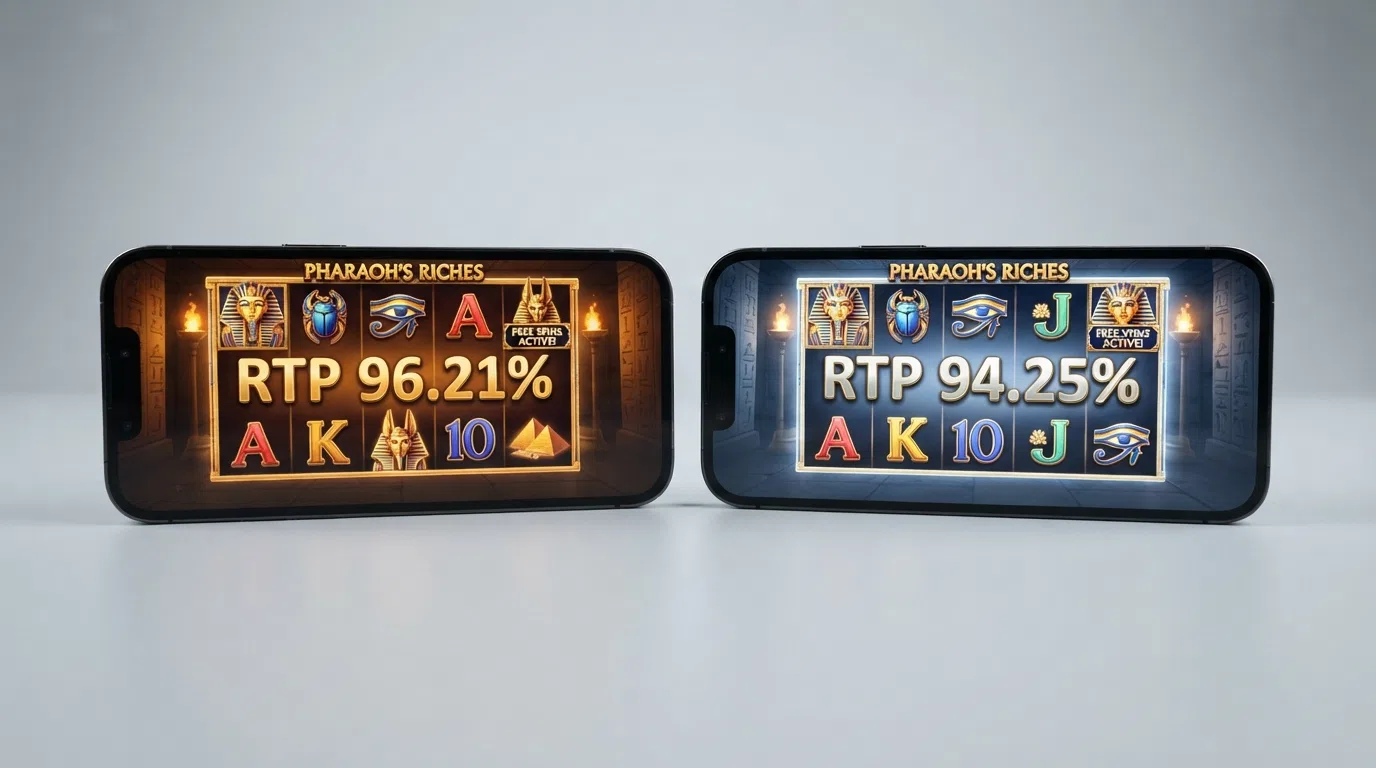
Blood Suckers is the fixed-RTP exception. NetEnt ships it at 98.00% with no lower tier available, so every UK casino runs it at exactly the same percentage. The casino cannot downgrade it even if it wanted to. That makes Blood Suckers the one slot where the headline figure and the deployed figure are guaranteed to be identical — and it is part of why older NetEnt titles continue to earn their reputation among players who actually check.
The deployment caveat is the part to carry away from the table. The percentage printed on a slot’s marketing page is the provider’s theoretical maximum. The percentage you receive at a given casino depends on which variant they chose to licence. The slots in this table are the highest-RTP titles available; they are not guaranteed to run at the figure printed here at every site.
Bet365
Bet365 is the only UK-licensed operator in this ranking that RTPTrack has verified as deploying variable-tier slots at the theoretical maximum across major providers. Book of Dead sits at 96.21% (versus the 94.25% Flutter/Entain/888 modal deployment), Gates of Olympus at 96.50%, Big Bass Splash at 96.71%. On Pragmatic Play’s flagship catalogue, Bet365 is paying out at the top end.
That changed in March 2026 — partially. From that point, RTPTrack observed Bet365 beginning to reduce RTP settings on smaller studio titles — Peter & Sons, Wazdan, Spinomenal — below the theoretical maximum, even as major-provider slots stayed at full deployment. The pattern is selective, not blanket, and it applies to studios where the headline numbers are lower-volume and lower-visibility.
The welcome offer is up to 500 free spins across 10 days (5–50 per day, randomly allocated), with a £10 minimum lifetime deposit and a 30-day claim window. There is no wagering requirement attached to the winnings, which are added straight to your withdrawable balance. Each day’s allocation must be used within 7 days. For a player who wants both the top RTP deployment and clean bonus terms, Bet365 is the single brand in the ranking that delivers both.
William Hill
William Hill sits in the 888/Evoke group and deploys Book of Dead at the group’s 94.25% — the modal UK deployment, two full points below the theoretical maximum. The trade-off shows up in the welcome offer: 200 free spins on Big Bass Splash at 10p each (total spin value £20) with 10× wagering on winnings and a 72-hour validity window from credit. 72 hours is short. A player who deposits on a Friday evening and comes back on Monday will find the bonus gone.
Blood Suckers at its fixed 98.00% is available in the library, because no operator can run it lower. The provider range runs NetEnt, Pragmatic Play, Play’n GO, Microgaming, Blueprint, Red Tiger and Evolution — a broad library, including the high-RTP slots named above. But on any *variable*-tier slot, William Hill is paying out at the second tier, and a player who values the top deployment is paying the difference in expected return across volume.
Sky Vegas
Sky Vegas is Flutter’s no-wagering brand. Up to 200 free spins with zero wagering on winnings, paid straight to cash, against a £10 deposit and £10 cumulative stake on slots or instant-win games. The 7-day validity window is twice William Hill’s, and the absence of wagering means every penny won from a spin is withdrawable on the spot.
Underneath the clean bonus terms sits the same Flutter second-tier deployment — Book of Dead at 94.25%, not 96.21%. The library is wide enough to include Blood Suckers at its fixed 98.00%, and the broader provider range (NetEnt, Pragmatic Play, Play’n GO, Microgaming, Blueprint, Red Tiger, IGT) covers most high-RTP titles. But a player choosing Sky Vegas is choosing bonus clarity over RTP deployment, and on variable-tier slots, the difference is a permanent two-point drag on expected return.
Ladbrokes
Ladbrokes is Entain’s high-street name, and its deployment pattern matches the Entain group — Book of Dead at 94.25%. The 94.25% figure describes the deployment on the high-volume flagship titles a player is most likely to open.
The welcome offer runs up to 500 free spins on a £10 stake, with 10× wagering on free-spin winnings — generous on quantity, costly on the wagering. Validity is not confirmed this run. For a Ladbrokes customer who knows to play only the fixed-RTP titles in the library (Blood Suckers, Ugga Bugga on Coral via the shared Entain catalogue), the second-tier deployment is a non-issue. For a customer who opens Book of Dead or any other Play’n GO variable-tier slot, it is a measurable cost.
Paddy Power
Paddy Power is the only operator in this ranking offering a no-deposit free-spins component to the welcome package. Sixty spins on sign-up — 50 on slots plus 10 on Paddy’s Mansion Heist — with no deposit required, plus 100 further spins on a £10 deposit and wager. Zero wagering on all free-spin winnings, paid as cash. Seven-day validity.
The catch is underneath, where it usually sits. Paddy Power runs the Flutter group’s 94.25% deployment of Book of Dead, and the Starburst figure in the library sits at 96.09–96.10%, fractionally below the theoretical maximum. A no-deposit welcome is unusual in the UK market post the 10× wagering cap and the wider bonus tightening — the cost of giving one away shows up somewhere, and here it is in the deployment tier rather than the wagering multiple.
Coral
Coral is Entain’s other high-street brand, and its library runs Book of Dead at the same 94.25% group deployment. The reason Coral makes this list is Ugga Bugga at 99.07% — the Playtech ten-reel title that holds the highest published RTP in the UK market and is available in Coral’s catalogue. A player who knows to play Ugga Bugga is playing at near-99%; a player who defaults to Book of Dead is at 94.25%. The same brand, the same library, and the difference is the title chosen.
The welcome offer is 100 free spins on a £10 stake with 10× wagering on winnings. Coral suits a player who is willing to pick their slots deliberately rather than default to the most heavily marketed title.
Betfred
Betfred is the clean bonus-terms brand that no independent tracker covers. Two hundred free spins with zero wagering on winnings, paid straight to cash, against a £10 debit-card deposit and stake within 14 days. Seven-day validity after credit. The bonus structure is comparable to Bet365 and Sky Vegas on terms.
The absence is RTPTrack. Independent deployment data is not available for Betfred this run, and the absence is information in its own right. A player who wants to verify the deployed RTP at Betfred before signing up cannot do so using third-party tracking. They can still open the in-game panel after signing up, but the comparison work that the rest of this ranking enables is not possible here. Players prioritising third-party verification will find better coverage elsewhere.
Betfair
Betfair is Flutter’s exchange brand. The deployment pattern is the same as Sky Vegas and Paddy Power — Book of Dead at 94.25%, the Flutter group modal. The welcome bonus is not confirmed this run, which limits how much can be said about the offer; the underlying RTP deployment is not in question. Betfair Casino is a Flutter brand; Flutter brands run at the Flutter tier.
For a player already on Betfair’s exchange, the casino is a familiar-company option rather than a fresh comparison. For a player choosing between Flutter brands, the deciding factor sits in the bonus structure and the game library, as the RTP deployment is standard across the group.
32Red
32Red’s welcome offer is the largest by spin count in this ranking — 320 free spins at £0.10 each, requiring a £30 stake on slots, with 10× wagering on free-spin winnings and a 48-hour expiry after credit. Forty-eight hours is the shortest validity window in the ranking. A player who lets the spins sit for two days finds them gone.
Independent RTP tracking is not available for 32Red this run. The deployment tier cannot be verified before sign-up, and the comparison that drives the rest of this ranking is not possible here. The 320-spin headline looks generous; the short expiry and the 10× wagering cut the realised value down to a number that depends on how quickly the player uses the spins.
BetVictor
BetVictor’s welcome offer is split across three products rather than concentrated on slots: £5 on live casino, £5 on game shows, £20 on slots, plus 50 free spins on Fishin’ Frenzy. Ten-times wagering on the bonus funds, zero on the free-spin winnings, with a 30-day expiry on the bonus funds. Fishin’ Frenzy’s RTP is not confirmed this run.
The split-product structure makes direct comparison harder. A player who only plays slots is using £20 of the £30 bonus; the other £10 sits on products they may not intend to use. RTPTrack does not cover BetVictor independently this run, so the deployment verification that anchors the rest of the ranking is not available here.
The Expected Cost of a Welcome Bonus
A welcome bonus has a real cost in pounds, not just in time. Take the William Hill offer as an example: 200 free spins at 10p per spin, total spin value £20, with 10× wagering on winnings. Assume the bonus returns its average expected value to the player — that the entire £20 in spin value is played through at slots running between 94% and 97% RTP (the UK online band), which is the realistic spread a UK-licensed casino deploys.
The required turnover is the bonus value multiplied by the wagering factor: £20 × 10 = £200 through the slots. At a 94% RTP, the expected loss on that turnover is £200 × (1 − 0.94) = £12. At a 97% RTP, the expected loss is £200 × (1 − 0.97) = £6. The difference between the two ends of the range is £6 of expected player loss on the same £200 turnover — six pounds the casino keeps or returns depending purely on which RTP tier is deployed.
That six-pound figure is the player-visible cost of the deployment gap. It is the difference between Bet365-style top-tier deployment and Flutter/Entain/888-style second-tier deployment, expressed in pounds on a typical welcome offer. On higher-spin-count offers the gap widens proportionally. It is not a small difference compounded over volume; it is a structural cost the player pays every time they open a variable-tier slot at a second-tier casino.
How to Find a Slot’s True Payout Percentage Before You Spin
- Open the in-game rules or info panel — the RTP figure printed inside the game is the deployed version and the only number that applies to your session.
- Check the casino’s RTP or fairness page — typically in the site footer — for a published table covering slot titles and their deployed RTP tiers.
- Cross-reference with a third-party tracker such as RTPTrack for operator-level deployment data, with the caveat that not every operator is tracked and the data can lag behind changes.
Checking the In-Game Info or Rules Panel
Every UK-licensed slot carries a help, info or rules button — usually a small icon in the corner of the game window. Opening it brings up a page that includes the slot’s RTP, typically printed to one or two decimal places. That number is the deployed RTP — the version the casino is running, not the theoretical maximum the provider markets.
The distinction is critical. The provider’s headline figure is the upper bound on what the slot can return; the figure inside the game is what the slot *does* return at your casino. They can differ by two to four percentage points on variable-tier slots. The in-game panel is the only figure that describes the session you are about to play.
The UKGC disclosure rule requires this information to be available. It does not require the casino to put it on the homepage. The button is usually small, the page is usually buried, and the number is usually printed in the same font as the rest of the rules text. A player who skips the rules page is gambling on the provider’s marketing figure, not on the slot.
Casino-Published RTP Tables and Where to Find Them
Some UK casinos publish a full RTP table — every slot title in the library, the RTP tier deployed, and the machine category. The table typically sits in the site footer or under a “fairness,” “RTP” or “game information” link, and it covers the full catalogue rather than just the most-played titles. A player comparing slots before committing a deposit can use the table to see exactly which version of each title the casino runs.
Not every casino publishes a complete table. The UKGC rule requires information to be available, not that it be consolidated in a single document. A casino that meets the rule by linking to each game’s individual info page is technically compliant; a player looking for an at-a-glance comparison will not find one. The brands that publish a full table — Bet365 is one — make the comparison work significantly easier than the brands that do not.
Third-Party RTP Trackers and Independent Databases
RTPTrack is the most visible UK-focused deployment tracker. It independently verifies deployed RTP across dozens of operators, building an operator-level map that shows which casino runs which variant of which slot. A player can use it to spot an operator running a lower tier on a slot they play, and to confirm a casino’s claim of full deployment before depositing.
The limits of the tracker matter. Not every operator is covered — Betfred, 32Red and BetVictor are not independently tracked this run, and the absence is itself information. Tracking data can also lag behind changes: Bet365’s March 2026 reductions on smaller studio titles were observed by RTPTrack, but the gap between a change being made and being reflected in the database is real. A tracker is a cross-reference tool, not a live feed.
What UK Regulation Says About Slot Payouts — and Where It Stays Silent
What the UKGC Requires Casinos to Disclose About RTP
The Gambling Commission requires operators to make information available about a gaming machine’s category, its %RTP and whether it is compensated or random. That is the disclosure obligation in full. The Commission does not prescribe how the information is presented, where on the site it appears, or which RTP tier an operator must deploy.
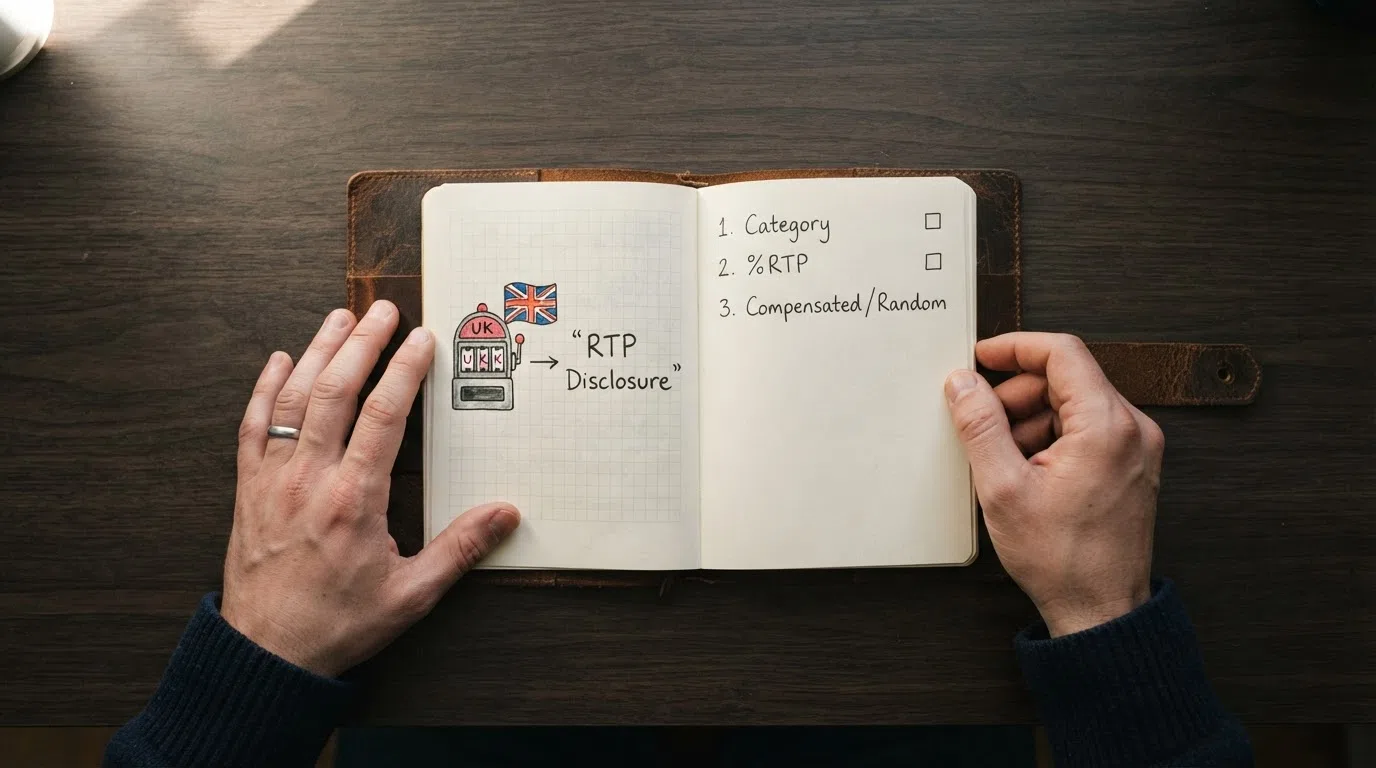
The machine category system distinguishes game types by structure — slots, table games, instant-win — and the compensated-versus-random distinction affects how many spins the simulation needs to settle the percentage. A random machine generates each outcome independently; a compensated machine adjusts payouts based on recent results to stay closer to the published RTP. Both are legal; both can be deployed; the player sees the percentage but not the mechanism behind it.
The disclosure obligation meets the Commission’s licensing objective of keeping gambling “fair and open.” It does not extend to mandating transparency about deployment choice. A casino running Book of Dead at 94.25% is fully compliant as long as the 94.25% figure is reachable in the game’s info panel. The fact that Bet365 runs the same slot at 96.21% is information the player has to find for themselves.
The Stake Caps and Game-Design Rules That Shape Your Play
The April and May $$CY-1$$ online slots stake limits are the sharpest edge the regulation introduces. Players aged 25 and over face a £5 maximum stake per game cycle (in force 9 April $$CY-1$$); players aged 18 to 24 face a £2 maximum stake per game cycle (in force 21 May $$CY-1$$). A game cycle runs from initiation to the point at which all money staked is lost or all winnings delivered — the cap applies to the total staked across that cycle, not per individual spin button press.
Two adults at the same casino on the same slot can face different maximum bets. The age band is the dividing line. The lower cap on the 18–24 band is deliberate — it is the Commission’s response to evidence that problem gambling rates peak in that age group — but it leaves a player who turns 25 mid-session with a £3 step-change in allowed stake.
The game-design rules (in force since 31 October 2021) reshape how RTP interacts with session play. Auto-play is banned — a player has to press the spin button each time. The minimum spin speed is 2.5 seconds, capping the volume of spins per hour. Features that speed up play are banned, as are losses disguised as wins. Reverse withdrawals are permanently banned — once a player has requested a withdrawal, the funds are gone from the playing balance. The combined effect is a slower, more deliberate session shape, which slows the rate at which the long-run RTP is realised.
Bonus-buy features are effectively banned where the cost exceeds the stake cap. A £100 feature buy on a slot with a £5 stake cap is not legal, because the buy-in would breach the per-cycle limit. The restriction is enforced through the stake cap rather than through a separate feature-buy prohibition, but the practical effect is the same.
Wagering Caps, the Statutory Levy, and Remote Gaming Duty — the Operator-Side Pressures
Three regulatory changes have stacked up against the operator between $$CY-1$$ and 2026. The first is the 10× wagering cap on bonuses, in force from 19 December $$CY-1$$ under LCCP Social Responsibility Code 5.1.1. Before the cap, wagering requirements as high as 60× were being applied — a player taking a £20 bonus had to turn over £1,200 before the winnings were theirs. The 10× cap reduces that to £200 on the same bonus. The cap cuts the house’s bonus-recapture margin sharply, which is why some bonuses shrank in headline value at the same time as the wagering multiplier shrank.
The second is the statutory levy, in force from 6 April $$CY-1$$. Remote casino operators pay 1.1% of gross gambling yield into a fund split 50% treatment, 30% prevention, 20% research. The levy is a fixed cost on revenue, not on profit — a casino with high fixed costs and thin margins absorbs the levy more painfully than a casino with broad revenue spread.
The third is the Remote Gaming Duty rise from 21% to 40%, effective 1 April 2026 and announced at the Autumn Budget $$CY-1$$. RGD is the operator’s main tax cost, and the near-doubling of the rate is the largest single change to online casino taxation in a generation. The operator’s response is constrained by the market — they cannot raise RTP above the theoretical maximum — but they can shift deployment toward lower RTP variants to recover margin. Whether individual operators do this is a question RTPTrack can answer per brand; the *incentive* to do it exists across the market.
What Happens When a Casino Breaches the Rules
The Commission enforces through disruption, not through blocking. Section 33 of the Gambling Act 2005 makes unlicensed operation a criminal offence — up to 51 weeks’ imprisonment, an unlimited fine, or both. The Commission’s enforcement tools are cease-and-desist notices, search-engine delisting referrals and payment-provider referrals. Between April 2024 and June 2025, the Commission issued 3,140 disruption notices, referred 447,778 URLs and saw 287,961 removed.
The Commission does not currently hold statutory ISP or DNS blocking powers. Those powers have been proposed and not enacted. A player who wants to reach an unlicensed site can do so without the network operator intervening. The block sits at the payment layer and the search layer, not at the connection layer.
A player who uses an unlicensed site loses every UK protection. GAMSTOP does not extend to unlicensed operators. Alternative Dispute Resolution access is gone. The Commission’s complaints route is closed. There is no established penalty for the player — using an unlicensed site is not, in itself, an offence — but there is no consumer redress if the operator withholds funds, refuses a withdrawal or disappears. The protections exist only on licensed sites, and only because the licence requires them.
Why RTP Literacy Belongs in Every Slot Player’s Safer-Gambling Toolkit
What the Numbers Actually Mean for a Single Session
A 96% RTP does not mean a player gets £96 back from £100. It means that across millions of spins, the slot returns an average of 96 pence per pound staked. Over a session of 200 spins at £5 each — £1,000 in stakes — the expected loss is £40, but the realised loss can be anywhere from a £600 profit to a £900 loss without the math breaking.
Session length and volatility interact with RTP to produce results far from the average. A high-volatility slot at 99% RTP can drain a £200 bankroll in 100 spins and pay nothing back, because the design concentrates payouts in rare, large events. A low-volatility slot at 96% RTP can sustain a £200 bankroll across 1,000 spins with steady small returns, because the design spreads payouts evenly. The percentage is the same direction. The ride is different.
Chasing a “due” payout after a losing streak is mathematically empty. RTP has no memory. A slot that has paid 80% over the last 100 spins is not “overdue” a payout at 112% on the next 100. The next spin is independent of the last. The slot does not know the player is behind. The house edge is constant across every spin, and the average the percentage describes is the destination, not the path.
Help Resources and Where to Turn
The National Gambling Helpline, run by GamCare on 0808 8020 133, is free and open 24 hours a day, every day. GamCare reported 996 referrals to treatment and peer-based support services in January 2026 — a 48% increase on the same month a year earlier. The line is the front door of the help system; behind it sits a network of treatment providers and peer-support groups.
The National Gambling Treatment Service treated 11,960 clients in 2024/25, an 11% increase on the previous year. Of the clients who completed treatment, 93% saw improvement. The service is funded by GambleAware and delivered through regional providers across England, Scotland and Wales. NHS gambling harm clinics operate in all three nations, providing specialist treatment within the NHS.
GAMSTOP is the national multi-operator self-exclusion scheme, mandatory for all UK-licensed online operators since 31 March 2020. A player can register for 6 months, 1 year, 5 years, or 5 years with auto-renewal. The exclusion cannot be cancelled early — the chosen period must run its course. Gamblers Anonymous provides peer support through local meetings across the UK.
GambleAware’s 2024 survey found 15.6% of GB adults classified at any level of gambling problems (PGSI 1+), up from 13.1% the year before. Problem gambling (PGSI 8+) rose from 2.9% to 3.8%. The numbers describe a population under pressure, and the help infrastructure exists because that pressure translates into demand for the services listed above.
How We Selected and Ranked the Operators on This Page
Every operator in this ranking is a confirmed active GB licence holder on the UK Gambling Commission’s public register. The selection was drawn from brands with a substantial UK slots presence and a documented welcome offer; the ranking was ordered by deployed RTP reputation first and bonus terms second.
Deployed RTP data comes from RTPTrack’s independent operator-level tracking where available, supplemented by the operators’ own published RTP tables where they exist. Where independent tracking is not available — Betfred, 32Red and BetVictor this run — the absence is noted rather than filled with assumed data. The ranking does not penalise an operator for being untracked; it notes the gap and lets the reader decide how much weight to put on it.
Bonus terms were verified against the operators’ own sites and against affiliate-database aggregations as of the publication date. Terms change frequently, and the figures here describe the offers as they stood at verification. A player who returns to an offer months later should expect to find the headline number, the wagering multiple and the validity window all subject to revision.
The ranking has limits. It is a snapshot, not a permanent ordering. An operator can adjust deployment at any time, and RTPTrack’s data lags behind changes by weeks. The bonus terms change faster than the deployment tiers. A reader using this page in three months’ time should re-verify the figures that matter to them, particularly the deployed RTP for the slots they actually play.
What UK Slot Players Should Actually Do With These Payout Percentages
Three habits make the percentage work for a player rather than against them. First, open the in-game rules panel and read the RTP figure printed inside the game before committing a session bankroll. The figure on the slot’s marketing page is not the figure you will be playing at. Second, use the casino’s published RTP table — if it has one — to compare slots before depositing. Third, cross-reference the casino’s deployment against an independent tracker such as RTPTrack where coverage exists.
The casino matters as much as the slot title. The same game can return two to four percentage points less depending on which site you open it at, and the difference compounds over volume. A player who plays Book of Dead for 10,000 spins at 96.21% expects to lose £378; at 94.25%, the expected loss is £575 — a £197 difference on the same slot, the same stake, the same number of spins. That difference is not a rounding error. It is the price the player pays for choosing a casino without checking the deployment.
RTP is a budget tool, not a prediction. It tells the player what the slot costs in expectation across volume. It does not tell them what the next spin will pay, what the next hour will return, or whether a session will end in profit or loss. The percentage is honest about what it is. The marketing around it is not.
The bottom line: pick the casino that deploys the highest available tier of the slots you actually play, check the deployed figure inside the game before you spin, and treat the percentage as an odds comparison tool. Use it to make informed choices. Do not use it to forecast a session.
Frequently Asked Questions
If a slot is advertised at 96% RTP, will I get £96 back from £100 of spins?
No. The 96% figure is a long-run statistical average measured over millions of spins. A £100 session of 200 spins at £0.50 each is a tiny fraction of that population and can return anywhere from a few pounds to several hundred. The percentage describes what the slot costs across volume; it does not describe what it returns in any single sitting.
Can a single slot title pay out at a different rate depending on which UK casino I open it at?
Yes. Providers ship variable-tier slots with multiple RTP variants and the casino chooses which to deploy. RTPTrack’s data shows Book of Dead running at 96.21% at Bet365 and at 94.25% across the Flutter, Entain and 888 brands — the same Play’n GO title, different deployments, different pounds in the player’s pocket. The figure printed inside the game’s info panel is the one that applies at your casino.
How do I verify which RTP version a casino is actually running before I start playing?
Open the slot, open the rules or info panel (usually a small icon in the game window), and read the RTP figure printed inside. That number is the deployed version — the one the casino is running and the only one that applies to your session. The provider’s headline figure is the theoretical maximum, not the operating percentage.
Are online slot payout percentages independently tested, or do providers mark their own homework?
Independently tested. Providers build the mathematical model and run their own simulations, but independent testing laboratories — eCOGRA, iTech Labs, Gaming Laboratories International among others — verify the model and run their own simulations before a slot can go live at a UK-licensed casino. The published percentage is the laboratory’s figure, not the provider’s marketing claim.
Why do two slots with the same published RTP percentage play so differently?
Volatility. A 96% high-volatility slot pays rarely but pays big when it does; a 96% low-volatility slot pays often but pays small. The long-run return is the same. The shape of a session — how long a bankroll lasts, how often a spin returns anything, how big the occasional win is — is set by volatility, not by RTP. The two metrics describe different things.
What does the 10× wagering cap mean for the real value of a UK casino bonus?
It caps the multiplier at 10×, down from offers that previously required 30×, 40× or even 60× turnover. A £20 bonus at 10× wagering requires £200 of slot play before winnings are withdrawable, compared with £1,200 under a 60× rule. The cap reduces the time and turnover needed to clear the bonus but does not change the underlying RTP of the slot — the player’s expected loss on the turnover still depends on which RTP tier the casino deploys.
Limits – nonukgc-licensedcasinos
Content created by the «nonukgc-licensedcasinos» team