
Paying for Online Casino With Your Phone Bill: The UK Picture
 Available in GB
Privacy is the word the marketing leads with, and for once it is not empty. A pay-by-mobile casino deposit takes a debit that lands on your next monthly phone statement — no card number, no bank sort code, no e-wallet login, nothing that connects the transaction to a current account on the cashier’s screen. For UK players who do not want their gambling visible on a bank statement or shared with a payment processor, that is the actual proposition, and it is why the method has stuck around long after the novelty should have worn off. Around 38% of adults in Great Britain gambled online in 2025, and a meaningful slice of that figure has tried the phone-bill route at least once.

The marketing copy calls it “instant,” “easy,” and “secure.” Thearithmetic is less flattering. A hard statutory cap stops every single deposit at £40 and every calendar month at £240 — you cannot pay your way around it with a different method or a different casino. Phone-bill payments are one-way: no operator in the UK market can route winnings back to your mobile account, which means the deposit method you pick at registration is not the method you pick at withdrawal—a limitation TalkSport notes as a key trade-off for phone-bill users. And the welcome bonus that the homepage shouts about? Most UKGC-licensed casinos quietly exclude pay-by-mobile from the very offer they are advertising, a standard industry practice.
This page works through the lot: the mechanics, the statutory caps, the bonuses that actually qualify, the slots you can play, the safer-gambling controls, and ten UKGC-licensed casinos that accept the method. Data current as of September 8, 2026; licence status verified against the UK Gambling Commission public register.
What a Pay-by-Mobile Casino Is — and Why It Took Off in the UK
The Core Proposition: Funding a Casino Account Through Your Phone Bill
A pay-by-mobile casino is an online casino that accepts deposits billed to a mobile phone account. The cashier routes the payment through either your mobile network (direct carrier billing) or a third-party billing intermediary (Boku, Fonix, PayForIt, PayViaPhone). The money is added to your casino balance within seconds; the debit appears on your next monthly phone bill, or is deducted from your prepaid credit if you are on PAYG.
What is not happening: no card number is entered. No bank account is touched. No payment processor sees a link between your bank and the casino. The casino receives a payment instruction from the billing intermediary, credits your account, and never holds your card or bank details in connection with that transaction. For a UK player who does not want their gambling visible on a bank statement or shared with a payment processor, pay-by-mobile is a privacy-friendly option. However, it cannot be used to withdraw, which means you always need a secondary method—such as a debit card or bank transfer—set up for cashing out.
The UK has been receptive. The UK Gambling Commission banned credit card gambling across all licensed operators in 2020, and the combination of that ban with the country’s high mobile-banking penetration created space for an alternative. Pay-by-mobile fills a gap: it is not credit (so it is legal), it is not a card (so it avoids the credit-card ban), and it is not crypto (which UKGC-licensed operators do not accept). For privacy-conscious and credit-averse players, it is the only deposit method that combines all three.
Which UK Mobile Networks and Billing Services Power Pay-by-Mobile Casino Deposits
The major UK networks — Vodafone, EE, BT Mobile, Sky Mobile, Tesco Mobile and Virgin Mobile — all support pay-by-mobile casino deposits. Three Mobile and O2 coverage varies by billing provider. The network is the rail; the billing service is the train.
Two routes exist. Direct carrier billing means your network handles the payment end-to-end and the casino integrates with the network’s own billing API. Boku, Fonix, PayForIt and PayViaPhone are intermediaries that sit between the casino and the network, processing the SMS verification and the payment instruction. The practical difference to a player is small — the deposit experience looks the same — but the intermediaries carry the regulatory weight of the Payment Services Regulations 2017, which is what makes the £40 per-transaction and £240 per-month caps possible.
The billing provider matters at the margins. Boku is the most widely adopted in the UK market and uses SMS-based verification. Fonix integrates directly with carrier networks and is the provider behind most of the operators reviewed below. PayForIt is a network-agnostic system commonly used for one-off deposits. PayViaPhone, used by Spinzwin in this set, charges a 15% fee on each deposit — a cost no other provider in the set imposes.
How Pay-by-Mobile Casino Deposits Actually Work (and Why You Cannot Withdraw)
The Deposit Flow: From Casino Cashier to Your Phone Bill in Under a Minute
The flow is short. At the casino cashier, select “Pay by Mobile,” “Pay by Phone,” or the billing provider’s name (Boku, Fonix, PayForIt). Enter a deposit amount within the casino’s stated range — £10 is the common minimum, £40 the statutory ceiling per transaction. Confirm the amount, and the casino hands off to the billing provider, which sends an SMS verification code to your registered mobile number. Enter the code in the cashier window. The deposit credits to your casino balance immediately. The charge lands on your next monthly phone bill, or is debited from your prepaid credit, depending on your contract type.
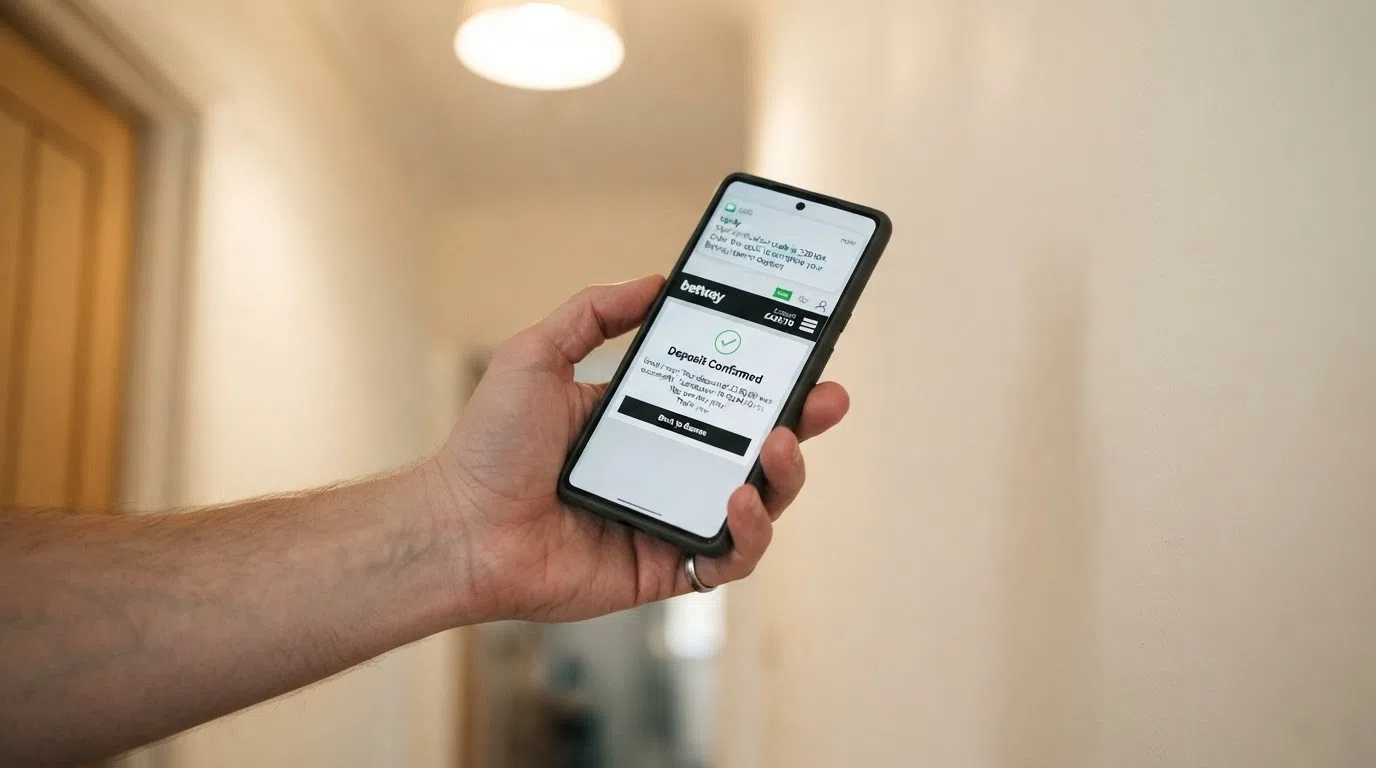
There is no card to enter, no app to download, no e-wallet to set up. The whole exchange takes under a minute. The deposit range varies by casino — Duelz, Mr Vegas, Monster, Rose, Space Wins, Great Britain, Casino Kings and NY Spins all accept £10–£40; Spinzwin accepts £10–£30 per day; Ivy accepts £20–£40.
Why Pay-by-Mobile Withdrawals Do Not Exist — and What to Use Instead
Pay-by-mobile is deposit-only. The structural reason is that the Payment Services Regulations 2017, under which phone-bill payments sit, exclude one-time electronic communications payments from the full payment-services framework — that exclusion is what makes the method possible, and it is also what blocks the return path. A casino cannot route winnings back to a phone bill because the regulatory channel only operates in one direction.
Every player at a pay-by-mobile casino needs a paired withdrawal method. The practical options are:
- Debit card — the most common pairing, already verified during KYC, no extra setup.
- Bank transfer — slower (one to three business days typical) but works at every UKGC-licensed casino.
- E-wallet (PayPal, Skrill, NETELLER) — fastest withdrawal times at casinos that support them, but a separate verification step at registration.
Set the withdrawal method up at the same time you register. Trying to add a withdrawal method after a big win tends to mean uploading ID documents under time pressure, and that is never the moment you want to be doing it.
Deposit Limits: The £40 Cap the Casino Does Not Set
The £40 per-transaction and £240 per-calendar-month caps are statute, not casino policy. They come from the Payment Services Regulations 2017 and apply to every UK pay-by-mobile deposit regardless of which casino you use, which network you are on, or which billing provider processes the payment. No casino can override the cap, and no casino can offer a higher ceiling — the most they can do is set a lower one.
Spinzwin’s £10–£30 per day range, for instance, sits comfortably below both statutory limits. Duelz, Mr Vegas, Monster, Rose, Space Wins, Great Britain, Casino Kings and NY Spins all hit the £40 ceiling at the top of their range, allowing the maximum statutory deposit per transaction. Ivy starts at £20, which means a player there cannot use the full £40 statutory allowance.
The £240 monthly cap is the under-appreciated one. At six maximum-statutory transactions per month, a pay-by-mobile player cannot move more than £240 through phone billing in any calendar month. For a high-stakes player that is a hard ceiling. For everyone else, it is a built-in spending brake that no other UK payment method offers.
The Best UK Pay-by-Mobile Casinos for 2026
| Casino | Welcome Bonus | Free Spins | Pay-by-Mobile Method | Deposit Range |
|---|---|---|---|---|
| Duelz | 100% up to £100 | 100 bonus spins | Fonix | £10–£40 |
| Mr Vegas | 100% up to £50 | 11 wager-free spins | PayForIt | £10–£40 |
| Monster | 100% up to £50 | 30 free spins | Fonix | £10–£40 |
| Spinzwin | 100% up to £1,000 + 100 FS (5 deposits) | 100 (Starburst + Book of Dead) | PayViaPhone (15% fee) | £10–£30/day |
| Ivy | 25% up to £50 | — | Fonix | £20–£40 |
| Rose | — | 20 FS on Big Bass Splash | Fonix | £10–£40 |
| Space Wins | — | 5 no-deposit + up to 500 on deposit | Fonix | £10–£40 |
| Great Britain | — | up to 500 FS on Big Bass Bonanza | Fonix | £10–£40 |
| Casino Kings | — | 100 FS on Big Bass Splash | Fonix | £10–£40 |
| NY Spins | — | 140 FS for £25 deposit and play | Fonix | £10–£40 |
Duelz Casino — 100% Match up to £100 Plus 140 Bonus Spins
Duelz’s welcome offer is a 100% deposit match up to £100 with 100 bonus spins on selected games. The minimum qualifying deposit is £25, the wagering requirement is 10× the bonus amount, and the bonus is valid for seven days. The 10× multiple is the post-January 2026 UKGC ceiling — Duelz is at the cap, not below it, so the bonus cannot get any cheaper to clear in terms of statutory structure.
UKGC licence 48695 is active (verified 29 July 2026). The game library runs through NetEnt, Play’n GO, Pragmatic Play, Microgaming and Evolution, covering the bulk of the UK slot market. Pay-by-mobile deposits go through Fonix in the £10–£40 range. Duelz offers a balanced entry point for players prioritizing library breadth and a competitive match structure.
Mr Vegas — 11 Wager-Free Spins and a 60-Day Window
Mr Vegas runs on a Videoslots Ltd UKGC licence (39380, active) and offers 100% up to £50 plus 11 wager-free spins. Two things stand out. The spins are genuinely wager-free — winnings are paid as cash, not bonus funds, so there is no turnover requirement on the spin returns. The 10× wagering requirement applies to the initial deposit, not the bonus, and the bonus validity runs 60 days — the longest in the set by a wide margin.
Pay-by-mobile runs through PayForIt at £10–£40. The provider library is the deepest in the set: 100+ providers including major studios like NetEnt and Pragmatic Play. Mr Vegas stands out primarily for its wager-free spins and extensive, high-variety game library.
Monster Casino — Straightforward 100% Match With 30 Free Spins
Monster Casino’s UKGC licence (58267, active) sits behind a 100% match up to £50 plus 30 free spins on a minimum £10 deposit. The terms are clean — no unusual conditions surfaced, and the Fonix billing integration offers the standard £10–£40 pay-by-mobile range.
The provider list covers NetEnt, Pragmatic Play, Microgaming and Evolution. Monster is an ideal choice for players seeking a no-nonsense welcome bonus without complex multi-deposit requirements.
Spinzwin — The £1,000 Multi-Deposit Package (Pay-by-Mobile Deposits Excluded)
Spinzwin’s headline figure is the largest in the set: 100% up to £1,000 plus 100 free spins on Starburst and Book of Dead, spread over five deposits. The wagering requirement is 10× the bonus, with 30 days to clear the deposit bonus and seven days to use the free spins. ProgressPlay’s UKGC licence (39335, active) is the regulatory anchor.
The catch is in the small print, and it is the kind of catch that ruins the headline. Spinzwin excludes pay-by-mobile deposits from welcome bonus eligibility, a pattern BonusFinder and CasinoWithdrawal note as common across the majority of UK operators. A player who funds their account through PayViaPhone will not trigger the welcome offer. And PayViaPhone, the billing provider Spinzwin uses, charges a 15% fee on each deposit — a £30 deposit costs £34.50 on the phone bill. The deposit range is £10–£30 per day, which is the tightest in the set.
For a pay-by-mobile player, Spinzwin is the wrong choice. The headline is for players depositing by debit card or bank transfer; the phone-bill route gets neither the bonus nor a fee-free deposit.
Ivy Casino — A Modest 25% Match With a Confirmed 10× Wagering Requirement
Ivy’s 25% up to £50 welcome offer is the lowest match rate in the set, but it comes with a confirmed 10× wagering requirement and a 28-day validity — a long window for a modest bonus. No free spins are bundled into the welcome. Pay-by-mobile runs through Fonix at £20–£40, meaning the statutory £10–£19 deposit range is not available here.
The UKGC licence was not independently confirmed in this review; players should check the public register at gamblingcommission.gov.uk before depositing. The provider mix covers standard UK studios. Ivy is a viable option for bonus-focused players who prioritize a lower wagering multiple over a higher initial deposit-match percentage.
Rose Casino — 20 Free Spins on Big Bass Splash for a £20 Deposit
Rose offers 20 free spins on Big Bass Splash — a Pragmatic Play title with a 96.71% RTP, high volatility and a 5,000× maximum win — for a minimum £20 deposit. There is no deposit-match component, so the welcome is spin-only. The UKGC licence was not independently confirmed; check the register before depositing.
Pay-by-mobile runs through Fonix at £10–£40. The provider list (NetEnt, Play’n GO, Pragmatic Play) covers the main UK slot studios. For a player who wants to try a high-volatility Pragmatic title with a low deposit threshold, Rose delivers what the welcome page says, no more and no less.
Space Wins Casino — 5 Genuinely Deposit-Free Spins, No Deposit Required
Space Wins splits its welcome into two parts: 5 no-deposit free spins, claimable without funding the account at all, and up to 500 additional free spins on first deposit (£10 minimum). The 5 no-deposit spins are the rarest offer type in the UK market — they require no payment, so the bonus-exclusion pattern that affects pay-by-mobile depositors does not apply to them.
The Fonix billing integration offers the £10–£40 pay-by-mobile range for the deposit-triggered portion of the offer. The UKGC licence was not independently confirmed; verify on the register before depositing. Space Wins provides a rare zero-commitment entry point with its no-deposit spin offer, ideal for testing the casino’s platform.
Great Britain Casino — Up to 500 Free Spins on Big Bass Bonanza
Great Britain Casino offers up to 500 free spins on Big Bass Bonanza — a Pragmatic Play slot with 96.71% RTP, high volatility and a 2,100× maximum win — for a minimum £10 deposit. The “up to” structure is standard for tiered free-spin offers, where the number awarded depends on the deposit amount or a randomised allocation.
Pay-by-mobile runs through Fonix at £10–£40. The UKGC licence was not independently confirmed; check the register. For a player who wants the highest free-spin count in the set and is comfortable with a high-volatility title, Great Britain is the most generous spin count on offer, though the per-spin value depends on the Big Bass Bonanza stake weighting at the time of the award.
Casino Kings — 100 Free Spins on Big Bass Splash
Casino Kings offers 100 free spins on Big Bass Splash (Pragmatic Play, 96.71% RTP, high volatility, 5,000× max win) for a minimum £20 deposit. No deposit-match component. Pay-by-mobile via Fonix at £10–£40.
The UKGC licence was not independently confirmed; verify on the register. For a player who wants a known high-RTP, high-volatility Pragmatic title and a clean 100-spin welcome, Casino Kings is a straight fit.
NY Spins — 140 Free Spins for a £25 Deposit-and-Play
NY Spins’ welcome is built around a single action: deposit and play £25 to receive 140 free spins. There is no deposit-match component and no separate bonus code structure. The 140-spin count is the joint-highest in the set alongside Duelz’s 100 bonus spins, though the trigger mechanism differs.
Pay-by-mobile runs through Fonix at £10–£40. The UKGC licence was not independently confirmed; check the register. For a player who wants a clean spin-for-deposit structure with a known spin count, NY Spins delivers.
Frequently Asked Questions
Is my money protected when I use pay-by-mobile at a UK casino?
Yes, because UKGC-licensed casinos must hold player funds separately from operating capital. If a casino fails, your balance is ringfenced, not part of the insolvency. You can also escalate complaints through the operator’s ADR, and the UKGC complaints process sits above them if further action is required.
What happens if I try to use a pay-by-mobile casino while registered with GamStop?
You will be blocked from depositing. GamStop integration is mandatory for all UKGC-licensed operators. When you attempt to deposit or log in, the system checks the GamStop database; if your record is found, the casino will refuse service regardless of the payment method you choose to use.
Will my mobile network or the casino charge me extra for a phone-bill deposit?
Most operators do not charge a fee, but it depends on the billing provider. PayViaPhone, for instance, adds a 15% surcharge to each deposit. Always check the payment terms in the casino cashier or the T&Cs before confirming your transaction to avoid any unexpected charges or surprises on your phone bill.
Which withdrawal methods work best after I deposit by phone bill?
Since pay-by-mobile is deposit-only, you need a withdrawal method. A debit card is the most common and typically verified during initial KYC. Alternatively, bank transfer works at every UKGC casino, though it is slower. E-wallets are often the fastest, but they require a separate verification step at your registration.
Are there any UK casinos where pay-by-mobile deposits actually qualify for the welcome bonus?
The majority of UK operators exclude phone-bill deposits from bonus eligibility. However, some sites have different T&Cs, and wager-free spin offers at operators like Mr Vegas are a notable exception where pay-by-mobile deposits are accepted. Always read the specific bonus exclusion list in the T&Cs first before you deposit.
Can I set a deposit limit on my pay-by-mobile casino account?
Yes. New UKGC rules effective 30 June 2026 require operators to offer a gross deposit limit based solely on the amount paid into the account. You can set this limit directly through the casino’s responsible gambling controls, providing a secondary layer of protection alongside the statutory monthly cap.
Boku vs Fonix vs PayForIt vs PayViaPhone: What Is Actually Different?
Boku is the longest-established pay-by-mobile billing provider in the UK and the most widely adopted. It uses SMS-based verification and works across all major UK networks. The deposit experience is identical to the other providers from the player’s side; the difference is in the backend integration and the contractual terms Boku offers casinos.
Fonix integrates directly with mobile carrier networks, which the company markets as “carrier-grade” reliability. In the set reviewed here, Fonix is the provider at Duelz, Monster, Ivy, Rose, Space Wins, Great Britain, Casino Kings and NY Spins — eight of the ten operators. The deposit range is consistently £10–£40 (Ivy excepted at £20–£40).
PayForIt is a network-agnostic system operated through a UK mobile-network joint venture. Mr Vegas uses PayForIt, with a £10–£40 deposit range. PayForIt’s distinguishing feature is its wide network coverage rather than any player-facing benefit.
PayViaPhone is the outlier. Spinzwin uses it, and it carries a 15% fee on each deposit — a real cost that no other provider in the set imposes. A £40 deposit through PayViaPhone at Spinzwin costs £46 on the phone bill.
The Bonus Exclusion Problem: Why Most Pay-by-Mobile Deposits Miss Out
The welcome bonus on the homepage is, for a pay-by-mobile player, often a mirage. Most UK online casinos exclude deposits made through pay-by-mobile, Boku, Fonix and PayViaPhone from welcome bonus eligibility—the same exclusion list that covers Skrill and NETELLER. The commercial rationale, where casinos state it, rests on three factors: higher processing costs for the billing intermediary, chargeback risk through the mobile network, and the regulatory friction of running a phone-bill payment through anti-money-laundering checks designed for card and bank payments.
BonusFinder notes: “The vast majority of UK operators do not award welcome bonuses, deposit matches or free spins if your account has been funded using Pay by Phone, Boku or Fonix.” That is the modal experience, not an edge case. A player who funds their account with a £40 phone-bill deposit at Duelz, expecting the 100% match, may find the bonus has not triggered.
The fix is mechanical, not clever. Open the bonus terms and conditions before depositing. Search the page for “Pay by Mobile,” “Boku,” “Fonix,” “PayForIt,” “PayViaPhone,” and “excluded deposit methods.” If the T&Cs list any of those alongside Skrill and NETELLER, the welcome offer will not trigger on a phone-bill deposit. The only exceptions in the set above are the genuinely deposit-free spins at Space Wins, which require no payment at all, and the wager-free spins at Mr Vegas, which sit in a different structural category.
Free Spins That Do Qualify: The Deposit-Free and Wager-Free Exceptions
Two offer types escape the exclusion trap. The first is the genuinely deposit-free spin: Space Wins’ 5 no-deposit free spins require no funding, so the question of which deposit method triggered the bonus never arises. No payment, no exclusion, no problem.
The second is the wager-free spin: Mr Vegas’ 11 wager-free spins pay winnings as cash rather than bonus funds, so there is no turnover requirement on the spin returns. Wager-free spins do not interact with the bonus-exclusion list in the same way as matched deposits, and Mr Vegas’ welcome explicitly extends eligibility to pay-by-mobile depositors. The trade-off is spin count: 11 is a small number, and the spin value is set by the casino.
For a pay-by-mobile player, the practical approach is to treat the welcome offer as a secondary consideration and weigh the casino on the deposit terms, the withdrawal options, the provider library and the licence status. The bonus is the cherry; the method and the safety net are the cake.
The 2026 Wagering Cap: What 10× Actually Means for Your Bonus
The UKGC’s Social Responsibility Code 5.1.1, effective 19 January 2026, caps promotional wagering requirements at 10× the bonus amount. Before that date, the UK market norm was 35× — the figure that dominates older bonus pages and affiliate reviews. A £100 bonus requiring £3,500 of wagering at 35× is the pre-2026 baseline; the same £100 bonus under the 2026 cap requires £1,000.
For a pay-by-mobile player, the cap changes the real cost of a bonus when pay-by-mobile does qualify. A £100 bonus at a 10× cap on Starburst (96.09% RTP) carries an expected loss of £1,000 × (1 − 0.9609) = £39.10 in real-money terms, before any spin winnings are counted. The same calculation at the pre-2026 35× standard would have produced an expected loss of £136.85 on the bonus alone. The cap does not change the underlying house edge, but it cuts the volume of money a player has to put through the slot to clear the bonus — and the volume is where the real cost lives.
The cap covers the bonus wagering multiple. It does not cover free-spin winnings wagering at every operator (free-spin wagering is a separate term in the bonus structure) and it does not cover deposit-only wagering, which remains at the casino’s discretion. Read the bonus T&Cs for the specific line items: “wagering on bonus,” “wagering on free-spin winnings,” and “wagering on deposit” are three different multipliers under most UK bonus structures.
The Slots Worth Playing With a Pay-by-Mobile Deposit
Slot Titles With Confirmed RTP: The Data Behind the Bonus Spins
| Slot | Provider | RTP | Volatility | Max Win |
|---|---|---|---|---|
| Starburst | NetEnt | 96.09% | Low | 500× |
| Book of Dead | Play’n GO | 96.21% | High | 5,000× |
| Big Bass Bonanza | Pragmatic Play | 96.71% | High | 2,100× |
| Big Bass Splash | Pragmatic Play | 96.71% | High | 5,000× |
| Rainbow Riches | Light & Wonder (Barcrest) | 95% | Medium | 500× |
The five titles above are the ones research carries a real per-title RTP for, and they are the slots named in the welcome offers across the featured set. Starburst and Book of Dead are Spinzwin’s bonus-spin titles; Big Bass Splash carries the welcome at Rose, Casino Kings and Great Britain; Big Bass Bonanza is Great Britain’s headline slot; Rainbow Riches is a high-street UK staple that appears across most major UKGC-licensed libraries.
The volatility split matters for a pay-by-mobile player. High-volatility slots (Book of Dead, Big Bass Bonanza, Big Bass Splash) eat bankroll faster per spin and produce longer dry stretches; the upside is the large max-win figures. Low-volatility slots (Starburst) produce more frequent but smaller returns. Medium-volatility (Rainbow Riches) sits between the two. For a player working with the £40-per-transaction statutory cap and the £240-per-month ceiling, low-volatility play stretches the bankroll further; high-volatility play concentrates the risk into fewer, larger bets.
Online slots generated £689 million in GGY in Q1 2025 — a 9% year-on-year increase — and they remain the single largest segment of the UK remote casino market. The titles in the table above are all mainstream UK releases from the four studios that dominate the licensed market.
The Provider Mix: What Game Libraries Pay-by-Mobile Casinos Actually Offer
The featured casinos share a core provider list: NetEnt, Play’n GO, Pragmatic Play, Microgaming and Evolution appear at the majority of operators in the set. Evolution is the live-casino specialist, and its presence signals that the casino runs a live-dealer product alongside the slot library. Microgaming’s presence is partly historical (the studio has been around since the 1990s) and partly structural (it powers a large number of progressive jackpot slots).
Mr Vegas is the outlier on breadth: 100+ providers on a Videoslots Ltd platform, which is the deepest library in the UK market. For a player who values slot variety over brand recognition, Mr Vegas’ library is the strongest in the set. The other nine operators carry the same core providers with some variation in the long tail of smaller studios.
Provider diversity is a proxy for slot quality, not a guarantee of it. A casino with Pragmatic Play and NetEnt can run the five titles in the table above; a casino with 100 providers can run those five plus 5,000 other games, but the marginal quality of the long tail is not the same as the quality of the headline titles.
Demo Mode and Low-Stakes Play: Testing Slots Before You Deposit
Most UKGC-licensed casinos offer demo or “fun” mode on slot titles, where a player can spin with virtual credit without funding a real-money account. Demo mode typically does not require registration at UKGC-licensed operators, though some studios (particularly newer releases) gate demo play behind an age-verification check.
For a pay-by-mobile player, demo mode has a specific value: it lets you test a slot’s volatility and hit frequency before committing any of the £40 statutory allowance. The £40 cap makes every pay-by-mobile deposit meaningful, and demo play is the only way to learn a slot’s behaviour without spending it. The transition from demo to real-money play is the point at which the £40 cap and the casino’s deposit range both kick in.
The statutory cap reinforces the value of pre-deposit testing in a way that other payment methods do not. A debit-card player can deposit £500 in a single transaction; a pay-by-mobile player cannot exceed £40. The marginal cost of an unresearched deposit is higher in pay-by-mobile because there are fewer deposits to learn from.
Is Pay-by-Mobile Casino Play Legal and Safe in the UK?
What a UKGC Licence Actually Protects: Player Safeguards, Fund Segregation and ADR
A UK Gambling Commission remote operating licence is the regulatory floor, and the floor is higher than the alternatives. The protections extend past the logo in the footer.
Fund segregation means player balances are held separately from the operator’s operating capital — if the operator becomes insolvent, player funds are ringfenced and recoverable, not pooled with creditor claims. The alternative dispute resolution (ADR) route gives a player an external body to escalate an unresolved complaint to, after the operator’s own complaints process has been exhausted. The UKGC’s own complaints procedure sits above the ADR provider and can investigate operator misconduct. The public register at gamblingcommission.gov.uk lists every licensed operator, the licence status, and any regulatory action.
The specific LCCP conditions that shape a pay-by-mobile player’s experience are: the credit card ban (LCCP 6.1.2), the KYC requirement (LCCP 17.1.1), and the new deposit-limit rules (RTS 12B, effective 30 June 2026), a mandate ensuring all online operators provide customers with the opportunity to set a “deposit limit” based solely on the amount paid into their account. Each of these is mandatory across the UK licensed market; an operator that fails any of them is in breach and subject to regulatory action.
The UKGC public register contained 2,663 records as of 29 July 2026. That number is the total register — active, expired, forfeited and lapsed licences combined — and is far larger than the set of operators any single review can feature. A licence register listing 2,663 records is the source of truth, not the affiliate page listing ten brands.
GamStop Self-Exclusion and Pay-by-Mobile: What the Block Actually Means
GamStop is the UK’s national self-exclusion scheme. A player registers at gamstop.co.uk, chooses an exclusion period (six months, one year or five years), and every UKGC-licensed operator is required to check the GamStop database and refuse service to registered users. The five-year exclusion is the most popular option, taken up by 47% of registrants. At the end of 2025, 561,983 active exclusions were on the register, with 117,756 new registrations during the year. The 16-24 age group saw the sharpest rise, accounting for 29% of new registrations.
For a pay-by-mobile player, GamStop integration is the same as for any other UKGC-licensed player: the exclusion applies regardless of payment method. A player who has registered with GamStop cannot deposit by phone bill at any UKGC-licensed casino, because the casino’s onboarding check will flag the GamStop record and block account access.
A site that advertises pay-by-mobile deposits while claiming to operate “not on GamStop” is, by definition, not UKGC-licensed. The two are structurally incompatible: UKGC licensing requires GamStop integration, and GamStop integration blocks self-excluded players. The marketing claim of bypassing GamStop is the marketing claim of operating outside the UK regulatory framework.
Non-GamStop and Offshore Casinos: What You Give Up When You Step Outside the UK Licensed Market
The “not on GamStop” search cluster is real and it is the seam where the UK licensed market meets the offshore one. Non-GamStop casinos are typically licensed in Curaçao, Malta or Gibraltar — jurisdictions that do not require UK-specific player protections. The UKGC has stated that offshore operators offering services to UK players appear to be doing so illegally.
What a UK player gives up at an offshore casino is concrete. No UKGC complaint route, because the UKGC has no jurisdiction over the operator. No ADR body that UK courts will enforce. No fund segregation under UK rules — if the operator becomes insolvent, the player’s balance is treated as a general creditor claim. No GamStop integration, which is precisely the marketing point but also precisely the regulatory gap. The Guardian reported in December 2025 that offshore bookmakers were exploiting self-excluded players through “Not on GamStop” search terms, which is the population the scheme was designed to protect.
UK players face no prosecution for playing at offshore sites, but they have limited legal recourse if a dispute arises. The practical position is that a player at an offshore casino has the same consumer protections as a player at any other overseas e-commerce site — which is to say, the protections depend on the operator’s home jurisdiction and the player’s ability to pursue a cross-border claim, both of which are weaker than the UKGC framework.
KYC and ID Verification: Why You Cannot Skip It at a Licensed UK Casino
UKGC LCCP Condition 17.1.1 requires every licensed operator to verify a customer’s name, address and date of birth before the customer is permitted to gamble. The verification happens at registration, typically through a document upload (passport or driving licence) and an electronic check against credit-reference and identity databases. A “no ID verification” casino is either unlicensed or misleading in its marketing.
The practical KYC flow at a UKGC-licensed casino takes a few minutes for an electronic verification, or up to 24 hours if manual document review is required. Some operators run age-verification at deposit rather than at registration, but the underlying requirement is the same: the operator must confirm the player is over 18 and is who they say they are before any real-money play.
For a pay-by-mobile player, the KYC check happens before the first phone-bill deposit, not at the moment of the deposit. The phone-bill route does not bypass identity verification; it sits on top of an already-verified account.
New UK Pay-by-Mobile Casinos to Watch in 2026
How to Vet a Newly Launched Pay-by-Mobile Casino Before You Deposit
A new casino launches every month in the UK, and the UKGC public register is the first checkpoint. Search the register for the operator’s name; if the licence number does not appear, walk away.
The second checkpoint is the payment method. A new pay-by-mobile casino should state which billing provider it uses — Boku, Fonix, PayForIt or PayViaPhone — and what the deposit range is. If the casino claims pay-by-mobile support without naming a provider, the claim is unverified. The deposit range should sit within the £10–£40 statutory band; a range that exceeds £40 is signalling either a regulatory gap or a marketing claim that the payment system cannot honour.
The third checkpoint is the bonus T&Cs. Search for “Pay by Mobile,” “Boku,” “Fonix,” “PayForIt,” “PayViaPhone” and “excluded deposit methods.” If any of those terms appear in the exclusion list, the welcome offer will not trigger on a phone-bill deposit. A new casino that does not state its pay-by-mobile bonus eligibility in the T&Cs is hiding something.
The fourth checkpoint is the provider list. NetEnt, Play’n GO, Pragmatic Play, Microgaming and Evolution are the core UK studios; their presence signals a mainstream product. A new casino with none of those studios is running a thinner library than the established market offers.
The PSR 2017 caps apply to every pay-by-mobile deposit at every UKGC-licensed casino, new or established. A new casino cannot legally offer higher limits than an established one, and any marketing claim to the contrary is a red flag.
Casino Apps and Mobile Browsers: Does It Change the Pay-by-Mobile Experience?
Dedicated Casino Apps vs. Mobile Browser Play for Pay-by-Mobile Deposits
The pay-by-mobile deposit flow is the same in a dedicated casino app and in a mobile browser, because the method is network-based, not app-dependent. The SMS verification works at the device level, not the application level, so the casino interface you are using when you hit “deposit” is irrelevant to the payment routing.
The differences are in the interface, not the payment. A dedicated app gives faster re-access (one tap from the home screen), push notifications for bonus offers and tournaments, and biometric login (fingerprint or face) for the session. A mobile browser requires no download, no device storage, no permission grants, and works on any device with a browser — including older phones and shared devices where installing a casino app is not appropriate.
For a pay-by-mobile player, the decision is about device space and personal preference, not deposit capability. A player who values fast re-access and bonus notifications will prefer an app; a player who plays occasionally and values storage space will prefer a browser. The deposit completes in the same time, at the same cost, with the same £40 statutory cap, in either case.
Staying in Control: Responsible Gambling With Pay-by-Mobile Deposits
The Help Resources: GamStop, GamCare and Where to Go If Gambling Stops Being Fun
- GamStop — the national self-exclusion register. Register at gamstop.co.uk. Choose a six-month, one-year or five-year exclusion; the five-year option is the most popular at 47% of registrants. At end-2025, 561,983 active exclusions were on the register, with 117,756 new registrations during the year. Every UKGC-licensed casino integrates with GamStop.
- GamCare — the National Gambling Helpline on 0808 8020 133 is free and available 24/7, with live chat at gamcare.org.uk. GamCare’s reporting year saw over 130,000 calls and online messages, with a 1.3-day average wait for treatment and 8,100 regional treatment sessions delivered.
- GambleAware — funds the National Gambling Support Network. Published statistics show 81% of gambling clients reported using a self-exclusion tool.
For context: around 0.5% of the adult English population experience problem gambling, and 3.8% are at elevated risk of gambling harms. The help resources above are free, confidential and reachable at any hour. A player who feels their gambling is no longer fun has a direct, low-friction path to support.
Deposit Limits, Session Reminders and the PSR 2017 Cap: Practical Controls for Phone-Bill Players
From 30 June 2026, every UKGC-licensed online operator must offer a gross deposit limit — one based solely on the amount paid into the account over a set period. The “gross” definition means the limit applies to deposits only, not to bonus credits or winnings. A player who wants to cap their monthly spend sets a gross deposit limit at the casino, and the casino is required to enforce it.
Casino-level controls are the first line: deposit limits, session time reminders, reality checks, time-out periods and self-exclusion. The PSR 2017 £240 monthly cap on pay-by-mobile deposits is the second line — a statutory ceiling that no casino policy can override. A player who sets a £200 monthly deposit limit and funds their account only by phone bill has two independent caps on the same behaviour, which is the kind of redundancy that safer-gambling design aims for.
The PSR 2017 cap is, paradoxically, a responsible-gambling feature. A player who wants to cap their gambling spend at £240 per month does not need to set a casino-level limit at all — the phone-bill channel will not allow more than that. The cap is a hard ceiling, not a soft suggestion. For a player who struggles to stick to self-set limits, the statutory cap is the most reliable spending brake in the UK market.
Session time reminders and reality checks are the casino’s responsibility to surface — pop-ups or notifications that interrupt play at set intervals. A pay-by-mobile player who deposits in small, frequent £10 increments has more deposit moments per session than a debit-card player, which is a behavioural risk that session reminders specifically address.
How We Selected and Ranked the Best UK Pay-by-Mobile Casinos
The ranking rests on a fixed set of sources. The UKGC public register is the licence-verification check for every operator reviewed, and only UKGC-licensed casinos are eligible for inclusion. Operator websites and published bonus terms are the source for welcome offers, pay-by-mobile method and deposit range. The UK Gambling Commission’s industry statistics and LCCP conditions are the source for the regulatory framework. GamStop’s annual report and GamCare’s published statistics are the source for the self-exclusion and treatment data.
The ranking criteria are qualitative, not weighted. Licence status is the first filter — every operator in the set holds an active UKGC remote operating licence, or has a licence number that was not independently confirmed in this review (in which case the reader is directed to the public register). Pay-by-mobile method availability and deposit range determine whether the operator is a candidate at all. Welcome bonus value, free-spin offer quality, provider diversity and bonus eligibility for pay-by-mobile depositors determine the ordering within the set.
The scope is limited. Ten operators is the set; the UK licensed market is larger than ten operators, and the UKGC register lists 2,663 records. Operators outside the set may accept pay-by-mobile deposits and offer comparable terms. The set is a curated shortlist, not an exhaustive survey, and a player comparing options should treat it as a starting point, not a closed list.
What Pay-by-Mobile Actually Means for Your UK Casino Play
Pay-by-mobile is a real product with real benefits and real limits, and the marketing has buried the limits under the benefits. The privacy gain is genuine: no card number, no bank detail, no e-wallet login, no entry on a shared bank statement. The speed is genuine: a deposit completes in under a minute, and the charge appears on the next monthly phone bill or against prepaid credit. The UK-wide network coverage is genuine: Vodafone, EE, BT, Sky, Tesco and Virgin all support the method, and the billing intermediaries (Boku, Fonix, PayForIt) have wide integration.
The limits are equally genuine. Pay-by-mobile is deposit-only, by the structure of the PSR 2017 framework, and a player who funds their account by phone bill needs a paired withdrawal method from day one. The £40 per-transaction and £240 per-month caps are statutory ceilings that no casino can raise, and they are a built-in spending brake that no other UK payment method offers — useful for players who want a hard cap, restrictive for players who do not. Most UK casinos exclude pay-by-mobile from welcome bonus eligibility, and the bonus on the homepage is often the bonus the pay-by-mobile player will not receive. PayViaPhone at Spinzwin charges a 15% fee, which no other provider in the set imposes.
The practical position: pay-by-mobile works best as a deposit top-up method for players who already have a debit card or bank transfer set up for withdrawals. It is not a sole payment method for casino play. The privacy is a genuine benefit; the bonus exclusion is a genuine cost; the withdrawal requirement is a genuine constraint. A player who treats pay-by-mobile as the deposit rail and a debit card or bank transfer as the withdrawal rail gets the privacy without losing the payout.
Before depositing, check the bonus T&Cs for pay-by-mobile eligibility. Before playing, verify the casino’s UKGC licence on the public register at gamblingcommission.gov.uk. Before assuming the headline bonus is yours, read the excluded deposit methods list and confirm the phone-bill route is not on it. The marketing is built to skip those checks; the regulatory framework is built to make them available.
Payments – nonukgc-licensedcasinos
Content created by the «nonukgc-licensedcasinos» team