
International casinos for UK players: bigger bonuses, fewer guardrails
 Available in GB
The marketing pitch for an “international casino” is short and tidy: don’t cap your stakes, don’t drag out payouts with endless checks, don’t shrink your bonuses. Each of those “don’ts” is a real UKGC rule that an offshore operator can sidestep, and that is the entire reason the category exists. What the pitch leaves out is the cost: every protection a British player takes for granted — GAMSTOP, an independent dispute route, fund segregation, the Gambling Commission’s complaint-handling — stays on the other side of the licence line. This page ranks the ten brands a UK search surfaces most often, separates what each one offers from what it costs, and lays out the trade-off honestly.
Current as of September 8, 2026; licence status and bonus terms verified against the UK Gambling Commission’s public register and the Curaçao Gaming Control Board register.
The offshore counter-market: what “international casino” actually means
“International casino” in a UK search is shorthand for a casino that holds no Gambling Commission licence. The label is regulatory, not geographic. A UKGC-licensed brand can run a Maltese, Gibraltar or Swedish operation and still be a British casino to a player in Leeds; a Curaçao-licensed site hosted in Cyprus and trading in pounds is what this page means by international. The split is the badge on the footer, not the address on the server rack.
Defining “international”: outside the UKGC, not across a border
“International” means a licence held outside Great Britain, not a casino located abroad. UKGC-licensed brands also run internationally, so the split is licence, not location. A Curaçao GCB or Anjouan badge is the practical marker on these sites, and the player-facing distinction is the GB licence they do not hold. Since the Gambling (Licensing and Advertising) Act 2014, an MGA, Curaçao or other foreign licence does not substitute for a GB licence. The point of consumption decides whose rules apply, not where the operator keeps its headquarters.
Offshore licensing vs the UKGC: two worlds, one screen
Three licence tiers dominate the international set. The UKGC tier carries GAMSTOP, an approved alternative dispute resolution provider, mandatory fund segregation and a Commission complaints route — the structure a player never has to read about because it works in the background. The Curaçao GCB tier, reformed in 2024, offers limited transparency: the licence is verifiable on the regulator’s register, but the player-facing complaint infrastructure is thin. MGA and Gibraltar sit closer to the UK model than to Curaçao; Anjouan, the Comoros-issued licence carried by the newest offshore brands, is the least proven tier of the four. A “licensed casino” badge means different things on each line, and the line a brand sits on decides what the badge actually buys the player.
How these sites operate day to day, from sign-up to cashout
Offshore, the sign-up flow does not pause to ask a player to set a financial limit, the £150 net-deposit vulnerability check that the UKGC brought in on 28 February 2025 does not run, and the £5 (25+) or £2 (18–24) age-banded slot-stake cap that took effect in April and May 2025 does not apply. Deposits clear through card, e-wallet or crypto. Withdrawals still require KYC — offshore operators run their own source-of-funds checks — but the British affordability friction does not layer on top. The result is a faster path from registration to first bet, and a thinner set of safety nets standing between that bet and the next one.
What playing there actually feels like: games, stakes and support
A Curaçao-licensed floor catalogues 5,500+ titles at Freshbet and roughly 6,000 games at Donbet, including around 120 live tables — numbers that match the largest UKGC-licensed brands. Spins run without the 2.5-second-per-game-cycle minimum that the UKGC imposes on online slots. Reality checks and on-screen time displays are variable; some operators run them, some do not. Support quality is the part of the pitch the marketing cannot reach: it varies brand by brand, and a player finds out which tier a given operator sits on only by emailing at 2am with a withdrawal stuck.
Best international casinos for UK players: the 10 we reviewed
Ten brands sit on this ranking, split by licence line: seven hold no GB licence (six Curaçao GCB, one Anjouan) and three are UKGC-licensed multi-jurisdictional operators. The ranking follows licence status, welcome terms and wagering — a UK player searching for “international” wants the non-UKGC options surfaced first, with the GB-licensed trio at the bottom of the table for comparison.

| Casino | Licence & status | Welcome bonus | Wagering |
|---|---|---|---|
| MyStake | Curaçao GCB (OGL/2024/1798/1048) — not UKGC-licensed, not on GAMSTOP | 300% up to £1,500 across 3 deposits | 30× on deposit + bonus |
| Goldenbet | Curaçao GCB (OGL/2024/1587/0365) — not UKGC-licensed, not on GAMSTOP | 300% up to £1,500 across 3 deposits + 100 FS | 35× on bonus funds |
| Freshbet | Curaçao GCB — not UKGC-licensed, not on GAMSTOP | 250% up to £1,500 across 3 deposits + 25 no-deposit FS | 30× on bonus funds |
| Donbet | Curaçao GCB — not UKGC-licensed, not on GAMSTOP | 150% up to £750 + 50 FS (casino); 170% up to £1,000 + 100 FS (crypto) | 30× on bonus funds |
| 7Bit Casino | Curaçao GCB (OGL/2023/174/0082) — not UKGC-licensed, not on GAMSTOP | Multi-deposit crypto package | — |
| Stake.com | Curaçao GCB (OGL/2024/1451/0918) — UKGC licence previously surrendered, UK players geo-blocked | No welcome bonus (rakeback / VIP model) | N/A |
| BC.Game | Anjouan (ALSI-202410011-FI1) — UKGC licence revoked Dec 2024, not on GAMSTOP | $4,000 + 400 FS welcome package | 40× on deposit + bonus |
| LeoVegas | UKGC-licensed (also multi-EU) | Promotional match offers | Subject to UKGC 10× cap |
| Betway | UKGC-licensed (also multi-EU) | Promotional match offers | Subject to UKGC 10× cap |
| 888Casino | UKGC-licensed (part of evoke plc) | 100% up to £100 | Subject to UKGC 10× cap |
The split tells the page’s story on its own. A UK player who wants the 300% headline reads down the top of the table and accepts the no-UKGC trade-off. A UK player who wants the GB complaint route reads to the bottom and accepts a 100% match and a 10× cap. The two columns of the choice sit six rows apart.
MyStake: the 300% welcome that tops this list
MyStake’s headline is the largest in the set: a 300% match up to £1,500 spread across three deposits, with 30× wagering on deposit plus bonus and a 30-day validity window. Minimum deposit £20. The Curaçao GCB licence, OGL/2024/1798/1048, is held by GTW B.V., and the operator has been live since 2020. Max cashout from bonus funds is set at £100,000 — a ceiling generous enough that the player is unlikely to hit it on a £1,500 bonus, but worth knowing. One review source sums up the brand as “a legitimate licensed operator with a functional platform and a track record of paying players — but it is not a UKGC regulated site, and UK players should understand that distinction clearly.” That sentence is the whole trade-off in one paragraph. The licence is verifiable, the platform pays, and the British protection layer is not behind the cashier.
Goldenbet: 300% plus 100 free spins
Goldenbet’s structure mirrors MyStake’s headline — 300% up to £1,500 across three deposits — and attaches 100 free spins on top. Wagering on the bonus funds runs at 35×, five turns higher than MyStake’s 30×, which is the price of the extra spins. Minimum deposit £20. The Curaçao GCB licence, OGL/2024/1587/0365, sits with Santeda International B.V., the same operator entity behind two other brands on this list. Comparing Goldenbet against MyStake comes down to a trade-off: are the 100 free spins worth five extra wagering turns on your cash bonus? That choice depends on your preference for bonus structure over raw bonus funds, with the additional spins potentially offsetting the slightly higher wagering requirement if the slots payout as expected.
Freshbet: spins the moment you sign up
Freshbet is the only brand on the list with a genuine no-deposit offer: 25 free spins credited on registration, before a player has touched the cashier. The matched welcome is 250% up to £1,500 across three deposits at 30× wagering. The 5,500+ title catalogue draws on Pragmatic Play, Evolution, Play’n GO, BGaming, Hacksaw Gaming and Push Gaming. Standard no-deposit free-spin cashout caps of £50–£100 apply, so the headline is a taster rather than a route to a withdrawable balance. A player who wants to test a casino without committing a deposit reads this row first.
Donbet: a casino and crypto welcome in one
Donbet runs two welcome tracks. The casino welcome is 150% up to £750 plus 50 free spins at 30× wagering; the crypto welcome is 170% up to £1,000 plus 100 free spins. A separate 15 free spins are credited on registration at a fixed 10p spin value with 30× rollover. The game catalogue of roughly 6,000 titles — 5,500 slots and 120+ live tables — is the largest on the list, and the live floor pulls from the same Evolution and Pragmatic Play feeds as the UKGC brands. If you already use cryptocurrency, the 170% crypto bonus is the clear standout option. For players sticking to standard fiat deposits, the casino welcome offers a solid, if slightly smaller, alternative with identical 30× wagering terms, making it a competitive choice for anyone wanting a reliable offshore casino experience.
7Bit: the crypto-first veteran since 2014
7Bit is the longest-running brand in the offshore half of the set, live on the SoftSwiss platform since 2014 under Dama N.V. The Curaçao GCB licence, OGL/2023/174/0082, predates the 2024 reform. The minimum deposit is set in bitcoin — 0.22 mBTC — and BTC withdrawals have been tested at one to three hours. The welcome package is a multi-deposit crypto structure whose exact terms are not confirmed this run, which is itself a signal: a player who needs to see the full T&Cs before depositing will need to read the bonus page on the day. The point of this brand is the account plumbing — crypto in, crypto out, eleven years of operation — rather than the headline match.
Stake: rakeback instead of a welcome bonus
Stake.com is the structural outlier in the set. There is no welcome bonus. The model is rakeback and a VIP ladder, and the funding is crypto-only — BTC, ETH, USDT, LTC, TRX, XRP, BNB and DOGE. The Curaçao GCB licence, OGL/2024/1451/0918, sits with Medium Rare N.V. The UKGC licence was previously surrendered, and the site geo-blocks UK players, which means a UK reader searching for Stake from a British IP address is not the audience this brand addresses. Stake is on the list because it is widely surfaced in search results for UK players, and the honest framing is: this is where the model points, not where a UK player can play.
BC.Game: a revoked licence and an Anjouan restart
BC.Game is the cautionary tale in the ranking. The UKGC licence was revoked in December 2024; the brand migrated from Curaçao to an Anjouan, Comoros-issued licence (ALSI-202410011-FI1) after withdrawing its Curaçao licence in December 2025, following a bankruptcy ruling over approximately $2.5 million in unpaid player claims. The current welcome is $4,000 plus 400 free spins at 40× wagering on deposit plus bonus — the highest wagering multiple in the offshore half of the table. The platform lists 38+ providers plus 75+ proprietary “BC Originals” advertised as provably fair. A player reading this row gets a different question than the others: not “is the bonus large enough” but “is the operator one I want to trust with £4,000 of bonus turnover.”
LeoVegas: the UKGC-licensed mobile flagship
LeoVegas is the GB-licensed mobile operator that the offshore set is being measured against. Welcome terms are not confirmed for the current run; what is confirmed is that any bonus the brand runs is subject to the UKGC’s 10× wagering cap from 19 December 2025, the minimum deposit is £10, and the platform is the award-winning mobile-first product with a dedicated app. The trade-off is the inverse of the offshore rows above: the headline match is smaller, the wagering is one-quarter of MyStake’s, and the GAMSTOP / ADR / Commission route sits behind the cashier.
Betway: UKGC-licensed with a global footprint
Betway is the second UKGC-licensed brand in the set, also licensed across multiple EU jurisdictions, with a £10 minimum deposit and an award-winning casino app. The UKGC 10× wagering cap applies. The brand does not need a 300% headline to compete because the pitch is global brand recognition, sportsbook depth and a familiar cashier — none of which require a bonus to advertise.
888Casino: the 100% match under a 10× cap
888Casino is the third UKGC-licensed brand, now part of evoke plc alongside the former William Hill International. The current welcome is 100% up to £100 at the standard 10× cap, which is the smallest headline on the table and the smallest wagering multiple. For a player who values a known GB brand name and a £100 cushion on the first deposit, the row reads as a different question than the offshore rows above — a different product, a different price, a different set of protections.
Playing offshore from Britain is legal — the cost is your protections
UK players are not prosecuted for gambling on an unlicensed site. The penalty under section 33 of the Gambling Act 2005 targets the operator — up to 51 weeks’ imprisonment, an unlimited fine, or both. The UKGC has no statutory ISP or DNS blocking power; enforcement is disruption-based: cease-and-desist notices, search-engine delisting, domain-registrar pressure, payment-provider referrals. Between April 2024 and June 2025, the Commission issued 3,140 disruption notices, referred 447,778 URLs to search engines and saw 287,961 URLs removed. The legal status of a player at the keyboard is clear; the cost is what the player surrenders by sitting outside the GB regulatory frame.
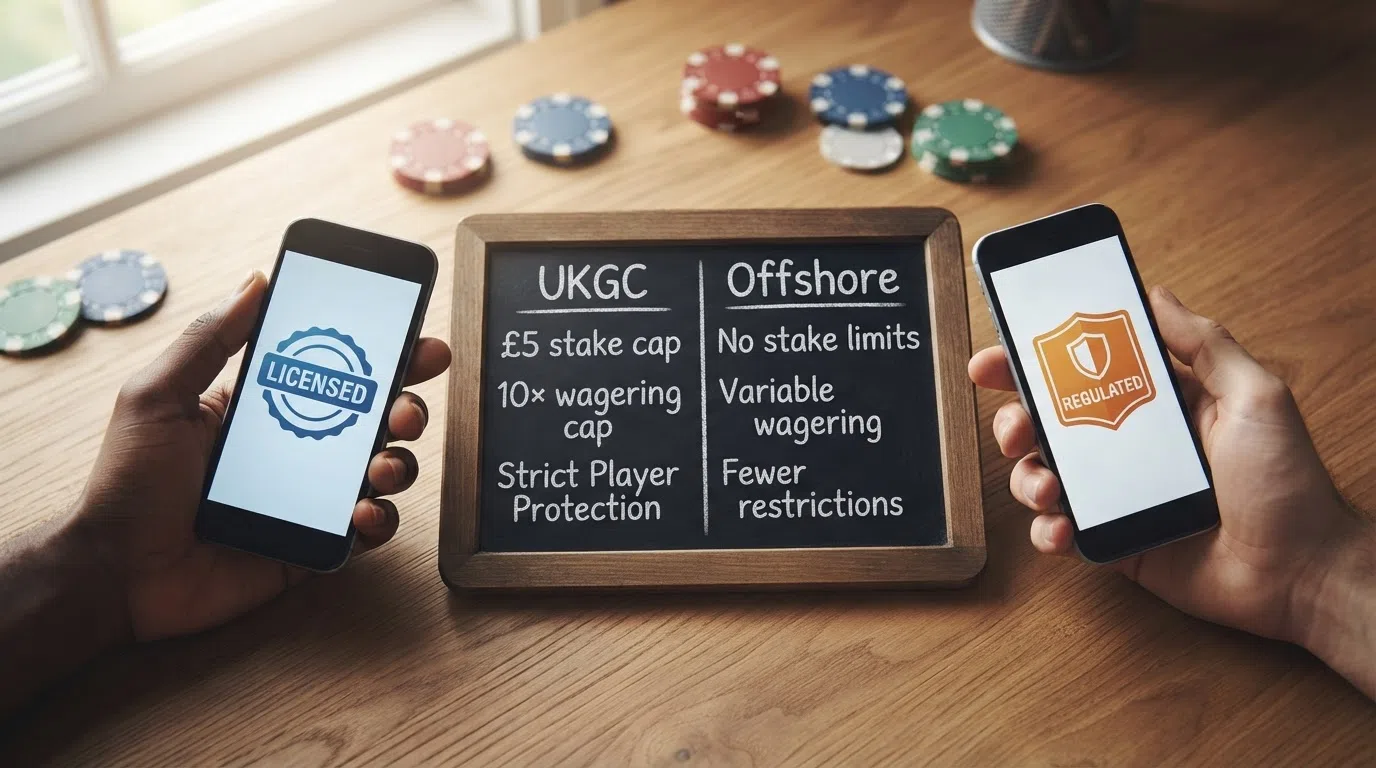
| Rule | UKGC-licensed site | International (offshore) site |
|---|---|---|
| Online slot stake cap | £5 per game cycle (25+), £2 (18–24) | No statutory cap |
| Wagering requirement | 10× maximum | Typically 30–40× |
| Mixed-product bonuses (e.g. bet on football, get free spins) | Banned | Available |
| Credit card deposits | Banned (including credit-card-funded e-wallets) | Accepted |
| Crypto deposits | Not standardised | Widely offered |
| Auto-play | Banned | Available |
| Minimum spin speed | 2.5 seconds | No restriction |
| Financial vulnerability check | Mandatory at £150 net deposits (rolling 30 days) | None |
| First-deposit financial-limit prompt | Mandatory (from 31 Oct 2025) | None |
| Self-exclusion (GAMSTOP) | Mandatory | Not covered |
| ADR / Commission complaint route | Available | Not available |
The two columns are not symmetric. The left-hand column is enforced by a regulator with inspection powers; the right-hand column is whatever the operator chooses to run. A “Curaçao licence” is a verifiable permission to operate; it is not a substitute for a GB licence, and it does not bring the left-hand column with it.
What “non-GamStop” means — and what it does not cover
GAMSTOP is the UK’s national multi-operator self-exclusion register, mandatory for every GB-licensed online operator since 31 March 2020. Exclusion periods are six months, one year, five years, or five years with auto-renewal. None of them can be cancelled early. The register does not cover unlicensed sites. A player who has set a GAMSTOP exclusion and then opens an offshore account is not in breach of the GAMSTOP terms — the offshore site does not read the register — but the protection the exclusion was meant to provide is no longer in place. The label “non-GamStop” describes a gap, not a feature.
The law: no player prosecution, no ISP blocking, no GB licence
Three facts correct the folklore. First, every criminal penalty under section 33 of the Gambling Act 2005 targets the operator and intermediaries, not the player. No player-prosecution case is on the record this run. Second, the UKGC has no statutory power to order ISP or DNS blocking; enforcement is the disruption model described above. Third, an MGA, Curaçao or other foreign licence is not a GB licence — the 2014 Act made the point of consumption the deciding factor, and a non-GB badge is exactly that. None of the three is a loophole; each one is a sharp edge that a player should see before depositing.
What you give up: GAMSTOP, ADR and the Commission’s complaint route
The protection ledger a player signs away is concrete. No GAMSTOP coverage, so a self-exclusion set at a GB site does not follow the player offshore. No approved alternative dispute resolution provider — the ADR route that the UKGC mandates as a final stage before the Commission is unavailable. No Commission complaint route, no fund-segregation requirement, and no British consumer redress if the operator withholds funds. The £150 financial-vulnerability check never runs, which is the part of the trade-off the marketing celebrates; the parts it does not mention are above.
Vetting an offshore casino: the regulator’s own register, first
The one check that matters before depositing is the licence number, and the one place to verify it is the regulator’s own register. Curaçao GCB publishes its licence holders on the cgcb.cw register. The Malta Gaming Authority publishes on mga.org.mt. The UKGC publishes on gamblingcommission.gov.uk/public-register. A licence number that does not resolve, or a corporate entity whose name does not match the footer, is a stop signal — not a complaint to file later, but a deposit not to make. The vetting is one search box and thirty seconds; the cost of skipping it is paid in a currency no register will refund.
Why a 300% welcome bonus is smaller than it looks
The 300% headlines at the top of the operator table are real, and so is the price the player pays for them. A 30× wagering requirement on deposit plus bonus at a £1,500 match means a player must turn over £60,000—at a £1.50 average spin, that is 40,000 spins; at £5 a spin, 12,000. The 10× UKGC cap that took effect on 19 December 2025 makes a £1,500 welcome at 888Casino cost the player £2,000 of turnover instead, and the same date banned the mixed-product offers UKGC sites used to run. The trade-off is not “big bonus vs small bonus” — it is “big bonus with three to four times the wagering work.”
The expected cost of clearing MyStake’s full welcome is not the headline match. A 300% bonus of £1,500 at 30× wagering means £45,000 of bonus turnover; at a 96.50% RTP (the figure for Gates of Olympus, one of the higher-RTP slots on the set), the expected loss on that turnover is about £1,575. Add the £500 deposit, and the player is statistically looking at roughly £2,075 of total action to convert the £1,500 bonus into withdrawable cash — and “expected” is the operative word, because a single session can finish anywhere in the range. The bonus is paid in time and play, and the time costs more than the headline suggests.
No-deposit offers: what a deposit-free sign-up is actually worth
Only two of the ten brands carry a no-deposit offer, and both are capped. Freshbet credits 25 free spins on registration with a standard £50–£100 no-deposit cashout cap. Donbet credits 15 free spins on registration at a fixed 10p spin value with 30× rollover. The other eight brands have no no-deposit offer confirmed for this run. A no-deposit bonus is a taster, not a route to a withdrawable balance — the cashout cap is the operator’s way of saying the same. A player who values testing a brand without committing cash reads the two rows above; everyone else is looking at deposit-gated matches.
Free spins with a deposit — and the few that come without
Goldenbet attaches 100 free spins to its 300% welcome. Donbet attaches 50 free spins to its casino welcome and 100 to its crypto welcome. BC.Game attaches 400 free spins to its $4,000 welcome. None of these are no-deposit spins. The distinction matters because the £50–£100 cashout cap that applies to a no-deposit spin does not apply to a deposit-gated spin in the same form; the wagering is on the bonus funds rather than the spin winnings, and the cap is the bonus’s max cashout, not the spin’s. A player comparing the rows should separate the two streams of value: the matched cash bonus and the spins that ride on it.
Welcome packages and match offers: reading the headline number
The 300% at MyStake and Goldenbet is the largest match in the set; Freshbet’s 250% and Donbet’s 150% sit below; 888Casino’s 100% up to £100 sits at the bottom of the ranking. The wagering multiple moves with the match: 30× at MyStake, 35× at Goldenbet, 30× at Freshbet and Donbet, 40× at BC.Game, 10× at the UKGC sites. The pattern is the inverse of what a marketing-led comparison would suggest — the larger the match, the larger the wagering, and the more turns a player must put the bonus through before it is theirs. A “300% bonus” is a ratio; what it costs is the multiplier.
The fine print: wagering, validity windows and max cashouts
Three terms decide whether a bonus pays. Wagering: 30× at MyStake, 35× at Goldenbet, 40× at BC.Game, 10× at the UKGC sites. Validity: 30 days at MyStake, not confirmed this run for the other offshore brands. Max cashout: £100,000 at MyStake against the £50–£100 cashout cap on the no-deposit spins at Freshbet and Donbet. The first two columns are visible in the bonus terms; the third is the ceiling on what the bonus can convert into, and the gap between MyStake’s £100,000 and the no-deposit cap is the gap between a deposit-gated welcome and a registration taster. A player who reads the terms before depositing spends ten minutes; a player who reads them after a stuck withdrawal spends the same ten minutes plus the bonus.
Fast payouts offshore come with a recourse you cannot see
The speed is real. 7Bit’s BTC withdrawals have been tested at one to three hours. The credit-card ban that took effect at UKGC sites on 14 April 2020 does not reach an offshore cashier, and the £150 net-deposit vulnerability check that the UKGC introduced on 28 February 2025 never fires offshore. The first withdrawal, which is the one that triggers KYC at any licensed operator, runs faster when no UKGC layer of affordability sits on top. The cost is the route the player does not have if a withdrawal stalls at hour four: no Commission complaint, no approved ADR, no fund-segregation requirement that an insolvency practitioner can ring-fence.
Real-money play: how a real bankroll behaves offshore
A real-money bankroll at an offshore casino behaves like one anywhere else: deposit in GBP or crypto, play in GBP or crypto, withdraw in the same currency. The UKGC prompt to set a financial limit before the first deposit does not appear. The first deposit clears without a £150 check. The first withdrawal triggers KYC, because every licensed operator — Curaçao and MGA included — runs source-of-funds verification. The difference is what is layered on top: no UKGC affordability framework, no Commission escalation, no British consumer-law fallback.
Deposit routes: cards, e-wallets and where the credit-card ban stops
UKGC sites cannot accept credit cards for any remote gambling transaction since 14 April 2020, and that ban includes credit-card-funded e-wallet deposits under LCCP 6.1.2. Offshore sites accept credit cards and credit-card-funded e-wallets as a matter of course. Crypto deposits are widely offered offshore and not standardised at UKGC sites. For a player who prefers to keep gambling spend off a card statement, the offshore cashier offers a route the GB cashier closed in 2020 — and the same trade-off, again, in the protections column.
Withdrawals: verification delays, limits and what “fast” really means
“Fast” at an offshore casino means: KYC runs once, the £150 check does not, the first BTC withdrawal at 7Bit has been tested at one to three hours. “Fast” at a UKGC site means: KYC runs once, the £150 check fires after 30 days of net deposits, affordability is layered on top, and the Commission’s complaint route is the backstop. The first figure is the time on the timer; the second figure is what sits behind the timer. A player who values speed reads the offshore rows; a player who values recourse reads the UKGC rows. The two are not on the same axis.
Crypto casinos: the anonymity the UKGC never offered
Crypto is the clearest offshore-only feature on the set. Stake.com supports BTC, ETH, USDT, LTC, TRX, XRP, BNB and DOGE. 7Bit’s minimum deposit is set at 0.22 mBTC and BTC withdrawals have been tested at one to three hours. Donbet runs a separate crypto welcome of 170% up to £1,000 plus 100 free spins. The UKGC sites on the list do not standardise crypto, and the GB regulatory framework has not settled on a single approach to player-funded crypto deposits. The card-network record the credit-card ban was designed to close does not exist on a blockchain — which is the structural reason the offshore cashier offers what the GB cashier does not.
Bitcoin casinos: how BTC deposits and payouts work
A BTC round-trip at 7Bit looks like this: deposit 0.22 mBTC, play, request a withdrawal, receive BTC in one to three hours. No card network in the loop, no bank statement line, no payment-processor friction at the GB end. The mechanics are the same at any of the crypto-accepting brands on the set; the operator’s wallet and the player’s wallet are the only two endpoints. The price is the volatility — a £1,000 balance measured at noon is a different number at six — and the irreversibility, which is the same feature the operator enjoys.
Why players choose crypto: anonymity, speed and no card trail
Three reasons recur in the player-side case for crypto. No card-network records: a bank statement does not show a casino line. Faster settlement: the one-to-three-hour test at 7Bit is the speed benchmark the rest of the market measures itself against. The credit-card ban does not apply, because there is no credit card. Each of these is a real answer to a real question, and each one is the inverse of a UKGC rule. A player who wants the privacy and accepts the volatility reads the crypto rows; a player who wants the GB protections accepts a card or e-wallet at a UKGC site.
Beyond Bitcoin: altcoins and multi-currency wallets
Bitcoin is the headline; altcoins are the ceiling. Stake.com supports eight coins, and Donbet runs a separate crypto welcome specifically because the operator wants the altcoin audience to land on a track designed for them. 7Bit’s account is crypto-first by design rather than as an add-on. The wallet is the player’s: a non-custodial wallet lets a player move between brands without a payment-processor record, which is the structural reason the offshore crypto set exists in the form it does. The same trade-off — speed and privacy against recourse and stability — runs through every coin on the list.
Apps or browser: how mobile casino play actually differs
The app gap is smaller than the marketing suggests. The two dedicated apps on this list belong to the UKGC pair: LeoVegas’s award-winning mobile-first platform and Betway’s award-winning casino app. The offshore brands’ app-store presence is not confirmed for this run, and the browser version carries the full catalogue on a phone screen. For a player choosing between the rows, the question is whether a dedicated app is worth the smaller match and the 10× wagering cap — or whether the browser is good enough and the offshore welcome is the better trade.
Dedicated apps or the browser: what each version runs
App-store presence is the exception, not the rule. The UKGC brands publish store apps in the UK stores and curate the library for the smaller screen. The offshore brands’ store listings are not part of the research this run, and a player who needs an app can verify on the day. The browser version is the default: every site on the list runs in mobile Safari and Chrome, and the full slot and live-dealer library carries over. A dedicated app is a polish on top, not a feature in itself.
Mobile game selection: what survives the smaller screen
The 5,500+ title catalogue at Freshbet and the ~6,000 at Donbet are site-wide figures, not mobile-specific. On the browser, the full library renders. On a dedicated app, the operator curates — typically the top few hundred slots and the live-dealer floor. No mobile-specific RTP or count is published for the brands on this list, and the right way to read the catalogues is as desktop numbers that also apply to mobile unless the operator says otherwise. Live tables stream the same Evolution and Pragmatic Play feeds on a phone as on a laptop.
App availability: which stores and regions carry these casinos
LeoVegas and Betway are store-listed in Britain and downloadable through the standard UK app stores. The offshore brands’ store presence is not confirmed for this run, and a player who wants a specific app should check the relevant store for the brand on the day. Region and device availability vary. The default position is the browser, and the app is the upgrade a player chooses if the operator offers one in the player’s region.
The studios and slots powering international casino games
The same providers supply both sides of the licence line. Pragmatic Play, Evolution, Play’n GO and NetEnt recur across Freshbet, Donbet, 7Bit and the UKGC trio. The slot library looks the same offshore because the studios are the same. Five researched titles have published, checkable RTP figures, and the table below carries them; the rest of the library runs at the studio’s published return, which the player can verify on the game sheet before each spin.
| Slot title | RTP | Volatility | Max win | Provider |
|---|---|---|---|---|
| Gates of Olympus | 96.50% | High | 5,000× | Pragmatic Play |
| Sweet Bonanza | 96.48% | High | 21,100× | Pragmatic Play |
| Big Bass Bonanza | 96.71% | Medium-high | 2,100× | Pragmatic Play |
| Book of Dead | 96.21% | High | 5,000× | Play’n GO |
| Starburst | 96.09% | Low | 500× | NetEnt |
The RTPs sit in a tight band between 96.09% and 96.71%, which is the working range of a modern online slot. The volatility column is where the titles diverge: Starburst is a low-volatility game that pays small amounts often, Gates of Olympus and Sweet Bonanza are high-volatility games that pay less often and bigger, and Big Bass Bonanza sits in between. The max-win column is the headline the marketing uses, and the right way to read it is as the ceiling on a single spin’s payout — a figure that requires the bonus feature to land at full capacity.
The slots library: titles, RTP and how to read a game sheet
RTP is the number that survives the marketing. A 96.50% return is a long-run average, not a per-session guarantee: a £100 bankroll at 96.50% RTP has an expected £3.50 house edge per £100 wagered, and the variance is the difference between that average and any individual session. Volatility is the shape of the variance: high-volatility titles pay less often but bigger, low-volatility titles pay more often but smaller, and the right choice depends on the bankroll and the session length. The game sheet is the source; the marketing is not.
Live dealer tables: studios, streams and the real-croupier draw
Live tables are the same studios, streamed offshore. Evolution and Pragmatic Play supply the live floors; Donbet lists 120+ live tables, Freshbet carries Evolution in its provider mix, and the streams run on the same feeds the UKGC brands use. The real-croupier draw is the part the offshore marketing does not need to oversell, because the experience is identical to a UKGC site. The 2.5-second-per-game-cycle minimum that the UKGC imposes is a slot rule, not a live-dealer rule, and live tables at offshore and UKGC sites run at the same pace.
Roulette and the classics: what an offshore floor offers
Table games sit outside the UK stake caps. The £5/£2 age-banded cap applies to online slots only; there is no statutory cap on live casino, sports betting or bingo at UKGC sites. Roulette and the classics therefore run at the same stakes on both sides of the licence line. The RTP logic is the same: European roulette at 97.30%, American roulette at 94.74%, blackjack above 99% with basic strategy. The “uncapped stakes” pitch the offshore marketing leads with is, on table games, not a difference.
The providers behind the games: who actually makes them
The studios, not the casino, build the games. Pragmatic Play, Evolution, Play’n GO, NetEnt and Hacksaw Gaming recur across the set; Freshbet, Donbet and 7Bit name their providers publicly. BC.Game adds 75+ proprietary “BC Originals” advertised as provably fair — a cryptographic system that lets the player verify each bet’s outcome after the fact. The brand on the footer is the operator; the names on the game lobby are the studios; and the RTP on the game sheet is the studio’s, not the operator’s.
New offshore brands: fresh bonuses, unproven protections
Newness is a risk signal, not a selling point. The Anjouan, Comoros-issued licence is the newest tier on the offshore set, and it is also the least proven. A brand launching on a fresh Anjouan licence has a thinner track record than a brand that has paid players for eleven years on the same Curaçao licence; the vetting is the same, but the history the player can check is shorter. The protection the player gives up is the same as on any offshore brand, and the time the player has to find out whether the operator honours withdrawals is shorter.
New launches that take UK players: what’s actually new this year
No specific new-casino launch is on the research this run. The honest framing is that the set above is the current market selection, and a player searching this month for a new international casino is reading the same list. A new brand that does appear after publication should be vetted against the same checklist: licence number on the regulator’s register, a payment history a player can read on a forum, a provider mix that names studios rather than aggregates them.
What to check before trusting a brand-new casino
The checklist for a brand-new casino is short. Confirm the licence on the regulator’s register: cgcb.cw for Curaçao, mga.org.mt for Malta, gamblingcommission.gov.uk/public-register for the UKGC. Confirm a payment history across player forums — the older the thread, the more reliable the read. Confirm the provider mix lists named studios rather than a single “and 50 more” line. Confirm there is no GAMSTOP or ADR coverage, which is the offshore default, and that the operator runs its own responsible-gambling tools at the level a player can live with.
Safer play when the UKGC tools are not watching
The harm numbers are real. The Gambling Commission’s 2024 Gambling Survey for Great Britain reports 2.7% of GB adults scoring 8+ on the Problem Gambling Severity Index, equivalent to approximately 1.3 million adults. The National Gambling Helpline, run by GamCare, made 996 referrals to treatment in January 2026 — a 48% year-on-year increase from the 674 recorded in January 2025, with 81.5% of contacts in 2026 citing online forms of gambling. The offshore gap removes the guardrails: no GAMSTOP coverage, no Commission route, no fund-segregation ringfence, no affordability check. The tools that exist on a GB site stop existing the moment a player crosses the licence line.
Self-exclusion and cooling-off: the tools that exist offshore
GAMSTOP will not follow a player offshore. The register is mandatory for every GB-licensed online operator since 31 March 2020, and offshore sites do not read it. Self-exclusion at an offshore site works only on the operator it is set on — there is no cross-operator equivalent offshore. Cooling-off tools vary by operator: some run a 24-hour or seven-day cooling-off period, some run a self-set deposit cap, and the player finds out which tier a brand runs by reading the responsible-gambling page before depositing.
Deposit, loss and session limits: what you can still set
Limits become the player’s own job offshore. UKGC sites prompt a financial limit before the first deposit from 31 October 2025; offshore sites have no equivalent prompt. A player who wants the same protection offshore has to set the deposit, loss and session caps manually, in the responsible-gambling section of the account, and revisit them on a schedule. The tools exist; the operator does not enforce them; the player does.
Where to get help: the GamCare line and NHS clinics
Help is UK-side, free, and works whatever an offshore site did or did not do. The National Gambling Helpline, run by GamCare, is on 0808 8020 133, available 24/7, free and confidential, with live chat also available through the GamCare site. GamCare runs counselling and treatment referrals across England, Scotland and Wales, including NHS gambling-harm clinics. Gamblers Anonymous runs peer support groups. None of these services requires a player to have played at a UKGC site. A player who needs the line should call it.
How we chose and ranked these casinos
The featured set represents the ten top-ranking online results for “international casinos for UK players” — typically 2,000 to 5,000-word guides structured around a numbered ranking, comparison tables, a FAQ, and a “how we rate” methodology blurb. Every brand on the list was checked against the UKGC’s public register and, where applicable, the Curaçao GCB and MGA registers. The ranking is ordered by licence status, welcome terms and wagering — a UK player searching for “international” reads down the offshore half first and the UKGC half second. No invented weightings, no bonus-led ordering: the licence line comes first because the licence decides the trade-off.
The decision that actually matters: bigger bonuses or British protection
The 300% headlines at the top of the table cost 30 to 40 times the wagering that a 10× UKGC cap allows. A £1,500 match at 30× is £45,000 of bonus turnover; the same £1,500 at 10× is £15,000. The 19 December 2025 rule change closed the mixed-product offers UKGC sites used to run, so the GB side cannot cross-subsidise a slot bonus with a sportsbook free bet. The harm statistics sit behind the choice: 1.3 million GB adults scoring 8+ on the PGSI, treatment referrals up 48% year-on-year, 81.5% of contacts citing online gambling. GAMSTOP, ADR and the Commission complaints route exist because the numbers are the numbers, and the offshore choice removes them.
The decision a UK player is actually making is not which casino to play at but which side of the licence line the next deposit sits on. The offshore half offers a 300% match, a £5 slot spin, a one-to-three-hour BTC withdrawal and no £150 check. The UKGC half offers a 100% match, a £5 slot cap, slower withdrawals and a Commission complaint route if anything goes wrong. Both columns are real. The page is what the column on the left costs the column on the right.
Frequently asked questions
Will GAMSTOP stop me playing at an international casino?
No. GAMSTOP’s reach is strictly limited to operators licensed by the UK Gambling Commission. Because offshore casinos operate outside this regulatory framework, they have no access to the self-exclusion register. An exclusion set at a UK site remains active but provides no coverage at these international brands, meaning you lose that essential safety net when playing offshore.
Do UK players pay tax on casino winnings from abroad?
No. UK players pay no tax on gambling winnings, whether the operator is licensed in Great Britain, Curaçao, Malta or Anjouan. The Remote Gaming Duty that applies to operators rose from 21% to 40% from 1 April 2026, and the statutory gambling levy charges remote casino operators 1.1% of gross gambling yield from 6 April 2025 — both are operator-side taxes, not player-side taxes. A UK player at an offshore site keeps the full balance of any withdrawal.
Can you fund an offshore casino with crypto from the UK?
Yes. The offshore brands on the list — Stake, 7Bit, Donbet, BC.Game, and the rest of the Curaçao and Anjouan cohort — accept crypto deposits, and Stake supports eight coins (BTC, ETH, USDT, LTC, TRX, XRP, BNB, DOGE). The UKGC sites on the list do not standardise crypto. The credit-card ban that took effect at UKGC sites on 14 April 2020 does not reach an offshore cashier, and there is no equivalent ban on crypto at the GB end. The trade-off is the same as on any offshore decision: faster settlement and no card-network record against the loss of the GB protections.
How do I know an international casino is safe before I deposit?
Verify the licence on the regulator’s own register before depositing. Curaçao GCB publishes its licence holders on the cgcb.cw register. The Malta Gaming Authority publishes on mga.org.mt. The UKGC publishes on gamblingcommission.gov.uk/public-register. A licence number that does not resolve, or a corporate entity whose name does not match the footer, is a stop signal. Beyond the licence, read player-forum threads for the brand’s withdrawal history — a year of paid withdrawals is the cheapest evidence available, and a brand with no thread history is a brand with no track record.
How fast do international casinos really pay out?
The fastest documented figure on the set is 7Bit’s BTC withdrawals at one to three hours. Donbet, Freshbet and the other Curaçao brands run on comparable crypto plumbing. Fiat withdrawals are slower because they go through a card or e-wallet processor; offshore fiat does not run faster than UKGC fiat, and the GB affordability layer is the difference, not the payment-processor layer. The honest answer is: crypto at the offshore brands is fast, fiat is not categorically faster than at a UKGC site, and the first withdrawal triggers KYC at any licensed operator.
What protections do I lose playing outside the UKGC?
When you play offshore, you lose the entire UK-mandated safety net. This means no GAMSTOP self-exclusion, no access to an approved alternative dispute resolution provider, and no protection from the Gambling Commission if an operator unfairly withholds your funds. Additionally, you are not covered by financial vulnerability checks, leaving you fully responsible for your safety.
Licence – nonukgc-licensedcasinos
Content created by the «nonukgc-licensedcasinos» team