
The Highest RTP Slots at UK Casinos — Every Game Worth Your Money in 2026
 Available in GB
A handful of online slots sit above 98% return to player, and only three break 99%. For a UK player who cares about getting the most play from a deposit, the choice is narrow, specific, and worth getting right. This page lists every slot that meets a verified 97.7% RTP threshold, compares them side by side, and shows which UK-licensed casinos actually carry them. The operative word is “verified” — an RTP figure only matters if it matches the version deployed at the casino where you’re playing.

Current as of September 8, 2026 · Licence and operator data checked against the UK Gambling Commission public register
Only a Handful of Slots Break 98% RTP — Here Is Every One Worth Playing in 2026
The 99% club contains three slots. Ugga Bugga by Playtech leads the field at 99.07% — the highest certified RTP of any widely available online slot — with low volatility and a modest 1,000x max win. Book of 99 by Relax Gaming delivers a clean 99% with high volatility and a 5,000x max win per spin (12,075x cumulative across feature retriggers). Mega Joker by NetEnt also reaches 99% but only in Supermeter mode at maximum coin; the base game sits closer to 76%, which is a distinction that matters more than the headline number suggests.
The 98% tier broadens the field considerably. 1429 Uncharted Seas from Thunderkick runs 98.5–98.6% with low volatility and a 670x max win on 25 paylines. Blood Suckers by NetEnt is fixed at 98% across all UKGC-licensed casinos — a stability that makes it one of the few slots where you can trust the figure will be the same everywhere. Marching Legions (98.12%, Relax Gaming) and Money Cart 2 (98%, Relax Gaming) both offer high volatility with 10,000x and 5,000x max wins respectively. Jokerizer by Yggdrasil sits at 98% with its Jokerizer Mode mechanic and a 6,000-coin mystery prize. Jackpot 6000 by NetEnt reaches 98.9% in Supermeter mode at high volatility on a 3×3 grid with 5 paylines. Rounding out the extended list, White Rabbit Megaways by Big Time Gaming lands at 97.72% with the Feature Drop purchased (97.39% without) — the highest-RTP Megaways title and the one that carries Megaways-style variance.
A slot is only on this list if its published RTP holds up against multiple verified sources — provider product pages, RTPTrack data, and UKGC certification records. Every figure here is reproducible; the same slot may run a different configuration at different casinos, which is why the in-game information panel is the only number that counts once you sit down to play.
The 99% Club — Three Slots That Return Nearly Everything
Ugga Bugga’s 99.07% is not a marketing number. Playtech certified it, independent testing labs confirmed it, and Oddschecker’s 2026 rankings still place it at the top. Low volatility means frequent small returns — this is a slot designed for extended sessions rather than chasing a single large payout. The 1,000x max win caps the ceiling, but for a player who values playtime over jackpot potential, the trade is favourable.
Book of 99 does the same work on high volatility. Relax Gaming built the 99% return around a Greek-mythology theme with 5,000x per spin and up to 12,075x cumulative across the feature. The difference in feel is dramatic: a session on Ugga Bugga returns a drip of small wins; a session on Book of 99 might produce nothing for long stretches and then a single payout worth hundreds of times the stake. Same RTP, completely different experience. The choice between them is not about which returns more — it is about which pattern of returns suits the session you’re planning.
Mega Joker requires more care. The 99% figure applies only to Supermeter mode at the maximum coin setting. The base game RTP sits around 76%, which is one of the largest gaps between a slot’s stated RTP and its actual return in normal play. A player who does not understand the Supermeter mechanic will see returns consistent with a mid-70s slot, not a 99% one. This is the clearest example on the page of why “the RTP is 99%” is meaningless without knowing which mode you’re in.
98%+ RTP Slots — Excellent Value One Tier Down
1429 Uncharted Seas deserves attention as the closest thing to a low-volatility 98%+ slot. Thunderkick’s 98.5–98.6% RTP, 25 paylines, and 670x max win produce a calm, extended play pattern — the kind of slot where a £20 deposit can last noticeably longer than the same stake on a high-variance game. The 670x ceiling is the trade: you will not hit a life-changing payout, but the slot will not punish a long losing streak the way Book of 99 or Marching Legions can.
Blood Suckers at a fixed 98% is the reliability play. NetEnt’s vampire-themed slot runs the same configuration at every UKGC-licensed casino — a rare consistency in a market where operators can deploy different RTP tiers. Low-medium volatility and a 7,500x max win put it in the middle of the risk spectrum, but the fixed percentage means a player comparing casinos does not need to wonder whether the version at one site pays less than another.
Marching Legions (98.12%, Relax Gaming) and Money Cart 2 (98%, Relax Gaming) both pair near-top-tier returns with high volatility. Marching Legions offers a 10,000x max win — the highest in the 98% tier. Money Cart 2 has no base game at all; players go straight to bonus reels, which produces extreme outcome dispersion. Both are slots where a session can end quickly with nothing to show, or end with a payout that justifies the wait.
Jokerizer (98%, Yggdrasil) runs on a 5×3 grid with a carnival theme and a Jokerizer Mode that can produce a 6,000-coin mystery prize. Jackpot 6000 by NetEnt reaches 98.9% in Supermeter mode — a smaller max win (6,000x) than Book of 99 but with the same pattern of requiring a specific play style to hit the published figure. White Rabbit Megaways at 97.72% sits just below the 98% line but earns its place by being the highest-RTP Megaways title available. The Feature Drop option changes the effective return: 97.72% with it purchased, 97.39% without. The Feature Drop costs extra per spin, so whether buying it improves the expected return depends on how often the feature triggers and pays out — the headline percentage is a model output, not a guarantee for any individual buying decision.
The Full RTP Database — Every Ranked Slot Compared Side by Side
| Slot | Provider | RTP | Volatility | Max Win |
|---|---|---|---|---|
| Ugga Bugga | Playtech | 99.07% | Low | 1,000x |
| Book of 99 | Relax Gaming | 99% | High | 5,000x |
| Mega Joker | NetEnt | 99% (Supermeter) | — | — |
| Jackpot 6000 | NetEnt | 98.9% (Supermeter) | High | 6,000x |
| 1429 Uncharted Seas | Thunderkick | 98.5–98.6% | Low | 670x |
| Marching Legions | Relax Gaming | 98.12% | High | 10,000x |
| Jokerizer | Yggdrasil | 98% | — | 6,000 coins |
| Blood Suckers | NetEnt | 98% | Low–Medium | 7,500x |
| Money Cart 2 | Relax Gaming | 98% | High | 5,000x |
| White Rabbit Megaways | BTG | 97.72% | High | — |
The table shows where each slot lives on the RTP–volatility grid. Volatility and max win are stated only where the source confirms them; cells without a verified figure carry the em-dash marker. A player who reads the percentage alone will miss half the decision — Ugga Bugga and Book of 99 both return 99%+ on paper, but they produce completely different sessions.
What RTP Actually Tells You — and What It Does Not
RTP is a long-run mathematical average calculated over millions of simulated spins before a slot is certified. It says essentially nothing about a single spin, a single session, or even a single day of play. Over 100 spins on a 96% RTP slot, you could be up 5,000x or down to zero — either is possible. The gap between the certified average and short-session reality is where most player misunderstanding lives, and closing that gap is the single most useful thing this page can do.
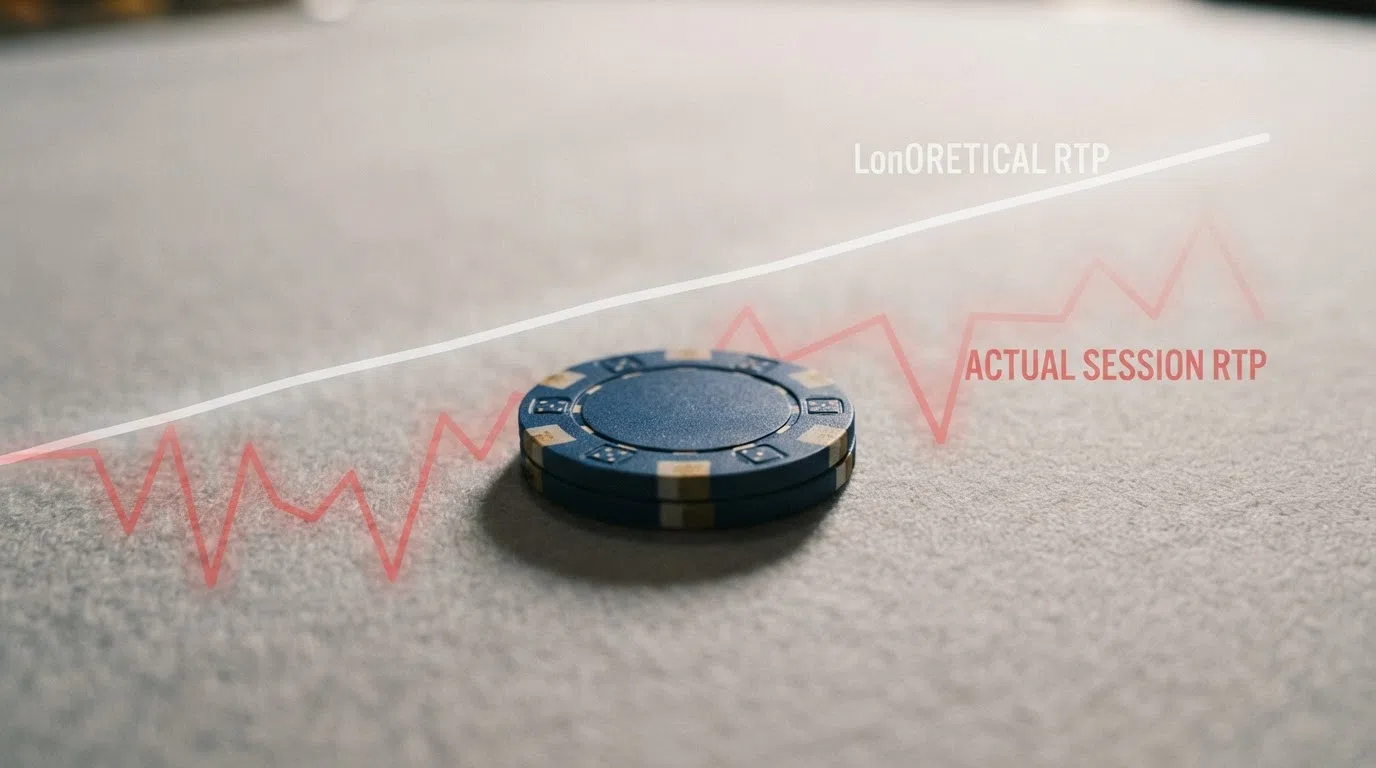
The figure on a review site is a model output. The figure in your casino’s in-game panel is the one that applies to your money. UK regulations require operators to make the deployed RTP easily available before a customer commits to gamble — but “easily available” means the information panel inside the game, not a marketing page. A player who never opens the panel is trusting the casino to run the higher-paying configuration, and casinos are not required to run the highest one.
RTP Defined — Return to Player Explained in Plain Terms
RTP quantifies the proportion of total wagers a slot is programmed to return over its lifetime. A 96% RTP slot is designed to return 96p for every £1 wagered, over millions of spins. The house edge is the inverse — 4% on a 96% slot. The arithmetic is simple, but the timescale is where players get into trouble. “Over its lifetime” means over the entire operational life of the game, not over your Tuesday evening session.
The distinction between theoretical RTP and deployed RTP is the one most players miss. A slot may carry a 97% theoretical RTP from its provider, but the specific configuration your casino runs could be 94%, 95%, or any other approved setting. The UKGC’s RTS 3 requires operators to disclose the deployed figure before play, but it does not require them to run the highest available configuration. Monopoly Megapots, for example, has a default 96.45% RTP but some operators run it at 86.29%. The slot is the same; the return is not.
How RTP Is Calculated and Independently Verified
The percentage is derived from millions of simulated spins run before certification. Testing labs feed the slot’s math model through that volume to confirm the long-run return matches what the provider claims. The UKGC requires independent testing against its Remote Technical Standards before any slot can be deployed by a licensed operator, and the approved labs are iTech Labs, BMM Testlabs, and eCOGRA. Once a slot is live, the certified figure is a fixed property of the math model — but the deployed figure at your casino may be a different configuration of the same model.
This is why the certificate is not the same as the receipt. A lab-certified 98% RTP guarantees the math model returns 98% over its full simulation. It does not guarantee that your casino runs the 98% configuration rather than the 95% one. The gap between “certified” and “deployed” is the place where RTP variability lives, and it is why the in-game panel matters.
Average, Good and Poor RTP — The Benchmarks That Matter
The typical online slot RTP sits between roughly 94% and 97%. Anything above 97% is good; above 98% is excellent; the 99% club is exceptional. These benchmarks apply to standard video slots. Progressive jackpot slots break the curve: their RTPs sit between 88% and 95% because 1–10% of every bet is diverted to the jackpot pool. A progressive with a 92% RTP is not a bad slot — it is a slot where a meaningful slice of every wager is funding a prize most players will never win.
The benchmarks also assume you are looking at a standard video slot configuration. Some providers offer “enhanced RTP” versions of popular titles, where the theoretical return is bumped up in exchange for a higher minimum stake or a different feature set. The label is real, but the term has no regulatory meaning — an “enhanced RTP” slot is simply a higher-paying deployment of the same math model, and whether the enhanced version is available at your casino is a question only the in-game panel answers.
How to Check a Slot’s RTP Before You Play
Open the in-game information or help panel at the casino where you intend to play. The deployed RTP is listed there, usually in a “Game Rules” or “Paytable” section. This is the only figure that applies to your session. A slot’s published RTP on a review site — even this one — may not match the version your casino runs.
The UKGC’s RTS 3 mandates that operators make RTP information easily available before the customer commits to gamble. In practice, “easily available” means inside the game itself, not on a marketing page or a footer. If the panel does not show the figure, or shows a different figure from the one you expected, the deployed configuration is the one that governs your play — regardless of what the review site or the provider’s product page says.
Online vs Land-Based Slots — Why the RTP Gap Exists
Online slots consistently return more than their land-based equivalents. The gap is structural: an online casino has lower operating costs per game than a physical venue, and the market is more competitive, so the additional margin flows back to the player in the form of higher RTPs. Land-based slots have higher overheads — premises, staff, machines, maintenance — and a less competitive market, so the return is lower.
The exception is high-denomination land-based slots, where the RTP can approach online levels. A £5-per-line land-based slot may run at 95% or higher, but the stake level puts it out of reach for most casual players. For anyone playing at standard stakes, the online market offers measurably better returns — and the 99% club on this page exists only because the online market can support it.
Why Volatility Matters as Much as the Percentage When Picking a High-RTP Slot
RTP without volatility is half the story. A 99% RTP high-volatility slot can drain a bankroll faster than a 96% low-volatility one over a short session — the long-run return is higher, but the path to getting there runs through longer losing streaks and rarer large wins. A 96% low-volatility slot returns a steady drip of small payouts that keep a session going. Both are valid strategies, but they suit different players and different bankrolls.
The skill is matching volatility to your session budget and patience. A player with £50 who wants 30 minutes of play should pick a low-volatility slot and accept the lower max win. A player with the same £50 who wants one shot at a meaningful payout should pick a high-volatility slot and accept that most sessions will end with nothing. Same percentage, different decision framework.
Highest RTP, Lowest Volatility — The Steady-Return Picks
Ugga Bugga at 99.07% with low volatility is the standout. It produces frequent small returns that extend session length, and the 1,000x max win — modest by high-RTP standards — is the trade for that steadiness. 1429 Uncharted Seas at 98.5–98.6% runs the same profile: low volatility, frequent small wins, a 670x ceiling. Blood Suckers at 98% with low-medium volatility sits between the two — more payout potential than 1429, more variance than Ugga Bugga.
This combination is rare at the top of the RTP table. Most 98%+ slots lean high-volatility because the math model for frequent small returns is harder to optimise above 97%. A player who values session length over payout size has fewer options at the top of the table, but the options that exist are genuinely good.
High RTP, High Variance — The Big-Win Trade-Off
Book of 99 (99%, 5,000x) and Marching Legions (98.12%, 10,000x) are the headline slots for players chasing large multipliers. Money Cart 2 (98%, 5,000x) goes further by eliminating the base game entirely — players go straight to bonus reels, which produces extreme outcome dispersion. Jackpot 6000 at 98.9% in Supermeter mode is the NetEnt entry in this tier. White Rabbit Megaways at 97.72% with up to 248,832 ways to win is the highest-RTP Megaways title and carries Megaways-style variance on top of its high-volatility classification.
A high-volatility 98% slot and a low-volatility 96% slot can produce identical session costs in expectation, but the lived experience is completely different. The high-volatility game concentrates its return into a small number of large payouts; the low-volatility game spreads it across many small ones. Neither is “better” — they are different products for different preferences.
How to Find High-RTP Slots at Any UK Casino
Start with the in-game information panel. Every UKGC-licensed casino exposes the deployed RTP inside the game, and that figure is the only one that applies to your money. The next step is filtering the lobby by provider: Relax Gaming, NetEnt, Playtech, and Thunderkick consistently produce high-RTP titles, and many casinos let you sort by provider to find them quickly.
For cross-referencing, RTPTrack tracks deployed RTP configurations across operators, which lets you confirm whether the casino’s version matches the provider’s highest-RTP setting. A slot missing from a casino lobby may mean the operator chose not to carry its high-RTP configuration — the lower-paying versions are more profitable for the house, so there is an incentive to deploy those where the player is not actively checking.
Not All High-RTP Slots Are Equal — Megaways, Progressives and What the Label Hides
Slot mechanics change what the RTP number delivers. A Megaways slot advertising 97% RTP can still produce more extreme variance than a fixed-payline 96% slot, because the expanding-reel math model amplifies outcome dispersion. A progressive jackpot slot with a 92% RTP is not a worse-designed game — it is a game where 1–10% of every bet funds a prize most players will never see. The headline percentage hides a structural cost that a player who reads only the RTP will miss.
“Enhanced RTP” is another label worth treating carefully. The term has no regulatory definition; it means the provider or casino is offering a higher-paying deployment of the same slot. Whether that enhanced version is available at your casino is a question only the in-game panel can answer. The label is real, but it is a marketing claim, not a certification.
Progressive Jackpot Slots — Why RTP Takes a Hit
Progressive jackpot slots fund the top prize by diverting 1–10% of every bet to a prize pool. That diversion comes directly out of the base-game return, which is why progressive RTPs sit between 88% and 95% — well below the standard 94–97% range for non-progressive slots. The slot is not worse-designed; it is designed around a different product, where the value proposition is the chance at a large prize, not the highest long-run return.
A progressive slot’s RTP breakdown, where disclosed, splits between the base-game return and the jackpot contribution. The two figures are not interchangeable: the base-game RTP is the return on standard play, and the jackpot contribution is the cost of the progressive prize. A 92% progressive might have a 95% base-game return and a 3% jackpot contribution, which means a player who never wins the jackpot is effectively playing a 95% game — but the published 92% figure is the one that applies to expectation.
Video Slots, Classic Slots and Enhanced RTP — The Format Spread
Video slots with complex bonus rounds and multiple RTP configurations typically sit at the higher end of the return range, but the configuration matters more than the format. A video slot running its lower-paying deployment may return less than a classic three-reel slot running its higher-paying one. The format is a rough proxy; the deployed RTP is the only figure that counts.
Classic three-reel slots like Mega Joker and Jackpot 6000 use a Supermeter mechanic that genuinely boosts the return — but only when the player activates the Supermeter mode at the maximum coin setting. The base game on these slots returns far less (around 76% on Mega Joker), and a player who does not engage the Supermeter is playing the lower-RTP version. The 99% and 98.9% figures are real, but they are conditional on a specific play style.
Where to Play the Highest RTP Slots — 2026 UK-Licensed Casino Comparison
The ten operators below are the UK’s best-known and most-lobbied venues for high-RTP slot play. Every one holds an active UKGC licence as of 29 July 2026, and every one has been verified against the public register. The comparison ranks them by welcome-offer value, wagering terms, and the depth of their high-RTP slot library — not by bonus size alone, because a large bonus with a 30x wagering requirement can be worth less than a smaller one with zero wagering.

UKGC regulations cap wagering requirements on bonus funds at 10x, which means the worst case across the featured set is a 10x playthrough. Some operators go further: PlayOJO and bet365 apply 0x wagering to free-spin winnings, and LeoVegas applies 1x wagering to the deposit amount only. These differences change the real value of an offer more than the headline number does, and they are the reason the comparison table below includes both the bonus type and the wagering terms.
| Operator | UKGC Licence | Welcome Offer | Free Spins | Wagering Requirement | Bonus Validity |
|---|---|---|---|---|---|
| bet365 Casino | 55149 (Hillside Media) — Active | Token deposit | Up to 500 spins at £0.10 | 0x on winnings | 7 days per batch; 30 days to claim |
| PlayOJO | 39326 (SkillOnNet) — Active | Token deposit | 50 spins on Big Bass Bonanza | 0x on winnings | No stated expiry |
| LeoVegas | 39198 (LeoVegas Gaming plc) — Active | Token deposit | 50 spins on Big Bass Splash | 1x on deposit | 7 days deposit; 3 days spins |
| Casumo | 39265 (Jocular Group) — Active | 100% match up to £100 | — | 30x on bonus | 30 days |
| Videoslots | 39380 (Videoslots Ltd) — Active | 100% match up to £50 | 11 spins on Starburst | 10x on cash bonus | 60 days wagering; 7 days spins |
| Grosvenor Casinos | 57924 (Rank Digital Gaming) — Active | 100% match (£20 → £40) | 100 spins on selected slots | 10x on deposit + bonus | 7 days |
| Unibet | 45322 (Platinum Gaming) — Active since July 2016 | Token deposit | 200 spins on Big Bass Bonanza | 10x on winnings | 30 days to clear |
| Ladbrokes | 1611 (LC International) — Active | Token deposit + £10 wager | 100 spins on selected games | 10x on winnings | 7 days; 48h to accept |
| Duelz | 48695 (SuprPlay) — Active | Token deposit | Up to 140 spins (20/day × 7) | 10x on winnings | 7 days per batch |
| Betway | 39372 (Betway Ltd) — Active | 100% match up to £50 | Varies by promotion | 10x on deposit + bonus | 7 days |
The spread across the table tells a story. The wagering requirement ranges from 0x (PlayOJO, bet365) to 30x on the bonus (Casumo — note that this is on the bonus amount only, not the deposit plus bonus). The free-spin counts range from 11 (Videoslots) to 500 (bet365). Validity windows range from 3 days for spin expiry (LeoVegas) to 60 days for wagering (Videoslots). None of these operators is the best at everything; the right pick depends on which constraint matters most to the player.
bet365 Casino
bet365 offers the highest free-spin count in the featured set: up to 500 free spins, revealed in daily batches of 5–50 over 20 days at £0.10 per spin on selected games including Book of Horus, Curse of the Bayou, Magic Forge, and Wrath of the Deep. Wagering on winnings is 0x, with no stated cashout cap. The UKGC licence is Account 55149 (Hillside Media), which is active on the public register. To unlock, customers must make a £10 minimum deposit. Game providers include NetEnt, Playtech, Playtech Origins, Blueprint, IGT, and bet365 Originals — a depth that covers most of the high-RTP slots on this page. The verdict: for a player prioritising spin volume over potential jackpot size, this 0x-wagering package is the strongest free-spin offer available.
PlayOJO
PlayOJO’s signature is “no wagering requirements ever” — the simplest offer structure in the featured set. The welcome offer is 50 free spins on Big Bass Bonanza (RTP 96.71%) at £0.10 per spin, with 0x wagering and no cap on winnings. The UKGC licence is Account 39326 (SkillOnNet Limited), currently active. A £10 minimum deposit is required. The provider portfolio is the broadest in the set: NetEnt, Microgaming, Pragmatic Play, Play’n GO, Big Time Gaming, Relax Gaming, and Thunderkick — which means the Relax Gaming and Thunderkick high-RTP titles (Book of 99, 1429 Uncharted Seas, Marching Legions, Money Cart 2) are all accessible. The verdict: this zero-wagering model ensures every penny of spin winnings remains withdrawable, removing the complex play-through math found in other welcome offers.
LeoVegas
LeoVegas applies 1x wagering to the deposit amount only, not to spin winnings. The welcome offer is 50 free spins on Big Bass Splash (RTP 96.71%) at £0.10 per spin, with a 7-day deposit wagering window and 3-day spin expiry. The UKGC licence is Account 39198 (LeoVegas Gaming plc), confirmed active. Providers include NetEnt, Microgaming, Pragmatic Play, Evolution, Play’n GO, Red Tiger, and Big Time Gaming. The token-deposit requirement is a £10 minimum. This 1x wagering is highly competitive, though the 3-day spin expiry requires prompt action.
Casumo
Casumo is the only featured operator offering a traditional deposit-match bonus without a free-spin component in the standard welcome offer. The offer is a 100% match up to £100, with 30x wagering on the bonus amount and a 30-day validity window. The UKGC licence is Account 39265 (Jocular Group Limited), confirmed active. The provider portfolio is deep: NetEnt, Microgaming, Pragmatic Play, Play’n GO, Evolution, Thunderkick, Big Time Gaming, and Relax Gaming. The token-deposit requirement is a £10 minimum. The verdict: while this is the highest wagering requirement in our list, the absence of free-spin complexity makes it a straightforward choice for those preferring traditional bonus funds.
Videoslots
Videoslots offers the largest game library in the set: 90+ providers and over 6,000 games. The welcome offer is a 100% match up to £50 with 11 wager-free spins on Starburst (RTP 96.09%), 10x wagering on the cash bonus, and a 60-day wagering window — the longest in the featured set. Spins must be activated within 7 days. The UKGC licence is Account 39380 (Videoslots Limited), confirmed active. The token-deposit requirement is a £10 minimum. With such a long wagering period and unparalleled game selection, this operator is a top-tier choice for consistent players.
Grosvenor Casinos
Grosvenor is the land-based legacy brand in the set, with a capped but clearly stated welcome offer. The offer is a 100% match — deposit £20, play with £40 — plus 100 free spins on selected slots at £0.10 per spin, with 10x wagering on deposit plus bonus, a 7-day validity, and a £2,000 maximum cashout — the only featured operator to state the cashout cap in clear figures. The UKGC licence is Account 57924 (Rank Digital Gaming (Alderney) Limited), confirmed active. The token-deposit requirement is a £20 minimum — the highest in the set alongside Duelz. Providers include NetEnt, IGT, Playtech, Blueprint, Evolution, Pragmatic Play, and Red Tiger. The verdict: the £2,000 cashout cap is the one figure in the set that constrains the upside, and a player who expects to clear a large bonus needs to check whether their expected winnings sit above or below it. For players who expect modest returns, the cap is irrelevant.
Unibet
Unibet offers 200 free spins on Big Bass Bonanza (RTP 96.71%) at £0.10 per spin, with 10x wagering on spin winnings and a 30-day clearance window — the joint-longest in the set. Spin expiry is 48 hours after crediting. The UKGC licence is Account 45322 (Platinum Gaming Limited), active since July 2016. The token-deposit requirement is a £10 minimum, restricted to debit card or Trustly. Providers include NetEnt, Microgaming, Pragmatic Play, Evolution, Play’n GO, Red Tiger, Yggdrasil, and Big Time Gaming. The 30-day validity window is a significant advantage for those who prefer steady play over rapid sessions.
Ladbrokes
Ladbrokes is the high-street name in the set, with 100 free spins on selected games (Big Bass Bonanza, Sweet Bonanza, or Starburst) at £0.10 per spin, 10x wagering at the UKGC cap, 7-day validity, and 48 hours to accept the offer. The token-deposit requirement is a £10 minimum deposit plus a £10 wager on slots to unlock the spins. The UKGC licence is Account 1611 (LC International Limited / Entain), confirmed active. Providers include NetEnt, Playtech, IGT, Blueprint, Evolution, Pragmatic Play, Red Tiger, and Barcrest. Players should be aware that the initial £10 wagering requirement must be met precisely on eligible slots to claim the spins.
Duelz
Duelz offers up to 140 free spins at 20 per day over 7 days, with 10x wagering on bonus winnings and a £100 cashout cap per daily batch of 20 spins — the tightest cap in the set. Claims require logging in daily via a pop-up, and each batch carries a 7-day validity. The UKGC licence is Account 48695 (SuprPlay Limited), confirmed active. The token-deposit requirement is a £25 minimum — the highest in the set alongside Grosvenor. Providers include NetEnt, Microgaming, Pragmatic Play, Play’n GO, Evolution, Thunderkick, Yggdrasil, and Big Time Gaming. This gamified daily-login structure is ideal for dedicated players who appreciate frequent, smaller-batch rewards.
Betway
Betway offers a clean deposit-match bonus at the UKGC wagering cap: 100% match up to £50, 10x wagering on deposit plus bonus, 7-day validity, with free-spin availability varying by promotion. The UKGC licence is Account 39372 (Betway Limited / Super Group), confirmed active. The token-deposit requirement is a £10 minimum. Providers include NetEnt, Microgaming, Pragmatic Play, Evolution, Play’n GO, IGT, and Red Tiger. The verdict: the clean structure and 10x cap make this the easiest offer in the set to evaluate, and a player who prefers a straightforward deposit match without free-spin mechanics will find it uncomplicated.
What UK Law Requires — Stake Limits, RTP Disclosure and Your Protections
The UK has some of the strictest online slot regulations in the world, and they directly shape the RTP landscape. The UK Gambling Commission is the sole regulator, established under the Gambling Act 2005. Its public register lists every licensed operator with their licence status, activity dates, and permitted activities — the only authoritative source for verifying whether a casino holds a current UKGC licence. The register was last updated on 29 July 2026.
The headline protections relevant to slot play are three. First, RTS 3 requires operators to disclose RTP percentage, house edge, and probability of winning events before the customer commits to gamble. Second, the April/May 2025 stake limits cap online slots at £5 per game cycle for adults 25+ and £2 for adults 18–24. Third, the UKGC’s LCCP Condition 5.1.1 caps wagering requirements on bonus funds at 10x. Each of these is enforceable, each is verifiable, and each changes what a player should expect from a licensed operator.
Operating without a UKGC licence is a criminal offence under the Gambling Act 2005 — up to 51 weeks imprisonment and/or an unlimited fine. The UKGC actively blocks unlicensed operators and works with payment providers to restrict transactions. For a player, the practical risk of using an offshore site is not the criminal penalty (which falls on the operator) but the loss of every protection described on this page: no GamStop access, no stake-limit protection, no RTP disclosure guarantee, no recourse for disputes.
How UKGC Licensing Protects the Slot Player
A UKGC licence is not a rubber stamp. It carries enforceable conditions that directly affect play. Identity verification is required before gambling — no anonymous play. Deposit limits, reality checks, and time-out tools are mandatory and must be accessible from the account settings. Wagering requirements on bonus funds are capped at 10x, and mixed-product promotions — requiring gambling across betting, casino, bingo, and lottery to qualify for a single offer — are banned.
The 10x wagering cap is worth understanding precisely. It applies to the deposit plus bonus, not to the bonus alone, and it means the worst case across all UKGC-licensed welcome offers is 10x playthrough. Some offers are lower (PlayOJO and bet365 at 0x, LeoVegas at 1x on deposit). The cap protects players from the kind of 40x–60x wagering requirements that exist in unregulated markets, where clearing a bonus can require thousands of pounds of play.
RTP Disclosure Rules — What Operators Must Tell You and When
RTS 3 mandates that operators make RTP percentage, house edge, and probability of winning events easily available before the customer commits to gamble. In practice, this means the in-game information panel — not a marketing page, not a footer, not a linked document. A player who opens the panel before playing will see the deployed RTP for that specific game at that specific casino.
The RTS 12B changes, effective 30 September 2026, rename “spend limits” to “stake limits” for clarity and amend the loss-limit definition to: “the total value of stakes placed on gambling products minus the total value of any winnings or returns from those stakes is limited for the period.” The renaming is a clarity exercise; the amended definition is a precision exercise. The underlying protections do not change.
The £5 and £2 Stake Caps — What They Mean for High-RTP Play
The online slots stake limits took effect in two phases: £5 per game cycle for adults 25+ from 9 April 2025, and £2 per game cycle for adults 18–24 from 21 May 2025. The caps apply only to online slots — not to roulette, blackjack, or other casino games. A “game cycle” means a single spin (or a series of linked spins within a feature), and the cap is on the total stake within that cycle.
The interaction with high-RTP play is structural. A lower stake ceiling extends session duration at a given bankroll — £50 at £2 per spin funds 25 spins, while £50 at £5 funds 10 — but also caps the absolute return on high-multiplier wins. A 5,000x win at £2 per spin returns £10,000; the same win at £5 returns £25,000. The cap reduces both the cost and the upside, and a player who values session length over jackpot potential is better served by the structure.
UKGC regulations also prohibit autoplay on online slots (since 31 October 2021), ban turbo and slam-stop features, and require operators to display the player’s net position throughout the session. These are not RTP rules, but they shape the session environment in which RTP operates — a slower, more visible session with fewer ways to dissociate from the play.
Licensed vs Offshore — Why the Distinction Matters
Playing at an unlicensed casino voids every protection this page describes. No GamStop access means a self-excluded player can still open an account. No stake-limit protection means a casino can set its own maximum stakes, and the £5/£2 caps do not apply. No RTP disclosure obligation means the deployed RTP may be lower than any published figure, and the player has no way to verify it. No dispute recourse means a complaint about a withheld payout goes nowhere.
The UKGC actively blocks unlicensed operators and works with payment providers to restrict transactions to those sites. The enforcement is not perfect — offshore operators continue to market to UK players — but the direction of travel is clear, and the protections stack: a UKGC-licensed casino is a regulated product, and an offshore casino is not.
RTP Is Not a Promise — Keeping High-RTP Play Safe and Realistic
The highest RTP in the world does not protect a player who chases losses or ignores session limits. RTP is a long-run theoretical average; it has zero predictive power for tonight’s session. The NHS Adult Psychiatric Morbidity Survey 2023–24 reports that 0.4% of UK adults experienced problem gambling (PGSI 8+) and 1.6% experienced at least moderate risk (PGSI 3+). An estimated 7% of the British population are negatively affected by someone else’s gambling. These figures are the context in which high-RTP play happens, and they are the reason every UKGC-licensed operator must offer deposit limits, reality checks, and time-out tools.
GamStop, the national self-exclusion scheme, shows over 614,000 active registrations as of mid-2026 — a 16% annual increase, with more than half of users opting for the maximum five-year exclusion. Under-25 registrations rose 26% year on year. The scheme blocks access to all UKGC-licensed remote operators for the chosen period, and registration is free at gamstop.co.uk.
RTP Is a Long-Run Average — Your Session Is Not the Long Run
The gap between the certified percentage and what happens on your screen tonight is the single most important RTP concept a player can learn. RTP is calculated over millions of simulated spins; 100, 1,000, or even 10,000 spins do not converge to the average. Over 100 spins on a 96% RTP slot, a player can be up 5,000x or down to zero — either is possible, and the RTP figure does not predict which.
This is not a caveat to be acknowledged and forgotten. It is the structural reason why a 99% RTP slot can produce a losing session, and why a 94% RTP slot can produce a winning one. The percentage governs the long-run return across millions of spins; the session is a sample of dozens or hundreds. The two are related, but the relationship is statistical, not deterministic.
Deposit Limits, Reality Checks and Time-Out Tools — What UK Casinos Must Give You
Every UKGC-licensed operator must offer three mandatory tools. Deposit limits are a hard cap the player sets on their own funding — daily, weekly, or monthly — and the operator must enforce them. Reality checks are timed pop-ups that show the player’s net position and session duration, interrupting play at set intervals. Time-outs are short cooling-off periods, typically 24 hours to 6 weeks, during which the account is locked.
These tools are accessible from the account settings on every UKGC-licensed site, and the UKGC requires them to be easy to find and easy to set. RTS 12B additionally requires operators to display the player’s net position throughout the session — not just at reality-check intervals. The structural protections (autoplay ban, turbo-stop ban, no celebration of returns ≤ stake) shape the session environment; the player-controlled tools (deposit limits, reality checks, time-outs) give the individual control over their own play.
GamStop Self-Exclusion — How It Works and Who Uses It
GamStop blocks access to all UKGC-licensed gambling sites for a chosen period: 6 months, 1 year, 2 years, 3 years, 5 years, or 5 years with auto-renewal. Registration is free at gamstop.co.uk and applies across every UKGC-licensed remote operator. The 2026 data shows 614,738 active registrations with a 16% year-on-year increase, over half on the maximum five-year exclusion, and under-25 registrations up 26% year on year.
After the exclusion period ends, the account is automatically reactivated unless the player extends. The scheme is binding for the chosen duration — a player cannot reverse a self-exclusion mid-period, which is by design. The growth in registrations, particularly among younger players, reflects both increased awareness and the structural protections (stake limits, credit card ban) that have made gambling harder to access impulsively.
Problem Gambling in the UK — The Numbers and Where to Get Help
The NHS Adult Psychiatric Morbidity Survey 2023–24 reports 0.4% problem gambling (PGSI 8+) and 1.6% moderate risk (PGSI 3+) among UK adults. An estimated 7% of the British population are negatively affected by someone else’s gambling — partners, family members, colleagues. The figures are sobering, and they are the reason the responsible-gambling framing on this page exists.
The National Gambling Helpline (0808 8020 133) is operated by GamCare, free, confidential, and available 24/7. GamCare also provides a free online self-assessment at gamcare.org.uk using the Problem Gambling Severity Index (PGSI), the standard clinical screening tool used in UK surveys. For anyone who finds themselves chasing losses, playing past their deposit limit, or gambling to escape other problems, these resources exist, they are free, and they are immediate.
How We Selected and Ranked the Highest RTP Slots — Our Methodology
Every slot on this page meets a single threshold: a certified RTP of 97.7% or higher, verified against multiple sources. The primary sources are provider product pages (Playtech, Relax Gaming, NetEnt, Thunderkick, Yggdrasil, Big Time Gaming), RTPTrack’s deployed-configuration data, the UKGC’s certification framework, and industry-wide comparison lists from major gambling portals like Oddschecker, SlotArk, and SlotMachines.uk.com. Where sources disagree — for example, on whether a slot’s RTP is 98.5% or 98.6% — the range is stated rather than a single figure chosen.
The operator selection criteria are equally specific. Every operator on the list holds an active UKGC licence, verified against the public register as of 29 July 2026. Welcome-offer terms were checked against operator T&Cs as of 2026. Game-library depth was assessed for high-RTP title availability — a casino that does not carry Relax Gaming, NetEnt, or Playtech was excluded regardless of its bonus terms, because the highest-RTP slots simply are not available there.
Slots below the 97.7% threshold were excluded. Operators without a current UKGC licence were excluded. Promotional codes and time-limited offers were excluded. The result is a list that is shorter than what a generalist affiliate page would produce, but every entry on it has been verified against a primary source, and every figure is reproducible.
What High-RTP Slots Actually Mean for Your Play — Our Verdict
Picking the highest-RTP slot is the starting point, not the strategy. The volatility match to your session budget matters more for session outcomes than the percentage does — a 99% RTP high-volatility slot can drain a £50 bankroll in minutes, while a 96% low-volatility slot can fund an hour of play. The practical workflow is: check the in-game RTP panel before the first spin, set a deposit limit that fits your session budget, and confirm the operator’s UKGC licence on the public register.
The honest trade-off is this: chasing 99% RTP means accepting lower max wins (Ugga Bugga at 1,000x), simpler mechanics (1429 Uncharted Seas at 670x), or Supermeter-mode complexity (Mega Joker, Jackpot 6000). The 99% club is not a free upgrade over 96% slots — it is a different product with different constraints. A 96% slot played within deposit limits and reality-check intervals is worth more to most players than a 99% slot chased past them.
The closing instruction is simple. Use the comparison table to pick a slot that matches your session budget and volatility tolerance. Verify its deployed RTP at your casino’s in-game panel — the only figure that counts is the one your casino deployed, not the one on a review site. Set your deposit limit before the first spin. The stake caps (£5 for 25+, £2 for 18–24) set the ceiling on what a single spin can cost; the deposit limit sets the ceiling on what the session can cost. Both are worth using.
Frequently Asked Questions
What does RTP mean in online slots?
RTP stands for Return to Player. It is the percentage of total wagers a slot is programmed to return over its lifetime, calculated over millions of simulated spins before certification. A 96% RTP slot is designed to return 96p for every £1 wagered across its full operational life. The house edge is the inverse — 4% on a 96% slot. RTP is a long-run theoretical average and does not predict outcomes for any individual session or spin.
How is RTP calculated in slot machines?
Before release, slot developers run millions of virtual spins through the math model to establish the return percentage. Independent testing labs verify that these simulations match provider claims. Although the math model itself is certified, the return percentage you see can vary because operators may choose from different configuration tiers approved for the UK market.
What is a good RTP for online slots?
The typical online slot RTP sits between 94% and 97%. Anything above 97% is good; above 98% is excellent; the 99% club (Ugga Bugga, Book of 99, Mega Joker in Supermeter) is exceptional. Progressive jackpot slots break the curve at 88–95% because 1–10% of every bet funds the jackpot pool. A “good” RTP is one that is verified at the casino where you play, not just published on a review site — operators can deploy lower-RTP configurations of the same slot.
What is the difference between RTP and volatility?
RTP measures the long-run percentage return; volatility measures the size and frequency of individual payouts. A low-volatility slot returns frequent small wins; a high-volatility slot returns rare large wins. Two slots with the same RTP can produce completely different sessions — a 99% low-volatility slot and a 99% high-volatility slot are different products for different preferences. Volatility matters as much as RTP for session outcomes: a 99% high-volatility slot can drain a bankroll faster than a 96% low-volatility one over a short session.
Are high RTP slots guaranteed to pay out more?
No. RTP is a long-run statistical average, not a per-session guarantee. Over 100 spins on a 96% RTP slot, a player can be up 5,000x or down to zero — either is possible, and the RTP figure does not predict which. A high-RTP slot gives better odds across millions of spins, but it does not promise any individual session will be profitable. The certified percentage governs the long-run return; the session is a sample too small to converge to the average. Deposit limits and reality checks are the tools that keep a session from exceeding what the player can afford to lose.
Megaways Slots and RTP — More Ways to Win, but at What Cost?
White Rabbit Megaways is the highest-RTP Megaways title at 97.72% with the Feature Drop purchased (97.39% without). The 248,832 ways to win produce extreme outcome dispersion — a single spin can produce nothing or thousands of times the stake, and the path between those outcomes is more volatile than a fixed-payline slot at the same percentage. The Megaways RTP range sits slightly below the top fixed-payline titles, partly because the expanding-reel math model is harder to optimise at the top end, and partly because providers price in the entertainment value of the mechanic.
The Feature Drop option is worth understanding separately. Purchasing the Feature Drop at full price changes the effective return to 97.72% from 97.39%, but the cost of the Feature Drop is additional stake — so whether buying it improves the expected return depends on how often the feature triggers and pays out relative to its cost. The headline percentage is a model output, not a guarantee for any individual buying decision.
Limits – nonukgc-licensedcasinos
Content created by the «nonukgc-licensedcasinos» team