
Online Casinos Without ID Verification in the UK: What You Trade for Speed
 Available in GB
You want to play. A British casino wants your passport before you can place a bet. That gap is the reason “no-ID casino” exists as a search term in the UK, and the reason offshore operators fill it. Ten of them appear in the table further down, all accepting British players, all letting you register with an email and a password, none of them holding a Gambling Commission licence.

That is not a warning bolted on for the regulator. It is the shape of the trade: you skip the document upload, and you skip everything the licence would have given you. The choice belongs to a reader who has read both sides, and the rest of this page is what that choice actually involves. Promotional data verified against operator terms and published affiliate reviews as of September 8, 2026; UKGC licence claims checked against the Commission’s public register.
No-ID Casinos: The Trade-Off Between Speed and Protection
A no-ID casino is an offshore site that lets you register, deposit and play without uploading a passport, driving licence or utility bill. The promise is simple: open the page, type an email, set a password, deposit crypto or a card, and you are in. The promise is also limited. “All online gambling businesses must ask you to prove your age and identity before you gamble,” the UK Gambling Commission states, and that rule, LCCP Condition 17.1.1, is the reason no British-licensed casino can offer what these sites offer. No operator is truly no-KYC at every threshold. Anti-money-laundering obligations apply everywhere. What “no-KYC” really means is no verification up to a higher threshold, usually £4,000 to £8,000 in cumulative crypto activity.
The trade-off is therefore not “no checks ever” against “full checks.” It is “checks later, only when you reach a threshold” against “checks before your first spin.” For a player who values privacy, a quick start, or a second chance after a GamStop exclusion, that is a real offer. For a player who wants the Commission complaints route, the statutory deposit-limit prompt, and a British fund-segregation regime, the same offer is a real loss. The rest of this section is about where exactly that line falls.
What “No ID” Really Means at an Online Casino
The no-KYC promise is narrower than its marketing. At most offshore casinos in this market, you can register, deposit, play and withdraw moderate amounts without ever uploading a document. The threshold is not a single figure: most no-KYC sites allow play without documents up to £4,000–£8,000 in cumulative crypto activity, and the most common KYC trigger at non-GamStop casinos is cumulative deposits and withdrawals of £2,000–£3,000. That window is wide enough to be invisible to a casual player and narrow enough to be a hard wall once a big win lands.
What changes inside the window is your day-to-day experience. You sign up with an email. You deposit Bitcoin, Ethereum, USDT or a card. You play. You withdraw, sometimes within the hour, often the same day. The verification step simply is not there. The catch is that “no routine KYC” and “no KYC ever” are different things, and the distinction is one the marketing copy is happy to blur. Every operator in this market reserves the right to ask for documents when its own triggers fire, and those triggers include single withdrawals above a few thousand dollars, unusual play patterns, or any flag from an automated AML system. The page on KYC at non-GamStop casinos lays out the same pattern: no operator is entirely document-free; the question is which threshold applies and what happens when you cross it.
Why British Casinos Demand Your Documents Before You Play
The reason a British casino asks for your passport is not caution. It is a licence condition. Under LCCP Condition 17.1.1, GB-licensed operators must obtain and verify a customer’s name, address and date of birth before the customer is permitted to gamble, whether with their own money or with a free bet or bonus. Before 7 May 2019 there was a 72-hour grace period; that grace period was abolished on that date, and the current regime is the one the Commission has enforced ever since. “All online gambling businesses must ask you to prove your age and identity before you gamble” is the Commission’s own wording, and the rule applies whether the platform is a household-name bookmaker or a new white-label site.
The legal teeth behind the licence condition are serious, but they bite the operator, not the player. Providing facilities for gambling without a GB licence is a criminal offence under section 33 of the Gambling Act 2005, carrying up to 51 weeks’ imprisonment, an unlimited fine, or both. The offshore operators in the ranking below are gambling on the practical reality that the Commission targets operators and intermediaries rather than individual players, and the absence of a domestic ISP-blocking regime makes enforcement largely a matter of payment friction and URL delisting. Between April 2024 and June 2025 the UKGC issued 3,140 disruption notices, referred 447,778 URLs to search engines for delisting, and achieved the removal of 287,961 URLs. None of that is aimed at you, the reader; it is aimed at the people running the sites.
Speed Versus Safety: What You Gain and What You Give Up
The speed is real. Sign-up at most offshore no-ID casinos takes under a minute: email, password, currency, done. Deposits clear within minutes on the crypto side, instantly on the card side. Withdrawals at the faster operators clear in under an hour, and the player never sees a document-upload screen for standard amounts. That experience is what the marketing is selling, and it is not invented: the casinos are configured to deliver exactly that.
What disappears is the framework that makes a complaint recoverable. A player at a no-ID casino has no GamStop coverage: GamStop exclusion periods are six months, one year, five years, or five years with auto-renewal, and once confirmed the exclusion cannot be cancelled before the chosen minimum period expires, but that protection only extends to GB-licensed sites. A player has no UKGC complaints route, because the Commission cannot investigate disputes with operators it does not licence, and no approved ADR provider, no statutory deposit-limit prompt at first deposit, and no financial vulnerability check at the £150 net-deposit threshold. A player has no 10× wagering cap on bonuses, no age-banded slot stake limits, no ban on autoplay, reverse withdrawals or losses disguised as wins, and no British consumer redress if funds are withheld. The full list of absent protections is laid out in the section on what you lose outside the UKGC framework. The short version: the protections are not optional, and they are not present at the sites in this ranking.
Why UK Casinos Must Check Your ID — and Where They Don’t
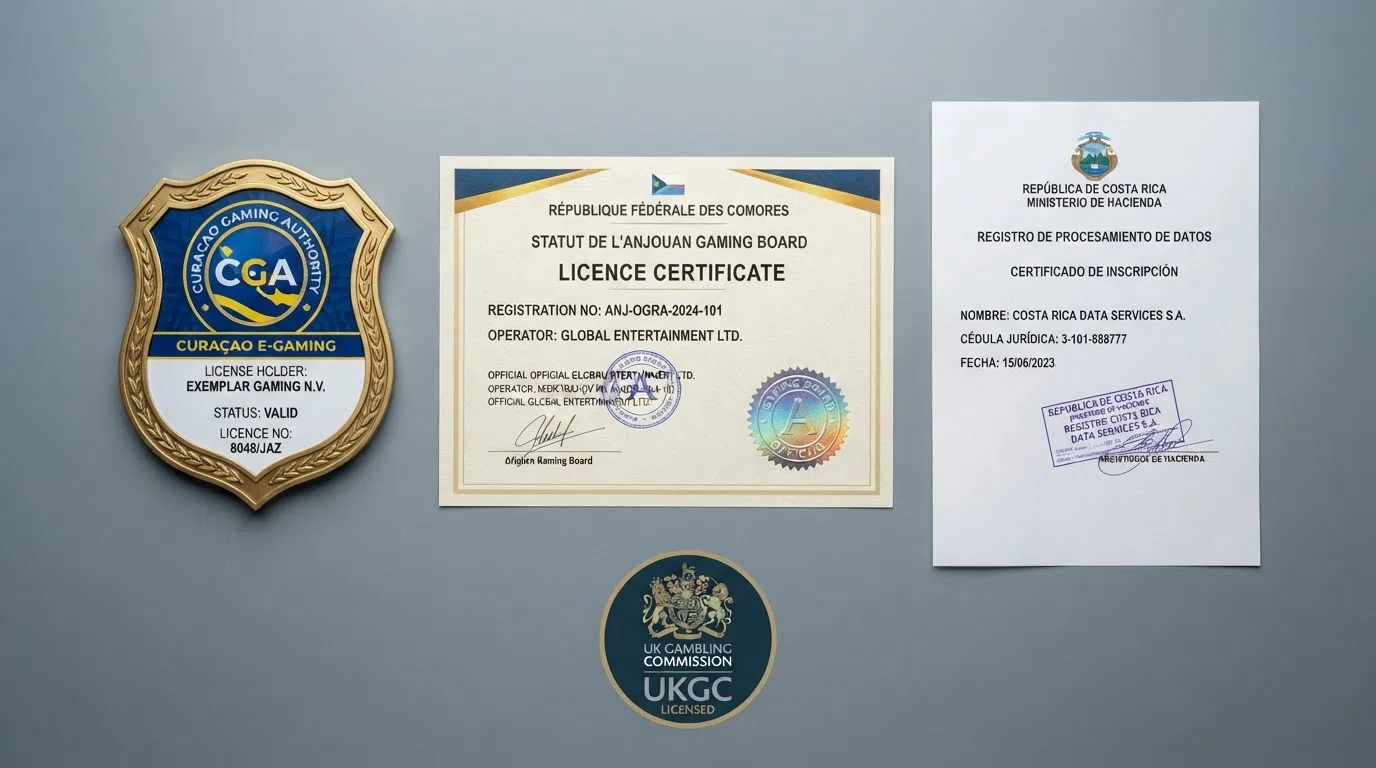
The UKGC framework is the reason no British-licensed casino can be a “no-ID casino.” A casino offering play without identity verification is, by definition, not operating under a GB licence, and the most common licensing jurisdictions for these operators are Curaçao, Anjouan and Costa Rica. Under the Gambling (Licensing and Advertising) Act 2014, any operator providing gambling facilities to customers in Great Britain needs a Gambling Commission licence regardless of where it is based. A Curaçao licence is not a substitute for a GB licence. Neither is an Anjouan licence, nor a Costa Rica data-processing registration. The offshore brands on this page do not hold UKGC authorisation, and the following sections are about what that fact costs a player in practical terms.
The UKGC’s Pre-Play Verification Mandate
LCCP Condition 17.1.1 is the centre of the rule. Every GB-licensed remote operator must verify a customer’s name, address and date of birth before the customer is permitted to gamble, and the verification must be against reliable sources, not a self-declared checkbox. Before May 2019, operators had a 72-hour grace period during which a customer could deposit and play before the checks ran; the grace period was abolished on 7 May 2019, and the current regime treats the pre-play check as a hard gate. The rule applies to free bets and bonuses as well as cash play, which is why even no-deposit free spins at a British casino arrive with a verified name on the account.
The supporting statute is the Gambling Act 2005. Section 33 makes providing facilities for gambling without the required licence a criminal offence, and the Commission has used the offence, alongside licence conditions, to push most of the offshore market off British-facing payment rails. The combination is what makes the no-ID route exclusively offshore: it is the only jurisdiction where pre-play verification is not a precondition of operating.
Offshore Licences: Curaçao, Anjouan, and Costa Rica
Curaçao, Anjouan and Costa Rica are the three jurisdictions that license no-ID casinos. Curaçao is the most common. The Curaçao Gaming Control Board has reformed its framework in recent years, but the licence still allows operators to offer crypto play with relatively light identity checks at registration. Anjouan, in the Comoros, has emerged as a second-tier option for operators that find Curaçao too expensive; its oversight is more limited still. Costa Rica, at the bottom of the trust scale, does not issue gambling-specific licences at all: a “Costa Rica-licensed casino” is typically registered under a data-processing or similar corporate classification, and the “licence” is not a gambling licence in any meaningful sense. Cryptorino is registered in Costa Rica under such a data-processing arrangement, and the same is true of CoinCasino.
None of these licences is a substitute for a GB licence under the Gambling (Licensing and Advertising) Act 2014. The Act requires a GB licence for any operator providing facilities to customers in Great Britain regardless of where it is based, which means every offshore brand accepting UK players is, strictly speaking, offering an unlicensed product to British consumers. The offshore operators know this; the affiliate sites ranking them know this; the Commission knows this. The arrangement persists because enforcement targets operators, advertisers and payment intermediaries rather than individual players, and because the demand created by the 2019 pre-verification reform has not gone away.
What You Lose Outside the UKGC Framework
The list of absent protections is long enough to deserve its own section, and most of the items on it are not negotiable at the operator level. They are statutory features of the British regime, and an offshore casino cannot replicate them by writing a clause into its terms and conditions. A player at a no-ID casino is outside every one of the following.
No GamStop coverage. GamStop is mandatory for all GB-licensed online operators since 31 March 2020, but the coverage extends only to participating GB-licensed sites. Every operator in the ranking below is outside GamStop. No UKGC complaints route. The Commission cannot investigate disputes with operators it does not licence, and there is no equivalent British body that can. No approved ADR provider. The alternative dispute resolution framework under the LCCP does not apply offshore, and the operators on this page do not route disputes through any UK-approved ADR body. No statutory deposit-limit prompt. The mandatory pre-first-deposit prompt under LCCP RTS 12, in force from 31 October 2025, applies only to GB licensees. No financial vulnerability check. The light-touch check at a £150 net deposit threshold in a rolling 30-day period, under LCCP SR Code 3.4.4 from 28 February 2025, is a Commission requirement that does not bind offshore brands. No 10× wagering cap. Wagering requirements on bonuses at GB-licensed casinos are capped at 10×, in force from 19 December 2025 under LCCP Social Responsibility Code 5.1.1, and offshore offers commonly carry 30×–80× wagering. No age-banded stake limits. Online slots carry a statutory maximum stake of £5 per game cycle for players aged 25+ and £2 for players aged 18-24 under the Gambling Act 2005 (Operating Licence Conditions) (Amendment) Regulations 2025; offshore slots have no such cap. No ban on autoplay, reverse withdrawals or losses disguised as wins. These are GB-licence conditions, not industry norms. No British consumer redress for withheld funds. If a no-ID casino decides not to pay, the player’s realistic options are the operator’s own internal complaint process and whatever reputation cost the operator fears, both of which are weaker than the Commission’s framework.
The ranking further down does not soften this list. The brands there are chosen because they are the operators UK players actually reach when they search for this topic, not because they are licensed recommendations. Market share data from the British market reflects the GB-licensed operators and does not apply to the offshore brands in the table.
Withdrawals Without ID Verification
The distinction between “no KYC at registration” and “no KYC at withdrawal” is the most important one on this page, and the one most affiliate reviews bury. A casino can be entirely document-free at sign-up and entirely document-heavy on cash-out, and the player only learns which kind it is when they try to move money. The pattern is consistent across the offshore market: no-KYC casinos allow play without documents up to a threshold, then request documents on the way out. Above that threshold, even the most permissive operator wants to see a passport and a proof of address.
Jackbit is the exception worth flagging. Verification at Jackbit is reserved for fraud or clear AML flags only; there is no routine document request on cash-out for standard withdrawals. That is not a euphemism. Independent reviews of the operator confirm that low- and mid-range cash-outs clear without a document prompt. BC.Game runs a similar model at signup but sets a numerical ceiling: no KYC to sign up or play, but verification may be triggered for single withdrawals above roughly $2,000–$3,000, and unverified monthly volume is capped around €10,000. The rule of thumb across the rest of the set is the same: deposit and play are document-free, withdrawals above a few thousand dollars are not, and the threshold is set by the operator’s AML policy rather than anything the player can verify in advance.
Crypto and Pay by Mobile as No-ID Routes
The payment method a player chooses does a lot of the verification work. Crypto is the primary no-ID route, and not by accident: a Bitcoin or USDT deposit does not pass through a UK-licensed payment intermediary, and the casino receives funds that are pseudonymous at the wallet level. No UKGC-licensed casino accepts cryptocurrency deposits directly in 2026; the only compliant route is via crypto-linked e-wallets that convert crypto to sterling before the casino receives it. The offshore brands in the ranking accept crypto at the wallet level, and that is precisely why they are offshore.
Pay by mobile is a partial workaround. A pay-by-mobile deposit is billed to the player’s phone bill, which means the mobile network has already verified the SIM, and the casino can argue that the verification has happened elsewhere. The argument is not watertight under UKGC rules, and pay-by-mobile at a GB-licensed casino still triggers the standard KYC process; the offshore brands that advertise pay-by-mobile as a “no-ID” route are selling a friction-reduction, not a bypass. Monero and other privacy coins sit at the extreme end: a Monero deposit is genuinely anonymous at the protocol level, and the operators that support it (Jackbit is one) do so because Monero is the only payment rail where the verification gap is structural rather than procedural. None of this changes the fact that a casino licensed in Curaçao or Costa Rica is, in British law, unlicensed for the purposes of taking UK customers, and the payment method is downstream of that fact rather than an answer to it.
One further restriction is worth flagging. Credit cards are banned for gambling since 14 April 2020 under LCCP licence condition 6.1.2; the ban extends to credit-card-funded payments through e-wallets. The rule applies to GB-licensed operators; offshore brands accept credit cards without that constraint, which is another way the offshore market differs from the domestic one.
Bonuses Without Verification: No 10× Cap in Sight
The bonus terms are where the offshore market diverges most sharply from the British one, and the divergence is the reason the figures on this page are worth comparing. Wagering requirements on bonuses at GB-licensed casinos are capped at 10×, in force from 19 December 2025, and a British welcome offer is, by Commission rule, ten times the bonus at most. Offshore operators have no such cap. Wagering of 30× is standard; 60× and 66× appear in the table further down; 80× appears in the worst cases. The headline match percentages are correspondingly larger, and the larger headline is the entire pitch: 100%, 150%, 200%, up to 1 BTC or £30,000.
The arithmetic of those offers is less generous than the marketing suggests, and the section on the bonus cost is where the analysis earns its place. BetPanda’s welcome bonus is a 100% match up to 1 BTC with 40×–80× wagering within 7 days, and the contribution rates matter: slots contribute 100%, live games 20%, and provably-fair games contribute 0%. The last of those is a quiet trap. A player who loads a provably-fair game to clear wagering makes no progress at all, because the bet contributes nothing to the requirement. Cryptorino’s offer is a 100% match up to 1 BTC with 66× wagering, 7-day validity, a €10 minimum deposit and a €12 maximum bet per spin. Vave offers 150% up to 1.5 BTC plus 100 free spins, with 40× wagering, 30-day validity, and a 10,000 USDT maximum win across all bonus types. CoinCasino runs a 200% match up to $30,000 plus 50 free spins, with 60× wagering releasing in 10% instalments, 14-day validity, and tiered spin values: deposits of $10–$99.99 give 20 free spins at $0.20 per spin, deposits of $100+ give 20 free spins at $1 per spin. MyStake’s offer is the lowest in the set for wagering, 30×, with 150% up to £750 on first deposit or 300% up to £1,500 across three deposits, plus 30 no-deposit free spins as a separate incentive.
The expected loss on a 1 BTC bonus at 40× wagering, played on Book of Dead at 96.21% RTP, demonstrates that the bonus costs more than the bonus pays, which is what every bonus at every casino does, but the gap is larger offshore than it is at a 10× GB-licensed offer. The full wagering comparison is in the table that follows.
| Operator | Wagering multiple | Validity window | Bonus match % | Minimum deposit |
|---|---|---|---|---|
| BetPanda | 40×–80× | 7 days | 100% | $10 |
| Cryptorino | 66× | 7 days | 100% | €10 |
| Vave | 40× | 30 days | 150% | 20 USDT |
| CoinCasino | 60× | 14 days | 200% | $10 |
| MyStake | 30× (deposit + bonus) | 30 days | 150% | £20 |
| Jackbit | 0× on free spins (winnings 10×) | 7 days | n/a (free spins) | $50 |
| BC.Game | 40× | 14 days | 100% | varies |
| GB comparison | 10× (capped) | varies | varies | varies |
The GB comparison row is the one the offshore column does not show. A British casino cannot offer 66× or 80× wagering under the current LCCP framework, which is why the same headline match percentage costs the player less at a domestic site. The wagering multiple is the single biggest variable in the cost of a bonus, and the offshore market is where the variable runs highest.
10 No-ID Casinos UK Players Can Join in 2026
Every operator in the table below is offshore. None holds a GB licence. The ranking is qualitative: there are no numerical scores, no weightings, and no implied order of recommendation. The criteria are verification strictness (the gap between sign-up and cash-out document requests), bonus fairness (wagering multiples, validity windows and win caps), game library depth, and withdrawal terms. Where two operators are close on those criteria, the tie-breaker is whether the operator holds a recognised gambling licence at all, because a Curaçao licence, weak as it is by GB standards, is a more credible framework than a Costa Rica data-processing registration.
| Casino | Licence jurisdiction | Verification approach | Welcome bonus shape | Wagering multiple | Free spins | GamStop connected? |
|---|---|---|---|---|---|---|
| Jackbit | Curaçao | No routine KYC on cash-out | 100 wager-free FS on $50+ deposit | 0× (FS winnings 10×) | 100 | No |
| BC.Game | Curaçao | KYC above $2,000–$3,000 withdrawals; €10,000/month unverified cap | 100% match first deposit | 40× | — | No |
| BetPanda | None (launched 2023) | KYC possible after big wins | 100% up to 1 BTC | 40×–80× | — | No |
| Cryptorino | Costa Rica (data-processing) | Email-only registration | 100% up to 1 BTC | 66× | 50 | No |
| Vave | Curaçao | Right to verify at any time | 150% up to 1.5 BTC + 100 FS | 40× | 100 | No |
| CoinCasino | Costa Rica (no gambling-specific licence) | KYC on meaningful withdrawals | 200% up to $30,000 + 50 FS | 60× | 50 | No |
| MyStake | Curaçao (GTW B.V.) | Low KYC risk | 150% up to £750 + 30 no-deposit FS | 30× | 30 no-deposit | No |
| Duelbits | Curaçao | Soft-KYC; full verification on AML flags | $20 deposit + slot wagering to unlock up to 500 FS | 1× deposit before withdrawal | Up to 500 | No |
| Flush | Curaçao | Minimal identity verification | Up to $3,000 + daily FS | — | Daily FS | No |
| Bilucky | Costa Rica | Standard offshore | Not detailed | — | — | No |
A few reading notes for the table. “Licence jurisdiction” names the authority the operator claims, not a quality endorsement. “Verification approach” describes what the operator says it does; the real behaviour depends on the threshold a particular withdrawal crosses. “Wagering multiple” is the figure that decides the bonus cost: a 10× offer costs a fraction of a 60× offer at the same match percentage. “GamStop connected?” is No for every row, and that column is included precisely because the absence of GamStop is the property that makes these sites “no-ID” in the first place.
Jackbit
Jackbit is the lightest-touch operator in the set. Sign-up is email and password; deposits clear in crypto; and verification is reserved for fraud or clear AML flags only, with no routine document request on standard cash-outs. The welcome offer is 100 wager-free free spins on a first deposit of $50+, with FS winnings carrying 10× wagering within 7 days and a $100 maximum cashout cap. The bonus is small by offshore standards and that is the point: the operator is selling privacy, not match percentage. Jackbit supports Monero, which makes it the strongest choice in the set for a player who wants the deposit rail to be anonymous at the protocol level rather than merely at the casino’s discretion. The game library is broad, the operator is Monero-supporting and crypto-native, and there is no GamStop connection. For anyone prioritising a frictionless experience over a massive bonus, Jackbit is the standout option here.
BC.Game
BC.Game runs the deepest game library among no-ID casinos: 10,000+ titles across 150+ supported coins. Sign-up is no-KYC; KYC may be triggered for single withdrawals above roughly $2,000–$3,000; and unverified monthly volume is capped around €10,000. The welcome bonus is a 100% match on the first deposit, with 40× wagering and a 14-day window, which is at the gentler end of the offshore range. The trade-off is that the $2,000–$3,000 withdrawal trigger is the lowest in the set, and a player who plans to move large amounts will see documents earlier here than at Jackbit. It is a top choice if you want variety and a well-stocked library that stays accessible.
BetPanda
BetPanda is VPN-friendly, launched in 2023, and operates without a formal gambling licence. The welcome bonus provides a 100% deposit match up to 1 BTC, coupled with 40×–80× wagering within 7 days, plus 10% weekly wager-free cashback on net losses. The wagering range is the most punishing in the set, and the contribution rules compound it: slots contribute 100%, live games 20%, and provably-fair games contribute 0%. A player who loads a provably-fair game to clear wagering makes no progress at all, and the 7-day window is tight. The upside is the 225+ provably-fair games and the cashback, which returns 10% of net losses weekly with no wagering. Withdrawal limits are €5,000 per 24 hours, €15,000 per week, and €45,000 per month. The high wagering and tight clearing window make this a better fit for high-stakes players who can navigate the specific bonus rules.
Cryptorino
Cryptorino is registered in Costa Rica under a data-processing licence, which is not a gambling licence in any meaningful sense. Sign-up is email-only, with no KYC prompt. The welcome bonus offers a 100% deposit match up to 1 BTC, subject to 66× wagering, 7-day validity, a €10 minimum deposit and a €12 maximum bet per spin. The €12 cap is a quiet constraint: on a high-volatility slot, a €12 max bet limits the upside on a bonus-funded run. The game library is the second-deepest in the set, 6,000+ games from 70+ providers, and the withdrawal limits mirror BetPanda’s at €5,000 per 24 hours, €15,000 per week and €45,000 per month. The 66× wagering is the second-highest in the ranking; the expected loss on a 1 BTC bonus at 66× is larger than at 40×, and the analysis is in the section that follows. It is a viable alternative if you need a large game library, provided you can clear the requirements within the short 7-day window.
Vave
Vave runs the biggest headline bonus in the ranking: 150% up to 1.5 BTC plus 100 free spins, with 40× wagering, 30-day validity and a 20 USDT minimum deposit. The free spins are released in batches: 25 per day across 4 days, rather than 100 at once. The 30-day window is the longest in the set, and 40× wagering is at the gentler end. The catch is the 10,000 USDT maximum win cap across all bonus types, a ceiling that can swallow a big run of luck on a high-volatility slot. The verification approach is the loosest described in the set: no ID at signup, with the right to verify at any time and no published threshold. The operator is crypto-focused and offshore, with no GamStop connection. If you want a significant headline match and a longer clearing window, Vave is the strongest candidate in this set.
CoinCasino
CoinCasino is a Telegram-native casino registered in Costa Rica with no gambling-specific licence. The welcome bonus is a 200% match up to $30,000 plus 50 free spins, with 60× wagering releasing in 10% instalments and 14-day validity. The 10% instalment structure is unusual: only 10% of the bonus becomes withdrawable at a time, and the rest unlocks as the cleared portion grows. The free-spin allocation is tiered by deposit: $10–$99.99 gives 20 free spins at $0.20 per spin, and $100+ gives 20 free spins at $1 per spin. The 60× wagering is the third-highest in the set. The game library is 4,000+ titles from around 60 studios, which is deep but not as deep as BC.Game or Cryptorino. While the wagering is steep, the sheer size of the bonus cap makes it worth a look for players willing to commit to the instalments.
MyStake
MyStake holds a Curaçao gaming licence under GTW B.V., which is the most credible licence on the page. The welcome offer is 150% up to £750 on first deposit (300% up to £1,500 across three deposits), with 30× wagering on deposit plus bonus, a £20 minimum deposit, a £5 max bet, and 30-day validity. The wagering is the lowest in the ranking outside the no-deposit free spins, and the deposit-plus-bonus structure means the wagering base is larger than the headline suggests: a £750 deposit at 150% produces a £1,875 wagering base at 30×. MyStake also offers 30 no-deposit free spins, the only deposit-free bonus in the featured set. The game library is broad and includes a sportsbook, which is unusual for the no-ID market. The verification approach is the lowest-risk in the set: low KYC risk, no defined withdrawal-cap threshold, Curaçao licence. For players needing a licensed operator with accessible terms, MyStake offers the most balanced approach currently available offshore.
Duelbits
Duelbits runs a soft-KYC model where many low-risk users can deposit, play and withdraw without documents, but full verification is triggered by AML checks or larger withdrawals. There is no standard matched-deposit welcome bonus. Instead, the Boosted Rookie Rush requires a $20 deposit and slot wagering to unlock up to 500 free spins, with no cash match and 1× deposit wagering required before any withdrawal. The 1× deposit wagering is the lowest barrier to withdrawal in the set, and the 500 free spins are the largest free-spin allocation available, earned through play rather than granted on deposit. The library is crypto-focused with a strong provably-fair section. For a player who values free spins over a cash match and wants the lowest barrier between deposit and withdrawal, Duelbits is the cleanest fit; for a player who wants a large headline bonus, the absence of a cash match is the cost.
Flush
Flush is a Curaçao-licensed, crypto-only casino with a privacy-first approach. The welcome bonus is up to $3,000 plus daily free spins, structured as an ongoing reward rather than a one-off match. BTC withdrawals have cleared in under one hour in testing, which is the fastest in the set. The verification approach is minimal identity verification for standard amounts, and the operator is offshore with no GamStop connection. The game library is crypto-native rather than mainstream-studio-heavy. For a player who values withdrawal speed above all else, Flush is the fastest in the ranking; for a player who values a single large welcome bonus, the daily-free-spins structure is a different product rather than a smaller version of the same one.
Bilucky
Bilucky is licensed in Costa Rica and explicitly outside GamStop. What sets it apart from the rest of the ranking is that it provides its own responsible-gambling toolkit: deposit limits, loss limits, session limits, stake limits, time-out and self-exclusion. None of those tools is required by Bilucky’s regulator, and the operator offers them voluntarily. The full suite of casino games is available, the bonus terms are not detailed in the source material, and the verification approach is the standard offshore model. For a player who values a casino that takes safer play seriously despite operating outside UKGC oversight, Bilucky is the most RG-conscious option in the set; the trade-off is the weaker Costa Rica licence and the absence of a documented welcome bonus in the source data.
What You Can Actually Play Without Handing Over Your ID
The game libraries at no-ID casinos are not a separate product. They are the same studios UK players see at domestic sites, distributed through the offshore market because the studios themselves are licensed to supply both. Pragmatic Play is the most consistently available major studio at offshore no-KYC platforms, Play’n GO and Hacksaw Gaming also maintain wide distribution, and Evolution powers most of the live-dealer offering. Around 60–70+ providers appear at the larger offshore casinos: Cryptorino carries 6,000+ games from 70+ providers, CoinCasino carries 4,000+ games from roughly 60 studios, and BC.Game carries 10,000+ titles. The variety is not the issue. The issue is that none of the games is wrapped in the British consumer-protection layer: no age-banded stake limits, no spin-speed minimum, no ban on autoplay, no ban on losses disguised as wins. The game is the same; the guard rails are absent.
Slots You Can Play Without Verification
The slots that dominate no-ID lobbies are the same high-volatility, high-RTP titles UK players recognise from domestic sites. Book of Dead, from Play’n GO, runs at 96.21% RTP, high volatility, with a 5,000× maximum win on a 5×3 reel with 1–10 paylines, and the expanding-symbol free-spin round that made the title a staple. Sweet Bonanza, from Pragmatic Play, runs at 96.48–96.51% RTP, high volatility, with a 21,100× maximum win on cluster pays with a tumble mechanic and multiplier bombs from x2 to x100. Wanted Dead or a Wild, from Hacksaw Gaming, runs at 96.38% RTP, very high volatility, with a 12,500× maximum win on a 5×5 reel with 40 paylines, and sticky plus multiplier wilds that drive the bonus round. These are the three titles the rest of this page reaches for, and the RTP figures are the ones that feed the expected-loss calculation further down.
The volatility is the part that needs reading carefully. High volatility means long losing runs punctuated by occasional large wins, and the long losing runs are exactly where the offshore terms hurt: a 7-day wagering window on a 66× bonus is short for a high-volatility title, because the title’s natural cycle does not respect the casino’s clearing schedule. A player who loads Book of Dead to clear a 66× wagering requirement is betting that the slot’s bonus round arrives inside the window; if it does not, the bonus expires mid-cycle. The British market’s 10× cap does not solve the volatility problem, but it does make the problem smaller at the same match percentage.
Live Dealer Tables at No-ID Casinos
Live dealer play at offshore casinos is the same Evolution and Pragmatic Play Live product UK players see on domestic sites. Roulette, blackjack, baccarat and game shows are widely available without ID verification at the signup stage. The studios are the same, the dealers are the same, the game mechanics are the same. What changes is the contribution to bonus wagering: live games typically contribute only 20% toward bonus wagering at offshore casinos, which means a £10 live-dealer bet on a 40× bonus clears £2 of wagering. Slots clear £10 of wagering on the same bet. A player who prefers live dealer and wants to clear a bonus is therefore clearing five times slower on the same money, and the clearing window is the same length.
The Studios Behind No-ID Casino Games
Pragmatic Play is the most consistently available major studio across offshore no-KYC platforms, with Play’n GO and Hacksaw Gaming also widely distributed. Evolution powers most of the live-dealer offering at the larger operators, and the live-game-show format (Monopoly Live, Crazy Time, Deal or No Deal Live) is widely available. The mid-tier studios appear in the 60–70+ provider count at the larger casinos: Nolimit City, ELK, Push Gaming, Thunderkick, Yggdrasil, Relax Gaming and Quickspin are the names a UK player is most likely to recognise, and they all appear in offshore lobbies. The distinction is not in the studios; it is in the absence of British regulatory features (autoplay ban, spin-speed minimum, losses-disguised-as-wins ban) that the studios would otherwise be required to implement for the GB market. Offshore, those features are not required, and not all operators enable them voluntarily.
Responsible Gambling When No One Knows Who You Are
Safer gambling at a no-ID casino is a different problem from safer gambling at a GB-licensed site, because the safety net is operator-dependent rather than regulator-enforced. The British framework makes the deposit-limit prompt, the financial vulnerability check, the reality check, the GamStop exclusion, and the ADR route automatic. The offshore framework makes all of them optional, and the operator’s own responsible-gambling page is the only evidence the player has of what is actually available. The data on the demand for these services is part of why this section exists. GamCare’s National Gambling Helpline received a record 55,228 calls and online chats in 2023-24, a 25% increase year-on-year. NHS gambling clinic referrals reached 4,355 in 2024/25, up from 2,284 in 2023/24. The Adult Psychiatric Morbidity Survey 2023-24 reported 0.4% of adults with problem gambling (PGSI 8+) and 1.2% with moderate-risk gambling (PGSI 3-7), with the highest prevalence among 25-34 year olds at 3.5%, and men (2.2%) more likely than women (1.0%) to score 3+ on the PGSI. The demand is real; the safety net at an offshore casino is partial; the page should be honest about both.
Responsible-Gambling Tools at Offshore Casinos
The tools that exist at GB-licensed casinos are not universal offshore. Bilucky is the notable example in the ranking: the operator provides its own full responsible-gambling toolkit (deposit limits, loss limits, session limits, stake limits, time-out and self-exclusion) despite operating outside UKGC oversight. Most of the other operators in the set offer basic deposit limits at most, with no statutory requirement to prompt the player at first deposit. The mandatory pre-first-deposit prompt under LCCP RTS 12, in force from 31 October 2025, applies only to GB licensees, and the reality-check obligations that come with it are similarly domestic. NICE guideline NG248 covers identification, assessment and treatment of gambling-related harms, and the guideline’s reach is British; an offshore casino is not bound by it. The practical effect is that a player who wants deposit limits, reality checks or self-exclusion at an offshore casino must set them up themselves, must verify the operator honours them, and must accept that the operator’s internal complaint process is the only available route if the limits are not honoured.
GamStop and Self-Exclusion at No-ID Sites
GamStop is mandatory for all GB-licensed online operators since 31 March 2020, but the coverage extends only to participating GB-licensed sites. Every operator in the ranking below operates entirely outside GamStop; none is connected, and the Commission’s list of participating operators is the definitive reference. GamStop exclusion periods are six months, one year, five years, or five years with auto-renewal; once confirmed the exclusion cannot be cancelled before the chosen minimum period expires. An excluded British player registering at an offshore casino faces no barrier and no safety net: the exclusion is a GB-licence condition, and the offshore casino is not bound by it. This is the property that makes no-ID casinos a common destination for self-excluded players, and the property that makes the responsible-gambling section of this page non-optional. If a reader is considering an offshore casino because GamStop is in the way, the right next step is not a different casino. It is the National Gambling Helpline on 0808 8020 133, free and 24 hours a day.
Spotting Problem Play Without the UKGC Safety Net
The prevalence figures are the starting point. 0.4% of adults with problem gambling (PGSI 8+), 1.2% moderate risk (PGSI 3-7), highest among 25-34 year olds at 3.5%, and men (2.2%) more likely than women (1.0%) to score 3+. GamCare’s helpline took 55,228 contacts in 2023-24, a 25% year-on-year rise. NHS gambling clinic referrals nearly doubled, from 2,284 in 2023/24 to 4,355 in 2024/25. The National Gambling Support Network offers free treatment with an average wait of under two weeks from referral, and 9,100 free treatment sessions were delivered in the year to April 2024. The PGSI self-assessment is available through NHS pages and through BetKnowMore UK’s anonymous online tool. The warning signs are familiar: chasing losses, gambling more than intended, lying about play, neglecting work or relationships, and borrowing to fund play. At a no-ID casino, none of the British automatic interventions fires. The deposit-limit prompt does not appear. The financial vulnerability check at the £150 net-deposit threshold does not run. The reality check does not pop up. The player is the only safety net, and the player is also the one placing the bets.
How We Evaluated These No-ID Casinos
The operators in the ranking were identified from UK-facing affiliate review sites (Betzoid, CasinoBeats, CryptoNews, NoKYC Vault) and cross-checked against the UKGC public register to confirm GB-licence status. The short version of that cross-check: none of the ten operators in the ranking holds a GB licence, and that fact is the reason the ranking exists at all. The evaluation criteria were verification strictness (the gap between sign-up and cash-out document requests), bonus fairness (wagering multiples, validity windows and win caps), game library depth and studio quality, and withdrawal terms (speed, limits, and the conditions attached to large withdrawals).
The ranking is qualitative. There are no weightings, no numerical scores, and no implied order of recommendation, because the offshore market lacks the standardised reporting that makes quantitative comparison possible. GB-licensed operators file regulatory returns; offshore operators do not. Every operator was checked against its own published terms and conditions and against independently published reviews, but the absence of UKGC oversight means game fairness, RNG certification and fund segregation cannot be independently verified for any offshore casino on this list. The Cryptorino registration in Costa Rica is a data-processing licence, not a gambling licence; BetPanda launched in 2023 without a formal gambling licence at all; CoinCasino is registered in Costa Rica with no gambling-specific framework. A reader who weighs licence credibility should know that the highest licence tier on the page is Curaçao, and that Curaçao is not a substitute for UKGC authorisation under the Gambling (Licensing and Advertising) Act 2014.
No-ID Casinos: Is the Convenience Worth the Risk?
The speed is real. At Jackbit you can register, deposit, play and withdraw in the time it takes to verify a crypto wallet and place a few bets, and you will not see a document-upload screen for standard amounts. BC.Game gives you 10,000+ games on the same frictionless path. Vave’s headline match percentage is the largest in the ranking. MyStake offers the lowest wagering multiple and a Curaçao licence. The convenience is not invented.
The protection gap is also real, and it is the same gap for every operator in the ranking. No GamStop coverage, no UKGC complaints route, no approved ADR provider, no statutory deposit-limit prompt, no financial vulnerability check, no 10× wagering cap, no age-banded stake limits, no ban on autoplay, no ban on losses disguised as wins, and no British consumer redress for withheld funds. The bonus numbers are bigger offshore, and the wagering makes them costlier than the headline suggests. The expected loss on a 1 BTC bonus at 40× wagering, played on Book of Dead at 96.21% RTP, runs into the hundreds of millions of satoshis over the clearing window, and this figure is the cost the bonus imposes on the player, not the gain the bonus delivers. That gap between headline and cost is the entire reason the wagering-cap comparison exists.
No-ID casinos exist because the UKGC’s 2019 pre-verification reform created a demand gap. The reform was the right call: pre-play identity verification is the single most effective harm-reduction tool a regulator can deploy, and the abolition of the 72-hour grace period on 7 May 2019 closed a real loophole. The reform also created a market for offshore operators willing to absorb the enforcement risk, and the market has grown rather than shrunk in the years since. UK players will keep finding these sites; the affiliate pages ranking them will keep ranking them; the Commission will keep issuing disruption notices. None of that resolves the question the reader is actually asking, which is whether the trade is worth it for them.
If the answer is yes, the practical steps are: play with money you can afford to lose; verify the operator’s licence yourself against the UKGC public register and the Curaçao Gaming Control Board’s register; withdraw winnings early rather than letting balances build past the KYC threshold, because once the threshold fires you are back to the document upload you came to avoid; and know the GamCare helpline number, 0808 8020 133, free and 24 hours a day, before the first deposit rather than after. The page’s job is to lay out both sides of the trade. The reader’s job is to make the call.
Frequently Asked Questions
Is it legal to play at an online casino without ID verification in the UK?
It is not illegal for a player in Great Britain to place a bet at an offshore site. The criminal offence under section 33 of the Gambling Act 2005 is aimed at operators providing unlicensed gambling facilities, not at individual customers. That distinction is the practical reason offshore no-ID casinos accept UK players, but it is not a green light. The site is offering an unlicensed product, the Commission cannot help if funds are withheld, and the player has none of the British protections that come with a GB licence.
What happens if a no-ID casino refuses to pay out — can I complain to the UKGC?
No. The UKGC can only investigate disputes with operators it licences, and none of the casinos on this page hold a GB licence. There is no approved ADR provider under the British framework for offshore disputes. The realistic options are the operator’s own internal complaint process, the Curaçao Gaming Control Board if the operator holds a Curaçao licence, or the small list of payment-dispute routes available through the deposit method. None of these is a substitute for the Commission’s complaints process.
Are no-KYC crypto casinos safe for UK players?
Safer than a site with no licence and no reputation, less safe than a GB-licensed operator. Crypto deposits do not pass through UK-licensed payment intermediaries, the casino is outside the UKGC’s jurisdiction, and the absence of fund-segregation rules means player balances are not protected by the British regime. The safer operators on this page are Curaçao-licensed with published terms and a track record of paying withdrawals; the less safe ones are registered in Costa Rica with no gambling-specific licence at all. A reader who plays should treat the balance as at risk.
How does GamStop self-exclusion work, and can no-ID casinos bypass it?
GamStop is mandatory for all GB-licensed online operators since 31 March 2020, and the exclusion periods are six months, one year, five years, or five years with auto-renewal; once confirmed the exclusion cannot be cancelled before the chosen minimum period expires. Every casino on this page operates outside GamStop, and the exclusion does not apply to any of them. Yes, no-ID casinos bypass GamStop by being outside the British licensing system. If a reader is considering an offshore casino because GamStop is in the way, the right next step is the National Gambling Helpline on 0808 8020 133.
Are there any UKGC-licensed casinos that do not require photo ID?
No. Under LCCP Condition 17.1.1, every GB-licensed remote operator must verify a customer’s name, address and date of birth before the customer is permitted to gamble, and the pre-2019 72-hour grace period was abolished on 7 May 2019. There is no legitimate “no-ID” route at a GB-licensed casino. A site that does not ask for documents is, by definition, not operating under a GB licence.
Which payment methods let me deposit at a casino without providing ID?
Crypto is the primary no-ID route: Bitcoin, Ethereum, USDT and, at some operators, Monero. No UKGC-licensed casino accepts cryptocurrency deposits directly in 2026; the offshore brands in the ranking accept crypto at the wallet level. Pay by mobile is a partial workaround at offshore sites, but it does not replicate crypto’s anonymity. Credit cards are banned for gambling at GB-licensed casinos since 14 April 2020, including through e-wallets; offshore brands accept cards without that constraint, which is another difference from the domestic market.
Account – nonukgc-licensedcasinos
Content created by the «nonukgc-licensedcasinos» team