
Penny Slots in the UK: What 1p Really Buys You
 Available in GB
The word “penny” sells the dream of spinning for next to nothing, but a penny slot is a slot where the coin denomination is one penny, and that is where the marketing ends. Once paylines come into play, the maths takes over. Most penny slots demand 20 or 25 active lines per spin, so the real cost of one spin on a penny slot in the UK ranges from £0.10 to £0.50, not 1p. Anyone who has watched the stake counter flash £0.25 on a game labelled “1p slots” has already met this gap between the name and the checkout price.

Current as of September 8, 2026; all licence claims verified against the Gambling Commission’s public register at gamblingcommission.gov.uk.
Why Your 2026 Penny Slot Costs More Than 1p a Spin
The penny myth: what “penny slot” actually means
The term dates back to physical machines in British venues, where a “penny” meant the coin inserted per line. Virgin Games sets out the convention plainly: penny slots are slot games where you can set your spin to just 1p, with the 1p referring to a single payline, not the full spin. That distinction is the engine of the entire penny-slot proposition, and it is also why the category confuses new players. Slingo’s gloss is sharper still: although line bets can be as low as 1p in penny slots, you will often be required to play a certain number of lines on each spin. Every line is multiplied into the stake. A 20-line game at 1p per line is a £0.20 spin before the reels stop. A 25-line game is £0.25.
The £0.10–£0.50 range for a real spin is not a quirk of expensive titles. It is the structural floor for almost every online penny slot. The lowest configurable stake is rarely a true 1p spin, because the game locks the line count and then applies the coin value to each of them. The result is that the “1p” in the marketing is a component, not a total, and the checkout counter on the right of the reels is the only number that matters at the point of spin.
How penny slots work: paylines, coin value and real spin costs
The mechanics turn 1p into a £0.50 spin through three settings working in concert. The coin denomination sets the minimum line bet, and on a penny slot that value is £0.01. The payline count sets how many lines each spin covers, and on a penny slot that is typically between 10 and 25, often fixed rather than adjustable. The stake-per-spin is the product of those two, plus any bonus-feature or multiplier overlay the game carries.
Gonzo’s Quest is a textbook example: £0.01 per line across 20 fixed paylines gives a minimum spin of £0.20. Cleopatra, Rainbow Riches and Big Bass Bonanza all carry similar minimums in the £0.10–£0.20 range, and the highest configurable stake on a penny slot can reach £0.50 per spin when a player raises the coin value across all lines. The “max bet” button on a penny slot takes the coin value to its ceiling, which on many titles lands between £0.25 and £0.50. That is still far below the Gambling Commission’s statutory stake caps, which since 2025 have set the maximum for online slots at £5 per game cycle for players aged 25 and over, and £2 per game cycle for players aged 18 to 24. The penny-slot category sits comfortably inside those limits, but the gap between the name and the real cost is still wide enough to mislead anyone who reads the lobby tile without checking the stake counter.
Online vs land-based: where penny slots live today
The decline of the physical 1p machine in UK venues has been steady for years, and the online format has absorbed the category almost entirely. The numbers from the Gambling Commission’s market overview for the quarter ending December 2025 illustrate the scale: 25.7 billion online slots spins across 4.6 million average monthly active accounts, with slots generating £788 million in gross gambling yield in the period — both records for the dataset.
That volume has consequences for the penny-slot player. Online penny slots draw from a deeper pool of titles than any physical venue could host, with hundreds of games from NetEnt, Play’n GO, Pragmatic Play, IGT and Barcrest sitting in a single lobby. They also carry more paylines than their land-based forebears, which is why the cost-per-spin gap between the £0.01-per-line number on the paytable and the actual spin stake is so consistent. The online format suits the penny-slot proposition because the long-tail library lets a player move between titles in seconds, and the spin-cost transparency is better than the cash-input mechanics of an older cabinet. The downside is that the frictionless spin cycle — one click, one result, no human exchange — removes the natural pace breaks a coin-operated machine imposed by default.
How to play penny slots online: a quick-start guide
- Pick a UKGC-licensed site and verify the operating licence on the Gambling Commission’s public register before depositing. Every featured operator on this page holds an active licence, but the register is the source of truth and is worth five minutes of checking.
- Set a deposit limit before funding the account. From 31 October 2025, every UK-licensed operator must prompt a customer to set a deposit limit before the first deposit; pick a number that reflects what a penny-slot session is actually worth, not what the welcome offer implies.
- Open the slots lobby, filter by minimum stake, and find a penny-slot section. Most UK sites group low-stake games into a dedicated tile or filter, and the minimum stake per spin should sit at or below £0.20.
- Read the paytable before the first real-money spin. The paytable shows the coin value, the active payline count, the bonus-feature triggers and the payline structure. A penny slot with a fixed 25-line configuration costs £0.25 per spin at minimum; a penny slot with 10 adjustable lines can cost as little as £0.10 if the player chooses to under-cover the lines.
- Use demo mode to test the title risk-free before staking. Every UKGC-licensed operator featured here carries demo mode on most slots, including the penny-denomination titles.
New and popular penny slot titles in 2026
The penny-slot field is dominated by five providers: Pragmatic Play, NetEnt, Play’n GO, IGT and Barcrest (now part of Light & Wonder). The trend over the last 12 months has been toward higher-volatility releases with bigger headline max-win figures — Piggy Riches at a 36,000× stake max win and Cleopatra at 10,000× are the obvious examples — but the underlying mechanics still run on the same coin-denomination and payline structure that gives the category its name.
Newer releases have layered Megaways engines and bonus-buy features onto the penny-slot chassis where UK rules permit. Megaways titles expand the payline count dynamically, sometimes into six figures per spin, while bonus-buy shortcuts the wait for a feature trigger for an additional stake. Both add volatility without changing the underlying penny denomination, and both work within the Gambling Commission’s stake caps because the per-spin ceiling sits well above the maximum cost of any of these titles.
Titles that gained traction among UK penny-slot players include Book of Dead (Play’n GO), Starburst (NetEnt), Rainbow Riches (Barcrest), Cleopatra (IGT), Gonzo’s Quest (NetEnt), Big Bass Bonanza (Pragmatic Play), Piggy Riches (NetEnt) and Fire Joker (Play’n GO). Each sits within the penny-denomination bracket, each is available across multiple UKGC-licensed operators, and each carries a researched RTP and volatility profile.
Free Penny Slots: Play Without Spending a Penny
Free vs real-money penny slots: what you give up in demo mode
Free-play on a UKGC-licensed penny slot runs on virtual credits. The reels behave exactly as they would on a real-money spin — the random number generator, the paytable, the bonus-feature triggers, the RTP calculation are identical — but every win is a virtual credit, and no cashout is possible. What demo mode cannot replicate is the weight of a real-money decision, and that is not a trivial gap. A 96% RTP slot looks very different when each “loss” is a credit the player did not earn than when each loss is a pound they did.
UKGC rules apply even in demo mode on licensed sites. The auto-play ban, the 2.5-second minimum spin speed and the losses-disguised-as-wins ban are game-design rules imposed on the title itself, not on the customer’s stake, so they carry through to virtual-credit play. Some licensed platforms also extend the mandatory session-tracking display and reality-check pop-ups to demo sessions, which is a useful safety net for a player testing the pacing of a high-volatility title.
No-download, no-registration: instant penny slots from your browser
Modern penny slots run on HTML5 and launch directly from a desktop or mobile browser. No plugin, no app install, no client download. On some UK-licensed operators, the demo version of a title is reachable without registering an account, which means a player can be spinning within thirty seconds of opening the site. The trade-off is that anonymous play does not carry saved preferences, session history or any cross-game continuity — each visit starts from zero.
Other operators gate demo mode behind registration, so the player must create an account (and verify identity, given the May 2019 rule that ID must be confirmed before first deposit or gambling) before the demo spins are unlocked. The choice between the two models is a matter of operator policy, not a feature the player can negotiate. Worth checking the lobby layout before signing up.
Free penny slots with bonus features: practise the rounds that pay
The bonus round is where most of a penny slot’s RTP lives. Free-spin rounds, pick-me games, expanding wilds and multiplier trails all contribute disproportionately to the long-run return, which means a player who has not tested a title’s bonus frequency in demo mode is flying blind on the most volatile part of the game. Big Bass Bonanza’s free-spin round with its progressive collector, Piggy Riches’ multipliers and Book of Dead’s expanding symbol are all worth rehearsing on virtual credits before staking real money, because each behaves differently from the base game and each has its own hit rate that demo play reveals over a few hundred spins.
The 96% average RTP across online slots means a player can expect £96 back for every £100 wagered over time, but the spread between titles is wide. A slot whose bonus round triggers once every 150 spins on average will feel very different from one whose bonus round triggers every 30 spins, and demo mode is the only way to feel that before committing a bankroll.
How to Pick Penny Slots That Actually Pay
The best penny slots to play in 2026: title-by-title
Eight penny-slot titles carry researched RTP, volatility and max-win data, each is available across multiple UKGC-licensed operators, and each carries a minimum stake that puts it squarely in the penny-slot bracket.
| Slot Title | RTP | Volatility | Max Win | Provider |
|---|---|---|---|---|
| Big Bass Bonanza | 96.71% | High | 2,100× | Pragmatic Play |
| Piggy Riches | 96.4% | Medium | 36,000× | NetEnt |
| Book of Dead | 96.21% | High | 5,000× | Play’n GO |
| Fire Joker | 96.15% | Medium | 1,000× | Play’n GO |
| Starburst | 96.09% | Low | 500× | NetEnt |
| Gonzo’s Quest | 95.97% | Medium-High | 2,500× | NetEnt |
| Rainbow Riches | 95% | Medium | 500× | Barcrest / Light & Wonder |
| Cleopatra | 95.02% | Medium | 10,000× | IGT |
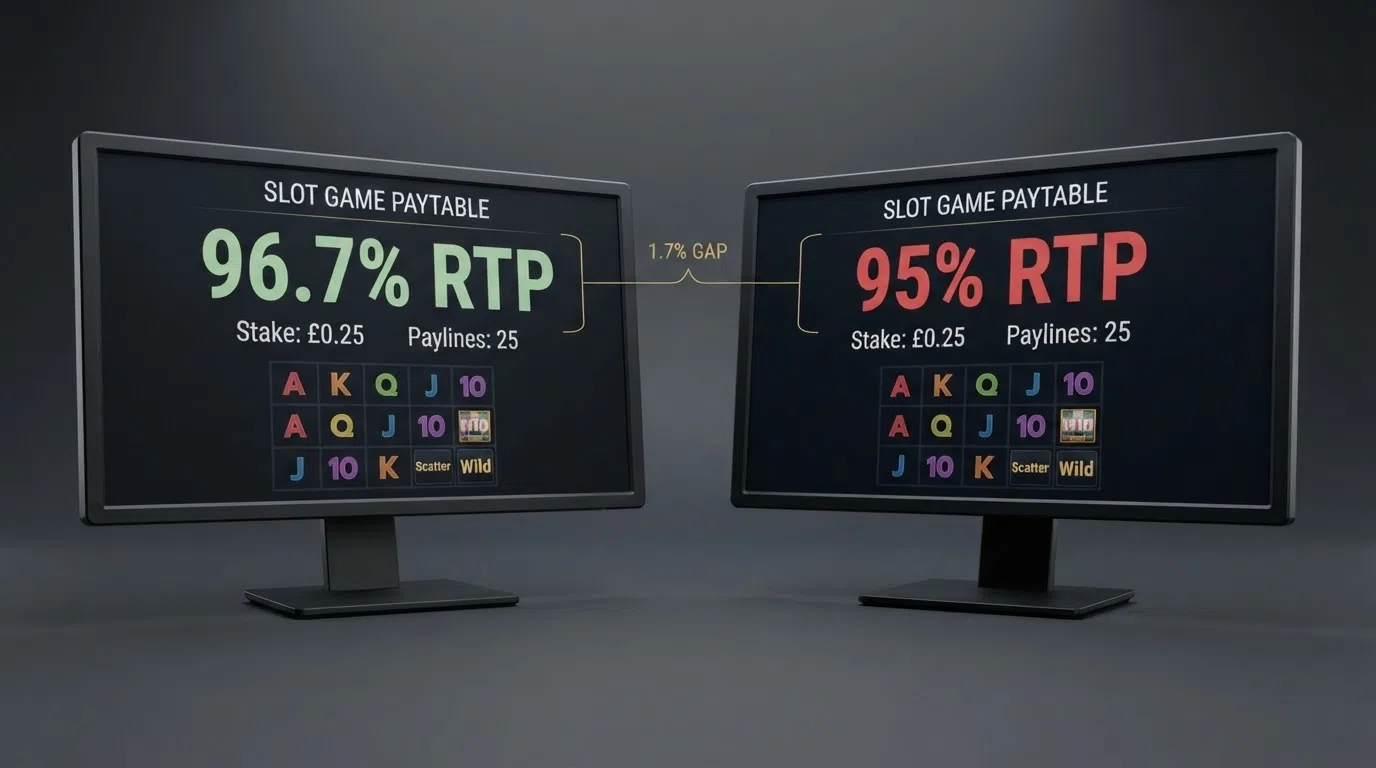
The column to weigh depends on the bankroll and the session shape the player wants. RTP is the long-run return, volatility is the session-by-session experience, and max win is the ceiling on a single spin. A low-volatility title like Starburst delivers steady small returns and stretches a £20 bankroll across more spins; a high-volatility title like Book of Dead or Big Bass Bonanza produces long dry spells punctuated by bigger hits, and the same £20 lasts fewer spins. The 96% average is a benchmark, not a guarantee — Big Bass Bonanza, Piggy Riches, Book of Dead and Fire Joker all sit above it, while Rainbow Riches and Cleopatra sit below. The 1.7-percentage-point gap between Big Bass Bonanza and Cleopatra at a £0.25 stake over 1,000 spins costs roughly £4.25 more in expected losses on Cleopatra, a small number per spin but a real one across a session.
Penny slots strategy: bankroll and payline tactics
- Set a session budget before opening the game and treat it as a hard ceiling. A £20 bankroll on a penny slot with a £0.25 spin covers 80 spins at the minimum stake, which is the kind of session length that lets volatility play out without breaking the bankroll before the bonus round lands.
- Activate all paylines. Most penny slots lock the line count, but where the player can choose, under-covering the lines reduces the spin cost and the chance of a paying combination. The only legitimate reason to reduce lines is to lower the per-spin cost to a level the bankroll can sustain; do not assume under-covering saves money in the long run, because every line you drop is a line that cannot pay.
- Set the stake as a small fraction of session bankroll — small enough that variance cannot wipe the bankroll before the player has seen the game’s rhythm. A common working rule is 1% to 2% of session bankroll per spin, which on a £20 bankroll sits between £0.20 and £0.40 per spin, well within the penny-slot range.
- Use the UKGC stake caps as a ceiling rather than a target. The £5 (£2 for 18–24) cap is the legal maximum; it is not a recommendation for the right stake. Penny slots sit at or below £0.50 per spin, and that is where most sessions should run.
The credit card ban since April 2020 means the bankroll must come from a debit card or a pre-funded account — no credit, no credit-funded e-wallet. That is a hard rule on every UKGC-licensed operator and a useful one for a player setting a budget, because it removes the option to chase a session into next month’s bill.
The return on a penny: understanding slot payout rates
The 96% average RTP across online slots is a theoretical figure calculated over millions of spins. It is not a session-by-session promise. A 96% slot will routinely deliver sessions above and below that figure, and a player running 100 spins at £0.25 will see anything from a substantial loss to a modest win, with the average hovering around the £24 mark on a £25 stake. The “long run” the RTP refers to is millions of spins, not a Tuesday evening.
The distinction matters for the way a player should weight RTP against volatility when picking a title. A high-RTP, low-volatility slot like Starburst delivers returns close to the theoretical average over a short session because the wins are frequent and small. A high-RTP, high-volatility slot like Big Bass Bonanza sits further from the average on any given session because the dry spells are longer and the wins are lumpier. For a player with a small bankroll, the volatility profile is often the more important of the two: a low-volatility title makes the bankroll last, while a high-volatility title burns it.
The eight titles in the comparison table above show how the RTP spread looks in practice. Big Bass Bonanza, Piggy Riches, Book of Dead and Fire Joker all clear the 96% average. Gonzo’s Quest, Rainbow Riches and Cleopatra sit below it. The differences are small in percentage terms but meaningful in pounds across a session.
Where to Play Penny Slots Online: 10 UK-Licensed Sites Compared
Every operator on this list holds an active Gambling Commission remote casino operating licence, verified against the Commission’s public register. The comparison below covers welcome-offer terms that a penny-slot player will meet at the sign-up screen.
| Operator | Free Spins | Min. Deposit to Trigger | Wagering on FS Winnings | Bonus Validity | Slot Library Size |
|---|---|---|---|---|---|
| bet365 | Up to 500 | £10 lifetime deposit | 0× | 30 days to claim; 24h per daily reveal | 1,000+ |
| 32Red | 320 | £30 deposit + stake | 10× | 30 days; 7-day claim window | 500+ |
| Paddy Power | 260 (60 no-deposit + 200 on stake) | £10 for deposit spins | 0× | 7 days | 500+ |
| Sky Vegas | 200 | £10 deposit + stake | 0× | 7 days on spins | 600+ |
| William Hill | 200 | £10 deposit + stake | 10× | 72 hours | 500+ |
| Betfred | 200 | £10 stake | 0× | 7 days | 500+ |
| Ladbrokes | 100 + 300 Ladbucks | £10 deposit + play | 0× | 7 days on spins | 800+ |
| Coral | 100 | £10 deposit + play | 10× | 30 days | 700+ |
| Gala Spins | 100 | £10 deposit | 0× | 7 days | 400+ |
| Betfair | 50 | £10 deposit + spend | Subject to UKGC 10× cap | 7 days | 400+ |
From 19 December 2025, wagering requirements on bonus funds are capped at 10× under the LCCP social responsibility code, so no UKGC-licensed welcome offer can ask for more than 10× playthrough on free-spin winnings. The column that matters most for a penny-slot player is the wagering requirement, because it determines whether the free-spin winnings land in the cash balance or carry a playthrough obligation. Six operators on this list sit at 0× and credit free-spin winnings directly as withdrawable cash; three sit at 10× and require the player to wager the winnings before withdrawing.
bet365: 500 free spins with zero wagering on winnings
The headline number is 500 free spins, the largest count on this list, revealed in daily batches of 5 to 50 over 20 days. The trigger is a £10 lifetime deposit — not a fresh deposit, but a cumulative £10 ever deposited into the account — which lowers the barrier for any player who has ever funded a bet365 account. The wagering requirement is 0×, so every pound won on a free spin is withdrawable cash from the moment it lands. The eligible games are Book of Horus, Curse of the Bayou, Magic Forge and Wrath of the Deep, each at a £0.10 spin value, and the 30-day claim window with a 24-hour shelf life on each daily reveal means a player who misses a day’s drop forfeits only that batch, not the rest.
The library sits at 1,000+ slots, the largest on this list by some margin, which means the penny-slot selection is broader than any other featured operator. NetEnt, Microgaming, Playtech, IGT, Pragmatic Play, Red Tiger and Blueprint are all in the mix, and demo mode is available on most titles. Hillside (UK Gaming) ENC is the licence-holder entity on the Gambling Commission’s register.
For a penny-slot player who values spin count and wagering-free winnings above the eligibility of a specific title, bet365 sits at the top of the pile. The catch is that the eligible games are a small set of Pragmatic Play titles rather than the headline penny-slot names elsewhere on this page, so the player who wants to spin Book of Dead or Starburst on the welcome offer is looking at the wrong operator.
Paddy Power: 60 no-deposit spins before you stake a penny
Paddy Power is the only operator on this list that gives free spins without a deposit. The offer splits into two tranches: 60 free spins on Paddy’s Mansion Heist, paid out at £1 per spin with zero wagering on winnings, plus 200 more on a £10 deposit and stake. The no-deposit tranche has a 7-day validity from registration, which is short, and the deposit tranche carries the same 7-day window from the moment the qualifying stake settles.
The 0× wagering applies across both tranches, so every pound won on a free spin is cash, including the £1 Mansion Heist spins that deliver a higher headline value per spin than the standard £0.10. The 500+ slot library is mid-pack, the demo-mode coverage matches the rest of the Flutter group, and the licence sits under the Flutter group’s UKGC remote casino operating licence.
Paddy Power suits a player who wants to test an operator with zero deposit commitment before deciding whether to fund an account. The trade-off is that the 60 no-deposit spins are locked to one title, and the 7-day window is tight enough that a player who registers and forgets has lost the offer by the weekend.
Sky Vegas: 200 wager-free spins with a low £10 entry
Sky Vegas runs a straightforward 200-free-spin welcome triggered by depositing and staking £10. The wagering requirement is 0×, so winnings are credited as cash and withdrawable immediately. The 7-day expiry on the spins and 30-day window to meet the qualifying stake give the player some breathing room on the trigger side, but the spin shelf life is the same as most other Flutter-group operators.
The 600+ slot library carries a strong penny-slot selection — NetEnt, IGT, Blueprint, Pragmatic Play and Red Tiger are all in the lobby — and demo mode is available on most titles. The licence sits under the Flutter group’s UKGC remote casino operating licence.
For a penny-slot player who wants a clean wager-free welcome with no caps and no hidden conditions, Sky Vegas is the most frictionless of the Flutter-group trio. The qualifying-stake mechanic is the only place a player can trip: stake £10 on any slot and the spins credit; fail to stake and the offer does not trigger.
William Hill: 200 spins on Big Bass Splash — but mind the 10× wagering
William Hill’s 200 free spins are locked to Big Bass Splash, which carries the Big Bass Bonanza series RTP of 96.71% — the highest RTP on this list. The trigger is a £10 deposit and stake, the wagering requirement is 10× — the maximum the UKGC permits under the December 2025 cap — and the validity window is 72 hours, the shortest on this list.
The 10× wagering means free-spin winnings must be played through ten times before they withdraw as cash, and the £30 redeemable cap on free-spin winnings is the only hard cashout ceiling on the list. The 500+ slot library in the Vegas section covers NetEnt, Playtech, IGT, Pragmatic Play and Blueprint, and demo mode is available on most titles. The licence is held under William Hill Organization Limited, account 002752 on the Commission’s register, in force since 1 January 2009.
William Hill suits a player who wants to play a specific high-RTP title with a large spin count and is comfortable with the playthrough. The short 72-hour validity is the constraint that catches players out: miss the window and the 200 spins expire unplayed.
Ladbrokes: 100 free spins plus Ladbucks — and zero wagering
Ladbrokes splits its welcome into two currencies: 100 free spins plus 300 Ladbucks on a £10 deposit and slots play. The free spins carry 0× wagering, so winnings are cash, and the Ladbucks are a site-specific token usable on Ladbrokes products — they are not free-spin winnings and are not subject to the wagering cap. The 7-day validity on the spins is short, but the Ladbucks mechanic adds a second reward to the welcome without complicating the spin terms.
The eligible games include Fishin’ Frenzy and Eye of Horus among others, the 800+ slot library is the second-largest on this list after bet365, and demo mode is available on most titles. The licence sits under the Entain group’s UKGC remote casino operating licence.
Ladbrokes suits a player who wants a wager-free spin welcome with a side helping of site currency. The trade-off is that 100 spins is mid-pack on this list, and the 7-day validity is tighter than the 30-day windows at bet365, Coral and 32Red.
Coral: 100 spins with a 30-day window and standard wagering
Coral’s 100 free spins are triggered by a £10 deposit and play on selected qualifying slots. The wagering requirement is 10× — at the UKGC cap — and the 30-day validity is the longest on this list alongside bet365 and 32Red. The longer window gives the player more room to fit the spins around other sessions, which matters for a player who funds an account but does not intend to play immediately.
The 700+ slot library covers Playtech, NetEnt, IGT, Pragmatic Play and Blueprint, demo mode is available on most titles, and the licence sits under the Entain group via Coral Interactive Gibraltar Limited on the Commission’s register.
Coral suits a player who values a long validity window over a low wagering requirement. The 10× playthrough on free-spin winnings is the price of the extra time, and a player who triggers the offer and forgets about it for three weeks still has a week to clear the spins before they expire.
Betfred: 200 wager-free spins — no playthrough, no cashout cap
Betfred runs a clean 200-free-spin welcome: stake £10 and the spins credit, win on them and the cash lands in the withdrawable balance. The wagering requirement is 0×, the 7-day validity starts from the moment the spins credit, and there is no stated cashout ceiling on free-spin winnings. The eligible games are selected by Betfred, and the bonus slot RTP is not specified in the terms.
The 500+ slot library covers Playtech, NetEnt, IGT, Pragmatic Play and Blueprint, demo mode is available on most titles, and the licence sits under Petfre (Gibraltar) Limited on the Commission’s register.
For a player who wants 200 wager-free spins with no cashout ceiling, Betfred is the cleanest offering on this list. The only structural limit is the 7-day spin validity, which is shorter than the 30-day windows at bet365, Coral and 32Red.
Gala Spins: 100 wager-free spins on a slots-first platform
Gala Spins is a slots-dedicated platform, which means the 400+ library carries nothing but slots — no sportsbook, no live casino distractions, no table-game lobby to navigate around. The welcome is 100 free spins on a £10 first deposit, with 0× wagering on winnings and a 7-day validity.
The licence sits under the Entain group via Gala Interactive Gibraltar Limited, and the library covers Playtech, NetEnt, IGT, Pragmatic Play and Blueprint. Demo mode is available on most titles.
Gala Spins suits a player who wants a slots-only experience with a wager-free welcome and does not need the wider game library of the bigger multi-product operators. The 400+ library is the smallest on this list, but it is curated for slot play rather than breadth.
Betfair: 50 spins on Jackpot King — smaller count, progressive angle
Betfair’s 50 free spins are aimed at progressive jackpot chasers rather than the mainstream penny-slot crowd. The eligible games are Crabbin’ For Cash Extra Big Catch Jackpot King and other selected Jackpot King titles, which are linked to Blueprint Gaming’s progressive pool network. The trigger is a £10 deposit and spend on eligible games, the validity is 7 days, and the wagering requirement is subject to the UKGC’s 10× cap.
The 400+ slot library is the same size as Gala Spins but covers a wider game-type range, and the licence sits under the Flutter group on the Commission’s register. Demo mode is available on most titles.
Betfair suits a player who is specifically interested in Jackpot King progressives and is happy with a smaller spin count in exchange. The 50 spins are the smallest haul on this list, and the progressive angle is the reason to pick Betfair over a bigger-count, wager-free alternative.
32Red: 320 free spins on Big Bass Splash — the highest deposit threshold
32Red’s 320 free spins are the largest single-title spin count on this list after bet365’s spread, and they are locked to Big Bass Splash — the same title as William Hill’s welcome, with the same 96.71% series RTP. The trigger is a £30 deposit and stake on slots, the highest entry threshold among the featured ten, and the wagering requirement is 10× at the UKGC cap.
The spin validity runs 30 days from claim, with a 7-day claim window from registration, which means the player must register, deposit and stake within a week to unlock the spins. The 500+ slot library covers Microgaming, NetEnt, IGT, Pragmatic Play and Red Tiger, and the licence sits under 32Red Limited within the Kindred group on the Commission’s register.
32Red suits a player with a £30 bankroll who wants a large spin count on a high-RTP title and is comfortable with the 10× playthrough. The entry threshold is the filter: a player with a £10 bankroll is looking at the wrong welcome.
Are Penny Slots Legal? Your UK Protections at Every Stake
UKGC licensing: what it means for your penny-slot session
The Gambling Commission is the sole statutory regulator for gambling in Great Britain, an executive non-departmental public body sponsored by the Department for Culture, Media and Sport. The framework sits on the Gambling Act 2005, extended to remote operators by the Gambling (Licensing and Advertising) Act 2014, which brought every online operator serving GB customers into the point-of-consumption licensing regime. Day-to-day obligations are spelled out in the LCCP (Licence Conditions and Codes of Practice) and the RTS (Remote Technical Standards).

The three licensing objectives in section 1 of the Gambling Act 2005 shape every rule a UK-licensed penny slot must obey: preventing gambling from being a source of crime or disorder, ensuring gambling is conducted in a fair and open way, and protecting children and other vulnerable persons from being harmed or exploited. Translated into player-facing rules, those objectives show up as identity verification before the first deposit or first spin (mandatory since 7 May 2019), the auto-play ban and 2.5-second minimum spin speed (in force since 31 October 2021), the ban on losses disguised as wins, the session-tracking display that every penny slot must show during play, and the deposit-limit prompt that every operator must offer before the first deposit from 31 October 2025.
Dispute resolution sits with ADR providers approved by the Commission. Every penny-slot session on a UKGC-licensed site sits behind a complaints route a player can use without going to court. That route does not exist on an offshore site.
Stake limits and the age-banded caps: £5 or £2 per spin
The age-banded stake limits for online slots were set by the Gambling Act 2005 (Operating Licence Conditions) (Amendment) Regulations 2025 (SI 2025/215). The £5 per game cycle cap for players aged 25 and over came into force on 9 April 2025; the £2 cap for players aged 18 to 24 came into force on 21 May 2025. The caps apply to the total amount staked within a single game cycle, defined as the period from when a game is initiated to when all staked money is lost or all winnings from that cycle are delivered — the cap cannot be defeated by splitting a spin into smaller bets.
The caps matter for the penny-slot category because they put a ceiling on every online slot a UK player can access, regardless of how deep their bankroll is. A player with a £1,000 session budget and a player with a £10 session budget face the same per-spin ceiling, which means the choice between penny slots and higher-denomination slots is no longer a question of stake affordability — it is a question of session shape and bankroll duration.
For the penny-stake player specifically, the caps are well above the operating range. No penny slot on any UKGC-licensed operator approaches £2 per spin, let alone £5, which means the cap is a structural ceiling rather than an active constraint on the category. The bigger practical impact of the caps is on the higher-denomination slots that used to sit in the £10–£20-per-spin range, which are now constrained to the £5 ceiling for over-25s and £2 for under-25s.
Offshore operators: the risks of playing penny slots outside UK regulation
A penny-slot site with a Curaçao, Maltese or Gibraltar licence but no UKGC registration number is operating illegally under section 33 of the Gambling Act 2005, a summary offence carrying up to 51 weeks’ imprisonment, an unlimited fine, or both. The Commission has pursued disruption rather than blocking: cease-and-desist notices, search-engine delisting, payment-provider referrals, and domain-registrar pressure. Between April 2024 and June 2025, the Commission issued 3,140 disruption notices, referred 447,778 URLs to search engines, and saw 287,961 URLs removed. The Commission does not currently hold statutory ISP or DNS blocking powers — legislation has been proposed but not enacted.
The player is not penalised for gambling on an unlicensed site under current UK law. What the player loses is everything the UKGC framework provides: no GAMSTOP coverage, so a self-exclusion does not carry across to the offshore site; no Commission complaints route, so a dispute over a withheld payout cannot be escalated to a regulator; no ADR, so there is no approved alternative-dispute-resolution provider to take the case; no statutory stake-cap protection, so the operator sets its own ceiling and can change it without notice; no British consumer-law redress, so a player whose winnings are not paid has no recourse under UK consumer-protection law. None of those protections cost the player anything to access. They come with the licence.
Playing Safe: The Tools Every UK Penny-Slot Player Has
Low stake does not mean low risk. Among clients entering treatment through the National Gambling Support Network in 2024–25, online casino slots was the most common gambling activity at 46%, up from 41% the year before. The penny-slot category sits at the entry point of that statistic — many of the players who ended up in treatment started on small-stake games and escalated over time. The safer-gambling infrastructure exists to interrupt that escalation, and every penny slot on a UKGC-licensed site sits behind it.
Deposit limits, session controls and reality checks
From 31 October 2025, every UKGC-licensed operator must prompt a customer to set a financial limit before the first deposit. A gross deposit limit — based solely on money paid in over a set period — must be offered and given at least equal prominence; only that form may be called a “deposit limit” in the operator’s interface. The prompt is the moment a penny-slot player decides what a session is worth. Setting a £20 weekly deposit limit before funding the account is the single most effective thing a player can do to keep a session budget intact, because it removes the option to top up mid-session.
Reality checks are timed pop-ups that show session duration, total wins and losses, and money spent during a slots session. Every UKGC-licensed site offers them, and a player can configure the interval — typically every 15, 30 or 60 minutes. Time-outs run from 24 hours to six weeks and sit between a reality check and a full self-exclusion as a middle-ground cooling-off period. A financial vulnerability check fires automatically at £150 net deposit in a rolling 30-day period from 28 February 2025, using publicly available data on County Court Judgments, Individual Voluntary Arrangements and bankruptcy orders.
A heavier regime of financial risk assessments was announced on 7 July 2026 but has not yet commenced. The Stage 1 thresholds are £5,000 in a rolling 24-hour period for players aged 25 and over (£2,500 for under-25s), with final thresholds due at £1,000–£3,000 / £750–£2,000. When these come into force, they will sit alongside the deposit-limit prompt as a second-line check triggered by stake volume rather than deposit volume.
GAMSTOP: one registration, every UK site blocked
GAMSTOP is the national multi-operator self-exclusion scheme for Great Britain. Participation has been mandatory for every GB-licensed online operating licence since 31 March 2020, which means every penny-slot operator on this page is in scope. The exclusion periods offered are six months, one year, five years, or five years with auto-renewal — and once a registration is made, it cannot be cancelled early. That is the point: the irreversibility is what makes the scheme work.
When a GAMSTOP registration matches an account, the operator must close the account and refuse service for the duration of the exclusion. The match is checked at the point of account creation and at every login, which is why a player who has self-excluded cannot simply open a new account at a different UKGC-licensed site — the scheme sees across operators. GAMSTOP is online-only and licence-bound, so it does not cover land-based venues; separate self-exclusion schemes cover those.
Where to get help: GamCare, NHS clinics and the National Gambling Helpline
The National Gambling Helpline (0808 8020 133) is run by GamCare and is free, confidential and available 24 hours a day. It is the single point of contact for anyone whose penny-slot play has moved from entertainment into something they want to change. NHS gambling harm clinics operate in England, Scotland and Wales and provide treatment for gambling disorder on the same footing as any other NHS service — referral is via a GP or directly through the clinic network. GambleAware is the commissioning body for research, prevention and treatment, and Gamblers Anonymous runs peer-support meetings across the country.
The infrastructure is funded by a statutory levy on the licensed gambling industry: 1.1% of gross gambling yield for remote casino, bingo and betting licences, in force from 6 April 2025. The split is 50% to treatment, 30% to prevention and 20% to research. The levy is the industry’s contribution to the cost of the harm its products can cause, and the National Gambling Helpline is one of the things it pays for.
How We Chose and Ranked the Best Penny Slot Sites
Every operator on this page was checked against the Gambling Commission’s public register at gamblingcommission.gov.uk/public-register, and every one holds an active remote casino operating licence at the time of writing. The licence status, licence-holder entity and licence duration are surfaced in the per-operator sections above.
The slot titles in the comparison table were selected on three criteria: the title carries a researched RTP from published slot reviews and operator data; the minimum stake per spin sits at or below £0.15, putting it in the penny-slot bracket; and the title is available across multiple UKGC-licensed operators, not just one. Eight titles met all three.
The operator ranking is built on five dimensions: the free-spin count on the welcome offer, the wagering requirement (0× weighted favourably, 10× at the UKGC cap as the ceiling), the bonus validity window (longer is better, because it gives the player more room), the slot-library breadth (more titles means more penny-slot options), and the demo-mode availability across the library. No numerical score or weighting system was applied — the dimensions are described qualitatively and the table above is the comparative output.
The sources consulted are the Gambling Commission’s public register and statistical releases, the operator terms pages for each welcome offer, independent slot-review databases for the per-title RTP and volatility figures, and GambleAware’s annual statistics for the safer-gambling prevalence context. Where the research did not surface a specific figure — for example, the exact wagering multiplier on Betfair’s welcome offer — the table carries the qualitative description “Subject to UKGC 10× cap” rather than an invented number.
Your Penny Slots Game Plan for 2026
The penny-slot category is not what the name implies. The £0.01 is the coin denomination per payline, not the cost of a spin, and the real cost sits between £0.10 and £0.50 once the game’s payline count is applied. Knowing that changes the way a player chooses a title, sets a bankroll and reads a welcome offer: a “1p slot” advertised at the lobby level is a £0.25 spin on most titles, and the gap is not a bug, it is the mechanic.
The UKGC’s age-banded stake caps make the penny-slot category relevant to every UK player, not only the budget-conscious ones. The £5 ceiling for over-25s and the £2 ceiling for 18–24s apply regardless of wallet size, which means the choice between penny slots and higher-denomination slots is a question of session shape rather than stake affordability. For a player who wants a long session and steady small returns, penny slots are the natural fit. For a player who wants fewer spins and bigger absolute wins, the higher-denomination slots that sit under the cap are the alternative. Both choices sit inside the same regulatory envelope.
The featured operators split cleanly on the wagering dimension. Six of the ten — bet365, Paddy Power, Sky Vegas, Betfred, Ladbrokes and Gala Spins — offer 0× wagering on free-spin winnings, which means every pound won on a free spin is withdrawable cash from the moment it lands. Three — William Hill, Coral and 32Red — sit at the 10× UKGC cap, which means free-spin winnings must be played through ten times before they withdraw. Betfair sits within the cap but with a smaller spin count aimed at Jackpot King progressives. The wager-free set is the better value for a penny-slot player who wants to keep what the welcome offer pays out, and the 10× set is the better fit for a player who is happy to chase a bonus balance through a playthrough.
The penny-slot titles divide on the RTP dimension. Big Bass Bonanza at 96.71%, Piggy Riches at 96.4%, Book of Dead at 96.21% and Fire Joker at 96.15% all sit above the 96% average, which means their long-run return is marginally better than the category benchmark. Starburst at 96.09% sits at the average. Gonzo’s Quest at 95.97%, Rainbow Riches at 95% and Cleopatra at 95.02% sit below it, with Cleopatra and Rainbow Riches the two titles where a penny-slot player pays the most in expected losses over a long session.
The practical course of action is straightforward. Pick one UKGC-licensed site from the ten on this page. Verify the licence on the Commission’s public register. Set a deposit limit before funding the account, and pick a number that reflects what a penny-slot session is actually worth. Test two or three titles in demo mode to feel the volatility profile before staking real money. Start at the minimum stake per spin and resist raising the coin value in the first session. Never chase losses, and never fund the account with a credit card — the credit card ban since April 2020 means the bankroll must come from a debit card or a pre-funded account, and that is a useful constraint on session size. The penny-slot category is built to be the cheapest entry point in the online casino lobby, and the way to keep it that way is to know the difference between the 1p on the paytable and the £0.25 on the stake counter.
Frequently Asked Questions
Can I really play penny slots for just 1p per spin in the UK?
Not in practice. A penny slot carries a coin denomination of £0.01 per payline, but most titles in the category require 10 to 25 active paylines per spin, which pushes the real cost to between £0.10 and £0.50 per spin. The 1p on the paytable is a component, not a total — the stake counter on the reels shows the true spin cost, and that is the number the bankroll is working against.
What are the best penny slots to play for real money in 2026?
The eight titles with researched RTP figures are Big Bass Bonanza (96.71%), Piggy Riches (96.4%), Book of Dead (96.21%), Fire Joker (96.15%), Starburst (96.09%), Gonzo’s Quest (95.97%), Rainbow Riches (95%) and Cleopatra (95.02%). Big Bass Bonanza, Piggy Riches, Book of Dead and Fire Joker all sit above the 96% slots-category average; the other four sit at or below it. The right pick depends on the volatility profile a player wants — low for steady small returns, high for longer dry spells punctuated by bigger hits.
What is the RTP (Return to Player) for penny slots?
The average RTP for online slots is approximately 96%, calculated over millions of spins as a theoretical return of £96.00 for every £100 wagered. The figure is a long-run average, not a session-by-session promise. Per-title RTPs vary widely, and the eight titles in the comparison table on this page span from 95% to 96.71%. The 1.7-percentage-point gap between the highest and lowest RTPs in the table costs a £0.25-stake player roughly £4.25 more in expected losses per 1,000 spins on the lower-RTP title.
How do I claim free spins on penny slots?
Pick a UKGC-licensed operator from the table on this page, register an account, complete the identity verification the operator requires by law, deposit the qualifying amount if the offer is deposit-triggered, and the spins credit automatically or appear in a “My Bonuses” section. Most welcome offers require a £10 deposit and stake to trigger, with the exception of Paddy Power’s 60 no-deposit spins. The free spins land on specific eligible games named in the terms, and the validity window — typically 7 days — starts from the moment the spins credit.
What is the difference between penny slots and 1p slots?
They are the same category. A “penny slot” and a “1p slot” both refer to slot games with a £0.01 coin denomination per payline. The two terms are used interchangeably by UK operators, and both carry the same structural feature — the coin value is 1p, but the per-spin cost depends on the number of active paylines. The “1p” in either name refers to a single payline, not the full spin, which is why the spin counter on every penny slot shows a higher number than the name suggests.
Progressive jackpots on penny stakes: can you really win big?
Progressive jackpots on penny-denomination slots are real, but they are not free. A progressive pool grows from a fraction of every stake across every connected game, and the jackpot pays out when a rare combination lands, typically on a maximum-lines spin. Whether a player on a 1p-per-line stake qualifies for the full pool depends on the title. Some penny-slot progressives require every payline to be active for the spin to count toward jackpot eligibility, which pushes the minimum qualifying spin well above 1p — usually to the full line count at the lowest coin value, often £0.20 or £0.25 per spin.
The scale of the progressive market is fed by the overall slots volume: slots generated £788 million in gross gambling yield in the quarter to December 2025 across 25.7 billion spins, the kind of turnover that builds meaningful pools. The trade-off for a penny-stake player is that the headline max-win figure on a penny progressive — often displayed in six or seven figures — assumes maximum lines and maximum coin value, not the 1p-per-line floor. The realistic max-win for a 1p-per-line player is the line win multiplied by the per-line stake, and that is typically a fraction of the headline.
Penny slots vs pound slots: are the cheaper games worth your time?
The structural difference between a penny slot and a pound slot is stake, payline count, RTP and max-win ceiling. Penny slots carry lower per-spin costs and longer session lengths for the same bankroll; pound slots carry higher per-spin costs, fewer spins per session and a higher ceiling on any single win. A 5,000× max-win headline at £0.25 per spin is a £1,250 ceiling, not the £25,000 the same max-win figure implies at a £5 stake.
Research does not carry a direct RTP comparison between penny slots and pound slots, so the call on whether penny slots are systematically cheaper or more expensive in long-run return terms cannot be made from the data alone. What can be said is structural: penny slots stretch a bankroll further, pound slots deliver bigger absolute wins when they hit, and the RTP comparison is title-by-title rather than category-by-category. The choice is a trade-off between session length and session ceiling, and the right answer depends on what the player wants from a session.
Slots – nonukgc-licensedcasinos
Content created by the «nonukgc-licensedcasinos» team