
Low Volatility Slots UK: The Gentle, High-RTP Picks Worth Your Bankroll in 2026
 Available in GB
The shortest honest answer sits at the top of the page. Low volatility slots are not a magic bullet, and the marketing copy that calls them “safer” is doing a piece of work the maths does not back up. The house always keeps an edge. What low volatility actually does is compress that edge into a steady drip of small returns — roughly one in every three spins paying something, with most wins landing between one and five times your stake. That rhythm matters when your budget is fixed, your session has a clock on it, and your bonus carries a turnover requirement you have to grind through.

This guide is built around three things the UK market now forces into the open. First, the 10× wagering cap that took effect in January 2026, which makes volatility a sharper variable than it was when bonuses ran at 35× and 50×. Second, the age-banded stake cap — £5 a spin for over-25s, £2 for 18-to-24s — which makes every spin count a little harder. Third, the 30%-plus hit frequency that defines the low-volatility tier, a figure absent from nearly every competing page that purports to rank this category. The titles below have all of those numbers attached.
Current as of September 8, 2026 and verified against the UK Gambling Commission’s public register (last updated 29 July 2026).
Frequent Small Wins: How Gentle Slots Protect Your Bankroll
A slot’s volatility is the shape of its payout distribution, not its generosity. Two slots can both return 96% of every pound wagered over the long run and feel nothing alike at the machine. The first pays small amounts often. The second pays rarely, and when it pays, it pays big. The first is low volatility; the second is high. RTP, the return-to-player percentage, is a separate dial — and conflating the two is the most common mistake in slot guides.
What Slot Volatility Actually Means
Volatility, also called variance, is the statistical spread of outcomes around the average return. A low-volatility title clusters its wins close to the stake size: one-times, two-times, the occasional five-times. The balance graph on these games is a slow upward drift punctuated by small dips, not the jagged plateaus of a high-volatility title where twenty dead spins in a row is normal and the recovery depends on hitting a feature.
The mathematical fingerprint is consistent. Low-volatility slots run a hit frequency above 30%, meaning more than one in three spins produces a return of some kind. Most of those returns land between 1× and 5× the bet. Bonus rounds — free-spin features, pick-me games, hold-and-spin mechanics — trigger roughly once every 80 to 150 spins. None of those numbers is published per-title by UKGC-licensed operators, which is why they do not appear in the ranking table further down this page. They are the band the category sits inside.
How Volatility Is Measured: Index Scores and Rating Systems
Providers and review sites use different scales to express the same underlying idea. The most common is a 1-to-5 rating, where 1 or 2 marks a low-volatility title, 3 is medium, and 4 or 5 is high. Some sites stretch it to 1-to-10. Pragmatic Play publishes a 1-to-5 volatility star rating on each of its games. NetEnt discloses volatility qualitatively — “low”, “medium”, “high” — without a numerical score. Third-party reviewers sometimes re-categorise based on observed spin data, and those re-categorisations do not always agree with the studio’s own label.
The cautionary example sits in plain sight. Big Bass Bonanza by Pragmatic Play lands on a great many “best low volatility slots” lists across the UK affiliate space. It is medium-to-high volatility. The 96.71% RTP is real; the volatility label on those lists is not. Pragmatic Play’s own product data rates it at three out of five stars — neither low nor the lowest. Players picking it on the strength of a “low volatility” recommendation are buying a bankroll profile the slot does not actually deliver.
Low vs Medium vs High Volatility: The Win-Pattern Difference
Hit frequency is the cleanest single number to compare. Low-volatility slots pay on roughly one in three spins. Medium-volatility titles drop closer to one in four or five. High-volatility games can sit below one in five, and stretches of twenty or thirty dead spins are routine. The size of the typical win moves in the opposite direction: low-vol wins stay between 1× and 5× the bet, medium-volatility wins stretch that range out, and high-volatility wins concentrate around feature triggers that can return hundreds or thousands of times the stake.
The bankroll trajectory differs in ways that matter at the table. A £50 balance on a low-volatility slot lasts longer in absolute spin count, but it also moves — slow, regular losses punctuated by small returns. The same £50 on a high-volatility slot can vanish in two minutes or quadruple in twenty. The player’s temperament, not just the budget, picks the right tier.
Hit Frequency and the Rhythm of Low Volatility Play
Hitting roughly one in three spins is the single most consequential number in this category. It means a balance does not feel like a countdown. The player gets feedback every few seconds: something landed, even if it was smaller than the stake. That feedback loop is what makes a low-volatility session feel like play rather than like waiting.
The contrast with high volatility is stark. On a high-volatility slot, a player can spin through 30 seconds, a minute, two minutes without a return — and the session feels stalled. On a low-volatility slot, the same stretch produces eight or ten small returns, and the session feels like it is going somewhere even when the balance is, in fact, drifting slowly downward. That sensation is real, and it shapes how long a player stays at the machine.
Who Low Volatility Slots Suit — and Who They Don’t
Low volatility fits four player profiles. Beginners, who want to learn how bonus features trigger without burning through a deposit in two features. Bankroll-conscious players, who care more about session length than about ceiling. Bonus-clearers, who have wagering to grind through and need their balance alive at the end of it. Session-extenders, who want a long, low-stress evening at the slots rather than ten minutes of high adrenaline.
It does not fit two. Players chasing a life-changing single win will find the 1×–5× ceiling claustrophobic. Experienced slots players who have graduated past the steady-drip rhythm may find the pace flat. The 1,000× max wins on the highest-RTP low-volatility titles are real money, but they are not the 5,000× or 10,000× ceilings that high-volatility titles advertise.
Low Volatility in Action: Titles That Show How It Works
Three titles anchor the category and recur across every credible UK low-volatility list. Blood Suckers by NetEnt carries a 98.00% RTP — fixed across every UKGC-licensed casino that runs the NetEnt catalogue — and a 1,014.6× max win on a 25-payline vampire theme. Starburst by NetEnt sits at 96.09% RTP with a 500× max win and remains the default free-spin slot at the majority of UK-licensed welcome offers, which is why it is the slot most UK players have actually played. 1429 Uncharted Seas by Thunderkick is the highest-RTP confirmed low-volatility title in the UK market at 98.50%, with a 670× max win and an unflashy cartographic theme that hides how generous the maths underneath actually is.
Best Low Volatility Slots UK: 10 Titles Ranked for 2026
The table below ranks the ten best low-volatility slots available at UK-licensed casinos, ordered by RTP. Where research did not supply a per-title figure the cell shows an em dash rather than a guess. Max win is included as a secondary differentiator because two slots at the same RTP can carry very different ceilings.
| Slot Title | Provider | RTP | Max Win |
|---|---|---|---|
| Ugga Bugga | Playtech | 99.07% | 1,000× |
| 1429 Uncharted Seas | Thunderkick | 98.50% | 670× |
| Blood Suckers | NetEnt | 98.00% | 1,014.6× |
| Starmania | NextGen Gaming | 97.87% | — |
| Jack Hammer | NetEnt | 96.96% | 700× |
| Dazzle Me | NetEnt | 96.90% | 795× |
| Joker’s Jewels | Pragmatic Play | 96.50% | 1,000× |
| Aloha! Cluster Pays | NetEnt | 96.42% | 700× |
| Starburst | NetEnt | 96.09% | 500× |
| Mega Joker | NetEnt | up to 99.00% / 94.05% | 2,000× |
The order is RTP-led. Max win breaks the ties where two slots sit within a tenth of a percentage point. Ugga Bugga’s 99.07% RTP is the highest figure any slot on this list carries, but it is also one of the oldest games in active rotation and its visual style reflects that. Blood Suckers’ fixed 98.00% is the more dependable anchor for everyday play, because the configuration does not vary by casino the way Mega Joker’s does.
What Makes a Low Volatility Slot One of the “Best”
The ranking follows a four-step method. RTP is the primary metric, because it is the only figure that translates directly into expected loss over thousands of spins. Max win is a secondary differentiator, because two slots at 97% RTP with very different ceilings are not the same game. UK licence availability is the gate — a slot that is not playable at a UKGC-licensed casino does not enter this ranking, regardless of how generous its maths is. Provider track record is the final filter, because the studios on this list have shipped and supported these titles for years without quiet configuration changes.
What the table deliberately does not include is hit frequency. The figure exists at the category level — above 30% — but it is not published per-title by any UKGC-licensed provider. Inferring it from the spin data on third-party trackers is possible, but the resulting figure is an estimate, not a published specification. The ranking runs on the numbers the providers publish.
The other thing worth knowing about this list: RTP configurations can vary by casino. Blood Suckers at 98.00% is fixed across the NetEnt catalogue, but other slots on this list may run at different RTP bands depending on the operator’s commercial deal with the provider. The in-game info screen is always the source of truth.
Sky Vegas — 500+ Slots, No-Wagering Free Spins
Sky Vegas runs a 500-plus slot catalogue spanning NetEnt, IGT, Pragmatic Play and Playtech. The welcome offer is the headline feature: 50 no-deposit free spins plus 200 free spins when you deposit and stake £10, all with zero wagering requirements. Spin value is 10p, expiry is seven days. Starburst is the default free-spin slot, which means a Sky Vegas sign-up is the cleanest no-risk way to find out what a low-volatility session actually feels like.
The Flutter Entertainment backing is visible in the licence status — GB-licensed, active on the UKGC public register as of the 29 July 2026 update. Demo mode is available on most slots, which matters when a player wants to test a title’s rhythm before committing a deposit. For a beginner who wants to learn what low volatility feels like without spending, Sky Vegas’s 50 no-deposit spins are a better first stop than any deposit-required alternative on this list.
888 Casino — £100 Match Bonus with a 90-Day Window
888 Casino’s welcome offer is the longest in this guide. A 100% match up to £100 on a first deposit of £10 or more, with 10× wagering on selected slots over a 90-day window and a £100 cap on bonus-derived winnings. The 90-day validity is the structural advantage — most competitors allow 30 days — and on a low-volatility slot, three months is enough runway to clear the turnover at a sane pace without rushing.
The catalogue runs to 500-plus slots across NetEnt and Pragmatic Play. 888 UK Limited holds account 39028 on the UKGC public register, status Active. Demo mode is available on most titles. For a player who wants the largest possible matched deposit at a UK-licensed brand and has the patience to clear it slowly, 888 is the natural fit. The £100 winnings cap is the ceiling — anything above that figure from bonus play is forfeited — but £100 is a respectable return on a £10 deposit if the maths breaks the right way.
Betway — 150 No-Wagering Free Spins plus a £50 Match Bonus
Betway is the only featured operator combining a no-wagering free-spin batch with a matched-deposit bonus. Stake a minimum of £20 and receive 150 free spins at £0.10 each, delivered 50 per day over three days, with zero wagering on the winnings. Separately, a 100% match bonus up to £50 with 10× wagering is available on a £10 minimum deposit. Bonus validity is seven days. The Betway Limited Casino Remote licence has been active since 1 November 2014, making it one of the longer-running remote licences on the UKGC register.
The catalogue runs to 400-plus slots from NetEnt, Microgaming and Pragmatic Play. Demo mode is available on most titles. The no-wagering element on the free spins is what makes Betway the best operator in this set for a player who wants to test several low-volatility titles in quick succession without burning a deposit. The £50 match is small, but it is also the easiest to clear, and the two-pronged offer is unusually generous by current UK standards.
32Red — 320 Free Spins on Big Bass Splash
32Red offers the largest single free-spin grant in this guide: 320 spins at £0.10 each on Big Bass Splash, released when you stake £30 on slots. The spin expiry is 30 days from claim. Wagering on winnings is 10×. The catalogue runs to 500-plus slots from Microgaming, NetEnt and Pragmatic Play. 32Red Limited is listed as Active on the UKGC public register.
A note on the title: Big Bass Bonanza — the original — is medium-to-high volatility, not low. Big Bass Splash is a closely related Pragmatic Play release in the same series, and its volatility profile is similar. Players selecting this offer specifically for low-volatility play should plan to use the free spins on Big Bass Splash because that is what is included, and should understand that the title they are playing is not in the low-volatility tier this guide ranks. For a Pragmatic Play catalogue more generally, Joker’s Jewels (96.50% RTP, 1,000× max win) is the genuine low-vol entry.
Virgin Games — 100 No-Wagering Free Spins, Zero Strings
Virgin Games’ welcome offer is 100 free spins on a selected game when you deposit and wager at least £10, with zero wagering requirements on free-spin winnings. The qualifying window is 30 days to complete the deposit-and-wager step, followed by a separate 30-day window to play the spins. The Gamesys/Bally’s backing shows in the catalogue: 400-plus slots across NetEnt, IGT and Pragmatic Play, plus the Gamesys in-house titles.
The absence of wagering is the structural advantage. A player who wins £20 from the free spins keeps £20. There is no playthrough to grind, no risk that a long drought burns through the winnings before they convert to withdrawable cash. For a low-volatility player who values simplicity over bonus size, Virgin Games is the cleanest offer in this set.
BetVictor — £30 Bonus Funds plus 50 No-Wagering Spins on Fishin’ Frenzy
BetVictor’s welcome offer splits into two parts. A £30 casino bonus funds grant with 10× wagering and a £300 maximum withdrawal cap, plus 50 no-wagering free spins on Fishin’ Frenzy. The qualifying stake is £10 or more. Bonus validity is 30 days. The catalogue is the largest in this guide at 600-plus slots across NetEnt, Pragmatic Play, Microgaming and IGT. BetVictor Limited is active on the UKGC public register.
The £300 cap on bonus-derived winnings is the highest in this set, and the 600-plus slot count means more low-volatility titles are playable here than at any other featured operator. For a player who wants both a wide catalogue and a generous conversion ceiling on a cash bonus, BetVictor is the natural pick. The Fishin’ Frenzy spins carry no wagering, which keeps the no-risk half of the offer clean.
William Hill — 200 Free Spins with a £30 Winnings Cap
William Hill’s Vegas welcome offer is 200 free spins at 10p each on Big Bass Splash when you deposit and wager £10. Wagering on winnings is 10×. The winnings cap is £30, the lowest among featured operators. The expiry is 72 hours from issue — the tightest window in this guide. The catalogue runs to 500-plus slots. WHG (International) Limited is active on the UKGC public register.
The tight 72-hour window and the £30 winnings ceiling both point at the same player: someone who wants a quick, bounded low-volatility session with a fixed worst-case outcome. £30 is small, but it is also guaranteed in the sense that the player knows the ceiling before they start. For a player with a small bankroll and a tight schedule, the William Hill offer is structured correctly.
Ladbrokes — 100 Free Spins with Sub-24-Hour Withdrawals
Ladbrokes offers 100 free spins on Big Bass Bonanza or a rotating featured slot when you bet £10, with 10× wagering on winnings. Spins expire within 30 days. The Entain / LC International Limited backing is the same as Coral, and the catalogues overlap heavily — 500-plus slots across NetEnt, Pragmatic Play, Playtech and IGT.
The differentiator is operational, not promotional. Sub-24-hour withdrawal processing is the fastest in this guide. For a player who expects to win something and wants it in their bank account the next morning, Ladbrokes is the operator to pick. The Big Bass Bonanza free-spin slot is medium-to-high volatility, which sits oddly with this guide’s subject — players using this offer specifically for low-volatility play will want to wait for the rotating featured slot, or use deposit funds on a separate title.
Coral — 100 Free Spins, Entain Backing, Straightforward Terms
Coral’s welcome offer is 100 free spins on a qualifying slot, with 10× wagering on winnings and 30-day validity. The catalogue runs to 500-plus slots from NetEnt, Pragmatic Play, Playtech, IGT and Blueprint. LC International Limited holds the licence, status Active on the UKGC public register.
The Coral offer is the simplest on this list — fewer moving parts than BetVictor’s split bonus, fewer conditions than William Hill’s tight window, no exotic qualifier like 32Red’s £30 slot stake. For a player who wants the cleanest possible interpretation of “100 free spins with 10× wagering”, Coral is the natural fit. The Entain catalogue is the same one Ladbrokes runs, so the slot choice between the two operators comes down to which welcome terms the player prefers.
When High RTP Meets Low Volatility: The Best-Paying Gentle Slots for UK Players
RTP and volatility are independent dials. A slot can be high RTP and high volatility — there are several in the UK market. It can be low RTP and low volatility, which is the worst combination for the player. The pairing this section ranks is the strongest one the maths supports: high RTP plus low volatility. The expected loss per spin shrinks because the house edge is small. The session lasts longer because wins come often. The combination compounds across thousands of spins.
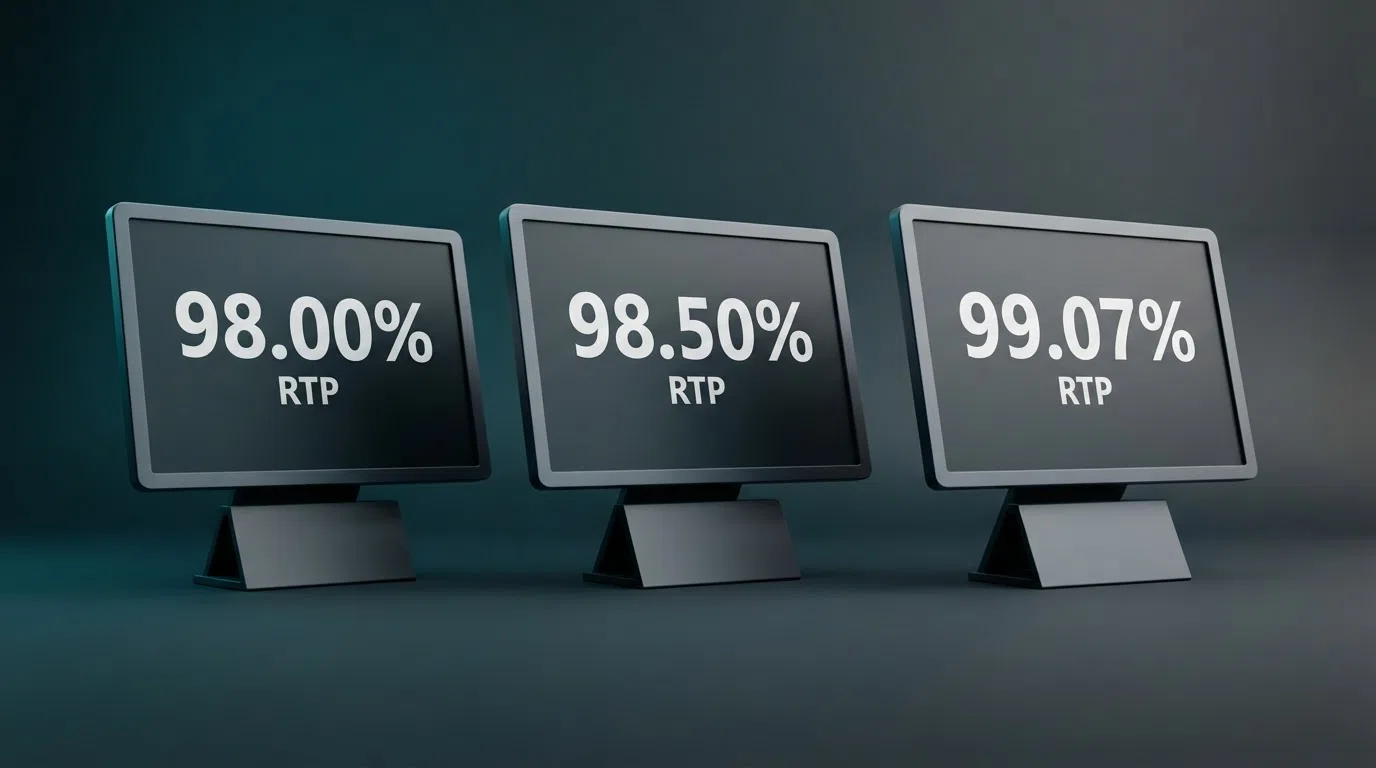
What RTP Means When Volatility Is Already Low
RTP is the percentage of all wagered money a slot returns to players over the long run. It is calculated across millions of spins and expressed as a single number. A 98% RTP slot returns, on average, 98p for every £1 wagered across the entire player base over the entire life of the game. The house edge is the inverse: a 98% RTP slot has a 2% house edge.
The reason RTP matters more when volatility is low is the variance penalty. A high-volatility slot with the same 98% RTP will, over a short session, produce wildly different outcomes — a player can lose 80% of their balance in a hundred spins and then recover, or they can sit on a small balance for an hour waiting for a feature that never arrives. The 2% house edge still applies, but it applies across a wider range of intermediate outcomes. A low-volatility slot with a 2% house edge applies that edge in small, regular increments. The expected loss over a thousand spins is the same mathematically, but the player’s experience of getting there is steadier — and the bankroll is more likely to survive long enough for the maths to play out.
The fixed-RTP versus configurable-RTP distinction matters in the UK market. Blood Suckers by NetEnt is published at 98.00% RTP, and that figure is fixed across every UKGC-licensed casino that runs the NetEnt catalogue — it does not vary. Mega Joker by NetEnt, by contrast, has a theoretical RTP of up to 99.00% in Supermeter mode at the maximum coin level, but most UK casinos in 2026 deploy it at 94.05%. The in-game info screen is always the source of truth. A player who picks Mega Joker without checking the configuration can land on a 94.05% version and wonder why the maths feels worse than the reviews promised.
The Highest-RTP Low Volatility Slots Available in the UK
The table below ranks the ten highest-RTP low-volatility slots available at UK-licensed casinos. RTP is the primary key; max win is included as a secondary differentiator. The Mega Joker row carries a split figure because the configuration matters — a player who lands on the 94.05% version is not playing the same slot as a player on the 99.00% Supermeter setup.
| Slot Title | Provider | RTP | Max Win |
|---|---|---|---|
| Ugga Bugga | Playtech | 99.07% | 1,000× |
| 1429 Uncharted Seas | Thunderkick | 98.50% | 670× |
| Blood Suckers | NetEnt | 98.00% | 1,014.6× |
| Mega Joker | NetEnt | up to 99.00% / 94.05% | 2,000× |
| Starmania | NextGen Gaming | 97.87% | — |
| Jack Hammer | NetEnt | 96.96% | 700× |
| Dazzle Me | NetEnt | 96.90% | 795× |
| Joker’s Jewels | Pragmatic Play | 96.50% | 1,000× |
| Aloha! Cluster Pays | NetEnt | 96.42% | 700× |
| Starburst | NetEnt | 96.09% | 500× |
Two warnings sit on top of this table. The Mega Joker configuration trap is the first: a slot advertised at “up to 99% RTP” can run at 94.05% depending on the casino, and a player who does not check the in-game info screen will get the lower figure. Blood Suckers at 98.00% is the cleanest dependable pick on this list because the configuration is fixed. The second warning is the visual age of the highest-RTP entries — Ugga Bugga and Starmania both predate the modern slot era, and a player expecting current-generation graphics and feature design should know what they are getting.
The RTP–Volatility Sweet Spot: Why This Combination Wins Over Time
The arithmetic behind the case for high RTP plus low volatility is straightforward. Take a £1 stake, repeated a thousand times. On a 96% RTP slot, expected loss is £40. On a 98% RTP slot, expected loss is £20. The £20 difference is not exciting in the abstract, but it compounds. Over ten thousand spins, the gap is £200. Over the life of a bankroll that runs to fifty thousand spins, the gap is £1,000.
The low-volatility layer amplifies the RTP advantage in a way that is harder to quantify but matters in practice. A high-volatility 98% slot will, over a thousand spins, produce a wider distribution of intermediate outcomes than a low-volatility 98% slot. Some of those intermediate outcomes will be catastrophic — a balance zeroed out at spin 400, well short of the thousand-spin horizon the expected loss figure assumes. The low-volatility slot, by spreading wins more evenly, gives the bankroll a better chance of surviving to the point where the long-run RTP figure starts to mean something.
The practical ceiling sits around 99%. Above that figure, the slot is either an outlier (Ugga Bugga at 99.07% carries the visual language of 2005 and a niche player base), or it carries a configuration trap (Mega Joker’s split RTP), or it is so rarely seen at UK-licensed casinos that listing it would mislead. The dependable ceiling for everyday play is 98.00% on Blood Suckers. Above that, every additional tenth of a percentage point costs the player a configuration check.
Reading the Paytable: How to Identify a Gentle Slot Before You Bet
A player does not need to rely on a list to find a low-volatility slot. The paytable, the in-game info screen and the provider’s own volatility label are all public before the first spin. The skill is reading them.
Paytable Clues and In-Game Indicators
The paytable is the most accessible volatility signal. The gap between the lowest-paying symbol and the highest-paying symbol is a rough proxy for the payout spread. A slot where five-of-a-kind on the lowest symbol pays 2× and five-of-a-kind on the highest symbol pays 10× is more likely to be low-volatility than a slot where the gap runs from 2× to 500×. The first concentrates returns; the second concentrates them around rare events.
The jackpot size relative to stake is a stronger proxy. A 500× max win is consistent with low-to-medium volatility. A 5,000× max win is consistent with high. This is not a hard rule — Blood Suckers at 1,014.6× max win is firmly low-volatility — but it is a usable filter when scanning a catalogue. Slots with max wins above 2,000× should be checked before being assumed low-volatility.
The in-game info screen is the source of truth on RTP configuration. Mega Joker’s split configuration (up to 99.00% / 94.05%) is the worked example that justifies the habit. A player who opens any slot and checks the RTP figure on the info screen before wagering is doing the one piece of research that catches the configuration traps. Most reputable providers print the RTP figure alongside the volatility label on the same screen.
The win-size distribution shape is harder to read from the paytable but visible in practice. A low-volatility slot produces a steady stream of 1×–5× wins with the occasional 10×–20× bonus payout. A high-volatility slot produces stretches of dead spins interrupted by features that return 50×, 100× or more. The pattern is unmistakable once a player has seen both.
Provider Volatility Labels and Demo Mode
Pragmatic Play publishes a 1-to-5 volatility star rating on every game in its catalogue. The rating is accessible from the game thumbnail and the info screen. A 1-star or 2-star Pragmatic Play title is reliably low-volatility; Joker’s Jewels sits at 96.50% RTP and is one of the studio’s confirmed low-volatility entries. Big Bass Bonanza sits at 3 stars, which is medium-to-high despite its frequent appearance on competitor “best low volatility” lists.
NetEnt discloses volatility qualitatively — low, medium or high — without a numerical score. The studio’s catalogue is large enough that the qualitative labels are easy to cross-check against third-party data. Starburst at “low” volatility and 96.09% RTP is reliably low-volatility across every UKGC-licensed casino. Mega Joker at “low” volatility and “up to 99% RTP” is reliably low-volatility but not reliably high-RTP, because of the configuration split.
Demo mode is the verification tool. Every UKGC-licensed operator must offer demo play on its slots. A player who wants to confirm a slot’s volatility profile can run two or three hundred demo spins without risking a deposit and watch the win pattern. The hit frequency reads as a rhythm within a few minutes. A slot that delivers a small return every three or four spins is doing what a low-volatility slot should do; a slot that delivers nothing for twenty spins and then a feature return is doing something else.
The UKGC requirement that demo play be available sits alongside the game-design rules that shape how the demo session feels: no auto-play, a minimum 2.5-second spin speed, no losses disguised as wins. The demo session is slower than the offshore equivalent, but it is also closer to what real play looks like.
NetEnt, Pragmatic Play & Thunderkick: The Studios Behind the UK’s Most Reliable Gentle Slots
The ten slots in the high-RTP table above are not evenly distributed across studios. NetEnt supplies the majority. Pragmatic Play supplies one genuine low-volatility entry and one frequently mislabelled one. Thunderkick supplies the highest-RTP confirmed entry. IGT’s footprint is real but harder to quantify at the per-title level.
NetEnt: The Undisputed Low Volatility Powerhouse
NetEnt dominates the high-RTP low-volatility list because the studio has spent a decade building the category. Blood Suckers at 98.00% RTP is the fixed-RTP anchor of the entire UK low-volatility market. Starburst at 96.09% RTP is the default free-spin slot at more UK-licensed welcome offers than any other title, which makes it the slot most UK players have actually touched. Dazzle Me, Jack Hammer and Aloha! Cluster Pays round out the NetEnt low-volatility roster at RTPs between 96.42% and 96.96%, all with max wins in the 700×–795× range.
Mega Joker is the configuration case study. The theoretical RTP of up to 99.00% in Supermeter mode at max coin is the highest figure attached to a NetEnt slot, but the deployed configuration at most UK casinos in 2026 sits at 94.05%. A player picking Mega Joker without checking the in-game info screen is gambling on a number the slot may not be running. The configuration trap is the reason this guide treats Mega Joker as the fourth entry in the high-RTP table rather than the second.
The fixed-RTP guarantee on Blood Suckers is the structural advantage NetEnt offers that other studios do not. Because Blood Suckers’ 98.00% RTP does not vary by casino, the maths is identical at every UKGC-licensed brand running the NetEnt catalogue. A player can pick the operator with the best welcome offer and know the slot will return the same figure.
Pragmatic Play: Joker’s Jewels and the Cautionary Tale of Big Bass Bonanza
Pragmatic Play’s low-volatility catalogue is narrow. Joker’s Jewels at 96.50% RTP and 1,000× max win is the studio’s confirmed low-volatility entry in the high-RTP table. The visuals are deliberately retro — a five-reel, three-row jewel theme with a jester wild — and the maths underneath is clean. The fixed-RTP configuration across Pragmatic Play’s UK deployments means the 96.50% figure does not vary by casino.
Big Bass Bonanza is the cautionary tale. The 96.71% RTP is real and the 2,100× max win is genuinely large. The volatility rating, however, is 3 out of 5 stars on Pragmatic Play’s own scale — medium-to-high. The slot appears on competitor “best low volatility” lists because the hit frequency is decent and the bonus feature is accessible, but neither of those is the same thing as low volatility. A bankroll-conscious player picking Big Bass Bonanza on the strength of a “low volatility” recommendation is buying a profile the slot does not deliver.
The verification path is straightforward: check the Pragmatic Play volatility star rating on the game thumbnail before depositing. 1 or 2 stars is low; 3 stars is medium-to-high; 4 or 5 stars is high. The studio’s own label is more reliable than third-party lists.
Thunderkick and IGT: The High-RTP Specialist and the Heritage Provider
Thunderkick’s contribution to the UK low-volatility market is a single title, and it is the highest-RTP confirmed entry in the table. 1429 Uncharted Seas at 98.50% RTP and 670× max win is a five-reel, three-row cartographic slot with a nautical theme that conceals how generous the maths underneath actually is. The studio’s catalogue is small enough that this single title carries the brand’s low-volatility reputation.
IGT’s footprint in the UK online low-volatility market is real but harder to quantify. The studio’s heritage is in physical slot machines, and the online catalogue reflects that lineage. Per-title RTP data for specific IGT low-volatility online slots is not consistently published in the sources this guide draws on, so the studio is acknowledged here rather than ranked in the table. Players browsing an IGT-heavy catalogue at a featured operator should treat the volatility label on each title individually rather than assuming the studio-wide profile.
Why Low Volatility Slots Are Your Best Bet for Bonus Wagering in 2026
The 10× wagering cap that took effect on 19 January 2026 changed which slots are worth using for bonus clearing, and it changed the maths of every welcome offer on the UK market. Before the cap, a typical bonus carried 35× or 50× wagering — a £100 bonus required £3,500 or £5,000 in turnover to clear, and any slot that kept the balance alive long enough to grind through that volume was valuable. The 10× cap reduces the volume dramatically, but it makes volatility matter more, not less, because the turnover now has to clear on a balance that is much smaller relative to the bonus size.
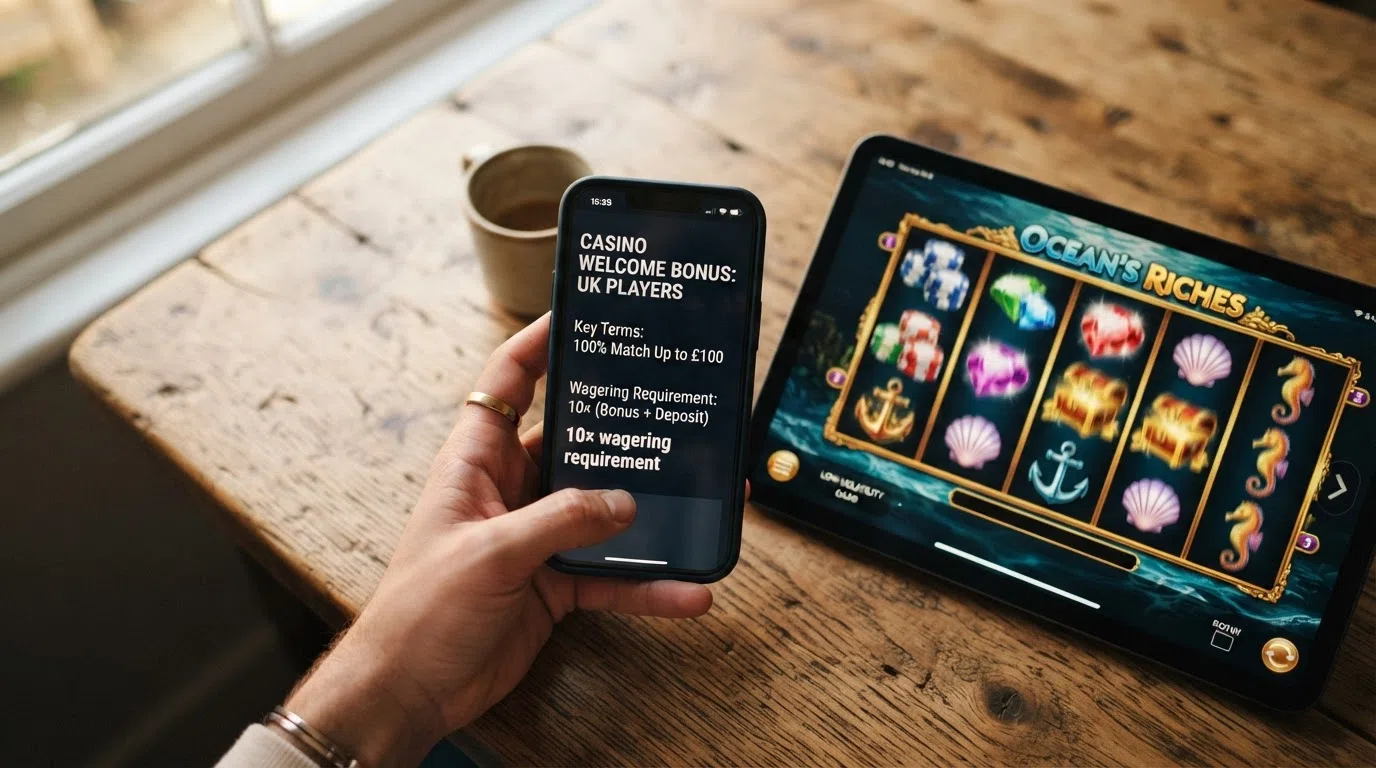
The Arithmetic of Wagering: Why Frequent Small Wins Beat Volatility
The wagering equation is fixed. Required turnover equals bonus multiplied by wagering factor. Under the 10× cap, a £100 bonus requires £1,000 in slot turnover. The expected loss during that turnover is turnover multiplied by the house edge, which is one minus RTP. On a 96% RTP slot, the expected loss is £40. On a 98% RTP slot, the expected loss is £20. The £20 difference is the RTP advantage.
The reason low volatility matters is that the turnover has to clear before the balance hits zero. A high-volatility slot can zero the balance in a single feature drought, leaving the bonus partially cleared and the remaining bonus funds forfeit. A low-volatility slot keeps the balance alive through the steady drip of small returns, giving the turnover time to complete. The maths is the same — expected loss is determined by turnover and RTP, not by volatility — but the variance penalty on a high-volatility slot means the player is more likely to bust before the turnover clears.
Take the 888 Casino welcome offer as a worked example. A £100 bonus at 10× wagering means £1,000 in turnover over 90 days. On Blood Suckers at 98.00% RTP, expected loss is £20. On Starburst at 96.09% RTP, expected loss is £39.10. The player choosing Blood Suckers keeps, on average, £19.10 more of the bonus — money that is withdrawable after the wagering clears. The two slots look similar at the machine; the maths underneath is meaningfully different.
The UKGC 10× Cap and What It Means for Bonus Strategy
Before January 2026, the UK bonus landscape ran on 35× to 50× wagering factors. A £100 bonus could require £5,000 in turnover, and the volume meant volatility genuinely determined whether the player cleared the bonus or bust out before completing it. The 10× cap cuts the volume to £1,000 for a £100 bonus, which makes the RTP choice more important in absolute terms and the volatility choice more important in survival terms.
The cap also ended mixed-product promotional offers — the “bet £10 on football, get free spins” structure that some operators used to attract sports bettors into the casino. Every bonus at a UK-licensed operator is now a casino-only bonus with a single wagering factor, and that factor cannot exceed 10×. The structural effect is to compress the bonus landscape: offers are smaller in absolute value, but the wagering is more achievable.
For a low-volatility player, the cap is favourable. A £100 bonus at 10× on Blood Suckers is a realistic grind — 200 spins at £5 stake, or 1,000 spins at £1 stake, both achievable inside the 90-day validity window on a steady bankroll. The same £100 bonus at 50× on a high-volatility slot was a much harder proposition, because the variance penalty was higher.
Which Low Volatility Slots Pair Best with Real UK Welcome Offers
The pairing depends on the offer type. For matched-deposit bonuses with wagering — 888 Casino’s £100 match, Betway’s £50 match, BetVictor’s £30 bonus funds — Blood Suckers at 98.00% RTP is the strongest pick, because the fixed configuration means the player is clearing the wagering against the smallest house edge available on the UK market. 1429 Uncharted Seas at 98.50% RTP is the second pick, but the configuration is less universally fixed across operators than Blood Suckers.
For no-wagering free-spin offers — Sky Vegas’s 200 spins, Virgin Games’ 100 spins, Betway’s 150 spins — the slot choice is academic, because there is no turnover to clear. Starburst is the default free-spin slot at most of these operators, and it is the right pick on those terms. The win is already withdrawable; the volatility only shapes how the session feels.
For wagered free-spin offers — 32Red’s 320 spins on Big Bass Splash, William Hill’s 200 spins, Ladbrokes’ 100 spins, Coral’s 100 spins — the slot is fixed by the operator. A player choosing between these offers should weigh the spin count, the wagering factor, the validity window and the winnings cap. The volatility of the slot is set; the player’s choice is between offers.
UK Slot Rules 2026: What Stake Caps, Spin Speeds and Bonus Limits Mean for Low Volatility Play
The UK runs the most restrictive online-slot regulatory framework in any major market. The stake cap, the game-design rules and the bonus cap together reshape how a low-volatility session plays, and mostly to the player’s advantage — though not in the way the marketing language usually suggests.
The Age-Banded Stake Cap: £2 or £5 Per Spin — and Why It Favours Low Volatility
The £5 (age 25+) and £2 (age 18 to 24) per-spin caps took effect in April and May 2025 under the Gambling Act 2005 (Operating Licence Conditions) (Amendment) Regulations 2025, statutory instrument SI 2025/215. The caps apply to online slots only — roulette, blackjack and live casino are not covered. The cap applies to the total staked within one game cycle, not per line, which means a 25-payline slot at £0.20 per line is a £5 stake and is at the cap.
The interaction with low volatility is structural. A £5 stake at 98% RTP returns, on average, £4.90 — a 10p loss per spin. Over a thousand spins, the expected loss is £100. The same stake at 96% RTP returns, on average, £4.80 — a 20p loss per spin and an expected loss of £200 over the same thousand spins. The low-volatility slot at the high-RTP end of the category maximises spin count for a fixed bankroll at the smallest possible loss rate.
A high-volatility slot at £5 per spin runs a different arithmetic. The same £5 stake on a 96% high-volatility title produces the same expected loss per spin in the long run, but the short-run variance is wider. A player can lose £100 in five spins on a high-volatility title and have nothing to show for it; the same player on a low-volatility title has likely lost £5 to £10 across the same five spins and is still in the game. Under a hard stake cap, low volatility is the rational choice for stretching a session.
No Auto-Play, No Turbo Spins: How UK Game-Design Rules Change the Session
The UKGC’s October 2021 game-design reforms banned every feature that accelerates play. Auto-play is banned. Spin speed cannot be faster than 2.5 seconds per game cycle. Features that speed up play are banned. Losses disguised as wins — slot animations that celebrate a return smaller than the stake as if it were a win — are banned. Reverse withdrawals are permanently banned, which means a player cannot cancel a withdrawal request and put the money back into play.
The cumulative effect on a low-volatility session is mostly positive. The 2.5-second minimum spin speed slows the pace enough that a player has time to register each spin’s outcome. On a low-volatility slot, where roughly one in three spins pays something, that pacing means the player experiences the small returns as they happen, rather than as a blur of near-misses. The session feels deliberate. The auto-play ban removes the option to set a thousand spins running and walk away, which closes off the bankroll erosion that auto-play enables.
The losses-disguised-as-wins ban is the subtler change. Before October 2021, a slot could animate a 50p return on a £1 stake with the same fanfare as a £5 win, training the player to read any return as a positive outcome. The ban ends that conflation. A 50p return on a £1 stake now reads as a 50p loss with animation, which is what it actually is.
Operators must also display total losses and wins and time played during a slots session. The mandatory session display is a passive reality check — the player sees the running totals without having to ask for them. On a low-volatility slot, where the running total drifts slowly, the display makes the drift visible. On a high-volatility slot, the display makes the spikes visible. Both readings are useful.
UKGC Licensing: What It Guarantees and What It Doesn’t
A GB licence guarantees the stake cap, the game-design rules, the 10× bonus cap, the credit card ban and GAMSTOP participation. It does not cap a player’s deposits, does not guarantee a given RTP configuration on a configurable slot, and does not block access to offshore unlicensed sites.
The public register — last updated 29 July 2026, 2,663 records of licensed gambling businesses — is the verification source. Every operator featured in this guide is listed as Active on the register. A player who wants to verify a licence can search the register by operator name and confirm the licence status, the licence type and the account number. The 888 Casino account number 39028 and the Betway Casino Remote licence number 039372-R-319367-028 are the kinds of identifiers the register publishes.
What a GB licence does not cover is the harder question. It does not impose a deposit ceiling — the UK regulates the product, not the customer’s spend, and the deposit-limit regime is mandatory prompting rather than a state-set cap. It does not impose an RTP floor on slots, which is why configuration splits like Mega Joker’s 94.05%/99.00% are legal. It does not currently give the Commission statutory ISP-blocking power over unlicensed offshore sites — the Commission uses disruption tactics (cease-and-desist, search-engine referral, payment-provider referral), and legislation has been proposed but not enacted.
A player who chooses a UKGC-licensed operator is choosing protection that is real but bounded. The stake cap, the game-design rules, the GAMSTOP backstop and the ADR complaints route are all genuine. The deposit ceiling, the RTP floor and the offshore block are not part of the deal.
The Financial Safeguards: Credit Card Ban, Deposit Prompts and Vulnerability Checks
Beyond the slot-specific rules, the UK’s financial-protection architecture shapes how every session is funded. The credit card ban took effect on 14 April 2020 under LCCP licence condition 6.1.2, covering all remote gambling including e-wallet-funded credit. The Commission’s stated ground was that 22% of online gamblers who used credit cards were classed as problem gamblers. A player cannot fund a slot session with a credit card at any UK-licensed operator, directly or through an e-wallet that draws on credit.
The deposit-limit prompting regime took effect on 31 October 2025. Every UK-licensed operator must prompt a customer to set a financial limit before their first deposit. A decrease in the limit must be actioned immediately; an increase may carry a delay. From 30 September 2026, a gross deposit limit must be offered with at least equal prominence to the deposit button. The effect is to make setting a limit the first thing a player does, not something they have to seek out.
The light-touch financial vulnerability check applies to customers reaching a net deposit threshold of £150 in a rolling 30-day period. It took effect on 28 February 2025. The check uses publicly available data — county court judgments, bankruptcy orders, individual voluntary arrangements, debt relief orders — and is not a credit check. A player who crosses the threshold is flagged for a vulnerability review.
The fuller financial risk assessment framework has been announced but has not yet commenced. The Stage 1 thresholds are £5,000 in net deposits over 24 hours for players aged 25 and over, and £2,500 for under-25s. The final thresholds tighten to £1,000 and £3,000 for the older group, and £750 and £2,000 for the younger group. The start date is not confirmed. When it commences, operators will run enhanced affordability checks on players crossing those thresholds, which is the regulatory direction of travel even though the dates are still pending.
Playing Safely: Responsible Gambling Tools Every UK Slot Player Should Know
The UK’s responsible-gambling infrastructure is the most developed in any major market. The tools are mandatory, the help is free, and the data on harm is published regularly. A low-volatility player who wants to keep their play bounded has more options than the marketing language usually acknowledges.
Deposit Limits, Reality Checks and Time-Outs: The In-Account Toolkit
Every UK-licensed operator must offer three in-account tools. Deposit limits, which the player sets and the operator enforces — a decrease is immediate, an increase may not be. Reality checks, which are pop-up session reminders that show the player how long they have been playing and what they have won or lost. Time-outs, which are short-exclusion periods from 24 hours up to several weeks that block access to the gambling account without enrolling in GAMSTOP.
The mandatory deposit-limit prompt before first deposit is the most consequential of the three. A player who sets a £50 weekly deposit limit on day one cannot deposit £500 in a single bad session later, because the operator enforces the ceiling. The prompt is the regulatory lever; the limit itself is the player’s choice.
Reality checks are the in-session tool. A pop-up every 30 or 60 minutes breaks the rhythm of play and surfaces the running totals. On a low-volatility slot, where the running total drifts slowly, the reality check makes the drift visible. The mandatory session-level display of total wins, losses and time played sits underneath the reality-check system as a passive layer — the player sees the numbers without having to ask.
Time-outs are the gap between a normal session and GAMSTOP enrolment. A 24-hour or 7-day time-out is enough to break a destructive streak without the longer commitment of a self-exclusion. Time-outs do not require GAMSTOP registration, and they do not extend across operators — a time-out at Sky Vegas does not affect a Coral account.
GAMSTOP: The National Self-Exclusion Safety Net
GAMSTOP is the single multi-operator self-exclusion scheme for Great Britain. Since 31 March 2020, every GB-licensed online operator must participate. A player who registers with GAMSTOP is excluded from every UK-licensed gambling site for the chosen period — six months, one year, five years, or five years with auto-renewal — and the exclusion cannot be cancelled early.
The single-registration structure is the key feature. A player does not have to enrol separately at every operator; one GAMSTOP registration blocks access to all of them. The mandatory participation rule means there is no UK-licensed operator a player can reach during an active exclusion. The offline gap — sites that do not hold a GB licence — is the one place GAMSTOP does not reach.
The auto-renewal option is the strongest commitment. A five-year exclusion with auto-renewal continues indefinitely until the player affirmatively opts out at the end of each five-year term. For a player who wants a hard backstop in case other safeguards fail, GAMSTOP enrolment is the most consequential single action available.
Where to Get Help: GamCare, the NHS and the National Gambling Support Network
The treatment infrastructure is free, NHS-backed and growing. GamCare runs the National Gambling Helpline, available 24 hours a day by phone and online chat. In 2023/24 the helpline received 55,228 calls and chats — a 25% increase on the prior year, with 41,070 (74%) classed as supportive interventions. The helpline is the front door for anyone who wants to talk about a gambling problem before they reach a treatment service.
The NHS runs 15 specialist gambling treatment clinics in England, Scotland and Wales as of December 2024. Referrals to those clinics reached 4,355 in 2024/25 — a 91% increase on the 2,284 referrals in 2023/24. The growth is real and reflects both rising demand and expanded clinic capacity. A player who wants clinical treatment rather than helpline support can ask their GP for a referral or contact a clinic directly.
The National Gambling Support Network (NGSN) treated 11,960 clients in 2024/25 — an 11% increase on the 10,754 treated in 2023/24. The NGSN is funded by GambleAware and delivered through regional provider organisations. It sits between the helpline and the NHS clinics in intensity of intervention. Over 52,000 calls to the National Gambling Helpline were logged in the same period.
GamCare also offers an online self-assessment tool for players who want to gauge their own risk profile before deciding whether to seek help. Gamblers Anonymous runs peer support groups across the UK. The combined infrastructure means a player who wants help can find it free, without going through their GP, and on a timeline they choose.
How Many UK Gamblers Are Affected: The Prevalence Picture
The numbers behind the safeguards explain why they exist. In England, 0.4% of adults experienced problem gambling (PGSI 8+) and 1.6% experienced at least moderate-risk gambling (PGSI 3+) according to the Adult Psychiatric Morbidity Survey 2023/24. Men (2.2%) were more likely than women (1.0%) to score 3+ on the PGSI. Prevalence peaked among 25 to 34 year olds at 3.5%.
The treatment gap is narrowing but still real. Almost 1 in 3 (30%) adults who gamble and are experiencing any level of problems want treatment, support or advice — almost double the 17% who said the same in 2020. The willingness to seek help is rising faster than the underlying prevalence, which is the positive direction of travel. The number of people affected by a family member’s or friend’s gambling rose from 6% in 2020 to 8% in 2024 — an estimated 4.3 million adults in Great Britain. The harm extends well beyond the gambler.
How We Picked the Best Low Volatility Slots: Our Methodology
The titles and operators on this page were selected against a fixed set of sources and criteria. The methodology is short because the criteria are short — RTP as the primary metric, volatility classification confirmed by provider or independent review, UK-licensed availability, max win as the secondary differentiator.
The sources used: the UK Gambling Commission public register (2,663 records, last updated 29 July 2026) for operator licence verification; provider product databases (NetEnt, Pragmatic Play, Thunderkick, Playtech, NextGen) for per-title RTP, volatility and max win figures; independent slot-review aggregators (Bojoko, SlotCatalog, RTPTrack, SlotArk) for cross-verification; and the GamCare and GambleAware annual surveys for the responsible-gambling statistics. The calculation inputs were drawn from the same sources.
The ranking criteria, in order: RTP as the primary metric, because it is the only figure that translates directly into expected loss. Volatility classification confirmed by provider disclosure or by at least two independent reviews, because miscategorisation is common — Big Bass Bonanza is the worked example of a frequently mislabelled medium-to-high title. UK-licensed availability, because a slot that is not playable at a UKGC-licensed casino does not enter this ranking. Max win as the secondary differentiator, because two slots at the same RTP with different ceilings are not the same game.
What was excluded: titles without a confirmed low-volatility rating or without a published RTP, which removes several popular slots that the affiliate space promotes without verified data. Operators not on the UKGC public register. Slots whose RTP configuration is known to vary by casino without a fixed guarantee, except where the configuration is disclosed on the in-game info screen — Mega Joker is the included example, with the disclosure condition attached. Big Bass Bonanza is excluded from the low-volatility ranking because it is medium-to-high volatility, despite frequent inclusion on competitor lists.
Frequently Asked Questions
What does low volatility mean in online slots and how does it affect gameplay?
Low volatility means a slot pays small amounts often, rather than large amounts rarely. This rhythm creates a smoother bankroll trajectory with fewer long dry spells. For players, it means a more consistent experience where frequent small wins keep the balance active and extend the session length significantly.
What is the maximum you can stake on online slots in the UK since the 2025 stake limit?
The statutory stake cap is £5 per game cycle for players aged 25 and over, and £2 for players aged 18 to 24. These caps were introduced under the Gambling Act 2005 (Operating Licence Conditions) (Amendment) Regulations 2025. They apply specifically to online slots, not to other casino games.
Do low volatility slots pay out more frequently than high volatility slots?
Yes, low-volatility slots generally offer a higher hit frequency, often exceeding 30%. This means wins occur roughly once every three spins. In contrast, high-volatility games have a lower hit frequency, often below 20%, meaning longer stretches of dead spins before you hit a feature or a significant payout.
Which UK-licensed casinos offer free spins with no wagering requirements?
Several UK-licensed casinos offer free spins without wagering requirements. Notable examples include Sky Vegas, which provides no-wagering spins in its welcome package, and Virgin Games. Betway also offers no-wagering free spins as part of its promotional package, making these options ideal for players who want to keep their winnings.
Can you play low volatility slots for free in demo mode at UK casinos?
Yes, UK-licensed operators are required to offer demo mode for their slot titles. This allows players to test a slot’s volatility and rhythm without risking a deposit. While demo sessions feature slower spin speeds and no auto-play, they provide an accurate experience of the game’s actual win frequency.
Slots – nonukgc-licensedcasinos
Content created by the «nonukgc-licensedcasinos» team