
The best UK online casinos with no limits, ranked honestly
 Available in GB
“No limits” is a promise no UK-licensed casino can keep, and the reason tells you most of what you need to know about high-stakes play in Britain. The Gambling Commission imposes a statutory £5 ceiling on every slot spin for players aged 25 and over, £2 for younger adults, and that figure is the legal maximum, not a suggestion. Live blackjack, live roulette and other table games carry no such cap, and that’s where the real ceiling sits for anyone playing with serious money. The ten casinos ranked below all hold active UKGC remote licences; what separates them is how high their table limits reach, how quickly withdrawals land, and how little the bonus terms take from what you win.

Last checked: September 8, 2026 against the UKGC public register of operating licence holders.
Why “No Limits” at a UK Casino Is Never What It Sounds Like
The Gap Between “No Limits” Marketing and UK Reality
Affiliate sites love the phrase “no limits” because it converts search traffic. What it actually means, in a regulated British market, is “the highest limits legally available”, a very different thing. Every operator that wants to take bets from customers in Great Britain must hold a UKGC remote licence, and that licence forces hard caps in places where offshore competitors leave the ceiling to the player’s wallet. The £5 per-spin cap on online slots for over-25s, in force since 9 April 2025, is the clearest example; the £2 cap for 18–24-year-olds, in force since 21 May 2025, makes it sharper still. A casino advertising truly unlimited slot play to British customers is either unlicensed, breaking the law, or selling something that does not exist.
A £50-per-spin offer is the giveaway, as one Comparasino reviewer put it: if a casino lets you spin for £50, that is not a VIP feature, it is a warning sign that the money is not being held under British safeguards. The same logic applies to bonus terms: wagering requirements at every UK-licensed operator are now capped at 10× on bonus funds under LCCP Social Responsibility Code 5.1.1, in force since 19 December 2025. Anything higher is impossible by law. The gap between “no limits” marketing and the regulated reality is not a small print issue; it is the defining feature of the British market.
High-Limit vs No-Limit: Two Different Tiers of Play
A high-limit casino and a no-limit casino are not the same thing, and the distinction matters more than the marketing suggests. A high-limit operator in Britain offers the largest table maximums, the most generous withdrawal terms and the fastest payouts its licence permits. A no-limit operator, in the literal sense, cannot legally exist in the UKGC fold, because the slot stake cap is non-negotiable regardless of deposit history, VIP tier or personal account manager. Even at the highest end of the loyalty ladder, a £5 spin is a £5 spin.
What VIP status does unlock is access to live-dealer tables with per-position maximums reaching £5,000 to £10,000 at blackjack, and combined table exposure exceeding £25,000 at roulette, alongside bespoke withdrawal terms and dedicated account management. Live dealer tables sit outside the slot cap entirely, which is why the high-stakes action at UK-licensed sites lives there rather than in the slot lobby. For any player seeking a genuine “no limits” feel under a UKGC licence, the live-dealer arena is the only viable destination. The strict slot stake caps defined by British regulation are a fixed market condition, not a term that any operator can bend for even their most loyal VIP.
How and Why Casinos Set Betting Limits
Three forces set every limit a player encounters at a UK-licensed casino. The first is regulation: the UKGC writes the floor and the ceiling, from the £5 slot cap and 2.5-second minimum spin speed to the 10× wagering ceiling and the mandatory identity check before first deposit. The second is risk management: games with higher return-to-player percentages, lower house edges or faster cycle times require tighter maximums to keep the operator solvent through a bad run. Slots, with their combination of high RTP variants, sub-three-second cycles and bonus features, carry the tightest legal ceiling for exactly that reason. The third is anti-money-laundering: the £150 net-deposit financial vulnerability check in a rolling 30-day window, which kicks in under LCCP Social Responsibility Code 3.4.4 using publicly available data, is a limit in everything but name.
The maximum bet field during bonus play is a separate mechanism, layered on top of the statutory caps. Casumo’s £5 max bet while a bonus is active, for example, is an operator-level rule that restricts how the bonus funds can be staked during the wagering period. It is stricter than the legal slot ceiling, not because the regulator demands it but because the operator does, to prevent bonus abuse and to control liability. A player reading any welcome offer should look for this field alongside the wagering multiplier, because it determines how fast the bonus can be cleared and how exposed the player is during the wagering period.
The Real Maximum Bets at UK Online Casinos
The hard ceiling on online slots is the figure that has defined the British market since spring 2025. A player aged 25 or over can stake no more than £5 in a single game cycle, where a cycle runs from the moment a spin is initiated to the moment it settles, including any gamble or feature bet that follows. A player aged 18 to 24 cannot exceed £2. The cap applies to the total staked within the cycle, not to the stake per line or per payline, and operators cannot offer a higher ceiling to anyone, for any reason, regardless of VIP status. These figures are set in statute by SI 2025/215 and are the legal maximum in Britain.
Live blackjack is where the real ceiling sits, with per-position maximums at top-tier Evolution and Playtech Live tables typically reaching £5,000 to £10,000, and higher at reserved VIP rooms. Live roulette allows single-bet maximums of £2,500 to £5,000 on individual numbers or outside bets, and combined table exposure exceeding £25,000 when a player spreads action across all positions. Baccarat and other table games follow a similar pattern, with operator-set maximums well into five figures. None of these table-game ceilings are set by statute: the UKGC caps the spin, not the hand. That distinction is the single most important fact for a high-stakes player comparing options in the UK market.
What High-Stakes Play Looks Like at a UK-Licensed Site
The reality of a high-stakes session at a UK-licensed site is shaped as much by what the regulator mandates as by the operator’s own choices. Identity verification, covering name, address and date of birth, has to clear before the first deposit, a rule in force since 7 May 2019. Reality checks interrupt play at intervals the operator sets, the session timer and total wins-and-losses display are mandatory, and reverse withdrawals are banned outright since October 2021. A player who wants their deposit balance back cannot be made to wait for a bonus to finish or for a wagering requirement to clear; UKGC guidance prohibits operators from imposing any maximum on the withdrawal of deposit-balance funds, and that rule applies to every casino in the featured set.
The 2.5-second minimum spin speed shapes the pace of a slot session in a way that surprises new high-stakes players. At the £5 ceiling for over-25s, the maximum theoretical hourly slot exposure is £7,200, calculated from 60 minutes divided by 2.5 seconds, giving 1,440 game cycles, multiplied by £5. That is the ceiling the regulator permits, and it is the ceiling no operator can raise. Auto-play is banned; turbo and slam-stop features are banned from January 2025 across all online casino products, not just slots. The session feels deliberate in a way offshore play does not, and that deliberateness is the regulator’s intent.
The 10 Best High-Limit Online Casinos for UK Players in 2026
| Casino | UKGC Licence | Welcome Offer | Free Spins | Wagering on Winnings | Fastest Payout Method | Withdrawal Limit |
|---|---|---|---|---|---|---|
| Bet365 | Active (39563) | Up to 500 free spins | Up to 500 | None | PayPal, Skrill, Trustly (1–4h) | £100,000 per transaction, no daily max |
| William Hill | Active (38718) | 200 free spins on Big Bass Splash | 200 at £0.10 | 10×, £30 cap | Visa Direct / Fast Funds (<4h) | Per-transaction limits apply |
| Ladbrokes | Active (39438) | 100 free spins + 300 Ladbucks | 100 | None | Fast Funds / PayPal (<4h) | No aggregate monthly cap confirmed |
| Betfair | Active (Flutter) | Not confirmed in research | Not confirmed | Not confirmed | Fast Funds / Instant Bank (<2h) | Not confirmed |
| Paddy Power | Active (Flutter) | 50 free spins | 50 | None | Fast Funds / PayPal (1–4h) | £25,000 daily |
| Sky Vegas | Active (39439) | 50 no-deposit + 200 deposit spins | 250 total at £0.10 | None | PayPal via Flutter rails | Not specified |
| Casumo | Active (61549) | 50% deposit match up to £100 | None | 10× on bonus | PayPal (<2h), debit card (<1h) | Not specified |
| PlayOJO | Active (SkillOnNet) | 50 free spins on Big Bass Bonanza | 50 at £0.10 | None (site-wide 0×) | PayPal (<24h) | No minimum cashout |
| Unibet | Active (39328) | 200 free spins on Big Bass Bonanza | 200 at £0.10 | Not confirmed | Trustly (<20min verified) | £100,000 Trustly/bank transfer |
| PartyCasino | Active (Entain) | £10 casino bonus | None | 10× | Trustly / Instant Bank (near-instant) | No monthly cap |
All ten operators were verified against the UKGC public register of operating licence holders. The register was last updated 29 July 2026 and contained 2,663 records at that point. The fastest payout method column reflects the shortest confirmed time from the available research; methods that were not confirmed are left blank rather than guessed.
Bet365 — 500 Free Spins, Zero Wagering and Six-Figure Withdrawal Capacity
Bet365 offers the largest free-spins welcome in the featured set: up to 500 spins distributed across ten daily picks of 5, 10, 20 or 50 spins at a time, with no wagering requirement on winnings from any of them. The eligibility threshold is modest, a minimum of £10 in lifetime deposits, and the claim window is 30 days from registration. The bonus slot rotates across the eligible games; the per-spin value varies by selection. Withdrawals sit at the top of the table: up to £100,000 per transaction via Trustly and bank transfer with no daily maximum, and PayPal, Skrill and Trustly payouts land within 1–4 hours for verified accounts. Hillside (UK Gaming) ENC holds the licence under UKGC account 39563.
What separates Bet365 from the rest of the field is the combination of a no-wagering welcome at scale and a withdrawal ceiling that handles six-figure payouts. A high-stakes player considering the welcome should also weigh the efficiency of the payout rails, which are designed to support rapid movement of funds. While spins provide a testing opportunity, the ability to process six-figure sums via Trustly in under two hours can assist with bankroll fluidity, though withdrawal times remain dependent on identity verification and processing cycles.
William Hill — 200 Spins with a £30 Cap and Standard 10× Wagering
William Hill’s 200 free spins on Big Bass Splash, at 10p each, sit behind a £10 deposit and a 10× wagering requirement on winnings, with a hard £30 maximum cashout from the offer and 72-hour validity from credit. Pragmatic Play’s Big Bass Splash is the bonus slot, with a stated return to player of 96.51%. WHG (International) Limited holds the licence under UKGC account 38718, and Visa Direct and Fast Funds withdrawals land within four hours for verified accounts.
The £30 redeemable cap makes this the most tightly bounded welcome in the featured set. A player who calculates the offer purely on the bonus terms will find the headline number generous and the realisable value modest; a 10× playthrough on winnings from 200 spins at 10p can chew through far more than £30 in expected loss before the cap ever triggers. For a high-stakes player, the calculation is honest: treat the spins as a small sample-size look at the slot lobby, and judge William Hill on the table maximums and the payout rails rather than the welcome.
Ladbrokes — 100 Wager-Free Spins from an Entain Stable Operator
Ladbrokes Casino offers 100 free spins on selected games, including Fishin’ Frenzy and Eye of Horus, with no wagering on winnings, after a £10 deposit and play on slot games. The bonus is paired with 300 Ladbucks, the operator’s site-credit token. LC International Limited, part of the Entain Group, holds the licence under UKGC account 39438, and Fast Funds and PayPal withdrawals land within four hours. No aggregate monthly withdrawal cap was confirmed in the available research, which means the practical ceiling is set by the payment method rather than by Ladbrokes itself.
The clean structure of this welcome, free spins with no wagering and no stated cashout cap, is the standout feature. Entain’s multi-brand infrastructure means Ladbrokes shares payment rails and game providers (Playtech, Evolution, NetEnt, Pragmatic Play, IGT) with Coral and Gala, and that scale tends to translate into stable payout times even at peak periods. Prioritizing transparency over sheer quantity pays off here: 100 spins without wagering requirements are consistently more valuable than 500 spins encumbered by a 10× playthrough condition.
Betfair — Fast Payouts on Flutter’s Exchange-Anchored Platform
Betfair’s casino welcome terms were not confirmed in the available research, and that gap is worth flagging rather than papering over. What the research does confirm is the payment infrastructure: Fast Funds and Instant Bank Transfer withdrawals land within two hours for verified accounts, the operator sits on PPB Counterparty Services Limited (Flutter Entertainment), and the live casino is built on Playtech, Evolution, NetEnt, Pragmatic Play and Red Tiger. The Flutter ownership means Betfair shares payment rails and platform engineering with Paddy Power and Sky Vegas, and that shared infrastructure is why the payout times are as fast as they are.
For a high-stakes player, the question is whether the casino welcome matters enough to be a deal-breaker. If the welcome is the reason for signing up, the absence of confirmed terms is a reason to wait. If the live tables and the payout speed are the reason, Betfair sits in the same Flutter-backed tier as Paddy Power, with the addition of the exchange heritage and the trading-floor liquidity that brings. The licence is active; the game providers are top-tier; the welcome is the one element the page cannot speak to with confidence.
Paddy Power — 50 Wager-Free Spins and a £25,000 Daily Withdrawal Cap
Paddy Power Games offers 50 free spins with no wagering on any winnings, and the withdrawal terms are the most explicitly stated in the featured set: a £25,000 daily withdrawal limit, with Fast Funds and PayPal payouts landing within 1–4 hours. The operator is PPB Counterparty Services Limited, Flutter Entertainment, under an active UKGC remote casino licence. Game providers are Playtech, Evolution, Pragmatic Play, Red Tiger and Slingo, the last of which is a Flutter-exclusive format that combines slot mechanics with bingo-style play.
The £25,000 daily cap is a real ceiling for a high-stakes player. Anyone whose session generates winnings above that figure will need to withdraw across multiple days, and the friction is worth pricing into the choice. Where Paddy Power competes is in the compactness of the welcome: 50 spins, no wagering, no hidden multiplier, and the Flutter payout rails doing the rest. For a player who plays in the four-figure range rather than the five- or six-figure range, the daily cap rarely binds.
Sky Vegas — 50 Deposit-Free Spins Plus 200 More, All Wager-Free
Sky Vegas is the only featured operator offering genuinely deposit-free spins: 50 free spins available on registration, with no wagering on winnings and no cashout restriction, plus 200 more free spins after a £10 deposit and wager. All 250 spins are wager-free at £0.10 each, with a 7-day expiry from credit. Bonne Terre Limited (Flutter Entertainment) holds the licence under UKGC account 39439, and the Flutter payment rails handle PayPal withdrawals at speed.
The 50 no-deposit spins are the page’s only example of a welcome that lets a player test the slot lobby without funding the account, and that distinction is worth more than the headline count. The 7-day expiry is tight, but for a player who intends to play within a week, the structure is unusually clean: 50 spins to test the platform, 200 more once committed, all wager-free, all at the same per-spin value. The Sky Vegas wagering terms are simpler than almost anything else in the featured set; the slot selection and the payout speed are the more useful comparators.
Casumo — The Only Deposit-Match Bonus in the Set, at 50% to £100
Casumo is the sole deposit-match welcome in the featured ten: 50% on the first deposit, up to £100 in bonus funds, with 10× wagering on the bonus, a £5 maximum bet while the bonus is active, a 7-day expiry and a £20 minimum deposit. Recro Limited holds the licence under UKGC account 61549. The payout rails are the standout: PayPal withdrawals consistently land within 2 hours and debit-card withdrawals within an hour, which is the fastest debit-card payout confirmed in the featured set.
The 10× wagering requirement on a 50% match sits within the statutory ceiling under LCCP Social Responsibility Code 5.1.1, in force since 19 December 2025, and the £5 max-bet-while-bonus-active rule is the operator’s own tighter layer on top of the £5 statutory slot cap. For a high-stakes player, the welcome is a smaller upside than the wager-free spin offers elsewhere, but the payout speed is the comparable that matters. A player whose bankroll turns over quickly needs withdrawals that match, and Casumo’s debit-card time is the fastest confirmed in the featured set.
PlayOJO — 50 Spins, Zero Wagering Site-Wide and No Minimum Cashout
PlayOJO runs a site-wide zero-wagering policy, which means every bonus and every free-spin win is withdrawable as cash from the moment it is credited, with no playthrough, no multiplier and no expiry multiplier lurking in the small print. The welcome is 50 free spins on Big Bass Bonanza at 10p each for a £10 minimum deposit, and Big Bass Bonanza is a Pragmatic Play title with a stated 96.71% RTP. SkillOnNet holds the licence under an active UKGC remote casino registration. PayPal withdrawals land within 24 hours, and there is no minimum withdrawal amount and no stated maximum cashout.
The no-minimum-cashout rule is the rarer feature. A player who wants to withdraw £3 from winnings can do so without waiting for a threshold; a player who wins £30,000 from a single bonus can withdraw it as cash without negotiating a cap. The wager-free site-wide policy is the most player-friendly bonus structure in the featured set, and the only catch is the modest welcome size compared to Bet365’s 500-spin or Unibet’s 200-spin offers. For a player who values terms over headline count, PlayOJO is the cleanest offer on the page.
Unibet — 200 Spins, £100,000 Withdrawal Ceiling and Sub-20-Minute Trustly
Unibet offers 200 free spins on Big Bass Bonanza at 10p each for a £10 deposit and stake, with Trustly withdrawals reported under 20 minutes for verified accounts and a maximum withdrawal of £100,000 via Trustly and bank transfer (£50,000 via debit card). Platinum Gaming Limited holds the licence under UKGC account 39328, and the platform carries NetEnt, Evolution, Microgaming, Pragmatic Play, Play’n GO and Red Tiger. The sub-20-minute Trustly is the fastest confirmed payout in the featured set.
The compliance context is part of the picture. Platinum Gaming Limited received a £10 million UKGC fine in October 2025 for anti-money-laundering and social responsibility failures and is now operating under a mandatory third-party audit. The fine is a public record, and the audit is the operator’s current compliance posture, neither of which changes the fact that Unibet holds an active UKGC licence and serves UK customers under it. A player weighing the welcome should know both: the payout speed is the fastest in the field, and the regulator’s recent action is the reason the audit is in place.
PartyCasino — £10 Bonus with 10× Wagering and No Monthly Withdrawal Cap
PartyCasino offers a £10 cash bonus for a £10 deposit and bet, with 10× wagering on the bonus and 30-day validity from registration, and the standout feature is the confirmed no-monthly-withdrawal-cap policy. LC International Limited (Entain Group) holds the licence under an active UKGC remote casino registration. Trustly and Instant Bank withdrawals are near-instant after a 24–48 hour pending review, PayPal and e-wallets clear within 24 hours, and Visa debit takes 1–5 business days.
The no-monthly-cap policy is the page’s only example of a withdrawal ceiling being removed entirely, and it is the comparison that matters most for a high-stakes player. A player who wins a five-figure sum at PartyCasino can withdraw it without waiting on a daily or monthly reset, and the pending review is the only friction in the chain. The £10 bonus is small, the wagering is standard, but the withdrawal structure is the cleanest in the featured set for a player whose sessions produce large payouts.
Where the Real Caps Land: Slots, Blackjack and Roulette Compared
The split between slot caps and table-game caps is the single most important fact for a high-stakes player in the British market. Slots carry the tightest legal ceiling; live tables carry the highest. The asymmetry is the design, and it tells a high-stakes player where to put their money.

Slot Betting Limits: The £5 and £2 Caps That Changed Everything
The £5 per-game-cycle cap for over-25s came into force on 9 April 2025, and the £2 cap for 18–24-year-olds followed on 21 May 2025, both under the statutory instrument SI 2025/215. A “game cycle” is the period from the moment a spin is initiated to the moment it settles, including any gamble or feature bet that follows, and the cap applies to the total staked within that cycle, not to a per-line or per-payline figure. The political rationale, set out in the UK Government’s announcement, was that easily accessible online slots are one of the most addictive forms of gambling, associated with large losses, long sessions and binge play, and unlike land-based gaming machines, they had no statutory stake limits before the 2025 reform.
The cap is the legal maximum, not an operator’s choice. No UK-licensed casino can offer a higher ceiling, regardless of deposit history, VIP tier or personal account manager, and a casino that advertises £50 or £100 slot spins to British customers is either unlicensed, breaking the law or describing a non-UK product. The two-tier age band, with the lower cap for younger adults, is the sharpest part of the policy: the regulator’s view is that players under 25 face higher risk from rapid-loss products, and the stake ceiling reflects that judgement.
No-Limit Slots Don’t Exist in the UK — Here’s What You Get Instead
Before April 2025, UK-licensed slot maximums were set by operators and ranged widely, with some games accepting £50, £100 or more per spin. That landscape does not exist any longer. Every UK-licensed slot is now capped at £5 or £2 depending on age, and the ceiling is the same on a £10 deposit as on a £10,000 deposit. What remains for high-stakes slot players is the live-table arena, higher-RTP slot variants, exclusive titles and faster game cycles at the 2.5-second minimum. The total online gambling GGY was £7.8 billion in FY 2024–25, of which slots GGY rose 12% year-on-year to reach £1.55 billion in Q4 FY 2025/26, the highest single-category growth figure in the published market data.
The right comparison is no longer between one UK-licensed slot and another. They all carry the same cap. The comparison is between slot play and live-table play, where the ceiling sits in five figures rather than single pounds, and where the 2.5-second minimum cycle does not apply. A player who wants the high-stakes experience at a UK-licensed site is, by design, a live-table player.
Live Blackjack Table Maximums: £5,000 to £10,000 Per Hand
Live blackjack table maximums at UK operators typically reach £5,000 to £10,000 per position at top-tier Evolution and Playtech Live studios, with Ladbrokes, Coral and Casumo named as hosts of the highest-limit tables in the available research. Side-bet limits sit well below the main-bet ceiling and are set by the studio rather than by the operator. VIP and private tables, available on request, can carry higher per-position maximums and bespoke side-bet structures, but the headline figure most players will encounter is the £5,000–£10,000 per-position range.
A 2.5% house edge at standard rules, multiplied by 200 hands per hour at a busy table, gives a high-stakes player a clear sense of exposure. At £5,000 per hand, the theoretical hourly loss is around £25,000 before variance. That is the scale of action a high-stakes player is looking for, and it is the scale the UK regulator permits, because blackjack is not a slot. The table caps are operator-set within a non-statutory ceiling; the slot caps are statutory. The distinction is the reason the live lobby is the page’s recommended arena for high-stakes play.
Live Roulette Betting Limits: Per-Spin Caps and Combined Table Maximums
Live roulette single-bet maximums typically sit at £2,500 to £5,000 on individual numbers or outside bets, with combined table maximums exceeding £25,000 when a player spreads action across all bet positions. The provider split is worth knowing: Evolution’s VIP and Salon Privé tables carry higher combined maximums than the standard studio tables, and Playtech Live’s high-roller rooms operate at a similar tier. For a high-stakes player, the relevant number is the combined table exposure rather than the single-bet ceiling, because the combined figure is what determines the worst-case outcome of a single spin.
Roulette’s house edge is fixed at 2.7% on a single-zero wheel and 5.26% on a double-zero wheel, and that figure is independent of stake size. What changes with stake size is the variance and the operator’s tolerance for short-term swings, which is why combined table maximums are a softer cap than single-bet maximums. A player who plans to spread action across dozens of positions per spin needs to read the combined table figure, not the per-bet figure.
How Table Limits Differ Across Game Categories and Providers
The limit hierarchy across live casino games follows the underlying house edge and game speed. Blackjack, with the lowest house edge at standard rules and the slowest hand cadence, carries the highest table maximums. Roulette, with a higher house edge and faster spin cycles, sits in the middle. Baccarat and game-show formats, including the live titles from Evolution and Pragmatic Play, sit below blackjack but above most slot products. The provider split is sharpest at the top of the range: Evolution’s VIP and Salon Privé tables and Playtech Live’s high-roller rooms operate in a different tier from the standard studio tables, and the difference shows up in the combined table maximums rather than the per-bet ceilings.
What the hierarchy means for a high-stakes player is that the choice of game and provider is as important as the choice of casino. A player who wants the highest per-spin exposure at a UK-licensed site is choosing Evolution VIP blackjack over a standard live table, and a Playtech Live roulette VIP room over a generic live roulette. The casino matters for the welcome, the payout speed and the withdrawal ceiling; the game and provider matter for the ceiling itself.
Getting Your Money Out: Withdrawal Ceilings, Deposit Rules and Payout Speed
A high-stakes player at a UK-licensed casino wins on the way in, the welcome and the table limits, and on the way out, the withdrawal ceiling and the payout speed. The regulators cap the slots; the operators cap the withdrawals. The trade-off is the structure of the market.
Withdrawal Limits: Which Casinos Let You Cash Out Without a Ceiling
| Casino | Withdrawal Ceiling | Fastest Payout Method | Fastest Payout Time |
|---|---|---|---|
| PartyCasino | No monthly cap | Trustly / Instant Bank | Near-instant (after 24–48h pending) |
| PlayOJO | No minimum, no stated maximum | PayPal | <24h |
| Unibet | £100,000 Trustly / bank transfer; £50,000 debit card | Trustly | <20min (verified accounts) |
| Bet365 | No daily max; £100,000 per transaction | PayPal, Skrill, Trustly | 1–4h |
| Paddy Power | £25,000 daily | Fast Funds / PayPal | 1–4h |
| Betfair | Not confirmed | Fast Funds / Instant Bank | <2h |
| Sky Vegas | Not specified | PayPal via Flutter rails | Not confirmed |
| Casumo | Not specified | PayPal / debit card | <2h / <1h |
| Ladbrokes | No aggregate monthly cap confirmed | Fast Funds / PayPal | <4h |
| William Hill | Per-transaction limits apply | Visa Direct / Fast Funds | <4h |
The two operators at the top of this comparison are the ones that have removed the ceiling most explicitly. PartyCasino’s no-monthly-cap is the page’s only confirmed example, and PlayOJO’s no-minimum-cashout policy sits alongside a site-wide zero-wagering structure that means winnings are never locked behind a multiplier. Unibet and Bet365 carry the highest stated ceilings (£100,000 per transaction via Trustly and bank transfer), which is the relevant figure for a player whose single-session winnings run into five figures. Paddy Power’s £25,000 daily cap is a real ceiling for a high-stakes player. For the rest, the figures research could not confirm are left blank rather than guessed.
Deposit Rules and Minimums at UK High-Limit Casinos
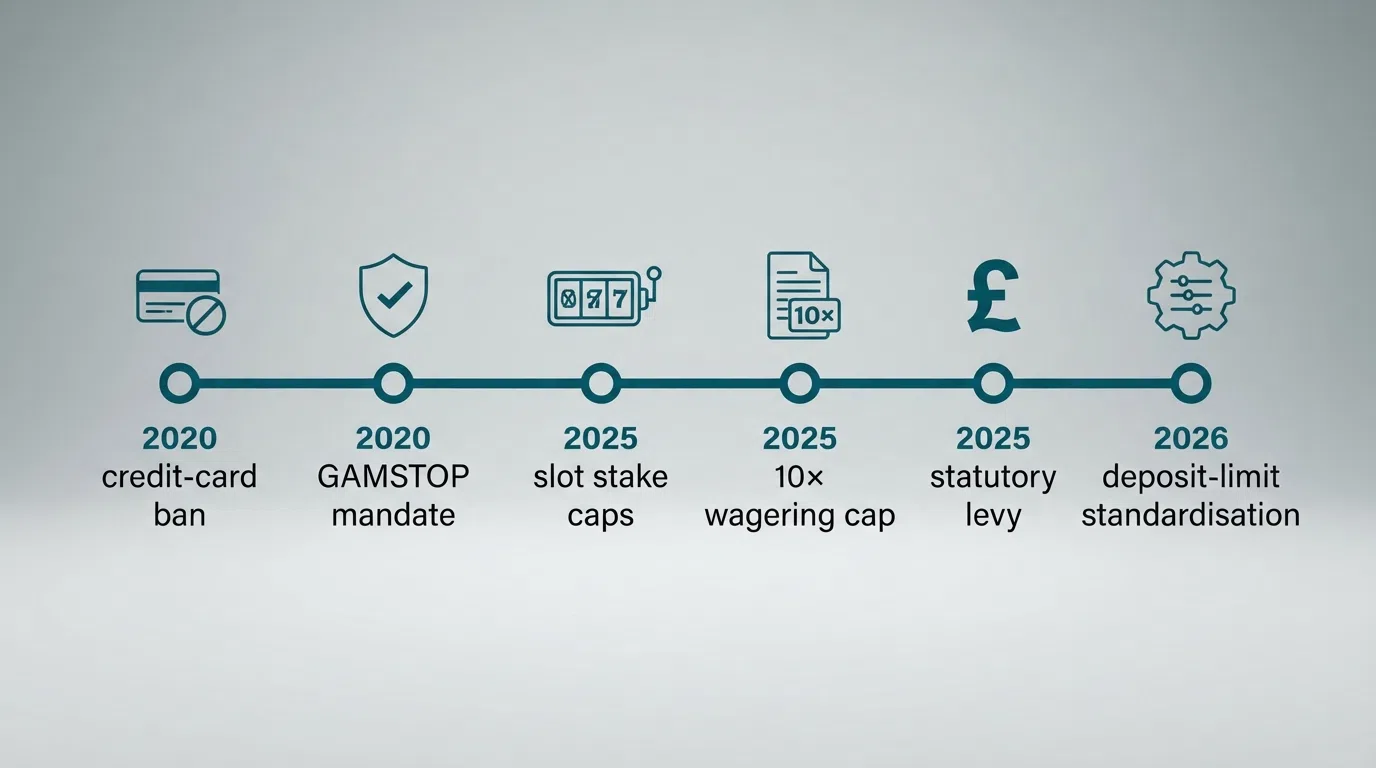
The deposit landscape in the British market is shaped by the credit-card ban, the minimum-deposit convention and the coming standardisation of “deposit limit” terminology. Most featured operators set a £10 minimum deposit, with Casumo’s £20 as the outlier. Credit cards have been banned for all remote gambling in Great Britain since 14 April 2020, and the ban extends to credit-card-funded e-wallet deposits under LCCP licence condition 6.1.2, so a Visa or Mastercard credit card will not work at any of the featured operators. Identity verification, covering name, address and date of birth, has to clear before the first deposit, a rule in force since 7 May 2019.
From 30 September 2026, all UK online operators must offer a gross deposit limit, based solely on money paid into the account, and only that form may be called a “deposit limit” under RTS 12. The change is a terminology and standardisation step rather than a new restriction: the player-set deposit limit remains voluntary, and decreases take effect immediately. The £150 net-deposit financial vulnerability check, in force under LCCP Social Responsibility Code 3.4.4, sits alongside the player-set limit and uses publicly available data only. None of the featured operators imposes a maximum deposit ceiling, and the statutory regime is to player-set limits plus vulnerability checks, not state-set caps.
Payout Speed: From Under-20-Minute Trustly to Five-Day Debit Card
Payout speed at UK-licensed casinos is the comparison that varies most across operators and payment methods. Unibet’s Trustly withdrawal, reported under 20 minutes for verified accounts, is the fastest confirmed payout in the featured set. Casumo’s PayPal, consistently within 2 hours, and debit card, under an hour, set the bar for non-Trustly methods. Bet365, William Hill, Ladbrokes and Paddy Power form a sub-4-hour tier for PayPal, Fast Funds and Trustly. PartyCasino’s Trustly and Instant Bank are near-instant after a 24–48 hour pending review, which is the bottleneck to factor in. PlayOJO’s PayPal within 24 hours is the slowest confirmed PayPal payout in the featured set, and the slowest method at any featured operator is Visa debit, which takes 1–5 business days across the board.
The reason payout speed varies comes down to two things: the payment rail and the operator’s pending-review window. Trustly, PayPal, Skrill and Fast Funds are designed for near-real-time settlement; debit cards run on slower banking infrastructure and are subject to scheme-level processing times. The pending-review window, typically 24–48 hours, is the operator’s own check on the first withdrawal from a new account or a new payment method, and it is where most of the delay in an otherwise fast payout chain tends to sit. A high-stakes player who wants sub-24-hour payouts should be funding and withdrawing via Trustly, PayPal or Fast Funds, not via debit card.
The UKGC Rules on Withdrawals: Your Deposit Balance Is Always Yours
The UKGC’s position on deposit-balance withdrawals is the regulatory foundation that distinguishes the British market from offshore alternatives. Operators must not impose any maximum limit on the amount a consumer may withdraw from their deposit balance; players are entitled to withdraw deposit-balance funds at any time, including when a bonus is pending or active. The rule applies to every UKGC-licensed operator, and it is the reason “no monthly cap” and “no daily maximum” are operator-level features rather than legal requirements. Operators may restrict bonus-funds withdrawals via wagering terms, and a player who has not yet cleared a bonus cannot withdraw the bonus portion, but the deposit portion is always the player’s to take.
Reverse withdrawals, the practice of returning withdrawn funds to the playing balance, are banned outright since October 2021. Closed-loop withdrawal, the policy that requires funds to return to the original deposit method where possible, is the standard practice and is the reason a player cannot withdraw a Visa deposit to a Skrill account without first withdrawing to Visa. The combined effect is a withdrawal framework that protects the deposit balance absolutely, restricts bonus funds only through wagering terms, and routes the funds back through the original channel for anti-money-laundering reasons. For a high-stakes player, the framework is the most player-friendly in any major regulated market.
The UKGC Rulebook: What the Regulator Caps, Bans and Demands
The regulatory architecture that shapes every bet, bonus and withdrawal at a UK-licensed casino runs from the Gambling Act 2005 through the LCCP and the Remote Technical Standards, with the Gambling (Licensing and Advertising) Act 2014 extending point-of-consumption licensing to remote operators. The architecture is dense, and most of it is invisible until a player encounters a specific limit.
The UKGC Licence: What It Requires and What It Prohibits
The UKGC’s three licensing objectives, set out in section 1 of the Gambling Act 2005, are preventing crime, ensuring fair and open gambling, and protecting children and vulnerable persons. The operating licence, with its LCCP conditions and codes of practice, is the mechanism through which those objectives are enforced, and the personal management licence, required for key personnel, sits alongside it. A UKGC remote casino licence is the single non-negotiable filter for any operator serving British customers, and the public register, last updated 29 July 2026 with 2,663 records, is the only authoritative source for licence status.
What the licence requires of operators is the architecture the player encounters in every session. Identity verification before first deposit, in force since 7 May 2019. Game-design rules from October 2021, banning auto-play, setting a 2.5-second minimum spin speed, banning losses disguised as wins, and banning features that speed up play, with the rules extended from slots to all online casino products from 17 January 2025. The 10× wagering cap from 19 December 2025 under LCCP Social Responsibility Code 5.1.1, with mixed-product promotions banned alongside it. The statutory levy from 6 April 2025, charging 1.1% of GGY on remote operators. The credit-card ban from 14 April 2020. None of these rules is a recent exception; together they form the floor a UK-licensed casino cannot fall below.
How UK Regulation Shapes Every Bet You Place
The regulatory interventions a player encounters during a single session are layered, and they are not all the same kind of intervention. The £5 and £2 slot caps are statutory hard ceilings, applied by law and not negotiable. The £150 net-deposit financial vulnerability check in a rolling 30-day window, in force under LCCP Social Responsibility Code 3.4.4 and using publicly available data, is a threshold at which the operator must check whether the player is showing signs of financial distress. The mandatory deposit-limit prompt before first deposit, in force from 31 October 2025, is a behavioural nudge rather than a cap. The announced but not-yet-commenced financial risk assessments, with Stage 1 thresholds of £5,000 gross deposits in 30 days or £2,500 net deposits, are a future intervention with a staged rollout that the regulator has signalled but not started.
The economic backdrop is part of the picture. Remote Gaming Duty rose from 21% to 40% from 1 April 2026, announced at Autumn Budget 2025, and the rise is the largest single change to operator tax in a generation. The 40% RGD sits on top of the 1.1% statutory levy, and together they amount to a significant share of GGY. The effect on the player is indirect: higher operator costs tend to compress promotional generosity, which is one reason the 10× wagering cap is a ceiling rather than a floor. A high-stakes player reading the bonus terms at a UK-licensed casino is reading the downstream of a 40% effective tax rate.
Offshore vs UK-Licensed: What You Lose When You Go Offshore
The protection gap between a UK-licensed casino and an offshore alternative is the most important fact a high-stakes player in Britain can know. Offering unlicensed remote gambling to GB customers is a criminal offence under section 33 of the Gambling Act 2005, carrying up to 51 weeks’ imprisonment, an unlimited fine, or both, and the Commission enforces through cease-and-desist notices, search-engine delisting referrals (447,778 URLs referred and 287,961 removed between April 2024 and June 2025), domain suspension and payment-provider referrals. The Commission does not hold statutory ISP or DNS blocking powers; legislation has been proposed but not enacted. The player who gambles on an unlicensed site faces no criminal penalty, but loses every protection the UK regime guarantees.
What the player loses is the list of things this page has spent its time describing. No GAMSTOP coverage, because GAMSTOP is licence-bound and online-only and cannot reach unlicensed sites. No alternative dispute resolution, because ADR is a UKGC licence condition. No statutory stake limits, no guaranteed deposit-balance withdrawal, no complaints route, no financial vulnerability check, no reality check. A “Maltese-licensed” or “Curaçao-licensed” framing does not substitute for a UKGC licence, and a casino licensed in Malta that targets British customers without a GB licence is operating illegally. The offshore-but-still-regulated framing is incorrect for the UK market.
Staying in Control: Deposit Limits, Self-Exclusion and the Tools That Work
The UK responsible-gambling infrastructure runs from the operator-level deposit cap at one end to the NHS gambling harm clinics at the other, and the tools work because they are layered, not because any one of them is sufficient.
Your Personal Caps: Deposit Limits, Loss Limits and Session Timers
Every UK-licensed casino offers player-set deposit limits, loss limits and session timers, and the deposit-limit prompt has been mandatory before first deposit since 31 October 2025. The distinction between the three is worth understanding: a deposit limit caps the total amount paid into the account, a loss limit caps the net amount lost over a period, and a session timer caps the time spent in a single session. Reality checks, in-game prompts showing time played and net result, are mandatory at intervals the operator sets. Time-out, a short break from 24 hours to six weeks, is available at every UK-licensed casino.
How adjustments work is the part most players do not read. Decrease requests take effect immediately; increase requests require a 24-hour cooling-off period and a confirmation step, a design choice intended to slow down the decision to bet more. From 30 September 2026, the deposit-limit terminology will standardise under RTS 12: only limits based on money paid in, gross deposits, may be called a “deposit limit”, and that form must be offered at equal prominence with any other limit type. The change is consumer-protection housekeeping rather than a new restriction, and the underlying principle is the same: a player who wants to bet less should be able to do so in a single click, and a player who wants to bet more should have to wait and confirm.
GAMSTOP: How the National Self-Exclusion Register Works
GAMSTOP is mandatory for every GB-licensed online operator since 31 March 2020, and the exclusion periods are six months, one year, five years, or five years with auto-renewal. Once registered, the exclusion cannot be cancelled early, regardless of the operator’s discretion or the player’s subsequent request; the only way back is to wait out the chosen period. The exclusion applies across every GB-licensed online operator simultaneously, and the player is removed from marketing lists for the duration. GAMSTOP is online-only and licence-bound, which means it cannot reach unlicensed sites; a player who self-excludes and then moves to an offshore casino bypasses the system entirely.
What happens when the exclusion period ends is worth knowing. The player’s account is not automatically reinstated; they need to contact the operator and go through a reactivation process, which includes a 24-hour cooling-off period and a responsible-gambling check. The auto-renewal option, five years with no opt-out, is the regulator’s preferred path for anyone who has needed the tool in the first place. The 0.4% problem-gambling prevalence figure, from the NHS Adult Psychiatric Morbidity Survey 2023–24, translates to roughly one in 250 adults in England; the absolute number is small, but the protection is mandatory for a reason.
GamCare, the NHS and the Full UK Safety Net
The treatment infrastructure behind UK safer-gambling policy runs from the 24/7 National Gambling Helpline, run by GamCare, through NHS gambling harm clinics in England, Scotland and Wales, to peer support through Gamblers Anonymous and research funding through GambleAware. GamCare made 996 referrals to treatment and peer-based support in January 2026, up 48% year-on-year from 674 in January 2025, and that figure is the single sharpest indicator of demand. The statutory levy, in force from 6 April 2025, charges 1.1% of GGY on remote operators and splits the proceeds 50% treatment, 30% prevention, 20% research, replacing the previous voluntary-contribution regime with a ringfenced funding stream.
The 0.4% problem-gambling prevalence figure (PGSI 8+) and the 1.6% moderate-risk figure (PGSI 3+) are the headline numbers from the NHS Adult Psychiatric Morbidity Survey 2023–24, and they describe the population the safety net serves. Around 3.8% of the English adult population is at elevated risk, and around 7% of the British population is negatively affected by someone else’s gambling, according to UK Government treatment-assessment data. The safety net is sized for a small but real population, and the 48% year-on-year rise in GamCare referrals is a measure of how many more people are reaching it.
Frequently Asked Questions
What does “no limits” actually mean at a UK online casino?
In the context of regulated British gambling, “no limits” refers to the highest betting caps available under UK law, rather than truly unlimited wagering. Since statutory slot stake limits of £5 or £2 are strictly enforced, the term highlights operators that offer the largest live-table maximums, fastest payouts, and most flexible withdrawal terms.
Are there online casinos in the UK with no wagering requirements?
Yes, some UK-licensed casinos offer wager-free bonuses, where any winnings from free spins or other promotional offers are credited as withdrawable cash. These operators typically prioritize transparency over massive headline numbers, allowing players to cash out their winnings without negotiating complex playthrough multipliers or hidden expiry clauses.
Is it legal for a UK casino to offer unlimited betting?
No, it is not legal for a UK-licensed casino to offer unlimited slot betting. The UK Gambling Commission mandates a statutory stake cap of £5 per game cycle for players over 25 and £2 for those aged 18–24. Live-dealer tables may feature higher operator-set maximums, but these are still subject to regulatory oversight.
How do I set a deposit limit at a UK online casino?
UK-licensed operators are required to offer player-set deposit limits, which you can typically manage through your account settings under “Responsible Gambling” or “Account Limits.” Decreasing these limits takes effect immediately, while increasing them requires a 24-hour cooling-off period and a confirmation step to encourage safer, more considered play.
What happens if I play at an online casino without a UKGC licence?
Gambling at an unlicensed site means you lose all legal protections guaranteed by the UK Gambling Commission, including access to GAMSTOP, independent dispute resolution, and guaranteed deposit-balance withdrawals. While you face no criminal penalty, unlicensed operators are not subject to UK standards on fairness, safer gambling, or financial vulnerability checks.
The featured ten were selected from a wider field of UKGC-licensed remote casino operators on three criteria: an active GB Remote Casino licence, verified against the UKGC public register on the date of the last data refresh; a published welcome offer with terms that could be confirmed against at least one source; and a withdrawal or payout profile that a high-stakes player would recognise as competitive. The register, which contained 2,663 records at the 29 July 2026 update, is the only authoritative source for licence status; the register confirms “Active” status but does not publish per-brand licence dates, and the verification noted in each operator’s write-up reflects a check of the register entry, not a check of the licence history.
The sources consulted for bonus and payout figures include operator websites, UKGC guidance documents, and a range of affiliate review sites including Betzoid, Casino.org, Racing Post, The Sun, Livescore, British Gambler, SpinVerdict and GambleGuru. Where two sources disagreed, the more recent and more directly-licensed source was preferred. The ranking is qualitative: there are no invented weightings, no scoring formulas, and no per-criterion percentages. The order reflects the balance of welcome size, wagering fairness, payout speed and withdrawal ceiling, with no single criterion overriding the others. Operators whose bonus or withdrawal terms could not be confirmed against at least one published source are flagged in the write-up rather than ranked on incomplete data.
The exclusion criteria were straightforward. Operators without an active GB Remote Casino licence were excluded. Operators whose bonus terms could not be confirmed against at least one published source were either flagged or excluded, depending on whether the missing data was structural or peripheral. Offshore brands, even those licensed in other reputable jurisdictions, were excluded because a Maltese or Curaçao licence does not substitute for a GB licence, and the page is about play inside the UK regulatory perimeter. The ten operators that remained are not the only UKGC-licensed high-limit options; they are the ten whose terms could be confirmed and compared.
What a High-Stakes UK Session Actually Costs — and What It’s Worth
A representative calculation shows what the headline bonus terms mean in real play. The 10× wagering cap, the statutory maximum under LCCP Social Responsibility Code 5.1.1, applied to a representative £100 bonus, requires £1,000 of qualifying turnover before the bonus funds convert to withdrawable cash. At the £5 maximum stake per slot spin, the statutory slot cap, that turnover works out to 200 spins, and at the 5-second minimum game cycle from the game-design rules, the time required is around 17 minutes. That is the time cost of clearing the £100 bonus at the maximum stake, and the figure is the floor: any reduction in stake-per-spin raises the spin count, and any reduction in game-cycle speed raises the time, so the actual time to clear the bonus for a player spinning below the cap will be longer.
What the figure does not show is the cost of the play itself, because the calculation deliberately leaves out the expected loss. A 10× playthrough on bonus funds at a typical 96% RTP slot costs the player, in expectation, around 4% of the wagered amount, or £40 in expected loss on a £1,000 turnover. The £100 bonus is therefore worth, in expectation, £60 once the wagering is complete, and the time cost of the playthrough, around 17 minutes at maximum stake, is the price paid to realise that value. None of this is guaranteed: a single bonus session can return more or less than the expected value, and the figure is a long-run average rather than a promise.
The honest conclusion is that “no limits” is a promise the British regulatory framework does not permit, and the trade-off is the structure of the market. Slot play is capped at £5 or £2 depending on age; live-table play is uncapped by statute, with operator-set maximums reaching five figures per position at blackjack and combined table exposure exceeding £25,000 at roulette. Welcome bonuses are capped at 10× wagering, which is the most player-friendly bonus ceiling in any major regulated market. Withdrawal ceilings vary by operator, from no monthly cap at PartyCasino to £100,000 per transaction at Unibet and Bet365, and deposit-balance withdrawals are guaranteed by regulation at every UKGC-licensed operator. Payout speed ranges from under 20 minutes via Trustly at Unibet to 1–5 business days via debit card, with PayPal, Fast Funds and Skrill clustering in the sub-4-hour tier.
The practical next step is to pick from the featured ten based on what matters most. A player who values payout speed chooses Unibet or Casumo. A player who values withdrawal ceiling chooses Bet365 or Unibet. A player who values bonus fairness chooses PlayOJO’s site-wide zero-wagering structure or Bet365’s 500 wager-free spins. A player who values no monthly cap chooses PartyCasino. A player who values the cleanest no-deposit welcome chooses Sky Vegas’s 50 wager-free spins on registration. The deposit limit should be set before funding the account, the UKGC licence should be verified on the public register, and the choice should be made knowing that every protection described in this article, from GAMSTOP to the deposit-balance withdrawal guarantee, from the £5 slot cap to the 10× wagering ceiling, vanishes the moment a player moves to an unlicensed site. The trade-off is real, and it is worth taking for anyone playing with serious money under British rules.
Limits – nonukgc-licensedcasinos
Content created by the «nonukgc-licensedcasinos» team