
Best RTG Casinos UK 2026: What the Licence Gap Means for Players
 Available in GB
Most UK-facing lists for “best RTG casinos” lead with the games and end with a bonus code. The frame they leave out is the one that decides what a player actually keeps. Real Time Gaming is a software provider, not a casino licence. The casinos that carry its library live mostly offshore, and offshore means the protections a UK reader expects — GAMSTOP coverage, the UKGC complaints route, approved alternative dispute resolution — sit outside the deal. This page treats that gap as the headline, because it is the only thing on a list like this that cannot be argued away once the slots start spinning.

Current as of September 8, 2026, verified against the UK Gambling Commission’s public register.
What an RTG casino is — and why the label misleads
The label reads as a single product. It isn’t. “RTG casino” is shorthand for a casino whose game library is built on the RealTime Gaming platform, which is a software question, not a regulatory one. Whether the casino is licensed in Great Britain is a separate question, and one the label never answers.
Real Time Gaming — the software, not the casino
Real Time Gaming supplies the games and the back-end platform a casino uses to run them. The platform is what determines which slot titles show in a lobby, how table games are dealt, and how video poker is wired up. CasinoFreak.com identifies RTG Slots as licensed and regulated by the UK Gambling Commission and the Isle of Man Gambling Commission, which speaks to the provider’s own licensing footprint rather than to any operator running its software.
A licence at the provider level does not transfer to the casino. Each operator still needs its own permission to serve customers in Great Britain, and the regulator for that is the UKGC, not RTG. Treating the provider licence as a pass-through is the mistake the keyword rewards.
What makes a casino an ‘RTG casino’
An RTG casino is one whose game library is built on the RealTime Gaming platform — slots, table games, video poker, plus whatever speciality titles the operator chooses to expose. The same software powers hundreds of brands worldwide, and most of them are not GB-licensed. As BestOnlineCasino.com puts it plainly: “Realtime Gaming (RTG) is primarily found at offshore casinos and has limited availability at UKGC-licensed sites.” That single sentence is the frame this page runs on.
For a UK player, the practical question is not whether the games are RTG; it is whether the operator is on the UKGC register. The label “RTG casino” tells you what runs under the hood. It says nothing about who is on the hook if something goes wrong.
Real-money RTG play and ‘best’ lists — read them as unverified
UK-facing “best RTG casinos” lists are mostly affiliate pages built around offshore brands that accept UK sign-ups but hold no GB licence. The lists look authoritative because they rank, score, and screenshot. None of that changes the licence status. Every featured operator in this guide is recorded as unlicensed for GB, because that is what the UKGC register shows — and it is the only verifiable line in the whole ranking.
A “best” list with no GB-licensed RTG casino in it is not a ranking of UK products. It is a ranking of offshore brands that take UK customers. The two are not the same thing, and the page should not pretend they are.
The RTG slot library — and why its RTP is a range, not a number
RTG’s catalogue is broad, and the brand-name recognition is real. The trap is the “highest RTP RTG slot” search, because the data the search wants doesn’t exist.
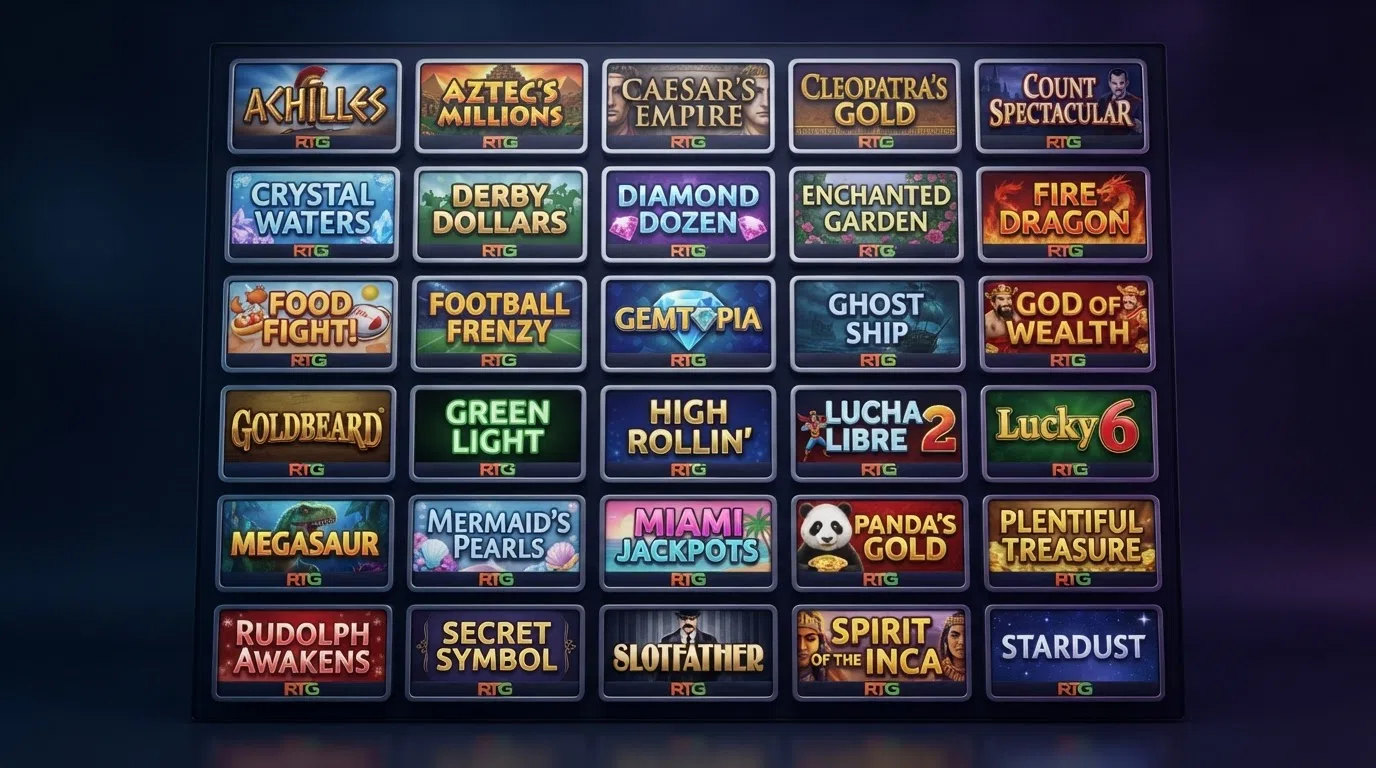
RTG slots and the games beyond them
The RTG library spans online slots as the headline product, alongside table games, video poker, and a long tail of speciality titles. Affiliate pages list dozens of named RTG slot titles, and several recurring names appear across them. Per-title RTPs and volatility classes for those titles were not confirmed in this round of research, so they are not transcribed here as if they were.
The library changes. RTG ships new releases on a regular cadence, and an older title’s availability at a given operator depends on the operator’s integration. A list compiled this month may be partly obsolete next quarter, which is why no static catalogue is built into this page.
Why RTG never pins down one payout figure
RTG does not specify an exact payout percentage for its games. Instead, it provides a range of RTP options operators can choose from when they integrate a title. That single mechanic is why “the highest RTP RTG slot” has no honest answer at the title level — the same game can run at a higher payout percentage at one casino and a lower one at another, depending on the operator’s chosen setting.
A reader searching for the “best RTP” RTG slot is searching for a number RTG declines to publish and the operator may or may not disclose. The honest answer is that the RTP range is the fact, and per-title claims should be treated as marketing unless the operator publishes the figure on the game’s information panel.
RTG bonuses — offers you must verify line by line
The bonus section is where most “best RTG” lists go wrong, because they print the headline percentage and stop reading. A welcome bonus at an offshore RTG casino is a contract. Its value lives or dies in the wagering requirement, the eligible games, the maximum cashout cap, and the bonus validity window — none of which were confirmed for the operators on this page.
Welcome bonuses, matches and bonus codes
A match bonus is the standard welcome shape: the casino offers to match a percentage of the first deposit up to a cap. The percentage and cap are the bait. The wagering requirement is the bill. A 100% match up to a stated cap with a 30x wagering factor on the bonus means a player has to turn the bonus amount over thirty times before any of it becomes withdrawable cash — and that calculation only counts the bonus, not the deposit.
Bonus codes, where they appear, are not value. They are routing tokens: a string that activates a specific offer’s terms. The terms are what matter. Reading the code without reading the conditions is the mistake the marketing page is designed to make.
For the ten featured operators in this guide, the welcome percentage, the cap, and the wagering multiplier were not confirmed from primary sources. Treat any specific figure a third-party list prints as unverified until the operator page itself shows it on the bonus terms.
No-deposit bonuses and free spins — none confirmed here
No-deposit bonuses and free-spin bundles are common headline offers at offshore RTG casinos. Their typical shape is a small cash credit or a fixed number of free spins issued on sign-up, with winnings converted to a bonus balance that carries its own wagering multiplier — frequently higher than the welcome bonus’s — and a maximum cashout cap on what those winnings can ever become.
For the featured set, no no-deposit terms and no free-spin bundles were confirmed from primary sources. A reader weighing a no-deposit offer at any brand on this list should ask the operator’s support for the wagering multiplier on the resulting bonus balance and the maximum cashout cap before playing, because those two numbers decide what the offer is worth.
Playing RTG slots for free — what demo mode actually takes
Demo play is the standard way to test a slot without risking real money. Whether a casino exposes it to logged-in UK players is a separate question from whether the slot supports it.
How demo mode works — and what isn’t confirmed
In principle, demo mode loads a slot with a play-money balance so a player can test the mechanics, the bonus features, and the volatility pattern without a real-money deposit. Most major providers, including RTG, support demo play at the game level. Whether a particular casino exposes demo play to logged-in users, blocks it for accounts in certain jurisdictions, or hides it behind a sign-up wall is an operator decision.
For the featured operators in this guide, demo availability and demo play-money mechanics were not confirmed this run. A reader who wants to test a slot before depositing should expect to sign up first at most offshore RTG casinos, and should read the demo section’s small print — some operators treat demo play as restricted to certain countries or to unregistered visitors only.
Fast payouts and PayPal at RTG casinos — claims the data doesn’t back
The “fast payout” badge on an offshore RTG casino is one of the loosest claims in search results. PayPal is the most-asked payment method from UK readers, and the credit-card ban shapes what is actually allowed.
Payout speed — ‘instant’ claims with no confirmed timings
“Fast withdrawal,” “instant cashout,” “same-day payout” — these banners appear on most offshore RTG casino homepages, and they all mean different things. Same-day payout can mean a request approved the same day; it does not mean funds landed the same day. Pending periods, weekend cut-offs, KYC re-verification, and bonus-balance clearance all sit between request and arrival.
For the featured operators in this guide, no confirmed payout timing data is carried. A reader weighing speed claims should ask three questions before depositing: how long the pending window is, which methods are eligible for fast withdrawal, and whether KYC re-verification pauses the first cashout. None of those answers were verified here.
PayPal, Paysafecard and the credit-card ban
PayPal is the dominant payment question from UK readers. For the featured set, PayPal availability per operator was not confirmed this run. A general rule still applies: at UKGC-licensed operators, credit cards are banned for gambling payments, and the ban extends to credit-card-funded payments routed through e-wallets such as PayPal, Skrill or Neteller. So a PayPal deposit at a GB-licensed casino must come from a PayPal balance funded by a debit card or bank transfer — not a credit card.
Paysafecard, a prepaid voucher, sits outside the credit-card rule and is supported at some GB-licensed sites. Its offshore availability varies. The rule to keep is the e-wallet catch: if the funding source behind an e-wallet is a credit card, the GB ban follows it through.
RTG on mobile — what ‘mobile-friendly’ really means
The mobile question for an RTG casino in 2026 is not whether a casino has a mobile site. Most do. The question is what shape the mobile experience takes, and whether it costs the player anything.
Browser play vs a dedicated app
RTG’s platform supports browser-based instant play, which means a phone or tablet running a modern browser can load the casino lobby and the slots without an app install. That covers the default case. Native apps exist for some RTG operators, but app availability per operator, app-store availability in the UK, and the side-loading requirements on iOS were not confirmed in this guide.
For a UK reader, the practical default is to use the mobile browser version, treat the app as a bonus where it exists, and avoid installing software from outside the official app stores. Browser play also avoids the iOS side-loading question entirely, which is the cleanest answer where one exists.
New RTG casinos — what to check before you join an unverified site
A “new RTG casino” headline tends to imply the novelty is the news. It rarely is. The licence status is the news.
The checks to run before you sign up
The first check is the UKGC public register. The Commission maintains a searchable list of every operator holding a remote gambling licence, and the search takes seconds. A brand that is not on the register is not licensed to serve GB customers, whatever its homepage says.
The second check is what “new” actually refers to. A brand-new domain with a fresh design can sit on the same RTG integration as a five-year-old sister site — and inherit the same offshore licence (or the same lack of one). Recency is not a stand-in for trustworthiness. The third check is the bonus terms, because new casinos often front-load aggressive welcome offers to fund acquisition. Read the wagering multiplier, the eligible games, and the maximum cashout cap before signing up.
Ten RTG casinos — and the GB licence none of them holds
The table below lists the ten featured operators, each running RTG software. Every entry is recorded as unlicensed for GB, because none of these brands is on the UKGC public register. The licence gap is the headline of the whole ranking, and it applies equally to all ten.
| Casino | GB licence status | Game provider |
|---|---|---|
| PrimaPlay Casino | Unlicensed for GB | RealTime Gaming |
| SlotsRoom Casino | Unlicensed for GB | RealTime Gaming |
| CryptoReels Casino | Unlicensed for GB | RealTime Gaming |
| Spinfinity Casino | Unlicensed for GB | RealTime Gaming |
| Slots Ninja Casino | Unlicensed for GB | RealTime Gaming |
| Casino Max | Unlicensed for GB | RealTime Gaming |
| Roaring 21 Casino | Unlicensed for GB | RealTime Gaming |
| Cherry Jackpot Casino | Unlicensed for GB | RealTime Gaming |
| Las Atlantis Casino | Unlicensed for GB | RealTime Gaming |
| Red Dog Casino | Unlicensed for GB | RealTime Gaming |
The next ten sections cover each operator on its own terms. The verdict at the end of each block names what this brand is worth to which reader.
PrimaPlay Casino
PrimaPlay runs on the RealTime Gaming platform and is not on the UKGC register, which means it has no GB licence to serve customers in Great Britain. Welcome offer terms, wagering multipliers, payout times, and eligible-game lists were not confirmed from primary sources in this round. A reader who can verify those terms directly with the operator before depositing can take the offer on its face; a reader who cannot is taking the operator’s word for it.
For a UK player who wants RTG games specifically and accepts that the protections in this guide’s legal section do not apply here, PrimaPlay is one of several offshore RTG options in the same shape. The fact that it accepts UK customers is not, on its own, a recommendation.
SlotsRoom Casino
SlotsRoom is another RealTime Gaming casino outside the GB licensing perimeter. Its UKGC register status is not confirmed, so its licence for GB is recorded as absent. Bonus terms, free-spin availability, and cashout mechanics have not been verified by primary sources in this round. Treat any specific offer a third-party list prints as unverified until the operator’s own terms page confirms it.
For a reader who already plays at offshore RTG sites and has a preferred cashier method, SlotsRoom is one of several similar options. The licence gap is the same gap as the rest of this list.
CryptoReels Casino
CryptoReels sits on the RTG platform and accepts cryptocurrency deposits alongside conventional methods. It is not on the UKGC register and is recorded as unlicensed for GB. Bonus terms and payout mechanics were not confirmed from primary sources in this guide. For a UK reader who specifically wants crypto funding for RTG play, this is one of a small number of offshore options; the licence gap still applies, and the credit-card ban discussed in the payments section has no GB-licensed equivalent here because the operator is not GB-licensed.
Spinfinity Casino
Spinfinity is an RTG casino without a GB licence. Welcome offer percentages and caps, wagering multipliers, and bonus validity windows have not been verified by primary sources in this round. The slot library is RTG’s standard catalogue. A UK reader who lands on Spinfinity through a third-party list should treat the bonus section’s headline number as marketing until the terms page confirms it.
Slots Ninja Casino
Slots Ninja runs on RTG and is recorded as unlicensed for GB. Bonus terms, free-spin bundles, and cashout caps were not confirmed from primary sources. For a UK player evaluating this brand alongside other offshore RTG options, the comparison is one of operator-specific terms the reader has to retrieve from each operator’s own pages — this guide does not carry those numbers.
Casino Max
Casino Max sits on RTG, accepts UK customers, and is not on the UKGC register. Welcome bonus mechanics, eligible games, and maximum cashout caps were not confirmed from primary sources this run. The “max” in the brand name is a marketing word, not a regulator’s word. A reader who wants to play here should ask the operator directly for the wagering multiplier, the eligible-game list, and the maximum cashout from the welcome bonus before depositing.
Roaring 21 Casino
Roaring 21 runs on RTG and is recorded as unlicensed for GB. Bonus terms, payout timings, and any free-spin bundles were not confirmed from primary sources this run. The licence gap applies in full. A UK reader comparing this brand to other offshore RTG options is comparing offers whose terms have to be confirmed at the operator level.
Cherry Jackpot Casino
Cherry Jackpot is an RTG casino outside the GB licensing perimeter. Welcome offer terms, wagering multipliers, and bonus validity windows were not confirmed from primary sources in this guide. A reader who arrives at this brand through a third-party “best RTG” list should treat every specific number in that list as unverified until the operator’s own bonus terms page confirms it.
Las Atlantis Casino
Las Atlantis runs on RTG and is recorded as unlicensed for GB. Bonus structure, payout mechanics, and eligible games were not confirmed from primary sources this run. The brand’s aesthetic is its most distinctive feature; the licence gap is the same feature it shares with the rest of the list. A reader weighing this brand against the others is weighing terms they have to retrieve themselves.
Red Dog Casino
Red Dog closes out the featured set. It runs on RTG, accepts UK customers, and is not on the UKGC register. Bonus terms, free-spin availability, and payout timings were not confirmed from primary sources this round. The honest summary for the whole ranking is that the licence gap is the dominant fact, and the operator-specific differences are downstream of terms the reader has to verify themselves.
How to read RTG casino reviews — trust first, stars second
The review pages that rank offshore RTG casinos are built to look authoritative. A score out of ten, a star rating, a pros-and-cons block, a screenshot — none of these answer the licence question, which is the only one that decides whether the protections in this guide’s legal section apply.
What to look for before you trust a listing
A review site’s star rating is a composite of its own choosing. Some weigh bonus value heavily; some weigh game library; some weigh support response times. None of those weights substitute for the UKGC register check. As CasinoFreak.com states directly: “Only play at UK casinos that operate with a valid UKGC licence.” That filter is the one that survives every weighting scheme.
A reader who treats a review page as a starting point rather than an endpoint — using it to find candidates, then verifying each one against the UKGC register before depositing — gets the use of the page without inheriting its omissions.
Ratings, scores and the factors that matter
When a reader does weigh review factors, the order matters. Licensing first, because the licence is the foundation for everything else in this guide’s legal section. Game variety second, because the RTG library is broadly consistent across operators and the differences are operator-specific. Payout speed third, because unverified timing claims are easy to print and harder to confirm. Support fourth, because the value of good support only shows up when something has gone wrong.
The law behind the licence gap — what GB regulation requires
Great Britain is a licensed online gambling market. The legal product is online casino provision by a UKGC-licensed operator. Everything else is the offshore grey zone, and the difference between the two is what this section sets out.

UKGC licensing and what a GB licence grants
Online gambling is legal in Great Britain when offered by operators holding the appropriate remote operating licences from the UK Gambling Commission and complying with its licence conditions, codes of practice, and technical standards. The foundational statute is the Gambling Act 2005, extended to remote operators serving GB customers by the Gambling (Licensing and Advertising) Act 2014. The regulator is the UK Gambling Commission, an executive non-departmental public body sponsored by DCMS.
The Act sets three licensing objectives: preventing gambling from being a source of crime or disorder, ensuring gambling is conducted in a fair and open way, and protecting children and other vulnerable persons from being harmed or exploited by gambling. The minimum age is 18, and remote licensees must verify name, address and date of birth before a customer can deposit or gamble. The operator pays Remote Gaming Duty on its gross gaming yield, which rose from 21% to 40% from 1 April 2026; the player pays no UK tax on gambling winnings.
UK-licensed operators vs the offshore sites
The table below sets out the practical differences between a UKGC-licensed operator and an offshore RTG casino. The cells are not negotiable: each is a regulatory requirement at the licensed end, and its absence at the offshore end is the shape of the grey zone.
| Player protection | UKGC-licensed operator | Offshore RTG casino |
|---|---|---|
| GAMSTOP self-exclusion coverage | Mandatory since 31 March 2020 | Not required |
| Credit-card gambling ban | Enforced, including via e-wallets | Not enforced |
| Online slot stake caps (£5 for 25+, £2 for 18–24) | Enforced | Not enforced |
| Auto-play ban and 2.5-second spin minimum | Enforced | Not enforced |
| Reverse-withdrawal ban | Enforced | Not enforced |
| Mandatory deposit-limit prompt | From 31 October 2025 | Not required |
| UKGC complaints route and approved ADR | Available | Not available |
| LCCP social responsibility and customer interaction | Required | Not required |
| UK statutory dispute resolution | Yes | No |
| British consumer protection under UK law | Yes | No |
The protection gap is the entire reason the licence status dominates this ranking. A reader using an offshore RTG casino trades every cell in the left column for the unverified terms the operator chooses to publish.
GamStop — how the national self-exclusion works
GAMSTOP is the national multi-operator online self-exclusion scheme for Great Britain. Since 31 March 2020, participation in GAMSTOP has been a mandatory condition of every Gambling Commission online operating licence, and the Commission has suspended licences over failure to participate. GAMSTOP allows self-exclusion from every UKGC-licensed online operator with a single request, and operators licensed by the UKGC are required to participate.
Exclusion periods offered are six months, one year, five years, or five years with auto-renewal. Once registration is confirmed, the exclusion cannot be deactivated before the end of the chosen minimum period. For a player who has self-excluded and is tempted by an offshore RTG casino, the practical point is that offshore sites do not participate in GAMSTOP — the exclusion does not carry across.
The same scheme pairs with the online slots stake caps. From 9 April 2025, the stake cap is £5 for players aged 25 and over; from 21 May 2025, it is £2 for players aged 18 to 24. These are age-banded per game cycle, not lifetime deposit limits.
Safer gambling at RTG casinos — the protections offshore sites drop
The safer-gambling tools the UK market requires are the protections offshore sites are not bound to offer. Where they sit in the licensed market, and where they don’t, is the practical shape of the choice this page sets out.
Deposit limits, reality checks and session reminders
Licensees must make responsible gambling information readily available, including self-exclusion options and measures to help customers monitor or control their gambling. From 31 October 2025, operators must prompt a customer to set a financial limit before their first deposit, and any request to decrease a limit must be actioned immediately.
Reality checks and session reminders sit alongside deposit limits in the UKGC’s customer-interaction framework. Auto-play is banned, the minimum spin speed is 2.5 seconds, features that speed up play are banned, and reverse withdrawals are permanently banned. Each of these is a UK rule; an offshore RTG casino is not bound by any of them.
Where to get help — GamCare, the helpline and GAMSTOP
The National Gambling Helpline is free, 24 hours a day, 7 days a week, on 0808 8020 133 for England and Scotland. Wales has a separate number, 0808 2819 265. GAMSTOP online self-exclusion covers every participating UKGC-licensed online gambling site. GambleAware and NHS gambling harm clinics provide further treatment and support pathways, and Gamblers Anonymous provides peer support. These resources operate independently of any casino, and a player who has self-excluded through GAMSTOP can still reach them while the exclusion is in force.
How we ranked these RTG casinos
The ranking draws on The Gambling Journal for the UK legal frame, the UKGC public register for licence verification, GAMSTOP for the self-exclusion framework, and CasinoFreak.com for the provider-level RTG context. Each operator’s UKGC register status was checked against the Commission’s public register; all ten came back unlicensed for GB. Operator-level bonus terms, payout timings, and licence dates were not confirmed from primary sources in this round, and no third-party figure has been carried across that gap. The order of the ten operators is not a quality ranking; it is the featured set, each carrying the same licence status and the same absence of operator-specific verification.
What to do next — one decision, argued from the licence gap
The single decision this page is built around is whether to play at an offshore RTG casino that accepts UK customers or to hold out for a UKGC-licensed alternative. The choice has a definite shape.
The licensed path offers GAMSTOP coverage, the UKGC complaints route, approved ADR, the credit-card ban (which protects the player from credit-funded gambling), age-banded stake caps, auto-play restrictions, mandatory deposit-limit prompts, and British consumer protection under UK law. The offshore path offers the RTG library and whatever bonus terms the operator chooses to publish — terms that, for the featured ten, remain unverified by primary sources. As CasinoFreak.com puts it: “Only play at UK casinos that operate with a valid UKGC licence.” For a player whose priority is the RTG library specifically, the licensed path may mean a narrower game catalogue; for a player whose priority is the protections, it means accepting that narrower choice.
A reader who has weighed the gap and chosen to proceed at an offshore RTG casino should do three things before depositing. Check the UKGC register for the operator’s name — and accept the result. Ask the operator directly for the welcome bonus’s wagering multiplier, eligible games, and maximum cashout cap. Set a personal deposit limit before the first deposit, and treat the operator’s voluntary tools as a supplement, not a substitute. None of these steps is complicated; all of them move the choice from a marketing page to a deliberate one.
Frequently asked questions
Do UKGC-licensed casinos offer RTG slots?
Real Time Gaming is licensed and regulated by the UKGC and the Isle of Man Gambling Commission at the provider level, which speaks to the software company’s permissions, not to operators. Whether a specific UKGC-licensed casino actually hosts RTG games is operator-by-operator; this guide did not confirm specific UKGC-licensed casinos currently offering RTG content.
How do I check if an RTG casino is licensed by the UKGC?
The UK Gambling Commission maintains a public register of every operator holding a remote gambling licence. Search the register by the operator’s legal name — the brand name on the homepage is not always the registered name. A brand that does not appear on the register is not licensed to serve GB customers, regardless of what the homepage says.
Are RTG casinos on GamStop?
GAMSTOP covers every UKGC-licensed online operator, and participation is mandatory. Offshore RTG casinos are not GB-licensed and do not participate in GAMSTOP. A self-exclusion registered through GAMSTOP applies to UKGC-licensed sites only; it does not carry to offshore RTG brands.
Are RTG casinos safe for UK players?
“Safe” depends on what the word is being asked to cover. The RTG software is a known product; the games themselves run on a tested platform. What is not present at an offshore RTG casino is the UK regulatory layer: GAMSTOP coverage, the credit-card ban, age-banded stake caps, the UKGC complaints route, and approved ADR. A reader weighing safety should weigh that absence alongside the operator’s own terms.
Which new RTG casinos accept UK players in 2026?
The “new RTG casino” market is provider-led and intersects heavily with offshore brands. A new domain with a fresh design can sit on the same RTG integration as a five-year-old sister site and inherit the same offshore licence status. The first check for any new RTG brand is the UKGC public register; the second is the operator’s own bonus terms. Treat every specific offer a third-party “new RTG” list prints as unverified until the operator’s own page confirms it.
Providers – nonukgc-licensedcasinos
Content created by the «nonukgc-licensedcasinos» team