
£1 Deposit Casinos in the UK: The Honest Math Behind the Marketing
 Available in GB
The marketing is loud and the math is short. Only two UKGC-licensed casinos currently accept a genuine £1 deposit, the rest sit at £5 or £10, and the bonus a pound actually unlocks is narrower than the search results imply. This guide separates the operators that process a pound from the ones that simply advertise a pound, maps the bonuses a £1 deposit triggers, and runs the arithmetic on what a single pound buys in real session time. The verdict up front: a £1 deposit is a low-cost trial, not a route to meaningful winnings, and the player who wants a real session should consider stepping up to £5 or £10 at an operator with a no-wagering offer.

*Current as of September 8, 2026. Licence status and bonus terms verified against the UK Gambling Commission’s public register of operating licence holders.*
What You Actually Get for a Pound at a UK Casino in 2026
What “£1 Minimum Deposit” Actually Means
The minimum deposit is the lowest amount a casino accepts to fund an account. It is not the minimum bet on a slot, nor the minimum stake at a table. A casino can advertise a £1 deposit floor and still require £0.10 minimum bets on every slot it hosts, which means a single pound buys ten spins on a low-stake title and nothing more. The two numbers are different levers, and conflating them is the first error most £1-deposit guides make.
The marketing promise and the cashier reality often diverge further. Some casinos advertise a £1 minimum, accept the deposit, and then gate the welcome bonus behind a higher threshold: deposit £1, but the 50 free spins only credit after a £10 top-up. Other casinos set the cashier floor at £5 or £10 outright, even though their landing page mentions “from £1” in a comparison table. The result is a category where the term promises more than the terms deliver, and the only way to tell the difference is to check the cashier before signing up.
Across the UK licensed market, the genuine £1 deposit casino is rare. Most UKGC-licensed operators sit at a £5 minimum, and the move from £5 to £1 requires a deliberate pricing decision the majority have not made. The handful that have, and the reasons the rest have not, frame everything that follows.
The Real-Money Reality at a £1 Deposit
A pound buys ten spins on Starburst at £0.10 per spin. At a 96.09% return-to-player, the expected loss across those ten spins is roughly £0.04, which is to say the pound is almost entirely preserved by the time the balance runs dry. Session length is short: ten manual spins, each held for at least 2.5 seconds by the UKGC’s spin-speed floor, take about 25 seconds of play. That is the full session for a £1 deposit on a low-stake slot.
The £5 statutory maximum stake for players aged 25 and over (and £2 for those aged 18 to 24) does not bind a £1 player at the low end. The binding constraint is the £0.10 minimum bet shared by most slots in the featured set. The auto-play ban, in force since October 2021, means every spin is manual, which further compresses session length. A pound at minimum stakes on a regulated slot is a 25-second experience.
Live dealer and table games are out of reach. Minimum stakes at live roulette and blackjack start at £1 per round, and many live tables require £5 or more. A single hand consumes the entire deposit. The structural mismatch is total: live casino is priced for deposits ten to fifty times larger.
The withdrawal floor is where the £1 proposition breaks. Most UKGC-licensed casinos set minimum withdrawals at £10 to £20. A £1 depositor who wins must deposit more, often several times more, before the cashier will process a payout. The pound that looked like a no-strings trial becomes a commitment to additional deposits before any winnings leave the site.
How to Spot a Trusted £1 Deposit Casino
Four markers separate a legitimate low-deposit casino from a site that simply borrows the keyword. The first is the UKGC public register: every legitimate operator appears there with a valid operating licence account number, and the register is searchable by brand name. The second is the cashier test: a £1 deposit must process without a redirect to a higher tier, and the welcome bonus terms must confirm the pound triggers the offer or state that it does not. The third is the withdrawal minimum: a site that takes a pound but refuses to pay out under £20 is not transparent about the gap, and the gap itself is a red flag. The fourth is the GAMSTOP check: every GB-licensed operator since 31 March 2020 must participate in the national self-exclusion scheme, and a site that does not is operating outside the UK framework.
Beyond those four, the regulatory environment filters out most of the obvious risks. Credit cards have been banned for gambling since 14 April 2020, including credit-card-funded e-wallet deposits, so the deposit method itself constrains the player pool. The financial vulnerability check at £150 net deposits in a rolling 30-day period applies to every licensed operator, which means the safeguards scale with the deposit, not against it. A £1 deposit is the smallest possible exposure in a market where the smallest exposure is already heavily regulated.
The Two UK Casinos That Genuinely Accept a £1 Deposit — and the Best of the Rest
| Operator | Licence | Min Deposit | Welcome Bonus | Wagering | Spins |
|---|---|---|---|---|---|
| Zodiac Casino | Yes (Casino Rewards) | £1 | 80 Free Spins on Mega Moolah | 200× (legacy) | 80 |
| DragonBet | 64908 | £1 | £20 Free Bet + 20 Free Spins on Big Bass Splash | 0× | 20 |
| Lottoland | Yes | £1 (bonus at £10) | 50 No-Wagering Spins on Big Bass Bonanza | 0× | 50 |
| PricedUp Casino | 001776 | £1 | Wager £30, get 90 Free Spins | 10× | 90 |
| bet365 Games | 55149 | £5 | Up to 500 Free Spins over 10 days | 1× | Up to 500 |
| William Hill Vegas | 39225 | £5 | 200 Free Spins on Big Bass Splash | 10× | 200 |
| Ladbrokes Casino | Yes (Entain) | £5 | Play £10, get 100 No-Wagering Spins | 0× | 100 |
| Coral Casino | Yes (Entain) | £5 | Play £5, get 100 Spins + £10 Bonus | 10× | 100 |
| 888casino | Yes (888 UK) | £10 | 100% Deposit Match up to £100 | 10× | — |
| Paddy Power Casino | Yes (Flutter) | £5 | 60 No-Deposit Spins + 200 Spins on £10 Wager | 0× | Up to 260 |
The table splits the featured set into the two genuine £1 acceptors and the eight near-misses. The near-misses are not bad operators; they are simply priced above the keyword, and their bonus value often rises with the deposit floor. The ranking reflects that structure: a player who insists on a £1 deposit has two real options, and a player willing to spend £5 or £10 has eight more.
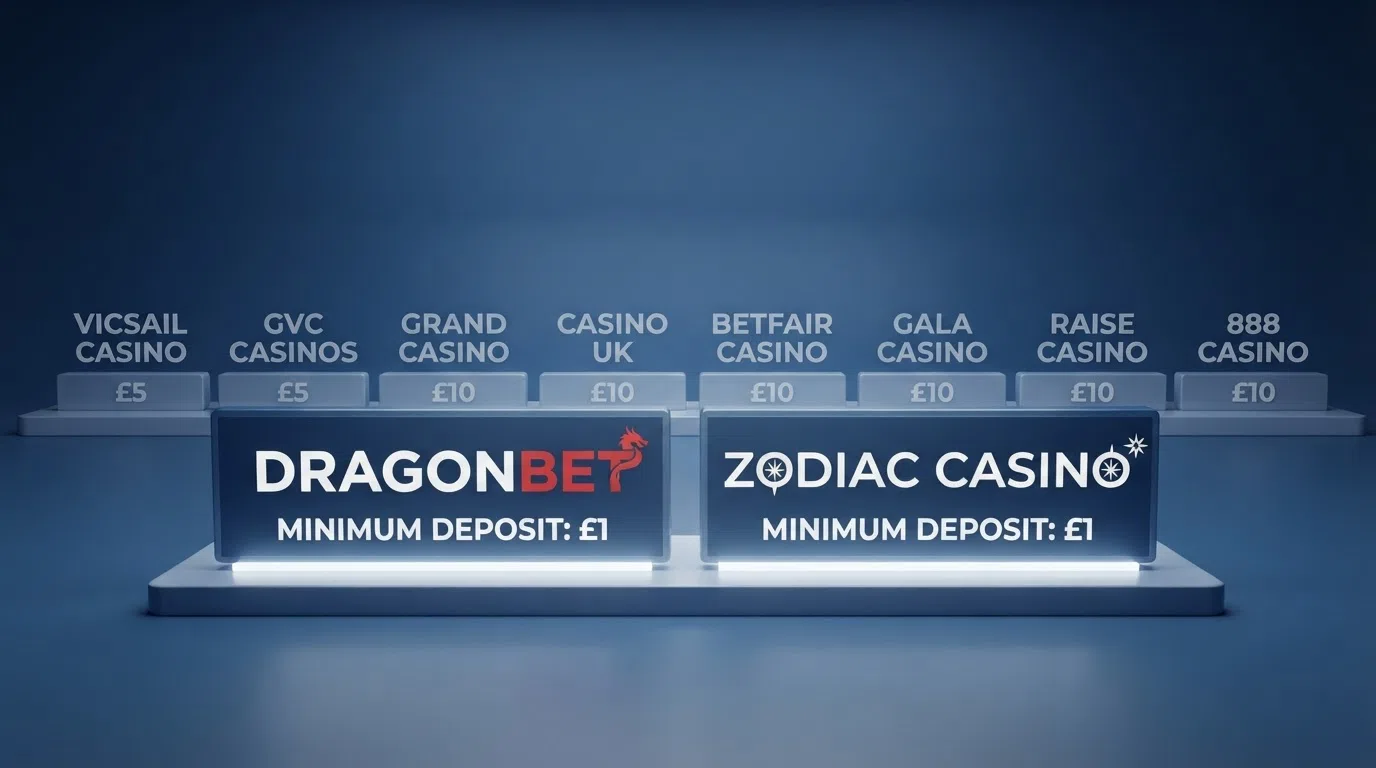
DragonBet — The No-Wagering £1 Deposit Standout
DragonBet is the only UKGC-licensed casino in the featured set that pairs a genuine £1 deposit with a zero-wagering welcome offer. The bonus: a £20 Free Bet plus 20 free spins on Big Bass Splash, both no-wagering, both triggered by a single pound. Big Bass Splash carries a 96.71% RTP at default configuration, high volatility, and a maximum win of 5,000× stake, which is a strong return profile for a bonus-triggered spin. The wagering requirement is zero, so whatever the spins produce is withdrawable subject to the site’s standard terms.
The UKGC licence sits under account 64908, and DragonBet is one of only two featured operators with confirmed native iOS and Android apps, a rarity among UKGC-licensed casino sites, most of which run browser-only. The combination of genuine £1 deposit, no-wagering bonus, and mobile app makes DragonBet the standout for a player who wants the full feature set at the lowest possible entry. The post-December 2025 10× wagering cap does not affect this offer because there is no wagering to cap.
Zodiac Casino — 80 Spins on Mega Moolah for a Pound
Zodiac Casino is the flagship £1-deposit welcome offer in the UK market: 80 free spins on Mega Moolah, each worth £0.25, for a total spin value of £20, triggered by a £1 first deposit. The spins target a progressive jackpot game with an RTP of approximately 88.12%, a lower figure than non-jackpot slots because a portion of every wager funds the jackpot pool. The headline prize (typically a seven-figure sum) is the trade for the lower return.
The wagering structure on Zodiac’s broader welcome package sits at 200×, a legacy figure from before the UKGC’s December 2025 cap. The terms page is the definitive reference for whether these spins are wager-free or subject to the legacy multiplier. The welcome package is a five-deposit structure, with subsequent deposits requiring a £10 minimum, so the £1 entry is the front door of a larger commitment. For a player who wants the Mega Moolah jackpot exposure at the lowest cost, Zodiac remains the market’s clearest answer.
Lottoland — £1 Deposit Accepted, Bonus Needs £10
Lottoland accepts a genuine £1 deposit, but the 50 no-wagering free spins on Big Bass Bonanza sit behind a £10 deposit gate. The pound funds the account; the bonus requires a top-up. This is the structural pattern several featured operators follow: the cashier minimum is one number, and the bonus threshold is a higher one, and the two are not the same.
The game library is broader than most: 2,200+ titles spanning slots, instant-win games, and lottery products, which reflects Lottoland’s origins as a lottery operator rather than a pure casino brand. Dedicated iOS and Android apps are available. For a player who values game variety and is willing to deposit £10 to unlock the bonus, Lottoland delivers a no-wagering offer on a 96.71% RTP slot, which is competitive with the rest of the no-wagering tier.
PricedUp Casino — £1 Minimum Across Every Payment Method
PricedUp Casino applies a £1 minimum deposit consistently across all supported payment channels, with no method-based gating. The bonus structure is a wager-to-unlock model: wager £30, receive 90 free spins, with a 10× wagering requirement on the spin winnings. UKGC licence account 001776.
The wagering-first offer suits a player who plans to play through the £30 regardless of the bonus, since the spins credit as a reward for activity the player would have done anyway. At 10× wagering on the spin winnings, the requirement sits exactly at the post-December 2025 UKGC cap, which makes the bonus transparent but not generous. PricedUp is the right fit for a player who values a consistent £1 floor across every deposit method and does not need a no-wagering offer.
bet365 Games — 500 Free Spins, 30-minute play window
bet365 Games is a heavyweight UK operator, and the welcome offer reflects the scale: up to 500 free spins over 10 days, with daily randomised allocations of 5 to 50 spins on selected games. The minimum deposit is £5, not £1, and the wagering requirement on the initial deposit sits at 1×, well within the post-December 2025 cap. The 500-spin offer requires roughly 30 minutes of play time to clear the randomized allocation.
The proprietary games sit alongside a broad third-party library, and the randomisation of the daily spin allocation means a player might receive 5 spins on day one and 50 on day five. The total ceiling of 500 spins is the upper bound, not the guaranteed allocation, and the expected value depends on the daily distribution. For a player willing to deposit £5, bet365 delivers volume and brand trust at a low entry cost.
William Hill Vegas — 200 Spins on Big Bass Splash at £5 Entry
William Hill Vegas offers 200 free spins on Big Bass Splash, each at £0.10, triggered by a £10 deposit and a £10 stake. The minimum deposit is £5, not £1, and the wagering requirement on the winnings sits at 10×, the current UKGC cap. The spins expire 72 hours from credit, with a 7-day window to make the qualifying deposit and stake, and the offer carries a £30 maximum cashout ceiling.
The combination of 200 spins and a £30 cap means the offer rewards volume at a capped value. A player who wins more than £30 from the spins cannot withdraw the excess, which limits the upside regardless of the slot’s 5,000× maximum win. William Hill is the right fit for a player who values a high-street brand and is comfortable with a short, capped bonus window.
Ladbrokes Casino — 100 No-Wagering Spins, £10 Stake Required
Ladbrokes Casino is an Entain-group brand offering 100 no-wagering free spins at £0.10 each, triggered by a £10 deposit and a £10 stake. The minimum deposit is £5, not £1, and the eligible deposit methods are Visa and Mastercard debit, Apple Pay, and Google Pay only. The spins carry a 7-day validity with a 48-hour acceptance window.
Zero wagering on the spins means whatever they produce is withdrawable, subject to the site’s standard terms. The £10 stake requirement is the real cost: a player must wager £10 to unlock 100 spins at a combined value of £10, and the spins effectively pay for themselves at any positive return. Ladbrokes suits a player who values no-wagering terms and is comfortable with the Entain ecosystem.
Coral Casino — £5 Deposit, 100 Spins Plus a £10 Bonus
Coral Casino is the Entain sister brand to Ladbrokes, offering 100 free spins at £0.10 each plus a £10 cash bonus, triggered by a £5 deposit and a £5 stake. The minimum deposit is £5, not £1. The bonus carries 10× wagering, the current UKGC cap, with a 30-day validity and a 14-day acceptance window. The spins carry 7-day validity with a 48-hour acceptance window. Eligible deposit methods: Visa and Mastercard debit, Apple Pay, and Google Pay.
The £5 stake is the lowest qualifying play in the featured set, which makes Coral the closest near-miss to a £1-deposit bonus: a player who deposits the £5 minimum and stakes the £5 minimum triggers the full offer for a total £10 commitment. The 10× wagering on the cash bonus is standard under the current cap, and the spins carry no separate wagering.
888casino — 100% Match to £100, but £10 Minimum Deposit
888casino is the proprietary-games pioneer in the featured set, with the Section 8 studio’s titles sitting alongside a large third-party library. The welcome offer is a 100% deposit match up to £100, with 10× wagering on selected slots within 90 days. The minimum deposit is £10, the highest in the featured set and the furthest from the £1 target.
The deposit-match structure rewards a larger first deposit, not a small one. A player depositing £10 receives a £10 bonus, which must be wagered 10× (£100 of slot play) before withdrawal, and the offer carries a £100 maximum cashout. 888casino suits a player who plans a £100 first deposit and wants the match, not a player testing the waters with a pound.
Paddy Power Casino — 60 No-Deposit Spins, 200 More at £10 Play
Paddy Power Casino is the Flutter-group brand with the rarest structure in the featured set: a no-deposit free-spins entry point. The offer splits into 60 no-deposit free spins (50 on slots and 10 on Paddy’s Mansion Heist) plus 200 additional spins triggered by a £10 deposit and wager. All spins carry zero wagering. The minimum deposit is £5, not £1, but the 60 no-deposit spins make the entry cost genuinely zero for the first tier.
This is the only true no-deposit offer in the featured set, and it matters to a £1 player because no deposit is required at all. A player who registers, claims the 60 spins, and plays them through has invested nothing beyond the identity verification the regulator requires. The 200-spin second tier is the upgrade path, and at zero wagering, it competes directly with the no-wagering offers at higher deposit tiers.
Why Your £1 Deposit Bonus Is Smaller Than the Headline Suggests
The gap between the advertised welcome bonus and what a £1 deposit actually unlocks is structural, not accidental. Most welcome offers require a £5 to £10 deposit even at casinos that accept £1, and the bonus terms reflect the higher threshold. The £1 deposit is the cashier floor; the bonus is a separate product priced at a different entry point.
The post-December 2025 10× wagering cap reshapes the value of every bonus in the market, but it does not change the deposit threshold. A £1 deposit at a casino with a £10-gated bonus still requires a top-up to claim the offer, regardless of the wagering multiple. The cap makes low-deposit bonuses more transparent, not more generous.
A bonus triggered by £1 and a bonus that merely coexists with a £1 deposit option are different products. Zodiac’s 80 spins on Mega Moolah fire at £1. DragonBet’s £20 Free Bet plus 20 spins fire at £1. Lottoland’s 50 spins require £10. PricedUp’s 90 spins require £30 of qualifying wager. The £1 deposit is the common entry; the bonus is the differentiator.
The £1-Deposit Welcome Bonuses That Actually Exist
| Operator | £1 Deposit? | Bonus | Wagering | Spins |
|---|---|---|---|---|
| Zodiac Casino | Yes | 80 Free Spins on Mega Moolah | 200× (legacy) | 80 |
| DragonBet | Yes | £20 Free Bet + 20 Free Spins on Big Bass Splash | 0× | 20 |
| Lottoland | No (£10 required) | 50 No-Wagering Spins on Big Bass Bonanza | 0× | 50 |
| PricedUp Casino | No (£30 wager required) | Wager £30, get 90 Free Spins | 10× | 90 |
| bet365 Games | No (£5 minimum) | Up to 500 Free Spins over 10 days | 1× | Up to 500 |
| William Hill Vegas | No (£10 required) | 200 Free Spins on Big Bass Splash | 10× | 200 |
| Ladbrokes Casino | No (£10 stake required) | 100 No-Wagering Free Spins | 0× | 100 |
| Coral Casino | No (£5 stake required) | 100 Free Spins + £10 Bonus | 10× | 100 |
| 888casino | No (£10 minimum) | 100% Deposit Match up to £100 | 10× | — |
| Paddy Power Casino | No (£5 minimum for first deposit) | 60 No-Deposit Spins + 200 Spins on £10 Wager | 0× | Up to 260 |
Zodiac and DragonBet are the only two operators whose welcome offer fires at a genuine £1 deposit. The other eight require a higher entry, and their offers are worth evaluating on their own terms, not as £1-deposit bonuses.
No-Deposit vs Deposit-Triggered: What the Terms Hide
Paddy Power’s 60 no-deposit free spins are the only true no-deposit offer in the featured set, and they matter to a £1 player because the entry cost is zero. A player who registers, verifies their identity, and claims the spins has invested nothing beyond the regulatory requirements. The spins carry zero wagering, so whatever they produce is withdrawable, subject to the site’s standard terms.
A no-deposit bonus at a £5-minimum-deposit casino still matters to a £1 player because the £1 player can claim the no-deposit offer without ever making the £5 deposit. The deposit floor applies to funded play; the no-deposit offer sits outside it. This is the structural advantage Paddy Power holds over the £5-deposit operators: a player who never deposits still receives value.
The hidden terms matter more than the headline. Max cashout caps truncate large wins. Game eligibility restrictions limit where the spins can be used. Expiry windows compress the play period. And the post-December 2025 10× wagering cap applies to deposit-triggered bonuses, not to no-deposit offers, which means the no-deposit path at Paddy Power sits outside the cap entirely.
The 10× Wagering Cap and What It Means for Your Pound
The UKGC’s December 2025 hard ceiling on wagering requirements, LCCP Social Responsibility Code 5.1.1, caps bonus wagering at 10× the bonus amount and bans mixed-product promotional offers. A £10 bonus requires £100 of slot turnover. A £20 bonus requires £200. A £100 bonus requires £1,000. The cap is a ceiling, not a floor: operators can set wagering below 10×, and several featured operators do (bet365 at 1×, DragonBet at 0×, Ladbrokes at 0×, Paddy Power at 0×).
The cap compares starkly to the legacy 200× figure on Zodiac’s welcome package. At 200×, a £10 bonus requires £2,000 of slot turnover, twenty times the current ceiling. Whether the 10× cap applies to Zodiac’s spins specifically is not confirmed this run; the legacy multiplier may persist on the broader welcome package, or the spins may be wager-free. The terms page is the definitive reference.
The ban on mixed-product promotions changes the calculus for a player who also bets on sports. A combined casino-and-sports welcome package is no longer permitted, which means each product must be offered separately with its own terms. For a £1-deposit player, the change is marginal: the £1 deposit barely funds one product, let alone two. For a player considering a larger entry, the ban simplifies the comparison: every bonus is single-product, and the wagering applies to that product alone.
The cap makes low-deposit bonuses more transparent but not necessarily more generous. A 10× bonus on a £1 deposit is a £10 turnover requirement, which is achievable in minutes on a low-stake slot. The transparency is the win: a player can calculate the full cost of clearing a bonus before claiming it, which was difficult when multipliers ranged from 10× to 200× across the market.
The Payment Trap: Why Getting Your Money Out Costs More Than Putting It In
The mismatch between the £1 deposit minimum and the £10 to £20 withdrawal floor is the structural flaw in the low-deposit model. A £1 depositor who wins must deposit more, often several times more, before the cashier will process a payout. The pound that looked like a no-strings trial becomes a commitment to additional deposits before any winnings leave the site.
The payment-method landscape constrains the £1 deposit further. Credit cards have been banned for gambling since April 2020, so the available methods are debit cards, e-wallets, pay-by-phone, and bank transfer. Not all of them process a pound reliably. Debit cards are the most consistent; e-wallets often impose higher internal minimums; pay-by-phone is designed for small amounts but carries per-transaction fees; bank transfer virtually never works at £1.
The withdrawal speed gap between e-wallets and debit cards adds a second layer. E-wallets typically process within 24 hours once the withdrawal is approved; debit cards take one to three business days. For a £1-deposit player who has topped up to meet the withdrawal minimum, the speed difference matters because the gap between withdrawal request and funds received is the gap during which a player might change their mind (or be tempted to reverse the withdrawal, which the UKGC has banned since October 2021).
Which Payment Methods Process a £1 Deposit
Debit cards are the most reliable £1-deposit method at UK casinos. Visa and Mastercard debit consistently process low amounts, and the UKGC’s payment-processor rules do not impose a higher floor. A £1 debit-card deposit clears in seconds, and the funds are available for play immediately.
E-wallets are inconsistent at £1. PayPal, Skrill, and Neteller often set their own transaction minimums above the casino’s deposit floor, and a £1 deposit may be rejected by the e-wallet before it reaches the casino. The exception is when the e-wallet and the casino have a direct integration, in which case the casino’s floor applies. Credit-card-funded e-wallet deposits are banned, so the e-wallet must be funded from a debit source.
Pay-by-phone billing is designed for small deposits, typically £1, £3, and £5, and the deposit is charged to the player’s mobile bill or deducted from pay-as-you-go credit. The per-transaction cap is usually £30 to £40, and daily limits apply. The method works for a £1 deposit, but withdrawals cannot be processed back to the phone bill: the player must nominate a debit card or bank account for withdrawals.
Bank transfer virtually never works at £1. The bank’s own transfer minimum, the processing delay, and the casino’s verification requirements all push the practical floor above £10. A player who wants to use bank transfer should expect a £10 to £20 minimum.
PayPal at £1 Deposit Casinos — What Works and What Does Not
PayPal’s own transaction minimum varies by account type and currency, but it generally aligns with or exceeds the casino’s deposit floor. A £1 PayPal deposit may clear if PayPal’s minimum for the player’s account is at or below £1, which is the case for most UK accounts. The casino’s deposit minimum then applies: if the casino accepts £1, the PayPal deposit processes.
Among the featured operators, PayPal support is inconsistent. The Entain brands (Ladbrokes, Coral) restrict eligible deposits to Visa, Mastercard debit, Apple Pay, and Google Pay, which excludes PayPal. Flutter brands (Paddy Power) and the larger operators (bet365, 888) typically support PayPal but at their standard minimums, which are £5 or £10 for most.
The e-wallet withdrawal speed advantage is real once the withdrawal minimum is met. PayPal withdrawals typically process within hours, compared to one to three business days for debit cards. For a £1-deposit player who has topped up to meet the £10 to £20 floor, the speed difference matters during the gap between request and receipt.
Identity verification applies before the first deposit at every UKGC-licensed operator, so anonymous PayPal play is not possible. A player who funds their PayPal account from an unverified source will be asked to verify at the casino level, regardless of the e-wallet’s own status.
Pay-by-Phone and Mobile Billing at £1
Pay-by-phone is the deposit method purpose-built for the £1 use case. The typical flow: enter the phone number, confirm the deposit via SMS, and the amount is charged to the mobile bill or deducted from pay-as-you-go credit. The deposit is available for play within seconds.
The per-transaction caps and daily limits are the constraints. Most pay-by-phone providers cap individual deposits at £30 to £40 and impose daily limits of £50 to £100, which is irrelevant for a £1 deposit but limiting for a player who plans to top up. The per-transaction fees, typically £0.50 to £1.50 on deposits above £5, may apply to smaller amounts at some providers, which reduces the effective deposit.
The withdrawal problem is structural. Pay-by-phone deposits cannot be withdrawn to the same method: the mobile network does not process refunds, and the pay-as-you-go credit cannot receive a transfer. A player who deposits £1 by phone and wins must nominate a debit card or bank account for the withdrawal, which means the player must have a withdrawal-capable method registered before the first deposit. The identity verification and financial-limit prompt required before the first deposit make this a one-time setup rather than an ongoing issue.
Among the featured operators, pay-by-phone support varies. The method is more common at lower-deposit-focused brands and less common at the major operators, which prefer debit-card and e-wallet rails. For a £1-deposit player who values the pay-by-phone flow, the operator set narrows further: genuine £1 deposit, pay-by-phone support, and a bonus that fires at £1.
The Games You Can Play (and Those You Cannot) with a £1 Deposit
| Slot Title | Provider | RTP | Volatility | Minimum Bet |
|---|---|---|---|---|
| Starburst | NetEnt | 96.09% | Low | £0.10 |
| Book of Dead | Play’n GO | 96.21% | High (10/10) | £0.10 |
| Big Bass Splash | Pragmatic Play / Reel Kingdom | 96.71% | High | £0.10 |
| Mega Moolah | Games Global / Microgaming | ~88.12% | — (progressive) | £0.25+ |
A £1 deposit buys ten spins on Starburst, Book of Dead, or Big Bass Splash at minimum stakes. On Mega Moolah, the minimum bet is higher (£0.25 per spin, as configured for the Zodiac offer), and the £1 buys four spins rather than ten. The £0.10 minimum bet is shared across the key titles, which means the slot market is accessible to a £1 player; the constraint is volume, not access.
RTP matters for a £1 player because the expected value of the session is a function of the return percentage. A 96% RTP slot returns £0.96 in expected value per £1 wagered; a 96.71% slot returns £0.9671. The difference is four pence per pound, which is trivial at £1 but scales linearly with deposit size. For a £1 player, the RTP difference is less important than the volatility profile: a high-volatility slot can zero a £1 balance in two or three spins, while a low-volatility slot stretches the session across the full ten spins.
Mega Moolah’s ~88.12% RTP is the outlier, and the reason is structural. A portion of every wager funds the progressive jackpot pool, which is why the base-game return is lower than non-jackpot slots. The trade is a seven-figure headline prize, and for a player depositing £1 specifically to chase the jackpot, the lower RTP is the cost of entry.
Live Dealer and Table Games at £1 — Not Viable
Live dealer minimum stakes start at £1 per round, and many live tables require £5 or more. A single hand of blackjack or a single spin of live roulette consumes the entire £1 deposit, and the session ends after one decision. Live casino is structurally priced for deposits ten to fifty times larger than a pound.
The higher RTP on blackjack (typically 99%+ with optimal play) and roulette (97.3% on European single-zero) does not help a one-round bankroll. The return percentage is a long-run average, and a single round is the shortest possible run. The expected loss on a £1 blackjack hand at optimal play is roughly £0.005, which is trivial in absolute terms but represents the entire deposit at risk on one decision.
The £5 statutory maximum stake per game cycle applies to online slots only. Roulette, blackjack, and live casino are exempt from the stake cap, which means a high-stake player at a live table faces no statutory ceiling. For a £1 player, the exemption is irrelevant: the binding constraint is the table minimum, not the statutory cap.
A £1-deposit player who wants maximum session length should stick to low-volatility online slots at £0.10 per spin. Starburst’s low volatility and 96.09% RTP make it the natural fit: ten spins, slow depletion, and the full session played out before the balance runs dry.
The £5 Stake Cap and What It Does to a £1 Session
The statutory £5 maximum stake per game cycle for players aged 25 and over, in force since 9 April 2025, does not constrain a £1-deposit player at the low end. The binding constraint is the £0.10 minimum bet, which means the effective stake range at a £1 deposit is £0.10 to the player’s full balance per spin. The £5 cap is a ceiling on a range the player never approaches.
The £2 cap for players aged 18 to 24, in force since 21 May 2025, is similarly irrelevant to a £1-deposit session. The cap applies to the upper end of the stake range, and a £1 player is at the lower end.
The caps protect a small bankroll from rapid depletion by limiting the maximum exposure per spin. A player with a £1 balance cannot spin at £5, so the cap is not a constraint. The cap also limits the upside: a single spin cannot win more than the statutory maximum allows, which means a £1 player cannot win £50,000 on a single spin even if the slot’s mechanics would otherwise allow it. The trade is a slower, safer session at the cost of a capped ceiling.
The spin-speed floor of 2.5 seconds per game cycle, in force since October 2021, and the auto-play ban apply identically to every player. A £1 player spins manually, one spin every 2.5 seconds at minimum, which means the ten-spin session takes at least 25 seconds. The floor prevents rapid depletion by limiting spins-per-minute, which is a second layer of protection on top of the stake cap.
Mobile Play at £1: What Works and What Does Not
Browser-based mobile play works at every featured operator without a download. The deposit flow, the game library, and the cashier are all available in the mobile browser, and the experience is functionally identical to desktop at the £1 deposit level. The HTML5 slot games run in the browser window, and the touchscreen interface replaces the mouse click without changing the game mechanics.
Native iOS and Android apps are scarce. DragonBet and Lottoland are the only featured operators with confirmed native apps, and both are available on the App Store and Google Play. The remaining eight operators run browser-only, which means the “app” experience is a bookmarked home-screen icon rather than a downloaded binary.
The gameplay and payment experience on mobile at a £1 deposit matches desktop: the same slots, the same £0.10 minimum bets, the same payment methods. The mobile browser does not impose a higher minimum or restrict the game library. For a £1-deposit player, the mobile experience is the desktop experience with a smaller screen.
Mobile Browser Play at a £1 Deposit
Every UKGC-licensed casino site works in a mobile browser without a download. The deposit and gameplay flow on mobile browsers at £1 mirrors the desktop flow: navigate to the cashier, enter the deposit amount, confirm the payment method, and the balance updates within seconds. The game library is the same, the bonus terms are the same, and the regulatory protections (GAMSTOP, deposit limits, reality checks) apply identically.
The performance and game availability on mobile browsers at £1 deposit match desktop for the most part. HTML5 slot games run in the browser without plugins, and the touchscreen interface is the only difference. A few legacy titles may not be optimised for mobile, but the key slots in the featured set (Starburst, Book of Dead, Big Bass Splash, Mega Moolah) are all mobile-compatible.
The advantage for a £1 trial player is the absence of install friction. A player who wants to test a casino with a pound does not need to download an app, grant permissions, or wait for an update. The browser flow is immediate, and the test can be completed in minutes.
Casino Apps That Accept Low Deposits
DragonBet and Lottoland are the only featured operators with confirmed native iOS and Android apps. Both apps are available on the App Store and Google Play, and both accept the same deposit minimums as the browser version: £1 for both operators, though Lottoland’s bonus requires £10.
The app-store age-rating and responsible-gaming prompts are the first differences. App stores enforce age-gating at the download level, and the apps include responsible-gaming links on the login screen. The deposit flow inside the app is similar to the browser, with the addition of biometric login (Face ID, Touch ID, fingerprint) on supported devices.
The app deposit minimum matches the website deposit minimum, so the £1 floor applies identically. The install-vs-browser trade-off for a £1 trial player comes down to convenience: the app loads faster on repeat visits, and the biometric login removes the password step. The browser requires no storage space and works on any device with a modern browser. For a player testing a casino with a pound, the browser is the lower-friction option; for a player who plans to return, the app is the faster option.
New £1 Deposit Casinos Worth Watching in 2026
Genuinely new UKGC licensees launching at a £1 deposit minimum are rare. The two operators that process a £1 deposit today (DragonBet and Zodiac) are established brands, and the new-entrant pipeline has not produced a third at the same entry point. The market structure, with most operators at £5 or £10, suggests the £1 floor is a deliberate competitive choice rather than a default.
A new-entrant £1-deposit casino would need to demonstrate several things to earn a place on a shortlist. The first is a valid UKGC operating licence with a recent grant date. The second is a cashier that genuinely processes £1 without a higher bonus gate. The third is a bonus that fires at £1 or a no-deposit entry point. The fourth is a withdrawal minimum that does not force further deposits at the lowest level.
The April 2026 rise in Remote Gaming Duty from 21% to 40% shapes new-casino bonus offers. The higher operator tax compresses margin on bonus-funded play, which means new entrants may offer smaller bonuses or stricter terms to maintain profitability. A player evaluating a new £1-deposit casino should expect the bonus value to be lower than the established operators, at least until the market adjusts.
The UKGC public register is the verification route for new licensees. The register is searchable by brand name and lists the licence account number, the licence type, and the status (active, suspended, revoked). A player considering a new casino should check the register before depositing, and a brand that does not appear is operating outside the UK framework.
Recently Launched Low-Deposit Casinos — What to Look For
Checking the UKGC register for the licence grant date and any early enforcement history is the first step. A new licence (granted within the last 12 months) has no enforcement record, which is neutral rather than positive. A licence older than 12 months with no enforcement actions is a better signal. The register is public and searchable, and the absence of a brand from the register is disqualifying.
A new casino’s bonus terms deserve closer reading because the 10× cap is universal but validity windows and game eligibility vary. A 7-day expiry on free spins is standard; a 24-hour expiry is aggressive; a 30-day expiry is generous. The game eligibility list determines where the spins can be used, and a restricted list (one or two titles) is less valuable than a broad list.
The payment-method and withdrawal-minimum check matters more at a new operator because the cashier terms are the first point of friction. A new casino that advertises £1 deposits but sets the withdrawal minimum at £30 is repeating the structural flaw in the low-deposit model, and the player should expect to deposit more to cash out. The terms page is the reference, and a casino that buries the withdrawal minimum in the footer is a red flag.
GAMSTOP participation is mandatory for every GB-licensed licence from day one, and the financial vulnerability check at £150 net deposits in a rolling 30-day period applies identically to new and established operators. A new casino that does not check GAMSTOP at registration is operating outside the UK framework, and a player who is self-excluded should not be able to register at a compliant operator.
The Licence Question: UKGC-Regulated vs Not-on-GamStop
The UKGC licence is the single most important marker of safety for a low-deposit player. It carries protections a non-GamStop site cannot offer: GAMSTOP self-exclusion, ADR complaints routes, deposit-limit prompts, financial vulnerability checks, the 10× wagering cap, the credit-card ban, and the statutory levy funding treatment and research. A site operating outside the UKGC framework is not bound by any of these, and the player accepts the gap by choosing to play there.
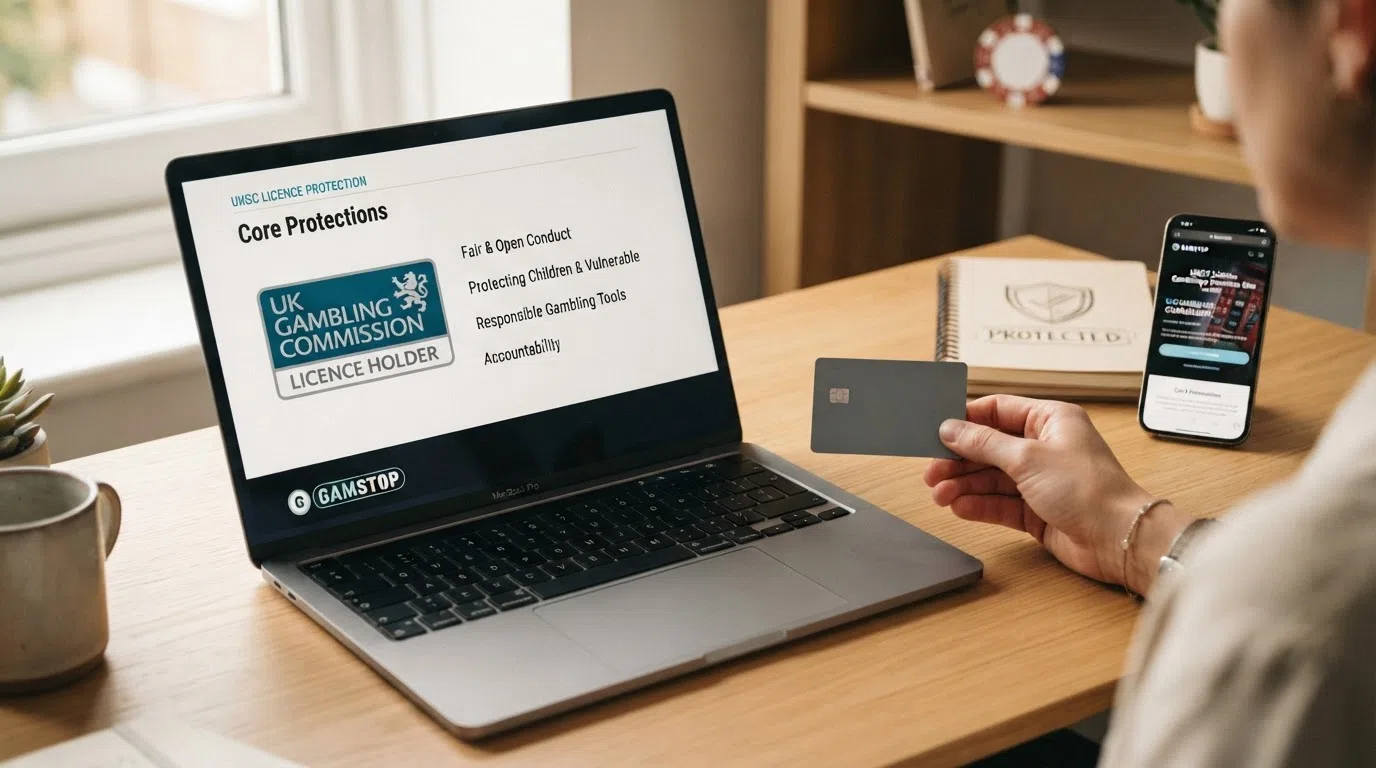
The UKGC licensing framework rests on three statutory objectives under section 1 of the Gambling Act 2005: preventing gambling from being a source of crime, ensuring fair and open gambling, and protecting children and vulnerable persons. Every LCCP and RTS obligation flows from these objectives, and the regulator’s enforcement powers (suspension, revocation, financial penalties) are the teeth behind the framework.
GAMSTOP has been mandatory for every GB-licensed online operating licence since 31 March 2020. A self-excluded player who tries to register at a licensed operator is blocked at the verification stage, and the exclusion periods (six months, one year, five years, or five years with auto-renewal) cannot be cancelled early. A non-GamStop site does not check the database, and a self-excluded player can register and play without restriction.
The protections a player loses outside the licensed market are concrete: no GAMSTOP database check, no UKGC complaints route, no approved ADR provider, no British consumer redress if funds are withheld. The operator’s licence may be from Curaçao, Anjouan, Gibraltar, or Malta, and the regulatory standards vary. The UKGC’s enforcement approach is disruption-based, not ISP-blocking: cease-and-desist notices, search-engine delisting referrals, domain suspension, and payment-provider referrals.
What the UKGC Licence Actually Requires
The concrete player protections baked into every GB operating licence are not abstract principles but verifiable rules that apply from the first deposit. GAMSTOP participation is mandatory, and the self-exclusion database check runs at registration. The deposit-limit prompt, in force since 31 October 2025, requires the operator to ask the player to set a financial limit before the first deposit. A UKGC-mandated check applies to customers reaching £150 in net deposits within 30 days to identify potential financial distress.
The 10× wagering cap, in force since 19 December 2025, limits bonus wagering to 10× the bonus amount. The credit-card ban, in force since 14 April 2020, prohibits credit cards and credit-card-funded e-wallets for gambling payments. The statutory levy, effective 6 April 2025, requires remote casino operators to contribute 1.1% of gross gambling yield, split 50% treatment, 30% prevention, 20% research.
The game-design rules, in force since 31 October 2021, ban auto-play on online slots, require a minimum 2.5-second spin speed, ban losses disguised as wins, and permanently ban reverse withdrawals. The display of total losses, total wins, and time played is mandatory during play. These rules apply identically to every GB-licensed operator, and the regulator’s enforcement data (208,088 enforcement actions on illegal online gambling between October 2024 and September 2025) shows the framework is active.
What “Not on GamStop” Means — and What You Give Up
Non-GamStop sites operate under licences issued outside Great Britain, commonly Curaçao, Anjouan, Gibraltar, or Malta. They are not bound by the UKGC’s LCCP or RTS, and they do not participate in GAMSTOP. A self-excluded player can register and play without restriction, because the operator has no access to the GAMSTOP database and no obligation to check it.
The protections absent at non-GamStop sites are the ones the UKGC framework guarantees. No GAMSTOP database check means a self-excluded player is not blocked. No UKGC complaints route means a dispute with the operator goes to the operator’s own ADR (if any) or to the licensing jurisdiction’s regulator, not to the UKGC. No British consumer redress means a player whose funds are withheld has limited recourse. The credit-card ban and the 10× wagering cap do not apply, and the operator’s bonus terms are whatever the operator decides.
The UKGC’s enforcement approach is disruption-based. Between October 2024 and September 2025, the Commission issued 3,140 disruption notices and referred 447,778 URLs to search engines for delisting. The Commission does not currently hold statutory ISP or DNS blocking powers; legislation has been proposed but not enacted. The enforcement is real, but the protection is the licensed market, not the disruption of the unlicensed one.
A player who chooses a non-GamStop site accepts the protection gap. The reasons vary: a self-excluded player seeking to circumvent the exclusion, a player who believes the UK market is too restrictive, or a player chasing a bonus offer that does not exist in the licensed market. The choice is the player’s; the consequences are the player’s as well.
The Licensed-Market Protections at a Glance
GAMSTOP self-exclusion is the headline protection. Inside the licensed market, every operator checks the database at registration, and a self-excluded player is blocked. Outside the licensed market, the check does not exist, and a self-excluded player can register and play. The protection is binary: it either applies or it does not.
The ADR provider and complaints route are available inside the licensed market through approved bodies (IBAS, for example), and the UKGC handles disputes that the ADR cannot resolve. Outside the licensed market, the ADR depends on the operator’s licensing jurisdiction, and the UKGC has no authority. A player whose funds are withheld at a non-GamStop site has limited recourse.
Deposit-limit prompts and financial vulnerability checks are mandatory inside the licensed market. The financial-limit prompt, in force since 31 October 2025, asks the player to set a limit before the first deposit. The financial vulnerability check at £150 net deposits in a rolling 30-day period flags players who may be in distress. Outside the licensed market, neither applies.
The credit-card ban and 10× wagering cap are enforced inside the licensed market and irrelevant outside. The statutory levy funds treatment, prevention, and research, and the contribution is mandatory for licensed operators. The levy does not apply to non-GamStop sites, and the treatment infrastructure (NHS clinics, GamCare) is funded by the licensed market, not the offshore one.
Safer Gambling on a Small Budget
A £1 deposit does not make gambling risk-free. The prevalence data is clear: 5% of adults in England scored 1 or more on the PGSI (Problem Gambling Severity Index) in 2024, indicating at-risk or problem gambling, and less than 1% scored 8 or more, indicating problem gambling. The figures have been stable since 2012, and a low deposit threshold does not change them. A player who would be at risk at a £100 deposit is also at risk at a £1 deposit; the deposit size is not the risk factor.
The escalation risk is real. A £1 deposit that turns into further deposits to reach the withdrawal minimum is a documented pattern, and the low-deposit model depends on it. The £1 gets the player in the door; the £10 to £20 withdrawal minimum forces further commitment before any winnings leave the site. A player who plans to deposit £1 and walk away after one session has a different experience from a player who deposits £1, wins, and tops up to cash out.
The UKGC-mandated safer-gambling tools are built into every licensed operator. Deposit limits, reality checks, time-outs, and self-exclusion are available from the first session. The financial-limit prompt before the first deposit is the entry point, and the GAMSTOP self-exclusion is the nuclear option for a player who needs to stop entirely. The tools are mandatory, and the regulator’s enforcement data shows the framework is active.
The help infrastructure is concrete. GamCare runs the National Gambling Helpline on 0808 80 20 133, free and 24/7, with 52,000+ calls per year. NHS gambling harm clinics operate in England, Scotland, and Wales, with 4,355 referrals in 2024/25, up from 2,284 in 2023/24. GAMSTOP self-exclusion is free, online, and takes about five minutes to register. The escalation in help-seeking (GamCare reported 996 referrals in January 2026, up 48% year-on-year) is a signal that the infrastructure is being used.
The UKGC Tools That Protect Every Deposit
The deposit-limit prompt, in force since 31 October 2025, requires operators to ask the player to set a financial limit before the first deposit. The prompt is a regulatory requirement, not an upsell, and the player can set the limit at any amount, including the minimum. The forthcoming gross-deposit-limit rule, effective from 30 June 2026 (extended to 30 September 2026), tightens the definition: only a limit based on money paid in may be called a “deposit limit” (RTS 12), which prevents operators from defining “deposit” to include bonus funds or net deposits.
Reality checks and time-out tools are built into every licensed operator. A reality check is a pop-up that appears at set intervals (typically 30 or 60 minutes) showing total time played, total wins, and total losses. A time-out is a self-imposed break from play, ranging from 24 hours to several weeks. Both tools are available without contacting support, and both are reversible at the player’s request.
A similar net deposit check applies to identify potential financial vulnerability.
The forthcoming financial risk assessment thresholds, announced but not yet commenced, will apply at higher deposit levels: £5,000 net deposits in 24 hours (25+) or £2,500 (under 25) for the initial assessment, and lower thresholds for ongoing assessments. The start date is not confirmed, and the thresholds may be revised before commencement.
GAMSTOP self-exclusion periods are six months, one year, five years, or five years with auto-renewal. The exclusion cannot be cancelled early, and the five-year auto-renewal option is the longest available. GAMSTOP covers online gambling only; retail (bookmakers, casinos) is covered by separate multi-operator self-exclusion schemes.
Where to Get Help — Numbers That Work
- National Gambling Helpline — 0808 80 20 133, free, 24/7, run by GamCare. Over 52,000 calls per year. GamCare reported 996 referrals to treatment and peer-based support in January 2026, up 48% year-on-year from 674 in January 2025.
- NHS gambling harm clinics — England, Scotland, and Wales. 4,355 referrals in 2024/25, up from 2,284 in 2023/24. Referral is through a GP or self-referral via the NHS website.
- GAMSTOP — free, online, five-minute registration. Covers every GB-licensed online operator. Exclusion periods: 6 months, 1 year, 5 years, or 5 years with auto-renewal. Cannot be cancelled early.
- Gamblers Anonymous — peer-support meetings across the UK. No cost, no appointment, no referral required.
- GambleAware National Gambling Support Network — funded by the statutory levy, provides treatment waiting times under two weeks and a national directory of support services.
How We Selected and Ranked These £1 Deposit Casinos
The UKGC public register of licence holders is the primary verification source for every operator’s licence status. Each operator in the featured set was checked against the register, and the licence account number is listed where confirmed (DragonBet 64908, PricedUp 001776, bet365 55149, William Hill 39225). The remaining operators are confirmed UKGC-licensed through their parent groups (Entain, Flutter, 888 UK, Casino Rewards).
The deposit-minimum check involved testing each operator’s cashier for genuine £1 processing. Only DragonBet and Zodiac process a £1 deposit and trigger a welcome bonus at that level. Lottoland accepts £1 but gates the bonus at £10. PricedUp accepts £1 across all methods but gates the bonus at £30 of qualifying wager. The remaining operators sit at £5 or £10 minimums.
The bonus-term review checked wagering, validity, game eligibility, and cashout caps against the post-December 2025 regulatory framework. The 10× wagering cap applies universally, and the featured offers sit at or below the cap. The no-wagering offers (DragonBet, Ladbrokes, Paddy Power) are zero-wagering, which is the most favourable position. The legacy 200× figure on Zodiac’s package predates the cap and may or may not apply to the spins specifically; the terms page is the reference.
The ranking criteria: genuine £1 deposit acceptance first, then bonus value at low deposits, then payment-method support, then game-library breadth, then mobile experience. The criteria are qualitatively assessed, not weighted. A player who values the £1 floor above all else has two options; a player willing to spend £5 or £10 has the full shortlist.
Is a Pound Enough? What a £1 Deposit Casino Is Actually Worth
A £1 deposit at DragonBet or Zodiac is a low-cost trial, not a route to meaningful winnings. The pound buys ten spins on a low-stake slot (four on Mega Moolah at £0.25 per spin), and the expected loss across those spins is roughly £0.04 on a 96% RTP game. The session lasts about 25 seconds at minimum stakes with the 2.5-second spin-speed floor. The experience is real-money play at the smallest possible commitment, and the player who walks away after one session has spent a pound.
The near-miss operators whose £5 or £10 deposit floors offer more bonus value are the better fit for a player who wants a real session. DragonBet’s no-wagering offer is the standout at £1, and the £20 Free Bet plus 20 free spins on Big Bass Splash provides genuine value at no wagering cost. Zodiac’s 80 spins on Mega Moolah offer jackpot exposure at a lower base RTP, and the legacy 200× wagering on the broader package is a concern that the terms page must resolve. Ladbrokes, Coral, and Paddy Power at £5 or £10 deliver no-wagering or low-wagering offers with more spin volume.
The withdrawal-minimum mismatch is the structural flaw in the £1-deposit model. A player who wins must deposit more to reach the £10 to £20 withdrawal floor, which turns a one-pound trial into a multi-pound commitment. The player who wins £0.50 on a £1 deposit and wants to cash out must deposit £9.50 more before the cashier will process the payout. The model works as a trial; it does not work as a low-cost path to winnings.
The verdict: a £1 deposit is a testing mechanism, not a gambling strategy. The player who wants to try a casino with minimal exposure has two real options (DragonBet and Zodiac), and both deliver a genuine welcome offer at the lowest possible entry. The player who wants a real session with a chance of a meaningful return should deposit £5 or £10 at an operator with a no-wagering bonus (Ladbrokes, Paddy Power, or the higher tiers of Coral and bet365). The pound is a door; the session behind it is shorter than the marketing suggests.
Frequently Asked Questions
Can I really deposit just £1 at a UK online casino?
Yes, but only at two UKGC-licensed casinos: DragonBet and Zodiac Casino. Most UKGC-licensed operators set their minimum deposit at £5 or £10, and the £1 floor is a deliberate competitive choice that the majority have not made. The £1 deposit must process through the cashier without a redirect to a higher tier, and the welcome bonus must trigger at £1 or the offer is effectively gated.
Do I get a bonus or free spins when I deposit £1?
At DragonBet, a £1 deposit triggers a £20 Free Bet plus 20 free spins on Big Bass Splash, both no-wagering. At Zodiac Casino, a £1 deposit triggers 80 free spins on Mega Moolah, each worth £0.25, with a 200× wagering requirement on the broader welcome package. At Lottoland, the £1 deposit funds the account but the 50 free spins require a £10 deposit to activate. The bonus is not automatic at every £1-accepting casino.
What is the minimum withdrawal at £1 deposit casinos?
Most UKGC-licensed casinos set minimum withdrawals at £10 to £20, regardless of the deposit minimum. A £1 depositor who wins must deposit more before the cashier will process a payout. The mismatch between the £1 deposit floor and the £10 to £20 withdrawal floor is the structural flaw in the low-deposit model, and the terms page is the reference for each operator’s specific minimum.
Is it worth depositing only £1 at an online casino?
A £1 deposit is worth it as a low-cost trial of a casino’s platform, game library, and withdrawal process. It is not worth it as a route to meaningful winnings: ten spins on a 96% RTP slot at £0.10 per spin returns roughly £0.96 in expected value, and the session lasts about 25 seconds. A player who wants a real session should consider a £5 or £10 deposit at an operator with a no-wagering bonus.
Are £1 deposit casinos safe and UKGC-licensed?
DragonBet and Zodiac Casino are both UKGC-licensed, and the UKGC public register confirms their operating licence status. The UKGC licence carries mandatory protections: GAMSTOP self-exclusion, deposit-limit prompts, financial vulnerability checks, the 10× wagering cap, and the credit-card ban. A £1-deposit casino that is not UKGC-licensed is operating outside the UK framework, and the player accepts the protection gap by choosing to play there.
Can I use PayPal to deposit £1 at a UK casino?
PayPal support varies by operator, and the £1 deposit depends on both PayPal’s own transaction minimum and the casino’s deposit floor. Among the featured operators, the Entain brands (Ladbrokes, Coral) exclude PayPal and accept Visa, Mastercard debit, Apple Pay, and Google Pay only. PayPal deposits at UKGC-licensed casinos require identity verification before the first deposit, so anonymous PayPal play is not possible. The e-wallet withdrawal speed advantage is real once the withdrawal minimum is met, typically processing within hours compared to one to three business days for debit cards.
Limits – nonukgc-licensedcasinos
Content created by the «nonukgc-licensedcasinos» team