
Playing Outside the UKGC Net: What British Players Should Know Before They Sign Up
 Available in GB
A “British casino not on GamStop” looks, on the surface, like a contradiction. Britain regulates gambling through the Gambling Commission; every legal British-facing casino must be on GamStop. So how can something be both British-facing and outside that scheme? The answer is that it is, by definition, not British-regulated — it is an offshore operator that accepts UK players. The word “British” in the search is a description of the audience, not a licence. This guide maps the gap between those two worlds: what a player gains by leaving the UKGC framework, what they lose, and which of the ten operators widely marketed to UK players in 2026 are worth comparing against each other.

Current as of September 8, 2026, verified against the UK Gambling Commission’s public register and the Curaçao Gaming Authority’s OGL registry.
What “British Casinos Not on GamStop” Actually Means — and Why It Matters
The phrase packs two ideas that pull in opposite directions. “British” suggests a UK-licensed product, a pounds-sterling account, and the consumer safeguards that come with the Gambling Commission’s licence. “Not on GamStop” signals the exact opposite — an operator that sits outside the Commission’s mandatory self-exclusion scheme, and therefore outside the licence itself. A casino cannot be British-licensed and not on GamStop at the same time. Every site that comes up under that search is, in regulatory terms, foreign — licensed in Curaçao, Anjouan, Malta, or elsewhere — and it is the player’s choice to engage with it.
That distinction matters because the protections the Gambling Commission enforces do not travel. A Curaçao licence gives an operator a right to run a casino from Curaçao; it does not give it a right to advertise to or accept custom from British customers. Since 2014, any operator taking British customers has been required to hold a GB operating licence from the Commission. The offshore sites that nonetheless serve the UK market do so without one. The legal exposure falls on them: section 33 of the Gambling Act 2005 makes unlicensed remote gambling a criminal offence for the operator, carrying up to 51 weeks’ imprisonment and an unlimited fine.
British players are not in that firing line. No UK player has been prosecuted for gambling on an unlicensed site. What they lose is the safety net — GamStop coverage, ADR, statutory stake and deposit limits, the credit-card ban, the financial-vulnerability check. That is the trade this page maps.
British and UK Casinos: Same Industry, Different Regulatory Worlds
In the casino industry “British” and “UK” are used loosely and interchangeably, but the regulator cares about geography, not vocabulary. A “British casino” in marketing copy is typically a site that targets British players — pounds-sterling balances, British-themed slots, customer support timed for UK evenings. A “UK casino” in the legal sense is one that holds a Gambling Commission operating licence. A site can be the first without being the second.
That gap is what “not on GamStop” describes. GamStop participation has been a mandatory condition of every Gambling Commission online operating licence since 31 March 2020. The exclusion list is the operator list, in effect. If a site is not on GamStop, the Commission does not have it on a leash. That is also why a non-GamStop casino can offer features a licensed one cannot: stakes above £5, credit-card deposits, wagering multiples above 10×, bonus structures that mix products. The freedom is real, and so is the absence of the framework that policed it.
The British Online Casino Landscape in 2026
The regulated British market is one of the most tightly governed in the world. Remote Gaming Duty sits at 40% of gross gaming yield from April 2026, up from 21%. A statutory levy of 1.1% of GGY funds treatment, prevention, and research. Online slot stakes are capped at £5 for adults 25 and over and £2 for 18–24-year-olds. Wagering requirements on bonuses are capped at 10×. Credit cards cannot be used to fund play. Operators must prompt customers to set a financial limit before their first deposit, and action a request to lower a limit immediately.
Outside that perimeter, an offshore ecosystem has grown up to absorb the demand the regulated market cannot serve — players who have self-excluded and want to reverse it, players who want higher stakes, players who want to use credit cards, players who simply prefer a bonus structure the 10× cap forbids. None of the operators reviewed in this guide hold a Gambling Commission licence. The table in the next section ranks ten of them on the dimensions players actually compare — bonus value, wagering terms, free spins, and GBP support — with the trade-offs called out beside each.
The GamStop System: What You Leave Behind When You Play Offshore
GamStop is the single most important thing a UKGC-licensed casino provides that an offshore one does not. The Commission made participation mandatory for every online operating licence on 31 March 2020; the scheme is a free national self-exclusion service, run independently of the operators, and it is the load-bearing wall of the British online-gambling harm-minimisation architecture. Step outside it and the wall is not there.
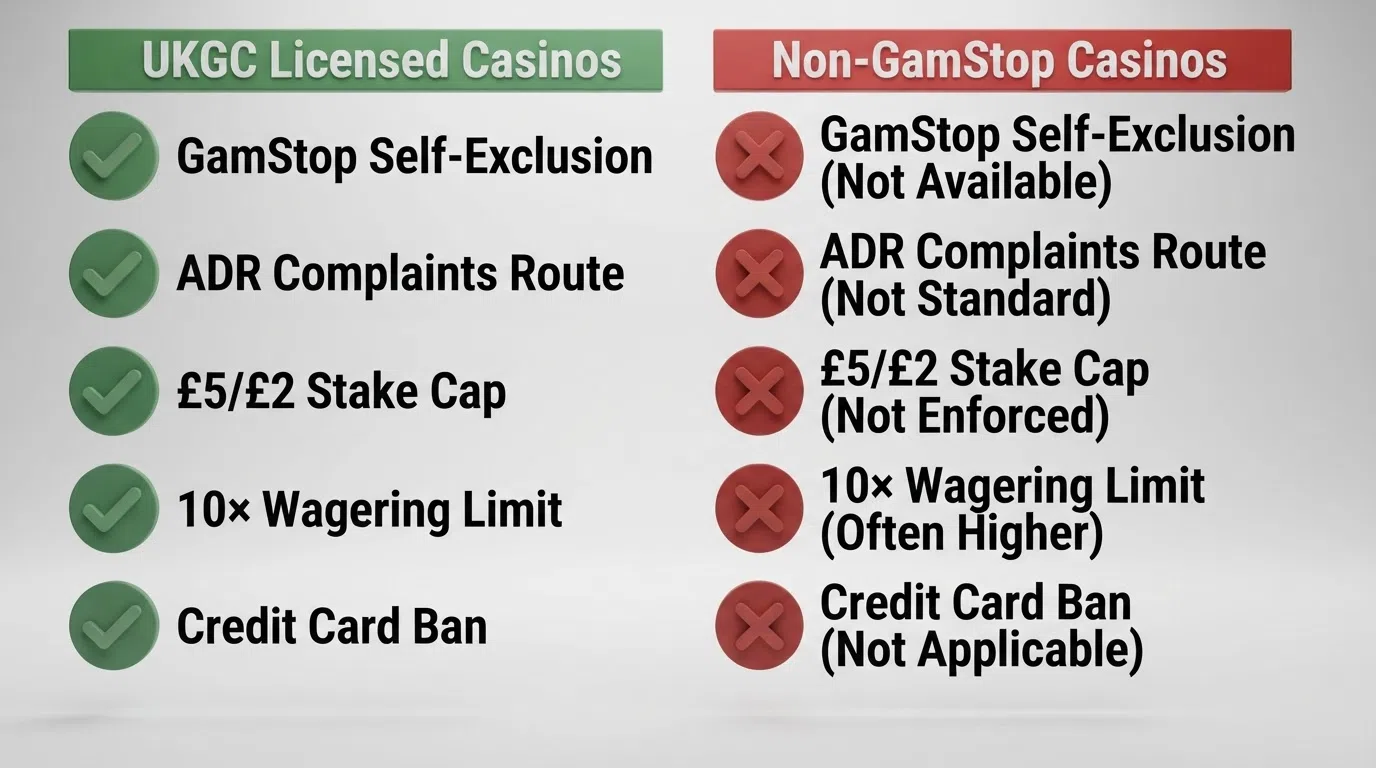
This section is honest about both sides. The protections a player gives up are real and named; the legal status of the player who steps around them is also what it is, and the page does not dress it up. Where the Commission has weighed in publicly, those words are quoted and attributed.
What GamStop Is and How the Self-Exclusion Works
GamStop is a free, confidential service that lets a person block themselves from opening new online gambling accounts with any UKGC-licensed operator. Exclusion periods run from a minimum of six months to five years, with an option to renew automatically at the end. A minimum-period exclusion cannot be lifted early; the Commission considers that the whole point. If a person does not contact GamStop after the exclusion expires, the scheme continues the block for up to seven further years — a quietly important detail, because the protection does not silently fall away on day one of year six.
The scheme’s reach covers every operator that holds a Commission online licence. That includes every mainstream British-facing casino, every major bookmaker with an online casino product, and every site whose URL ends in .co.uk and advertises on British television. It does not cover offshore operators, which is the gap the search term exploits.
The UKGC Safety Net: Protections Every Licensed British Casino Must Provide
A UKGC-licensed casino is not just regulated in name. Three licensing objectives anchor the Gambling Act 2005: preventing crime, ensuring fairness, and protecting children and other vulnerable people. Translated into daily experience, the protections British players take for granted include:
- Stake limits on online slots — a statutory maximum stake of £5 per game cycle for adults 25 and over, and £2 for 18–24-year-olds, in force from April and May 2025 under SI 2025/215.
- A wagering cap of 10× on bonus funds, in force from 19 December 2025, alongside a ban on mixed-product promotional offers that would, for example, hand out casino free spins in return for a sports bet.
- Mandatory deposit limits — operators must prompt customers to set a financial limit before their first deposit, and act on any request to lower a limit immediately, in force from 31 October 2025.
- A ban on credit cards for any gambling payment, including those routed through e-wallets, since 14 April 2020.
- A ban on auto-play, reverse withdrawals, and features that disguise losses as wins — the game-design floor of the regulated market.
- A complaints route to an approved Alternative Dispute Resolution provider, with the Commission as the backstop.
The statutory levy, raised by the Gambling Levy Regulations 2025, sits on top of all of this. Remote casino operators pay 1.1% of gross gambling yield to fund treatment, prevention, and research — a number that affects operator cost, not the player directly, but it is part of the architecture the offshore sites do not contribute to.
What a British Player Loses by Playing Outside GamStop
Cross the line and the list above effectively inverts. There is no GamStop coverage; the self-exclusion scheme does not know the operator exists. There is no Commission complaints route, and therefore no approved ADR provider the player can be referred to. There are no statutory stake or deposit limits — the £5/£2 caps apply only to UKGC-licensed sites. Credit cards are not banned. The mandatory financial-limit prompt does not exist. Auto-play and reverse-withdrawal bans do not apply. Affordability checks, where the operator chooses to run them, are at the operator’s discretion and not against a Commission-set threshold.
The Commission has been blunt about the contrast. “We are aware of the shameless advertising of unlicensed gambling that is clearly targeting vulnerable people,” a UKGC spokesperson told industry trade press in 2025. That is the regulator’s view of the marketing that surrounds non-GamStop sites, and it is the reason the protections exist in the first place. The trade the offshore casino offers is not free; it is paid for in the loss of every safeguard just named.
The Legal Status: No Criminal Risk for Players, but Offshore Operators Are Unlicensed
The honest answer to “is it legal?” has two parts, and they should not be conflated. For the player, the law is not the risk. No UK player has been prosecuted for gambling on an unlicensed site; the offence under section 33 of the Gambling Act 2005 sits with the operator and the people who run it. The Commission’s enforcement record between April 2024 and June 2025 — 3,140 disruption notices, 447,778 URLs referred to search engines, 287,961 URLs removed, an average 32% fall in engagement across 160 disrupted sites — is all aimed at operators, advertisers, and intermediaries, not customers.
For the operator, the position is different. Since the Gambling (Licensing and Advertising) Act 2014, a GB licence has been compulsory for any operator taking GB customers, wherever it is based. Without one, the operator is committing a criminal offence under section 33 of the Gambling Act 2005, punishable by up to 51 weeks’ imprisonment, an unlimited fine, or both. The Commission disrupts where it can — through payment-provider referrals, domain-registrar pressure, and search-engine delisting — but it has no statutory power to compel ISP-level blocking in Great Britain. That gap is why offshore sites remain reachable from a British IP address.
How to Assess Safety at a Non-GamStop Casino When the UKGC Badge Is Missing
Without the Commission’s badge, the only thing a player can lean on is the licence the operator does hold — and the licensing landscape for offshore casinos changed materially in late 2025. The Curaçao Gaming Authority’s orange authorisation seal expired on 15 October 2025, ending the old sub-licence system. From that date, only direct OGL licences issued under the new LOK regime are valid. An operator whose licence number begins with 8048 under the old sub-licence structure is no longer legitimately authorised, even if their footer still shows a Curaçao badge.
Three checks are worth running before depositing. First, look the licence number up on the issuing authority’s own register — the Curaçao GCB register for direct OGL licences, the Anjouan register, or the MGA register. Second, watch for warning signs: a licence number that cannot be found, an expired or transferred number, or a number the operator is reluctant to display in the footer. Third, weigh the operator’s track record. Community reputation, independent audit certification, complaint history on player forums, and the age of the operation are the substitutes for the Commission’s ongoing supervision.
MyStake’s Curaçao CGA licence assessment was in progress at the time of writing, with the licence having lapsed in December 2025, while the brand now operates under GTW and Anjouan licences. Donbet, by contrast, holds a direct OGL under the new regime — licence OGL/2024/250/0115 — and is one of the few operators in the featured set with a clean post-reform licence. That contrast is exactly why a licence check matters.
The Best Non-GamStop Casinos for British Players: 2026 Ranked Comparison
None of the ten operators below holds a UKGC licence. All are offshore-licensed, none participates in GamStop, and all accept British customers. The ranking is built on licence status, bonus terms, wagering multiples, free-spin value, and GBP support — the dimensions a comparison shopper can verify at a glance. Where research did not confirm a figure, the table shows an em dash rather than a guess. Two of the ten (BC.Game and Cloudbet) are crypto-primary with limited GBP, and that is shown in the GBP column rather than smoothed over.

| Casino | Licence and Regulatory Status | Welcome Bonus | Wagering Requirement | Free Spins | GBP Deposits |
|---|---|---|---|---|---|
| MyStake | Curaçao CGA (lapsed Dec 2025), GTW + Anjouan | 150% up to £750 (1st); 300% up to £1,500 across 3 deposits | 30× deposit + bonus | — | Yes |
| Donbet | Curaçao GCB OGL/2024/250/0115 (direct LOK) | 150% up to €750 | 30× bonus funds | 50 | Yes |
| Rolletto | Curaçao CGA OGL/2024/1798/1048 (Santeda) | Up to £5,500 across 3 deposits | 40× bonus funds | 200 (50 instant + 30/day × 5) | Yes |
| Goldenbet | Curaçao GCB | 300% up to £1,500 across 3 deposits (100% up to £500 each) | 35× deposit + bonus; 1× on free-spin winnings | 100 (Book of Witches) | Yes |
| Freshbet | Curaçao-licensed | 100% up to £500 (1st); 300% up to £3,000 across 3 deposits | 30× bonus only | 25 no-deposit + 200 with welcome | Yes |
| Jokabet | Curaçao-licensed | 255% up to €1,500 across 3 deposits | 40× | 250 | Yes (offers in EUR) |
| BC.Game | Curaçao | Up to $20,000 in matched deposit (crypto) | — | — | Limited |
| Cosmobet | Curaçao-licensed | — | 35× | 20 no-deposit | Yes |
| Emperia Casino | Curaçao (Fortuna Games N.V.), launched 2026 | Up to £3,000 + 325 free spins across 4 deposits | — | 325 | Yes |
| Cloudbet | Curaçao, Anjouan | 100% up to 5 BTC | — | — | Limited |
The shape of this table is the shape of the market. GBP support is now the norm, not the exception — eight of ten take pounds directly. The wagering multiples cluster in the 30× to 40× range, three to four times the UKGC cap. The two crypto-primary operators (BC.Game and Cloudbet) sit at either end of the maturity spectrum, with Cloudbet the veteran and BC.Game the larger crypto brand; both make British pounds an afterthought. Emperia Casino is the new launch, and the absence of confirmed wagering and validity terms is itself information — a player who needs certainty should wait for the operator to publish a track record.
MyStake — The Broadest Game Lobby with a Licence in Transition
MyStake’s selling point is the game count: 80+ providers, including Pragmatic Play, Evolution, NetEnt, and Hacksaw Gaming, which translates into one of the broader game libraries in the featured set. The welcome package is split across three deposits — 150% up to £750 on the first, 300% up to £1,500 in aggregate — with 30× wagering on deposit plus bonus combined and 30 days to clear. GBP deposits are supported.
The thing that makes a player pause is the licence. MyStake’s Curaçao CGA licence lapsed in December 2025, and the brand is now operating under GTW and Anjouan licences while the Curaçao assessment is in progress. Trustpilot shows a 4.3 rating, since hidden, which suggests the brand has been responsive to player feedback but has also stopped publishing the score. A player who values breadth of game library and is comfortable with the current licence transition will find MyStake a workable choice; a player who needs a confirmed post-reform Curaçao OGL should look at Donbet instead.
Donbet — Direct Curaçao OGL Licence and a Clean Welcome Package
Donbet is one of the few operators in the featured set with a direct Curaçao OGL under the new LOK regime — licence OGL/2024/250/0115 — which is the post-October-2025 standard the GCB itself set. The welcome offer is 150% up to €750 plus 50 free spins, with 30× wagering on bonus funds and 30 days to clear. The minimum deposit is £20. The game library runs to 70+ providers, including Pragmatic Play, Evolution, and BGaming, and GBP deposits are accepted.
This is the operator to start a comparison from if licence legitimacy is the primary concern. The bonus terms are straightforward, the wagering is at the lower end of the offshore range, and the licence is verifiable on the GCB register. The downside is euro denomination on the bonus — a British player depositing in pounds will see a small conversion hit on the headline figure — but that is a minor friction, not a structural issue.
Rolletto — The Biggest Welcome Package Among the Featured Set
Rolletto’s headline is the largest in the featured set: up to £5,500 across three deposits, plus 200 free spins delivered as 50 on first deposit and 30 per day for the next five daily logins. The game library is broad at 80+ providers — Pragmatic Play, Play’n GO, Evolution — and GBP deposits are supported with a £20 minimum. The licence is Curaçao CGA OGL/2024/1798/1048, held by Santeda.
The wagering multiple is where the headline number earns its keep. 40× on bonus funds across a £5,500 ceiling is a large total-turnover requirement, and the daily drip of free spins over five consecutive logins is a retention mechanic as much as a perk. A player who plans to deposit across all three stages and play regularly will extract more value than a player who deposits once and walks away. The match is good for the committed bonus hunter with time to play through; it is less good for the casual visitor.
Goldenbet — The Highest Match Percentage in the Featured Set
Goldenbet offers a 300% match across three deposits, the highest match percentage in the table, taking the headline figure to up to £1,500. The 100 free spins ride on Book of Witches from ThunderSpin and require an exclusive code, with 35× wagering on deposit plus bonus and 1× on the free-spin winnings. The 7-day validity on the free spins is shorter than the 30 days on the match, and that is the main thing to keep in mind.
70+ providers, Curaçao GCB licensing, £20 minimum deposit, and full GBP support round out a clean package. The match is generous; the wagering base (deposit plus bonus, not bonus alone) is the cost of that headline figure. Compared with Freshbet’s 30× on bonus only, Goldenbet’s 35× on the combined amount is the larger real cost for a given deposit — a player choosing between the two should think in terms of the effective turnover per pound deposited, not the headline percentage.
Freshbet — No-Deposit Free Spins and the Lowest Wagering in the Set
Freshbet is the only operator in the featured set offering no-deposit free spins on registration — 25 of them, no deposit required, alongside a welcome package of 100% up to £500 on the first deposit (300% up to £3,000 across three deposits) plus 200 free spins with the welcome. The wagering is 30× on bonus only, not deposit plus bonus, which is the cleanest base in the table.
The library runs to 60+ providers including Pragmatic Play, Evolution, and BGaming. Curaçao licensing, GBP support, £20 minimum. For a player who wants to try the casino before committing, the no-deposit offer is a genuine test drive. For those planning to deposit, the bonus-only wagering base offers the most favourable terms in the featured set — a £500 deposit with a £500 bonus triggers £15,000 of turnover, effectively halving the £30,000 requirement found at deposit-plus-bonus sites.
Jokabet — A 255% Welcome Bundle with 250 Free Spins
Jokabet’s three-deposit welcome runs 255% up to €1,500 plus 250 free spins — 100% up to €500 with 150 free spins on the first deposit, 55% up to €500 with 100 free spins on the second, and 100% up to €500 on the third. The default wagering is 40×, and the default bonus validity is 14 days — the shortest in the featured set. 60+ providers, Curaçao licensing, GBP deposits accepted, £20 minimum.
The short validity is the issue. A player who cannot clear 40× wagering in 14 days loses the bonus; a player who can plays a tight clock. Euro denomination on the offers is a small friction for GBP depositors. The casino suits a player who plans to clear bonuses quickly and is comfortable with euro-priced offers; it is less forgiving than Freshbet or Donbet for the player who plays intermittently.
BC.Game — The Crypto-First Non-GamStop Option
BC.Game is a crypto-native casino, and its welcome package reflects that — up to $20,000 in matched deposit bonuses, denominated in crypto rather than pounds. Free spins and wagering terms were not confirmed for the standard welcome during research; the headline figure should be read with that uncertainty in mind. The game providers are major crypto-focused studios, the minimum deposit is the crypto equivalent of $10, and GBP access is limited.
This is the operator for a player who already holds crypto and is comfortable with a USD-pegged bonus. The British player depositing in pounds will sit on the wrong side of two conversion layers. As a comparison option, BC.Game is in the table because of its scale and brand recognition; for a pounds-first player, the rest of the table is more directly relevant.
Cosmobet — 20 No-Deposit Spins and a 35× Standard
Cosmobet is a smaller Curaçao-licensed operator with 50+ providers, confirmed GBP support, and a 20 free-spin no-deposit offer — the second no-deposit offer in the featured set, behind Freshbet’s 25. The wagering on bonus is 35×. The full welcome bonus and bonus validity were not confirmed during research, which is a meaningful gap for a player deciding where to deposit.
The no-deposit offer and the 35× standard are the cleanest confirmed figures. Where Cosmobet is light on confirmed detail elsewhere, a player should weigh that against the operators with fuller published terms. A reader who prizes the no-deposit test drive above a large match might still find Cosmobet worth a look; a reader who needs the full terms before depositing has stronger options in the table.
Emperia Casino — The Newest Face: 12,000+ Games and a 2026 Launch
Emperia Casino is the 2026 launch in the featured set — operated by Fortuna Games N.V. under a Curaçao licence, with 80+ providers and over 12,000 games in the library. The welcome package runs to up to £3,000 plus 325 free spins across four deposits. GBP deposits are supported. Wagering, bonus validity, and minimum deposit were not confirmed during research, which is a track-record gap rather than a marketing one.
A new launch has no community history to lean on, and the welcome headline is generous in the way new-operator bonuses tend to be. A player who wants to be among the first should run the licence check (Fortuna Games N.V. on the Curaçao GCB register), read the bonus terms carefully when published, and test support responsiveness before committing. The library size is a real draw; the track record is still being written.
Cloudbet — The Veteran Crypto Casino with a BTC Welcome
Cloudbet is the longest-running crypto casino in the featured set, with Curaçao and Anjouan licensing and a 100% match welcome up to 5 BTC. Free spins are not part of the standard welcome, wagering and bonus validity were not confirmed, and GBP access is limited — the 0.001 BTC minimum deposit is the clearest indicator of where the operator’s centre of gravity sits.
The brand recognition and operating history are the value. A crypto-first British player will find Cloudbet a more mature option than BC.Game for a comparable welcome; a pounds-first player should treat it as a benchmark rather than a destination.
Bonuses Without the UKGC Handcuffs: What Non-GamStop Sites Actually Offer
The single biggest reason British players end up at non-GamStop casinos is the bonus structure. UKGC-licensed sites are now capped at 10× wagering and cannot run mixed-product offers; offshore sites have no such ceiling. The numbers that look generous in marketing copy translate into very different real costs when the wagering multiple sits at 30× to 50×. This section works through the bonus landscape honestly, with the calculation in plain prose and the figures the table cannot carry.
A worked example, using the Donbet welcome as the cleanest case in the featured set. A player claims the 150% up to €750 bonus with a €500 deposit and a €750 bonus credit. At 30× wagering on bonus funds, the required turnover is €750 × 30 = €22,500. At a typical €0.50 stake per spin, that is 45,000 spins. At the 5-second interval the formula assumes, that is 225,000 seconds, or about 62.5 hours of continuous play. At a 96% RTP on a typical slot, the expected loss on the bonus is €22,500 × (1 − 0.96) = €900 — more than the bonus itself, before any winnings are taken into account. The bonus is a marketing number; the real cost is the gap between the wagering multiple and the RTP.
No-Deposit Bonuses and Free Spins: What British Players Can Actually Claim
The standard no-deposit free spin offer at non-GamStop casinos runs 10 to 25 free spins on a selected Pragmatic Play or BGaming slot, with wagering on winnings between 35× and 50× and a cashout cap of £50 to £100. Two operators in the featured set carry confirmed no-deposit offers: Freshbet’s 25 free spins on registration, and Cosmobet’s 20. The cashout cap is the figure to weigh alongside the spin count — a 25-spin offer with a £50 cap returns a maximum of £50, not the gross win.
A no-deposit offer serves as a test drive rather than a substantial bankroll. The wagering multiple on winnings is high because the casino assumes the risk for a player who hasn’t yet committed capital; the cashout cap acts as a safeguard against a lucky first spin. When comparing these offers, weigh the spin count, eligible slot, wagering multiple, and cashout cap as your primary metrics.
Deposit-Match Welcome Bonuses: How the Numbers Break Down
The deposit-match welcome is the headline offer, and the range across the featured set is wide. Freshbet and Cloudbet both sit at 100% on the first deposit; Goldenbet leads the match percentage at 300% across three deposits. The wagering multiples run from 30× at Freshbet, Donbet, and MyStake to 40× at Rolletto and Jokabet, with Goldenbet at 35×. Bonus validity runs from 14 days at Jokabet to 30 days at most other operators.
| Operator | Headline Bonus | Match Percentage | Wagering Multiple | Wagering Applies To | Bonus Validity |
|---|---|---|---|---|---|
| Freshbet | 100% up to £500 (1st); 300% up to £3,000 (3 deposits) | 100% (1st) | 30× | Bonus only | 30 days |
| Donbet | 150% up to €750 | 150% | 30× | Bonus funds | 30 days |
| MyStake | 150% up to £750 (1st); 300% up to £1,500 (3 deposits) | 150% (1st) | 30× | Deposit + bonus | 30 days |
| Goldenbet | 300% up to £1,500 (3 deposits) | 100% per deposit | 35× | Deposit + bonus | 30 days (7 days on FS) |
| Rolletto | Up to £5,500 (3 deposits) | — | 40× | Bonus funds | 30 days |
| Jokabet | 255% up to €450 (3 deposits) | 100% / 55% / 100% | 40× | Bonus funds | 14 days |
| Cloudbet | 100% up to 5 BTC | 100% | — | — | — |
| BC.Game | Up to $20,000 (crypto) | — | — | — | — |
| Emperia Casino | Up to £3,000 + 325 FS (4 deposits) | — | — | — | — |
| Cosmobet | — | — | 35× | — | — |
The comparison that matters is the wagering base. A 30× on bonus only at Freshbet on a £500 deposit with a £500 bonus is £15,000 of turnover. A 30× on deposit plus bonus at MyStake on the same deposit is £30,000 — double the cost for the same match percentage. Goldenbet at 35× on the combined amount is in the same range as MyStake. The wagering multiple alone does not tell the reader the cost; the base it applies to does.
Bonus Codes, Loyalty Schemes and VIP Rewards at Non-GamStop Casinos
Bonus codes at offshore casinos usually unlock a specific promotion rather than act as a voucher. Goldenbet’s 100 free spins on Book of Witches, for example, require an exclusive code — without it, the welcome may not credit the spins. The practice is widespread enough that a player who intends to claim a code-gated offer should check the offer page before depositing, since claiming without the code can forfeit the perk even after the deposit lands.
Loyalty and VIP tiers at non-GamStop casinos typically run on points, cashback, and reload bonuses — the kind of ongoing structure the UKGC mixed-product ban prohibits. Cashback in particular is a common offer at offshore sites; reload bonuses on subsequent deposits are standard. The details vary by operator and are not always published up front; the structure exists, the specifics do not transfer from one site to another, and a player should check the loyalty page of any operator they intend to play with long-term. The UKGC ban on mixed-product promotions has no parallel offshore, which is the structural reason offshore loyalty programmes are more elaborate than their regulated-market equivalents.
From British-Themed Slots to Live Dealer Tables: Games at Non-GamStop Casinos
Game library is the second-biggest reason players move offshore. The scale is different: Emperia Casino advertises over 12,000 games from 80+ providers; MyStake and Rolletto list 80+ providers each; Donbet, Goldenbet, and Freshbet sit between 60 and 70+ providers each. The provider mix across the featured set is the standard one for a serious offshore casino — Pragmatic Play, Evolution, NetEnt, Play’n GO, BGaming, Hacksaw Gaming, Microgaming — and that means British players will find the same slots they would at a UKGC site, plus titles the UKGC’s design rules exclude.
The design rules are the point. UKGC-licensed slots cannot offer auto-play, cannot run faster than one spin every 2.5 seconds, cannot disguise losses as wins, and cannot exceed the £5/£2 stake ceiling. None of those rules apply offshore, which is why a non-GamStop slot looks and feels different — the spin cycle is faster, the bonus rounds trigger more aggressively, the loss-as-win animations are present, and the stake goes as high as the operator allows. Some players find that more engaging; some find it the opposite. The trade is real on both sides.
Online Slots: British-Themed, New Releases and Real-Money Play
British-themed slots are a sub-genre in their own right — titles with British iconography, British voiceover, British settings, and British humour. Offshore casinos carry them because the British market is the audience; the UKGC-regulated market carries them because the demand is there too. The difference is the rest of the slot catalogue. Offshore, the release cycle is faster because the games are not waiting on UKGC design-rule approval; new slots land on the same day at a Curaçao-licensed casino as they do at a UKGC one, and often earlier.
Demo mode and free-play access remain standard at non-GamStop casinos, and that is a useful feature for a player who wants to test a slot before committing real money. The removal of the £5/£2 stake cap changes the experience for a high-stakes player, who will find offshore slots uncapped on stake; the removal of the 2.5-second spin floor changes the experience for a player who prefers faster play. Both changes go the same way — more freedom, less framework.
Live Dealer Tables and Table Games: The Casino Floor, Streamed
Live dealer coverage across the featured set is concentrated on Evolution and Pragmatic Play Live, the two studios that dominate the European live-casino market. Most operators in the table list both providers, and the table game coverage — blackjack, roulette, baccarat, game-show formats like Crazy Time and Monopoly Live — is the standard one a player would expect from a major live casino studio.
The UKGC’s multi-table ban, which extended to non-slot products in January 2025, has no parallel offshore. A player who wants to play two blackjack hands simultaneously can do so at a non-GamStop casino. The Commission banned simultaneous multi-table play on the grounds that it correlates with higher loss rates; an offshore operator that allows it makes its own choice, and a player who values that freedom will find the table is open. Game-show formats, side-bet-heavy variants, and the higher-stake live tables that the UKGC’s design review has curtailed are all available without the regulatory filter.
Progressive Jackpots and Slot-Site Quality at Non-GamStop Casinos
Progressive jackpot availability is the area where the picture is least clear from research, and the page should say so. None of the operators in the featured set had specific progressive jackpot titles or pool sizes confirmed for this guide, and a player who is shopping specifically for a Mega Moolah-class jackpot will need to check the lobby directly. The provider breadth — 80+ at MyStake, Rolletto, and Emperia — makes a wide progressive-jackpot selection likely, but “likely” is not a figure a player should stake a deposit on.
RTP expectations at non-GamStop casinos are set by the provider, not the operator, and most major providers publish their RTP bands. A Pragmatic Play slot, for example, has a 96%+ default RTP that does not change between a UKGC-licensed and a Curaçao-licensed casino. What the operator can change is the RTP variant offered, and a small number of offshore casinos do offer lower-RTP variants to protect margin. A player who cares about RTP should check the in-game information panel before playing.
Getting Real Money In and Out: Payments at Casinos Not on GamStop
Payment rails are the third-largest differentiator between UKGC and non-GamStop casinos, and the one that most directly affects the player. UKGC rules ban credit cards, require identity verification before first deposit, and route the complaints process through an approved ADR if anything goes wrong. Offshore sites do none of those things by default, and the result is a faster and more flexible banking experience — at the cost of the consumer protections just named.
The headline figures on speed are well established: cryptocurrency withdrawals typically clear within 1 to 6 hours after processing; e-wallet settlements run 12 to 24 hours; bank transfers take 3 to 5 working days. The UKGC imposes no statutory payout timeframe, so the speed is at the operator’s discretion — and the operators that publish their speeds are the operators worth comparing.
Playing for Real Money: Deposit Methods British Players Can Use
- Credit and debit cards (Visa, Mastercard) — accepted at most featured operators despite the UKGC ban, with a £20 minimum at the fiat-focused brands
- Cryptocurrencies (Bitcoin, Ethereum, USDT, and others) — primary at BC.Game and Cloudbet, supported alongside fiat at most of the rest
- E-wallets — Neteller, Skrill, and similar, with e-wallet withdrawals typically settling within 12 to 24 hours
- Bank transfer — the slowest rail, taking 3 to 5 working days, but available at most operators
- Prepaid cards and vouchers — varying support across the featured set
The UKGC credit-card ban does not extend offshore, which is why a player who wants to fund play with a credit card will find the door open at a non-GamStop casino. The trade is the same one the rest of this section keeps making: faster rails, fewer rails, and a complaints process that does not include the Commission.
GBP and Pound-Sterling Banking: Which Casinos Take British Currency
Eight of the ten featured operators accept GBP deposits directly — MyStake, Donbet, Rolletto, Goldenbet, Freshbet, Jokabet, Cosmobet, and Emperia Casino. The two exceptions are BC.Game and Cloudbet, which run on crypto-primary models with limited GBP support. Jokabet accepts GBP but offers the welcome in euros, which means a British player depositing pounds sees a small conversion cost on the bonus headline.
For a player who plans to deposit, play, and withdraw in pounds, the eight fiat-friendly operators are the direct comparison set. Currency conversion is the silent cost a player pays at the non-GBP operators: the spread between the mid-market rate and the operator’s rate is typically 1% to 3%, and over a series of deposits and withdrawals it adds up. A player who is comparing bonuses on a headline-percentage basis should also compare the currency the bonus is denominated in.
Withdrawal Speed and Cashout Realities at Non-GamStop Casinos
The published withdrawal times are the floor, not the ceiling. Crypto withdrawals clearing within 1 to 6 hours assume the casino has already processed the request; processing can take anywhere from a few minutes to a couple of days, depending on the operator’s queue and whether the player has completed KYC. The first withdrawal at any non-GamStop casino will almost always trigger an identity check, even at operators that advertise “no verification” — payment fraud rules push back, and a serious operator will run the check before releasing the first cashout.
A player who wants the advertised speed should complete the KYC process before requesting the first withdrawal. The documents are the same as at a UKGC casino — proof of identity, proof of address, and sometimes proof of payment method. The difference is that the offshore operator is not bound by the Commission’s affordability thresholds, so the check is identity-focused, not income-focused. The trade, again, is the same one: faster, lighter, and with a complaints process that does not include the Commission.
Playing on the Go: Mobile Access at Non-GamStop Casinos
Mobile play at non-GamStop casinos is overwhelmingly browser-based. Native casino apps from offshore operators are rare in the UK app stores — Apple and Google restrict their stores to operators licensed in the relevant jurisdiction, and a Curaçao-licensed casino is not on the list. The practical effect is that most non-GamStop mobile play happens in Safari or Chrome rather than in a dedicated app, and the experience is built on HTML5, which is what Evolution, Pragmatic Play Live, and the major slot providers ship.
The mobile-browser experience at the featured operators is broadly comparable to the desktop one. Modern HTML5 lobbies carry the full game library; live dealer streams run on the same codecs as on desktop; deposits and withdrawals are reachable from the same account menu. The differences are the small ones — touch-optimised bet selectors, vertical-screen-friendly lobby layouts, and the absence of certain desktop features (multi-window play, desktop-only tournaments) that do not translate to a phone.
Native Casino Apps vs Mobile-Browser Play: What the Featured Set Offers
A native app at a non-GamStop casino typically means a direct download from the operator’s site rather than the app store, with the operator bearing the responsibility for the install. The advantage is speed — a native app can cache assets locally, push notifications, and integrate biometric login — and the disadvantage is the trust placed in the operator’s hosting. The featured operators do not uniformly publish native apps, and the honest answer to “which has the best mobile app” is that most players in this category are playing in a browser.
A mobile browser is the safer default. The browser sandbox restricts access to the operator’s verified domain, the OS maintains the app permission model, and you avoid granting an operator’s APK unnecessary device permissions. Before installing any “native” app, verify the download link points to a regulated domain that matches the operator’s claimed licence.
Mobile Casino Features and Game Availability: What Works on a Phone
Game availability on mobile is effectively full for the providers in the featured set. Evolution and Pragmatic Play Live, the two dominant live-dealer studios, ship mobile-native tables; Pragmatic Play, NetEnt, Hacksaw, and the rest ship HTML5 slots that scale to phone screens. The areas where mobile play falls short of desktop are the high-end live-dealer variants that benefit from a larger screen and the multi-table layouts the UKGC has banned, which an offshore operator might still allow on desktop but not bother to optimise for phone.
Banking on mobile is the same as banking on desktop at every featured operator. Deposits, withdrawals, KYC uploads, and bonus claims all run through the same account interface, and the touch-optimised layouts are standard. The mobile experience at a non-GamStop casino is, in practical terms, the desktop experience shrunk to a phone screen — which is exactly what a player who plays on the go wants it to be.
New Non-GamStop Casinos in 2026: Fresh Launches and What to Watch For
The newest entrant in the featured set is Emperia Casino, launched in 2026 by Fortuna Games N.V. under a Curaçao licence. The headline is the 12,000+ game library, the broadest in the table, and the four-deposit welcome of up to £3,000 plus 325 free spins. The track record is the thin side — there is none yet, by definition — and the rest of the terms (wagering, validity, minimum deposit) were not confirmed during research. A new launch is an opportunity and a risk, and the trade-off is the standard one: bigger bonuses, less history.
The broader context is the Curaçao licence reform. The GCB’s orange authorisation seal expired on 15 October 2025, ending the sub-licence system that most non-GamStop casinos operated under. From that date, only direct OGL licences under the LOK regime are valid. Donbet’s OGL/2024/250/0115 and Rolletto’s OGL/2024/1798/1048 (Santeda) are the cleanest examples in the featured set. A new launch in 2026 that claims a Curaçao licence should hold a direct OGL number; anything else is a flag.
What to Look for in a New Non-GamStop Casino Before You Deposit
Before depositing, verify the casino’s licence by checking the issuing authority’s register for a direct OGL under the new Curaçao LOK regime. Check the operator’s corporate ownership, history, and parent company licences. Carefully read the full bonus terms, including the wagering base, validity, and free-spin cashout caps. Look for independent player reviews and community feedback, bearing in mind that new operators lack a long-term track record. Finally, test customer support responsiveness before committing any funds.
The no-deposit free-spin benchmarks from the bonuses section — 10 to 25 spins, 35× to 50× wagering on winnings, a £50 to £100 cashout cap — apply as a yardstick for any new operator’s free-spin offer. A new launch that comes in materially above those bands (50 free spins no-deposit, 10× wagering) is mispriced; one that comes in below (5 free spins, 60× wagering) is the other extreme. The mid-band is where the market has settled.
Responsible Gambling: Help and Tools When Playing Outside GamStop
The single hardest section of this guide to write is this one, because the subject is what the rest of the page is about. Non-GamStop casinos exist because players want to step around the UKGC’s harm-minimisation framework. The framework is imperfect — NHS gambling referrals rose 91% year-on-year in 2024/25, GamCare’s National Gambling Helpline made 996 referrals to treatment in January 2026, up 48% on the previous year, and the 15 NHS specialist gambling clinics have seen service use increase 130% — but it is the framework the British state has built, and the alternatives offshore are not equivalent. This section names every UK help resource with the contact routes and the recent usage data, because YMYL content that does not name the routes a reader needs is not YMYL content.
UK Help Resources: Where to Go If Gambling Becomes a Problem
GamCare runs the National Gambling Helpline and made 996 referrals to treatment and peer-based support services in January 2026, up 48% from 674 in January 2025. GamCare’s helpline is the first call for a player who is worried about their own gambling or someone else’s. The National Gambling Support Network, funded by GambleAware, treated 11,960 clients between April 2024 and March 2025, an 11% increase on the previous year. The 15 NHS specialist gambling treatment clinics — across England, Scotland, and Wales — received 4,355 referrals in 2024/25, up 91% on the prior year, and service use is up 130% over the preceding year. Gamblers Anonymous provides peer support through local meetings across the UK. None of these services are offshore; all of them are reachable from a British phone, regardless of where the gambling happens.
The prevalence figures put the scale in view. 0.4% of adults in England experience problem gambling (PGSI score of 8+), and 1.6% experience at least moderate risk gambling (PGSI score of 3+). The 16% of adults who gamble and experience some level of problems (PGSI 1+) has risen from 13% in 2023. The numbers are small as percentages and large as people; the help infrastructure is built for the people, and it is free.
Self-Exclusion, Deposit Limits and Reality Checks: Tools That Work Anywhere
GamStop itself is the cornerstone of the UKGC system, and it does not cover offshore operators. A player who has self-excluded via GamStop and then plays at a non-GamStop casino is not only outside the Commission’s protection but is also undermining their own self-exclusion decision. The honest counsel here is straightforward: if a player has self-excluded, the offshore site is the wrong place to be. A player who has not self-excluded but wants to set limits has tools that work anywhere — operator-set deposit and session limits, browser-based blocking software (such as Gamban and BetBlocker), and the cooling-off periods most non-GamStop casinos offer at the account level.
The UKGC’s mandatory financial-limit prompt, in force from 31 October 2025, is the regulator’s attempt to make a deposit limit the default rather than the exception. Offshore operators do not have to prompt. A player who wants the same friction at a non-GamStop casino has to set the limit voluntarily, and the cleaner approach is to set it before the first deposit, not after. The tools exist; the discipline of using them is the player’s own, and that is the structural difference between the regulated and unregulated markets.
How We Selected and Evaluated These Non-GamStop Casinos
The ten operators were evaluated against the UK Gambling Commission’s public licence register and the Curaçao Gaming Authority’s OGL registry. All ten are confirmed absent from the UKGC register; the comparison set is, by construction, the unlicensed market. Where an operator held a direct Curaçao OGL (Donbet, Rolletto) that was verified against the GCB register. Where a Curaçao CGA licence had lapsed (MyStake), that lapse is named in the operator’s profile.
The ranking criteria were licence validity and regulatory standing, bonus terms (wagering multiple, validity, the base wagering applies to), game-provider breadth, GBP support, and player community reputation. No weighting or scoring system is claimed — this is a qualitative assessment against disclosed criteria, and the table is the assessment. Where research did not confirm a figure, the table shows an em dash rather than a guess, and the operator profile names the gap.
This ranking is not a recommendation. It does not endorse unlicensed gambling, and every operator listed operates outside UKGC regulation. A player who reads this guide and decides to play at one of the operators listed is making a decision outside the British regulatory framework, and the consequences of that decision are theirs.
What British Players Should Actually Do With This Information
The non-GamStop casino landscape in 2026 offers more bonus value and fewer restrictions than the regulated market, and it does so at the cost of every protection the UKGC framework provides. That is the trade, in one sentence. A player who values the UKGC protection — the GamStop coverage, the £5/£2 stake caps, the 10× wagering ceiling, the credit-card ban, the financial-vulnerability check, the ADR route — has no reason to leave the regulated market, and a real cost to doing so. A player who has weighed that cost and decided to play offshore has a smaller set of choices than the marketing suggests: the operators with verified direct OGL licences (Donbet, Rolletto) over the ones with lapsed or transitional licences, the bonus-only wagering base over the deposit-plus-bonus base, GBP-denominated offers over euro- or crypto-denominated ones, and an operator with a track record over a new launch where the wagering terms are not yet published.
The one non-negotiable is the help infrastructure. The 0.4% of adults in England who experience problem gambling, the 1.6% who experience at least moderate risk, the 996 GamCare referrals in January 2026, the 4,355 NHS referrals in 2024/25 — those figures are the reason the UKGC framework exists, and the reason a player stepping outside it should know the routes back in. GamCare’s National Gambling Helpline, the NHS specialist gambling treatment clinics, the National Gambling Support Network, Gamblers Anonymous — every one of them is reachable regardless of where a player has been playing. The non-GamStop casino industry is real, British players use it, and the best outcome of reading this guide is an informed choice: a choice that knows what the UKGC gives up, knows what the offshore casino takes, and knows where to turn if the choice stops being the right one.
Frequently Asked Questions
What protections do I lose by playing at a casino not on GamStop?
You lose GamStop self-exclusion coverage, the UKGC complaints route and any approved ADR referral, the statutory £5/£2 slot stake caps, the 10× bonus wagering cap, the credit-card ban, auto-play and reverse-withdrawal restrictions, and the mandatory deposit-limit prompt. No UKGC protection, including the financial-vulnerability check, applies at a non-GamStop casino. The Commission’s enforcement record (3,140 disruption notices in 2024/25) is aimed at operators, not players.
How do I verify a non-GamStop casino’s licence?
Look the licence number up on the issuing authority’s own register. For Curaçao, the GCB register lists direct OGL licences under the new LOK regime — the orange seal expired in October 2025, so old sub-licence numbers are no longer valid. For Anjouan and the MGA, the same approach: the authority’s public register, the licence number the operator publishes, and a match. Donbet’s OGL/2024/250/0115 and Rolletto’s OGL/2024/1798/1048 are the two cleanest examples in this guide.
What payment methods can I use at casinos not on GamStop?
Credit and debit cards (Visa, Mastercard), cryptocurrencies (Bitcoin, Ethereum, USDT), e-wallets (Neteller, Skrill), and bank transfer. Credit cards are accepted offshore despite the UKGC’s 2020 ban, and crypto is the primary rail at BC.Game and Cloudbet. Withdrawal times run 1–6 hours for crypto, 12–24 hours for e-wallets, and 3–5 working days for bank transfers. The £20 minimum deposit is standard at the fiat-focused operators.
Do non-GamStop casinos have stake limits like UKGC-licensed sites?
No. The statutory £5/£2 slot stake caps (SI 2025/215) apply only to UKGC-licensed operators, and the 10× bonus wagering cap (LCCP SR Code 5.1.1) is the same. Offshore casinos set their own stake limits, and many allow stakes well above £5 per spin. The 2.5-second spin-speed floor, the auto-play ban, and the loss-disguised-as-win ban do not apply offshore either. The trade for the higher stake ceiling is the absence of the framework that set it.
Where can I get help if I have a gambling problem in the UK?
GamCare runs the National Gambling Helpline (996 referrals to treatment in January 2026, up 48% year-on-year). The 15 NHS specialist gambling treatment clinics across England, Scotland, and Wales received 4,355 referrals in 2024/25, up 91% on the prior year, and service use is up 130% over the preceding year. The National Gambling Support Network (funded by GambleAware) treated 11,960 clients in 2024/25, and Gamblers Anonymous provides peer support through local meetings. Every service is free and reachable from anywhere in the UK.
New-Casino Bonuses and Perks: Are Launch Offers Worth the Risk?
Launch offers at new non-GamStop casinos are typically larger than at established operators, and for the obvious reason — the operator needs players, and a bigger bonus is the most direct lever. Emperia’s £3,000 plus 325 free spins is the example in the featured set; a player who looks at that headline should read it as marketing, not as a settled offer, until the wagering, validity, and minimum deposit are confirmed in the published terms.
The trade is the standard one. A larger bonus against an unproven track record is a higher-variance proposition than a smaller bonus against an established operator. A player who wants to be early should commit a small deposit, test the withdrawal path, and only scale up once the operator has cleared a cycle. A player who values certainty has nine other operators in the table with longer track records.
Account – nonukgc-licensedcasinos
Content created by the «nonukgc-licensedcasinos» team