
Where your debit card still does the work — ten UK casinos that handle Visa and Mastercard the way a serious player needs them to
 Available in GB
Every UK-licensed casino takes Visa and Mastercard debit. The interesting question is not whether your card is accepted — it is which sites clear the money back to you fastest, which welcome offer is worth the wagering attached, and which rules now govern how a deposit becomes a spin. This page ranks ten UKGC-licensed operators on those terms, then walks through the rest of what every debit card player should know before tapping in a card number.

_Data current as of September 8, 2026; verified against the UK Gambling Commission’s public register._
What Your Debit Card Unlocks at a UK Online Casino
A UKGC-licensed online casino is a casino site authorised by the Gambling Commission to offer remote gambling in Great Britain. Every such site that takes card payments accepts debit cards — Visa Debit, Mastercard Debit — because credit cards have been banned for gambling since April 2020. The shape that leaves is simple: a UK player who wants to play with a card uses debit, and the choice of operator is made on offer quality, withdrawal speed and game breadth, not on which payment rails the site permits.
The UKGC public register of gambling businesses lists 2,663 active licences (last updated 29 July 2026). The ten operators ranked below are drawn from that register. Every one of them is licensed, Gamstop-registered, and takes debit cards. What separates them is what your deposit buys you.
How a Debit Card Casino Works — From Deposit to First Spin
A UK debit card casino is a remote gambling site that lets players fund play with a Visa or Mastercard debit card linked to a UK bank account. The end-to-end flow is shorter than most players expect.
Account registration takes a few minutes: name, date of birth, address, email. Age and identity are touched at this stage, but full KYC — passport or driving licence, proof of address, sometimes a selfie — typically runs before the first withdrawal rather than at sign-up. A mandatory financial-limit prompt now appears before the first deposit, since 31 October 2025, and the limit you set there is editable at any point thereafter.
The deposit itself is a standard card transaction. You open the cashier, pick “Debit Card,” enter the card number, expiry and CVC, choose an amount, and confirm. The funds clear via the card network and appear in your casino balance within seconds. The casino does not see your bank details — the transaction is handled by the operator’s payment processor, and the merchant on your statement reads as the operator’s billing name.
The rule that shapes everything downstream is the closed-loop policy: withdrawals return to the same payment method used to deposit, in most cases the same card. You deposit with a Visa Debit, you withdraw to that Visa Debit. KYC must be cleared before that first withdrawal is approved, which is where most of the delay in the pipeline comes from.
Yes, Debit Cards Are Welcome at UK Online Casinos — Here Is Why
Yes, every UKGC-licensed online casino accepts Visa and Mastercard debit cards, and the reason is regulatory. The Gambling Commission banned credit card use for any gambling payment in Great Britain from 14 April 2020 under LCCP Condition 3.7.1. The ban closed off the only other major card-based payment route and left debit cards as the de facto standard for card play in the UK.
The ban reshaped the UK casino payment landscape in two ways. First, it forced the licensed market onto a single card rail — debit only — which simplified the cashier for players but also concentrated regulatory attention on it. Second, it pushed the volume of UK card gambling through a small set of card networks, which is partly why bank-level transaction monitoring is now so visible: the same Visa and Mastercard rails that move retail spending also move gambling deposits, and the major UK banks have built gambling-specific controls on top of them.
Offshore casinos that target UK players may also accept debit cards, sometimes with weaker checks than the UKGC requires. They are outside the UKGC’s jurisdiction, and the protections the UKGC mandate — closed-loop withdrawals, segregated player funds, source-of-funds checks, Gamstop — do not apply.
Which UK Casino Sites Accept Debit Cards
UKGC-licensed casinos accept debit cards as the standard card payment method — that is a condition of the licence, not a marketing choice. The question is therefore not whether a site takes your card, but which sites handle the deposit and the return of winnings on terms that suit you.
The fastest way to verify a site is its own footer. A valid UKGC licence number is published there, alongside the Gamstop and GambleAware logos. Cross-reference the licence number against the public register at gamblingcommission.gov.uk, which is searchable by business name, trading name, domain or account number and was last updated 29 July 2026. The ten operators in the comparison block below are all on that register.
The substantive question — which of those ten offers the best combination of welcome bonus, wagering fairness, withdrawal speed and game library — is what the rest of this page is built around.
Debit Card vs Other Payment Methods — Speed, Limits and the Closed-Loop Rule
Debit cards sit in the middle of the UK casino payment stack on speed, and at one end of it on accessibility. E-wallets (PayPal, Trustly) often clear withdrawals in around two hours, and Visa Direct can cut the debit card timeline to four hours or less. Bank transfers are slower than debit cards on withdrawals because they are routed through a different system. Open Banking — the same rails used to connect to your bank from a budgeting app — appears at some operators, including LeoVegas, and resolves to a bank account rather than a card.
The closed-loop rule is what makes debit cards different from e-wallets in practice. A PayPal deposit typically allows a PayPal withdrawal to a different PayPal account, because the e-wallet is itself the method. A debit card deposit ties the withdrawal to the specific card used — same number, same name, same expiry. The casino cannot, in most cases, send the money to a different card even if you have since replaced it, and the bank cannot receive it on a card that does not match. This is the source of more player frustration than any other rule in the cashier, and the operator pages document it in different words.
The practical result: if you are a regular player who wants fast withdrawals and flexibility on the receiving end, an e-wallet has the edge. If you want a payment method that almost every UK casino takes, that does not require a third-party account, and that is now embedded in the regulatory framework, the debit card wins on reach.
The Real Reason Your Debit Card Withdrawal Isn’t Instant
A deposit at a UK casino is usually instant because it is a card authorisation, not a transfer. A withdrawal is a transfer — from the casino’s bank to yours — and it has to clear three stages: the casino’s internal pending period, the payment team’s approval, and the bank leg. The 1–3 working day figure that appears on most operator pages is the bank leg, after the first two stages are done. Most of the delay sits in those first two.
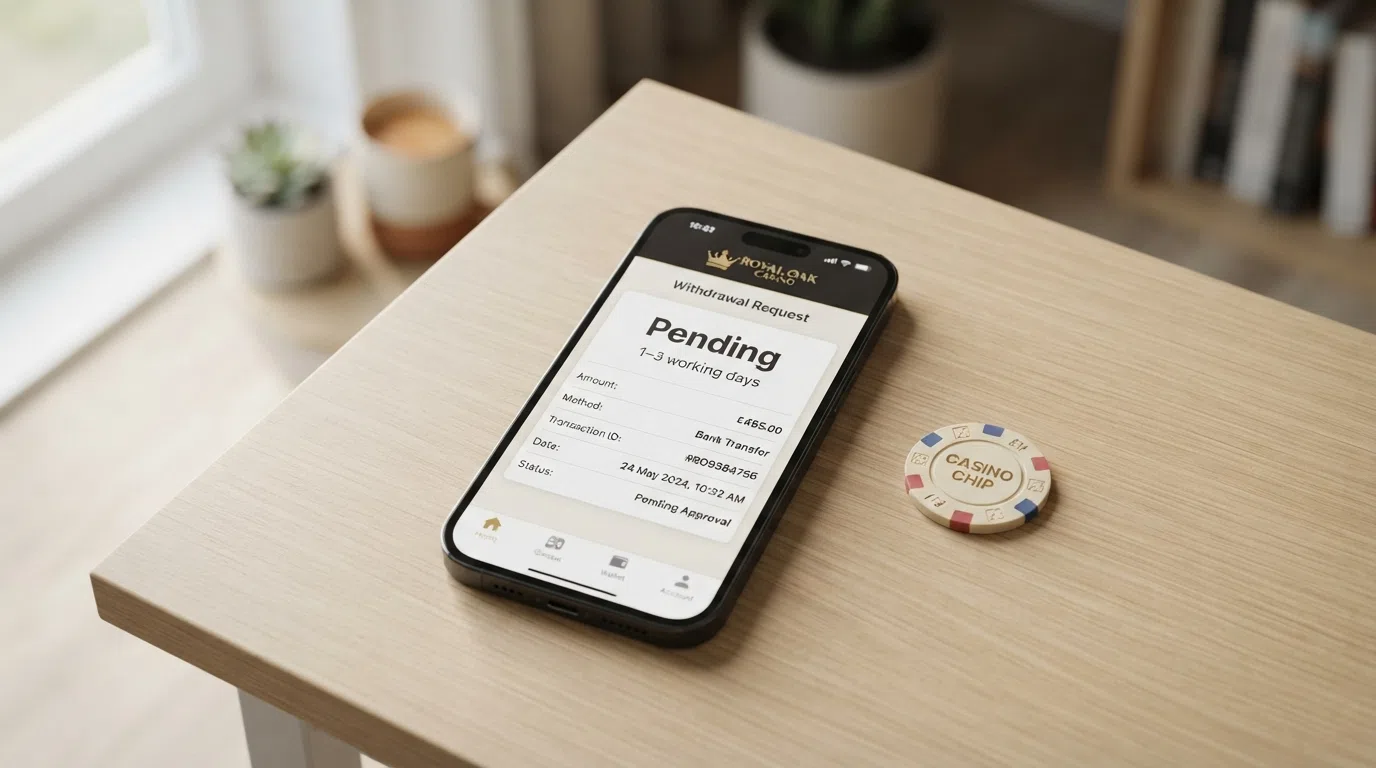
The casino’s pending period is a built-in delay during which a withdrawal can still be reversed. The window is typically 24 to 72 hours, depending on the operator and on the player’s account history. Until the pending period ends, the funds have not left the casino. The payment team’s approval is the second stage: an operator check for KYC, bonus terms, anti-fraud flags. Once those are cleared, the money is released to the bank.
The bank leg is the part that the card network controls. Standard Visa and Mastercard payouts take 1–3 working days after the casino releases them. Weekends and UK bank holidays extend the timeline. The exception is Visa Direct, a faster-payout rail that some operators support, and which can land the money in your account within four hours. William Hill Vegas, bet365 Games and Ladbrokes run on it. Most other featured operators do not, which is why their published withdrawal times are in days rather than hours.
The asymmetry between deposit and withdrawal is therefore not a marketing trick. It is a reflection of the fact that a deposit is a card authorisation and a withdrawal is a cross-bank transfer that has to satisfy two sets of compliance.
How to Deposit with a Debit Card — Step by Step
- Register and verify age. Open the casino site, click “Join,” and complete the sign-up form. Age is verified at registration. Full KYC (passport or driving licence, proof of address) usually runs before the first withdrawal rather than at sign-up.
- Open the cashier and pick “Debit Card.” The cashier is usually reachable from the account menu. Select the deposit option. Visa Debit and Mastercard Debit are listed together or as two separate options.
- Enter card details. Card number, expiry date, CVC, and the cardholder’s name (which must match the account). Details are handled by the casino’s payment processor; the casino itself does not store them after authorisation.
- Choose a deposit amount. The cashier shows the minimum and maximum. Most featured operators take £10 as the floor; Grosvenor takes £20 for its bonus. The maximum ranges from £10,000 (Sky Vegas daily withdrawal) to £99,000 (William Hill on Visa Debit).
- Confirm. A 3-D Secure step may follow (your bank’s app or a one-time code). Once confirmed, the funds appear in your casino balance within seconds.
A financial-limit prompt appears before this sequence completes for the first time, and the limit you set applies to subsequent deposits as well. The same panel lets you change the limit at any point.
Cashing Out to Your Debit Card — Timelines and What Slows It Down
A debit card withdrawal at a UK casino goes through three stages. The casino’s internal pending period is the first, and the most common source of delay that players blame on the bank. The pending period is the time between requesting a withdrawal and the casino’s payment team releasing the money. Operators set it for security: it gives the player a chance to reverse a withdrawal and gives the operator time to run KYC and bonus-compliance checks. The window is typically 24 to 72 hours.
Once the payment team approves the withdrawal, the money enters the bank leg. Visa and Mastercard clear standard card payouts in 1–3 working days after approval. Visa Direct can land the money in your account within four hours where the operator supports it. E-wallet payouts, where available, often clear in around two hours.
KYC verification is the most common single delay trigger. If your account has not been fully verified before you request a withdrawal, the casino will pause the payment until the documents are in and approved. The fix is straightforward — verify at sign-up, not at first withdrawal — but most players do not, and the result is a withdrawal that sits in pending for days.
Weekends and bank holidays extend the bank leg. A withdrawal approved on a Friday afternoon will not usually reach your account until Tuesday or Wednesday. The casino’s pending period is also affected by internal staffing at weekends, which can lengthen the first stage by a day.
UKGC rules protect the deposit leg of this: the deposit balance must be withdrawable at any time, including while a bonus is active, and the deposit and bonus balances must not be mixed. A player who has not wagered a bonus cannot be required to forfeit their deposit in order to withdraw.
Which Debit Card Casinos Pay Out Fastest in the UK
The fastest tier for debit card withdrawals in the UK is Visa Direct. William Hill Vegas pays out in up to 4 hours, bet365 Games in 30 minutes, and Ladbrokes in 4–8 hours. The exact time depends on the issuing bank, but the order of magnitude is hours rather than days.
The mid-tier is 1–2 working days. Paddy Power Games sits here, with Casumo up to 2 days after approval. The standard tier — and the one most featured operators fall into — is 1–3 working days. Sky Vegas, LeoVegas, and Grosvenor all publish this window.
The fastest-payout casinos are identifiable from the banking page before you sign up. Look for explicit mention of Visa Direct or a published “same day” or “within hours” window. Operators that publish per-method times are a stronger signal than operators that only publish aggregate ranges.
Minimum and Maximum Amounts — Deposit and Withdrawal Limits Explained
Minimum deposits at the featured operators are largely standardised at £10 for debit card deposits. Grosvenor takes £20 to qualify for its welcome offer, though £10 is the general minimum. Ladbrokes does not publish a specific figure in its public materials, so a standard £10 minimum is the safe assumption.
Maximum deposits vary widely. Paddy Power sets a £25,000 daily maximum, LeoVegas £20,000, and William Hill a £99,000 maximum on Visa Debit — the highest in the set. Operators that do not publish a specific cap typically apply one at the cashier based on account history and payment method.
Minimum withdrawals are smaller than minimum deposits at most operators. William Hill takes £5 as the minimum debit card withdrawal — the lowest in the set — and Grosvenor £10. Most others align with the £10 deposit floor. Maximum withdrawals are stated as daily or monthly limits; Sky Vegas sets a £10,000 daily maximum, and operators that do not publish a figure apply a per-account cap that the cashier will show you on request.
Operators that do not publish a specific limit in their terms typically state the floor or ceiling in the cashier itself. The terms page is the right place to look for the rules; the cashier is the right place to look for the actual figure on your account.
Does Your Card Network Matter? Visa Debit and Mastercard Debit Compared
For most players, the choice between Visa Debit and Mastercard Debit at a UK casino makes no practical difference. Both networks are near-universally accepted at UKGC-licensed casinos, both route through the same payment processors, and both are subject to the same closed-loop rule. The substantive differentiator is whether the operator supports Visa Direct, the network’s faster-payout rail, and that is the network’s own product rather than something the casino chooses to enable per card type.
Mastercard does not have an equivalent faster-payout rail of comparable reach in the UK market. A Mastercard debit withdrawal sits in the standard 1–3 working day window for the bank leg. A Visa debit withdrawal is in the same window, except at the operators that run on Visa Direct, where it drops to hours. The networks are interchangeable for everything else, including bank-level transaction blocks — Ulster Bank/NatWest Group, Monzo, Starling and Barclays apply their gambling controls to both networks equally.
The practical answer: pick the debit card you already use. The network makes no difference beyond Visa Direct availability, and the difference between the two networks on that single rail is the only reason a player with a real choice between them would pick one over the other.
The Operators Where Your Debit Card Goes Furthest in 2026
The ten operators ranked below are all UKGC-licensed, all on the public register, and all accept Visa and Mastercard debit cards. The split is roughly two-thirds no-wagering offers — free spins whose winnings are paid as cash — and one-third wagering offers, where the bonus is matched against a multiple of the deposit. The question the table answers is which welcome offer returns the most to a debit card player, and how long it takes to get it back.
The ranking uses four criteria. UKGC licence status is mandatory for inclusion, so it does not differentiate. Welcome-offer value, adjusted for the wagering burden, is the primary criterion: a 200-spin no-wagering offer beats a 100% match with a 30x playthrough on the same deposit, because the no-wagering offer is paid in cash. Debit-card withdrawal speed is the second criterion, with Visa Direct operators ahead of the standard 1–3 day tier. Game breadth is the third. The fourth is the bonus ceiling: the highest no-wagering spin counts and the most generous match amounts rank above their smaller equivalents.
Top 10 Debit Card Casinos at a Glance — Comparison Table
| Operator | UKGC Licence Status | Welcome Offer | Free Spins | Wagering Requirement | Debit Card Withdrawal Time |
|---|---|---|---|---|---|
| bet365 Games | Active | Up to 500 free spins, 10 selections over 20 days | Up to 500 | 0x | 30 minutes (Visa Direct) |
| Paddy Power Games | Active | 50 FS no wagering + up to 200 more with £10 wagered | Up to 260 | 0x | 1–2 working days |
| Sky Vegas | Active | 50 no-deposit FS + up to 200 with £10 deposit | Up to 200 (plus 50 no-deposit) | 0x | 1–3 working days |
| 888casino | Active | 100% deposit match up to £100 | None | 10x | — |
| William Hill Vegas | Active | Bet £10, get 200 FS on Big Bass Splash (10p/spin) | 200 | 0x | Up to 4 hours (Visa Direct) |
| LeoVegas | Active | 50 FS on Big Bass Splash | 50 | 1x | 1–3 business days |
| Grosvenor Casino | Active | Deposit £20, play with £40 + 100 FS on Big Bass Splash | 100 | 10x | Up to 3 banking days |
| Casumo | Active | 100% match up to £300 + 50 bonus spins | 50 | 30x | Up to 2 days |
| Ladbrokes | Active | 200 no-wagering free spins | 200 | 0x | 4–8 hours |
| Betfair Casino | Active | 50 no-deposit FS + 100 more with £10 deposit | 150 | 0x | — |
Two of the ten do not publish a per-method debit card withdrawal time: 888casino and Betfair Casino. The standard 1–3 working day window that the rest of the set publishes is the realistic assumption until either operator states otherwise on its banking page.
bet365 Games
bet365 Games leads the set on a combination of three things: the largest no-wagering free spin offer in the UK market, the fastest standard-tier withdrawal time, and a 2,000+ game library that gives a wide choice of where to use those spins. The welcome offer is structured as ten daily selections of 5, 10, 20 or 50 free spins over 20 days, with winnings paid as cash — no wagering, no cap. The minimum deposit is £10 and the debit card qualifies, though Paysafecard is excluded from the bonus.
Debit card withdrawals are quoted at 30 minutes via Visa Direct, which puts bet365 alongside William Hill at the top of the speed table. The combination of zero wagering on the welcome offer and same-day withdrawals is the strongest no-friction profile in the set, and the breadth of the game library is the secondary reason it sits at the top of the ranking. For a debit card player who wants the welcome offer paid in cash and the winnings back in the bank the same day, this is the closest the UK market gets to a clean answer.
Paddy Power Games
Paddy Power Games offers up to 260 free spins with zero wagering, the highest no-wager spin count among the featured operators once the deposit-and-wager step is taken. The structure is 50 free spins on sign-up followed by up to 200 more once £10 has been deposited and wagered, with all winnings paid as cash. The minimum deposit is £10, and only debit card, Pay by Bank, or Apple Pay qualify for the bonus — other e-wallets may be excluded.
Debit card withdrawals are quoted at 1–2 working days, which places Paddy Power in the mid-tier of the speed table. The £25,000 daily maximum deposit is the second-highest in the set, behind only William Hill. For a high-stakes player who wants a no-wagering welcome offer and a deposit ceiling that does not require a conversation with customer support, Paddy Power is the right match.
Sky Vegas
Sky Vegas is the only featured operator with a meaningful no-deposit element: 50 free spins on registration, with no deposit and no wagering, plus up to 200 more free spins once a £10 debit card deposit is made. The 0x wagering applies throughout, and the 900+ slot library (per The Standard) sits in the middle of the set.
Debit card withdrawals take 1–3 working days, the standard tier, and the £10,000 daily maximum withdrawal is the highest published cap in the set. For a player who wants to try a casino without committing a deposit first, Sky Vegas is the only option in the ten that lets them. The 50 no-deposit spins are the strongest such offer in the licensed UK market, and the £10 deposit step doubles the spin total without re-introducing wagering.
888casino
888casino is the sole deposit-match offer in the set: 100% up to £100. The wagering requirement is 10x on selected slots within 90 days, and the wagering uses bonus funds only once the cash balance reaches £0. Winnings from the bonus are capped at £100 — the figure that defines what the offer is actually worth.
The minimum deposit is £10. Debit card withdrawal times are not published per method, so the standard 1–3 working day window is the realistic assumption. There are no free spins with the current welcome offer, which makes 888casino the wrong choice for a spin-first player but a reasonable one for a player who prefers the slot table, the live casino, or a single deposit matched against a single playthrough. The £100 win cap is the cost of entry at this bonus level, and the player who takes this offer is taking a defined ceiling on what they can walk away with.
William Hill Vegas
William Hill Vegas is the most efficient bet-£10, get-freespins offer in the set: 200 free spins at 10p per spin on Big Bass Splash for a £10 debit card bet, with zero wagering on the winnings. The minimum deposit is £10, the minimum withdrawal is £5 on debit cards (the lowest in the set), and the maximum deposit on Visa Debit is £99,000 (the highest in the set). Debit card withdrawals are same-day via Visa Direct, with a published window of up to 4 hours.
The combination is the most generous single offer in the set on raw terms — a £10 bet that produces up to £20 of spin value on a single named slot, paid in cash, and withdrawn the same day — and the underlying operator has the largest payment ceiling and the lowest withdrawal floor of the ten. For a player who wants one offer, one slot and the shortest possible settlement time, William Hill Vegas is the cleanest answer.
LeoVegas
LeoVegas offers 50 free spins on Big Bass Splash with 1x wagering, the lightest wagering burden among the non-zero offers in the set. The minimum deposit is £10 via debit card or Open Banking — PayPal is excluded from the bonus, which is unusual for a UK casino. Debit card withdrawals take 1–3 business days, the standard tier, with a £20,000 maximum deposit.
The 3,000+ game library is the largest in the set alongside Ladbrokes, and the Open Banking payment option is a meaningful addition for players who prefer not to use a card at all. For a player who wants a small no-wagering-style offer (50 spins at 1x is effectively a cash bonus) and the widest game selection, LeoVegas is the strongest fit. The 1x wagering is the closest a player gets to a no-wagering offer without it being one outright.
Grosvenor Casino
Grosvenor Casino offers a 200% deposit match: deposit £20 via debit card, get £40 in bonus funds plus 100 free spins on Big Bass Splash. The wagering requirement is 10x on deposit and bonus together, which is £600 of play-through on a £20 deposit — and the maximum win from the bonus is capped at £200.
Debit card withdrawals take up to 3 banking days, the slowest published time in the set, and the minimum withdrawal is £10. The £20 minimum deposit to qualify for the bonus is higher than the £10 floor at most of the other operators. The wagering and the win cap together define the offer: a player who can clear £600 of play-through on a £20 deposit and walk away with up to £200 has extracted the offer’s full value; a player who clears the wagering but hits the cap first has not.
The 30 roulette games are a useful extra for a table-game player, but the headline numbers are the wagering and the cap. For a player who wants the largest nominal bonus on the smallest deposit, Grosvenor delivers it. For a player who wants the bonus paid back in cash, the other nine operators are more efficient.
Casumo
Casumo offers a 100% deposit match up to £300 plus 50 bonus spins, with 30x wagering on the bonus amount. The minimum deposit is £10, and the maximum bonus is the highest in the set. The 100+ software providers (per industry data) place Casumo at the top of the set on game variety at the provider level, and the withdrawal time of up to 2 days after approval is in the mid-tier.
The 30x wagering is the most demanding in the set and one of the more demanding in the UK market. The bonus arithmetic is unfavourable at the ceiling: £300 bonus × 30 = £9,000 of play-through required, all of which has to be cleared before any winnings become withdrawable. For a player who wants the highest match ceiling and is willing to put the volume in to clear it, Casumo is the largest single match on offer. For a player who wants a no-wagering or low-wagering welcome, the six no-wagering operators in the set are a better answer.
The same wagering arithmetic runs differently at a lower deposit. A £10 deposit produces a £10 bonus with £300 of play-through, which is the wagering demand a smaller bankroll actually faces. The work is the same; the bankroll required to complete it is not.
Ladbrokes
Ladbrokes offers 200 free spins with zero wagering, a clean no-frills structure that matches the no-wagering operators elsewhere in the set. The minimum deposit is not published in the operator’s public materials, so a standard £10 floor is the realistic assumption. Debit card withdrawals are quoted at 4–8 hours, the second-fastest published time in the set after William Hill and bet365.
The 5,700+ game library (per The Standard) is the largest in the set. For a player who wants a no-wagering welcome offer, the fastest mid-tier payout, and the largest game selection, Ladbrokes is the strongest fit in the set on those three criteria alone. The withdrawal speed places it ahead of the 1–2 day tier without the Visa Direct infrastructure that the very top tier requires, and the game count places it ahead of every other operator on raw breadth.
Betfair Casino
Betfair Casino offers 50 free spins on registration with no deposit and no wagering, plus 100 more free spins at 10p per spin with a £10 debit card deposit — 150 free spins in total, all at 0x wagering. The minimum deposit is £10, the standard floor, and the no-deposit first 50 spins are the second such offer in the set after Sky Vegas.
Debit card withdrawal times are not published per method, so the standard 1–3 working day window is the realistic assumption. The no-deposit element makes Betfair a fit for a player who wants to test the casino first, and the deposit-gated second 100 spins carry the same no-wagering structure as the rest of the bonus. For a player who values the no-deposit option, Betfair is the second answer in the set; for a player who values the same no-wagering offer with a published faster withdrawal, Paddy Power or Ladbrokes is the better match.
Playing Slots with a Debit Card: What the £5 Stake Limit Means in Practice
The UK online slot market runs on a two-tier stake cap that has reshaped how welcome bonuses are cleared. From 9 April 2025, players aged 25 and over can stake a maximum of £5 per spin on any online slot. From 21 May 2025, players aged 18 to 24 can stake a maximum of £2 per spin. Both are statutory limits with no opt-out, attached to every UKGC remote casino operating licence, and enforced at the game level rather than the deposit level.
The cap matters for a debit card player because it caps the size of the spin that wagering playthrough can use. A bonus with 10x wagering on a £100 deposit, played at the £5 max, requires 200 spins of clear wagering at a 5-second minimum interval — a touch over 16 minutes of pure spin time, before any losses. A bonus with 30x wagering on the same £100 requires 600 spins, or 50 minutes at the same rate. The £5 cap is therefore the clock speed of the entire bonus-clearing process, and the lower £2 cap for under-25s roughly doubles the time the same wagering takes.
The autoplay ban and the spin-speed ban, both in force since 17 January 2025, layer on top. Every spin must be triggered manually, the spin interval cannot drop below 5 seconds, and the casino cannot run autoplay or “slam stop” features that the player used to be able to switch off. The combined effect is a slower, more deliberate slot session than the one a player who joined before 2025 will remember, and the maths of bonus wagering has to be done against that clock.
The Best Slots You Can Play with a Debit Card in the UK
The slot titles that surface in the welcome offers of the featured operators are a small set. Big Bass Splash is the most-featured bonus slot in the ranking, appearing at William Hill Vegas (200 spins at 10p), LeoVegas (50 spins, 1x wagering) and Grosvenor (100 spins, 10x wagering). Starburst and Book of Dead appear across the rest of the set as enduring UK favourites, the long-tail titles that have been the industry’s free-spin workhorse for years.
The figures that define a slot’s behaviour — return to player (RTP) and volatility — are not in the research. They are published in each game’s information panel, and a player who wants to compare titles should look there before staking. A high-volatility slot at the £5 stake cap can exhaust a small deposit faster than a low-volatility one, and the difference is not visible in the welcome offer’s headline number.
The stake-cap interaction is the practical constraint. A player who enjoys long slot sessions at low stakes has more time on the £5 cap than a player who plays higher-volatility titles at the same cap, because the same wagering requirement takes more spins on the higher-volatility game. Welcome offers at this stake cap favour players who clear wagering on low-to-medium volatility titles.
How Slot Sites Handle Debit Card Payments
A debit card deposit at a slot-focused casino triggers the welcome offer the same way it does at any other UKGC casino: the funds appear in the cashier, the bonus is credited according to the operator’s terms (some credit instantly, some credit the next day), and the spin balance is updated to reflect both the deposit and the bonus.
The closed-loop rule applies to slot winnings in the same way it applies to every other game: the withdrawal returns to the same debit card used for the deposit. KYC has to be cleared before the first withdrawal, which is the most common cause of slot-casino withdrawal delays — the bonus is cleared, the win is sitting in the balance, and the payment is held while the verification documents are processed.
The 5-second minimum spin interval shapes how long a bonus session actually lasts. A 200-spin bonus cleared at £1 per spin is 1,000 seconds of spin time at the minimum interval, or about 17 minutes. A 600-spin bonus at the same stake is 50 minutes. The autoplay ban means the player has to trigger every spin manually, which adds the click interval to the 5-second spin interval and lengthens the effective time per spin.
The UKGC rules that protect a slot player from the casino’s own accounting are specific: the deposit balance must be withdrawable at any time, including while a bonus is active, and the deposit and bonus balances must be displayed separately rather than as a single pot. A player who has not wagered their bonus funds can withdraw their deposit at any point without losing it.
The Rules Protecting Your Debit Card Casino Play — and the Gaps
The UK regulatory framework around online casinos is the most developed in the world for the player, and the most prescriptive about how a deposit becomes a withdrawal. The Gambling Commission is the regulator, the Gambling Act 2005 is the primary statute, and the public register is the player verification tool. The same framework has gaps, and they are concentrated at the offshore edge.

The UKGC’s enforcement powers cover licence suspension, revocation, financial penalties and prosecution. The public register is the first check a player should make: 2,663 businesses are listed, last updated 29 July 2026, searchable by name, trading name, domain or account number. An operator not on the register is operating outside the UK framework, and a UK debit card deposit to that operator is not covered by any of the protections below.
The gap is the offshore market. Casinos licensed in Curaçao or other non-UK jurisdictions accept UK debit cards and target UK players, but they are outside UKGC jurisdiction. The protections — closed-loop withdrawals, segregated player funds, alternative dispute resolution, source-of-funds checks, Gamstop — do not apply, and the UKGC has linked some of these operators to criminal activity targeting self-excluded individuals. UK banks have responded by increasingly blocking debit card transactions to offshore gambling merchants.
UKGC Licensing — What It Means for Your Debit Card Deposits
A UKGC licence is the operator’s confirmation that it sits on the public register and is bound by the Gambling Commission’s licence conditions. The conditions that most directly affect a debit card depositor fall into a short list.
| Requirement | Threshold or Rule | Applies To | Effective Date |
|---|---|---|---|
| Credit card ban | No credit cards for any gambling payment | All UKGC-licensed operators | 14 April 2020 |
| Slot stake limit (25+) | £5 maximum per spin | All remote casino online slots | 9 April 2025 |
| Slot stake limit (18–24) | £2 maximum per spin | All remote casino online slots | 21 May 2025 |
| Autoplay / turbo / spin-speed ban | No autoplay, no turbo stops, min 5-second interval | All online gambling products | 17 January 2025 |
| Financial limit prompt | Operator must prompt before first deposit | All UKGC-licensed operators | 31 October 2025 |
| Deposit limit definition | “Deposit limit” = amount paid in (not net) | All online operators | 30 June 2026 |
| RTS 12B stake/loss limits | “Spend limits” → “stake limits”; loss redefined | All online operators | 30 September 2026 |
| Mixed-product bonus ban | One product type per incentive | All UKGC-licensed operators | 2025 (LCCP SR Code 5.1.1(3b)) |
| Maximum bonus wagering | 10x cap on bonus wagering | All UKGC-licensed operators | January 2026 |
| Gamstop integration | Mandatory for all online operators | All UKGC-licensed online operators | 31 March 2020 |
| Affordability check thresholds | £1,000/24hr or £3,000/90 days; £750/24hr under-25s | All UKGC-licensed operators | Phase-in 2025/2026 |
| Deposit balance withdrawability | Deposit balance withdrawable at any time, including with active bonus | All UKGC-licensed operators | Ongoing |
The 10x maximum wagering cap on bonuses, effective January 2026, is the most consequential change for the comparison table. Two of the featured offers — 888casino and Grosvenor — sit exactly at the cap. Casumo, at 30x, remains an outlier in the current market. The 1x wagering on LeoVegas free spins and the 0x wagering on six of the other offers all sit comfortably below the cap.
Gamstop and Debit Card Play — How Self-Exclusion Works
Gamstop is the UK’s national self-exclusion scheme, free to use, and mandatory for every UKGC-licensed online operator since 31 March 2020. A player registers on gamstop.co.uk, chooses an exclusion period of 6 months, 1 year, or 5 years, and is then blocked from opening an account, logging in, or making a debit card deposit at any UKGC-licensed online casino or betting site for the chosen period.
The exclusion is irreversible. A player who registers for five years cannot shorten the period. The scheme is designed to give a self-excluded player time away from the licensed market, on the assumption that the player who wants back in can wait.
What Gamstop does not do is cover offshore casinos. The offshore operators that target UK players with debit card acceptance are outside the scheme, and a Gamstop registration does not block deposits at them. The result is that a self-excluded player who wants to keep gambling can still find a route, and the offshore route is the one that accepts UK debit cards.
The “cooling-off” reality of self-exclusion is that the longer the chosen period, the more it works. A six-month exclusion is the shortest, the most reversible in the player’s mind, and the most often broken. A five-year exclusion is a different commitment, and the players who choose it tend to be the ones who have already tried and failed to stop on their own.
Non-Gamstop Casinos That Accept Debit Cards — What You Risk
Non-Gamstop casinos are typically Curaçao-licensed operators that target UK players from outside the UKGC’s jurisdiction. They accept UK debit cards, process payments through international card networks, and offer casino and slot products that look similar to the licensed alternatives. The differences are not in what they sell but in what they do not provide.
The protections the UKGC mandates — closed-loop withdrawals, segregated player funds, alternative dispute resolution, source-of-funds checks, Gamstop integration, mandatory financial-limit prompts — do not apply at non-Gamstop operators. A player who has a complaint about a delayed withdrawal, a voided bonus, or a closed account has no UK regulator to appeal to and no ADR scheme to escalate to. The operator’s own terms govern the dispute, and the operator’s own jurisdiction governs the rest.
The UKGC’s published position is that it has linked some offshore operators to criminal activity targeting self-excluded individuals. The Commission does not license them and cannot enforce against them, but it can and does name them in public statements. The bank-side response is more concrete: UK banks increasingly block debit card transactions to offshore gambling merchants, and the same NatWest Group, Monzo, Starling and Barclays gambling blocks that cover licensed operators also decline transactions to many of the offshore ones. A player who has enabled their bank’s gambling block will find that the debit card simply does not work at most of these sites.
The practical effect is that a UK player who wants to use a debit card at a non-Gamstop casino in 2026 will often find the bank’s block stops them first. The remaining routes are cards issued outside the UK, e-wallets funded outside the UK, and cryptocurrency — none of which carry the same consumer protections that a UK debit card deposit at a UKGC casino does.
Staying in Control: Responsible Gambling Tools Every Debit Card Player Should Know
The picture on UK gambling behaviour is a useful starting point. 47% of UK adults gambled in the past four weeks, according to the Gambling Survey for Great Britain Wave 4, conducted by the National Centre for Social Research between September 2025 and January 2026. 38% gambled online. The headline figure is stable year-on-year, but the online share is the part that touches debit card play directly.
The trend on problem gambling is less stable. 81.5% of GamCare helpline contacts in 2026 cited online gambling, a five-year high. Almost 1 in 3 (30%) adults who gamble and experience any level of problems want treatment, support or advice, nearly double the 17% figure from 2020. The licensed market has built a three-layer safety net in response: operator-level tools, bank-level blocks, and national help services.
The first layer is the operator tools. UKGC rules require a financial-limit prompt before the first deposit, reality checks at set intervals, cooling-off periods, and the option to self-exclude at the account level. The second layer is the bank-level gambling block, available at most major UK banks. The third layer is the national infrastructure: the National Gambling Helpline on 0808 8020 133 (free, 24/7 via call, online chat or WhatsApp, operated by GamCare), GamCare at gamcare.org.uk, and GambleAware.
Deposit Limits, Reality Checks and Cooling-Off — The Tools Built Into Your Account
The deposit-limit regime has been rebuilt twice in the last 18 months. From 31 October 2025, every UKGC-licensed operator must prompt a customer to set a financial limit before their first deposit, and the limit must be reviewable and changeable at any point afterwards. The prompt is mandatory — the operator cannot let the first deposit go through without one.
From 30 June 2026, the term “deposit limit” must mean solely the amount paid into the account over a set duration. Operators can no longer offer a “deposit limit” that is calculated as net of withdrawals or as a stake limit under a different name. The change is consumer-facing: the number you see in the cashier is the number of pounds you have paid in, not the number of pounds you have left after withdrawals.
From 30 September 2026, RTS 12B renames “spend limits” to “stake limits” and redefines the loss calculation as total stakes minus total winnings and returns. The change is technical but visible: the loss number a player sees will be calculated differently from the one they see now, and the difference reflects what the regulator considers the actual cost of play.
Affordability checks are the upper layer. Players who spend more than £1,000 in a 24-hour window or £3,000 in a rolling 90-day window will face a financial risk assessment, based on credit reference agency data, before further deposits are allowed. Under-25s have a lower threshold — £750 in 24 hours — and the same phase-in process. The check is a credit search, not a means test; the operator is asking whether the player’s deposit pattern is consistent with the data the credit agencies hold, not whether the player can afford to lose the money.
Reality-check pop-ups and cooling-off periods are the in-session tools. Operators must display reality checks at set intervals during play, and a player can self-set a cooling-off period of 24 hours to 6 weeks at any point. The cooling-off is account-level rather than platform-level — it covers the casino account, not the wider UK market.
Self-Exclusion via Gamstop — How to Lock Yourself Out
Gamstop registration is free, online, and takes a few minutes. The player goes to gamstop.co.uk, provides the personal details that match the operator records (name, date of birth, address, email), and chooses an exclusion period of 6 months, 1 year, or 5 years.
The effect from day one is comprehensive. Every UKGC-licensed online gambling site is required to refuse new account openings, logins, and debit card deposits from a registered player. The block sits on the player’s personal details rather than on a specific device or card, so a new card or a new device does not bypass it. The exclusion is irreversible for the chosen period.
What a Gamstop registration does not cover is the offshore market. Non-Gamstop casinos that accept UK debit cards are outside the scheme, and a self-excluded player who wants to keep gambling can still find a route through them. The block at the bank level — enabling a gambling transaction block on the debit card — is the second line of defence that catches some of these routes, because UK banks increasingly decline gambling transactions to offshore merchants.
For a player who has tried to cut back and failed, or who has hit a financial limit they did not intend to, the 5-year exclusion is the option that does the work. The 6-month option is the one that gets tried first; the year is the compromise. The five-year option is the commitment that survives the impulse to come back.
Bank-Level Gambling Blocks — When Your Debit Card Says No
The second line of defence sits at the bank, not the casino. Most major UK banks offer a gambling transaction block on debit cards, and the block works at the merchant-category level: the bank declines any transaction whose merchant code matches a gambling operator before the transaction reaches the casino.
NatWest Group, which includes Ulster Bank, offers a gambling transaction block on both debit and credit cards. The block can be enabled in the banking app and removed on request, with a 48-hour cooling-off period before the removal takes effect. The cooling-off is the same pattern as Gamstop: a deliberate delay between the decision to remove the block and the block coming off, designed to interrupt an impulse.
Monzo, Starling, and Barclays offer equivalent blocks. The features vary by bank — some apply the block to all cards on the account, some only to a specific card, some allow a per-merchant opt-out — but the underlying mechanism is the same. The card declines at the merchant category level, the casino never sees the deposit attempt, and the player has not had to register with a self-exclusion scheme to get the protection.
The difference from Gamstop is the scope. A bank-level block covers every gambling merchant the bank has categorised, including offshore operators. Gamstop covers every UKGC-licensed operator. The two together cover the licensed market comprehensively and the offshore market partially. The remainder — offshore operators not in the bank’s block list — is the residual exposure that neither tool closes.
How We Ranked the Best Debit Card Casino Sites
The ranking draws on four data sources. The UK Gambling Commission’s public register is the licence-verification authority, used to confirm that every operator in the set holds an active UKGC licence; the register held 2,663 businesses as of 29 July 2026. Each operator’s own banking page is the source for payment-method acceptance, minimum and maximum amounts, and published withdrawal times. Independent player-community and review data (OLBG, The Standard, ClearCasinos, igaming providers) provides game counts and withdrawal-time test results where the operator does not publish them directly.
The ranking criteria are four. UKGC licence status is mandatory for inclusion, so it does not differentiate between the ten — every operator is on the register. Welcome-offer value, adjusted for the wagering burden, is the primary criterion: a no-wagering offer ranks above a wagering offer of the same headline size, because the no-wagering offer is paid in cash. Debit-card withdrawal speed is the secondary criterion, with Visa Direct operators ahead of the standard 1–3 day tier. Game breadth is the third criterion, used as a tiebreaker. The fourth is the match ceiling or the spin count at the top of each offer.
The ranking is qualitative, not numerical. There are no weighted scores or percentage breakdowns. The order reflects the relative fit of each operator’s offer, withdrawal speed, and game library to the profile of a UK debit card player who wants the welcome offer paid in cash and the winnings back in the bank quickly. Where two operators are close, the tiebreaker is the published withdrawal time, and where those are also close, the tiebreaker is the game count.
What to Check Before Your First Debit Card Casino Deposit
- Verify the UKGC licence. Open the casino’s footer, copy the licence number, and search the public register at gamblingcommission.gov.uk. The operator should be listed under its business name and any trading name. If the licence does not match, do not deposit.
- Read the withdrawal terms before you opt into the welcome offer. The pending period, the debit card processing time, the minimum withdrawal amount, and the closed-loop rule are all in the terms page or the banking page. The welcome offer does not change any of them, but the bonus terms may delay your first withdrawal if the wagering has not been cleared.
- Check the wagering requirement and any win cap. A 30x wagering requirement is not the same as a 0x one. A £100 win cap is not the same as no cap. The two together define what the welcome offer is actually worth in cash terms.
- Set a deposit limit before the first deposit. The operator is required to prompt you to do this from 31 October 2025. The prompt is mandatory, the limit is editable, and the limit is the single most effective control a player has at the account level.
- Know your bank’s position. Some UK banks (NatWest Group, Monzo, Starling, Barclays) offer a gambling transaction block on debit cards. If you want the protection, enable the block in your banking app before you deposit. If you want to deposit, check the bank’s policy first so that a declined transaction does not come as a surprise.
Frequently Asked Questions
Why did the UK ban credit cards for gambling but keep debit cards?
The UK Gambling Commission banned credit card use for all gambling payments from 14 April 2020 under LCCP Condition 3.7.1. The ban was introduced to reduce the harm from gambling on borrowed money, on the basis that credit-funded gambling lets a player spend more than they have and accrues interest on the loss. Debit cards spend only what is in the bank account, so the same harm mechanism does not apply in the same way. The ban applies to every UKGC-licensed operator, and a UK player who tries to deposit with a credit card at a licensed casino will be declined at the cashier.
Are debit card deposits at UK online casinos safe?
Yes, at UKGC-licensed operators. A UKGC licence requires the operator to segregate player funds, use closed-loop withdrawals, and provide access to an alternative dispute resolution scheme if a complaint cannot be resolved with the operator directly. The card payment is processed by the operator’s payment processor, the casino does not store the card details after authorisation, and the deposit balance is withdrawable at any time. The protections do not extend to offshore operators that accept UK debit cards but are licensed outside the UK.
Can I withdraw casino winnings to a different debit card than the one I deposited with?
In most cases, no. The closed-loop policy requires the casino to return withdrawals to the same payment method used for the deposit, and in practice this means the same card number. If your debit card has been replaced by your bank with a new number, the withdrawal may need to go to the new card on the same account, and the casino’s payments team will sort this on a case-by-case basis. Withdrawals to a different person’s card or to a different card on a different account are not permitted under the closed-loop policy.
My bank blocked my casino deposit — why, and what can I do?
UK banks apply gambling transaction blocks at the merchant-category level, and they have been widening the scope of these blocks since 2020. NatWest Group (including Ulster Bank), Monzo, Starling, and Barclays all offer gambling transaction blocks on debit cards. If your deposit was blocked, your bank may have a gambling block enabled on your card, your bank’s transaction monitoring may have flagged the merchant, or the casino you are trying to deposit at may be on your bank’s block list of offshore operators. The casino’s support team can confirm whether the transaction reached them, and your bank’s app or support team can confirm the block.
Do I have to prove my identity before a debit card withdrawal?
Yes. UKGC rules require every licensed operator to complete KYC verification before the first withdrawal, regardless of the payment method. The verification usually means a passport or driving licence for identity, a recent utility bill or bank statement for address, and sometimes a selfie or a photo of the card used to deposit. The verification is a one-off process per operator, and a player who verifies at sign-up rather than at first withdrawal will avoid the most common cause of payout delay.
Payments – nonukgc-licensedcasinos
Content created by the «nonukgc-licensedcasinos» team