
Casinos That Accept eCheck in the UK: What Replaces It
 Available in GB
A UK player typing “casinos that accept eCheck” into a search bar is chasing a payment method the licensed British market does not provide. The term belongs to the North American ACH (Automated Clearing House) network, where an electronic cheque moves funds from a bank account to a merchant through a batch-processed clearing system. No major UKGC-licensed operator (the Gambling Commission, Great Britain’s statutory regulator, licenses every remote casino serving British players) lists eCheck or eCheque as a named deposit method. What those operators offer instead, and what to look for, is the subject of this guide.

Data current as of September 8, 2026, verified against the Gambling Commission’s public register and individual operator cashier pages.
The UK Reality Behind “eCheck” Casino Deposits
The search term promises a method that British casino cashier pages do not deliver. eCheck deposits at online casinos typically take 1–3 business days to appear in a player’s account, and withdrawals via eCheck take 1–5 business days after approval. In the US, that delay is the price of a low-cost bank-funded payment rail. In the UK, the equivalent rails are faster, more regulated, and never labelled eCheck.
What a UK player should understand first: eCheck transactions use the ACH network to move funds directly from a bank account to the casino, offering lower transaction costs than credit cards, a flat rate or small percentage rather than the 3–5% plus interchange that cards carry. The cost saving is genuine, but it is achieved by accepting the same batch-clearing delay that makes cheques slower than debit cards. Faster Payments and BACS (the UK’s domestic bank-transfer schemes) replaced that model in Britain years ago, and UKGC-licensed casinos built their cashier pages around instant or near-instant rails.
NatWest does not offer an eCheque facility. In the bank’s own framing, eCheques are similar to normal cheques in that they are a legal document requesting the transfer of money from one account to another. They require manual clearing, which means they do not reach their destination as fast as a faster payment or debit card payment would. The only widely available product in Britain carrying the “eCheque” label is PayPal’s bank-account-funded mode, which takes 4–7 business days to clear precisely because it routes through cheque-like processing rather than PayPal’s instant balance.
What an eCheck Actually Is, and What It Is Not in Britain
An eCheck is an electronic instruction to debit a bank account, processed through the ACH network in the United States and Canada. The funds move from the customer’s bank to the merchant in a batch that clears overnight, which is why eCheck deposits at online casinos typically take 1–3 business days. The eCheck is a payment-rail name, not a universal concept: outside the US and Canada, the term either has no equivalent or maps to a product the local market has already replaced.
Britain’s banking system uses Faster Payments and BACS, not ACH. The two rails that govern almost every bank-to-merchant transfer in the UK process transactions in seconds or by next-business-day batch, not on the 2–3 day ACH timeline. When a UKGC-licensed casino advertises an instant deposit, it means a debit card or open-banking rail is moving the money through Faster Payments or a card network’s real-time authorisation, not through a US-style electronic cheque.
The only product a UK player is likely to encounter under the eCheque label is PayPal eCheque, a bank-funded PayPal payment that takes 4–7 business days to clear because it is processed as a cheque rather than as a card or balance transaction. Even that is a PayPal internal mechanism, not a method a casino cashier page advertises by name. No operator in the featured set lists eCheque alongside debit card, PayPal and bank transfer.
eCheck vs Debit Card vs Bank Transfer: What UK Casinos Actually Offer
| Payment Method | Deposit Speed | Withdrawal Speed | Operator Fees | UK Casino Availability |
|---|---|---|---|---|
| Debit card (Visa/Mastercard) | Instant | 1–3 working days | None reported | Universal |
| PayPal (balance-funded) | Instant | Within 6 hours | None reported | Most operators, but Betfred removed it and Virgin Games excludes new players |
| PayPal eCheque mode | 4–7 business days | 4–7 business days | None reported | At any operator accepting PayPal, when payment is bank-funded |
| Trustly / Open Banking | Instant | Within 6 hours | None reported | Sky Vegas, Betfred and expanding |
| Bank transfer (Faster Payments) | Up to 24 hours | 1–3 working days | None reported | Most operators; bet365 minimum £100 |
The table describes what a UK player actually gets, not what they searched for. Debit card and open-banking rails are the speed leaders; PayPal sits in the middle when balance-funded, at the bottom when bank-funded; bank transfer is the fallback when speed does not matter. PayPal eCheque mode is the only entry that behaves like the eCheck the reader was searching for, and the entry that justifies the entire 4–7 business day column. Bet365 takes debit cards, PayPal, Apple Pay, Google Pay, Paysafecard, Pay by Bank App and bank transfer, with a £5 minimum for most methods and a £100 minimum for bank transfer. Sky Vegas takes deposits instantly for every method except bank transfer, which takes up to 24 hours, and clears PayPal and Trustly withdrawals within 6 hours. The market has moved past the eCheck model the search implies.
Real-Money Play with Bank-Funded Casino Deposits
Funding a UK casino from a bank account means funding it through rails the Gambling Commission has spent six years tightening. Identity verification, the requirement that a casino confirm a player’s name, address and date of birth before any deposit or wager, has been mandatory since 7 May 2019. The check happens before the first pound moves. From 31 October 2025 the same first-deposit flow must include a prompt to set a financial limit, the deposit-limit offer the operator is now required to make.
The credit card ban, in force since 14 April 2020 under licence condition 6.1.2, removed credit-card funding (and credit-card-funded e-wallet transactions) from the market entirely. Bank-funded methods, debit cards, open banking, bank transfer, are the compliant default. Players pay no tax on gambling winnings in the UK; player-side betting duty was abolished in 2001 and has not returned.
New UK Casino Sites and Their Payment Options in 2026
Newly launched UK-licensed casinos tend to open with debit card, Apple Pay, Google Pay and open banking as their core deposit suite. The trend is away from e-wallets, not towards them. Betfred removed PayPal and other e-wallets in January 2026, leaving debit cards, Apple Pay, Open Banking through TrueLayer and bank transfer. Virgin Games offers only debit card, Apple Pay and Google Pay, with PayPal removed for new players since November 2020. Open banking, whether routed through Trustly or TrueLayer, is the fastest-growing payment rail at new UK casino sites, and the only one that gives a UK player both an instant deposit and a near-instant withdrawal from a bank account.
The economics of launching a new UK casino in 2026 are tighter than they were two years ago. Remote Gaming Duty on online casino operators rose from 21% to 40% with effect from 1 April 2026, the largest single jump in the duty’s history. New sites that once spread their cashier pages across every available e-wallet are now concentrating on the cheapest-to-process bank-funded rails.
What to Look for When Choosing a Bank-Funded Casino Method
Five criteria separate a good bank-funded deposit experience from a poor one. Processing speed, the gap between confirming a deposit and seeing the balance update, ranges from instant (debit card, open banking) to 24 hours (bank transfer) to 4–7 business days (PayPal eCheque mode). Withdrawal timeframes split the operators in the featured set: Trustly and PayPal balance-funded withdrawals clear within 6 hours at Sky Vegas; debit card and bank-transfer withdrawals take 1–3 working days. Bonus eligibility, the third criterion, is the one that catches a reader who has read the welcome offer but not the terms. Skrill and Neteller deposits are excluded from the 888casino welcome bonus. Ladbrokes’s 100 no-wagering free spins require a Visa or Mastercard debit, Apple Pay or Google Pay deposit, and PayPal does not qualify. Fees are the fourth filter: no operator in the featured set charges a fee for a bank-funded deposit or withdrawal, but the cost can show up as a clearing delay rather than a line item. Minimum and maximum limits, the fifth criterion, are where bank transfer and debit card diverge sharply: bet365’s bank-transfer minimum is £100, twenty times the £5 minimum for its debit-card option.
How eCheck-Style Payments Actually Work at UK Casinos
The lifecycle of a bank-funded casino payment in the UK runs through three stages: deposit initiation, operator-side processing, and the funds appearing in the casino balance. The reverse flow, withdrawal, adds two more stages: a pending period while the operator checks the request, and a clearing delay while the payment rail moves the money. The honest position is that no UK casino offers a truly instant bank-funded withdrawal; even the fastest rail, Trustly or PayPal balance-funded, carries a 6-hour window at Sky Vegas, and the operator’s pending period is a separate cost on top of the rail’s clearing time.
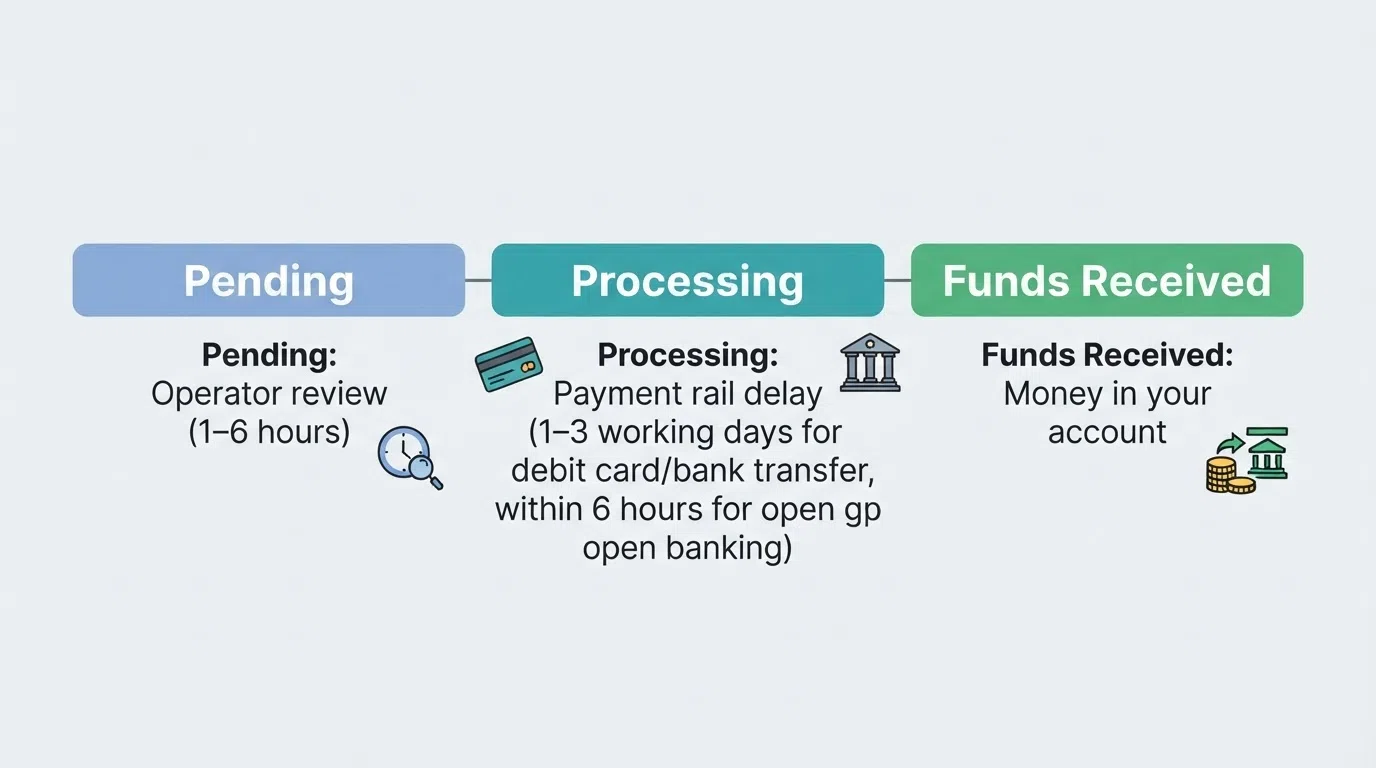
The general eCheck experience captures it: the primary downside is the slower processing time, with deposits and withdrawals taking 2–5 business days. The UK market compresses that window at the high end (6 hours for Trustly) and stretches it at the low end (4–7 business days for PayPal eCheque mode). A player choosing a payment method is choosing which point in that range their money will sit.
How to Deposit Using Bank-Funded Methods at UK Casinos
The deposit flow at a UKGC-licensed casino starts before the cashier page. The casino verifies the player’s identity, name, address, date of birth, before processing the first deposit, and from 31 October 2025 prompts the player to set a financial limit. Only then does the cashier open.
The minimum a UK player will encounter: £5 for debit cards at bet365 and William Hill, £10 for PayPal and Paysafecard at William Hill, £20 at 888casino, £100 for bank transfer at bet365. These are not averages, they are the specific floors at the named operators. Selecting a method and entering the amount takes under a minute; the confirmation time depends on the rail. Debit card and open banking are instant. Bank transfer via Faster Payments takes up to 24 hours. PayPal is instant when balance-funded, 4–7 business days when the payment routes as an eCheque.
Withdrawal Timeframes for Bank-Account Casino Methods
A withdrawal request enters a pending period, typically several hours, while the operator checks the request against anti-money-laundering (AML) rules and any bonus-wagering conditions. Once approved, the speed of the rail takes over. Debit card withdrawals clear in 1–3 working days. Bank transfer withdrawals via Faster Payments clear in 1–3 working days. PayPal withdrawals, when balance-funded, clear within 6 hours; when the PayPal account routes the payment as an eCheque, the clearing delay stretches to 4–7 business days. Trustly and open-banking withdrawals, the fastest bank-funded option, clear within 6 hours at operators that support the rail end-to-end, including Sky Vegas.
The eCheck comparison sums it up: withdrawals via eCheck take 1–5 business days after approval. The UK equivalents all sit at or below the bottom of that range.
Instant vs Delayed Processing: What “Instant eCheck” Really Means
“Instant eCheck deposit” is a contradiction in the British context. True eCheck and ACH transactions are never instant: they batch through a clearing house on a 1–3 business day cycle. When a UK casino advertises an instant deposit, the rail is a debit card or an open-banking flow, not an electronic cheque. PayPal eCheque mode is explicitly slow, 4–7 business days, because the payment is bank-funded and cheque-processed rather than balance-funded.
The fastest bank-funded method available at UK casinos is Trustly or open banking, with deposits settling instantly and withdrawals clearing within 6 hours. The deposit-and-withdrawal symmetry is the point: the method that funds your account fastest is also the one that returns your winnings fastest.
Paying by Bank-Funded Method on a UK Casino Mobile App
Mobile deposits in the UK run through three dominant bank-funded rails. Apple Pay and Google Pay, linked to a debit card but processed through the phone’s secure element, appear at bet365, Sky Vegas, Ladbrokes, Coral, William Hill, Paddy Power, Betfred and Virgin Games. Pay by Bank App, an open-banking flow that redirects to the player’s banking app for confirmation, appears at bet365 and Paddy Power. PayPal on mobile uses an app-switch flow: the player authorises the deposit inside the PayPal app and returns to the casino. Deposit limits on mobile match the desktop floor; bet365’s £5 minimum and £100 bank-transfer minimum are not platform-specific.
Payment Security and Fees on Bank-Funded Casino Deposits
UKGC licence conditions require operators to segregate player funds from operating capital. A player’s balance is not the casino’s working capital, and the protection rating (basic, medium or high) is published on the operator’s website. Bank-funded methods carry no operator-side fee at the researched casinos; the cost sits with the operator, absorbed as a payment-processing expense. PayPal does not charge the player for a deposit, but the eCheque clearing delay is the trade-off for a rail that mimics a cheque.
The £150 net-deposit threshold in a rolling 30-day period triggers a mandatory financial vulnerability check under licence condition SR Code 3.4.4, in force since 28 February 2025. The check uses publicly available data (county court judgments, bankruptcy orders, individual voluntary arrangements, debt relief orders) and is frictionless for most players. Beyond that threshold, source-of-funds enquiries, requests for bank statements or payslips, become standard practice at higher spend levels.
10 UK-Licensed Casinos Ranked by Their Bank-Funded Payment Options
Every operator in the featured set is UKGC-licensed, and none lists eCheck as a payment method. The ranking compares the UK equivalents: debit card, PayPal, open banking and bank transfer, ordered by the breadth of the payment suite, the speed of the deposit and withdrawal, and the bonus eligibility of each method.
| Operator | UKGC Licence Status | Welcome Bonus | Wagering Multiplier | Free Spins |
|---|---|---|---|---|
| bet365 | UKGC-licensed (public register) | Bet £10 Get £30 free bets (sports) | Stake not returned | Via separate casino promotions |
| Sky Vegas | UKGC-licensed (Flutter Entertainment) | 200 Free Spins No Wagering | 0x | 200 at £0.10 each |
| Ladbrokes | UKGC-licensed (Entain) | Play £10 Get 100 No Wagering Free Spins | 0x | 100 at £0.10 each |
| William Hill | UKGC-licensed (evoke) | Bet £10 Get £30 free bets (sports) | Stake not returned | Via separate casino promotions |
| Coral | UKGC-licensed (Entain) | Deposit £10 Get £50 casino; Bet £10 Get £30 sports | Standard casino terms | Via separate promotions |
| Paddy Power | UKGC-licensed (Flutter Entertainment) | 60 No-Wagering Free Spins no deposit + 200 after £10 wager | 0x | 260 at £0.10 each |
| Betfred | UKGC licence 39544 (Petfre (Gibraltar) Ltd.) | Stake £10 Get 200 Free Spins | 0x | 200 at £0.10 each |
| 888 Casino | UKGC-licensed (888 UK, evoke) | 100% match to £100 OR 100 Free Spins | 30x matched / 10x free spins | 100 at £0.10 each |
| Virgin Games | UKGC-licensed (Nozee, Gamesys/Bally’s) | Deposit and Wager £10 — free spins, bingo or cashback | 0x | Included in welcome |
| Gala Bingo | UKGC-licensed (Entain) | 100 Free Spins | 0x free spins / 40x cash bonus | 100 at £0.10 each |
bet365: The Widest Payment-Method Spread of Any UK Casino
bet365 takes deposits from debit cards (Visa and Mastercard), PayPal, Apple Pay, Google Pay, Paysafecard, Pay by Bank App and bank transfer. The minimum is £5 for most methods, and £100 for bank transfer, a jump that makes bank transfer a method for players moving larger sums rather than topping up a session. The sports welcome offer is Bet £10 Get £30 in free bets with a 7-day validity; casino promotions sit separately. PayPal is available, and a player funding that PayPal account from their bank rather than a balance will trigger the 4–7 business day eCheque clearing delay on the way in and on the way out. Game providers span Playtech, Microgaming, NetEnt, Evolution and Pragmatic Play. bet365 provides the most comprehensive bank-funded suite in the featured set, making it the primary choice for players prioritizing breadth.
Sky Vegas: No-Wagering Free Spins with Open-Banking Withdrawals
Sky Vegas’s welcome offer is 200 free spins at £0.10 each with zero wagering, no stated cashout cap and 7-day validity. The payment suite is narrower than bet365’s: debit cards, PayPal, Apple Pay, Trustly (open banking) and bank transfer. The differentiator is speed. Deposits are instant for every method except bank transfer, which takes up to 24 hours. PayPal and Trustly withdrawals clear within 6 hours, the fastest withdrawal window in the featured set. The operator sits in the Flutter Entertainment group and holds a UKGC licence confirmed on the public register. Sky Vegas delivers the industry’s fastest bank-funded withdrawals, positioning it as the top pick for players who prioritize speed.
Ladbrokes: 100 No-Wagering Free Spins, but Bonus Eligibility Is Tight
Ladbrokes’s casino welcome is 100 no-wagering free spins (£0.10 each) after depositing and betting £10 on slots. The free spins must be accepted within 48 hours and are valid for 7 days. Winnings carry no wagering and no stated cap. The catch sits in the payment-method eligibility: only Visa or Mastercard debit, Apple Pay or Google Pay deposits qualify. PayPal and every other method is excluded. The operator is part of the Entain group and is UKGC-licensed, with a game-provider lineup that spans Playtech, Evolution, Pragmatic Play, NetEnt and IGT. Ladbrokes’s bonus structure is streamlined for card and mobile-wallet users, excluding PayPal to maintain its simplified eligibility requirements.
William Hill: PayPal and Revolut Alongside the Card Basics
William Hill takes deposits from Visa, Mastercard, Revolut, PayPal and Paysafecard. The minimum is £5 for debit cards and £10 for PayPal and Paysafecard. The sports welcome offer is Bet £10 Get £30 in free bets with a 7-day validity and the stake not returned; separate casino promotions carry the free-spin offers. The operator sits in the evoke group (formerly 888 Holdings) and is UKGC-licensed. Revolut is the standout method: a player funding a casino from a Revolut account pays through a UK bank rail rather than a card network, with the same payment-rail behaviour as a debit card. PayPal is available, and the eCheque caveat applies when the funding source is a bank account rather than a PayPal balance.
Coral: Entain Stable with a £50 Casino Welcome on a £10 Deposit
Coral’s casino welcome is deposit £10 get £50, a 5x match, alongside a separate sports offer of Bet £10 Get £30 in free bets. The operator takes debit cards, Apple Pay, Google Pay and PayPal. Standard PayPal eCheque caveats apply when the PayPal account is bank-funded. Coral sits in the Entain group, sharing infrastructure and game providers with Ladbrokes: Playtech, Evolution, Pragmatic Play, NetEnt and IGT. UKGC-licensed. Coral presents the highest matched-deposit ratio for a £10 budget, making it a compelling option for players targeting maximum bonus value.
Paddy Power: 260 No-Wagering Free Spins, 60 with Zero Deposit
Paddy Power’s welcome offer is 60 no-wagering free spins with no deposit required, plus 200 more after depositing and wagering £10, a total of 260 free spins at £0.10 each with zero wagering and 7-day validity. The payment suite is three methods: Pay by Bank, Apple Pay and debit cards. PayPal, Skrill and Neteller are excluded from bonus eligibility, so a player who deposits through those methods would lose the 200-spin second tranche. The operator sits in the Flutter Entertainment group alongside Sky Vegas and is UKGC-licensed. Paddy Power’s combined offer—featuring no-deposit spins and a subsequent deposit match—provides the highest total spin volume in this ranking.
Betfred: 200 No-Wagering Free Spins, and PayPal Is Gone
Betfred removed PayPal and every e-wallet in January 2026, leaving debit cards, Apple Pay, Open Banking through TrueLayer and bank transfer. The welcome offer is stake £10 get 200 free spins (£0.10 each, zero wagering), with uncapped winnings, 14 days to claim from registration and 7 days to use the spins. The UKGC licence number is 39544, held by Petfre (Gibraltar) Ltd. The stripped-back payment suite makes Betfred the purest bank-funded operator in the featured set: every deposit rail routes directly from a UK bank account. Following its move away from e-wallets, Betfred now operates as a pure bank-funded site, well-suited to players who exclusively use open banking or debit cards.
888 Casino: 100% Match to £100, the Operator with a Cashout Cap
888casino’s main UK welcome bonus is a 100% matched deposit up to £100 with 30x wagering, or 100 free spins at £0.10 each on selected Pragmatic slots with 10x wagering. Winnings are capped at £500 from bonus funds and £300 from free spins, the only explicit cashout cap in the featured set. The minimum deposit is £20. Skrill and Neteller deposits are excluded from bonus eligibility. Players have 90 days to wager the matched bonus and 7 days to use the free spins. The UKGC licence sits with 888 UK Limited, part of the evoke group. For a player who understands that 30x wagering on a £100 bonus means £3,000 in qualifying bets, the offer is a large match with a transparent ceiling.
Virgin Games: Zero Wagering, Three Payment Methods, and a £3,000 New-Account Cap
Virgin Games runs zero wagering on every welcome-offer option. Deposit and wager £10, then choose free spins, free bingo tickets or live casino cashback, all with no wagering and no cashout cap, subject to a £10 minimum balance for withdrawal. The payment suite is the narrowest in the featured set: debit card, Apple Pay and Google Pay, three methods, with PayPal removed for new players since November 2020. New accounts face a net deposit limit of £3,000 per day for the first 30 days, a ceiling the operator applies on top of the customer’s own deposit-limit setting. The licence sits with Nozee Limited, part of the Gamesys group (Bally’s), and is UKGC-licensed. For a player who pays by card or mobile wallet and values zero-wagering offers above all else, Virgin Games is the cleanest match, and the £3,000 daily ceiling is a real constraint for higher spenders.
Gala Bingo: 100 Free Spins with a 40x Cash-Bonus Wagering Fallback
Gala Bingo’s welcome offer is 100 free spins (£0.10 each) with zero wagering on the winnings. The cash-bonus side of any promotion, if a player takes it instead of the spins, carries a 40x wagering requirement, the highest in the featured set. The payment suite is three methods: debit cards, PayPal and Apple Pay, with the standard PayPal eCheque caveat for bank-funded payments. The operator sits in the Entain group alongside Ladbrokes and Coral, sharing infrastructure, and is UKGC-licensed. For a player who specifically wants the free-spin path and avoids the cash-bonus route, the offer is competitive; for a player who might take the cash instead, the 40x multiple is the cost.
The UK Gambling Rules That Protect Every Bank-Funded Deposit
The Gambling Commission is the single statutory regulator for Great Britain, operating under the Gambling Act 2005 with three licensing objectives: preventing gambling from being a source of crime, ensuring it is conducted fairly and openly, and protecting children and other vulnerable persons. Since the Gambling (Licensing and Advertising) Act 2014, any operator taking UK players must hold a GB licence, the point-of-consumption reform that ended the offshore loophole. Identity must be verified before first deposit, a rule in force since 7 May 2019. The minimum age is 18.

A UKGC licence attaches four structural protections to every pound a player deposits. Player funds are segregated from operator working capital. Mandatory identity verification happens before the first wager. An approved Alternative Dispute Resolution (ADR) provider is available to challenge a disputed transaction. The national GAMSTOP self-exclusion scheme blocks the player’s identity across every GB-licensed online operator. The Commission’s own complaints route sits behind the ADR process as a backstop.
Enforcement is disruption, not blocking. Between October 2024 and September 2025 the Commission recorded 208,088 enforcement actions on illegal online gambling, the largest category being search-engine referrals. Operating without a licence is a criminal offence under section 33 of the Gambling Act 2005, carrying up to 51 weeks’ imprisonment, an unlimited fine, or both.
UKGC Licensing: What It Means for Your Casino Deposit
The protections attached to a UKGC licence are concrete. Player funds are segregated from operating capital under a published protection rating, so a player’s balance is not at risk if the operator fails, though the rating (basic, medium or high) determines how much of the balance is actually protected. The credit card ban, in force since 14 April 2020, means every deposit must come from funds the player actually has in a bank account or e-wallet. The mandatory deposit-limit prompt, in force from 31 October 2025, forces a conscious choice before the first deposit. The 10x wagering cap, in force from 19 December 2025, limits how long a bonus can tie up a player’s money.
The wagering cap ended a structural feature of UK casino bonuses. Before 19 December 2025, a 30x or 40x wagering requirement was standard. Now no UKGC-licensed operator can require more than 10x playthrough on any bonus, and mixed-product promotional offers (deposit on a casino, get free spins that can only be used on slots) are banned. The change flattens the worst end of the bonus market and makes a £100 deposit bonus at 10x wagering a £1,000 playthrough, the new ceiling.
Anti-Money-Laundering Rules and Bank-Funded Casino Payments
UKGC licence conditions require operators to verify the source of funds at higher spend levels. Bank-statement requests and payslip verification are standard practice once a player crosses the thresholds. The £150 net-deposit threshold in a rolling 30-day period, in force since 28 February 2025, triggers a mandatory financial vulnerability check using publicly available data: county court judgments, bankruptcy orders, individual voluntary arrangements and debt relief orders. The check is frictionless for most players.
Bank-funded methods simplify AML compliance rather than complicate it. The paper trail is built into the payment rail: a debit-card deposit carries the card number and the merchant name; a Faster Payments transfer carries the sort code and account number; an open-banking payment carries the bank-authorised reference. A player funding a casino from a UK bank account leaves an audit trail no e-wallet can replicate, which is one reason the regulator treats bank-funded deposits as lower-risk than card-funded e-wallet top-ups.
The Commission has also announced a financial risk assessment pilot, designed to be frictionless for around 97% of players, with staged rollout dates not yet confirmed as of July 2026. The pilot would move beyond the £150 vulnerability check into a fuller affordability assessment at higher net-deposit thresholds, but the live dates are not settled.
Player Fund Protection and Dispute Resolution
UKGC licence conditions require fund segregation: player balances must be held separately from operator operating funds. The protection rating, basic, medium or high, is published on every licensed operator’s website and tells the player how the segregated funds are held, whether in a separate bank account, in trust, or with a guarantee. Basic protection is the minimum; medium and high add layers that improve the chance of recovery if the operator fails.
Every UKGC licensee must appoint an approved ADR provider, an independent body that reviews disputed transactions at no cost to the player. The ADR route is the player’s first formal channel when a withdrawal is withheld or a bonus term is disputed. When the ADR route fails, the Gambling Commission’s own complaints process sits behind it as a backstop. A player on a UKGC-licensed site has two formal escalation paths; a player on an offshore site has none.
GAMSTOP Self-Exclusion and Bank-Funded Casino Accounts
GAMSTOP is the national multi-operator online self-exclusion scheme, mandatory for all GB-licensed online operators since 31 March 2020. Exclusion periods are six months, one year, five years, or five years with auto-renewal. The exclusion cannot be cancelled early, and it continues for up to seven years beyond the minimum period if the player does not contact GAMSTOP to lift it.
The exclusion follows the player’s identity, not the payment method. Opening a new account at the same operator with a different bank card is not possible, because the operator checks the player’s details against GAMSTOP before processing the first deposit. The limit is scope: GAMSTOP is online-only and licence-bound, so it cannot reach operators outside the GB licensing system. A player who self-excludes through GAMSTOP and then opens an account at an offshore site has no protection from the scheme.
Responsible Gambling Tools for Bank-Account Casino Players
Approximately 0.5% of the adult English population experience problem gambling, and 3.8% are at elevated risk of gambling harms. The National Gambling Helpline, operated by GamCare, received over 130,000 calls and online messages between April 2024 and March 2025, up from 80,000 in 2023/24. A GamCare finding from 2025 reported that 82% of those disclosing gambling struggles cited online gambling specifically, a five-year high. The numbers describe a population for whom the bank-funded deposit, instant and frictionless, is also the rail that removes the natural pause a cheque would have imposed.
The bank statement is a built-in spend tracker. Every deposit leaves a transaction line; every withdrawal returns to the same account. A player using a debit card or open-banking rail has a permanent audit trail of gambling spend, with merchant names and timestamps, in a format their bank’s app already categorises. A PayPal eCheque deposit aggregates under PayPal rather than the operator name, which is one reason the eCheque mode costs the player some visibility along with the clearing delay.
Setting Deposit Limits on Bank-Funded Casino Accounts
From 31 October 2025, every UK operator must prompt the customer to set a financial limit before the first deposit. The prompt is mandatory; declining is a choice the operator records. From 30 June 2026, extended to 30 September 2026, only a gross deposit limit, based solely on money paid in, may be called a “deposit limit” under Remote Technical Standard 12. The terminology matters because the operator cannot call a net-of-withdrawals figure a deposit limit; the number on screen is money in, not money played.
The online slots stake cap is the only hard ceiling the state sets: £5 per game cycle for players aged 25 and over (in force 9 April 2025) and £2 for players aged 18 to 24 (in force 21 May 2025), imposed by SI 2025/215. Britain does not have a nationwide deposit, loss or spend ceiling. The state caps the spin and mandates the offer of a limit; the level stays with the player.
Self-Exclusion and Cooling-Off with Bank-Funded Play
GAMSTOP is the mandatory national scheme: six-month, one-year, five-year, or five-year auto-renewal exclusion periods, no early cancellation, up to seven years of carry-over beyond the minimum if the player does not contact GAMSTOP. The exclusion is identity-bound, so a player who has self-excluded cannot open a new account at the same operator with a different bank card, because the operator runs a GAMSTOP check before processing the first deposit.
Operator-level cooling-off periods and self-exclusion sit underneath GAMSTOP as shorter, reversible tools. A player who wants a 24-hour or 7-day break can set it at the operator; a player who wants a six-month or longer exclusion registers with GAMSTOP and is blocked across the entire GB-licensed market. The limit, once again, is scope: GAMSTOP cannot reach unlicensed offshore sites that accept UK players.
UK Responsible-Gambling Resources: GamCare, GambleAware and Beyond
The National Gambling Helpline (GamCare) runs 24 hours a day, by phone and online chat, and took over 130,000 contacts in 2024/25. The National Gambling Support Network, commissioned by GambleAware, treated 11,960 clients in 2024/25, an 11% increase on the previous year, and nine in ten of those who complete treatment see an improvement. NHS gambling harm clinics operate in England, Scotland and Wales. Gamblers Anonymous runs peer-led meetings. The infrastructure is free, confidential, and outside the casino industry.
The statutory levy, in force from 6 April 2025, funds this infrastructure. Remote casino, remote bingo, remote general betting and gambling software licensees pay 1.1% of gross gambling yield (GGY) to the Commission, which distributes it 50% to treatment, 30% to prevention and 20% to research. The levy replaced the previous voluntary contribution and now sits on the operator’s balance sheet rather than its marketing budget.
Tracking Your Casino Spend Through Bank Statements
Every bank-funded casino deposit appears on the player’s statement. Debit card transactions show the operator’s merchant name directly, so a £20 deposit at Sky Vegas shows as Sky Vegas in the transaction list. PayPal deposits aggregate under PayPal, with the operator’s name in the transaction detail; the player has to tap through to see the casino. Open-banking payments show the operator name directly, the same visibility as a debit card. The audit trail is a free safer-gambling tool for any player willing to look at it.
The 2024/25 GamCare finding sharpens the case. With 82% of those disclosing gambling struggles citing online gambling specifically, a five-year high, the bank-statement audit is a practical early-warning layer that costs nothing. A player can set a notification threshold in their banking app, a push alert every time a debit card transaction at a casino merchant exceeds £X, and turn the app’s spend-categorisation into a weekly gambling review. The tool is built into the rail.
How We Evaluated UK Casino Payment Methods for This Guide
The operators in this ranking were drawn from the UKGC public register of licensed remote gambling operators; only GB-licensed operators were considered. The evaluation criteria were the breadth of bank-funded payment methods, deposit and withdrawal processing speed, bonus eligibility by payment method, and the presence or absence of open-banking rails. The research drew on operator cashier pages, UKGC licence conditions, Gambling Commission enforcement data, GamCare and GambleAware annual statistics, and payment-provider documentation.
The honest limitation: none of the ten featured operators lists eCheck as a named payment method. This guide compared the UK equivalents and rated operators on those rails, not on a method the British market does not provide. A reader searching for eCheck specifically will not find it on any UKGC-licensed cashier page; the ranking tells them what they will find instead.
What a UK Casino Player Should Actually Do About the eCheck Question
The term “eCheck” is a dead end in the UK licensed market. No major UKGC-licensed operator supports it, and searching for it filters out every safe option. The three UK bank-funded rails that replace it are debit card (universal, instant deposits, 1–3 day withdrawals), open banking through Trustly or Pay by Bank App (instant deposits, within-6-hour withdrawals at operators that support the rail), and PayPal (familiar, instant when balance-funded, 4–7 business days when the PayPal account routes the payment as an eCheque).
The decision matrix is short. Speed-first players pick a Trustly or open-banking operator: Sky Vegas for the no-wagering spins and the 6-hour PayPal and Trustly withdrawals, or Betfred for the stripped-back bank-funded suite after the January 2026 e-wallet removal. Bonus-first players check payment-method eligibility before depositing: Ladbrokes’s 100 no-wagering free spins only qualify on Visa/Mastercard debit, Apple Pay or Google Pay; 888casino’s matched deposit excludes Skrill and Neteller. Safety-first players stay inside the UKGC-licensed set, accept the identity verification that happens before the first deposit, and use the deposit-limit tools the licence now mandates.
The one action every bank-funded player should take: set a gross deposit limit at the first-deposit prompt. From 31 October 2025 the operator must offer the limit; from 30 June 2026 the figure on screen is money in, not money played. The limit the state mandates you be offered is the one limit that actually protects you, because it is the only one that the operator cannot quietly reframe as a net-of-withdrawals number once you have agreed to it.
Frequently Asked Questions About eCheck and UK Casino Deposits
How long does an eCheck deposit take to process at a UK casino?
A true eCheck deposit takes 1–3 business days, and an eCheck withdrawal takes 1–5 business days after approval. UKGC-licensed casinos do not offer eCheck, but the equivalent bank-funded rails clear faster: debit card and open-banking deposits are instant, and open-banking withdrawals clear within 6 hours at operators including Sky Vegas.
Are there any fees for using eCheck at UK online casinos?
No UKGC-licensed operator charges a player fee for a bank-funded deposit or withdrawal. eCheck transactions cost less to process than credit cards (a flat rate rather than 3–5% plus interchange), which is why operators absorbed the method in the US; the cost saving never reached the player as a fee, and the same holds for the UK equivalents.
Is eCheck a safe payment method for online gambling in the UK?
eCheck is safe in the sense that ACH transactions are reversible and traceable, but the method is not available at any UKGC-licensed casino. The UK equivalent, open banking through Trustly or Pay by Bank App, is regulated by the Financial Conduct Authority, carries Strong Customer Authentication (SCA, the two-factor verification banks require under PSD2, the EU/UK payment-services directive), and settles to a UKGC-segregated player-fund account. Safer than eCheck; available now.
Do eCheck deposits qualify for welcome bonuses at UK online casinos?
Since no UKGC-licensed operator offers eCheck, the question is moot for the UK market. The parallel question matters: payment-method eligibility for welcome offers varies. Skrill and Neteller are excluded from the 888casino welcome bonus; PayPal, Skrill and Neteller are excluded from Paddy Power’s bonus; only Visa/Mastercard debit, Apple Pay or Google Pay qualify for Ladbrokes’s 100 no-wagering free spins. A player should check the bonus terms before depositing, because the welcome offer can disappear at the cashier if the chosen method is on the exclusion list.
What are the minimum and maximum deposit limits for eCheck at UK casinos?
eCheck itself has no UK minimum because no UKGC-licensed casino offers it. The bank-funded UK equivalents have specific floors: £5 for debit cards at bet365 and William Hill, £10 for PayPal and Paysafecard at William Hill, £20 at 888casino, £100 for bank transfer at bet365. The maximum is set by the operator’s own deposit-limit framework and the player’s own limit setting, with no nationwide ceiling.
Can I use eCheck on a UK casino mobile app?
eCheck is not available on any UKGC-licensed casino app. The mobile bank-funded rails are Apple Pay and Google Pay, linked to a debit card but processed through the phone’s secure element, and Pay by Bank App, an open-banking flow that redirects to the player’s banking app for confirmation. PayPal works on mobile through an app-switch flow: the player authorises the deposit in the PayPal app and returns to the casino, with the same 4–7 business day eCheque clearing delay when the PayPal account is bank-funded.
Payments – nonukgc-licensedcasinos
Content created by the «nonukgc-licensedcasinos» team